Archive for the ‘seo news’ Category
Tuesday, May 31st, 2022
On May 25, 2022, Google began rolling out the May 2022 core update, this update came over six months after the November 2021 core update, whereas there was about four and a half months span between the November update and the July 2021 core update. This was the the first update we had in 2022, in contrast, in 2021, we had a total of three core updates.
Historically, we have waited longer to report on the impact of these core updates but honestly, after writing several of these core update impact stories, generally the vast majority of the impact is realized within the first few days of the update (although there have been outliers to this). With this update, the impact was felt super quickly, within 24 hours of the announcement, so we feel it is now safe to report on the impact of this May 2022 core update.
Data providers on the May 2022 core update:
Generally the data providers, which have consistently been Semrush and RankRanger for these reports, have agreed on how volatile these updates have been but with this update – they seem to disagree, that is until you dig into the data.
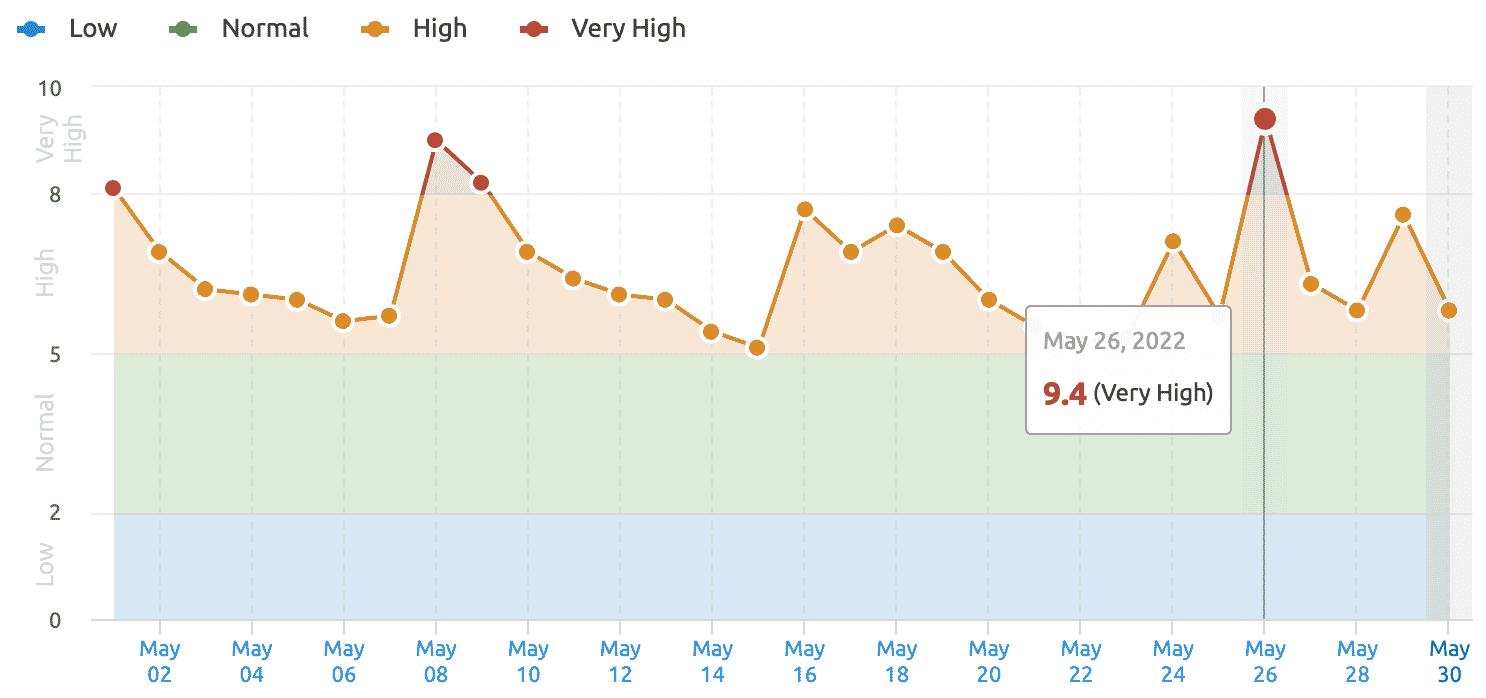
Semrush. Semrush data showed that the May 2022 core update hit pretty quickly after the announcement. In terms of its volatility tracker, as shown below (or you can view live at the Semrush Sensor tool).
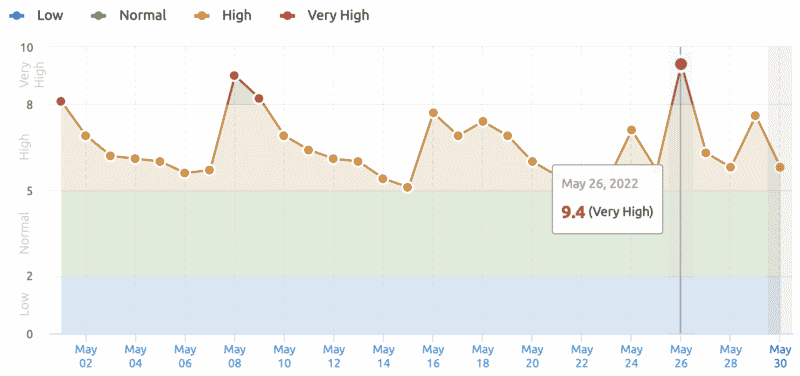
In terms of the speed for these core updates to roll out, “This is already the 3rd core update in a row where the initial roll-out saw a very short burst of initial rank volatility,” Mordy Oberstein, Semrush Communication Advisor, told us. He added that “this seems to be a new pattern” with the rollout of these core updates.
When you compare the May 2022 core update to the November 2021 core update, at first glance, it seems the May update was less volatile than the November update. This is with the exception of the real estate niche, “which seemed to undergo a significant shakeup,” the company shared. Here is this chart comparing the May 2022 core update to the November 2021 core update by vertical:
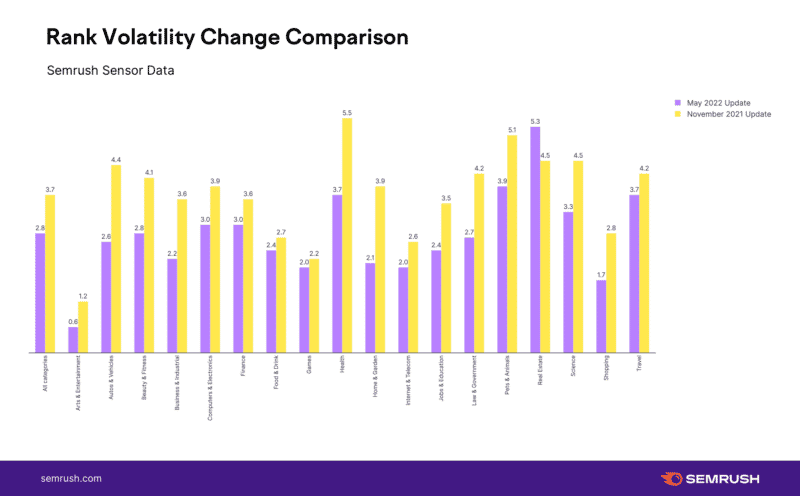
The issue is that the average level of volatility prior to the May 2022 core update was higher than that of the volatility seen before the November 2021 core update, Semrush explained. In fact, Semrush said the overall increase in rank volatility compare to the baseline level of before the core update volatility was 19% less during the initial release of the May 2022 update compared to the November 2021 core update on desktop, and 24% on mobile.
So if you plot the peak volatility, you see things differently:
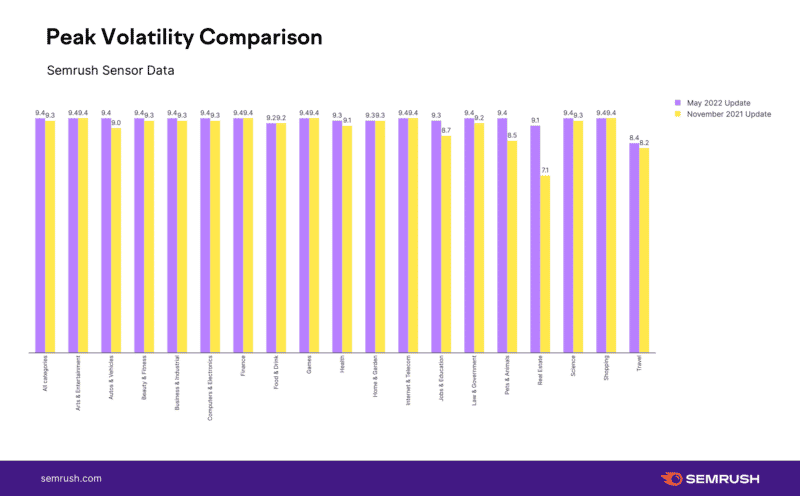
So this might mean that even with Semrush data, May 2022 might have been more volatile than the November 2021 core update? Again, it is all about how you process and interpret the data.
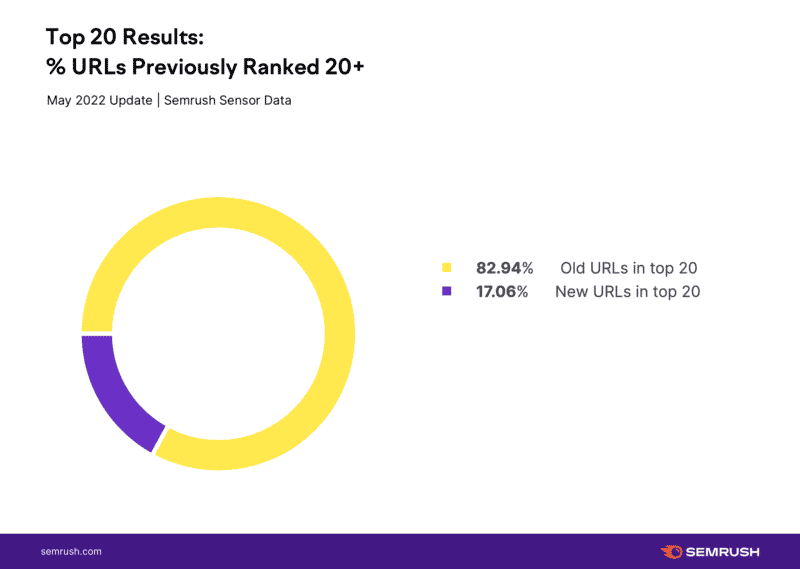
This chart below shows you that 17% of the new top 20 ranked results in Google post May 2022 core update came from position 20 or beyond, which is not far off from the previous November 2021 core update:
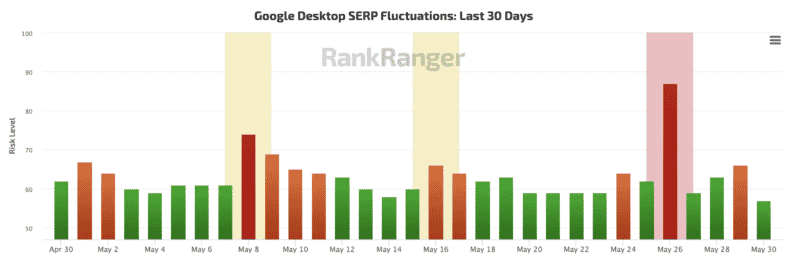
RankRanger. The RankRanger team also analyzed the Google search results after this May 2022 core update rollout and here you can see how quickly there tool also picked it up (you can also see this live at the Rank Risk Index tool). RankRanger did say the May 2022 core update was a “significant update.”
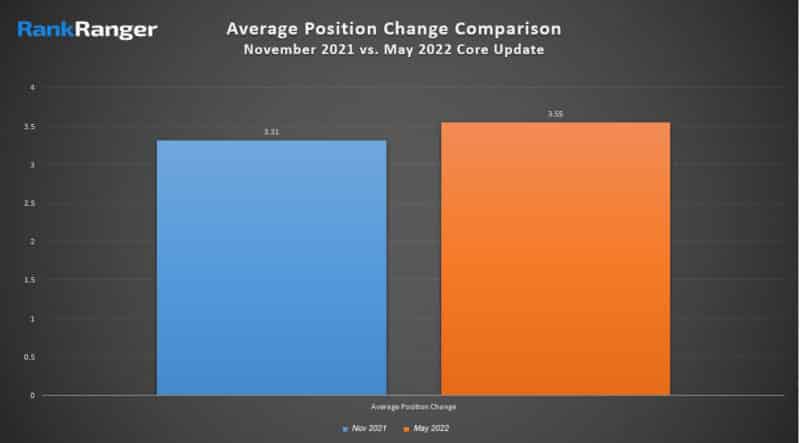
The folks at RankRanger did compare the May 2022 core update to the November 2021 core update for us as well. RankRanger found that in its data the May 2022 update’s average position changes were higher than the November 2021 update.
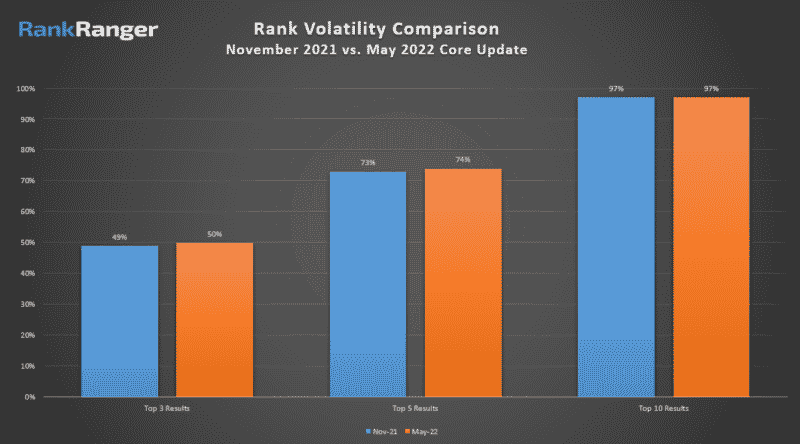
When you dive in and compare by position, the volatility does seem more similar across positions:
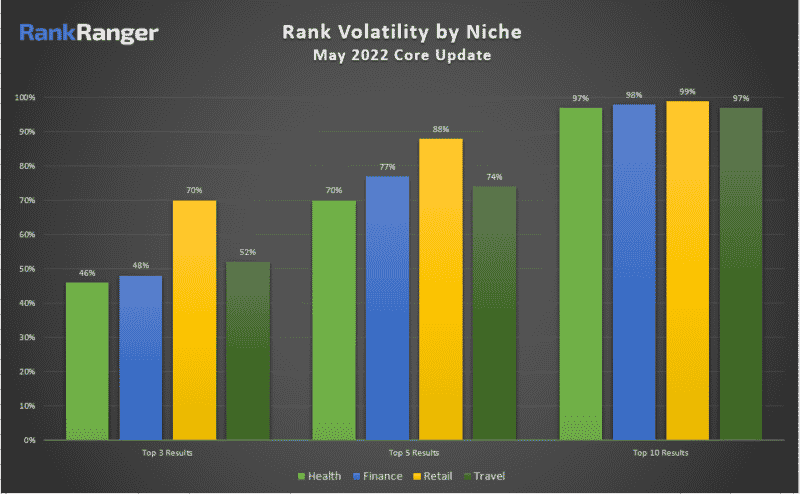
Retail seemed to be most impacted according to RankRanger data, as you can see by these charts below:
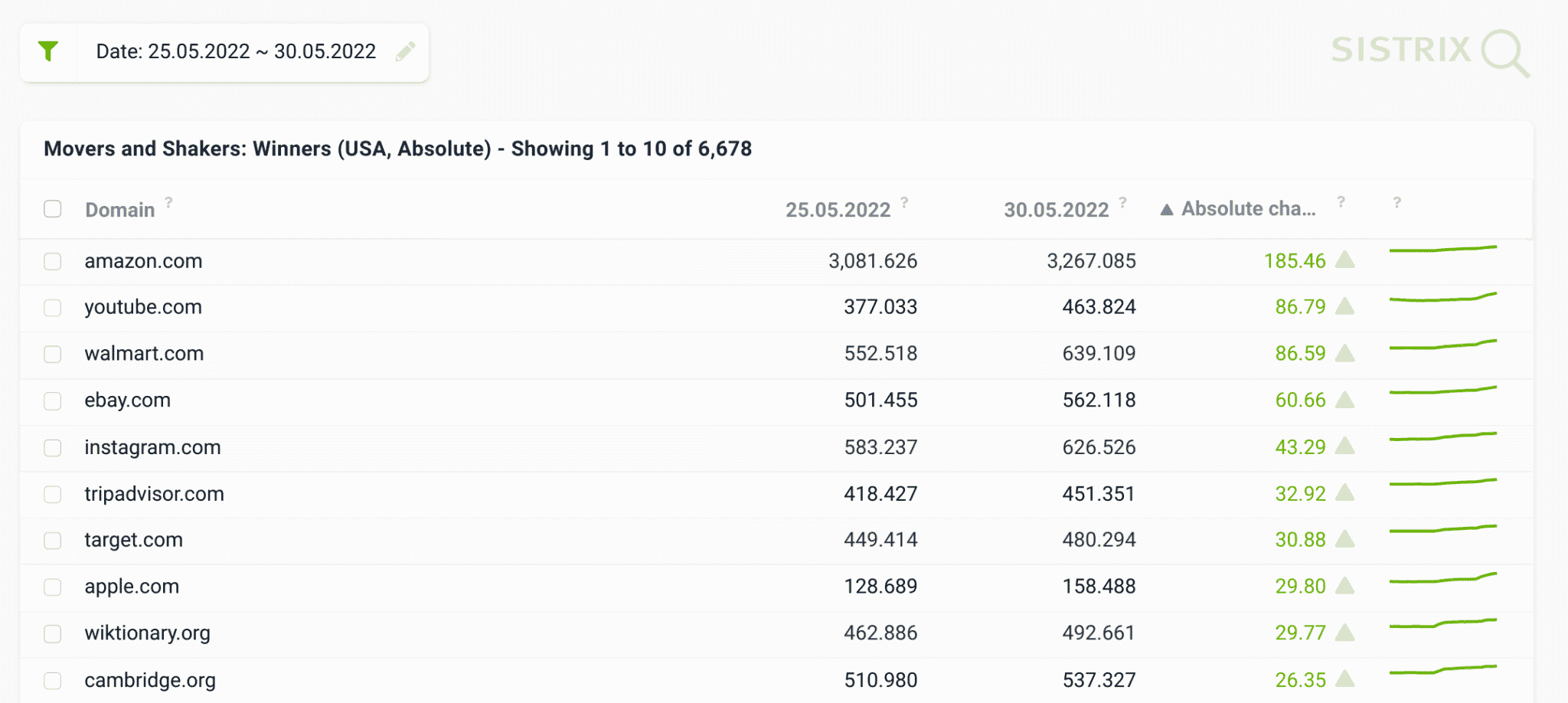
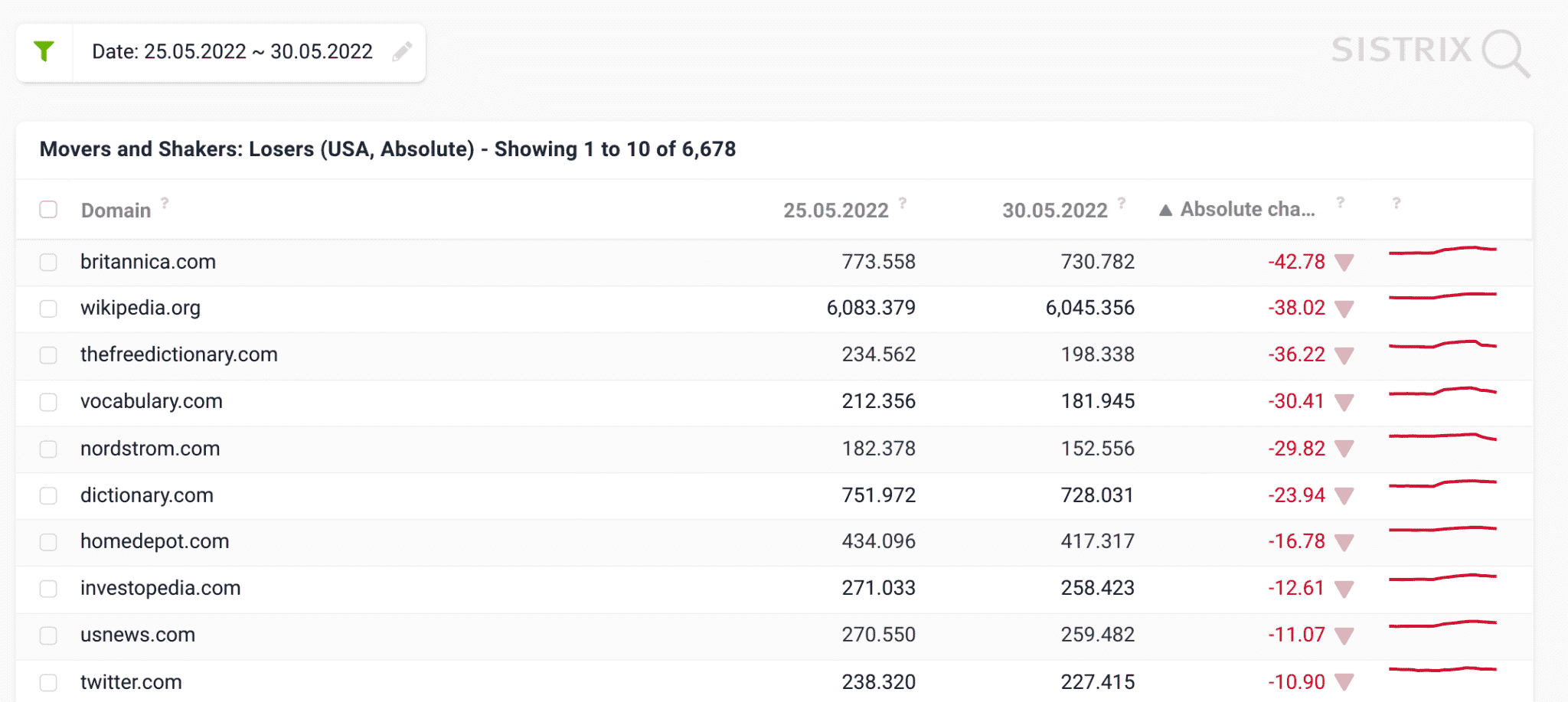
SISTRIX. SISTRIX, another data provider that tracks the changes in the Google search results, sent their top 20 winners and losers for the May 2022 core update. These are US based sites from Sistrix’s data set.
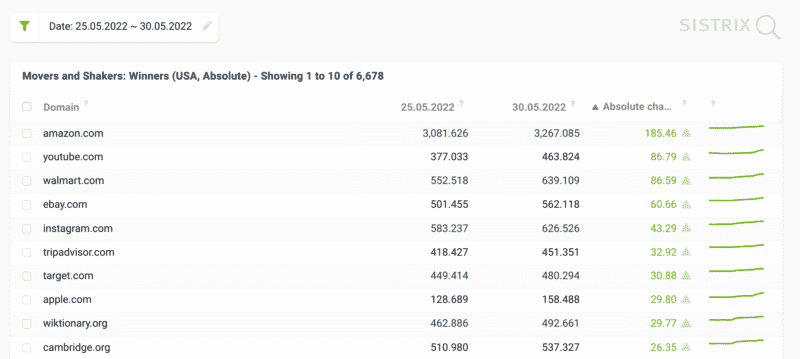
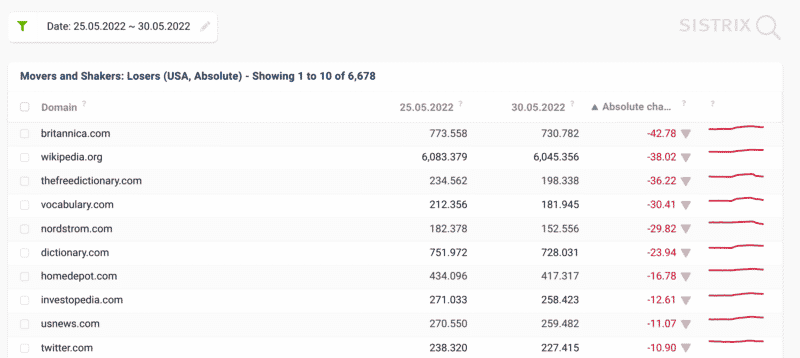
Sistrix added “In our example, we saw that the visibility of the domain was 25.84 points on Thursday, then increased to 27.95 on Friday and as of now (Monday 30th May 08:55) the Visibility Index is 31.98.”
More on the May 2022 core update
The SEO community. The May 2022 core update to the community seems much more significant than the November 2021 core update. Unlike the November 2021 core update, where the timing for that update was not the best, i.e. right during the busiest online shopping season, this update was scheduled a lot better for retailers. I was able to cover the community reaction in one blog post on the Search Engine Roundtable early on. It includes some of the early chatter, ranking charts and social shares from some SEOs.
On Twitter you can find plenty of examples of SEOs sharing charts from their clients – mostly showing winners but also showing losers – with this update.
What to do if you are hit. Google has given advice on what to consider if you are negatively impacted by a core update in the past. There aren’t specific actions to take to recover, and in fact, a negative rankings impact may not signal anything is wrong with your pages. However, Google has offered a list of questions to consider if your site is hit by a core update. Google did say you can see a bit of a recovery between core updates but the biggest change you would see would be after another core update.
Why we care. It is often hard to isolate what you need to do to reverse any algorithmic hit your site may have seen. When it comes to Google core updates, it is even harder to do so. What this data and previous experience and advice has shown us is that these core updates are broad, wide and cover a lot of overall quality issues. The data above has reinforced this to be true. So, if your site was hit by a core update, it is often recommended to step back from it all, take a wider view of your overall website and see what you can do to improve the site overall.
We hope you, your company and your clients did well with this update.
More on Google updates
Other Google updates. This year, we only had one confirmed update outside of this May 2022 core update. We have the March 2022 product reviews update. Last year we had a number of confirmed updates from Google and many that were not confirmed . In the most recent order, we had: The July 2021 core update, Google MUM rolled out in June for COVID names and was lightly expanded for some features in September (but MUM is unrelated to core updates). Then, the June 28 spam update, the June 23rd spam update, the Google page experience update, the Google predator algorithm update, the June 2021 core update, the July 2021 core update, the July link spam update, the November spam update and a December 2021 product reviews update.
Previous core updates. The most recent previous core update was the November 2021 core update which hit hard and fast. Prior to that was July 2021 core update which was quick to roll out (kind of like this one) followed by the June 2021 core update and that update was slow to roll out but a big one. Then we had the December 2020 core update and the December update was very big, bigger than the May 2020 core update, and that update was also big and broad and took a couple of weeks to fully roll out. Before that was the January 2020 core update, we had some analysis on that update over here. The one prior to that was the September 2019 core update. That update felt weaker to many SEOs and webmasters, as many said it didn’t have as big of an impact as previous core updates. Google also released an update in November, but that one was specific to local rankings. You can read more about past Google updates over here.
The post Google’s May 2022 core update impact was mixed, but it touched down fast and seemed very large appeared first on Search Engine Land.
Courtesy of Search Engine Land: News & Info About SEO, PPC, SEM, Search Engines & Search Marketing
Tuesday, May 31st, 2022
Google Search Console’s News performance report had a logging error which may have resulted in displaying a drop in impression and clicks from Google News.
Google said this was just a reporting glitch and it had no real impact on how your site was ranking or serving in Google News.
The notice. Google posted this notice here stating “Because of a logging error, site owners might see a drop in their Google News data during this period. This is just a logging error and not a real drop in Google News performance.”
Timeframe impacted. The timeframe where Google had this logging error was between May 12, 2022 through May 26, 2022.
Why we care. If you have or will provide clients with reporting, keep in mind the News performance report had logging issues for about half of the month of May. Make sure to annotate this logging error and communicate this to your clients and stakeholders.
The post Google Search Console reporting issue with News performance report appeared first on Search Engine Land.
Courtesy of Search Engine Land: News & Info About SEO, PPC, SEM, Search Engines & Search Marketing
Thursday, May 26th, 2022
None of us have likely become an SEO for the love of reporting, in fact, it’s among the least favorite activities for many SEOs based on a poll I did a while ago.
However, decision-makers care a lot about reporting as it’s how we communicate and they assess the SEO process investment and overall success. In fact, the effectiveness of SEO reports can end up being the difference between getting fired rather than more SEO support or a raise by decision-makers.
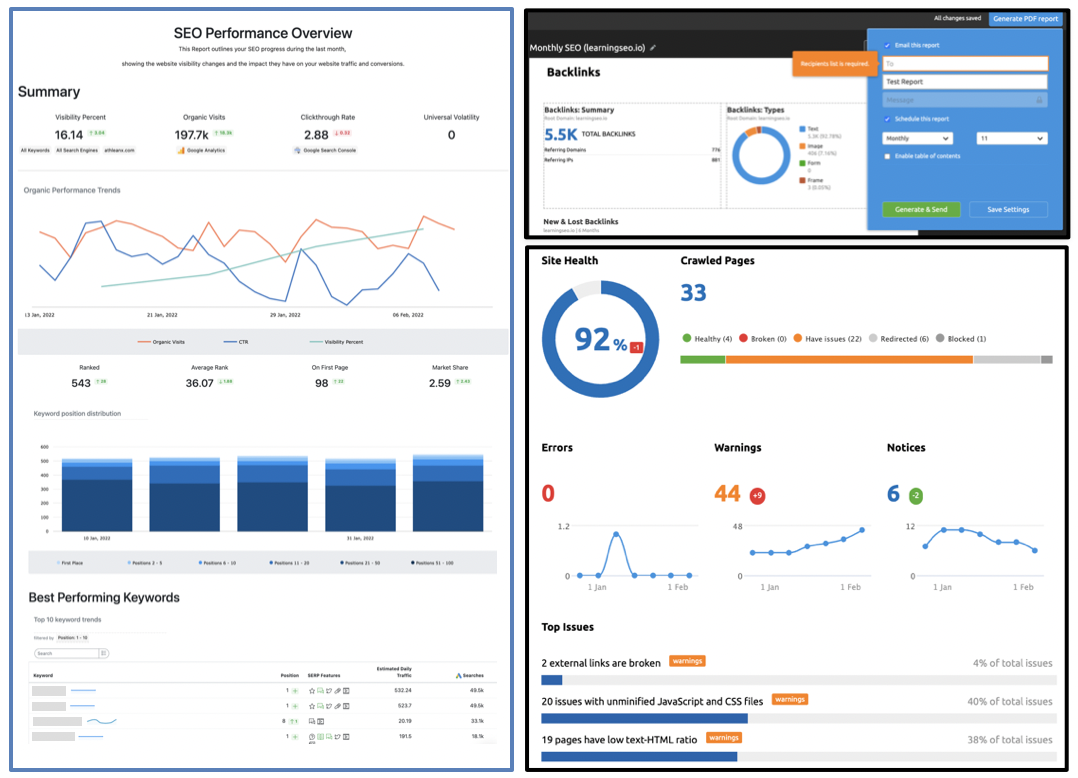
Despite this, many SEO reports are broken as they’re just a compilation of dashboards automated via tools featuring SEO metrics. I asked over Twitter and 41% of SEOs who answered said to only use a dashboard with data for SEO reporting.
Data from our SEO dashboards can be included in reports but they can’t replace them as a whole: an SEO dashboard is a visualization resource that contains the most important, latest status of all metrics we want to follow up from our SEO process, to easily monitor its progress at any time.
On the other hand, an SEO report is a document featuring a collection of key performance indicators from a certain time period along with an analysis and conclusions, to be used for periodic analysis and assessment of the SEO process towards the achievement of its goals.
Using only automated SEO dashboards as reports can end up harming more than helping. They are filled with information that the audience – often non-technical stakeholders or decision-makers – won’t understand or care about, with no prioritization, insights, analysis, or outcome actions. This only generates more questions than providing answers.
Get the daily newsletter search marketers rely on.
Even personalized SEO dashboards can’t achieve all SEO reporting goals – especially taking into consideration that a high share SEOs don’t always present their reports which are the following:
- Communicate SEO results: The SEO process evolution towards the established goals (what has been achieved vs. what was expected?)
- Explain the cause of SEO results: Why the different areas are or aren’t evolving as expected.
- Drive actions to achieve SEO results: Establish SEO-related activities and request support for the next steps to achieve goals.
The biggest challenge to developing personalized SEO reports is caused by timing restrictions as we tend to feel the pressure to develop reports fast to get back to “SEO execution,” but SEO reporting is also in most cases only a monthly effort too.
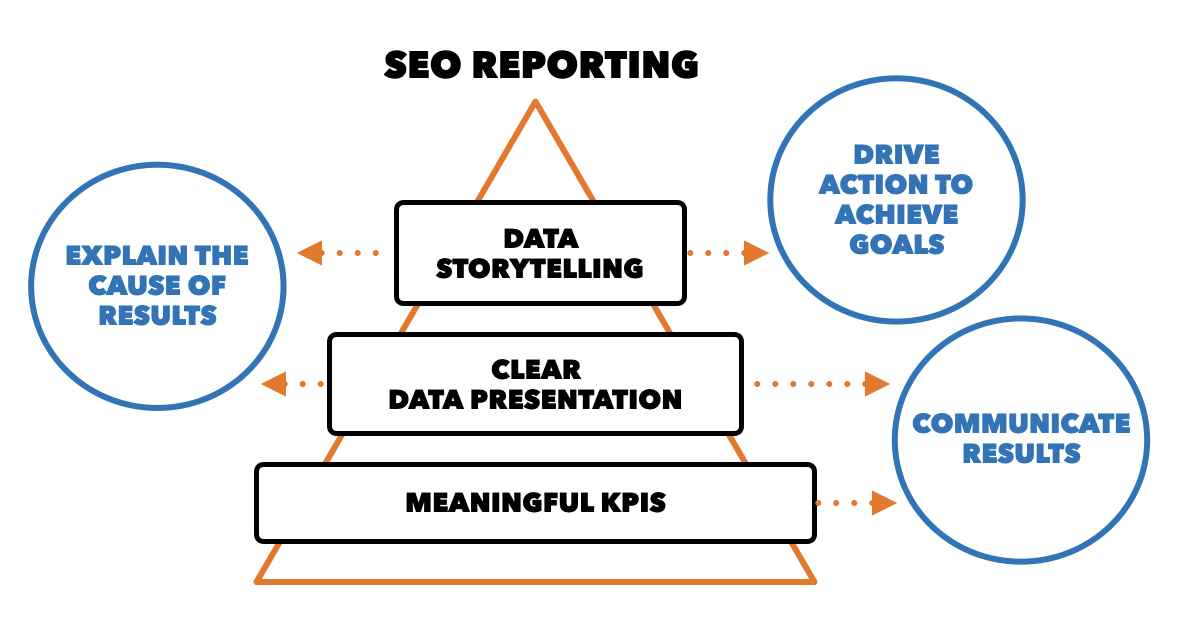
Ready to help effectively tackle your SEO reporting goals while accelerating the process? Here are three principles to follow.
1. Use only meaningful KPIs that communicate your results
Cut the noise and minimize doubts with the data you include in SEO reports.
Avoid using confusing proprietary metrics, as they’re unreliable and difficult to connect with your actual SEO goals.
Don’t add everything you monitor to reports either, only Key Performance Indicators (KPIs) that show the progress towards those SEO goals the audience is actually interested in.
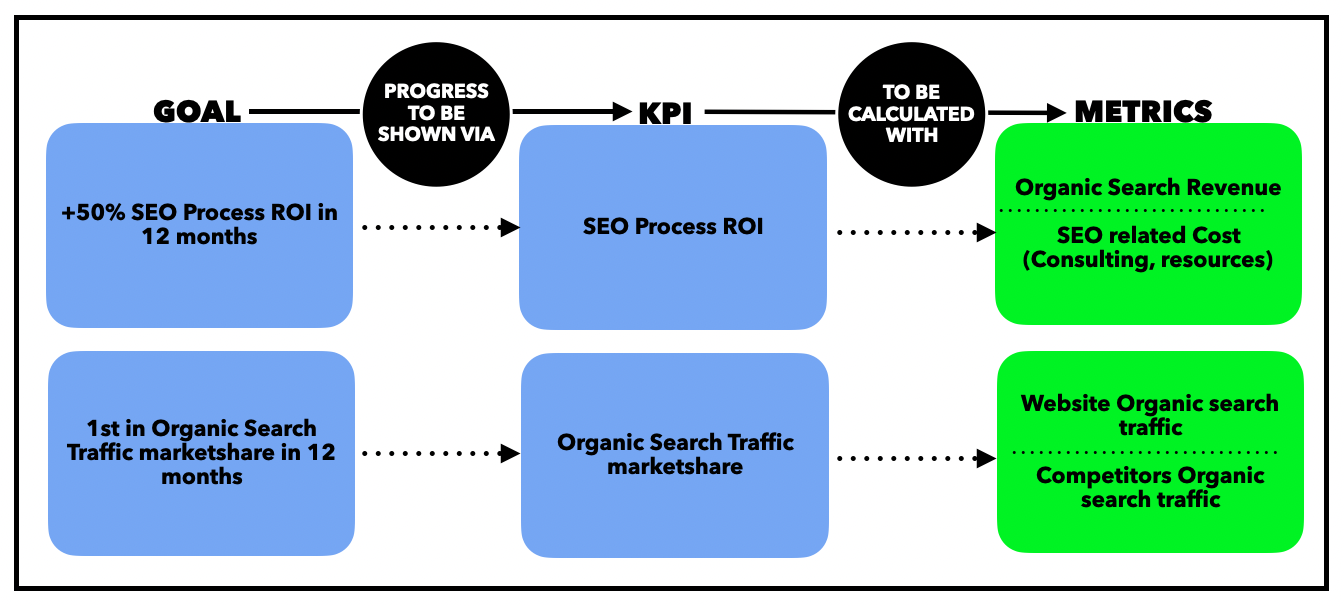
This is why the KPIs to include in each case should be personalized based on the audience profile and interests: the SEO related goals the CEO and CMO care about will be different (eg. SEO activities ROI, revenue and organic search market share) than those the head of SEO is interested in following up with (eg. SEO activities ROI, revenue and organic search market share along with other more technical related ones like non-branded commercial search traffic growth, top-ranked targeted queries, key pages crawlability and indexability, etc.).
Because of this, the KPIs used in the reports targeted to the former will be different than the latter, as well as the metrics to calculate them.
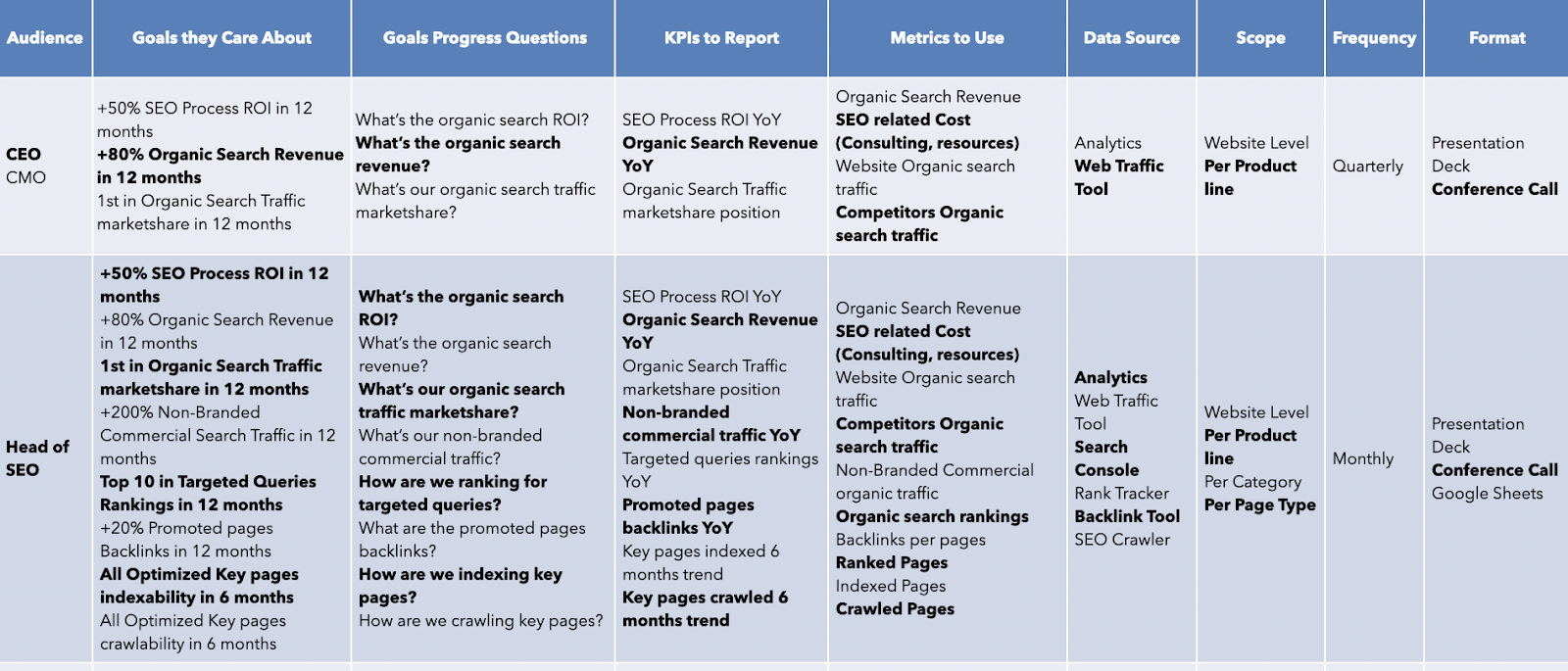
Here are a few steps and criteria to help you select relevant KPIs to include in your SEO reports:
- Start by establishing your SEO reports audience: Who will you report? Each audience will want to answer different questions about the SEO process’s progress. Ask each stakeholder about the SEO goals achievement they want to be informed of. Make sure these are actual goals that have been set for the SEO process and there are actions to be executed that are connected to their achievement.
- These should be “SMARTER” SEO goals (specific, measurable, attainable, relevant, time-bound, evaluated, reviewed), connecting SEO efforts with business objectives. Depending on the stakeholder role, they can be operational or business-related: Agree on which goals progress questions should be answered with SEO reports. Once you have these questions, it will be easier to establish the KPIs to report, as well as the metrics to obtain and measure to calculate the KPIs. If you can’t establish meaningful metrics to calculate KPIs and answer goal progress questions, then the goal might not be a SMARTER one.
- Ensure metrics data sources are reliable and stakeholders trust them and establish a couple of methods to gather the same data for consistency check. If it’s difficult to ensure accuracy for some KPIs, ensure precision (its consistency over time).
- Confirm the scope, frequency and format to present the SEO report to ensure you use a medium to facilitate its consumption (Google Slides, Google Docs, etc.). Set expectations about timing to avoid unnecessarily too-frequent reporting (e.g., there’s no point in doing weekly reports if there won’t be meaningful changes during this period due to SEO nature and frequency of releases).
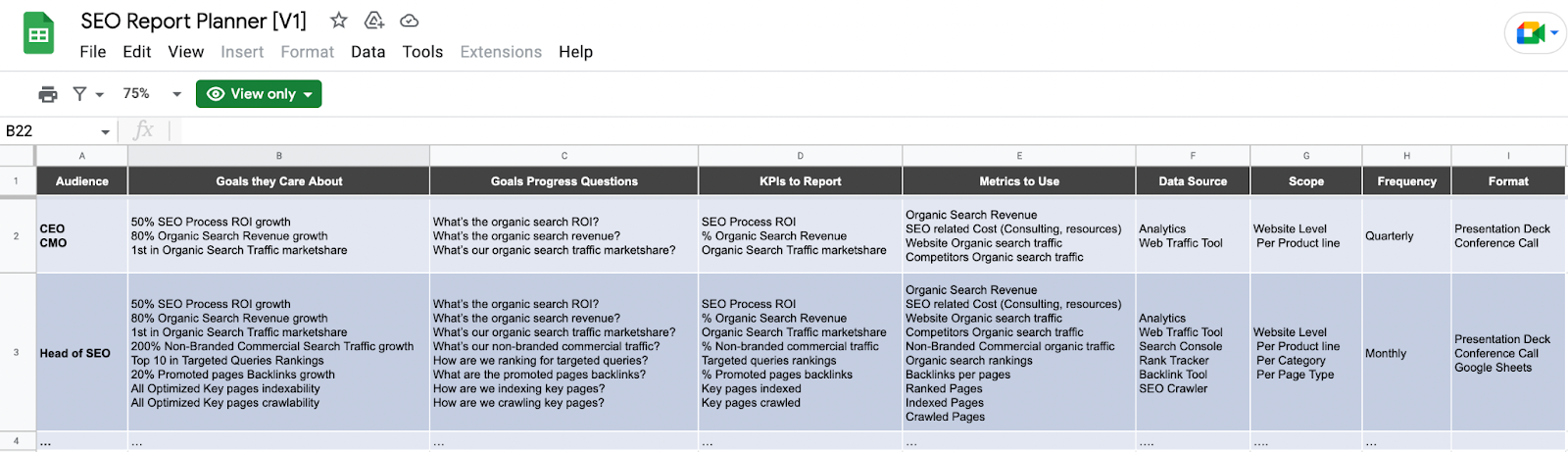
You now have the input needed to start collecting data and putting SEO reports together with only relevant KPIs for each audience and their understanding metrics. Here’s a Google sheet version of the SEO report Planner for using meaningful KPIs to facilitate this process further:
2. Ensure clear KPIs presentation to facilitate progress understanding
Your SEO reports KPI presentation efforts shouldn’t be about “creating a pretty document with beautiful charts” but about making the featured data easy to understand and achieving SEO reporting communication goals.
Sometimes a simpler scorecard will make it easier to understand goals achievement than a fancy time series.
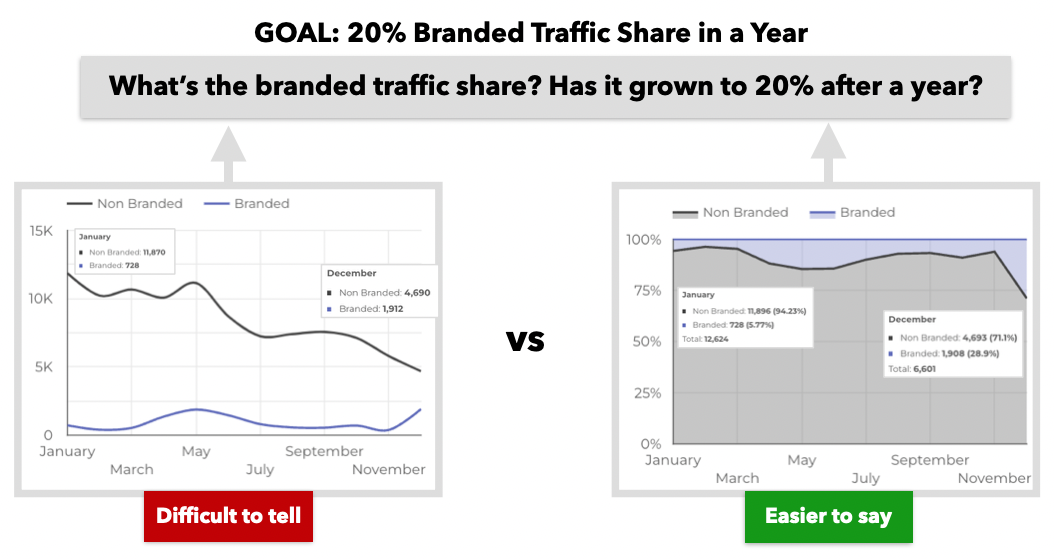
This is why it’s fundamental to follow certain data presentation and visualization best practices when selecting how to feature your KPIs:
- Identify the best data visualization format for each KPI by asking a few questions, as described here and here, the most important being:
- What’s the story your data is trying to deliver?
- Who will you present your results to?
- How many data categories and points do you have?
- Should you display values over time or among groups?
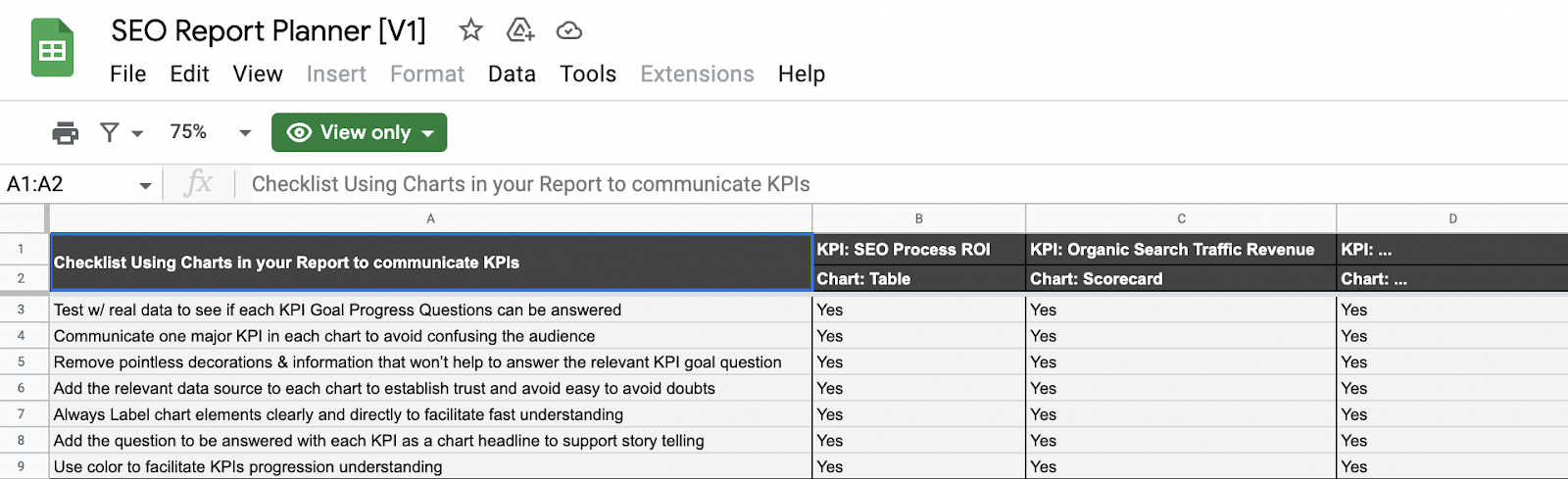
- Test with real data to see if each KPI goal progress question can be answered.
- Communicate one major KPI in each chart to avoid confusing the audience.
- Remove pointless decorations and chart information that won’t help to answer the relevant KPI goal question.
- Add the relevant data source to each chart to establish trust and avoid potential doubts.
- Always label chart elements clearly and directly to facilitate fast understanding.
- Add the question to be answered with each KPI as a chart headline to facilitate storytelling.
- Use color with intent to facilitate KPIs progression understanding.
Here’s a Google Sheet checklist for KPIs clear data presentation that you can use to facilitate your decision-making process:
3. Leverage data storytelling to explain and drive action with your SEO reports
Data storytelling creates compelling narratives to help audiences understand and drive action from your data analysis.
As explained by PPCexpo, stories attract and maintain people’s attention for longer, numbers without stories can quickly become boring, and stories communicate insights with higher clarity. As a consequence, storytelling should help to communicate the value of the data you’re showing.
However, it’s fundamental to avoid misrepresenting the data and bringing it to the wrong conclusions when leveraging storytelling.
For this, it’s recommended to avoid cherry-picking data or manipulating scale. Always show the whole picture, giving full visual context and keeping visuals and language consistent across the report.
SEO reporting storytelling should explain and drive action from the data without misleading. Even if the results are not positive, otherwise, you will lose trust.
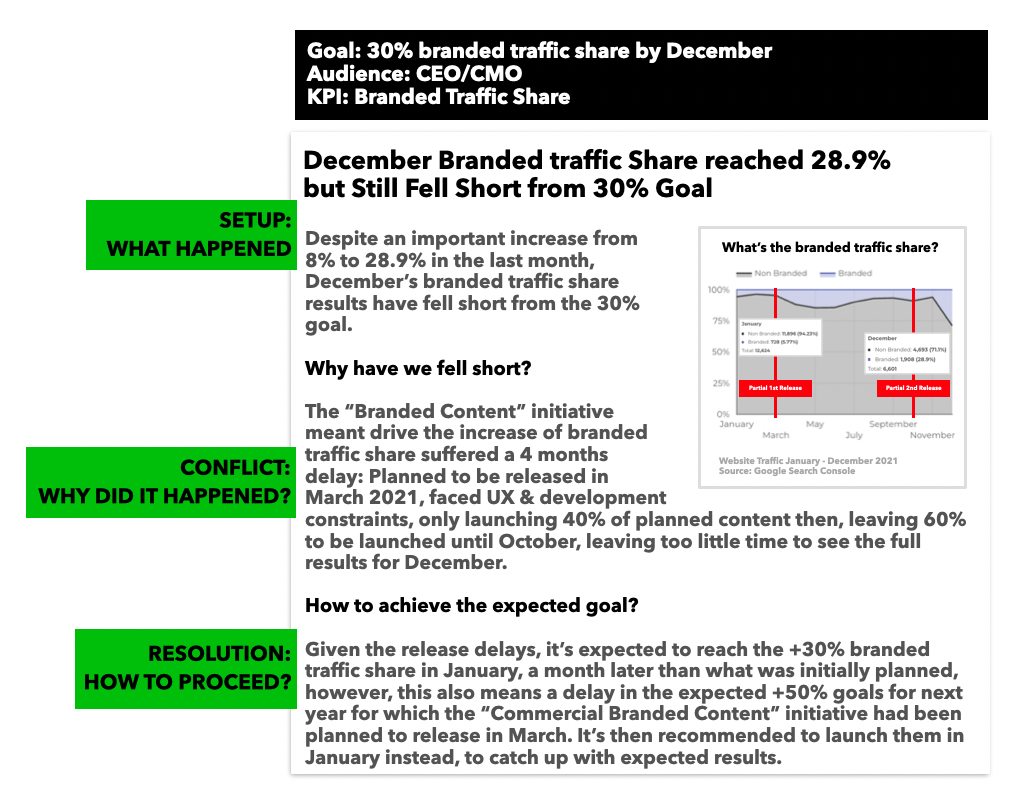
For this, craft a compelling narrative for each KPI using the three-act structure, asking the following questions:
- Setup: What happened? Describe “what happened” with each KPI result vs. expected goal progress, taking the audience into account.
- Conflict: Why did it happen? Explain the why behind the result, whether positive or negative and describe the cause of the results
- Resolution: How to proceed? What to do next to achieve the expected goal given the current results? Summarize top-recommended actions
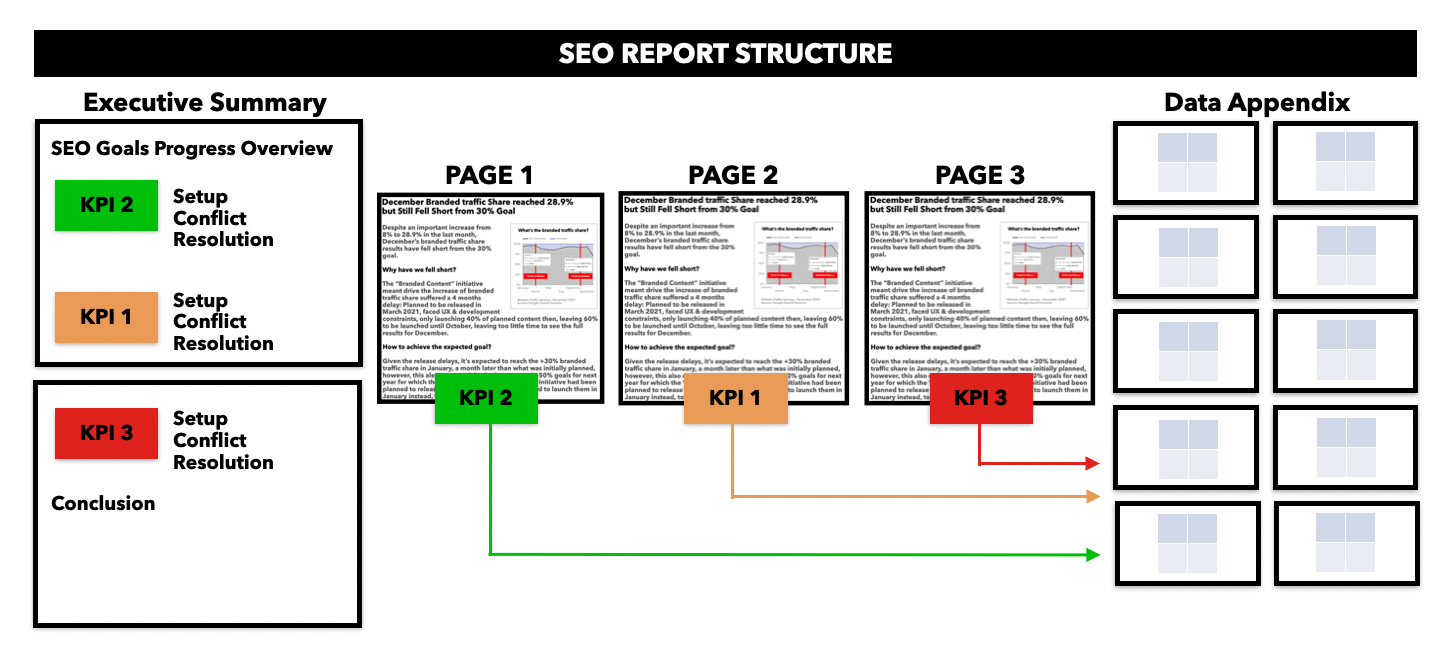
Then to effectively structure your SEO report:
- Include a page or slide per KPI by organizing the pages to begin with, the most important KPIs to the audience.
- Add a data appendix at the end with additional evidence to refer to from the KPIs pages.
- Include an executive summary at the start, highlighting the main KPIs results and actions: It should be concise but include enough to stand by itself as a report overview.
It’s also important to remember that there’s nothing like presenting the SEO report yourself to facilitate understanding and get feedback to improve.
SEO reporting is critical for SEO success, and you should prioritize it accordingly. I hope these principles, guidelines and templates can help you with it as they’ve helped me.
The post SEO reporting to impress: How to successfully report your SEO process, efforts and result appeared first on Search Engine Land.
Courtesy of Search Engine Land: News & Info About SEO, PPC, SEM, Search Engines & Search Marketing
Thursday, May 26th, 2022
SEO is a big thing. Yes, it is made up of a lot of small things. Some connected, some not.
We’d all love to stay on track, on plan and have everything go smoothly.
But the reality is that, at some point, something won’t perform as expected or a resource won’t come through.
That’s why, to some degree, SEO is based on problem-solving as a whole.
We have to be ready for those situations and know what to do because SEO roadblocks and challenges are inevitable.
Some SEOs are great strategists, others great implementers. Few excel at both. Everyone has different strengths and levels of idea generation, strategy development and tactical implementation disciplines.
With so many stakeholders and variables involved in SEO, what does it takes to be a successful SEO problem-solver? Here are nine ways to become an SEO problem-solver.
Get the daily newsletter search marketers rely on.
1. Understand your stakeholders (all of them)
SEO success (fair or not) is often judged by non-SEOs and, at the same time, can be held back or negatively impacted by others as well.
Problem-solving gets easier when you already know the expectations, identify possible roadblocks in advance and have a full context. Whether it is company politics, differing levels of understanding of SEO subject matter, or wildly different expectations for performance and timing, you need to know all the players and assess what challenges might be ahead.
The more you can manage the stakeholder mix and expectations, the easier it will be to troubleshoot issues or to go down the right path when they happen. And yes, that’s a “when,” not an “if.” I’m not being snarky, but nothing ever goes according to plan.
2. Set up roles and communication plans
Beyond the full set of stakeholders, there are distinct people who you work with. That may include people on your team, within your agency, within your department and/or other functions whether agency-side or client-side.
You will need others to be successful unless you have the skills and roles beyond SEO of writer, designer, developer and approver.
Establish clear roles and responsibilities. Know who your go-to people are for the different functions you need. Learn their processes and sync them up with yours.
Understand lead times and turnaround times. Make sure they know that unplanned requests and things will happen.
Make it crystal clear what you know you need and what you might need, and how timing and responsiveness will impact SEO performance. Build allies and include them in your problem-solving and troubleshooting process and work to gain as much agility with resources that you can.
3. Maintain baselines and goals
You want to have as much objectivity and cause and effect as you can in any SEO effort.
There are so many misunderstood and gray areas that, without baselines and goals of where the effort is going, you can get way off track with resources, why something isn’t going according to plan, and more.
There are often many ways to accomplish your goals. We can get lost down a rabbit hole on a technical issue if we can’t tie it back to a baseline or impact on a goal.
We also can take a step back and reprioritize our efforts when we receive resistance or a roadblock if we find out that a dev update to resolve a technical issue might take six months.
4. Leverage your strategy and plan
First, I hope you have a defined strategy and plan. If you don’t have it or your baselines and goals (noted above), take a step back and work on this. Otherwise, it is hard to be proactive and lead in the SEO effort as you’ll always chase down issues.
With your strategy and plan, you can further build on the objective aspects of the campaign or cause that your baselines and goals help with.
As I noted in the intro, SEOs can be great at big picture strategy, some at detailed implementation, and many have a range of experience and favorite parts (technical vs. content, etc.).
Unification around a strategy and plan will allow you to know how hard to push for a specific fix versus moving on to bigger impact items. However, it allows you to adjust expectations. If the content writer or approval process is booked for months out, you can raise the red flag about how that will cause a change in the plan and expected timing and what that might do to push results further out.
Using your plan and any changes that come to manage expectations will help you get resources or engage others who can help you.
5. Go off-script and be agile
Even with the best plan and all the resources you could want at your disposal, things often play out in different ways that we project or anticipate. Sure, we work through all of the title and meta description tags and they are “perfectly” optimized. Yet we might find that there are issues that remain with duplicate tags or how they are being indexed.
- Should we check off the box and move on?
- Should we do another round of optimization?
- Should we start doing other things in the plan in parallel?
- Do we need to get a developer or copywriter involved?
Again, things don’t always go according to plan. Sometimes we have to double down in certain areas.
Finding the right balance of adjusting the plan and being agile while you go versus sticking to the plan is probably the most important troubleshooting or problem-solving ability that an SEO can have.
6. Develop technical skills and/or resources
Knowing the “what” and “why” of an SEO issue is powerful. This is a step beyond being able to rely on tools or performance issues as indicators that something is not performing according to expectations.
If you can dig into the XML sitemap, robots.txt, HTML code or other related factors yourself to get to the root of the problem, you can get deeper into problem-solving directly.
At a minimum level, you need to be able to quarterback a situation by bringing your resources together. However, with the ability to solve issues yourself or speak the same language and be highly prescriptive and direct with your resources, you’ll have a better chance of getting a resolution to your satisfaction and hopefully quicker.
7. Have content backup plans
One of the top reasons plans and performance get off track: not getting the quality and volume of content needed.
I don’t know many SEOs who still are writing or making content edits. In most cases, SEOs rely on a client, another resource, or a partner responsible for writing and producing content. In some industries, this is also shaped by legal and compliance requirements.
Content resources can get booked up even if you have a content calendar and needs established.
- What happens when your content resource is unavailable or gets off track from the initial plan?
- Do you have backup resources?
- Do you go deeper into technical and off-page optimization to compensate?
It is one thing to be a problem-solver when content isn’t performing. It is another when you can’t get the content you need.
8. Be patient, but don’t wait
Be a team player and respectful of your partners and resources you collaborate with.
Pushing too much and/or not being tactful won’t help your cause. Give some grace and have patience, but also don’t wait.
If you’re stuck on content (per the section above), or a dev edit, or a technical update or on any specific resources beyond your control, find ways to move things around in the plan.
You can always prioritize link building, tag updates, or some other type of audit or update to keep things moving forward.
It might take some creativity, but don’t sit idle while waiting on others. Keep moving something forward.
9. See roadblocks as opportunities
My tone has probably been pretty strong because there will be challenges, roadblocks and things to troubleshoot. That’s the nature of SEO and the web in general.
A problem-solver mentality is important.
Accepting this reality and being positive in the face of adversity, being a realist and getting others on board with this reality are critical.
SEO is hard for everyone. We’re trying to be the best possible with our website and strategy.
If it were easy, everyone would be good at it, and we’d have a different set of problems.
The post 9 ways to become an SEO problem-solver appeared first on Search Engine Land.
Courtesy of Search Engine Land: News & Info About SEO, PPC, SEM, Search Engines & Search Marketing
Thursday, May 26th, 2022

Social media benchmarking involves comparing your metrics and processes against the industry standards. Learn how you can get a clear idea of how you stack up against the competition.
Hear from Rival IQ and NetBase Quid experts about the metrics and benchmarks you can use to measure your social media performance.
Register today for “Benchmark Your Social Media Performance For a Competitive Edge” presented by NetBase Quid.
The post Webinar: Benchmark your social media performance for a competitive edge appeared first on Search Engine Land.
Courtesy of Search Engine Land: News & Info About SEO, PPC, SEM, Search Engines & Search Marketing
Thursday, May 26th, 2022
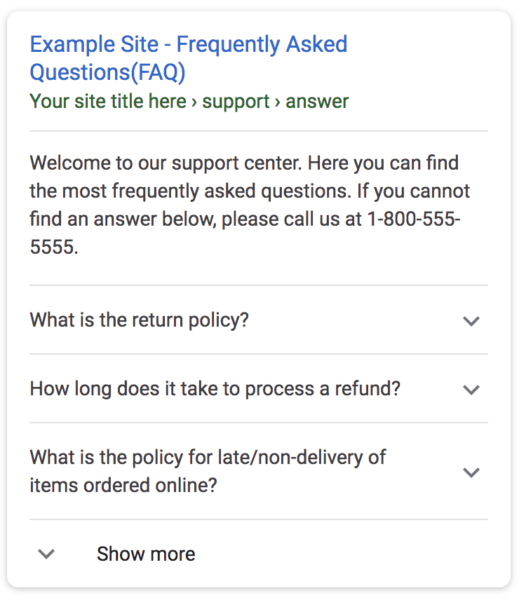
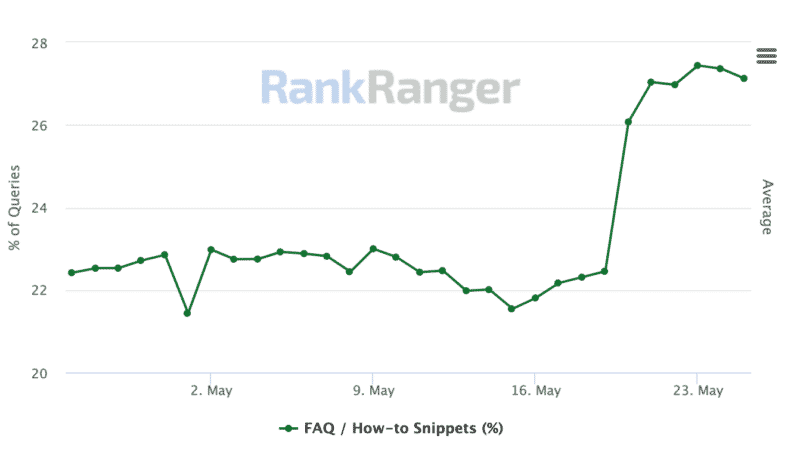
Google Search seems to be displaying more FAQ rich results in its search results over the past few days. Both RankRanger’s tracking tool and some SEOs are noticing this increase in the number of times a site is showing FAQ rich results.
What are rich result FAQs. Web pages that have a list of frequently asked questions (FAQs) that contain a list of questions and answers pertaining to a particular topic can markup the questions and answers with FAQ structured data. Google may then show those FAQs in the search results snippets as illustrated below:
More showing. Google is now showing these FAQ rich results five percentage points more often according to RankRanger, who happened to be recently acquired by Similarweb. Here is the data chart showing the uplift:
SEOs like Brodie Clark and Glenn Gabe noticed the increase too on clients they have access to:
The most effective way to review this change is via Semrush. Filtering with instances where the subfolder ranks within FAQ rich results, we can see the uplift. This uplift correlates with other tools such a RankRanger and Moz, which show an overview of this data publicly. pic.twitter.com/ZxKjuqAwgB
— Brodie Clark (@brodieseo) May 25, 2022
Two links. As a reminder, Google recently limited the number of links you can see within an FAQ rich result to two links. A couple years ago, Google also tightened the guidelines around using FAQ schema on your site.
Why we care. With more FAQ results showing up in Google Search, it may benefit your site if you gained those rich results but at the same time, if your competitor now shows up for these rich results, then it might have the opposite affect. Rich results generally lead to a higher click through rate from the Google search results snippet to the publisher’s site but not always. In this case, if the searcher gets his or her answer from the FAQ rich result, they made not end up clicking over to your site.
So test, test and test to see if you want these FAQ rich results for your site.
The post More FAQ rich results being displayed in Google Search appeared first on Search Engine Land.
Courtesy of Search Engine Land: News & Info About SEO, PPC, SEM, Search Engines & Search Marketing
Wednesday, May 25th, 2022
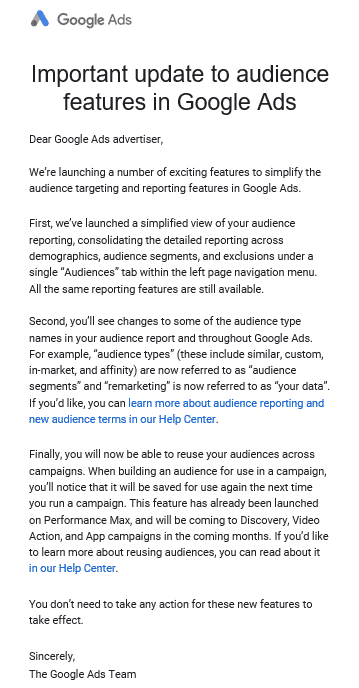
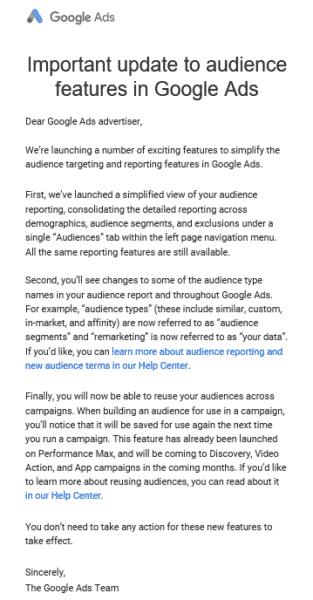
Google Ads is reminding advertisers about some changes to its audience targeting and reporting features. These changes, which were shared via email with advertisers, are fairly minor and some have already started rolling out to accounts.
Reuse audiences. Advertisers will be able to reuse audiences across campaigns. When you build an audience to use in a campaign, Google Ads will save it so you can use it again in a future campaign.
This feature is now available for use as an audience signal on Performance Max and is coming soon to Discovery, Video Action and App campaigns. The ability to reuse audiences will be expanding to more campaign types in the coming months, according to a tweet from Ginny Marvin, Google’s ad products liaison.
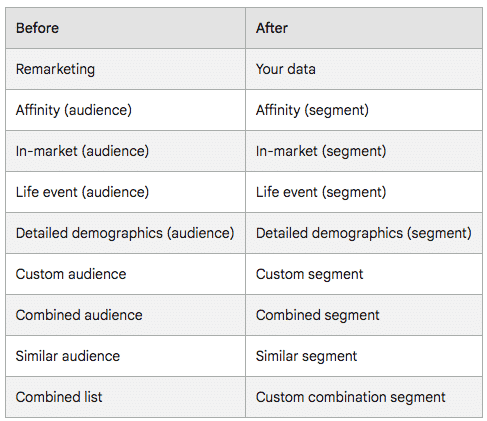
New terms. Google Ads is renaming some key terms in your audience report and throughout Google Ads. You may have seen this already in some accounts. Google revealed this via this help documentation in September 2021.
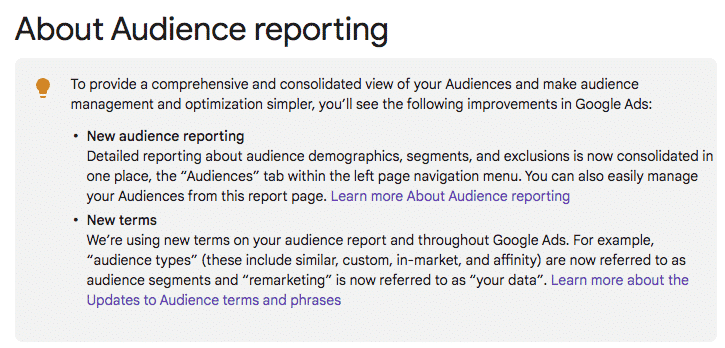
For example, Audience types (e.g., similar, custom, in-market, affinity) are now audience segments and Remarketing is now Your data. Here’s the full list of name changes:
New audience reporting. Google is consolidating audience reporting into a new Audiences tab. Located in the left-side navigation menu, you’ll find reporting about demographics, audience segments and exclusions. Google said this is a “simplified view” of all the same reporting features. This is another change you may have seen already in some accounts.
Why we care. Instead of rebuilding audiences manually in each campaign, new reusable audiences will allow advertisers to save time while keeping targeting consistent across campaigns. The experience should be similar to how custom segments act currently, where once an audience is created, it can be applied to any campaign instead of manually checking off types in each campaign. Changes to the audience segments will then be distributed to all campaigns targeting the audience segment.
Here’s the email from Google, shared on Twitter by @PPCGreg:
 (Click to enlarge)
The post 3 changes coming to Google Ads audience features appeared first on Search Engine Land.
Courtesy of Search Engine Land: News & Info About SEO, PPC, SEM, Search Engines & Search Marketing
Wednesday, May 25th, 2022
Google Ads has a bug of some sorts impacting some a “subset of non-US campaigns” where cost-per-click amounts are incorrectly inflated, the company posted.
The notice. Google posted this notice about 30 minutes ago:
We’re aware of a problem with Google Ads affecting a significant subset of users. We will provide an update by May 25, 2022, 1:00 AM UTC detailing when we expect to resolve the problem. Please note that this resolution time is an estimate and may change. We’re aware that a subset of non-US campaigns are affected by a technical issue causing cost-per-click (CPC) to be incorrectly inflated. We are working to resolve this issue.
Seeing inflated costs. If you are seeing inflated CPCs and costs on your non-US campaigns, do not worry, Google is aware and working on a fix.
It is not clear if this is a reporting issue or an issue impacting your budgets. Either way, you should ask for refunds after we learn more about the underlining issues.
Fix coming. Google has not posted an estimated time for when this will be resolved but Google will provide and update within the next 12 hours or so.
Why we care. If you are running campaigns outside of the US and you notice CPC inflation, you are not alone. Google is aware and will fix the issue – so no need to panic. Stay tuned as we provide more updates as they come in.
The post Google Ads bug inflating some cost-per-click (CPCs) for non-US campaigns appeared first on Search Engine Land.
Courtesy of Search Engine Land: News & Info About SEO, PPC, SEM, Search Engines & Search Marketing
Wednesday, May 25th, 2022
Good content, above all, is all about the story.
That’s according to new research from Google and Talk Shoppe, a research agency. Google wanted to find out how viewers determine the quality of content.
Why we care. While the findings of Google’s research are geared toward visual content (specifically: YouTube), the broad lessons can be applied to any type of content you create.
Good content has four elements:
1. Relevant. People want content relevant to their interests. But they also want content that is created by approachable and relatable creators.
- Key stat: 80% of people are more open to advertising or branded content when the content is relevant to them.
2. Intellectual. People want content that introduces them to new things. This includes brands.
What types of content? It could be an educational series, a how-to or a product review.
- Key stat: 88% of people said YouTube helped expand their perspectives or ways of thinking.
Is this statistic in conflict with the first stat? Yes, at least partially. But the use of the word “intellectual” may be the issue.
Many people seek out content that reinforces things they already believe, regardless of the level of “intellect.” That’s why over the past decade there have been so many concerns around filter bubbles and what engagement-driven algorithms recommend to us.
3. Sensorial. Good storytelling is all about the details. For video specifically, people said “unique storytelling or production” can be more stimulating than “cinematic quality.”
- Key stat: 94% of people said good content tells a good story.
- Another key stat: 92% of them say good content is produced with thought and effort.
What it means: content doesn’t have to be perfect. But your content should always be authentic, be useful/helpful, have a purpose and tell a story.
4. Emotional. Most people want a content experience – something that makes them feel something – or even multiple emotions (though it failed to specify whether positive or negative emotions made a difference).
Bonus: if you can achieve this with your content, this can help create a deeper connection with your audience. In other words, content that wins peoples’ hearts should translate to greater loyalty.
- Key stat: 85% of people said good content makes them feel something emotionally.
The full story. You can view the research, which was created as a visual story, on Think With Google.
So is that all that makes content good? No. In fact, it really depends on who you ask.
For this research, Google asked content consumers.
But ask someone on the SEO/marketing/creator side, typically metrics determine whether something is “good.”
In other words, all that matters is how the content performed. Was your content consumed or ignored?
To figure that out, we look at things like:
- Number of pageviews
- Time on page
- Number of links
- Organic visibility / ranking
- Organic traffic
- Click-through rate
- Engagement (comments, shares)
- Bounce rate
- Lead generation / task completion (e.g., add to cart, subscribe, content download, book an appointment)
But we all know that not every piece of content succeeds. Most content won’t do huge numbers. You probably can think of “good” content you’ve created that failed to do great numbers.
Does that mean the content isn’t good? No. It just means the content failed.
Need help creating good content? Check out these resources:
The post 4 elements of good content, according to Google research appeared first on Search Engine Land.
Courtesy of Search Engine Land: News & Info About SEO, PPC, SEM, Search Engines & Search Marketing
Wednesday, May 25th, 2022
Google Lens results within Google Chrome on desktop will now be displayed on the right side of the same browser tab you are viewing. This is instead of the results opening up in a new tab or new window within Chrome.
How it works. Here are the steps to take on Chrome to see this yourself:
- Open a page in Chrome.
- Right-click on an image.
- In the menu, choose “Search image with Google Lens.”
- If you right-click anywhere outside an image, from the menu, you can choose “Search images with Google Lens.” After you click this option, you can drag to select an image.
Tip: Search results display on the right side of your screen. To display them in a new tab, click Open  .
.
Here is a GIF of it in action:
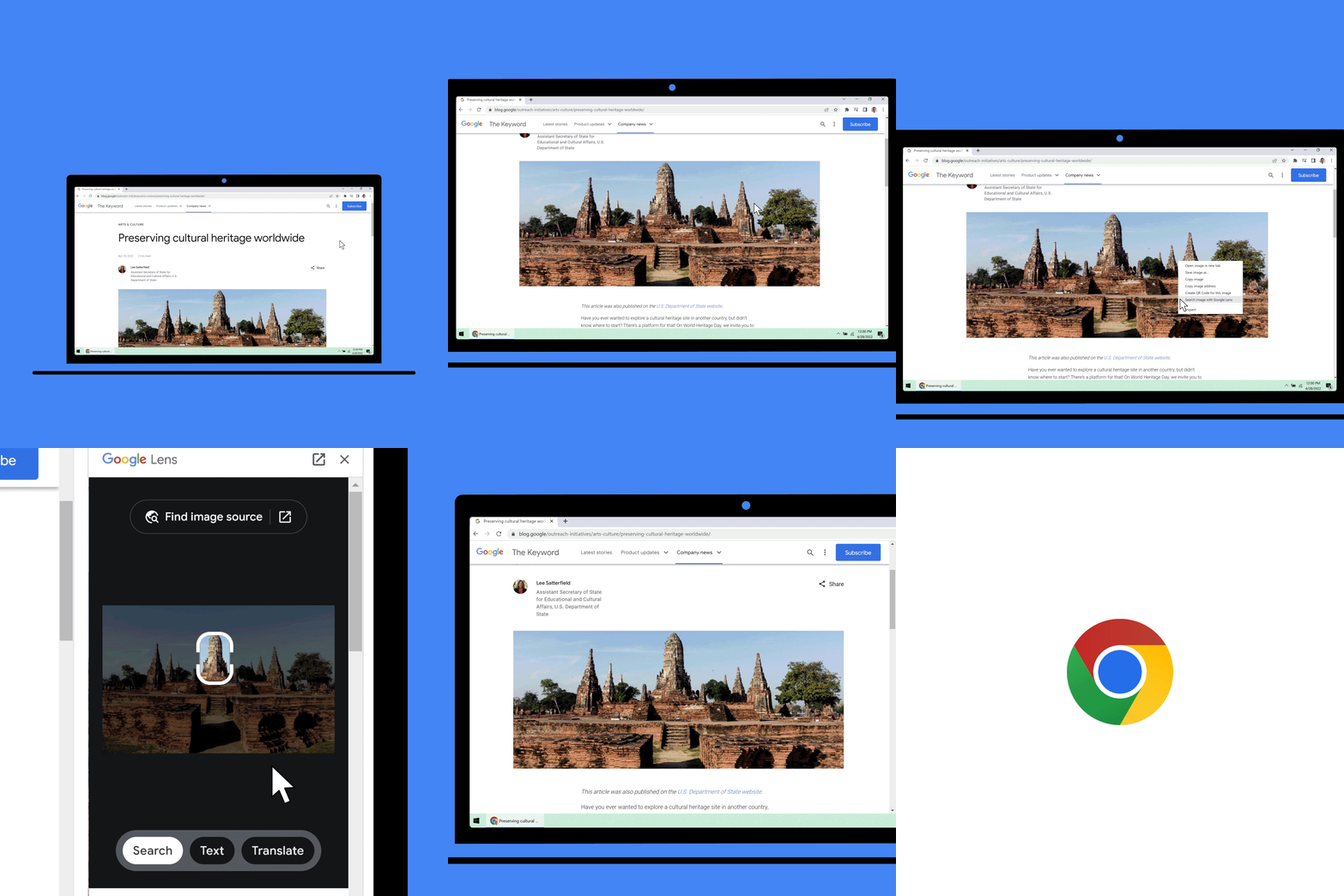
Who can see it. Google said this feature is now rolling out to all Chrome users. Google said this is part of the search company’s “broader effort to help people search and access information in more natural and intuitive ways.”
Why we care. This may encourage searchers and Chrome users to search more visually using Google Lens. If your content is displayed in these results, there is a chance you might see more traffic to your site through this search feature. Either way, you should be aware of this new Chrome feature as a potential source of traffic to your site and also how useful it can be for you to learn about images or things.
The post Chrome will show Google Lens results in the same browser tab appeared first on Search Engine Land.
Courtesy of Search Engine Land: News & Info About SEO, PPC, SEM, Search Engines & Search Marketing