Archive for the ‘seo news’ Category
Friday, July 26th, 2024
OpenAI today announced SearchGPT, its long-awaited search product.
- SearchGPT is a “temporary prototype” and limited to just 10,000 users and publishers at launch.
- OpenAI plans to integrate the “best” parts of the new search features directly within ChatGPT in the future.
How SearchGPT works. SearchGPT responds to queries using its AI models plus information pulled from the web. It will include links to relevant sources, OpenAI explained in a blog post.
OpenAI is teasing SearchGPT like this:
- “A prototype of new search features, using the strength of our AI models to give you fast answers with clear and relevant sources.”
What SearchGPT looks like. It looks fairly similar to what it has been doing since the arrival of GPT-4o – what is known as “browse mode.” OpenAI shared some videos of the “faster and easier” SearchGPT experience:
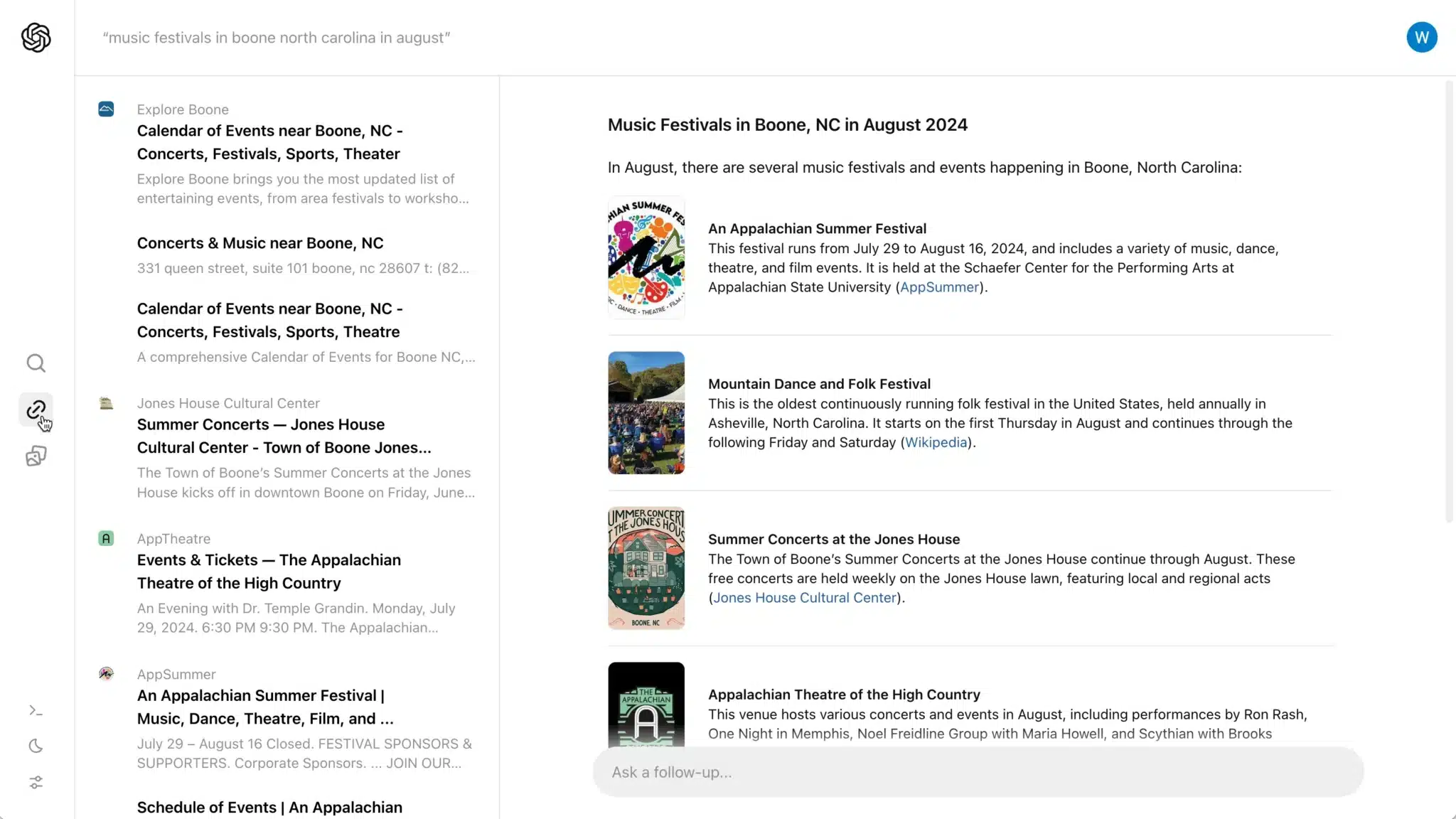
- It starts with a search box asking you, “What are you searching for.”
- After entering your query, SearchGPT will provide an answer that includes links to sources within the text answers and shows sources beneath the answer.
- Additional results will be shown in a sidebar.
Here’s a search for [music festivals in Boone, NC in August 2024]:
Here’s a search for [best tomatoes to grow in Minnesota]:


For publishers. OpenAI is “launching a way for publishers to manage how they appear in SearchGPT, so publishers have more choices. Importantly, SearchGPT is about search and is separate from training OpenAI’s generative AI foundation models. Sites can be surfaced in search results even if they opt out of generative AI training.”
Coming soon. OpenAI said it plans to improve searches related to local information and commerce.
Waitlist. You can join the SearchGPT waitlist here.
The OpenAI search story so far. We first heard about OpenAI’s plan for a search product in February. Rumors heated up in May – but OpenAI didn’t launch its search product (GPT-4o launched instead). Then, earlier this month, The Atlantic CEO confirmed that OpenAI was “going to build a search product.”
Why we care. The next Google won’t do what Google does, as ex-Google CEO Eric Schmidt once said. OpenAI CEO Sam Altman has made it clear he has no interest in copying Google Search – but creating a new user-friendly search that combines LLMs and search without drowning you in advertising. While it’s too early to know whether ChatGPT will become a Google Search killer, this is clearly a story we’ll be watching closely over the coming months and years.
Courtesy of Search Engine Land: News & Info About SEO, PPC, SEM, Search Engines & Search Marketing
Wednesday, July 24th, 2024
Comparing your website’s organic search performance to the latest industry benchmarks is the best way to contextualize YTD organic search traffic data, adapt SEO and content strategies to maximize results, and set more informed KPIs.
Join Steven van Vessum, Director of Organic Marketing at Conductor, and Shannon Vize, Sr. Content Marketing Manager at Conductor, as they share the latest organic search traffic benchmarks, trends, and insights for 2024 to help inform and improve your search strategy.
Save your spot now to ensure your organic search and content strategies are set up for success for the remainder of 2024 and beyond.
Courtesy of Search Engine Land: News & Info About SEO, PPC, SEM, Search Engines & Search Marketing
Wednesday, July 24th, 2024
Google is rolling out a new notification in select Google Ads accounts, offering personalized support for implementing enhanced conversions.
Why we care. Despite Google’s decision to stall removing cookies from Chrome, advertisers still need new ways to measure and optimize their campaigns. Enhanced conversions provide a privacy-focused solution to maintain accurate conversion tracking.
Details.
- The notification offers a consultation with Google’s technical support team.
- Users can book an appointment to discuss implementing enhanced conversions.
- A “Get started” button directs advertisers to a workflow in the Google Help Center.
How to check eligibility.
- Look for the notification in your Google Ads account.
- Alternatively, you can check eligibility by updating a specific URL with your account’s ocid number.
First seen. We were first alerted to this update from PPC News Feed:

What’s next. Advertisers who implement enhanced conversions may see improved measurement accuracy and campaign performance as the digital ad landscape evolves.
Courtesy of Search Engine Land: News & Info About SEO, PPC, SEM, Search Engines & Search Marketing
Wednesday, July 24th, 2024
After years of back and forth between Google and regulatory bodies, the news finally came in yesterday that Google is scrapping plans to kill third-party cookies in Chrome.
Unsurprisingly, advertisers had something to say about that.
Emotions ranged from lack of surprise to relief. Many see it as good news for advertisers, while some have mixed feelings.
Most importantly, they implore us to keep emphasizing first-party data and a privacy-first strategy with our clients.
Skepticism and lack of surprise
Niki Grant, a paid media specialist, said she always has been skeptical about a magical 2024 world where third-party cookies have been ruled obsolete, so she was not particularly surprised at the news:
- “Those of us who have had to actively hunt out alternatives are all too aware of the limitations of most cookie-less solutions, and I personally think privacy concerns related to third-party cookies were generally blown out of proportion in the first instance anyway!
- “It looked good for the likes of Google to be super proactive in finding an alternative, but I would have been astounded if they had actually identified a viable alternative in only a matter of years. The proof will be in the Chrome-usership pudding; in the meantime I appreciate Google’s candor instead of a messy ‘make do and mend’ solution to save face.”
Also not shocked by Google’s change in course is Julie Bacchini, president and founder, Neptune Moon:
- “The Google Ads ecosystem (and all ad platforms to be fair) is so dependent on data from cookies it has always been hard to imagine how the platform as we know it could function without cookie data. There are still a lot of questions around exactly what they mean by offering users more control. But it is a bit of a sigh of relief as it is one less thing to have to figure out in the next few months or coming year!”
Gil Gildner, the cofounder at Discosloth, compared this to “The Boy Who Cried Wolf” fable:
- “Google always seems to announce imminent changes, then pushes back the date or scraps plans altogether. It’s how they try to motivate users (who otherwise wouldn’t care) to adopt new tech. They did it with GA4 and they’ll do it with something else next.”
Paid search specialist Sarah Stemen said the delay in phasing out third-party cookies by Google is probably strategic:
- “As the dominant browser owner, Google is under scrutiny for antitrust behaviors. The proposed Privacy Sandbox, while marketed as a privacy-enhancing tool, likely raises barriers for competitors. This could lead to less competition and more market consolidation in the ad tech industry.
- “By delaying the depreciation of cookies, Google buys itself time to either refine the Privacy Sandbox or to make its implications less transparent. Another alternative is that they simply don’t have a solution, but I think it’s likely a delay.”
Relief and positive reactions
Asher Mirza, a digital and performance marketing specialist, said it was great news to wake up with as a performance marketer and shocking as a consumer.
- “Seems like big corp went too far ahead with the new privacy era and realized it would be a loss for everyone and decided for this massive U-Turn. What a time to work in marketing where no one can decide what will happen tomorrow.”
Sophie Fell, director of paid media, Two Trees PPC, said this is good news for advertisers because so many still don’t have a decent grasp on their first party data and this was proving to be a big hurdle for them to overcome.
- “I think the question now is, ‘What’s next?’ It’ll be interesting to see what the uptake on the privacy ‘toggle’ is as a percentage of Android and Chrome users, and then how that impacts audience targeting. For example, will fewer 55+ year olds tweak their privacy settings, and therefore will marketing to this age group using cookies be much easier than marketing to <35s who may be more likely to utilize it? Lots of very interesting data to come over the coming months and no doubt a few more hurdles for advertisers along the way.”
Digital marketer Brett Bodofsky wondered whether similar audiences might come back now.
- “Google Ads deprecated similar audiences due to third-party cookie limitations. Now that the plan is scrapped I wouldn’t hate seeing those come back. I understand there has been launches to help account for their deprecation. But honestly, I liked similar audiences.”
Digital marketing specialist Robert Brady said removing the foreboding deadline (that kept getting pushed back) is a positive.
- “Google has to manage expectations and there is simply too much uncertainty from regulatory bodies and the technology itself to set a firm date on cookie deprecation. I fully expect Google to continue their efforts.”
Mixed feelings/need for adaptation
John Gbemileke Adeoti, growth marketing lead, Expedier, said the news was both annoying and a relief.
- “Relieved that I can put my worries to rest. But annoyed that advertisers and brands don’t need to go through these many changes within a short while. I mean, when you consider how many brands and marketers are still struggling with the switch from UA to GA4! Big tech needs to do better than toy with our time and effort, to be honest.”
Veronika Höller, global search lead, Tresorit, said the privacy debate isn’t going away anytime soon, adding that having an alternative (like the Privacy Sandbox) doesn’t guarantee it will be effective.
- “The real focus should be on empowering users to share their data willingly, for a truly personalized experience. It’s about building trust, brand awareness, and thinking outside the box. We shouldn’t expect data to be handed to us on a silver platter. Most of it is already out there, scattered across different platforms we use. Let’s connect those dots, and suddenly every change isn’t a catastrophe.
- “And even if Google does decide to pull the plug entirely – which, let’s face it, is always a possibility – we’ll be prepared. At the end of the day, we control what users share with us. That happens best when we’re honest, highlight the benefits, combine data sources, and communicate directly with our audience.
- “Instead of waiting for incomplete analytics data and crying over it, let’s be proactive. Let’s build relationships and earn that data. It’s a far more sustainable and rewarding approach.”
Meanwhile, Navah Hopkins, brand evangelist, Optmyzr, said advertisers essentially “won” a game of chicken with Google, but:
- “It doesn’t change the fact that the privacy-first world is here via GDPR, CCPA, and other regulatory considerations. Just because we have an extension on our ability to target through website traffic, see users (device-dependent) across multiple devices and domains, doesn’t change the fact that many markets have adopted privacy-first era rules and regulations.
- “Just because Chrome is giving the extension doesn’t mean other channels are going to follow suit. So while we all can laugh, smile, and cheer that cookies are “here to stay”, people should not be complacent. So here are three critical things every user should do in preparation for the privacy-first world regardless of whether cookies are here or not:
- Build consent into every single thing you do.
- Make sure your stakeholders understand reporting efficacy will be ad channel-dependent and device-dependent.
- Think beyond Google and Chrome.”
Emphasis on first-party data and privacy
Digital marketing strategist Nicholas James said Google’s reversal was expected for several reasons, including the unfinished state of the Privacy Sandbox and with this move, it is still unclear how it will impact its usage.
- “However, refining your first-party data strategies remains crucial, as success in this area will distinguish the true leaders in the evolving digital landscape.”
Fraser Andrews, global search lead, JLR, said he sees this very similarly to the consent mode v2 update.
- “It’s ultimately going to be more beneficial for advertisers to have consented data (provided they actually do something with it!) So my recommendation would still remain – get access to consented data and learn how best to utilize it to enhance performance.”
Heinz Meyer, director and owner, Orris Digital, said the media is taking a slightly extreme stance on this.
- “Google isn’t scrapping the third-party cookie blocking on Chrome, they’re giving users the choice to opt into third-party cookies. Therefore, my advice is: prepare for a world without third-party cookies like we were before.”
Broader industry implications
Marketing strategist Reid Thomas said this is an admission by Google and the IAB in general that there isn’t a solution for tracking other than cookies.
- “Non-cookie identification, due in part to efforts by browsers not owned by the largest DSP, has never really taken off. In essence, Google has worked with privacy regulators and advocates to try and find a solution and simply has not been able to.
- “For advertisers, I’d still keep treating the world as if cookies are deprecated. For ~30% of users, they already are (Safari, especially mobile; Firefox; Opera; and some Edge users). For the rest, recent data shows that cookie-based targeting is ROI negative (Ahmadi et al 2023) and largely is not significantly more accurate than random targeting (Neumann et al 2022).
- “Essentially, this is more of a capitulation that there is no ‘new cookie’ and that rethinking how we reach audiences needs to happen, rather than celebrating that the ‘good old days’ are back.
Lisa Erschbamer, director, digital advertising at Proficio, said she’s unsurprised that Google couldn’t make it work in a way that is profitable to them (and without losing media budgets to other ad networks).
- “But: More people are data and privacy aware and I hope more PPC specialists have started thinking beyond Google Ads, treating it as the part of a whole strategy that it is. So not all bad.”
Courtesy of Search Engine Land: News & Info About SEO, PPC, SEM, Search Engines & Search Marketing
Wednesday, July 24th, 2024
The short answer is, “no.”
Perhaps a more relevant question is: Could AI render human SEO analysis and actions redundant? In other words, will AI eventually replace your job?
Early analysis suggests that AI still falls short, particularly in technical SEO analysis. While this study primarily used basic prompts, some users report better results with more detailed prompt crafting.
This raises an interesting point: If a generalist SEO manager were to replace you with AI, they would need to develop advanced prompt-crafting skills, potentially negating the need for specialized analysts.
Currently, it seems unlikely that your manager could easily replace you with AI, at least in the short term.
While AI can perform technical SEO analysis with detailed prompts, the knowledge required to craft such prompts favors technical analysts like yourself.
You might be better positioned to leverage AI for your own benefit, potentially reducing the need for certain management roles.
However, don’t celebrate too soon – as AI continues to evolve and absorb more information, this advantage may be temporary.”
Why does AI require technical prompting expertise?
AI aims to eliminate the need for semi-technical expertise. Where data is commonly highly structured (e.g., coding a Python script), AI holds an advantage.
But even then, the technical expertise of a human operator is still needed. While AI can create a script to perform a task, without detailed instructions and bug fixes from a human, the result won’t be usable.
Currently, generative AI bridges a gap by producing working functions when given detailed prompts. Since AI still “thinks” like a machine, technical individuals are best positioned to leverage its full potential.
Technical knowledge is still required with AI-assisted, on-page SEO tasks like generating product descriptions or alt text at scale. And even if you are familiar with OpenAI’s API, tools like Microsoft Excel are still needed to create thousands of prompts.
AI needs human instructions to function and the quality of these instructions is crucial for good output. Thinking like a machine (using IDs, classes and distinct entities) is key to successful AI-generated results. AI boosts efficiency for technical workers, so it’s important to embrace it rather than reject it.
While generative AI requires human input to produce anything (like analysis, text or images), crafting these instructions is a critical skill. Employers should consider their employees’ technical expertise when using AI for efficiency gains.
Why does AI perform poorly on SEO tasks with basic instructions?
Data is both AI’s strength and weakness.
For instance, Google Gemini and OpenAI’s GPT-4o, which can access vast web data, have not matched the performance of GPT-4, which uses a curated data model. Giving AI more data was believed to improve its performance, a key principle of machine learning.
However, this was also how we understood basic algorithms, which use pure information to produce results. For example, Google has recently tried to downplay the importance of PageRank.
While this is true ideologically, Google still relies on such data for search rankings. Similarly, AI struggles to handle subjective human input, even when it’s converted to numerical data, often producing unexpected results.
This raises the question: Is more information always beneficial to AI? The open web contains both empirical data and subjective opinions. AI struggles to distinguish between fact and fiction. Recently, giving AI access to non-curated data has caused more errors.
Finding the sweet spot for data input is the next challenge for AI developers. How much data helps or harms AI, and how much curation is needed?
Dig deeper: 6 guiding principles to leverage AI for SEO content production
Are we safe? Is AI limited?
There is some truth to this argument, though there is also some degree of false representation.
Like any technology, AI has limitations within its current form.
Generative AI can only act with human input. Even if this is not the case (as it may soon be), AI struggles to differentiate between fact and fiction.
Some algorithms have met their worth in terms of commercial viability. This is arguably why Google is trying to convince us that links are redundant before they truly are.
Consider AI as an evolution of algorithmic output. Now, such technologies can attempt to make analytical determinations based on their input data. However, the idea that feeding AI more and more data is an unrestricted path to success is already facing up against significant limitations.
This doesn’t mean technical analysts are safe. Humanity’s ambition for faster insights will continue. Initially, AI will be seen as the solution to everything. If one AI falls short, another can critique its results.
However, AI requires significant processing power. The real challenge will be finding the balance between AI and simpler algorithms. Algorithms should handle basic tasks, while AI should be used for analysis and insights.
This balance between AI and algorithmic efficiency is still some years (perhaps decades) from fruition. Only then will AI truly test us as SEO professionals and create the opportunity for redundancies.
AI’s learning is hindered by the web’s misinformation, providing SEO professionals with temporary insulation. This advantage won’t last forever, but it offers a valuable head start.
Dig deeper: How AI will affect the future of search
AI limitations: Factors of society
There are also limitations in terms of the societal acceptance of AI. Many technological innovations (the internet, the calculator) were originally considered “cheating” by wider society.
Calculators were banned from exam rooms, and the internet was considered to be a simpleton’s cheat sheet for research vs. visiting one’s local library. And yet, how long can such perspectives remain profitable?
Most technologies, despite rapid advancements, are not quickly accepted by society due to cost and sociological factors. We value our unique human perspective and resist technology that threatens our thinking or livelihoods.
The main barrier to AI replacing us is our own perception of it. As long as we see AI as a threat to our ability to provide, it won’t take our jobs. However, this perspective will change over time.
When these technologies become normalized, we will see change. By then, governments will have adapted, continuing to challenge human creativity.
Algorithms and Google didn’t end human interaction on the web, and AI won’t eliminate contributions from willing individuals.
In short, we will need to adapt in the medium-to-long term.
SEO in the AI age: Technical expertise still matters
As we adapt to the changing SEO landscape with AI, here are some key insights about our profession’s future:
- AI integration with SEO: Contrary to fears, AI will not render SEO obsolete. Instead, it will reshape our approach to SEO practices. AI aids in automating routine tasks such as generating on-page product descriptions and alt texts for images. However, its effectiveness (currently) hinges on the precision and technical depth of human input.
- Importance of technical expertise: The ability to craft detailed, technically sound prompts is becoming increasingly vital. This skill set ensures that AI tools are leveraged effectively, reinforcing the irreplaceable value of seasoned SEO professionals in an AI-driven landscape.
- Data sensitivity in AI performance: Experiments have shown that AI’s effectiveness in SEO varies significantly based on the data it processes. Systems that utilize curated datasets like GPT-4 exhibit different behaviors from those with unrestricted web access. This underscores the necessity for strategic data management and highlights AI’s limitations without structured human oversight.
- Evolving roles in SEO: As AI technologies advance, the role of SEO professionals is not diminishing but transforming. In the future, SEO experts will likely focus more on managing AI operations and refining AI outputs rather than being superseded by AI.
- Societal acceptance and technological adaptation: The widespread integration and acceptance of AI within SEO depend on how quickly society adapts to these technologies. As AI becomes normalized and regulations evolve, our roles will need to adapt accordingly.
- Future outlook: Despite AI’s growing capabilities, the nuanced, creative and complex elements of SEO will continue to require human insight and expertise. AI is not a replacement but a tool that, when used correctly, can amplify our effectiveness and efficiency.
The integration of AI into SEO is inevitable and transformative. It presents an opportunity for us to refine our skills and adapt our strategies.
The future of SEO will not be devoid of human input. Instead, it will be a collaborative interplay between human ingenuity and machine efficiency.
Dig deeper: How to start an SEO program from scratch in the AI age
Courtesy of Search Engine Land: News & Info About SEO, PPC, SEM, Search Engines & Search Marketing
Tuesday, July 23rd, 2024
We’ll look back at 2024 as the year AI made its way into the martech stack.
Generative AI, in particular, quickly appeared in a wide range of martech applications.
In fact, as the martech landscape grew to more than 14,000 new applications in 2024, 77% of the 3,068 new tools introduced this year are based on generative AI.
Every year, the annual MarTech Replacement Survey asks the marketing community about the martech solutions they replaced in the past 12 months.
In the past several years, the survey identified a number of interesting trends:
- Marketing automation platforms are the most-replaced martech application for three years running as we launch the 2024 survey.
- A growing number of replacements (more than one-third in 2023) are aimed at improving the customer experience.
- Commercial applications continue to replace homegrown solutions.
In the year that’s passed since the 2023 survey was launched, we’ve seen continued layoffs in the tech sector, in particular.
Marketers and marketing operations professionals who took part in MarTech’s most recent Salary & Career Survey identified a decrease in job satisfaction, a focus on demonstrating the value of their work and resource limitations.
Against this backdrop, we’re launching the 2024 MarTech Replacement Survey.
This brief survey will explore the applications your marketing organization replaced in the past year, why you replaced them, whether your martech stack is growing or shrinking, and more.
Take the 2024 MarTech Replacement Survey.
Courtesy of Search Engine Land: News & Info About SEO, PPC, SEM, Search Engines & Search Marketing
Tuesday, July 23rd, 2024
Google is reversing course and won’t phase out third-party cookies in Chrome as previously planned, instead opting for a new approach that gives users more control, the company announced today.
Why we care. This decision marks a significant shift in Google’s privacy strategy and will come as a relief to many in the advertising industry who have been scrambling to prepare for a cookieless future.
Details:
- Google will introduce a “new experience” in Chrome that will allow users to make informed choices about their web browsing privacy.
- The Privacy Sandbox APIs will continue to be developed and made available as alternatives.
- Google is discussing this pivot with regulators, including the UK’s CMA and ICO.
By the numbers. Recent tests of Privacy Sandbox technologies showed promising results, according to Google:
- 89% recovery of advertiser spend in Google Display Ads.
- 97% recovery of conversions per dollar in Google Display Ads.
- 55% recovery in remarketing spend for Google Ads.
Between the lines. This move suggests Google is trying to balance privacy concerns with the needs of the ad industry and its own business model.
What they’re saying. Anthony Chavez, VP of Privacy Sandbox, wrote in a blog post:
- “We developed the Privacy Sandbox with the goal of finding innovative solutions that meaningfully improve online privacy while preserving an ad-supported internet.”
The big picture. This decision follows more than four years of back-and-forth and multiple delays in Google’s plans to phase out third-party cookies.
What’s next. Google hasn’t provided a specific timeline for the new approach, likely to avoid the pitfalls of previous delays.
Courtesy of Search Engine Land: News & Info About SEO, PPC, SEM, Search Engines & Search Marketing
Tuesday, July 23rd, 2024
This year’s shopping season is unusually short. Instead of the normal four and a half to five weeks, we have just 27 days between Thanksgiving and Christmas. On top of that:
- Hanukkah starts on Christmas, and Kwanzaa is on the day after.
- Christmas and Hannukah are on Wednesdays, eliminating the ease of shopping retail over the weekend for last-minute gifts. E-gifts and gift cards may be in demand.
- It’s an election year in the U.S.
- The previous election was during the pandemic, so shopping habits and promotions are not comparable
The shorter shopping period means the last shipping day deadline is earlier, there’s less time to clear inventory for 2025 and fewe ad space and promotions available will increase costs.
There’s also good news that will make your life easier as a marketer.
- You don’t have to separate holiday campaigns this year, saving time and money. They can use an all-encompassing message with each religion in one, including Solstice, which occurs on December 21 this year.
- Your email campaigns apply to all holiday customers, so there is less design work, split testing and fewer deadlines.
- The last day to ship is the same for everyone saving you additional calendar reminders.
- Media will matter and markups haven’t started because many people haven’t realized it’s a short year yet, so you can get solid deals by reserving space now.
Here are a few ways you can prepare for the holiday season by marketing channels:
(Note: I left out SMS, email and social media because they can benefit from a combination of the above.)
Niche sites, influencers and publishers
Niche sites, influencers and media companies create content for small business Saturday, have round-ups sharing the best of Black Friday and Cyber Monday, as well as listicles of the best XYZ.
The ability to share specific products is limited as you only have so many videos that can be filmed and placements to publish without chasing fans away. With fewer days until free shipping and time to publish, now is the time to line up the lists.
Consider the following when planning your editorial calendar.
- Which niches or industries take more time to ship, as free shipping is a huge part of the consumer decision process. Line those up sooner in the season. This includes furniture, made-to-order gifts and print-on-demand products.
- With limited time to publish shopping lists, send email blasts and do social media posts, try increasing your pricing because you have to make up for the lack of quantity this year.
- Pay attention to trends and interests earlier this year to line up sponsorships based on consumer demand. The “it” toys and gifts will always be included. Find the unique ones with similar or the same audience demographics and mix those in.
The uniqueness of your lists will stand out compared to the big media companies that mostly feature big brands, as the big brands may be paying big bucks to be featured.
By targeting a similar buyer base and including products they want, rather than relying on big brand budgets, you can achieve more conversions with affiliate and paid sponsorship links, encouraging them to make another media purchase.
PPC and paid social
You’re already expecting costs to increase with the holiday season and even more this year because there’s less time to shop, so budgets need to be spent. That’s why messaging is my tip here.
(Note that nothing about this section is political, and I do not recommend promoting politics with your messaging. It is about the tone and voice of the words you use. You want to meet the potential customer in their current mental state.)
Look at the top counties and, ideally, ZIP codes your customers live in and segment out the top 30 to 100 or more if you can. Once the election happens, look how each one voted, as America is very purple. Now, modify your messaging based on voting patterns into three categories.
- Supportive: The side that loses.
- Upbeat and excited: The side that wins.
- Standard holiday: When votes are close to a 50/50 split.
The beauty of PPC and social media advertising is that you can target where they are using inclusions, exclusions and geographically. Politics is intense, so you can say the same thing differently depending on how the election goes with the votes.
Let’s pretend you sell water heaters. Here’s how you could phrase the following based on the three bullets above.
- Supportive: There’s enough stress in the world. Replacing your water heater now keeps your escape running clean so you can have that well-deserved “me time” when you need it most.
- Upbeat: Don’t let an old water heater ruin your “me time” this winter. Replace it now and keep your shower, bath and systems running hot this holiday season.
- Standard: Don’t get stuck with cold showers this winter. Now’s the time to replace your water heater, and you can save XY% during the holiday event.
You can always test standard with upbeat or comforting messaging using the ad rotation tools to see if modifying based on election results and how counties or ZIP codes voted has an impact.
SEO
Search engines have entered the shopping process. Some have created shopping experiences that feature brands and filters, and others display things of interest like coupon codes.
It is also likely that they’ll show when products are available nearby for last-minute gifts, so now is the time to get your tech stack in order.
- Learn to use the promotions feature in Google Merchant Center to try and get your deals to show up in your organic search results.
- Keep your data feeds up-to-date, submit them to search engines like Google, ensure they’re working, and make sure local retail locations are doing the same.
- Track which products are expected to have high conversions and work with your PR and affiliate teams to get your products and services listed at the top. The links are not backlinks for SEO, but they can be crawled and help get your most important holiday tweaks found.
For national and international SEO, it’s usually too late to make changes by the time the season starts due to code freezes. Instead, be proactive with the steps mentioned to stay effective in SEO and benefit your company or clients.
Dig deeper: 9 SEO tactics for the holiday period
Affiliate and influencer
This is the one channel where time is not on your side, so you need to prepare now. Most of the year, a good affiliate manager works on building evergreen content that brings top-funnel traffic to the site. The holidays are about getting pushes and blocking competitors.
This year’s space is limited. Reserve the following now, get contracts with partners signed and get budgets approved as soon as possible:
- Influencer dates for promotions and products in their hands.
- Conversion phrases and wording by product and category to share with all content creators (YouTube, social media, niche sites, listicles, PPC partners, etc.).
- Email and newsletter features and sponsorships.
- Guaranteed inclusions in specific listicles and ad space in them.
- Share which listicles have non-affiliate ads running with the social and PPC teams so they can advertise heavily on the ones that drive affiliate sales.
- Social media day and time promotions to block competitors and lock in the space.
Navigating a compressed holiday shopping season
With just 27 days between Thanksgiving and Christmas and the added complexity of multiple overlapping holidays, this year’s compressed timeline demands a strategic approach to SEO and marketing.
By implementing the above strategies and remaining flexible, you can turn the challenges of the 2024 holiday season into opportunities for growth.
The key is to act now – the earlier you prepare, the better positioned you’ll be to capture your share of holiday sales in this condensed shopping period.
Courtesy of Search Engine Land: News & Info About SEO, PPC, SEM, Search Engines & Search Marketing
Tuesday, July 23rd, 2024
Conversion rate (CVR) is one of the top performance drivers when it comes to PPC campaigns.
This article outlines key factors that can influence PPC conversion rates so you can squeeze as much revenue from your paid campaigns as possible.
Optimizing for PPC conversion rates
A common conversion rate optimization (CRO) methodology involves three steps:
- Step 1: Investigation. Collecting data, analyzing past results, generating insights, etc.
- Step 2: Design. Crafting hypotheses, prioritizing actions, etc.
- Step 3: Implementation. Using tools like Google Ads’ Experiment feature, AB Tasty, etc.
CRO is mainly about A/B testing, but most tests focus only on landing pages. While important, improving conversion rates involves more than just landing pages. I’ve discussed A/B testing challenges before, but data collection often gets stuck on just landing pages.
To avoid this, here are the factors influencing your PPC campaigns’ conversion rate and how to improve them.
Tracking conversions effectively
It may seem obvious, but you can’t improve conversion rates without tracking them. More importantly, you must use the right tools to evaluate conversions.
For example, suppose your Meta Ads campaign leads to a landing page that isn’t accessible anywhere else on your website. Let’s also assume that you leverage retargeting audiences a lot, and, as a result, most people convert within a one-day view-through window.
In this scenario, your data tells you your audience converts using another page. Focusing CRO on your Meta Ads-dedicated landing page does not make sense, right?
Make sure to understand where and how conversions relate to your customer journey. That way, you can avoid misconceptions and truly work on impactful CRO tests.
Measurement tools and ‘triangulation’
Here’s another example. Let’s say that you’re working for an ecommerce store that uses GA4 to track purchases. It’s handy because it deduplicates purchase events, so you know which channel “scored the final goal.” As a result, your CRO plan will focus on GA4-level purchases.
In this common scenario, Meta Ads may appear ineffective because they target higher in the funnel compared to search. You might think Meta Ads traffic is low quality, but from a CRO perspective, we can find several solutions:
- Focus on retargeting audiences (since it’s closer to the purchase event). The downside is that we’re only gaming the attribution system here, so it’s probably too short-sighted.
- Review the target KPI (initially those GA4 purchases) so it matches Meta Ads’ intent. It’s certainly a better solution, but it fails to picture all touchpoints and could lead to lower-quality traffic because you don’t use a signal as strong as purchases (if you’ve ever run lead gen campaigns, you know that all leads are not made equal. Same thing here).
- Use both Meta Ads’ attribution tool and GA4 to understand how this channel impacts conversion rates. This method shows both the “last click” channel and the overall impact of Meta Ads. Using additional attribution tools improves accuracy, a method known as “triangulation.”
This overview isn’t complete, so check out the articles below for more details.
However, keep in mind that these advanced measurement strategies may not be suitable for quick CRO improvements and could be excessive for now.
Take measurement tools and attribution models into account when collecting data. This will help map CRO opportunities and manage expectations so that each channel’s results are properly segmented and analyzed.
Audiences, intent and external factors
Here is an example from one of my agency’s clients (focusing on education) for Google Ads campaigns’ conversion rates:
- Competitor: 2.8%
- Generic: 6.1%
- Brand: 27.8%
As you can see, conversion rates vary greatly depending on the audience. Similar to measurement tools, this means that targeting is a critical CRO component in and of itself. Let’s break that down.
(Auto) bidding and setup
Note: I’m focusing on auto-bidding since it powers the vast majority of ad campaigns. However, the overall thought process remains true for manual bidding, too.
Feeding ad networks’ algorithms with the proper conversion will make a world of difference to your targeted audience and, ultimately, your conversion rate. This is why you need to regularly audit:
- Conversions: They need to reflect your CRO goal.
- Monthly/weekly conversion volumes: They need to meet algorithms’ minimums (see Google Ads’ tROAS guidelines or Meta Ads’ guidelines).
- Conversion latency to meet algorithms’ needs: Based on experience, you don’t want to exceed four weeks between ad clicks and actual conversions, but it can vary depending on volumes and industries.
If your historical data meets the above criteria, then you play with a decent budget. However, if that’s not the case, you want to review the budget as part of your CRO mapping. Sometimes, improving conversion rates simply means increasing the budget to better feed algorithms.
Auto bidding is not magic. Make sure it’s set up for success (and yes, that does include budget). That setup should be a top priority in your CRO opportunities map.
Audience segmentation
When mapping out CRO efforts, you should segment your goals by funnel stages and integrate them with traffic acquisition tests.
Let’s say you want to improve the purchase rate. Unfortunately, there’s a massive out-of-home (OOH) awareness campaign happening at the same time. The result is that you will most certainly see a dip in conversion rates since more top-of-funnel visitors will pop up on your website.
Is that a bad thing? No. You simply need to better integrate that CRO map with other teams’ tests.
Conversely, smaller brands that “only” run Google Ads paid search and have small SEO traffic (which mostly originates from branded queries) can probably ignore segmenting audiences altogether.
In any case, take external factors into account. There are the usual sales, Q4 madness, summer holiday and back-to-school periods to consider, as well as political or global events.
Audiences vary in their conversion rates. Group them and adjust your KPIs and measurement methods accordingly. If audience patterns change (e.g., due to seasonality), reassess to better understand your CRO results.
Ad copy, creative and product
An ad should urge people to take action. To improve conversion rates, align the ad with the desired action.
While improving Quality Score with relevant ad copy and landing pages is important, focusing too much on vanity metrics can harm conversion rates.
To balance ad effectiveness for better CRO and profitability, consider these three key items.
Audience and messaging personalization
A brand can only expect many keywords to resonate strongly with its products, and that is OK. Improving CRO should mean tailoring your ad copies and creatives to that very specific audience.
This means that sometimes, ads should repel some people (the unqualified). Let’s take a personal example.
PPC professionals are often marketing-educated. We tend to think all creatives should look sleek, mobile UX/UI should follow the latest trends, etc.
But if your audience is plumbers, they probably will not care about those items because they are not familiar with the latest UI or design trends. Worse, they could think that such sleek-looking creatives mean that your price tag will be above their budget.
Should you test making your customer journey uglier? Could be. Depends on your target audience.
Audiences are unique. You cannot use a one-size-fits-all approach to copywriting, creative production and tone of voice. Not sure where to start? Benchmark competitors and add that to your CRO map.
Product and offer positioning
Ad copy and creative often fail to clearly explain products. Marketers get out of touch with their target audiences and start using jargon when they should not.
No wonder conversion rates turn bad. Ads attract (and repel) the wrong type of prospects.
For example, a client recently suggested a Meta Ads image that, out of context, conveyed a completely different message. They were so focused on their own perspective that they didn’t see how it would appear to others.
Another example: a client insists on using video ads produced by an agency that doesn’t specialize in performance marketing. As a result, the videos lack strong hooks. Simpler, more impactful image ads would actually drive better traffic and conversion rates.
Test showing your Meta Ads ad in a busy Instagram feed to potential prospects. And see whether it hooked them. Then ask them what they understood from your ad.
If your ad passes the test, it’s a good one. Otherwise, it’s got to be featured on your CRO map simply because it will not drive action.
Product/offer value and differentiation
While ads are meant primarily to drive traffic, they will be seen alongside competitors’ ads. They should be as strong as possible, so prospects take the desired action right away, dismissing competitors.
If we take the above item further, you should also focus on competitors’ pricing and/or USPs. For ecommerce brands, a great tool to get started with is Google Merchant Center’s Price Competitiveness report.
That kind of benchmark will help you understand where you stand and whether your copy and creative should focus on differentiation rather than fighting competition head-on. If your product is average, it only fuels branding discussions.
Benchmark competitors regularly and ensure that your product is better or different. CRO is closely tied to the product, so include this in your strategy to avoid issues caused by competitors’ changes in pricing, features or releases.
Landing pages and user journey
At this point, you may have understood that improving conversion rates does not solely involve landing pages. If anything, landing pages should follow the same basic rules seen above:
- Correctly tracked with the right tools.
- Personalized according to targeted audiences.
- Aligned with the ad message and the product’s USP.
There are lots of other landing page-specific items. Search Engine Land contributors already did a great job detailing them:
The above points don’t cover technical details, but you should also check load time, UX/UI, and mobile friendliness. Make sure to address these aspects and prioritize your CRO efforts based on their impact on your business.
Offsite properties
User journeys span several touchpoints. Some can be dark social or “simple” review sites like Trustpilot.
While you only see a 30-minute session in GA4, your prospects multitask and gather external information. They may come back, having read positive reviews about your product, and buy it. Or they close their browser’s tab and never bother.
The downside is that you would think the conversion rate drop is due to your landing page (for example). But it could very well be due to a poor online reputation.
Depending on your industry, you may want to include review sites in your CRO activities. For example, you may want to prioritize Glassdoor if you’re looking to hire people.
Post-purchase experience
This is slightly off-topic since conversion rate does not exactly relate to LTV and repeat purchase rate. But direct traffic can hide returning customers, who will show higher conversion rates.
If you’re looking at the overall GA4-level purchase rate for all website visitors. You want to make sure that customer retention is top-notch, too.
There are plenty of options, and it will depend a lot on your business, but here are 10 ideas to improve churn rate, which will directly improve returning customers’ conversion rate.
Mapping CRO opportunities in PPC campaigns
Conversion rate is usually regarded as primarily driven by landing pages, but PPCs (and traffic managers) can help boost that KPI significantly.
Make sure to review this CRO map every now and then to correctly prioritize your efforts and improve ROI!
Courtesy of Search Engine Land: News & Info About SEO, PPC, SEM, Search Engines & Search Marketing
Thursday, July 18th, 2024
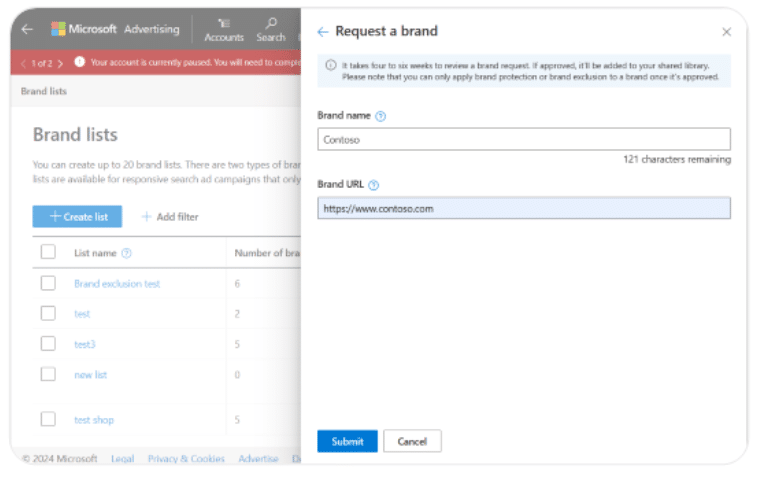
Microsoft Ads is rolling out a new feature called “brand lists” for Performance Max (PMax) campaigns. It promises more control over your brand image and ad visibility.
Brand lists allow advertisers to exclude their ads from appearing alongside specific brands, potentially improving ad relevance and return on ad spend (ROAS).
How it works.
- Advertisers can create up to 20 brand lists.
- They can add brands from a predefined list or request specific brands to be added.
- Brand exclusion can be applied to prevent ads from serving on branded search queries.
Why we care. This PMax feature offers advertisers more control over the sites and searches they see their ads against. It allows advertisers to avoid association with competitors or brands that don’t align with their values.
Key features.
- Covers misspellings automatically.
- Includes an editorial review process for brand requests.
- Takes 4-6 weeks for brand requests to be reviewed.
Get the daily newsletter search marketers rely on.
Between the lines. This move signals Microsoft’s efforts to compete with Google Ads by offering more granular control over ad placements.
What they’re saying. Microsoft touts the benefits as helping advertisers “mitigate risks” and “display ads with relevant content.”
The big picture. As digital advertising becomes more complex and automated, platforms are introducing more tools for brand safety and ad targeting precision.
Courtesy of Search Engine Land: News & Info About SEO, PPC, SEM, Search Engines & Search Marketing