Archive for the ‘seo news’ Category
Monday, June 27th, 2022
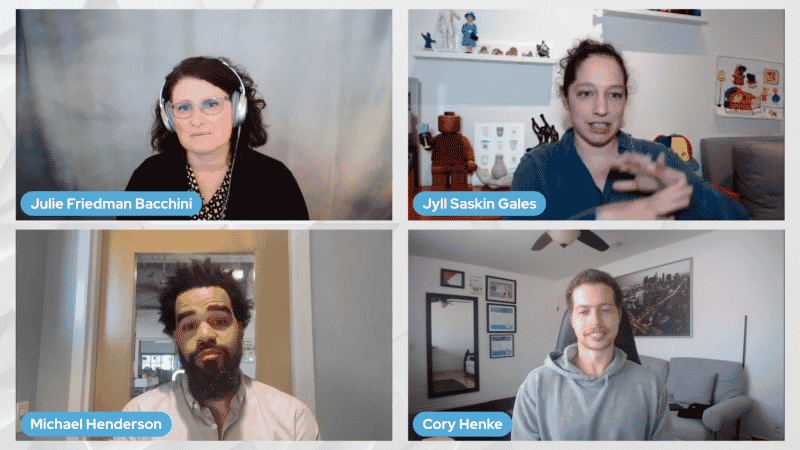
At this year’s SMX Advanced Julie Bacchini, President of Neptune Moon, moderated a roundtable discussion with three other experts on the topic of the recent Google Marketing Live 2022.
Included in the panel were:
GML2022: Thoughts & reactions from the panel
One of the underlying thoughts from the panel was this GML2022 was a very different Google Marketing Live event than past shows.
“So this year’s Google Marketing Live was all about commerce,” Gales said. “Commerce was the star of the show and I don’t know that I was expecting that.”
Bacchini highlighted the point that this year there was a lot of talk about auto-generated creative and speculates that we will see more of this in the future.
“In the keynote, they said ‘Let’s build the future of marketing together’ and then every mention of the future of marketing was AI and automation,” Henderson said. “It felt a little over the top.”
The consensus was also that folks were expecting more about some of the newer campaign types like Performance Max, but real news on the topic never materialized.
All agreed that the lack of talk around keywords and bidding was surprising, and unique, for a Google Marketing Live event.
Reaction to Amazon & Tiktok
The panel thought that the event felt more “reactive” to Amazon and TikTok with announcements aimed at taking market share from the ecommerce and social media giants.
Everyone on the panel also agreed that this year’s event was the most ecommerce heavy event to date.
Gales was most excited about the new vision for the search experience. She said:
- “We always think of search as more bottom of funnel, demand capture with people looking for exactly what they want and finding a solution … and instead this new vision informed by shopping features, by video features was really about discovery and engagement.”
She also went on to state that this vision may be a longer-term play and that not all of the plan will come to fruition immediately.
“In previous Google Marketing Lives I was always looking for more video and in this year’s Google Marketing Live video had its place,” Henke said.
Henke also praised the efforts of Google in competing with the likes of TikTok and Instagram with the creator funds and full adoption of vertical video on Google’s biggest stage.
There were also questions about how video will actually fit together with the new story ad types.
Other positives from Google Marketing Live
Some additional GML2022 elements that the panel liked were:
- Shareable asset library. Henderson noted that he wasn’t expecting the new shareable asset library, but that he was delighted at the prospect of it.
- Google tag. The panel had high hopes for the new Google tag that was announced but are still hungry for more information.
- Connected TVs. Henke made an astute point that you can currently target TV-only campaigns, but with new partners like Hulu this is yet another way to “step on more turf” of competitors.
- Geo-experiments. Henerson was excited to test the geo-experiments feature around conversion lift.
- Discovery campaigns. The panel was excited about the ability to bring video into discovery campaigns and on the continued buildout of that campaign type.
Potential concerns from Google Marketing Live
One main element of concern for the panel was the risk posed by uploading user data.
Bacchini made it clear that while Google wants advertisers and agencies to upload first-party data, there may be a risk associated with that, which falls directly to the advertiser/agency.
She made a plea to consult with your legal team before acting on some of the first-party data uploads.
Bottom line
Whether you like or dislike the changes announced at this year’s Google Marketing Live, they will be coming to your accounts soon. This roundtable gives a fair look at how four ads experts are planning for these changes.
Watch the full SMX Advanced roundtable
You can view the full discussion at no cost until Aug. 31, along with all of the other sessions from this year’s SMX Advanced.
Not registered for SMX Advanced? Get your free pass here.
Already registered for SMX Advanced? Log in here.
The post Google Marketing Live 2022: Reactions from the experts appeared first on Search Engine Land.
Courtesy of Search Engine Land: News & Info About SEO, PPC, SEM, Search Engines & Search Marketing
Friday, June 24th, 2022
Organizations have been investing resources into improving their Core Web Vitals scores, according to new research.
Enterprise SEO platform BrightEdge has compared the top rankings for 500 keywords, from this year to last, in four markets: education, B2B technology, finance and retail.
Core Web Vitals, one year later. It’s been just over a year since Google’s page experience update started rolling out June 15, 2021. It was completed Sept. 2.
The three Core Web Vitals website performance metrics were a subset of the overall Page Experience Update. Those metrics are:
- Largest Contentful Paint (LCP) – loading, target 2.5 seconds.
- First Input Delay (FID) – interactivity, target 100 milliseconds. (Note: Google announced in May that it might replace FID with a new metric called INP – Interaction to Next Paint).
- Cumulative Layout Shift (CLS) – visual stability, target 0.1.
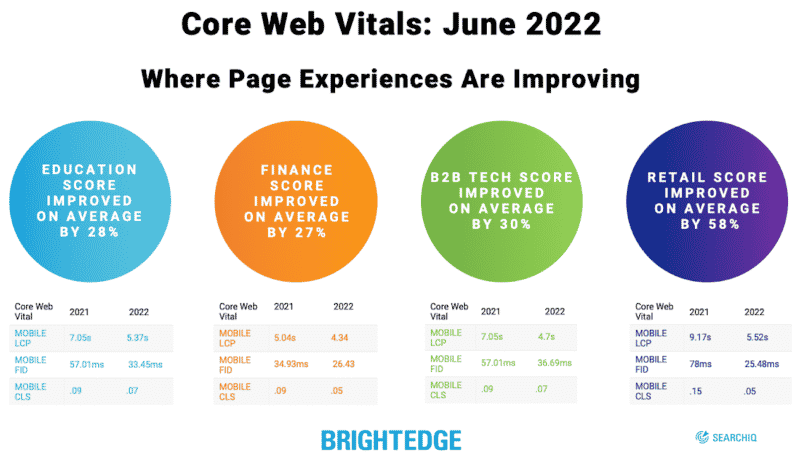
Page experiences are improving. Here’s the data from BrightEdge:
 Source: BrightEdge
On average:
- Retail scores improved by 58%. BrightEdge noted that retail giants have made significant strides in improving poor experiences – last year, top-ranked retail sites failed to meet Core Web Vitals metrics.
- B2B tech scores improved by 30%. Publishers and resources from SaaS platforms have made good gains.
- Education scores improved by 28%. More .gov sites are ranking and have good Core Web Vitals scores.
- Finance scores improved by 27%. This sector was best prepared last year and perhaps due to that saw the least amount of performance gains.
Why we care. SEOs weren’t sold on Core Web Vitals. However, this research shows that companies have been taking Core Web Vitals seriously. It is impossible to point to Core Web Vitals as the sole reason for any ranking boosts or declines. But smart SEO requires driving incremental gains. And every possible positive signal you can give Google (such as good Core Web Vitals scores) is a potential way to positively influence your ranking and visibility.
The post Core Web Vitals scores improving for top-ranked sites appeared first on Search Engine Land.
Courtesy of Search Engine Land: News & Info About SEO, PPC, SEM, Search Engines & Search Marketing
Thursday, June 23rd, 2022
Google has updated its help document on Googlebot to specify that Googlebot will crawl up to the first 15MB of the page and then stop. So if you want to ensure that Google ranks your page appropriately, make sure Googlebot can crawl and index that part of the page within the first 15MB.
What is new. In the Googlebot help document, Google added this section that reads:
Googlebot can crawl the first 15MB of content in an HTML file or supported text-based file. After the first 15MB of the file, Googlebot stops crawling and only considers the first 15MB of content for indexing.
Why we care. In general, you probably want to keep your pages pretty light for both users and search engine crawlers. But here Google is being very clear about how much Googlebot will consume from your page.
A good way to test this is to use the URL Inspection tool in Google Search Console and see what parts of the page Google renders and sees within the debugging tool.
The post Googlebot will crawl and index the first 15MB of content per page appeared first on Search Engine Land.
Courtesy of Search Engine Land: News & Info About SEO, PPC, SEM, Search Engines & Search Marketing
Thursday, June 23rd, 2022
Twitter announced yesterday they were launching Branded Likes. Branded Likes are custom Like animations for tweets that brands can create through the ads manager.
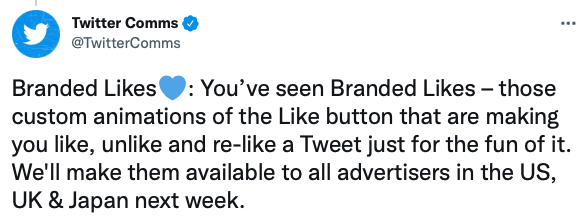
What are Branded Likes. Branded Likes are Like buttons stylized for specific tweets. You can see an example here promoting the ‘Scream’ movie.
A costly addition. Branded Likes were featured during the Super Bowl with brands Anheuser-Busch and PepsiCo taking the bait. But the price tag for the emojis then was around $1 million. They won’t cost that much when they’re launched, but it does make us wonder what sort of impact they had at that time if any.
Who will get access. Twitter says that they’ll make Branded Likes available as an ad option to all advertisers in the US, UK, and Japan next week.
Why we care. I’m not entirely sure we do. Branded Likes are a novelty, but there aren’t any early indicators that they’ll have a positive effect on brand awareness or engagement.
The post Twitter launching Branded Likes appeared first on Search Engine Land.
Courtesy of Search Engine Land: News & Info About SEO, PPC, SEM, Search Engines & Search Marketing
Thursday, June 23rd, 2022
Following discussions with the Commission and network of national consumer protection (CPC) authorities, TikTok has agreed to implement regulations around promoting alcohol, cigarettes, and ‘get rich quick’ schemes. They will also allow users to report undisclosed branded content and flag ads that trick children into making purchases.
New labels for paid ads. The policy will also identify ads with a new label, allowing users to see immediately whether a post is sponsored. Publishers will also have to switch on a toggle button when they’re publishing content captioned with certain keywords such as #ad or #sponsored. In addition, users with more than 10,000 followers will also have their videos reviewed to ensure they meet TikTok’s guidelines.
The new commitments. According to the European Commission, the main commitments agreed to by TikTok are:
- Users can now report advertisements and offer that could potentially push or trick children into purchasing goods or services.
- Branded content now abides by a policy protecting users, which prohibits the promotion of inappropriate products and services, such as alcohol, “get rich quick” schemes and cigarettes.
- Users are prompted to switch on a toggle when they publish content captioned with specific brand-related keywords such as #ad or #sponsored.
- If a user has more than 10,000 followers, their videos are reviewed by TikTok against its Branded Content Policy and Community Guidelines to ensure that the content is appropriate.
- Policies clarify how to purchase and use coins, and pop-up windows will provide the estimated price in local currencies. Consumers are allowed to withdraw within 14 days from the purchase, and their purchase history is also available.
- Policies also clarify how to get rewards from TikTok and how to send gifts, for which users will be able to easily calculate their price.
- Paid advertisements in videos will be identified with a new label, which will be tested for effectiveness by a third party.
- Users are able to report undisclosed branded content, and new rules for hashtags and labels will be implemented.
What the Commission says.
All social media platforms are required to play by the rules and make sure that consumers can easily identify commercial content, including when promoted by influencers. We welcome TikTok’s commitment for more transparency in the way it operates its business activity. Thanks to our dialogue, consumers will be able to spot all kinds of advertisements that they are exposed to when using this platform. Despite today’s commitment, we will continue to monitor the situation in the future, paying particular attention to the effects on young users.
A troubling history of challenges. In 2020, TikTok came under hot water regarding its content moderation process and it’s exposure of young users in the app. While there was no evidence of wrongdoing by the app itself, a leaked document in 2020 showed that TikTok moderators had been instructed to suppress content that featured people who may have been seen as less desirable, as investigations have uncovered that TikTok relies on pretty young women, in particular.
TikToks commitment. To learn more about TikToks commitment to EU rules, you can read the article here.
Why we care. Any regulations aimed at cracking down on predatory social platforms that target children, and moderate content based on insufficient policies and practices that leave users vulnerable, are OK in our book. We hope these new regulations help make social media a safer place for children, but we’ll see.
The post TikTok commits to updating ad policies to better align with EU rules appeared first on Search Engine Land.
Courtesy of Search Engine Land: News & Info About SEO, PPC, SEM, Search Engines & Search Marketing
Thursday, June 23rd, 2022
Twitter has just launched Campaign Planner, a forecasting tool designed to help advertisers estimate campaign results before launching.
What does Campaign Planner do. The new Campaign Planner helps advertisers:
- Forecast reach, impressions, average frequency, and CPM for a specific audience, duration, frequency setting, and placement
- Budget for auction-based campaigns
- Start and save draft campaigns directly from the tool
What Twitter says. Twitter created this tool in order to help empower partners and advertisers to better understand the size and cost of reaching a target audience during the campaign planning process.
Campaign Planner unlocks more forecasting information than ever before and we’re excited to continue to build toward the goal of making Twitter easier to buy for advertisers. Throughout the coming months, we will be expanding campaign planner to support more objectives and in more markets, and enable plan comparison to help evaluate the best campaign settings for your goals.
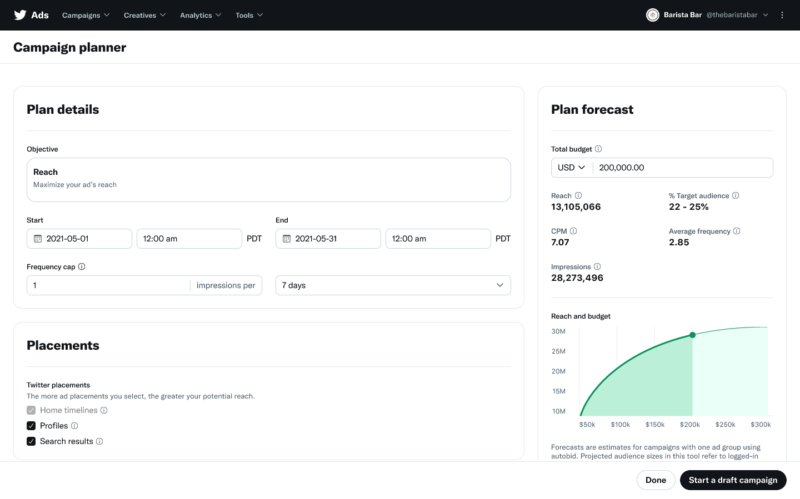
How to access Campaign Planner. The Campaign Planner is available to all managed advertisers in the US, UK, and Japan. Managed partners can access the tool by contacting their Twitter Client Partner. You can access the Campaign Planner from your Twitter Ads account. Upon doing so, you’ll be prompted to enter details to begin building your forecast.
What the Campaign Planner Looks like.
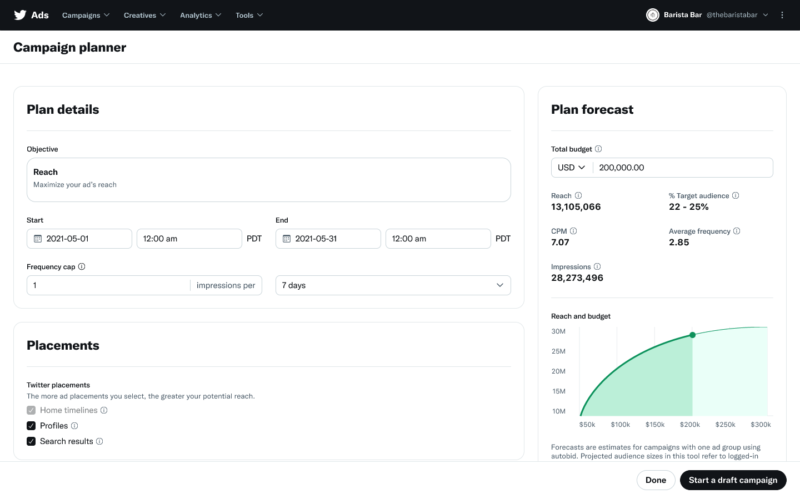
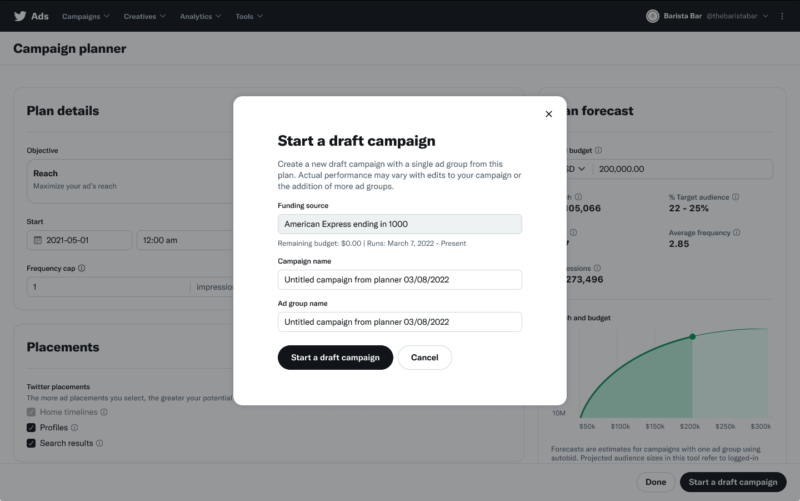
Twitter recommended settings. Twitter has outlined recommendations on how to set up your campaigns most effectively. Twitter claims these recommendations are backed by research, but advertisers should set up their campaigns how they see fit based on testing and what works for their specific business.
Reach and frequency. Once you determine your core audience, Twitter recommends using higher levels of weekly frequency to achieve better results. Most advertisers are aware that increased brand awareness leads to better results. A higher budget can help you achieve this.
Campaign length. Twitter also recommends letting your campaigns run for a longer period of time to allow sufficient time to build brand recognition. They suggest letting the campaigns run over 5 weeks to gain momentum and up to 13 weeks to resonate with your audience.
Learn more about Campaign Planner. You can read more about Campaign Planner via the announcement here.
Why we care. The Campaign Planner seems like a useful tool for advertisers to predict the impact of their campaigns. However, the Campaign Planners forecast is estimated and their recommendations are general. There is no substitute for constant monitoring and testing.
The post Twitter launches Campaign Planner appeared first on Search Engine Land.
Courtesy of Search Engine Land: News & Info About SEO, PPC, SEM, Search Engines & Search Marketing
Wednesday, June 22nd, 2022
Google has announced it has added a new attribute to Google Business Profiles for LGBTQ+ owned businesses. This new attribute can be added within your verified Google Business Profile and it makes it easier to find LGBTQ+ owned businesses in their own community.
What the attribute looks like. Here is what the new LGBTQ+ owned attribute looks like in a business listing in Google Maps or Google Search:

How to add the attribute. Here are the steps to add this attribute to your Google Business Profile:
- Go to your Business Profile. Learn how to find your profile.
- Select Edit profile
 Business information.
- Near the top, select the More tab.
- Select the category you want to change.
- Next to the attribute, select Yes or No.
- When you’re finished updating your attributes, select Save.
Other attributes. Yelp has had this type of attribute since May 2021, this is another case of where Google is playing catch up to Yelp. In 2018, Google introduced family-led (which is no longer available), veteran-led and women-led attributes, in 2020 Google added black-owned attributes and in 2021 Google added a latino-owned attribute in business profiles.
One note, Google did have the LGBTQ+ Friendly and Transgender Safespace back in 2020, this new attribute is more objective and is designed to just highlight LGBTQ+ business owners much like Black-owned and Latino-owned attributes do
Pride month. Google added that the “LGBTQ+ community represents nearly 8% of the American population, with 20% of Gen Z identifying as a member of the community. As the number of LGBTQ+ individuals increase, so does our presence and prominence in our communities. In fact, there are 1.4 million LGBTQ-run companies in the U.S., accounting for $1.7 trillion a year in revenue too. Over the past decade, Google has partnered with the National LGBT Chamber of Commerce (NGLCC) and 30 local affiliate chambers to support and grow LGBTQ+ owned businesses and organizations. Today, Grow with Google’s partnership with the NGLCC has helped thousands of LGBTQ+ owned businesses grow their digital skills and thrive online. As we celebrate Pride, it’s important to remember visibility and representation are critical, all year round. A flag in the window of a small business has the power to bring queer folks together, to celebrate our joy, honor our history, and fight for our diverse community. It’s our hope that this attribute will allow business owners to celebrate their identity and community with the world.”
Why we care. Attributes like these can help generate visibility for your profile, so if you qualify for any of these Business Profile attributes, you should add them to your profile – and at least test it out. Businesses need to leverage any advantage they can to help grow their revenue and their customer base. Plus, it is nice to see Google to continue to promote diversity.
The post Google adds LGBTQ+ owned attribute to business profiles appeared first on Search Engine Land.
Courtesy of Search Engine Land: News & Info About SEO, PPC, SEM, Search Engines & Search Marketing
Wednesday, June 22nd, 2022
Microsoft Ads is now offering Cash back promotions to drive more sales and conversions for online retailers.
How it works. The new feature is a Microsoft-run cash back program for the US on product ads. The goal of the program, Microsoft says “is to drive incremental sales and return on ad spend (ROAS) growth for advertisers and retailers.”
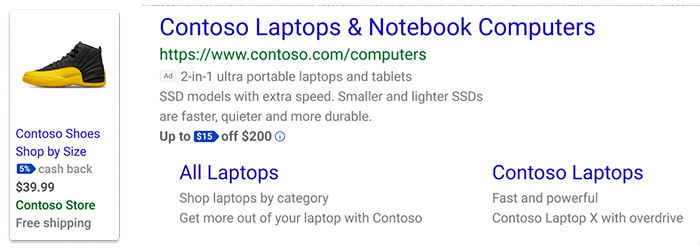
When a user clicks on an ad that features a Cash back promotion, they will have 24 hours after the click to complete the purchase. Microsoft will automatically attribute the purchase to the click and process the cash back.
All Cash backs are managed by Microsoft and users can redeem their rewards through the Microsoft Cash backs dashboard.
The Cash back promotions are served for eligible campaigns if and when the AI determines that it will bring in value. They do not give any indication of the criteria the AI will use to determine where it will serve the promotion.
What Microsoft says. Microsoft claims that the increased performance will outweigh the cost of the program. If they cannot deliver on performance, the AI will not serve the promotion. However, in the blog post announcement today, Microsoft says the cost per click (CPC) you’re charged will increase nominally to accommodate the cost of optimizing the program.
The goals of Cash back promotions. According to Microsoft, the goals of the new Cash back promotions are:
- Grow sales efficiently by incentivizing users with the right value of savings to drive conversions.
- Optimize savings to users’ needs by showing them deals for products they care about, thereby increasing efficiency.
- No effort is required because Microsoft uses your existing campaign setup. Microsoft also handles all optimizations and post-purchase inquiries.
Setting up Cash back promotions. Microsoft claims that there are no additional set up steps required to serve Cash back promotions. Microsoft handles all optimizations, payouts, and user inquiries. They do, however, require that you have purchase conversions set up, as well as a bid strategy that is “optimized for growing conversions and conversion values.” As if retailers would have less. They also suggest “a budget to have the headroom to accommodate any increase in volume.” Though, they give no further guidelines on what that budget is.
Read more about Cash back promotions. You can read the full post here.
Why we care. Though this is a Microsoft-run program, online retailers are paying for it through increased CPC’s. If the Microsoft AI can differentiate between low and high-value sales, and drive traffic accordingly, seems like a great way to get more clicks and conversions. However, we have yet to see if the increased CPC will make the program worthwhile.
The post Microsoft launches Cash back promotions for product ads appeared first on Search Engine Land.
Courtesy of Search Engine Land: News & Info About SEO, PPC, SEM, Search Engines & Search Marketing
Wednesday, June 22nd, 2022
I have a gift: an innate ability to find weird stuff in SEO.
As an SEO professional, this ability can be both a blessing and a curse.
A blessing, because I can typically figure out what makes one website rank above another. A curse, because I would spend many hours, including many late nights, studying search results and looking at stuff for so long that it led to what I called “brain aches.”
Never heard of FWS? That’s because it’s a new initialism, of my creation. Yes, you are witnessing SEO history right now.
Ready to FWS? Here are a few things you can do when approaching a new prospect or project.
FWS
In all of the years of running SEO initiatives and employing SEOs, I have found that there are many who have a talent in content strategy, Information architecture/taxonomy, or perhaps even deep technical analysis.
As much as we may try to create the perfect process documentation for SEO efforts, there will always be one-off issues. Challenges that you won’t find on checklists.
Sometimes, finding weird stuff may unlock the key to SEO success.
Get the daily newsletter search marketers rely on.
So let us account for time for FWS in our SEO scopes. We need a set amount of time for research and discovery, even a few hours each month, for a project.
Convincing a client to agree to “research” (pulling threads and following the trail) can be difficult.
So, assuming that you can convince the powers-that-be that FWS is necessary, what are some ways we might learn how to think differently and find those nuggets that might lead to SEO success?
The site: query
You can learn a lot about a website by performing this simple task. Type site: into Google, followed by whichever domain it is that you want to review.

Then, repeat this exercise with the www version:

Now, in this case, Searchengineland.com resides on just that, no www. So, you would expect the “www” query to return zero results if everything is as it should be. And that is correct – zero results for www.
But I cannot count the number of times I have discovered unknown subdomains for companies. Sometimes even some great/old content was heavily linked to and was about to be washed away in the next redesign.
We now needed to think about how we might incorporate a refreshed version of that content and redirect those URLs so that we maintained the link value and perhaps even recaptured some search traffic (rankings) that existed years ago.
Another common occurrence is finding .pdf content that no one cared about.
When you’re reviewing your analytics to determine the performance of your SEO efforts, you are likely to be unaware of the amount of traffic coming to .pdf pages hosted on your website because they lack analytics tracking.
However, if you were to run a Semrush report and filter those results by .pdf, you may find that you are ranking for some pretty significant keywords and have no visibility into the traffic.
In many cases, you may find that by converting these .pdfs into HTML pages, you can accomplish a few things:
- Analytics tracking for these ranked pages.
- A more consistent user experience, with a fully built page, complete with site navigation, etc.
- Ability to update these pages and optimize them; perhaps also link out from these pages to other relevant pages.
Review the history of a website
Too often, I’ve seen people jump into an SEO initiative and “optimize what’s there” rather than dig into a website’s history to see what used to be there.
Case in point (real-world example) – I was recently approached by a prospect who had lost a significant amount of their organic search traffic over the past year. A routine that I’ve always followed is to generate an Organic Research report via Semrush, filter to remove brand keywords and look at the All-Time trends.
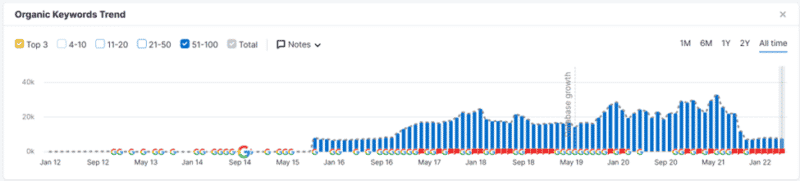
You can see quite easily the significant dip.
The next step is copying this report, pasting it into a separate tab, and start comparing URLs.
In this case, the prospect had gone through a redesign. Rather than recreating the successful pages, they (under the guidance of a “SEO consultant”) decided to turn those pages into a section of a page (ie: category#page-name.html).
By using the Wayback Machine (archive.org), I was able to see exactly what these pages looked like previously and illustrate to the prospect – in very plain terms – why it is that things fell off a cliff.
Google search the brand
Another tactic I use to FWS is to search a company’s name and click through some of the results.
Several times when doing this, I have found official company domains that I didn’t recognize. In other words, the company had changed domains for their company and just parked the old domain.
For those interested in link building, this could be a quick fix. This is why my agency has a standard domain portfolio analysis procedure. We want to know every domain that our client owns so that we might understand how (or if) these domains are being used.
With this domain research, you may also learn about their affiliations with other companies.
Did a company purchase them in the past? Did they purchase companies in the past?
Drill down on this and you may find opportunities beyond the specific project you’re working on.
Perhaps other companies within their “network” require SEO assistance, too? Maybe they should be consolidating domains/websites to form a powerhouse of a website rather than two (or more) weaker websites?
Other places to FWS
- Check robots.txt and XML sitemaps. You’ll often find pages that shouldn’t be on the site or publicly available.
- Crawl the site and compare it to the sitemaps. You’ll often find orphaned pages or important pages that have fewer internal links than they deserve
- Google Search Console – signs of unknown content appearing on the site in the Coverage > Indexed, not submitted in sitemap report.
- Google Search Console > Settings > Crawl Stats – signs of previous hacks and unknown content.
- Reading through Page Speed Insights and looking at the source code – you’ll sometimes find things like JS, CSS, or images being served multiple times or tracking pixels that are no longer in use.
- Link profile – it can uncover link networks or bad link strategies such as random blog commenting or efforts of the previous agency, where they may have exploited WordPress vulnerabilities to create links.
- DNS – if you can get a list of their DNS zone files, you’ll often find references to sub-brands, prior acquisitions, micro sites, or other marketing and product initiatives.
Set aside some scheduled time to find weird stuff
I believe that good SEO goes beyond knowing how to use the tools of the trade well, conducting keyword research, competitive analysis and the like.
Being inquisitive is an important aspect of SEO.
We need time to think about, consider and find weird “stuff.”
It can often be that there are valuable finds if we allow ourselves the time to think creatively.
The post Finding weird stuff (FWS) is part of SEO appeared first on Search Engine Land.
Courtesy of Search Engine Land: News & Info About SEO, PPC, SEM, Search Engines & Search Marketing
Wednesday, June 22nd, 2022
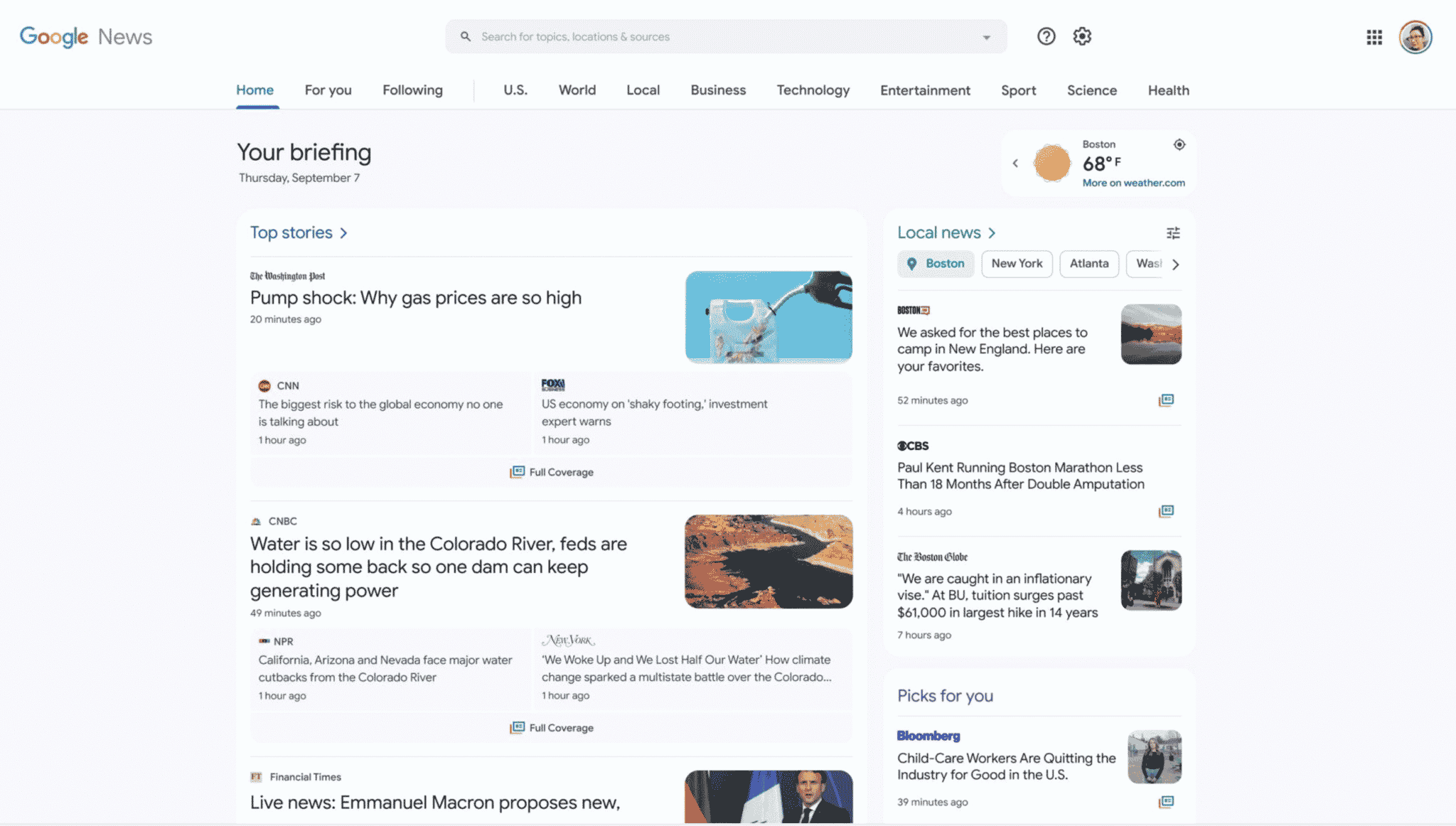
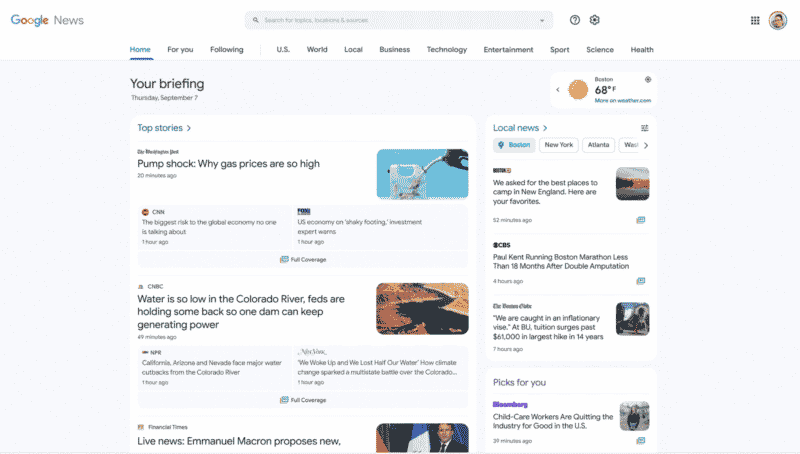
Google has launched the new version of Google News today on its 20th year anniversary of Google News. The new design, which we caught Google testing a month ago, brings forward Top stories, Local news and personalized picks to the forefront of the Google News home page, Google said.
Local news. You can now find a local news box at the top right of the Google News home page. It makes it easier for you to find local news from your community that matters to you. There is a new filter button to add multiple locations to your local news section, so you can find local news about communities you love but no longer currently live in. Google said this helps with local news publishers gain more exposure and traffic from Google.
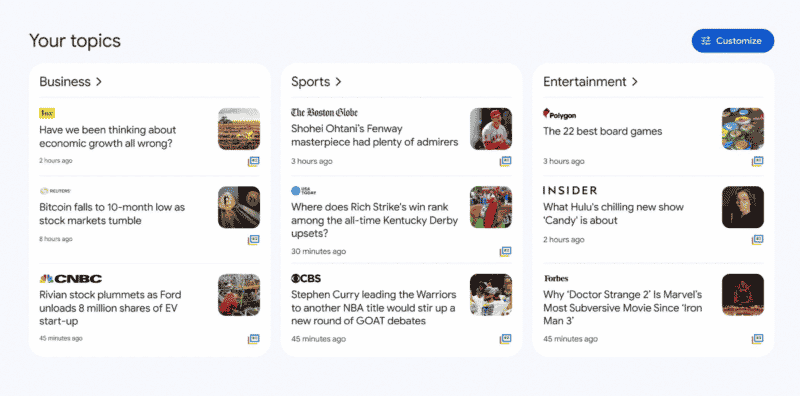
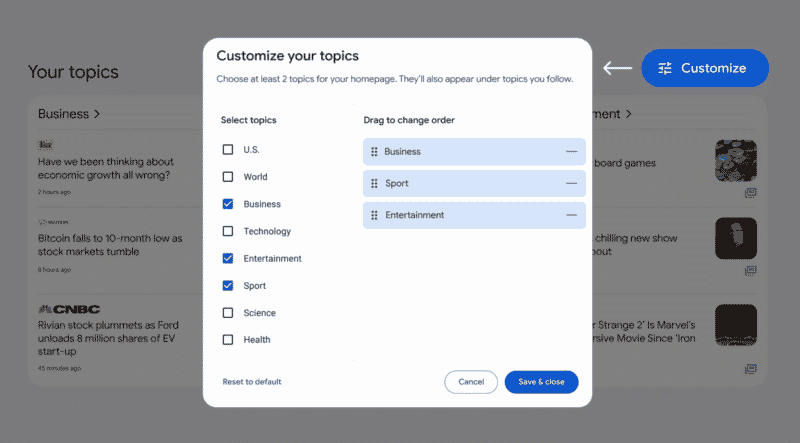
Customize Google News. You can now also customize the topics that appear in Google News for you by clicking on the customize button. There you can add, remove or reorder topics with the slider feature.
Improved fact check. Google has also improved the Face Check section in Google News by providing more context, the original claim, independent organization assessments, adding the About This Result and more.
Back in Spain. 8 years after Google shut down Google News in Spain due to Spanish law, Google has finally brought back Google News in Spain. We knew this was coming and today is the day where Google News works again fully in Spain. Google said “this is a result of a new copyright law and we hope that the return of Google News to Spain helps more people and more news, from more places, and helps publishers and new readers.”
Why we care. As we said when we saw the redesign test, whenever Google releases a new design or user interface in Google Search or Google News, that can impact ones visibility and clicks to their web site. So keep these user interface tests in mind when understanding any risks or rewards you might see in the future with Google News interface changes.
For those in Spain, they can now access Google News without any restrictions.
Also, Google News officially launched on September 22, 2002, so we are not exactly at the 20 year mark but close to it.
The post Revamped Google News design goes live with top stories, local news and personalized articles appeared first on Search Engine Land.
Courtesy of Search Engine Land: News & Info About SEO, PPC, SEM, Search Engines & Search Marketing