Archive for the ‘seo news’ Category
Monday, July 11th, 2022
A couple of months ago Google teased a new video indexing report in Google Search Console, that new report is now rolling out, the search company announced. The Video indexing report is rolling out “gradually over the next few months, so you might not see any changes for now,” the company added.
What is the video indexing report. The video indexing report shows how many indexed pages on your site contain one or more videos, and on how many of those pages a video could be indexed. Google said the report can help you understand the performance of your videos on Google, and identify possible areas of improvement.
What it looks like. Here is a screenshot of this report:
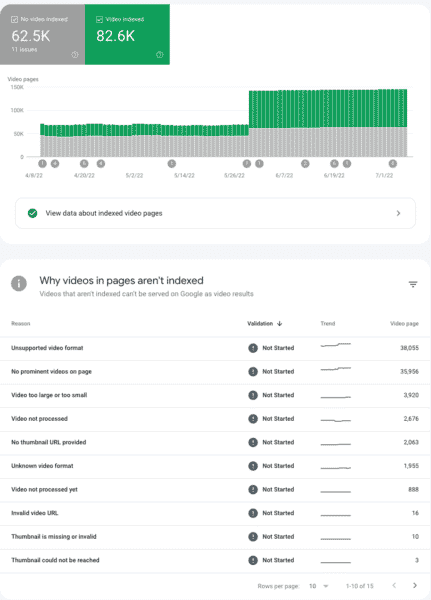
When the report shows. Google said if Google detects videos on your site, the Video indexing report will appear on the left navigation bar in the coverage section. If Google has not detected a video on your website, you will not see the report.
What it tells you. The report shows the status of video indexing on your site. It helps you answer the following questions:
- In how many pages has Google identified a video?
- Which videos were indexed successfully?
- What are the issues preventing videos from being indexed?
In addition, if you fix an existing issue, you can use the report to validate the fix and track how your fixed video pages are updated in the Google index, Google explained.
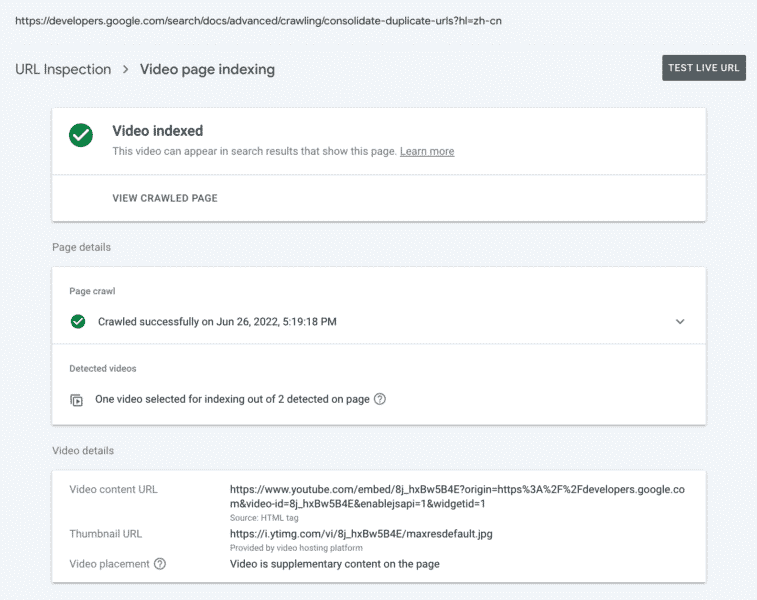
URL Inspection tool for video pages. Google also also enhanced the URL Inspection tool to allow you to check the video indexing status of a specific page. When inspecting a page, if Google detected a video in it, you will see the following in the results:
- Details such as the video URL and the thumbnail URL.
- The page status showing whether the video was indexed or not.
- List of issues preventing the video from being indexed.
Please note, this does not work for the live URL inspection feature.
What The video URL inspection looks like. Here is what this looks like:
Why we care. If you host videos on your site or embed videos on your site, you will want to check out this report to see if there are ways to improve those videos or help other videos to show up in Google Search. Videos are an important aspect of search traffic and visibility in Google Search.
There are a lot more details on this new report in this Google help document.
The post Google Search Console’s new video indexing report now rolling out appeared first on Search Engine Land.
Courtesy of Search Engine Land: News & Info About SEO, PPC, SEM, Search Engines & Search Marketing
Monday, July 11th, 2022

Personalizing your marketing campaigns for one customer is easy, but how about one hundred or thousands of customers across multiple marketing channels?
Work smarter, not harder, by using artificial intelligence (AI) as part of your martech stack and giving your customers the unique experiences they crave.
Register today for “Use Data to Create Next-Level Customer Experiences at Scale,” presented by MoEngage.
The post Webinar: Reimagine your customer experience strategy appeared first on Search Engine Land.
Courtesy of Search Engine Land: News & Info About SEO, PPC, SEM, Search Engines & Search Marketing
Monday, July 11th, 2022
Frederick Vallaeys spent 10 years working at Google and was instrumental in helping build features like conversion tracking and analytics. For the last 10 years, he’s been running his current company Optmyzr, which is a PPC management software that helps advertisers optimize their campaigns. In his session at this year’s SMX Advanced, Vallaeys goes into detail on how to make the most out of your RSAs and automated bidding strategies.
The numbers. About 92% of advertisers have shifted to using RSAs, and the majority of those who have turned them on or used them, leave them on without shutting them off. Vallaeys hypothesizes that even years ago when advertisers didn’t know that RSAs were going to be the only option, performance was good enough that advertisers were willing to stick with them.
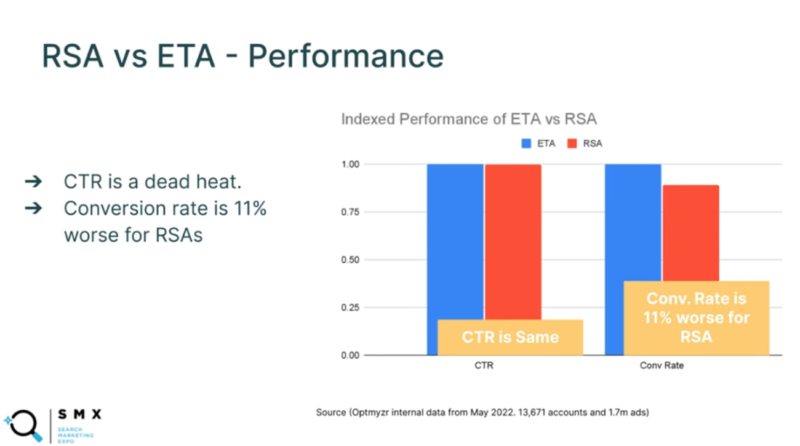
Vallaeys goes on to say that of the 1.7 million ads they audited, the CTR was almost exact between RSAs and ETAs. However, the conversion rate was about 11% worse with RSAs. They found that ad groups with RSAs received 1.6 times as many conversions as ad groups without RSAs. And that’s all we really want, right? More conversions.
Making the leap to RSAs. Google recommends taking your existing ETAs and start building your RSAs. Google claims that without making any changes to the ad text, creating an RSA will result in about a 7% increase in conversions with a similar cost per acquisition.
Vallaeys and the team at Optmyzr even wrote a script that you can download to make the transition from ETAs to RSAs much easier. You can download the script here.
Smart bidding strategies. Vallaeys is a fan of using smart bidding with RSAs, though when it comes to using broad match keywords, he says that’s up to the advertiser. Google did studies where they found a 20% “lift” when enabling smart bidding and broad match keywords. Though they didn’t clarify if the “lift” was an increase in clicks, CTR, or conversions.
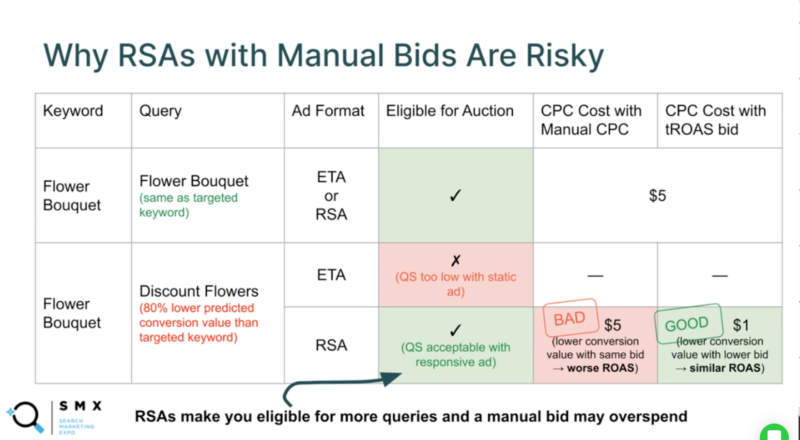
Vallaeys reminds us that with an automated bidding strategy with RSAs, Google will show ads that match your keywords, even if the queries aren’t exactly the same. If the keyword or phrase is similar and your ad shows, you may be stuck paying a higher CPC than you normally would if the bidding were left up to Google. The chart below outlines the differences in what you could pay if your campaigns were left on Manual CPC.
Google loves scores. Ad strength is another score in your account. Vallaeys explains that ad strength scores tend to help newer advertisers, but seasoned ad veterans know that it’s not related to actual performance. Ad strength scores are suggestions gathered from other advertisers and “what everyone else does.” Limited Eligibility status is now gone and “Poor” ad strength is not an indicator of how well your ads will serve, so take it with a grain of salt.
One interesting experiment that Vallaeys outlines is that Google suggested adding specific text into the ads and indicated that it would increase the ad strength. When that text was manually added by typing the words in, the ad strength didn’t get better. But when they click the link that Google gives you to add the exact same text, the ad strength got better. This experiment may indicate that ad strength as a statistic or measuring tool isn’t that sophisticated.
RSA structure. Based on the 1.7 million ads that Optmyzr has analyzed, Vallaeys provides several tips to help make the most of our ads:
- Having two RSAs per ad group seems to be ideal for improving conversion rates
- Use labels to connect RSAs with automation
- Use pinning techniques to fake ETAs or leave ad combinations exactly where you want them (this is suggested if you have been testing for a long time and know what works)
- More headline variants lead to more impressions
- Adding DKIs and ad customizers may increase impressions, but likely decreases conversion rates
- RSAs need to be tested against RSAs. RSAs cannot be tested against ETAs simply because they’re too different
- Don’t fixate on old metrics
- Use ad variations to test and iterate creative (on the Campaign level, under the Experiments link)
Don’t miss Frederick Vallaeys session in SMX Advanced 2022
For more details on testing and optimizing RSAs and the results of the experiments Optmyzr ran, get your free pass here.
Already registered for SMX Advanced? Log in.
The post Creating better ads in a world with only RSAs appeared first on Search Engine Land.
Courtesy of Search Engine Land: News & Info About SEO, PPC, SEM, Search Engines & Search Marketing
Monday, July 11th, 2022
Google recently announced that web data reporting will be supported within the Ad Manager publisher networks.
What this means. Now when you link a Google Analytics 4 property to your Google ads account, data from that property is available to view in your Ad Manager reports.
What metrics are measured. Ad traffic from Google ads will show the following metrics in your reports:
- Ad format
- Ad source
- Ad unit
- Page path + query string and screen class
- Ad unit exposure
- Publisher ad clicks
- Publisher ad impression
- Total ad revenue
Technical requirements. To view the technical requirements for linking Google Analytics 4 to Ad Manager, you can read the help doc here.
Why we care. Viewing and gathering reports on information regarding app monetization and behavioral data from Google Analytics 4 allows advertisers to further track the customer journey and provide deeper audience insights.
The post Google Analytics 4 integration now available for Ads Manager appeared first on Search Engine Land.
Courtesy of Search Engine Land: News & Info About SEO, PPC, SEM, Search Engines & Search Marketing
Saturday, July 9th, 2022
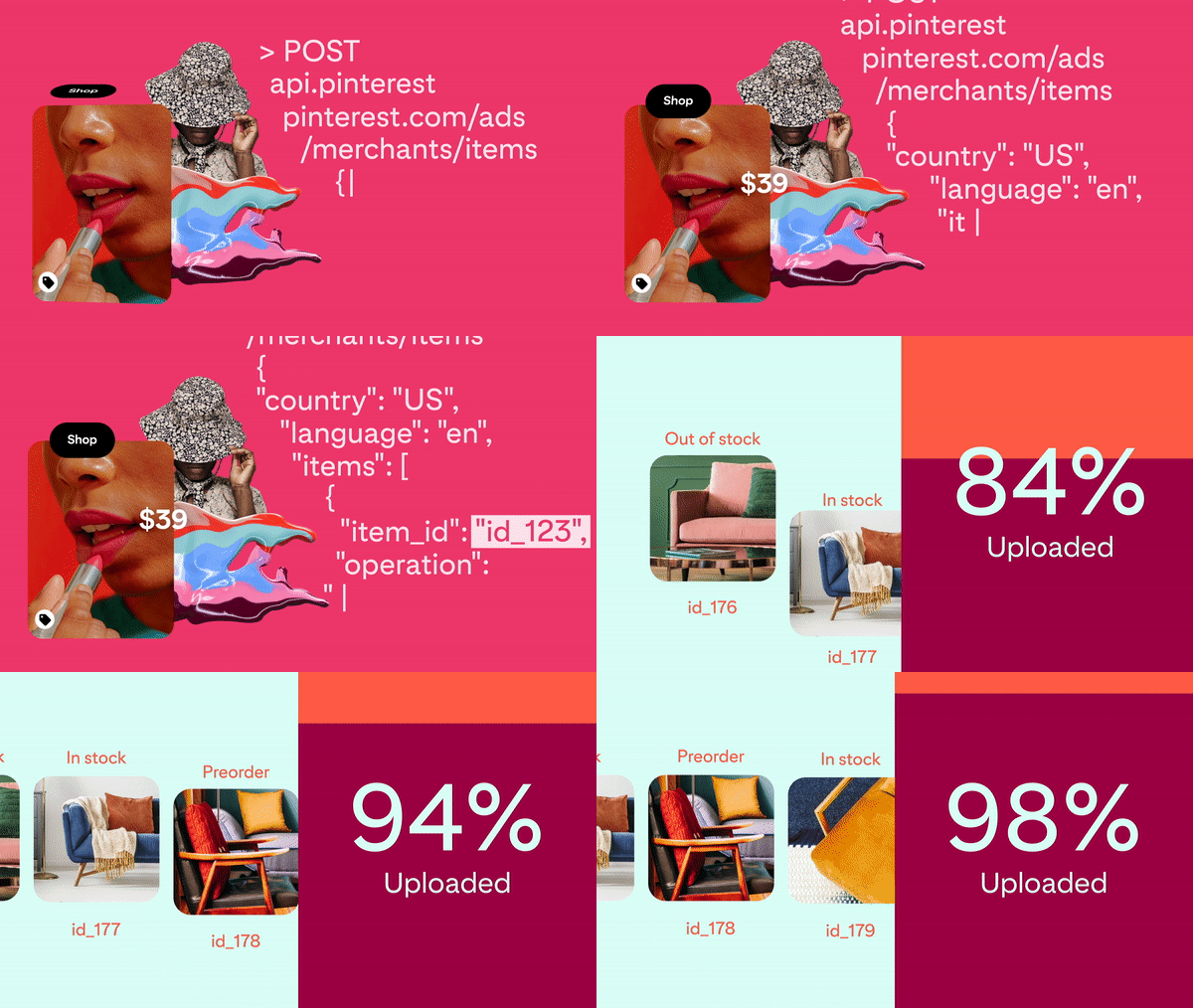
This week Pinterest introduced four new merchant features to help retailers promote their stores.
- Product Tagging on Pins
- Video in Catalog
- Shop Tab on Business Profiles
- The API for Shopping
Product Tagging on Pins. Product Tagging allows merchants to make their pins shoppable, so shoppers can click and purchase seamlessly within the app. In early tests, Pinterest reported a 70% higher intent on product Pins tagged in scenes versus standalone product photo Pins.

Video in Catalog. Video ad formats increased click-through-rate by 158%, lowered cost-per-click by 42%, and lowered cost-per-acquisition by 58% in early tests versus static images. Video ads allow merchants to show additional angles of their products to further drive conversions.
The Shop Tab on Business Profiles. Merchants will be able to display a prominent Shop button on their business profiles, giving shoppers an easy way to find and view shoppable products. In early tests merchants reported about 30% of their first attributed sales from the Shop tab.
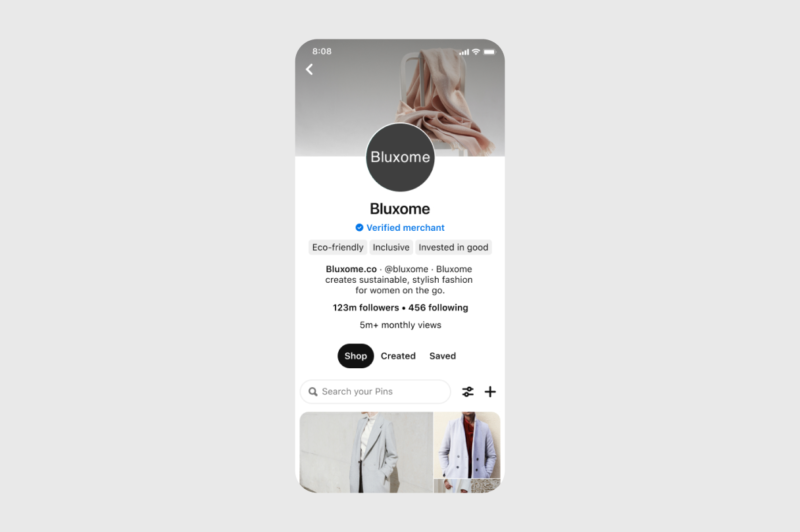
The API. The API allows for better and more accurate metadata management and improved quality for products. Accuracy in early tests came in at about 97%.
What Pinterest said. “At Pinterest, our goal is to turn inspiration into action, and our vision for shopping is to make it possible to buy anything Pinners are inspired by on the platform. In 2021, the number of Pinners engaging with shopping surfaces on Pinterest grew over 215%, and 89% of weekly Pinners use Pinterest for inspiration in their path to purchase. The new shopping features such as the API for Shopping allows brands and retailers to reach high-intent Pinners during the earliest stage of their shopping journey with the most updated catalog data” says Jeremy King, SVP of Engineering at Pinterest.
Read the full announcement on the Pinterest blog here.
Why we care. Albeit following in Instagram’s footsteps a couple of years late, Pinterest merchants and advertisers are finally getting new ways to reach and engage with high-intent shoppers. If you’re a retailer on Pinterest, be sure to implement these new features ASAP.
The post Pinterest is doubling down on Shopping by adding 4 new features appeared first on Search Engine Land.
Courtesy of Search Engine Land: News & Info About SEO, PPC, SEM, Search Engines & Search Marketing
Saturday, July 9th, 2022
Justifications are snippets of text that Google shows in the local pack to help users “justify” why the business is showing up for their search query.
There are a variety of types of justifications. The type you see highlighted in the local pack varies based on a user’s search query.
This guide will help you understand Google justifications.
Why do Google justifications matter?
While they may not cause rankings, recent research from Moz shows that 57% of local packs feature justifications.
Some listings even show multiple justifications when a listing is expanded.
Types of Google justifications
Website mentions
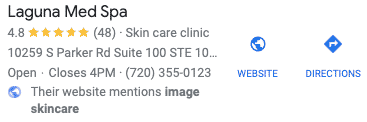
Pulled directly from content on your website, this type of justification will often show a user the page on your website where the content is being pulled from. It may include a meta description and photo.
Tip: Use these justifications to see what content on your site influenced the ranking for that search phrase, and use when working on strategy for other pages.
Review

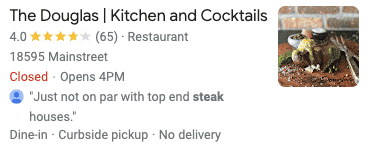
Review justifications come from information within Google reviews for a business.
Review justifications can be influenced if reviewers use preferred keywords within their reviews.
Tip: Review justifications are not always positive. Actively managing Google reviews can help brands avoid embarrassing results.
In stock
If a business has activated See What’s in Store, or SWIS, function for their listing, in stock justifications may be displayed.
Tip: This is a third-party function. There are a few platforms that can help you get this feature enabled, like dbaPlatform.
Sold Here
Sold here justifications show a shopper that the product they’re searching for is available for sale at your location.
They’re identified by a checkmark in front of the justification. These justifications cannot be influenced.
Provides
Like “sold here”, these service-based justifications use a checkmark icon in front of the justification. They pull from a brand’s Services in their Google Business Page.
Tip: Be careful about how you word your GBP services to avoid embarrassing results. For example, a plastic surgeon offering a broken nose does not seem very welcoming.
Menu
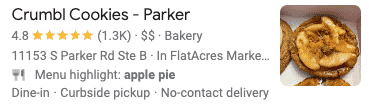
This is a justification for restaurants. Menu information is pulled from the restaurant’s menu within your Google Business Profile or the menu highlights, and menu items will display in the justification accordingly as a “menu highlight” or “on the menu”.
Tip: Keep your GBP menu information up to date – you never know when a midday craving will bring new business your way!
Post
These justifications pull in keywords from your Google posts and have an exclamation point icon in front of the justification.
Post justifications are updated as new Google posts are published by your brand, but do not just look for exact-match, they also pull related keywords. They can overwrite other justifications and can be influenced by your brand’s Google post content.
Tip: If you’re trying to optimize for post justifications, keep posts to one main topic instead of listing a variety of products or services.
Justifications: What you need to know
Justifications update quickly
We have seen results update nearly in real-time. Joy Hawkins has discovered justifications in search results based on an edit she had made barely minutes earlier.
This is great for correcting suggested edits, attributes that may be blocking justifications, or for changing information in your Google Business Profile.
If something isn’t working, review the above justification types and see if there’s something you can update in order to assist in triggering a new justification for a particular local result.
Justifications do not affect rankings
While website items featured in justifications may have a correlation to ranking, the justifications themselves do not.
If you see a result with a justification, that result was already ranking and now Google is adding more information to support the search result they’ve chosen to provide.
While many people believe that Google posts affect local rankings, testing has found that Google posts do not affect rankings.
Justifications are not a replacement or bandaid for a bad website or Google Business Profile.
Make sure that you’re providing relevant content for your business and your local area, strong onsite SEO, and are following other local SEO best practices.
Website justifications may be one possible exception to this rule.
When users see a “their website mentions” justification, this is likely an indication that Google finds this content to be reputable and relevant to the search query, and is likely relevant to the business ranking for that particular query.
Some justifications can be affected by user-generated content
Obviously, review justifications display content or information provided by users. However, Sold Here justifications do as well.
Google gets information on available inventory from Know this place? push notifications from Google Maps by asking users to answer questions about a local business after a recent visit.
At this time, we have not discovered a way to determine which questions Google will ask a user, only that Google pushes the questions after they’ve determined that a user has recently physically visited the business location.
Devices can cause variations in justifications displayed
Different device and display types will show different justifications.
A desktop result may show a justification when mobile does not, or mobile may show a review when desktop shows menu options.
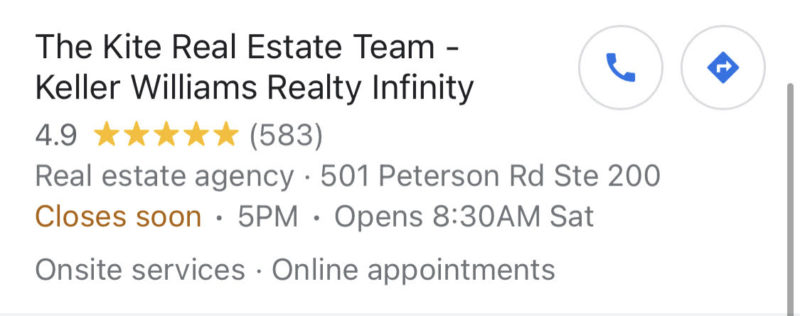
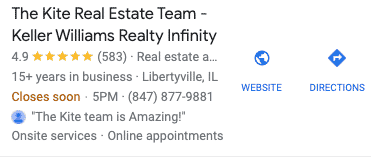
Why doesn’t your brand show justifications in local search?
Be careful when setting up your Business Profile.
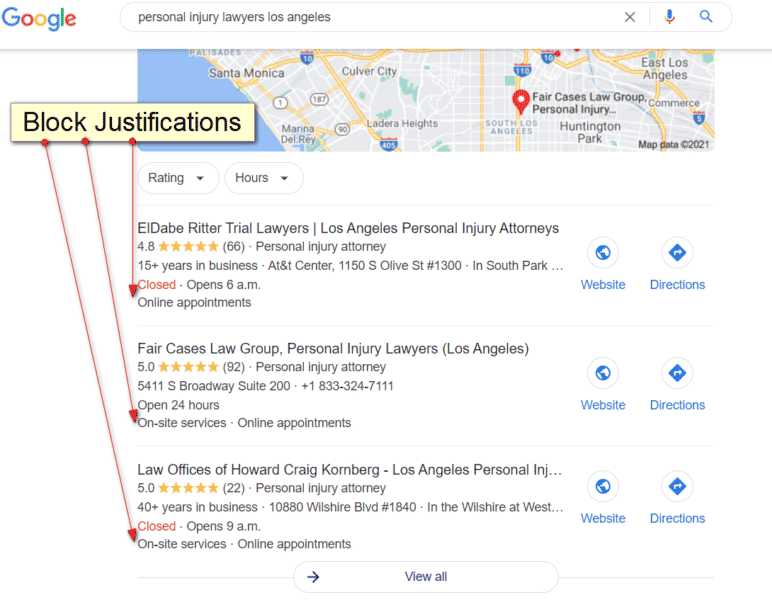
Both “online services” and “online appointment” attributes within a brand’s Google Business Profile will block justifications from showing in the local pack.
Typically, justifications will start showing up within approximately 48 hours of removing the attributes.
Share valuable information with justifications
Justifications are a fantastic way for brands to help share valuable information in the search results.
Map pack real estate is valuable. Take advantage of the potential of Google justifications.
Maximizing your efforts can pay off big.
The post Google local justifications: Everything you need to know appeared first on Search Engine Land.
Courtesy of Search Engine Land: News & Info About SEO, PPC, SEM, Search Engines & Search Marketing
Saturday, July 9th, 2022
In their latest efforts to fend off a lawsuit from the US Department of Justice, Google is offering to split the part of the business that auctions and places ads on websites and apps into a separate company under the Alphabet umbrella.
No word from the DOJ. While the Justice Department spokesperson isn’t commenting at this time, it’s not entirely clear if they would accept any offer short of an asset sale. Antitrust officials have hinted at deeper structural changes to the ad-tech business, rather than promises to change business practices.
Trouble for Google in EU. Google is also facing a similar ad-tech investigation in the European Union. Last month we reported that in their offer to the EU, Google has stated that they would allow competitors to broker the sale of ads directly on YouTube. “We are concerned that Google has made it harder for rival online advertising services to compete in the so-called ad tech stack,” said Margrethe Vestager, the EU’s competition chief.
Additional cases against Google include:
- The ongoing case from the DOJ alleging Google uses anticompetitive tactics to maintain the dominant position in online search.
- A lawsuit from Texas argues that Google is running a monopoly that harms ad industry competitors and publishers. One which Google is attempting to get dismissed and says is “full of inaccuracies and lacks legal merit.”
- U.S. senators have proposed a new antitrust bill that could force Google to divest parts of its ad-tech business.
- EU agreed this spring on two new major tech regulations, including one called the Digital Markets Act, that puts new fairness obligations on companies like Google.
- In 2013 Google resolved an FTC investigation by agreeing on changes to it’s practices. Google attempted to do the same in the EU but the EU rejected their offer and filed antitrust charges in 2015.
What Google says. “We have been engaging constructively with regulators to address their concerns. As we’ve said before, we have no plans to sell or exit this business. Rigorous competition in ad technology has made online ads more relevant, reduced fees, and expanded options for publishers and advertisers.”
Regulators are also investigating whether Google is abusing it’s role by representing both advertisers and publishers in online auction exchanges. Google denies the allegations.
What else is in store for Google. You can read the full article from the Wall Street Journal here.
Why we care. Any moves by Google to restructure parts of its ad-tech business or offer policy changes could disrupt the digital advertising industry. We all make a good living off of Google presently. But if Google gets broken up or changes, our industry will feel it.
Jeff Ferguson, Adjunct Professor, UCLA and CEO, Amplitude Digital adds “Google isn’t anywhere close to a monopoly of the internet advertising business, much less the entire advertising business, and there’s little chance the DOJ can prove actual anti-competitive practices. The only way they’ll ever get Google (or Facebook, by the way) is to rewrite the laws. Google must see something else going on because splitting off this part of the business won’t solve the DOJ concerns.”
On the other hand, giving rival ad-tech publishers the chance to compete and buy ads on Google owned platforms like YouTube could drive down costs for advertisers, who will have more options and additional ad-buying tools to consider.
The post Google offering concessions to avoid DOJ lawsuit appeared first on Search Engine Land.
Courtesy of Search Engine Land: News & Info About SEO, PPC, SEM, Search Engines & Search Marketing
Saturday, July 9th, 2022
Twitter is testing a new feature, called CoTweets, that lets any two users collaborate and expand their reach beyond their own followers.
It is a limited test, available to select accounts in the U.S., Canada and Korea.
Why we care. Marketing is all about getting in front of your target audiences. If CoTweets roll out to more accounts, expect to see many brands and businesses experimenting with it in an attempt to gain additional engagement, visibility/brand awareness and new followers.
What is a CoTweet. A CoTweet is a tweet that has two authors’ profile pictures and user names. A CoTweet appears on both users’ profiles and is shown to all of their followers.
Only the first tweet in a thread can be a CoTweet. A CoTweet can include:
- Polls.
- GIFs.
- Images.
- Videos.
- Links.
How it works. Here’s what Twitter has revealed about how it works:
- One author creates the tweet by selecting the CoTweet icon, then invites a co-author, who receives it via direct message (DM).
- A co-author must follow you and have a public account.
- If the co-author accepts the invitation, the CoTweet is published to each account’s profile and in the timelines of their followers.
- You can’t edit a CoTweet once the invitation is sent. You have to delete the tweet and start over.
- If the co-author declines the invitation, the CoTweet invitation will be deleted.
- There is no limit on how many CoTweet invites you can send.
- You can block any accounts from sending you a CoTweet request.
If you author a CoTweet but no longer want to be associated with it for some reason, your only option is to delete the tweet.
If you are the co-author of a CoTweet and want to remove yourself, you would select the three dots on the CoTweet, then Revoke CoTweet.
You can read more in Twitter’s Help Center.
All CoTweets could go away. Twitter warned that “At the end of this experiment, we may turn off this feature and any CoTweets that were created may be removed.”
So, assuming Twitter considers this experiment a failure, any content that people in the test group may simply be deleted.
This warning seems odd, given their argument that an edit button would “alter the record of the public conversation.” Wouldn’t Twitter deleting CoTweets alter that record as well?
The post Twitter tests CoTweets, co-authored tweets appeared first on Search Engine Land.
Courtesy of Search Engine Land: News & Info About SEO, PPC, SEM, Search Engines & Search Marketing
Wednesday, July 6th, 2022
Google has added support for sites using Google Analytics 4 to show data in Google Search Console Insights. Previously, if you only set up GA4 for your site, Search Console Insights would show you almost no information but now that has changed.
The announcement. Google announced this on Twitter saying “Have a GA4 property but couldn’t use it with Search Console Insights? Now you can! We are rolling out GA4 support, check it out!”
 Have a GA4 property but couldn't use it with Search Console Insights? Now you can! We are rolling out GA4 support, check it out!
  https://t.co/XTwC0VhfIW
— Google Search Central (@googlesearchc) July 6, 2022
What is Search Console Insights. Search Console Insights is designed specifically for content creators and publishers and “can help them understand how audiences discover their site’s content and what resonates with their audiences,” according to Google. The Search Console Insights reporting is powered by data from both Google Search Console and Google Analytics.
When did it first launch. Google launched a beta of this last year and then opened limited access to some content creators to debug it and give Google feedback on the reports. Back then, Google said, “it’s a way to provide content creators with the data they need to make informed decisions and improve their content.”
Full launch. Google fully launched Search Console Insights in June 2021 and you can all access the Search Console Insights reports at search.google.com/search-console/insights.
What it looks like. Here is a screenshot of some of the reports:
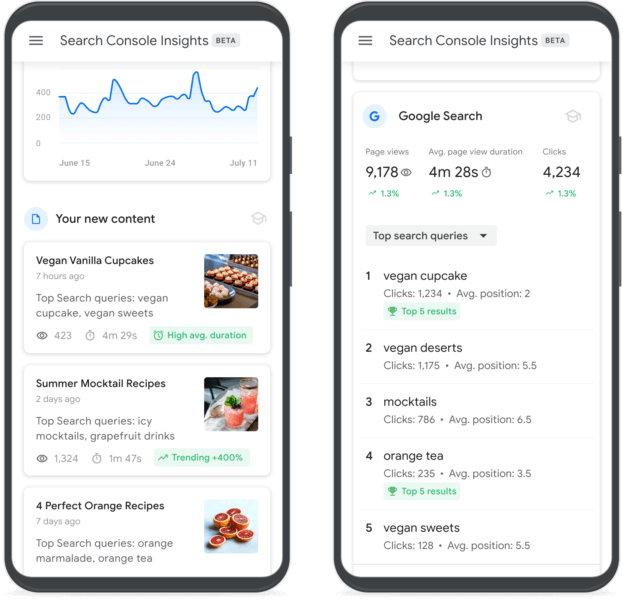
Why we care. If you have set up a new site and only used Google Analytics 4, now you can see a lot more data in your Search Console Insights report. Also, with Google doing away with Universal Analytics 3 in about a year from now, this is an important integration Google had to make.
The post Google Search Console Insights now supports Google Analytics 4 appeared first on Search Engine Land.
Courtesy of Search Engine Land: News & Info About SEO, PPC, SEM, Search Engines & Search Marketing
Wednesday, July 6th, 2022
To help advertisers ensure their Performance Max campaigns are set up correctly, Google has launched diagnostic insights. The insights are aimed to help ensure there are no delays or issues causing low engagement or disapproved ads.
Visibility into potential issues. When a new Performance Max campaign is launched, the diagnostic insights view can automatically identify issues related to:
- Status
- Billing
- Policies
- Conversion tracking
- Budget
- Strategy targets
- Ad strength
You’ll also be able to view recommendations via the progress bar.
What Google says. Right now, the insights are only available for Performance Max campaigns, but Google says they plan on rolling out the insights for other campaign types in the next few months. You can read more information and visit the help doc here.
Why we care. The new insights could be helpful when it comes to ensuring advertisers don’t violate ad policies, and giving helpful visibility into ad strength. But advertisers should be aware that these are insights, and not all suggestions will be required fixes. Insights into budget and strategy are left up to the advertiser and should be manually reviewed and carefully considered before implementation.
The post Google launches diagnostic insights for Performance Max campaigns appeared first on Search Engine Land.
Courtesy of Search Engine Land: News & Info About SEO, PPC, SEM, Search Engines & Search Marketing