Archive for the ‘seo news’ Category
Tuesday, July 30th, 2024
Google is rolling out new features to boost creative results and transparency in its advertising platforms, particularly for Performance Max campaigns.
Why it matters. These updates aim to help advertisers create more effective ads, understand their performance better, and ensure brand safety across Google’s ad network.
Key updates:
- New reporting tools:
- Conversion metrics in asset-level reporting.
- YouTube video placement reporting.
- Third-party verification for brand suitability on YouTube and Display.
- Enhanced AI-powered creative tools:
- Expanded image editing capabilities, including object removal and addition.
- Improved asset generation for multiple campaign types.
- Easier access to creative tools from the “Create” menu.
- New partnership:
- Integration with Typeface for seamless asset creation and implementation.
Between the lines. Google continues with its move to leverage AI to help advertisers create more diverse and high-quality assets while providing more transparency into ad performance and placement.
What to watch. The rollout of these features across different campaign types and languages, and their impact on ad performance and advertiser adoption.
The big picture. As digital advertising becomes increasingly complex, Google is positioning itself as a one-stop shop for advertisers, offering both creative tools and performance insights.
Courtesy of Search Engine Land: News & Info About SEO, PPC, SEM, Search Engines & Search Marketing
Tuesday, July 30th, 2024
Perplexity, the AI-powered search startup, is rolling out a new “Publishers’ Program” to share ad revenue with media partners, amid recent plagiarism controversies.
This move signals a shift in how AI companies are approaching content partnerships, potentially setting a new standard for compensating publishers whose work is used to train and power AI systems.
Details:
- Publishers will receive a “double-digit percentage” of ad revenue when their content is featured in search results.
- Initial partners include Time, Der Spiegel and Fortune.
- The program includes free access to Perplexity’s Enterprise Pro tier and developer tools.
Why we care. As Perplexity grows, it could become a significant new channel for digital advertising, offering alternatives to dominant players like Google. Their AI-powered search could evolve into new ad formats or targeting capabilities that aren’t possible with traditional search advertising.
The big picture. AI-powered search is more expensive than traditional search, pushing companies like Perplexity to quickly develop sustainable business models.
Between the lines. This initiative comes after recent accusations of plagiarism against Perplexity, including incidents involving Forbes and Wired.
However, unlike content licensing deals from companies like OpenAI and Google, Perplexity claims it doesn’t need to license content as it’s not training its language model on publishers’ writing.
What they’re saying:
- “It’s a much better revenue split than Google, which is zero,” says Automattic CEO Matt Mullenweg.
- Perplexity’s CBO Dmitry Shevelenko acknowledges the program may impact profit margins but sees it as necessary for long-term success.
- Perplexity intends for advertising to be its main source of revenue, Shevelenko said, adding his goal is to break the search engine model, which historically has not provided media partners with a revenue share model
What to watch. How this program compares to similar initiatives from competitors like OpenAI and whether it will satisfy publishers’ concerns about AI using copyrighted content.
Courtesy of Search Engine Land: News & Info About SEO, PPC, SEM, Search Engines & Search Marketing
Tuesday, July 30th, 2024
Website migrations are a part of an enterprise’s natural evolution. Companies may migrate because they’re rebranding, going to the cloud to scale their site easier or numerous other reasons.
However, while migration may seem simple on paper, one misstep can lead to SEO problems, such as:
- 404 errors.
- Lost rankings.
- Missing content.
- Lost revenue.
Before beginning your migration, you’ll want to run a site crawler to inventory your pages. The goal is to have a list of all pages that you can refer to when the migration is complete to verify that everything is migrated correctly.
You’ll also want to identify when your site traffic is highest so you can avoid performing a migration during these hours. Once you’re ready, it’s time to move on to the first part of your planning stage.
Communication plan
I see most guides go right into the pre-migration phase, and while this may be fine if you’re a one-person owner, it’s not OK when multiple stakeholders are involved.
A basic communication plan is necessary, and it should include:
- Internal communication and insights into the migration, when it will occur, who it will impact and what team members may assist you.
- External communication to alert clients and customers of the migration and potential downtime that may occur.
Make sure everyone knows what’s going on to avoid any critical issues that can disrupt the migration or someone else’s work in the organization.
Pre-migration planning
Screaming Frog is a great tool to help with collecting data on your site before the migration, such as:
- Comparing crawls.
- Staging.
- URL mapping.
But you’ll need more data than this. You’ll also want to gather a list of your rankings before and after the migration. Ahrefs and Semrush allow you to easily track and export your keywords.
You can – and should – create an annotation inside your Google Analytics to mark the pre–migration data so that you can refer to it when you’re done with the site migration.
Once you’ve created your list, you’re ready to move on. The following are 11 steps that will help you successfully migrate your website.
Caution: Do not delete your old site. It’s good to have a fallback if your new site fails for some reason.
Dig deeper: 12 SEO pitfalls to avoid during a website platform migration
Step 1: Setup hosting, DNS, CDN, mail
Migrations have many moving parts.
First, make a backup of your site and database. If something goes wrong, you’ll be thankful that you have a backup to restore your site. Ideally, you’ll also create a staging site to test the migration to reduce any initial hiccups that can occur along the way.
Staging environments allow you to test the migration and identify any critical errors. If you’re migrating a well-known site that receives a lot of traffic and may even generate revenue, staging is important.
Business stakeholders will want answers from you if something goes wrong, and the presence of a staging site helps you prevent unwanted issues in production.
Use the staging environment to test redirects, duplicate content and the numerous other parameters mentioned throughout this article.
Once you’re done with the staging site, you’ll want to:
- Set up your hosting environment and transfer all files.
- Set up the DNS information.
- Change your CDN information.
- Change mail parameters.
Complete these preliminary steps before moving into your redirects.
Step 2: Create a list of redirects
Internally, you and your team should have a list of redirects that you need to create and ones that already exist. You’ll refer to this list to ensure that all existing redirects are in place on your new site.
Thankfully, if you don’t have many redirects and are changing domains, you’ll need a single redirect to redirect the site.
Dig deeper: How to speed up site migrations with AI-powered redirect mapping
Step 3: Review your SEO structure
SEO specifications should be put in place. You’ll need to check the following to make sure the migration is successful:
- Crawlability.
- Custom URLs.
- Alt text.
- Canonical tags.
- Robots.txt.
- Sitemaps.
- Internal links.
- Hreflang.
- Structured data.
- URL structure.
- Mobile setup.
- Pagination.
Review your current site’s SEO structure to ensure that you can check it when the migration is complete. The key to site migration success is creating lists and reviewing them multiple times.
Step 4: Run benchmarks
Benchmarks are going to tell you a lot about your migration and site. From a technical SEO standpoint, you’ll want to view the following data:
- Page load speed.
- Page indexing rates.
- Crawl errors.
- Keyword rankings.
You’ll be returning to these benchmarks multiple times over the coming weeks. If you notice that the site speed is slow or you lost rankings, you’ll want to look through your site more to pinpoint the issue.
If you have this data available, you’ll also have something to show your client (if you’re working with one) that can highlight the success of the benchmark.
Technical SEO benchmarks
You want your users to have an exceptional experience on your site. To achieve this, crawlability needs to remain high and speeds must also be monitored:
- Mobile-friendliness: Sites need to be mobile-friendly. Two tools that can help you verify that users across mobile devices can use your site seamlessly are Bing and Website Grader.
- Site speed: Your site speed also matters, so you’ll want to run tests before and after the migration using PageSpeed Insights.
- Duplicate content: Sometimes, migrations go wrong, and duplicate content pops up. You want to verify that you don’t have a bunch of duplicate pages.
Running Screaming Frog when the migration is done will allow you to identify errors that you’ll need to correct to avoid any crawlability issues that may pop up, including duplicate content.
Step 5: Analyze key site pages
Your key site pages are the most important revenue-generating pages and should be the first that you target. Analyze these pages to make sure that they’re running properly. Even if you have 1,000+ pages, choose the top 5% pages and go through them one by one.
These are pages that:
- Have high keyword rankings.
- Generate the most revenue.
When you look through your analytics, you’ll want to keep a close eye on these pages while continuing through the rest of these steps.
Step 6: Rerun site crawlers to compare
Rerunning your crawler is a good idea at this point. You’ve already gone through most of the tedious steps, but now it’s time to compare your old site crawl to the new one.
The goal is to check the following:
- Broken site links (404 errors).
- Redirects.
- Meta titles.
- Meta description.
Compare your metadata to ensure that everything migrated properly. Sometimes, metadata is lost during the migration, especially if you change content management systems that try pulling data from a database column or table that doesn’t exist.
Step 7: Audit the site
Audits come next, and you can also use some of the data collected in the last step.
Your audit should include checking:
- Redirects.
- Internal links.
- Server response times.
- Noindex/index information.
You’ll also want to create your robots.txt file, set up canonical tags and ensure that your key pages are running well.
Step 8: Set up Search Console and Webmaster Tools
If you’re changing domains, add your site to Google Search Console and Bing Webmaster Tools. You’ll want to follow this up by requesting that your site be indexed and submitting your XML sitemaps.
Google Search Console allows you to change your site address. You can set up the change of address by going to Settings (Gear icon) > Change of address.
The Search Console’s change of address allows you to alert Google of your site’s address change. However, you will need to verify that you’re the owner of both sites before submitting your change of address.
Step 9: Run usability tests
Usability is one aspect of a site migration that people overlook. Your site may maintain its rankings, yet you’ll lose revenue if usability diminishes.
Manually testing key areas of your site is the next step, and these tests should be performed on mobile and desktop devices.
Check the following areas to ensure that they’re working properly:
- Downloadable content.
- Forms.
- Full checkout process.
- Live chat function.
- Mailing lists.
- Navigation.
You want to ensure that all of your site’s features run properly. If you come across any issues, correct them as necessary.
Step 10: Monitor analytics and perform any necessary cleanup
Over time, you’ll want to look in your Google Search Console for errors and warnings. Review your analytics or keyword rankings for your top pages.
Traditionally, you’ll want to view your highest traffic-generating pages and see if they’ve experienced a loss in traffic. If they have lost significant rankings and traffic, start analyzing key issues, such as:
- Improper redirects.
- Slow load times.
- Lost internal links.
- Missing meta tags.
You’ll want to closely watch Google Search Console’s Coverage tab, which will show you any critical errors on your pages and warnings. As these errors pop up, go through them one by one and fix them.
Step 11: Post-migration monitoring
Post-migration monitoring is necessary for the first few weeks, but most changes will be immediate. A few items that you’ll want to add to your monitoring checklist are:
- 403/404/etc. errors.
- Analytic setup verification.
- Set up Google Search Console.
- Submit sitemaps.
- Verify third-party licenses are transferred.
- Verify that the caching system is working properly.
- Make sure email is working properly.
- Check the navigation to verify that it works.
- Run Screaming Frog to identify errors.
You can use this template, which I’ll keep updated to help you verify your migration.
Ensure a smooth site migration with these key steps and tips
Website migrations require considerable diligence and time to execute properly. While a few steps may be added to the list above to streamline the migration process further, they’re a good foundation to build on.
Dig deeper: How to run a successful site migration from start to finish
Courtesy of Search Engine Land: News & Info About SEO, PPC, SEM, Search Engines & Search Marketing
Monday, July 29th, 2024
Pinterest is testing a new program that could reshape advertising strategy, leveraging the relationships and expertise of news outlets and other publishers.
Why we care. This move creates a new offering for advertisers of potentially more targeted and effective ad placements.
Details:
- Pinterest is exploring an ad auction system on its pages, with revenue sharing for publishers.
- The company aims to tap into publishers’ existing advertiser relationships.
- Publishers could gain access to larger deals and a wider advertiser base.
Zoom out. Other social platforms are making similar moves:
- LinkedIn’s Wire Program. which allows publishers to sell ads on distributed videos, is in beta testing.
Between the lines. These initiatives reflect a broader trend of social media platforms diversifying their revenue streams and enhancing their value propositions to advertisers.
What to watch. The success of these programs could influence future collaborations between social media platforms and traditional publishers.
Courtesy of Search Engine Land: News & Info About SEO, PPC, SEM, Search Engines & Search Marketing
Monday, July 29th, 2024

Is your marketing team overwhelmed and underperforming? It’s time to harness the power of automation.
This free guide from Act-On provides a step-by-step blueprint to transform your marketing efforts. Learn how to:
- Streamline your workflow: Reduce manual tasks and focus on high-impact activities.
- Personalize your messaging: Deliver targeted content to the right audience at the right time.
- Generate more leads: Convert website visitors into qualified prospects.
- Improve sales productivity: Align marketing and sales for maximum impact.
Inside this guide, you’ll discover essential steps to build a strong foundation for marketing automation success and tips for launching a successful pilot program. Follow the steps and you’ll be well on your way to achieving marketing automation success. Download The Marketing Automation Quickstart Guide today!
Courtesy of Search Engine Land: News & Info About SEO, PPC, SEM, Search Engines & Search Marketing
Monday, July 29th, 2024
Google is rolling out a new feature that bridges the gap between Google Merchant Center and Google Ads, enhancing the ad creation process for e-commerce businesses.
Why we care. This integration allows advertisers to leverage their existing product images directly within Google Ads’ AI image editor, streamlining the creation of high-quality visual assets for campaigns.
Details:
- Advertisers can now link Merchant Center feeds with Performance Max campaigns.
- The AI image editor in Google Ads can access and enhance product images from Merchant Center.
- Edited images are saved to the Asset Library for use in campaigns.
- Performance Max campaigns can include up to 20 images.
How it works. After linking Google Ads to Merchant Center, advertisers can import product images into the Asset Library through the AI image editor’s media picker.=

Between the lines. This feature aims to simplify the ad creation process, potentially saving time and resources for advertisers while improving ad quality.
What to watch. The impact of this integration on ad performance and adoption rates among e-commerce advertisers.
First seen. We were first alerted to this update from Dario Zannoni’s LinkedIn:
Courtesy of Search Engine Land: News & Info About SEO, PPC, SEM, Search Engines & Search Marketing
Monday, July 29th, 2024
Google is now promoting its AI Overviews directly in Google Discover. As users scroll through the Google home page, they may see a sample of a question that Google thinks its AI Overviews in Google Search can do a nice job of answering.
What it looks like. Here is a screenshot of my Google Discover feed showing a promotion for AI Overviews. In this case, Google is promoting Olympics swimming by asking the question, “Why aren’t full-body swimsuits allowed on race day?”
Here is a screenshot:
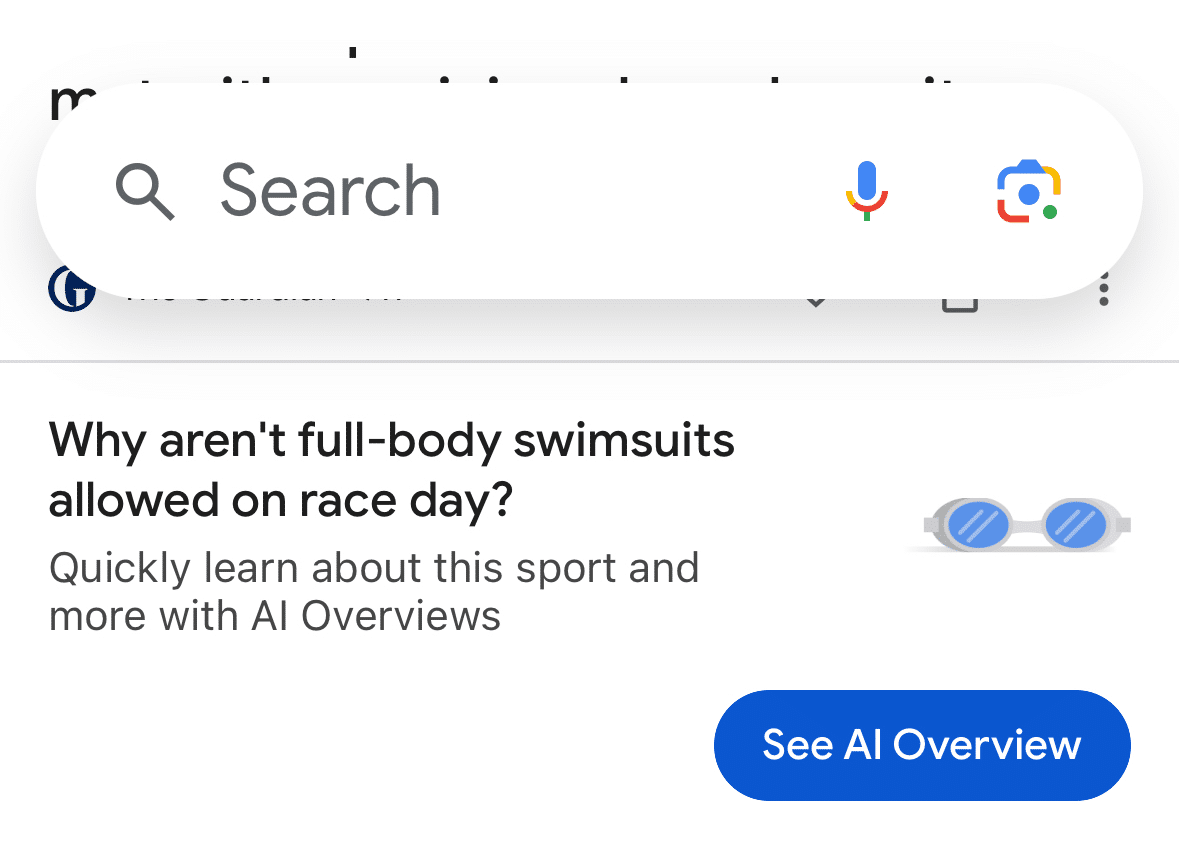
When you click “See AI Overview,” you are taken into Google Search, and Google will then show you the AI Overview at the top of the search results page.
I covered examples of fencing earlier today, here are some of those examples:
Olympics partnership. This is likely part of the Google partnership with the Paris Olympics, where Google announced that you can “learn more about the Games with Gemini.”
Why we care. It is interesting to see Google pushing AI Overviews, maybe to get more users more accustomed to them. It is clear, AI Overviews are here to stay and will be a big part of Google Search for the foreseeable future.
Courtesy of Search Engine Land: News & Info About SEO, PPC, SEM, Search Engines & Search Marketing
Friday, July 26th, 2024
Reddit has launched Lead Generation Ads in public beta, available globally for advertisers working directly with the platform.
Why we care. Reddit’s new ad format allows advertisers to collect user information directly on the platform, potentially improving lead quality and campaign performance for businesses across various industries.
Key features:
- Mobile-optimized design with auto-populating email fields.
- Privacy-focused approach for secure data handling.
- Integration with Zapier for direct CRM connectivity.
By the numbers:
- 75% of B2B decision-makers say Reddit has the most influential perspectives on business products.
- 28% of redditors researched online education programs in the past 6 months.
- 93% of redditors say the platform helps them make informed tech upgrade decisions.
What they’re saying. LaunchDarkly, a feature management platform, reported a 30% decrease in cost per lead and a 25% increase in lead submission rates during beta testing.
Between the lines. The Zapier integration allows advertisers to streamline lead management by automating the process of sending leads directly to their CRM systems.
Bottom line. Reddit’s new ad format, combined with its engaged user base and Zapier integration, could make it a more attractive platform for businesses looking to generate high-quality leads efficiently.
- Reddit’s move into lead generation ads, represents a significant step in bridging the gap between user engagement and advertiser needs, potentially reshaping how businesses approach lead acquisition in online communities.
Courtesy of Search Engine Land: News & Info About SEO, PPC, SEM, Search Engines & Search Marketing
Friday, July 26th, 2024
Unlike big proactive PR campaigns, where working with professionals can prevent you from wasting a huge amount of time and money, reactive digital PR is usually something that you can bootstrap with a bit of time and effort.
As long as you follow a few basic rules, you can earn yourself a handful of foundational links early on in your brand’s life without having to pay for an agency or consultant to do digital PR for you.
Get to know the key writers in your niche
If PR isn’t your full-time role, you likely don’t want to monitor every single journalist in the land, their likes and dislikes and who they work for.
It’s a long process, and there is a reason PR professionals pay good money for expensive journalist databases to keep track of them all.
Instead, with some initial research, you can find the top journalists in your niche and the publications you wish to appear in. Stick with a handful, maybe 4-5 at most.
Follow them on X and connect with them on LinkedIn. Read what they write about your industry, and then send an email to introduce yourself.
Clearly mark in your subject line what type of expert you are. It doesn’t matter if you’re an architect or a dermatologist.
At some point, a journalist may need your expertise and search their inbox. You want to be findable when that happens.
Keep a spreadsheet with their email addresses in case there is a breaking news story in your niche that you want to comment on. You don’t want to be scrambling around looking for their emails when time is of the essence.
Timing is everything
Once the article is published, it’s too late
This is not link building; you cannot email a journalist two months after an article in your niche has been published and ask to insert your expert opinion (and link) into the article.
This is just not how journalism works.
At best, you’ll get a confused response; at worst, you’ll get called out for it on X.
If the news happened yesterday, it’s too late
Earlier this month, I woke up to a dozen news alerts. There had been a massive IT outage affecting everything: doctors, planes, Gail’s Bakery.
I knew then that my software client could comment on this, but I also knew that everyone else’s software clients could. I opened my laptop and contacted my client right away to get a comment put together.
We moved quickly. I then emailed it to the key writers in our niche before lunchtime. This meant we secured coverage across both tech blogs and the national and international press.
Was ours the best comment? Maybe, maybe not, but what we were is quick. And that, when it comes to newsjacking, is the secret sauce.
If I had to go through an arduous sign-off process with multiple people making edits and wanting to check the comments, we would have missed out on those links.
When DIY-ing your reactive PR, your superpower is speed. You can write a comment and email it to your key writers straight away, while bigger competitors have to work through layers of corporate red tape to get a comment out the door.
If the holiday/awareness day/event is happening tomorrow, it’s too late
If you run a floristry website and want to talk about the top flower trends for Valentine’s Day, you don’t want to send that out on Feb. 13.
Google Search data, according to its own AI overview, suggests that searches for Valentine’s Day may start as soon as Christmas is over and build through January.
Therefore, journalists will be looking to write about Valentine’s Day, populate gift guides and get expert views on the year’s Valentine’s Day trends at this time.
Share your expertise and experience
It’s all good to be told to share your expertise with the press, but what does that mean?
Let’s break it down into three approaches:
Newsjacking
A big news story breaks in your industry and journalists need expert comment and analysis.
This one can be a little tricky. It’ll take you a few tries to get it right and that’s OK.
Essentially, a big news story has broken in your niche, and journalists want experts to give their opinions. In many cases, they will be looking to:
- Understand why something has happened.
- Gather some wider background or context.
- Establish what this might mean for those affected by the story.
- Predict what is likely to happen next.
If you’re a cybersecurity brand and a data breach has happened, you might be able to tell the journalist what caused it (e.g., people sharing passwords or a vulnerability in the system).
The wider background might be that this has happened before. What this might mean for those affected could be that they need to change their passwords or contact their banks.
What is likely to happen next is that the company will release a statement, tighten up its processes, or even potentially be fined.
Journo requests
This is when a journalist puts out a request on a journo request platform (we’ll cover the best ways to find these below).
This is perhaps the easiest for beginners, as you simply need to answer the questions the journalist has provided.
When you do this, remember to add color to what you are saying. Let’s be honest: they’re likely going to receive a bunch of bland, ChatGPT-written responses.
If you want to stand out, then provide answers that showcase your opinions and expertise.
Use examples if possible and don’t try to hide your personality. Journalists want answers from humans, not large language models, so lean into being human.
Seasonal trends and evergreen expertise
Some examples include summer or winter skincare for beauty brands, advice on moving house, removing red wine stains from carpets, drying laundry inside or using compost in the garden.
We Google these things when we want to know the best way to do something. Lifestyle content is constantly seeking tips and hacks from experts to answer its readers’ questions.
Unsure of the questions in your niche?
Use tools such as AlsoAsked (other tools are available, but this is the one I find most user-friendly) to find out what people are asking in your niche.
If you have a site with plenty of informative content, where you’ve already done the hard work, you might be able to work smarter, not harder, with some clever repurposing.
Dig deeper: How SEO and digital PR can drive maximum brand visibility
Repackage your on-site content (and your social content)
You have likely spent a lot of time and money creating on-site content to help your page rank.
This content will be designed to showcase your authority in your niche, detailing your expertise and trustworthiness.
Hopefully, Google will recognize this hard work, but here is how you can make it work harder for you.
If you’re a florist, you might have informational content on your site that explains how consumers can increase the longevity of their flowers once in a vase. This could easily be repackaged and outreached to journalists ahead of Valentine’s Day.
As a skincare brand, you probably have a page that details how to choose the best SPF and sunscreen for your skin type.
If the weather office is predicting a heatwave next week, it might be worth taking this and repackaging it for the press. Send it out to lifestyle writers who cover skincare ahead of the hot weather.
This definitely makes things quicker and easier, but you can’t just copy and paste the content.
Rewrite it to be fresh, topical and designed for the publication’s audience. It’s definitely quicker than writing content from scratch.
You might then want to include the link back to that page in your outreach, explaining that they can get further information there.
A similar approach works with social content. If your brand has a product that goes viral on TikTok, compile the video link, key stats (views, shares, etc.), product info, purchase link and standout comments into an email.
You can then send it to journalists who cover these products. “TikTok users are going WILD for this new mascara” is a headline we see more and more.
If your product causes a stir on socials, make sure to alert the press to compound that success.
Ease into reactive PR with journalist requests
If cold outreach and newsjacking seem a bit too brave an option, the journalist requests are the perfect place to try your hand at reactive PR.
Journalists nearly always need experts and case studies to bring their reporting to life and give it the gravitas it needs.
Whether they are writing lifestyle content on interior trends or hard news about a cybersecurity breach, they will undoubtedly need to hear from experts.
One way they connect with experts is via journalist requests. If you know where to find these – particularly in your niche – then it can be an easy way to get your foot in the door and begin building your first digital PR links.
Some of these are free, like the #JournoRequest hashtag on X, and some offer a freemium model. The ones below are the ones I have used successfully.
- #JournoRequests on X: The original and still the best despite Elon Musk’s best attempts at making the platform less user-friendly to everyone and the influx of spam. To make this more manageable, you can use your search bar to type in the hashtag and keywords related to your industry, e.g., ‘#JournoRequest Plumber.’
- Qwoted: Qwoted operates a freemium model, but the basic account is worth paying for if you find initial success with a free account. Qwoted is particularly good for U.S. brands and publications, but it’s also starting to get better for the UK and Europe. Its UX lets you search and submit quotes and comments easily.
- SOS: The new HARO. It’s early days, and while it may take time to build up to the success of its predecessor HARO, now is a great time for brands to use it to build relationships with journalists before it becomes overrun.
- ResponseSource: This is great for the UK market, but it’s not cheap and provides plenty of excellent press opportunities. ResponseSource is a great thing to build up to, and if you’re doing digital PR yourself and only need journalist requests in your niche, you may find an account more cost-effective than outsourcing your digital PR.
Effective reactive PR strategies for building brand visibility
Everything I’ve explained above will help you build relationships with journalists in your niche, increase awareness of your brand and hopefully build some links. It is crucial to remember that this is a long game.
These tools will help you build foundational links and initial awareness of your brand in the press and build relationships with key journalists in your industry. However, they won’t equate to overnight success in the SERPs.
When it comes to digital PR links, no matter what some impressive-sounding agencies might tell you, it really is quality over quantity.
A little and often approach to digital PR to help you build sustainable growth is fine at the beginning. As your brand and business develop, you may want to bring in a digital PR freelancer or agency to scale up these efforts.
But you’ll already be ahead of the game and you’ll know how it works and be less easily impressed by promises of hundreds of low-quality links.
Lastly, remember journalists don’t owe you links or coverage. All you can do is be willing to put yourself out there and share your knowledge and expertise.
If you do this consistently enough, it will nearly always lead to coverage and links over time, but they are not guaranteed in digital PR.
Dig deeper: 5 underrated skills you need to be a good digital PR – and how to master them
Courtesy of Search Engine Land: News & Info About SEO, PPC, SEM, Search Engines & Search Marketing
Friday, July 26th, 2024
Some so-called digital marketing experts have said “blogs are dead,” especially in big business.
This couldn’t be further from the truth, especially with changes in search like AI Overviews and the endless flow of trust customers now require.
Blogs build trust gradually, contrary to what shady marketers claim. Results aren’t instant. It’s a long-term strategy that grows over time. If Warren Buffett were a marketer, he’d be a blogger.
Over time, blogs enhance brand awareness, attract qualified leads and ultimately strengthen the bottom line.
Many ecommerce and service-based business leaders view blogging as unnecessary, which reflects an outdated attitude. As audiences evolve and AI changes how we search for products, content becomes crucial for reaching new customers and nurturing existing ones.
Blogging is far from dead and has never been more vital for brands and business leaders.
Here’s why every business should focus more on their blog during a time when AI continues to rule search and attention spans get smaller and smaller.
The way we shop online is changing
The latest data from Google shows that roughly 53% of customers conduct online research before purchasing a product or service.
Informative content can help influence users’ purchasing decisions or even empower users to make the right decisions. That much is obvious.
But, in competitive keyword searches where your result is not on top, there is a great opportunity to still reach customers with your brand using content. This may appear under People Also Ask or as an organic blue link under the Shopping Carousel.
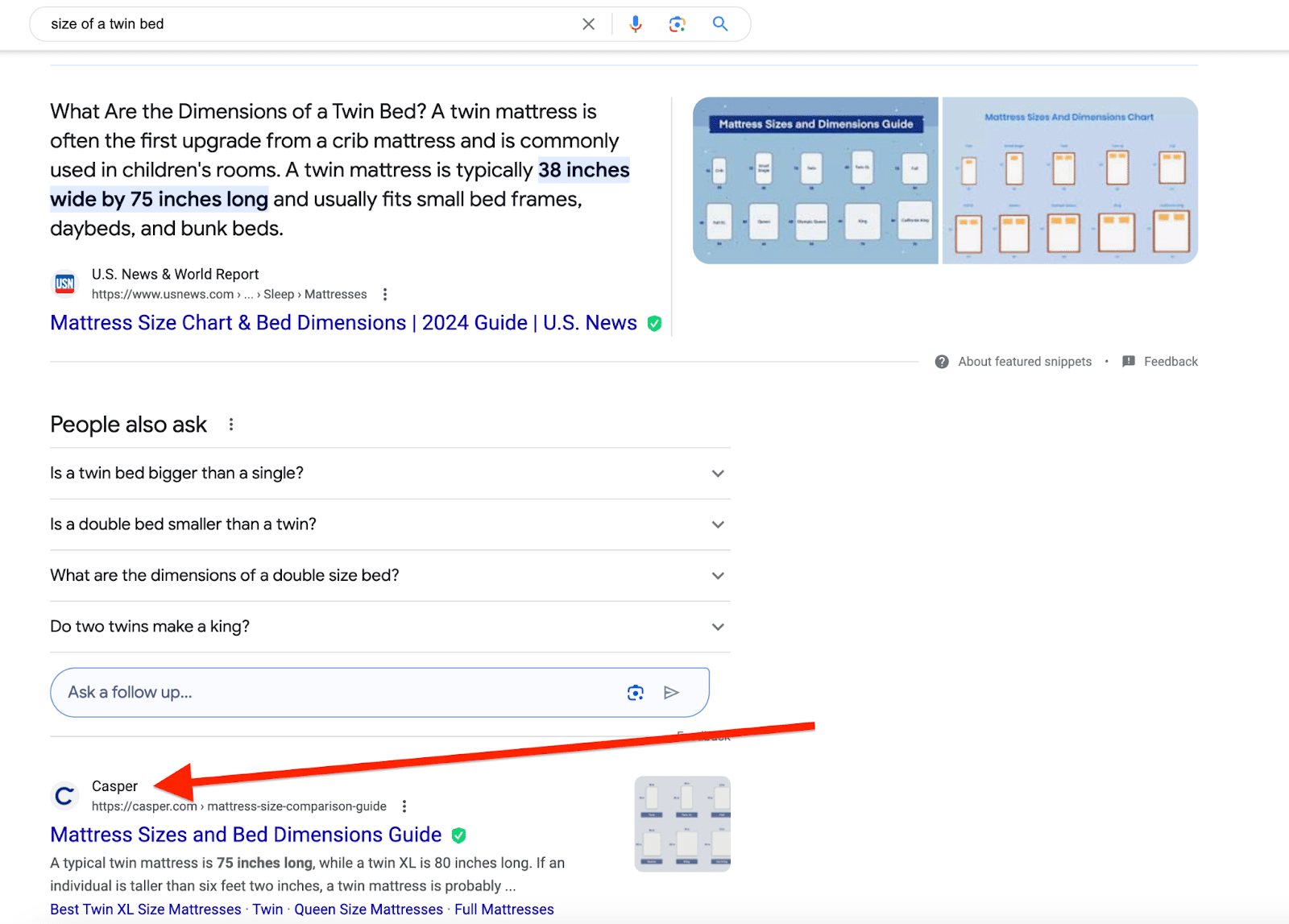
Likewise, creating content with referral links to your products or store is also a great way to reach customers who are still in the research stage. Check out how Casper uses content to make customers aware of their mattresses and pillows.
Content will help you weather generative search
It’s not just customers changing their behaviors, but also Google itself.
Google’s foray into AI is now a reality. AI Overviews radically promises to shift the way we search for products.
AI-generated results will use a mix of products, blogs and local-pack results to offer customized and personalized results.
While it’s difficult to influence what products Google displays for its AI-powered results, you may have some luck by writing custom content for longer-tail keyword searches.
Brand ethics are more important than ever
Studies show that most consumers are more likely to be loyal to brands that practice sustainability or ethics. This is especially true of younger generations who prioritize corporate responsibility more than older generations.
Creating blog content around your business’s various initiatives is a great way to tell a story and engage with users.
Nordstrom has an ongoing blog called Nordstrom Now, which details its corporate initiatives. Kohl’s and many other brands do the same.
Blogging builds brand loyalty
One fast track to brand loyalty may, surprisingly, be content marketing.
A study out of Vietnam found that relatable digital content marketing increased perceived brand loyalty among customers. Another from the Pakistan Journal of Social Sciences found a similar relationship.
Blogs are the ultimate way to reach your customers and also influence their perception of your brand.
Some examples of power content to experiment with include:
- Content that shows the human side of a brand.
- Content that entertains and relates to its audience through storytelling.
- Educational content that instructs and empowers customers to make active decisions.
Authorship is powerful for branding
People are more likely to link to and share content from people they trust. Building authorship on your platform is an easy way to develop that trust.
I’ve worked with a remarkable number of C-level executives who never considered sharing their knowledge on a blog or any platform.
There is so much value to be had in developing authority and reputation for your business and personal brand by sharing first-hand knowledge from your industry in a blog.
Encourage more company leaders to write for your blog and share it with their social media networks to develop greater buzz and loyalty toward your business.
Get the newsletter search marketers rely on.
Blogs can aid in conversion optimization
Blog content is a powerful tool across all areas of your sales funnel.
At the top end of the funnel, informative content is a great, free resource to attract visitors to your site. Once on your website, offer incentives that force people to give you contact information for lead follow-up, such as signing up for a newsletter.
Then, once leads are further inside your funnel, you can use content to help influence leads to decide on a purchase.
My digital marketing company uses technical SEO checklists and evergreen guides straight from our blog to help customers make decisions. These blogs also provide them with standalone value, earning our brand more authority.
You can even repurpose evergreen content into aesthetically pleasing ebooks or downloadables that make your company look even more authoritative.
Blogs can be repurposed across multiple channels
Blog content can easily be repurposed across multiple channels to reach even more customers outside your orbit.
Consider repurposing existing blogs to create:
- Email newsletters.
- Social media posts.
- LinkedIn newsletters.
- Webinars.
Blog topics and information can also be repurposed into other digital mediums, such as video or audio, to put on any other platforms your company already uses.
On the flip side, it’s always good practice to post anything you share externally on your blog so you can build a second-traffic source. For example, post videos you share on YouTube on your blog with a small informative post to help it rank even higher in Google’s algorithm.
Business blog guidelines
I’ve written extensively about blog strategy over the years. Here’s a quick summary of the essentials:
Step-by-step guide to developing a content strategy
- Define your goals: Clearly define what you want to achieve with your content. This could be increasing brand awareness, generating leads or improving customer engagement. Make sure these goals are specific, measurable, attainable, relevant and time-bound (SMART).
- Understand your audience: Gather data on your audience’s demographics, preferences and pain points to develop detailed buyer personas. Refine these personas using surveys, social media analytics and customer feedback.
- Conduct a content audit: Review your existing content to identify what’s working and what’s not. This helps you understand gaps and plan future content that fills these gaps and aligns with your audience’s interests.
- Plan your content: Based on your audit, plan a variety of content types that cater to different stages of the buyer’s journey. Incorporate blog posts, videos, infographics and podcasts to diversify your approach.
- Schedule and manage: Use a content calendar to effectively schedule your content. This helps maintain a consistent publishing schedule that keeps your audience engaged.
- Measure and optimize: Continuously track your content’s performance using key performance indicators (KPIs) like traffic, engagement rates and conversion rates. Use this data to tweak and optimize your strategy over time.
Always think of SEO
- Focus on user intent: Tailor your content to match your audience’s queries and needs. This involves understanding the intent behind search terms and providing comprehensive answers.
- Optimize for voice search: With the rise of digital assistants, optimize your content for conversational queries. This means using natural language and question-based keywords.
- Leverage AI and machine learning: Use AI-driven tools to analyze the success of your content and to personalize content offerings based on user behavior.
Enhancing engagement with interactive blog features
- Polls and surveys: Embed interactive polls to engage readers and collect their opinions on various topics.
- Infographics and visual data: Use tools like Canva or Venngage to create eye-catching infographics that simplify complex data.
- Downloadable resources: Offer downloadable ebooks, white papers or checklists that provide added value in exchange for email addresses, aiding in lead generation.
By implementing these guidelines and utilizing the recommended tools, you can significantly enhance your blogging strategy, making it more aligned with your business objectives and responsive to your audience’s needs.
Business blogs: Your world of untapped opportunity
In the ecommerce space, where brands compete for a small share of digital real estate, blogs open up a whole other stream of traffic that can be just as valuable to your business.
I’ve seen businesses scale in the ecommerce space, writing blogs on everything from aftermarket truck parts to fitness products you can use at home.
The best part of a business blog is that you can write at your own pace or hire a team of specialized writers. Notice I say specialized. You wouldn’t want your trained pest expert blogger writing content for lawyers and vice versa to offer a simple explanation.
Plus, unlike ads, the traffic doesn’t go away as soon as you turn off the money tap. It compounds, helping build your authority, rankings and, ultimately, your bottom line.
Courtesy of Search Engine Land: News & Info About SEO, PPC, SEM, Search Engines & Search Marketing








 (@ndyjsimpson)