Archive for the ‘seo news’ Category
Wednesday, September 7th, 2022

Winning an industry award is a rewarding, cost-effective way to generate publicity, attract new business, boost team morale, and stand apart from the competition. Enter the 2022 Search Engine Land Awards now for your chance to take home the highest honor in search!
The final deadline is coming up at the end of this week – submit your application by 11:59pm this Friday, September 9 to be considered by our esteemed judging panel, featuring John Lee – Head of Evangelism at Microsoft, Cyrstal Carter – Head of SEO Communications at Wix.com, Thom Craver, Director of Consumer Products at CBS News, and more.
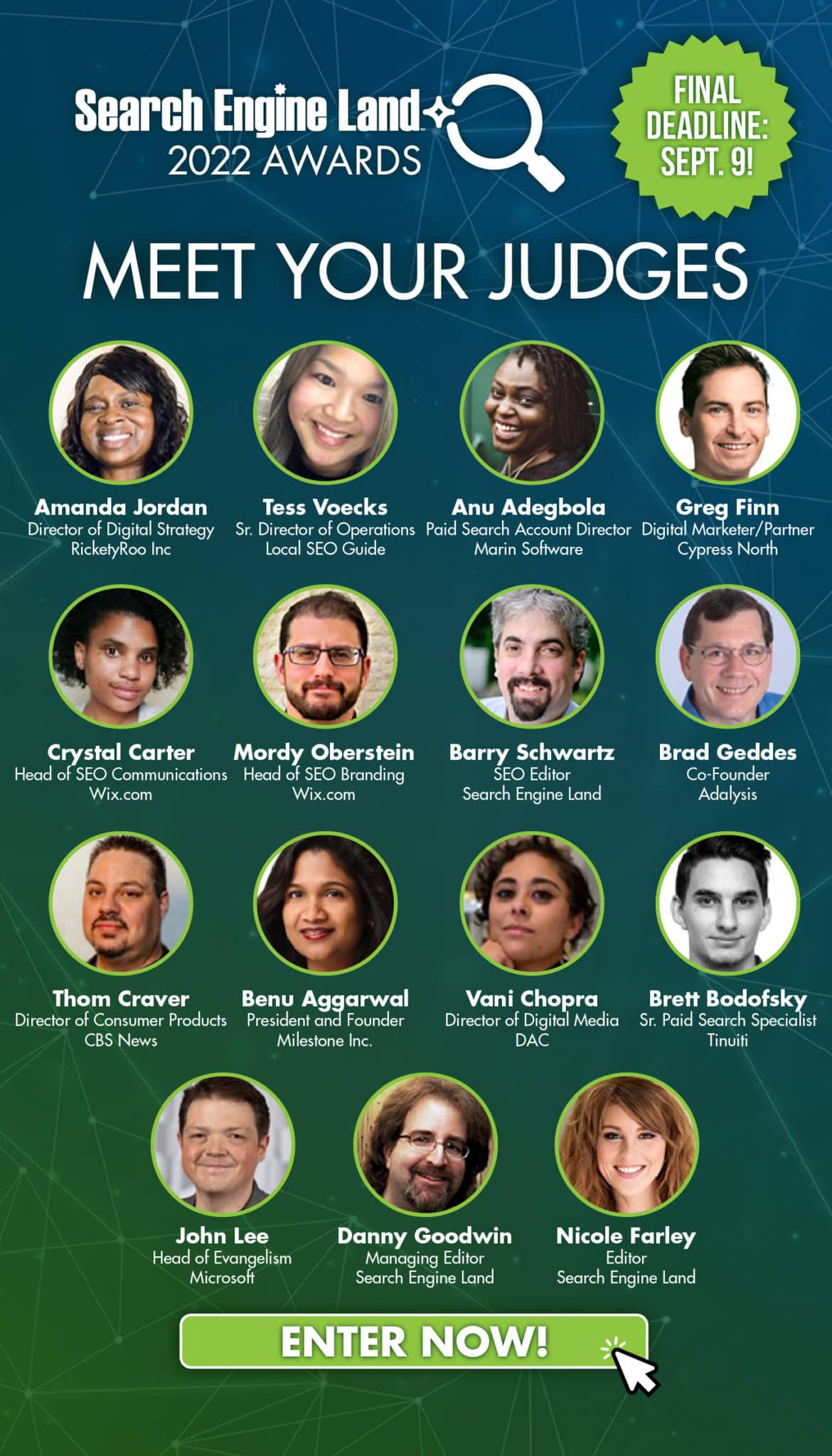
Not sure where to begin? Check out How to craft a winning Search Engine Land Awards entry: Past judges share their advice for insights on what makes a winning application. If you have any other questions, send them our way at awards@searchengineland.com and we’ll get back to you ASAP.
Winners will be announced on October 17 in exclusive coverage on Search Engine Land – the industry publication of record.
Take the first step now by creating your account and exploring the application process. If you have questions, please reach out to us at awards@searchengineland.com.
Best of luck! We look forward to your submission!
The post FINAL CHANCE to submit your Search Engine Land Award entry! appeared first on Search Engine Land.
Courtesy of Search Engine Land: News & Info About SEO, PPC, SEM, Search Engines & Search Marketing
Friday, September 2nd, 2022
Google is updating the privacy threshold for the Search Query report in Universal Analytics, and the Google Ads query, First user Google Ads query, and Session Google Ads query dimensions for the explorations in Google Analytics 4.
What is the privacy threshold. Google announced new privacy thresholds last year, ensuring user anonymity by only reporting on terms that have seen sufficient search volume across all Google searches. They also committed to giving advertisers more data.
What this means. The new thresholds should make what advertisers are seeing in their Google Ads accounts more consistent with what they see in GA4. But Google says that “Due to differences in data models, with this update, search query terms reporting in Universal Analytics will be more limited than Google Ads reports.”
Learn more. You can read the announcement from Google here.
Why we care. The Search Query report has always been a source of data to help advertisers ensure they’re bidding on the right keywords. But if the new standards of privacy thresholds continue to only show keywords with significant search volume, it may no longer be a useful tool.
The post Google updates privacy threshold for Analytics Search Queries report appeared first on Search Engine Land.
Courtesy of Search Engine Land: News & Info About SEO, PPC, SEM, Search Engines & Search Marketing
Friday, September 2nd, 2022
Google’s help document on controlling your snippets in search results has added some examples of “bad” and “better” meta descriptions.
The bad. Google advises avoiding these four types of “bad” meta descriptions:
- List of keywords: “Sewing supplies, yarn, colored pencils, sewing machines, threads, bobbins, needles”
- Same description used for every news article: “Local news in Whoville, delivered to your doorstep. Find out what happened today.”
- Doesn’t summarize the page: “Eggs are a source of joy in everyone’s life. When I was a small child, I remember picking eggs from the hen house and bringing them to the kitchen. Those were the days.”
- Too short: “Mechanical pencil“
The better. Google’s examples of better meta descriptions:
- Explains what the shop sells and details like opening hours and location. “Get everything you need to sew your next garment. Open Monday-Friday 8-5pm, located in the Fashion District.”
- Use a snippet from the specific news article: “Upsetting the small town of Whoville, a local elderly man steals everyone’s presents the night before an important event. Stay tuned for live updates on the matter.”
- Summarize the whole page: “Learn how to cook eggs with this complete guide in 1 hour or less. We cover all the methods, including: over-easy, sunny side up, boiled, and poached.”
- Are specific and detailed. “Self-sharpening mechanical pencil that autocorrects your penmanship. Includes 2B auto-replenishing lead. Available in both Vintage Pink and Schoolbus Yellow. Order 50+ pencils, get free shipping.”
The updated document. Google published its documentation on controlling your snippets in search results in October. You can see all the new additions, here.
Why we care. While there is nothing earth-shattering and this is mostly just basic SEO, it’s good to see Google provide some more specific guidance on how to create helpful and descriptive meta descriptions that are more likely to get clicks and traffic. Not that we can ever count on Google to use those meta descriptions, of course.
The post Google shares 4 examples of how to improve a meta description appeared first on Search Engine Land.
Courtesy of Search Engine Land: News & Info About SEO, PPC, SEM, Search Engines & Search Marketing
Friday, September 2nd, 2022
SEO agencies can vary in terms of their quality of service. That means a large number of brands and organizations have been burned at least once.
Additionally, many agencies look and sound the same – just swap out the logo and branding. Yet, they offer varying levels of depth of experience and expertise.
SEO agencies aren’t one-size-fits-all, and getting into a bad-fit relationship can be costly in terms of both dollars and time lost.
I’ve been involved in this process for a long time as an agency leader. It probably sounds self-serving that I’m writing this article. But, let me be the first to say that I don’t want to work with every brand, and my agency isn’t the right fit for everyone.
Leveraging experiences on the agency side of the table, I have outlined nine tips to help you work through the process of choosing the right fit and right agency for your organization.
1. Develop and define goals
If you haven’t translated organizational, sales and marketing goals down to SEO specifically, now is the time to start thinking about it.
Good agencies will ask you pretty early on what your goals are whether those are tied to ROI, conversions, or whatever your measure of success is. (Beware if someone wants to do SEO for you without getting into the topic.)
It is fair not to know what is possible to expect from SEO without the agency helping with the research. However, do what you can to at least know what ROI looks like for you. That can be in the form of the number of conversions you need or specific actions.
You can also look at any industry benchmarks and your own performance baselines as reference points.
Regardless of what you know or don’t, be clear on what success looks like in making money or achieving your goals. Have as much of it as possible before you start your SEO agency search.
2. Evaluate internal resources
You’re likely looking for an SEO agency because you don’t have the internal SEO expertise or time resources required to succeed. Whatever the case, there will be some level of collaboration or effort by you or your team to have a successful agency partnership.
Even if you have the agency do everything, you’ll need certain time commitments and availability for approvals, oversight, feedback and performance reviews.
In many cases, brands and organizations hold onto additional aspects or have other partners to cover the full spectrum of things that SEO needs, including content, IT, UX and any collaborative elements.
Plan out what your internal team could or should own. Be available to collaborate or utilize the agency or outside partners. This will help you evaluate whether the agency is suitable for all or some aspects you’ll eventually need in the SEO work.
3. Consider your budget
You can hopefully find some budget parameters to work from by taking the combination of goals and knowing what ROI looks like, plus the internal resources or existing partners you can lean on.
Even if you want to hear the first number from the agency, knowing your budget parameters will help you qualify faster and filter the ideal agencies in terms of size, scope, and fit.
For example, if you can get some ballpark pricing quickly and know what arena you’re in, you can move on if it is way above (or concerningly below) your estimated budget.
It’s totally fine not to know. It is even better in many cases to have it tied to an ROI ratio rather than a fixed number – viewing SEO as an investment rather than an expense line item.
Be upfront with that information and inquire about how the agency will help you in any initial strategy or audit steps to understand avenues to hit your goals and the risk for different budget levels and investments.
4. Do your research
As you look at websites, talk to those referring you to potential agencies, or get into any initial outreach, be mindful that specific dimensions matter.
That includes the size of the agency compared to your organization. Or, more importantly, how capable they are of serving your company. The stage of your company’s growth and lifecycle might be another factor to consider.
Agencies can be pure generalists who take on any and all clients who have a dollar to pay them. A few consider different factors that help narrow things a bit, like pricing minimums, focus on particular niches or industries, audiences, conversion types, or even the makeup or structure of your team.
Save time and energy on looking for the right areas that match up with who you are and what you want. Resist pitches from agencies that seem to be out of your league or not in alignment with your focuses.
Great ways to do so include:
- Seeking out case studies, credentials, references and thought leadership content pieces.
- Looking at the mix of clients they work with currently.
Do your homework and be prepared to ask about or challenge any contradictions or mixed messages you see.
Get the daily newsletter search marketers rely on.
5. Have an interview plan
Often, I get a lot of really good questions from prospects I talk with. Other times, I don’t get asked enough, so I end up answering questions I wish were asked or assume that my potential clients want to know.
The more organized you are in the questions you ask, the more objective your comparison can be at the end of the agencies you are considering.
Plan questions related to anything and everything important to you, whether that is tied to:
- Their focus (or aspects of #4 above).
- Their approach.
- Ways you’d work together.
Be prepared, especially if you have some internal resources that will own copy or content, dev, or other things that require a tight partnership and collaboration.
Additionally, know who you’re working with and how cultures align (or don’t).
Have a solid list of questions, plan for who is asking what, and whatever level of notes or scorecard you can. In the end, you can be objective and also go back to your finalist(s) with more profound levels of details you’re seeking to firm up.
6. Evaluate fit
Do your personalities match?
I’m not talking about just you and me, the president who is leading the conversation at this point (or whatever sales or account representative).
I’m talking about between those on your team and the agency’s team who’ll be working together in the trenches.
Assess the fit between teams. Learn about retention rates of employees and stability. Understand what level of transparency to expect. How hands-on will they be?
These aspects, plus agreement on the agency’s approach, are critical. You don’t want to hit a wall or drop off right after the contract is signed or just a few months into an ongoing agreement.
7. Do a gut check
Does something sound too good to be true? Is something off? Is there a red or yellow flag somewhere?
Trust your gut and dig deeper. If you have concerns about how you match up with the agency, validate them. Ask your hard questions.
Don’t move forward if things are off or don’t feel right. That’s a warning sign, and you should trust your instinct to pause and dig deeper.
I’m not saying to run away. Maybe you’re the first client they have had in your niche or industry. That could be OK with the right level of transparency, research approach, and risk tolerance. In some cases, it can be great to go with someone fresh versus the cookie-cutter strategy everyone else in the industry uses.
8. Understand the process
Beyond resource constraints and lack of enough understanding of SEO strategy – communication and mismanaged expectations are among the biggest roadblocks to success.
Every client has a different level of SEO knowledge, awareness of SEO processes, and a grasp of the agency’s unique takes on those things.
We (agency people) can take for granted that not everyone nerds out at the level we do.
Ask, and ask again if you’re unclear on what the process is.
What will it look like in terms of steps from contract to discovery, onboarding, research, strategy, optimization, reporting, communication, timing, and results accountability?
Be clear on it all. Keep asking if you don’t know, and make your notes to get up to speed and have the right level of accountability and expectations for the partnership.
9. Be clear on the agreement terms
Don’t sign something that you haven’t read! If you don’t understand the agreement’s contents, have a lawyer or advisor familiar with SEO look over it.
Beware of long-term agreements, sticky cancellation clauses and work ownership claims. None of those things are wrong, but you want to know what you’re getting into.
Long-term might get you cost savings and commitment from both sides in the relationship. SEO does take time. However, you want to avoid the following scenarios:
- Having your work product, content, or properties to be held hostage.
- Working together a couple of months in only to get hit with change orders.
- Assuming that other areas (such as content, dev updates, CRO, etc.) are covered and part of the agency’s responsibility, only to find out they weren’t.
- Getting into a gray area where they weren’t spelled out.
The ideal scenario is that the relationship is built on trust and accountability, where billings and value stay balanced over time. You don’t have to think about the contract again after signing it.
Conclusion
Selecting the right fit SEO agency is difficult. It can be challenging to get through the clutter of so many sounding alike, find ways to assess the experience and expertise or map out your fit with them.
More than that, it can lead to wasted time, energy and dollars. I don’t want that for you.
Hopefully, the tips I have shared help you prepare for and think about the process in a detailed way to ensure that you find the right fit for you and succeed.
The post 9 tips for selecting an SEO agency appeared first on Search Engine Land.
Courtesy of Search Engine Land: News & Info About SEO, PPC, SEM, Search Engines & Search Marketing
Friday, September 2nd, 2022
Available on AWS Marketplace, Crownpeak helps brands quickly create and deliver digital experiences that build trust and maximize customer lifetime value. Join experts from Crownpeak and AWS for a special conversation and hands-on demonstration.
The post Digital customer experience: Solution in focus appeared first on Search Engine Land.
Courtesy of Search Engine Land: News & Info About SEO, PPC, SEM, Search Engines & Search Marketing
Thursday, September 1st, 2022
Have you been working in an in-house marketing role and considering a switch to agency life?
Agencies are great because you can gain exposure to various types of businesses and learn to optimize against different marketing objectives. But they’re also fast-paced and come with significant differences relative to working in an in-house marketing role.
One of the most significant differences between in-house marketing and agency life is that you may be responsible for several accounts at once and need to focus on time and attention management more than ever.
Making the switch to agency life can be a little intimidating, especially if you’ve been working in-house or focused on one brand for a long time.
The following seven tips can help you hit the ground running so that your agency career is as awesome as you hope it will be.
1. Adhere to the 80/20 rule
One of the most important things in any agency is working quickly and efficiently. It’s helpful to timebox yourself and think about where the 80/20 rule applies. This is where I’ve seen people struggle the most during a transition from corporate life, especially on smaller client accounts where hours are limited.
For example, a client may have a 20-hour-per-month contract, and you have to deliver as much value as possible using those hours. Approach the problem this way – delivering several things at 80% will likely add more value to their business than going 100% on one thing.
For example, you could spend two hours researching keywords to target and get a lot of the information you need or spend five hours and come up with some additional words you may not work on for six months. Think of what else you could do with the extra three hours that might be more valuable than additional keyword research.
Another rabbit hole is doing competitive backlink research. Spend a couple of hours developing an initial target list, but be realistic about what you’ll use over the next few months.
It’s easy to keep digging and lose track of time when something doesn’t have a finite end (like keyword research or reviewing backlinks), so block an hour or two to work on it and then see how you feel about the results.
You’ll want to think about delivering value constantly and consistently. Remember that every day you hold back or delay sharing information is a day that clients can’t move forward in growing their businesses and achieving their goals, so don’t overthink things and aim for “perfect!”
2. Plan your schedule to create room for ad hoc work
Managing simultaneous clients can be daunting for people coming over from in-house marketing roles. I’d recommend blocking meetings out on your calendar with specific tasks assigned to each. It’s even better if you can book recurring meetings at the same time each week to build a rhythm.
For example, “Client A content briefs” every Monday at 2 p.m. or “Client B weekly report” on Wednesday at 3 p.m.
If you can plan out 80% of your time, this should allow you to absorb ad hoc requests from your manager, colleagues, or clients without them getting in the way of completing your projects.
Friday afternoon is a great time to plan out the following week so that you don’t stress about it over the weekend!
3. Get comfortable working with imperfect information
When you work in-house, it’s easy to put things off until you get all the information you need from your colleagues or your research.
However, you have to get comfortable working with imperfect information when you work for an agency. This might include not receiving information about audience demographics, a rough estimate of cost-per-lead targets, or historical performance data.
You will rarely get everything you need from a client. It’s essential to move forward and work around constraints. Waiting for all data will lead to burning through days and weeks on projects that generally already have tight timelines.
Think of your time as perishable inventory or like an unsold hotel room – once the day passes, it’s gone, and there’s no getting it back.
Get the daily newsletter search marketers rely on.
4. Sync with your peers to get up to speed quickly
When you work for an agency, you should get comfortable with the fact that sometimes “and other duties as assigned” may be the biggest part of your job and that you might enter a project or take over a client mid-stream.
Usually, it’s faster to learn about a new industry or client by listening to what your peers have already figured out rather than trying to get up to speed on everything by yourself.
Peers may be able to communicate enough background information in a one-hour call to get you started, where it would otherwise take you hours to dig through all of the original materials or old emails.
This is tougher if the person you’re taking over has already left. In that case, you may want to ask for a copy of an original kick-off document, dig through Slack, or review the past four or five weekly / monthly reports.
5. Respond quickly without dropping other priorities
Offering high-touch service doesn’t mean dropping everything or your existing commitments for ad hoc requests. Responding to an email, text, or Slack immediately can disrupt your workflow – unless it’s a true emergency (like a site outage, broken data feed or similar issue).
While clients (and colleagues) expect that you’ll communicate promptly, don’t confuse offering excellent service with doing the work immediately.
Schedule time to check your email and Slack (or similar) several times throughout the day, and get familiar with sending these types of responses:
- “Got it! When do you need this by?”
- “I can get it to you by the 15th – will that work?”
- “Sure thing. I’m tied up this week but can start on that on Tuesday. Is that okay with you?”
- “Confirming I got your email. Unfortunately, we can’t commit to getting this done in the time frame you need. We’ll do our best but can definitely get it to you by Friday. Please let me know if that will work for you.”
You can preserve your relationships by learning to set realistic timeframes and sticking with your other commitments. Juggling conflicting priorities is tough – make sure you don’t confuse “important” with “urgent.”
If you have multiple emails from clients with different requests, you may want to consolidate the answers into a single email. Consolidating different threads should help reduce the number of responses you get back!
6. Control the conversation by planning
A surefire way to make an impression with your colleagues and clients is to plan ahead. As an in-house marketer, you were likely either just tackling whatever felt most important, getting ready for seasonal spikes, or doing analysis.
Clients will look to you to push them forward in their marketing – that’s why they’ve hired an agency!
Here are a couple of planning opportunities:
- Early in the month, or ahead of it: Ask clients if there are any important product launches, meetings, or conversations that they’ll need help with (i.e., board meeting) so you can plan accordingly
- Build 30-, 60- and 90-day plans and get alignment with clients on tests, projects and initiatives. Plan for most likely scenarios. You can always pull things forward, but it looks worse to push things out.
This also works really well with organizing your schedule – once you have an approved 30-, 60- or 90-day plan, you can block time out on your calendar to get the work done on time.
Plans inspire confidence and let clients know you’re thinking ahead, not just reacting to their requests.
7. Learn to track your time
This is one of the most challenging things for people transitioning into agencies from in-house roles, but it’s important. Time tracking helps agency leaders plan for capacity and staffing, understand client profitability, and bill clients accurately.
I’ve found it easiest to track in real-time, leaving a browser tab with the time tracking tool (e.g., Harvest, Toggl) open next to my email so it’s always visible. But, as I suggested earlier, you can also track your time at the end of the day or week if you block projects out of your calendar.
Agencies also keep an eye on utilization and billable time, so keeping up with time tracking will help ensure you get “credit” for your hard work!
The post 7 tips for transitioning from in-house marketing to agency life appeared first on Search Engine Land.
Courtesy of Search Engine Land: News & Info About SEO, PPC, SEM, Search Engines & Search Marketing
Thursday, September 1st, 2022
Google has been experiencing an issue with Auction Insights and Impression Share reporting since August 29.
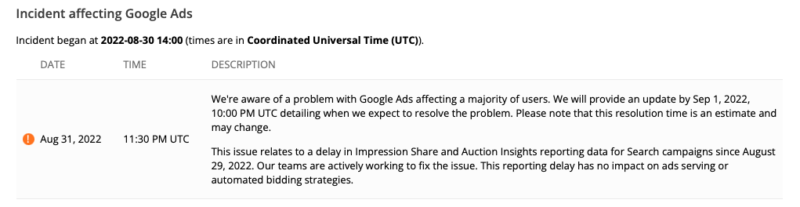
What Google says. Ads Liason Ginny Marvin said in a tweet that their team was working to fix the issue, and there would be no impact on ad serving or bidding strategies.
We're aware of an issue related to a delay in Impression Share & Auction Insights reporting for Search campaigns since 8/29 & are working to fix it. This doesn’t impact ad serving or automated bidding strategies. We’ll have updates here: https://t.co/o5sTGAwBbc
— AdsLiaison (@adsliaison) August 31, 2022
When will the issue be fixed. There is no ETA on when the issue will be fixed. But Google says they will provide an update by September 1. Advertisers can keep checking the status dashboard here.
Why we care. If you’re trying to report on Impression Share or use Auction Insights to manage your campaigns, you may want to wait until the issue has been resolved to prevent false information from affecting your decisions.
The post Google reports issue affecting Impression Share and Auction Insights appeared first on Search Engine Land.
Courtesy of Search Engine Land: News & Info About SEO, PPC, SEM, Search Engines & Search Marketing
Thursday, September 1st, 2022
If you were to play word association game about Google’s helpful content update, what would you say? Dud? Underwhelming? Or something similar?
That seems to be the general consensus so far. The Google helpful content update began rolling out one week ago. Google said it would take two weeks to fully roll out.
“Update isn’t done.” Google Search Liasion Danny Sullivan discussed the helpful content update yesterday in a series of tweets. He reminded us that the update hasn’t been fully rolled out yet and it will continue to be tuned and refined.
“Update isn’t done. It’s also part of a continuing effort, as we’ve explained. We’ll keep refining how it works. Directionally, the guidance we’ve given is what SEOs and creators should be considering.”
Danny Sullivan tweet
And Google’s John Mueller added: “I’d give it a bit more time”
“Updates don’t necessarily mean a big giant shift.” Google’s helpful content update was hyped to be as big as Panda and Penguin were a decade ago. But that hasn’t been the case so far.
“I also get that when we announce an update, there are the memes and the gifs and the jokes and the OMG the sky is falling reactions that can even make me laugh. But updates don’t necessarily mean a big giant shift. If you have good content, you’re generally fine…”
Danny Sullivan tweet
In some cases, that reaction has been warranted. Algorithm updates like Penguin, Panda, and Florida had a huge, detrimental impact on websites and businesses. However, Google didn’t pre-announce any of those updates.
But whenever a major update is pre-announced, people remember that chaos and confusion. That said, a couple of more recent Google updates (“mobilegeddon” and the page experience update) were pre-announced and ended up having a much smaller than anticipated impact.
Google discussed the helpful content update just a few days before launching it, which was hardly enough time to address potential sitewide content issues. Overall, SEOs weren’t overly concerned about the helpful content update.
“Part of a continuing effort.” While we’re a week in and all seems quiet so far, Sullivan reiterated that this is an update you shouldn’t ignore.
“With this helpful content update, as I said before, it’s part of a continuing effort. Directionally, it’s what SEOs and creators should pay attention to. We’ll continue to tune it, refine it. It matters, which is why we’ve spent so much time talking about it.”
Danny Sullivan tweet
And:
“If there hasn’t been any announced update, but you notice a change in traffic, it makes sense to review all our guidelines and advice. And if you find ‘hmm, maybe some of this content I have isn’t meeting what’s advised about helpful content,’ that’s a sign of what to work on.”
Danny Sullivan tweet
Why we care. Google algorithm updates can impact your rankings, traffic and revenue. Google led us to believe that this would have a significant impact. It hasn’t so far (or at least we’re not hearing about a large number of websites being negatively impacted). But this update is one you shouldn’t ignore.
The post Google: Helpful content update isn’t done appeared first on Search Engine Land.
Courtesy of Search Engine Land: News & Info About SEO, PPC, SEM, Search Engines & Search Marketing
Thursday, September 1st, 2022

We hear a lot of talk about SEO and Paid Search living together in perfect harmony, side by side on your search engine results page, but how do we?
The cost of unnecessary paid brand clicks quickly adds up. Especially if you’re already dominating your SERP (search engine results page). This can feel like an uphill battle for you and the team as economic sentiment continues in uncertainty and spend efficiency is still top of mind.
Join Gary Galloway, Senior Director of Product Marketing at Adthena, as he covers how you can support growth strategies and help your brand achieve SERP while also decreasing costs
Register today for “Skyrocket your results with organic and paid search harmony,” presented by Adthena.
The post Webinar: Paid and organic search harmony can skyrocket your results appeared first on Search Engine Land.
Courtesy of Search Engine Land: News & Info About SEO, PPC, SEM, Search Engines & Search Marketing
Wednesday, August 31st, 2022

When we talk about creating a video strategy, people usually see it as getting found on YouTube. And for good reason – billions of users access the platform every single month.
And then comes an inevitable argument: “I don’t think my product or service is a good fit for YouTube.”
Yet, creating and marketing videos goes far beyond YouTube findability.
Videos can make your content better, your product easier to understand and your brand more credible and relatable. Further, videos continue to receive exposure on Page 1 of Google’s search results for an increasing number of queries.
Even beyond that, a well-shaped video strategy can boost your overall SEO efforts. Here’s how.
1. Deeper understanding of your customers’ buying journeys
Video keyword research allows for discovery regarding which queries your target audience is using when searching for videos.
Knowing how your target audience is searching for related videos can give you a better understanding of their buying journeys, problems they are struggling to solve and tasks they are trying to complete.
When we turn to video content, we tend to look for informational or entertaining content, but we may also be able to uncover content opportunities that naturally solve the customers’ needs best in video format: how-to videos, product demonstrations, comparisons, and so on. A solid marketing strategy should always include both of these parts of buying journeys.
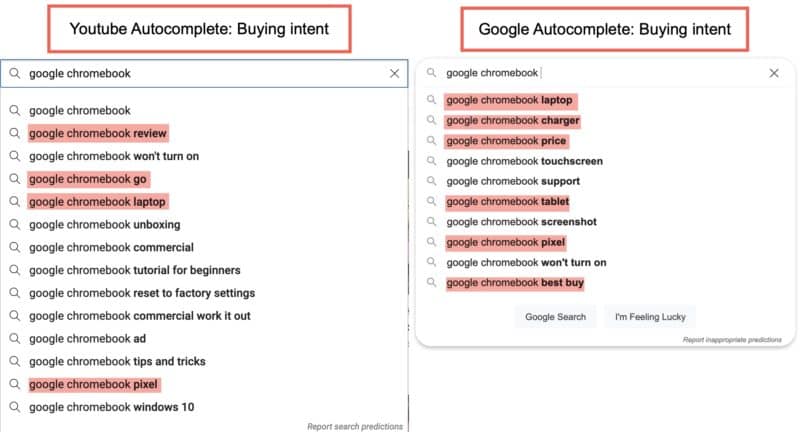
If you compare Google and YouTube auto suggestions, you will notice that YouTube search attracts a specific type of audience. If you search Google for Google Chromebook, for example, the top suggestions will be Google Chromebook laptop, Google Chromebook charger and Google Chromebook price – all three clearly signaling a commercial intent (i.e., start of a buying journey).
Some of YouTube’s top suggestions for Google Chromebook are Google Chromebook won’t turn on and Google Chromebook tutorial for beginners, which reflect an informational intent, possibly for a current owner of the product.
Not all YouTube suggestions have an informational intent, though. Based on YouTube autocomplete, people use the platform to find reviews of products from current customers of the brand, unboxing videos, as well as information on specific models.
And yet, YouTube-driven buying journeys seem to be very different from those that happen in Google, which makes YouTube suggestions such a powerful addition to any keyword research strategy.
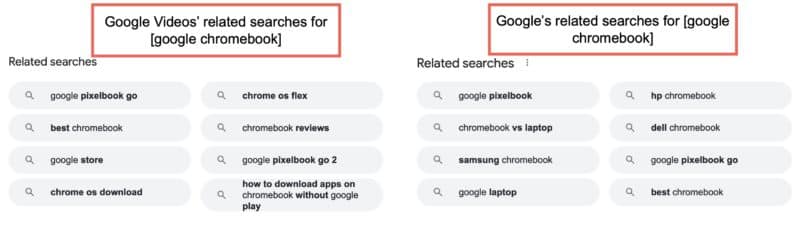
A similar pattern applies to Google Video search, which often reveals a different angle or buying journey your target audience may take when researching their options.
Like Google’s regular search, the Google video section generates “related search” suggestions underneath organic search results. Here again, video-related searches differ from those you will see when using Google’s main search showing that people use Google videos for different purposes:
This way, Google Videos’ related searches allow you to discover keywords you’d miss if you were only relying on Google’s regular search results.
To sum up, when you start researching video-driven search queries, you get a better understanding of your target market and where your product may fit in. Your overall SEO strategy becomes better informed than that of your competitors.
Talk about a good way to find new “helpful content” opportunities! 
2. Better on-SERP visibility through video carousels
Google’s search engine results are much more diverse, visual and interactive than they were a decade ago.
These days Google’s SERPs include related images, instant answers, popular questions, and more.
One of the most visible sections is the one that includes related videos.
Videos have gained huge visibility in organic search results, mainly through video carousels.
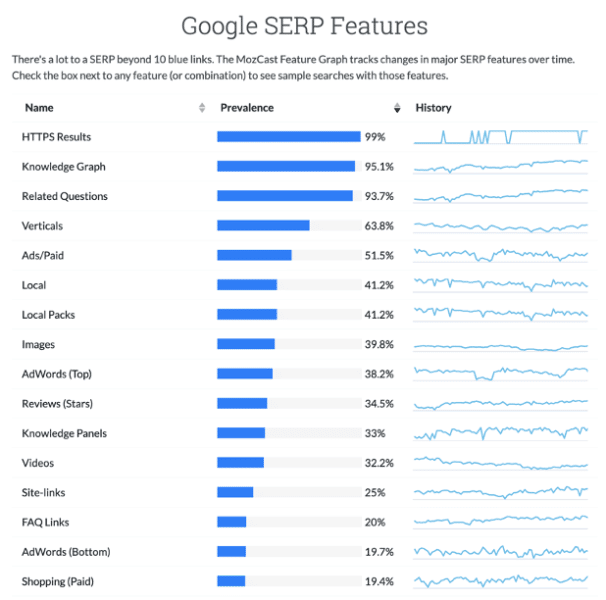
Based on Mozcast data, videos show up in at least 30% of Google’s SERPs:
In many cases, video results are “blended,” i.e., they are included in a standalone section that is not an organic listing but is added within SERPs as a standalone element.
This section is called a video carousel.
What is a video carousel?
A video carousel is a separate search element within Google SERPs that contains related videos.
Video carousels are often included on the first page of search results, but the location of the section may vary depending on the specific searcher’s intent.
Sometimes video carousels show up right on top of SERPs: Try searching for “how to tie a tie,” for example. The video-only search snippet and the video carousel dominate the whole above-the-fold part of the screen, especially if you search from a mobile device. For other queries, the section may be included lower on a search result page.
In some cases, YouTube videos are not included into a carousel and simply act as organic results. This is different (a video actually counts towards the ten organic links that are allowed on page one) but still rewarding: You are able to see a huge thumbnail of the video, which is hard to miss, likely increasing the click-through rate for that rank position.
In both cases (carousels and organic results), when accessed from a mobile device, this video can be played right within search results.
In other words, in both of these cases, well-optimized and hence high-ranking videos that are branded provide additional visibility to a brand helping it dominate its target search result pages with more than a single organic listing.
3. More visibility in organic search with video-rich snippets
While YouTube video pages may act as organic listings giving you additional visibility, earning video-rich snippets allows you to get your own page ranked in the same SERPs.
Video rich snippets are enriched organic search results that include a video thumbnail from the page, making the result that much harder to miss:
Unlike video carousels that provide brands with indirect exposure (people clicking a video in a carousel normally land on that YouTube page or watch that video right away from within Google’s search result page), video-rich snippets trigger a direct click to your site.
To earn a video-rich snippet, publishers need to embed a video on that page and use video schema.
Another benefit of earning a video-rich snippet is that it creates an expectation: People seeing a video thumbnail and clicking through to a page expect to find a video on that page, so they are more likely to stay on the page and watch the video. This, in turn, increases the probability that they will continue their journeys through the site, engage with your brand more, and dive deeper into the conversion funnel.
Conclusion
A video marketing strategy is more than making your brand or product findable on YouTube. When you start researching video opportunities, you’ll get to understand your audience better and uncover more SEO opportunities. Additionally, you make your brand stand out in search by having your video show up in related carousels, ranking your YouTube page in organic search and/or earning video snippets.
Google has created a lot of opportunities to make your SEO strategy better informed and more diverse by including videos into your digital marketing routine. If you’re unsure where to begin or don’t have the resources to implement a video strategy yourself, a comprehensive video creation and marketing service can help transform your digital presence, improve brand sentiment & trust, and increase sales & conversions across the web.
The post How video SEO can boost your overall digital marketing strategy appeared first on Search Engine Land.
Courtesy of Search Engine Land: News & Info About SEO, PPC, SEM, Search Engines & Search Marketing