Archive for the ‘seo news’ Category
Monday, August 5th, 2024
A federal judge ruled that Google maintained an illegal monopoly in search and advertising markets, marking a significant victory for the Department of Justice.
Why it matters. This is the first major decision in a wave of tech monopoly cases brought by the U.S. government in recent years, potentially setting a precedent for future rulings against other tech giants.
Key details:
- Judge Amit Mehta found Google violated Section 2 of the Sherman Act, which prohibits monpolies
- The court focused on Google’s exclusive search deals with Android and Apple devices as key to its anticompetitive behaviour.
- The ruling focuses on Google’s liability, not remedies
- Decision comes after a 10-week trial last fall
Why we care. While immediate changes are unlikely, advertisers should start preparing for potential long-term impacts on their digital marketing strategies.
Between the lines. The case revealed Google pays Apple $20 billion annually for default search status on iPhones.
The big picture. This ruling could influence how century-old antitrust laws are applied to modern digital markets in pending cases against Amazon, Apple, and Meta.
What’s next:
- Remedies to address Google’s monopoly will be determined in future proceedings
- Google faces another DOJ trial over its ad tech business, starting September 9th
What they’re saying. “Google is a monopolist, and it has acted as one to maintain its monopoly,” Judge Mehta wrote in his decision.
The bottom line. While a major setback for Google, the full impact on its business practices remains to be seen as the case moves to the remedies phase.
Courtesy of Search Engine Land: News & Info About SEO, PPC, SEM, Search Engines & Search Marketing
Monday, August 5th, 2024
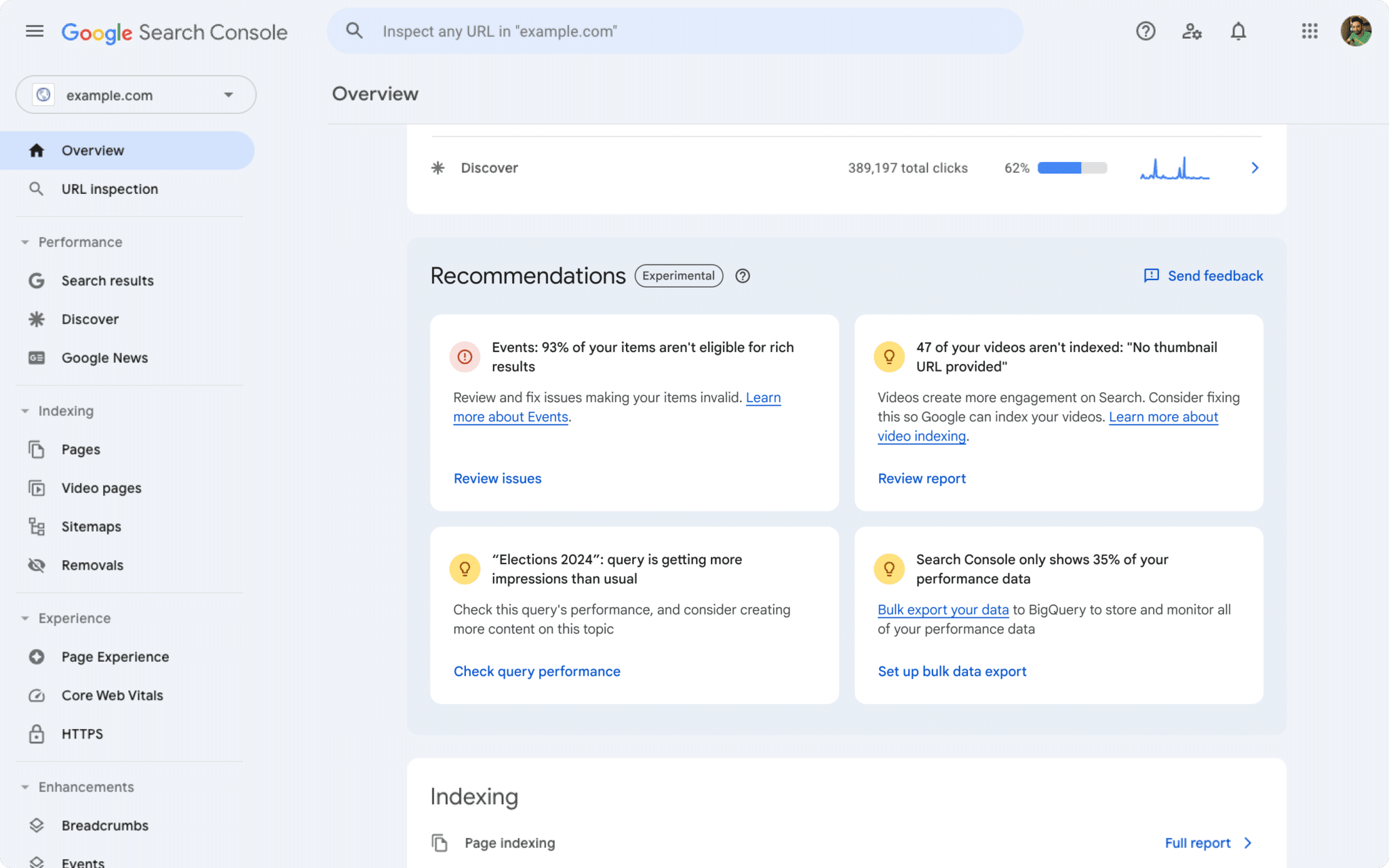
Google Search Console is rolling out recommendations within Google Search Console for some users. Google said this is an experimental feature and gives you insights and recommendations to improve your site’s performance on Google Search.
What are Search Console recommendations. Search Console recommendations is a “feature that provides websites with optimization opportunities and suggests actions they can take to improve their presence on Google Search,” Google wrote.
Recommendations offer you tips to help with indexing, crawling and serving based on the data Google collects in Search Console. “The data was already available to you on Search Console, but now we’re helping to make it more accessible by providing direct recommendations,” Google added.
Google updates the recommendations on a “regular basis and may expire or change details over time,” Google added. If Google does not have any recommendations, Google will show none.
You can learn more in this help document.
What it looks like. Here is a screenshot from Google of these new recommendations in Search Console:
Why we care. These recommendations may provide insights into improving your sites or client site’s indexing, scrawling and serving in Google Search. Some may be obvious to experienced SEOs, some may prove to not be too helpful, while others may be super helpful.
Keep on the look out for these recommendations in Search Console.
Courtesy of Search Engine Land: News & Info About SEO, PPC, SEM, Search Engines & Search Marketing
Friday, August 2nd, 2024
Google Ads is experiencing a significant outage affecting multiple reporting tools and product management features.
Why we care. This outage is impacting advertisers’ ability to manage campaigns and access critical performance data.
Details:
- Down: Report Editor, Dashboards, Saved Reports in web interface.
- Affected: Products, Product Groups, Listing Groups pages across web, API, and Google Ads Editor.
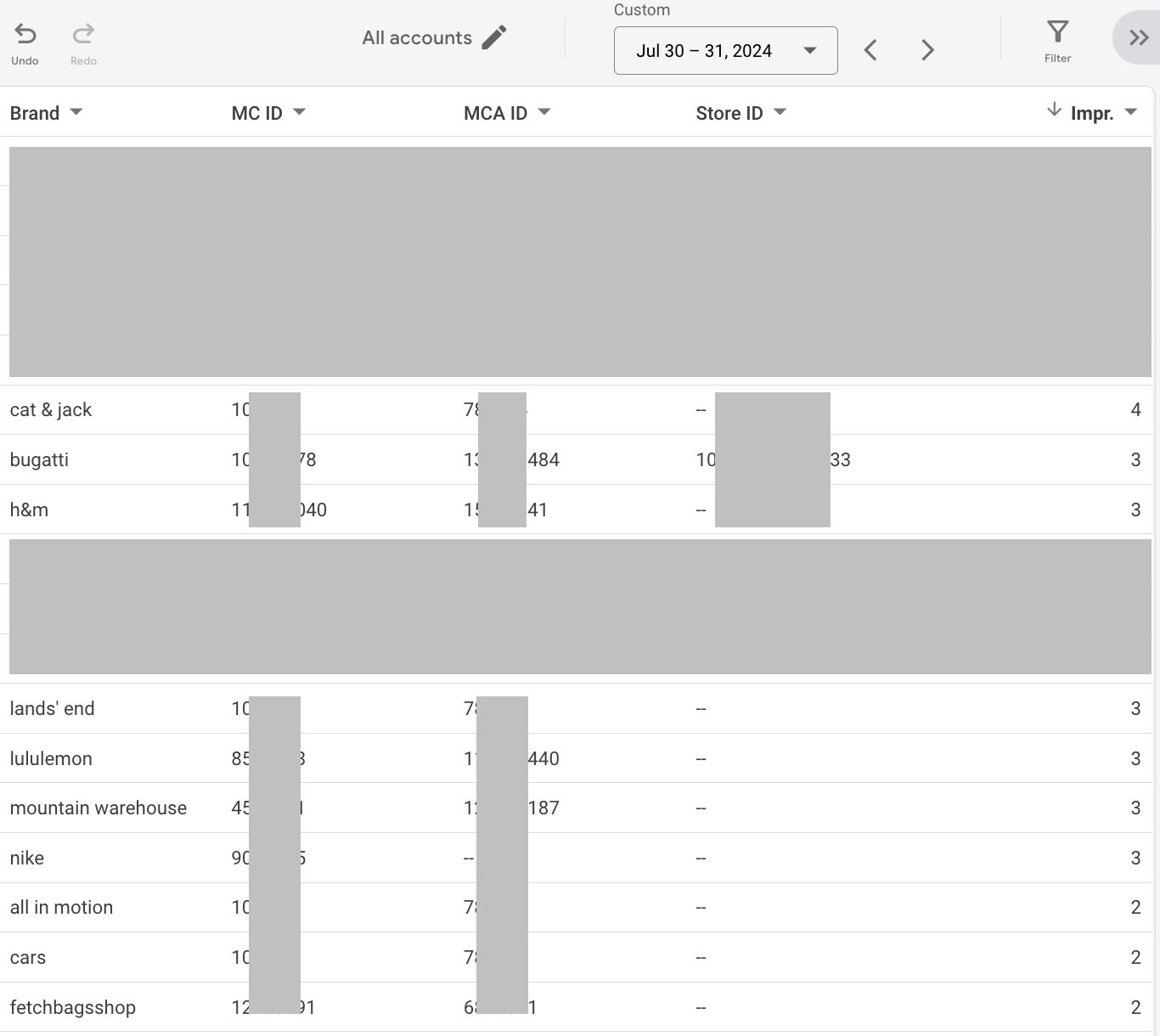
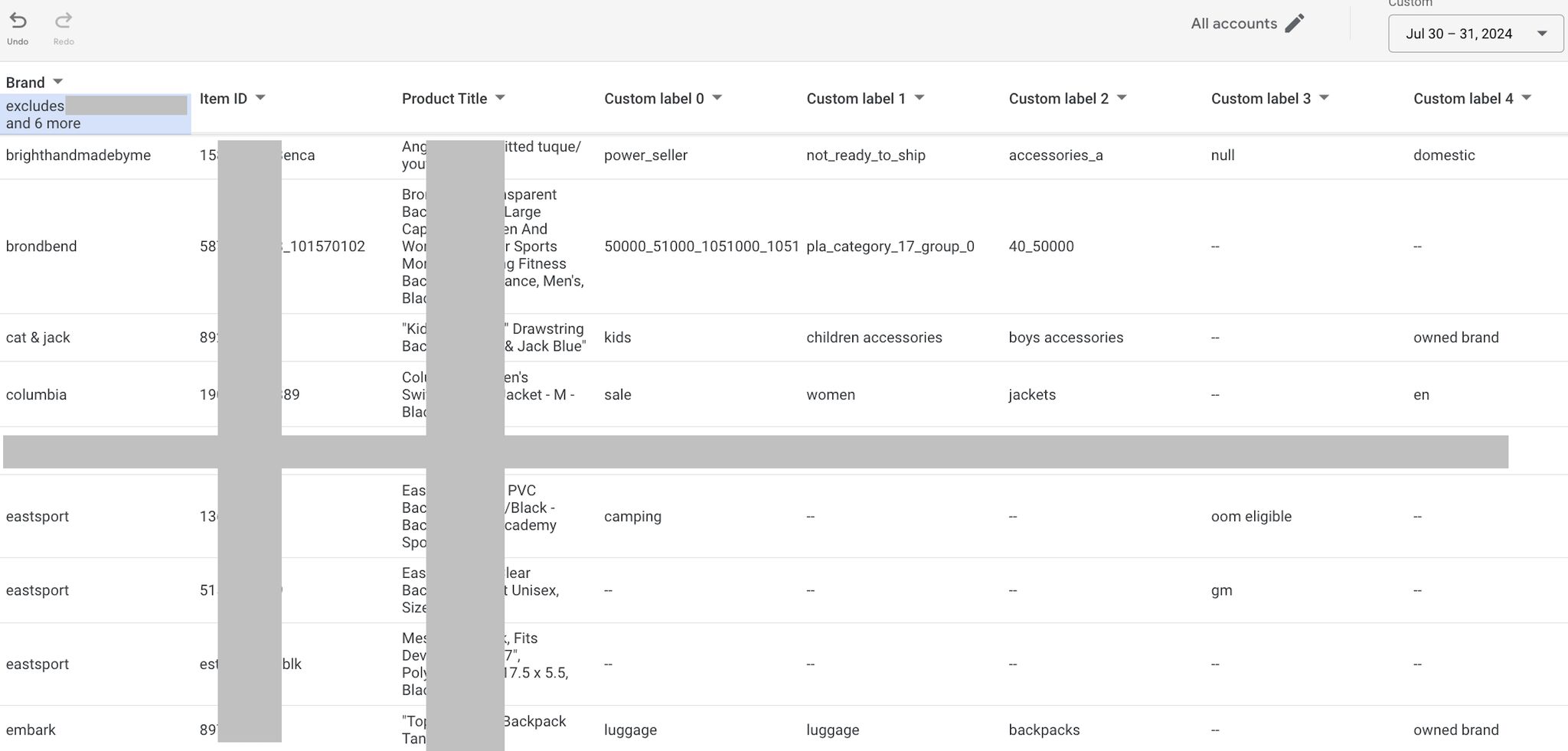
- Data breach: Unrelated item IDs, product titles, and Merchant Centre information visible to competitors.
Between the lines. This glitch raises serious privacy concerns, as advertisers can potentially identify direct competitors by searching exposed product titles.
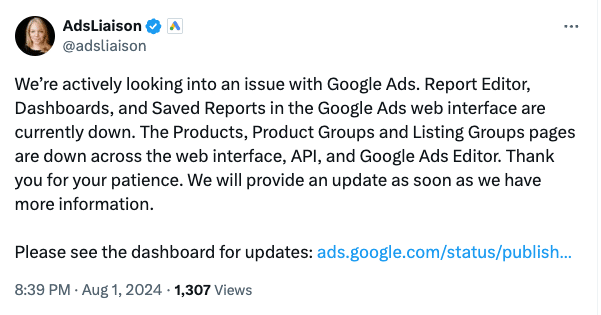
What they’re saying. Google Ads Liaison, Ginny Marvin acknowledged the issue on X, and is “actively looking into” it, promising updates as more information becomes available:
What to watch. How quickly Google resolves the outage and addresses the data exposure, and potential fallout from the privacy breach.
First seen: UK advertising agency, Bidnamic reported a severe data breach on LinkedIn between July 30-31, 2024, with advertisers seeing competitors’ sensitive information in their accounts.
Bottom line. Advertisers should exercise caution when accessing their Google Ads accounts and avoid acting on any data until Google confirms the issue is resolved.
Courtesy of Search Engine Land: News & Info About SEO, PPC, SEM, Search Engines & Search Marketing
Friday, August 2nd, 2024
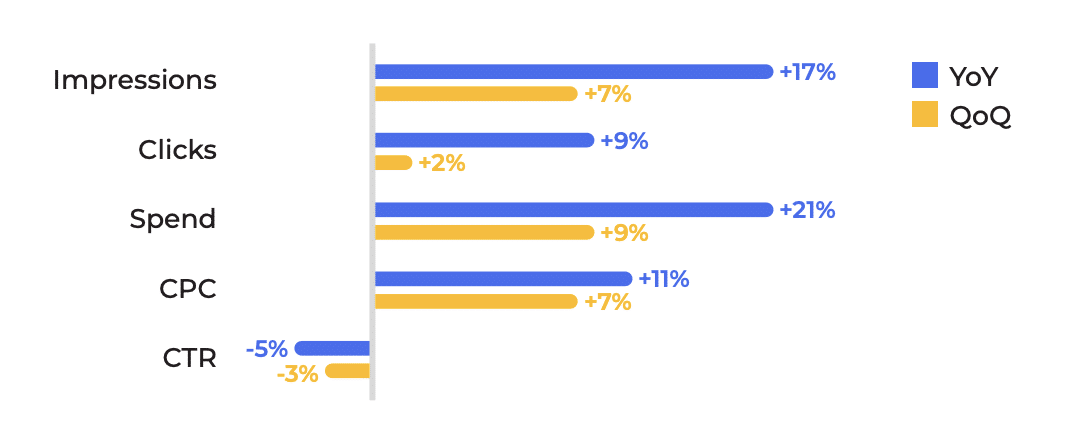
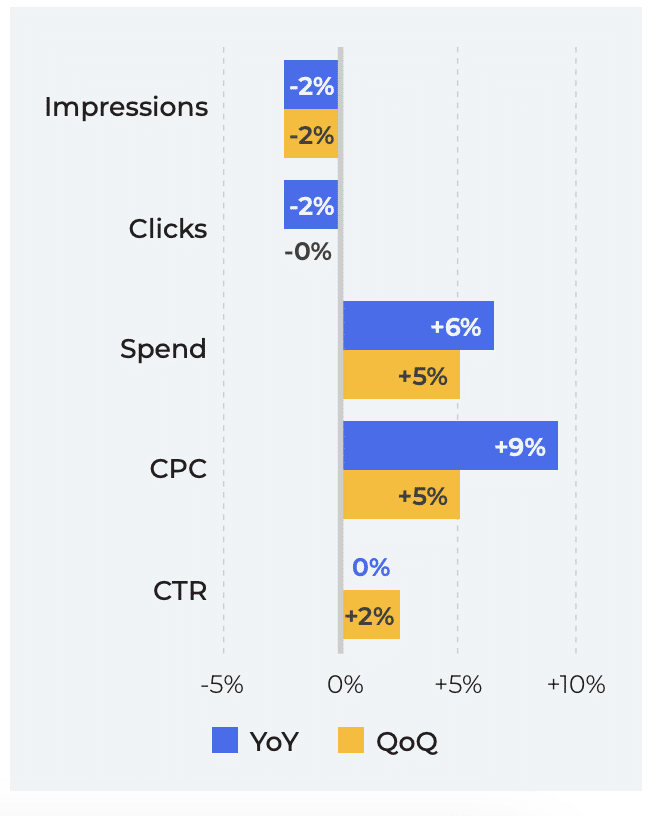
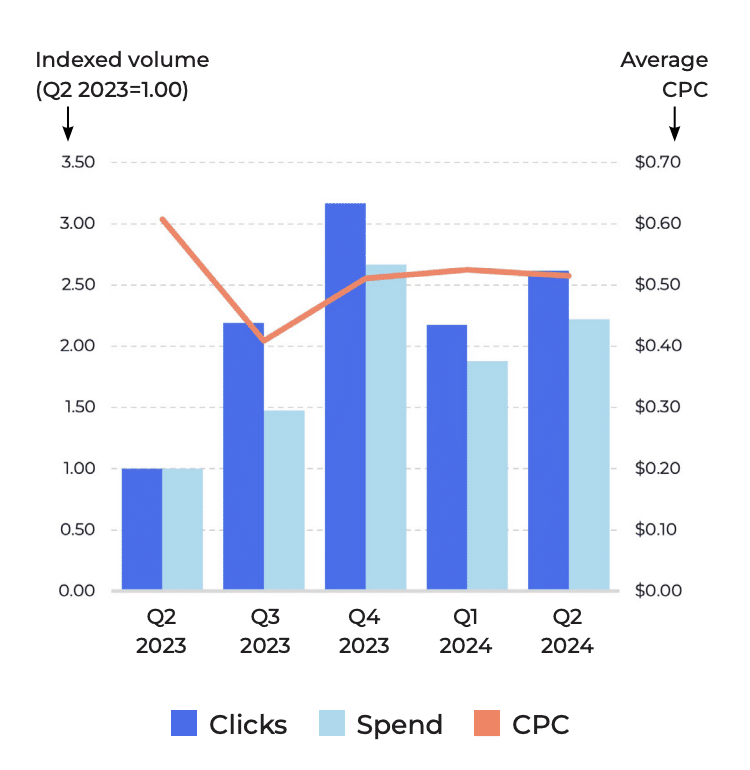
Digital advertising spend increased across retail media, paid search, and paid social in Q2 2024, despite rising ad prices, according to new data from Skai.
By the numbers:
- Retail media spend grew 21% year-over-year.
- Paid search spend increased 6% YoY.
- Paid social spend rose 13% YoY.
The big picture. Higher ad prices drove most of the spending growth, while ad volumes (clicks and impressions) slowed or decreased in some channels.
Yes, but: Despite higher prices, key performance metrics like conversion rates have largely kept pace, suggesting improved ad efficiency.
Why we care. Despite higher prices, conversion rates are holding steady, suggesting potential opportunities for advertisers who can navigate the changing landscape effectively and aren’t deterred by all the AI updates.
Between the lines: The shift to newer ad formats like Google’s Performance Max and Meta’s Advantage Shopping Campaigns+ is contributing to the changing dynamics.
- Performance Max now accounts for 13% of paid search spend on Skai’s platform:
- Advantage Shopping Campaigns+ spending grew nearly 6x YoY, but still only makes up 5% of Meta spend
What to watch. As advertisers adapt strategies to handle higher prices, historical trends suggest this period of price increases may be temporary.
Bottom line. Advertisers are navigating a complex landscape of rising costs and evolving ad formats, but so far are maintaining performance through optimization and new tools.
The report. You can read the full Q2 2024 Quarterly Trends Report (PDF) from Skai.
Courtesy of Search Engine Land: News & Info About SEO, PPC, SEM, Search Engines & Search Marketing
Friday, August 2nd, 2024
Enterprise SEO will always be a unique challenge for those who are in the field and doing the work. Most enterprises make changes more slowly than the SEO landscape evolves.
This will be even more true in 2024, given how rapidly AI and tools like ChatGPT, Gemini and Copilot are building a presence in how people find information and how much they trust it.
In this article, we’ll touch on key skills, both hard and soft, that I think are critical to enterprise SEO today and beyond.
AI
I’ve gone through my personal thoughts on AI previously, and while I do not use it for content creation, I still use it for other purposes, such as:
- Formula creation.
- Building AppScripts.
- Guiding in the creation of tools to help my own productivity, which I wouldn’t otherwise be able to do myself without a lot more time and effort.
It’s a big issue you can’t ignore if you want to succeed.
1. Using AI on your own day-to-day
Up to 64% of business owners stated that AI would improve business productivity and 42% believe it will streamline job processes, according to Forbes. That is now a blanket expectation for “office” roles like SEO.
Even if, like me, you aren’t keen on using AI-based tools for the creative elements of your role, leverage them to build the processes in the background for your boring, repeatable tasks.
2. Applying AI within SEO
The AI market is expected to reach $407 billion by 2027, and to date, half of U.S. mobile users use voice search every day. Whether you believe that ChatGPT and other LLMs are going to be viable marketing channels, your bosses probably do.
You need to carefully explore how to increase your visibility in ChatGPT. This is a cutting-edge area of SEO with limited resources, but experts like Wil Reynolds, Michael King and Jes Scholz can help. Key points to consider are:
- While a good starting point, ChatGPT does not retrieve answers the same way “People Also Ask” answers seem to.
- Bing’s index powers many current LLM models, like ChatGPT. Use Bing Webmaster Tools more frequently and start digging.
- Understanding RAG, how it works and what triggers it could make or break visibility in LLMs.
Scalability
One of the biggest differentiators of enterprise SEO is scale. It’s not a few hundred pages; it’s a few million, maybe more.
It’s difficult to sit down and actually analyze trends if you aren’t able to analyze to scale. The migration of many to GA4 might only make this more difficult.
I will fully admit that these two particular skills are controversial because I’m still learning them.
3. SQL
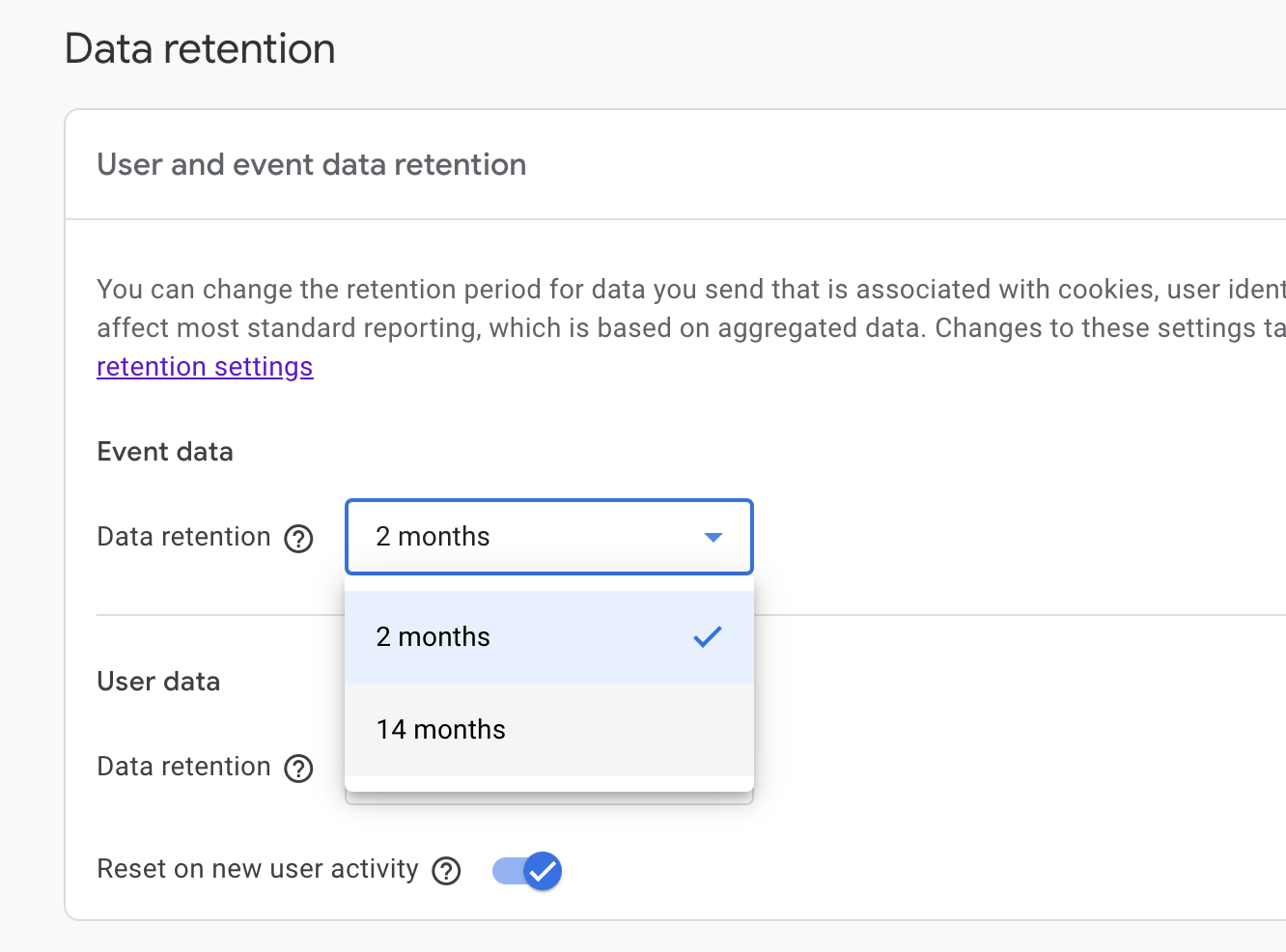
With GA4 and the push to create data lakes via BigQuery with your own historical data rather than Google retaining it, you may hit a point in your year-on-year analysis in Google Analytics now within the interface where you may hit a wall, specifically with conversion events.
Even though I haven’t faced this with my clients yet, I’d rather be prepared in advance than learn everything quickly when it happens.
Learning these skills could mean you lessen your reliance on your analytics team for questions about things like year-on-year conversion data and deep dives into why or how that was.
4. Log file analysis
This skill helps you understand how and when Google crawls your website. It also helps you identify if Google is stuck on or repeatedly visits unimportant pages.
While not exactly “pruning,” knowing how Google interacts with your site is increasingly important for crawlability.
Dig deeper: Why server logs matter for SEO
5. Python
While SQL for SEOs is most closely related to data analysis within Google Analytics or your data lake, you can deputize Python to do any number of things, including, but not limited to:
- Identifying user intent.
- Monitoring competitor websites for changes.
- Internal link analysis.
While the late Hamlet Batista’s archive, SEO Pythonistas, is no longer live, he has a range of tutorials here on Search Engine Land to help you kick off your learning journey.
Dig deeper: 5 Python scripts for automating SEO tasks
Brand
SEO is moving closer and closer to the brand team.
Why?
Because Google is able to ingest so many more “brand” signals.
Over the years, Google has built a detailed understanding of brands, similar to its own version of Wikipedia, to grasp their importance and nuances better.
6. PR/digital PR
I’m not saying everyone needs to become an expert in outreach and brand management. However, it’s increasingly important to connect with the people in your company who handle press and PR.
Traditional PR is catching up on SEO and practices like deep-linking, but they might need some guidance or reminders.
Dig deeper: What is digital PR for SEO?
7. Social channels
Google is getting better at understanding your brand as a whole and showing that in search results. This makes it crucial to have a unified marketing strategy across all channels.
For example, if something is heavily promoted on Instagram or TikTok but barely mentioned on your website, it might not perform well.
Communicating and planning with your other marketing channels, especially social media, will help improve your results.
I say “particularly social” because Google is using videos from platforms like TikTok and Instagram directly in search results. Brand consistency is likely to become even more important as generative search expands.
Dig deeper: Social search and the future of brand engagement
8. Schema and semantic markup
As Google evolves and adds more data, it will accept more types of schema markup. Knowing how to properly use and organize schema markup will become increasingly important as data grows.
Emilia Gjorgjevska at WordLift explained why schema and semantic markup are important and here to stay. She highlights schema’s crucial role at the enterprise level, even if its impact on revenue or sales isn’t always clear:
“Schema markup enhances search engine understanding by providing structured data that helps search engines better comprehend the content of a webpage. […] Generative AI models, like those used in search engines, rely on clear and accurate data to provide relevant results. Schema markup ensures that AI can accurately interpret and leverage your content, thereby enhancing its visibility and relevance.
Enriching your website with schema markup also enhances the discoverability of your content. […]
[S]chema markup enables businesses to quickly and accurately update search engines about changes and new offerings. This rapid communication is vital for maintaining up-to-date information and ensuring that users receive the most current data about products and services.”
9. Reporting
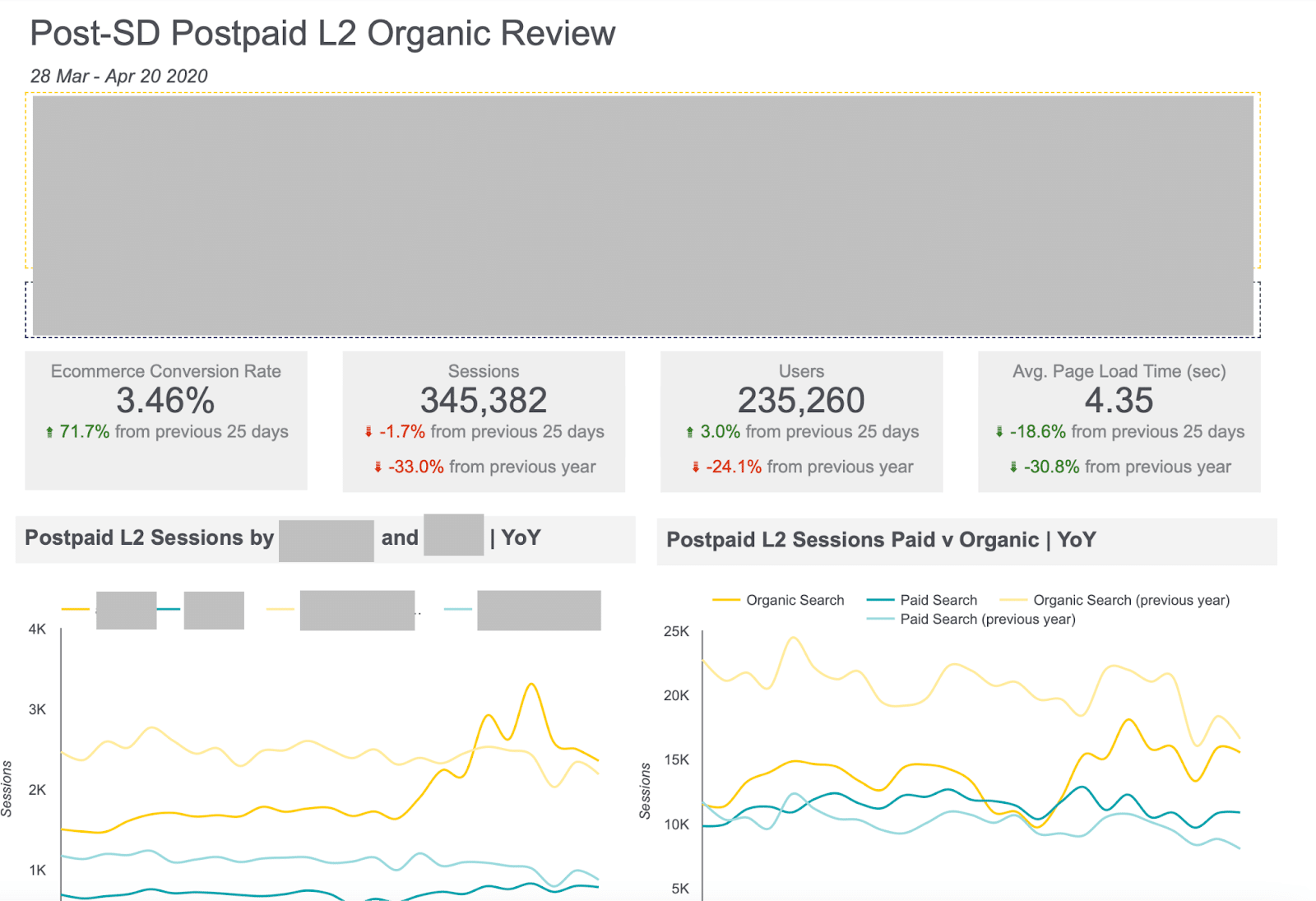 The author’s first attempt at progressive reporting at a previous enterprise role.
Enterprise reporting can be challenging. We might have to pull data manually; it can be incorrect or there might be outages or delays. But sometimes, we make it more complicated than necessary because we’re too focused on the details.
I’m an advocate of what Ian Lurie has long suggested: use progressive detail.
- For your boss’s boss who only wants a summary of business KPIs, give them that.
- For product owners in sales who need more details on the same KPIs, provide that.
- And for your immediate colleagues or boss who want detailed charts, give them those.
Learning how to create graphs that get to the point quickly and align with business KPIs will likely make your life quite a bit easier. Reporting well is a skill and a muscle that needs building.
Along with Lurie, Tom Critchlow also has some fabulous guidance on reporting and metrics.
10. Stakeholder management
Much like reporting, stakeholder management is a skill that requires effort and practice to develop.
Ultimately, it is an exercise in compromise. This may be difficult if you’re coming into the enterprise from a smaller company where you were able to access the website and make the changes yourself if nobody was particularly responsive.
Dig deeper: How to use SEO education for stakeholder management
11. Business and market understanding
You may notice I’ve mentioned the business a lot, whether it’s KPIs or brand continuity. Understanding the business context is crucial for making a significant SEO impact at an enterprise level.
Knowing what your competitors are doing and your own business roadmap should guide your SEO strategy. For example, if you plan to launch a gaming arm in 18 months, start building relationships and context now.
If you’re about to change your pricing, don’t update product pages with language about saving money. The idea is to align your SEO priorities with your business plans.
Dig deeper: Enterprise SEO is 50% education and culture
Courtesy of Search Engine Land: News & Info About SEO, PPC, SEM, Search Engines & Search Marketing
Friday, August 2nd, 2024
Reddit will continue blocking Microsoft and other search engines and AI models from crawling its content using robots.txt – unless they strike a content licensing deal. That’s what Reddit CEO Steve Huffman said in a new interview.
Why Reddit is blocking search engines. Noting it’s been “a real pain in the ass to block these companies,” here’s what else Huffman told technology news site The Verge:
- “Without these agreements, we don’t have any say or knowledge of how our data is displayed and what it’s used for, which has put us in a position now of blocking folks who haven’t been willing to come to terms with how we’d like our data to be used or not used.”
- “We’ve had Microsoft, Anthropic, and Perplexity act as though all of the content on the internet is free for them to use. That’s their real position.”
- “I think the traditional value exchange from search engines has changed. Search and summarization and training are merging, and the value exchange of crawling in exchange for traffic back is becoming muddied.”
Freeware. Yes, Microsoft AI CEO Mustafa Suleyman actually called web content “freeware,” saying anybody can copy and use it:
- “…With respect to content that is already on the open web, the social contract of that content since the ’90s has been that it is fair use. Anyone can copy it, recreate with it, reproduce with it. That has been freeware, if you like. That’s been the understanding.”
Google not blocked. Meanwhile, Reddit didn’t block Google. That’s because Google pays Reddit $60 million a year. That content licensing deal was announced in February.
Microsoft statement. Following the news about Reddit blocking search engines, a Microsoft spokesperson told Search Engine Land:
- “Microsoft respects the robots.txt standard and we honor the directions provided by websites that do not want content on their pages to be used with our generative AI models. Bing stopped crawling Reddit after they implemented their updated robots.txt file on July 1, which prohibits all crawling of their site.“
Why we care. Reddit is in a powerful position, having a licensing deal with Google – not to mention the insane amount of organic visibility and traffic it’s getting due to its prominence in Google Search results. However, other content producers and publishers likely will need whatever visibility and traffic they can get from AI search and answer engines by incorporating generative engine optimization (GEO) strategies.
Courtesy of Search Engine Land: News & Info About SEO, PPC, SEM, Search Engines & Search Marketing
Thursday, August 1st, 2024
Google Analytics 4 (GA4) is a powerful tool for analyzing website and app traffic, offering valuable insights into user behavior and campaign performance.
This article explores how SEO professionals can leverage GA4’s features to refine their strategies, from linking with Google Search Console to analyzing organic traffic and setting up custom events.
We’ll examine specific reports and metrics that provide actionable data for improving SEO performance.
Link Google Search Console with GA4 for data analysis
By default, Google Analytics 4 does not automatically show Search Console data just by linking accounts.
You need to publish the reports manually to view this data in GA4, which is useful for analyzing organic traffic. (Learn how to link GA4 with Google Search Console in this article.)
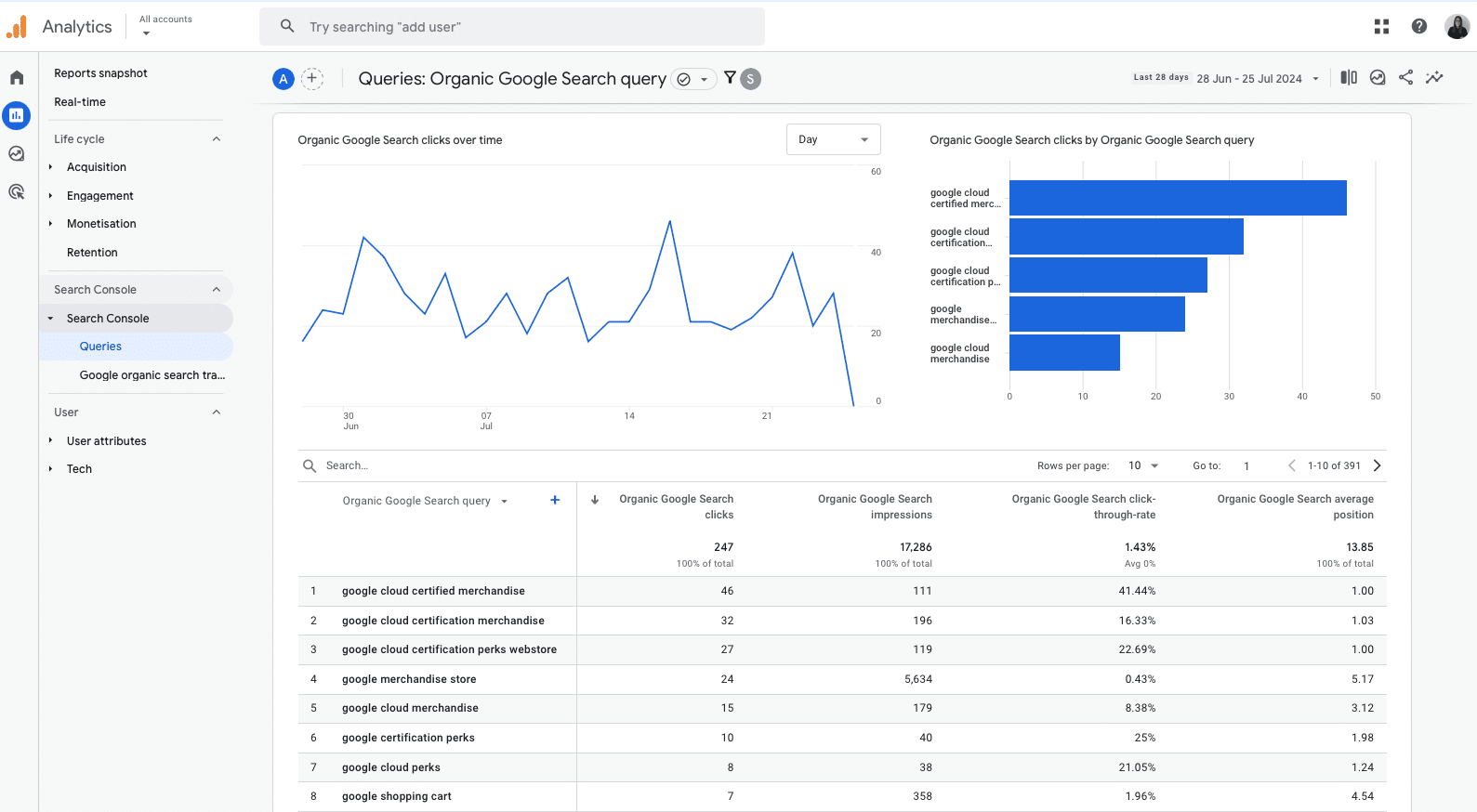
Linking and publishing Search Console data in GA4 will allow you to have the following reports for analyzing queries and organic traffic:
- Queries report: This report shows metrics for search terms used by visitors from Google organic search. You can see impressions, clicks, click-through rate (CTR) and average keyword rankings.
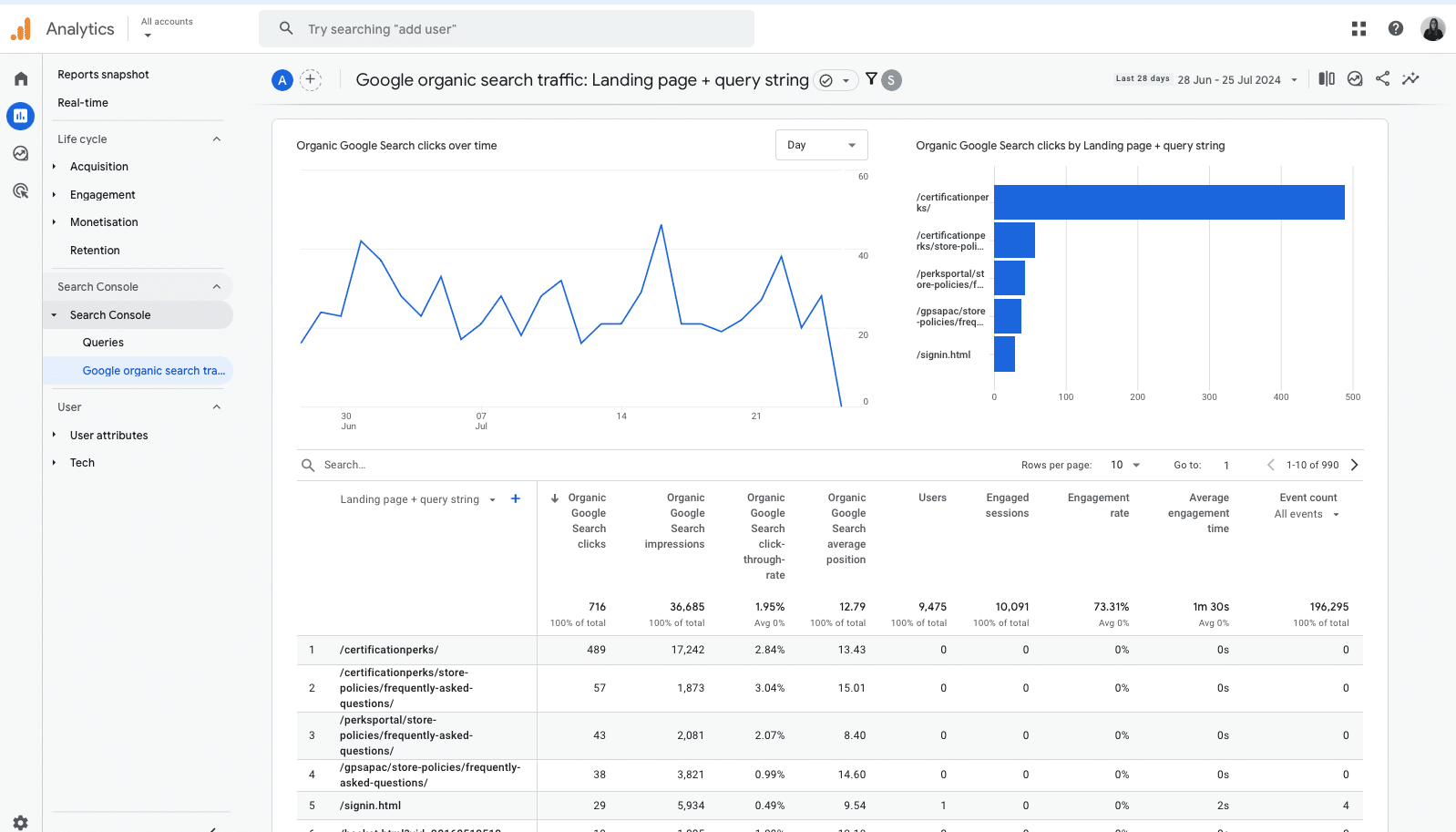
- Google organic search traffic report: This report shows how individual URLs perform with traffic from Google’s organic search. You can analyze data by the users’ landing page + query string, country and device type.
Analyze your website’s organic traffic
Organic traffic is the traffic acquisition channel by which users reach a website through non-advertising links from organic search results.
In GA4, in addition to Search Console data, there are other reports available that help you analyze your website’s organic traffic:
Measure organic traffic in GA4
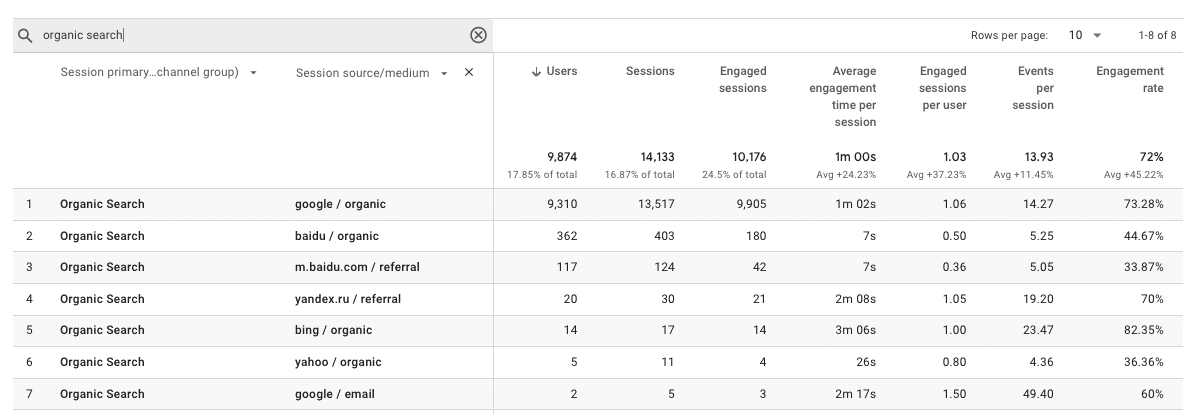
GA4 account owners can analyze organic traffic from search engines using the GA4 Acquisition report.
In this section, you can filter by different mediums (i.e., “organic”) and traffic sources (e.g., Google or Bing) and see how well these campaigns are performing.
Analyze specific website URLs
Organic traffic can be analyzed both broadly and at the level of individual URLs. This helps you evaluate the performance of specific pages.
The landing page report
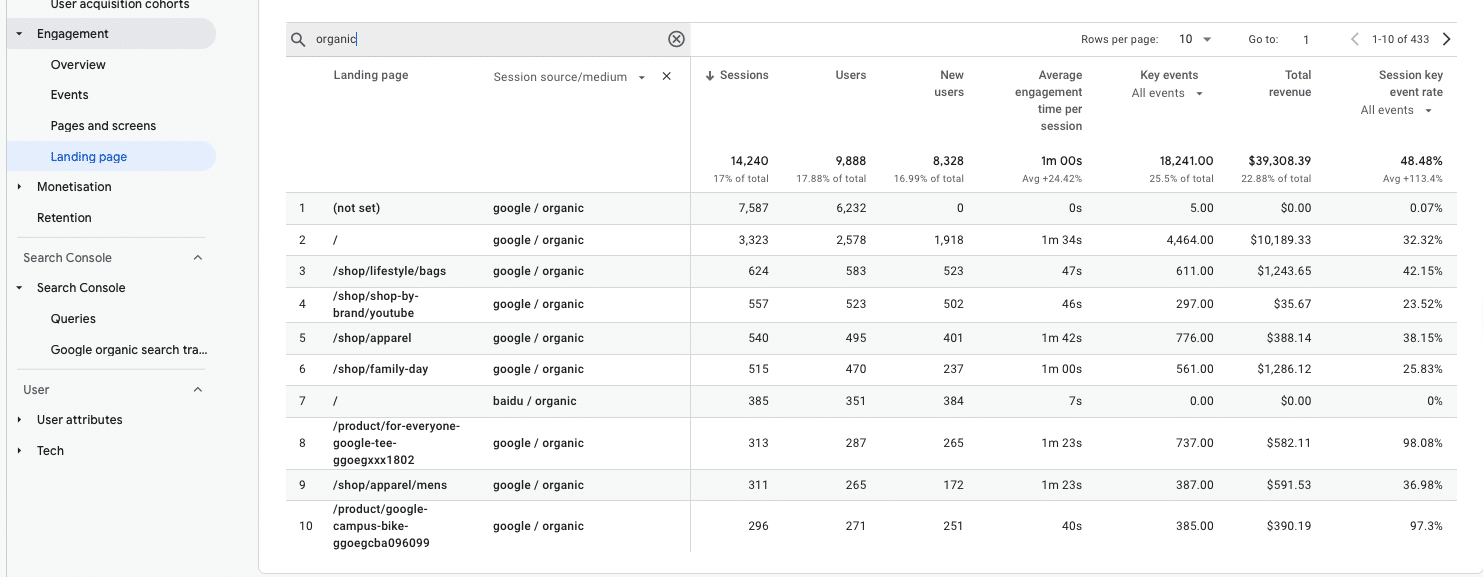
In Reports > Engagement, the landing page report shows the first page visitors land on and the number of visitors to each page. This helps identify which pages get the most organic traffic and how they perform.
For example, you can filter and analyze visits coming from organic traffic, measure user interaction time and evaluate the percentage of users who engage with the content.
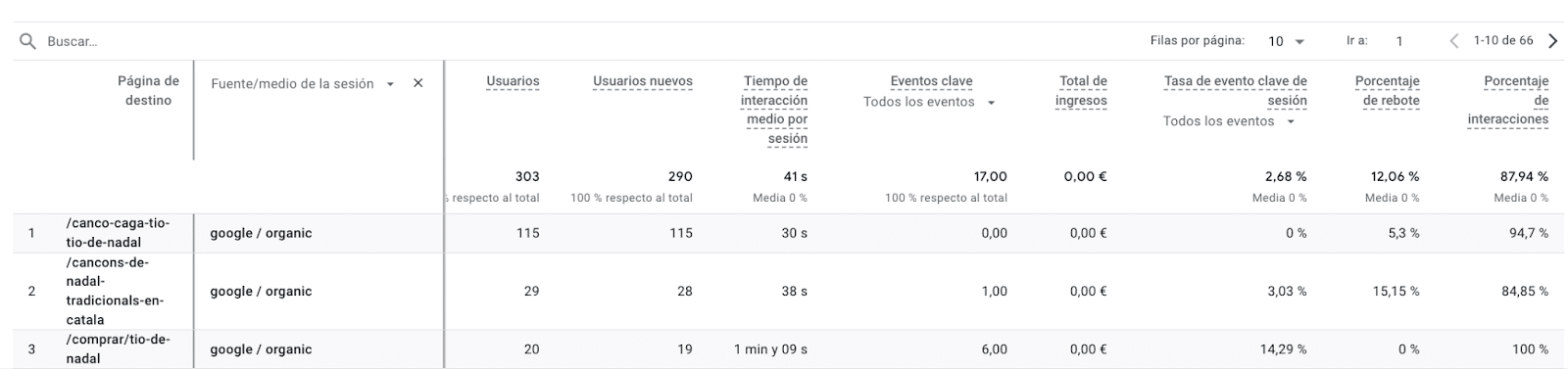
On the other hand, you can also track the bounce rate, which indicates the percentage of users who leave the site without interacting further:
This report also provides insights into how users convert on each specific URL of the website.
You can analyze the events, even filtering by specific events, that users perform based on their landing page.
This can help you improve landing pages and prioritize those with better performance:
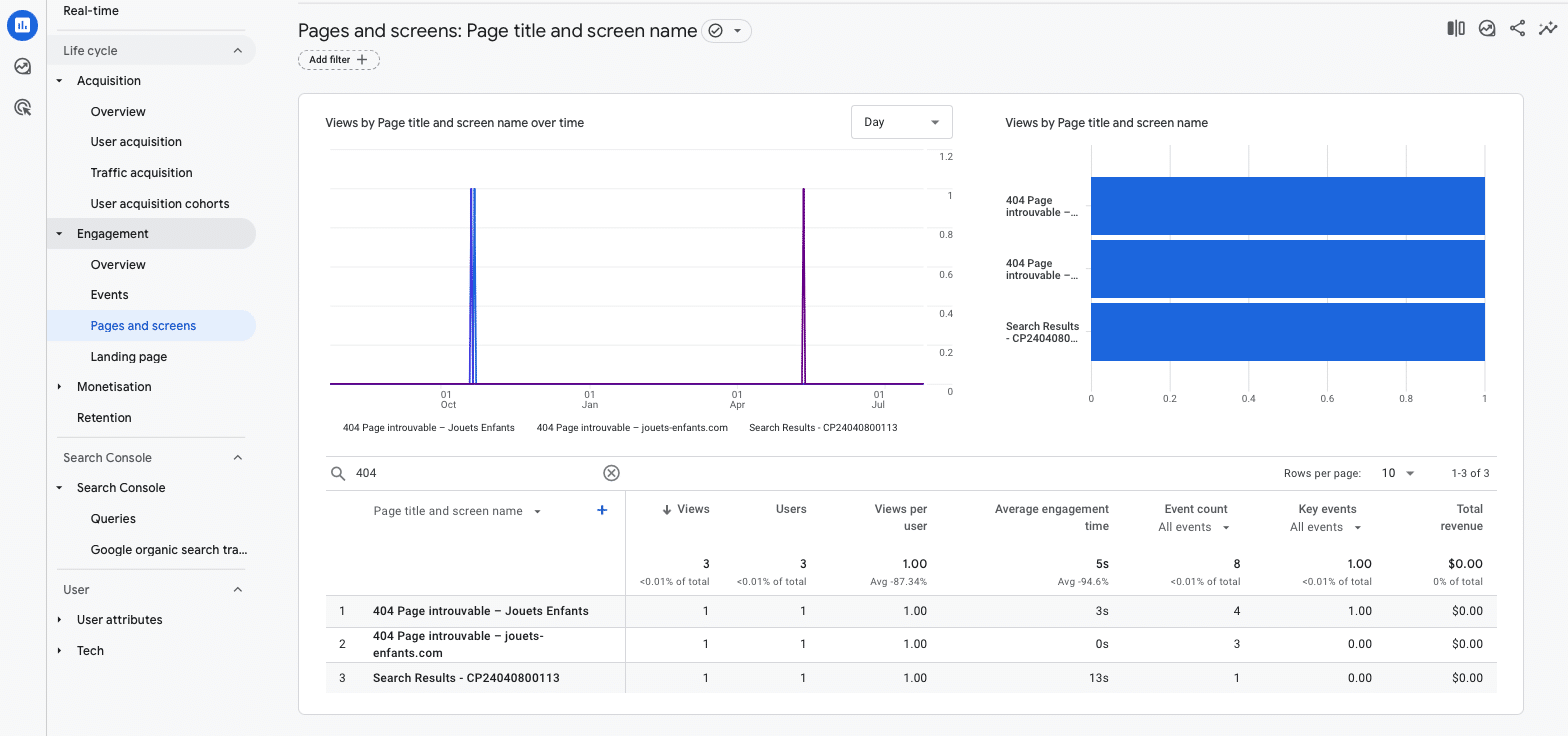
Pages and screens
Within the engagement reports, you also find the pages and screens report, which allows you to see the individual pages visited by users or screens, in the case of mobile apps.
404 pages: Page not found
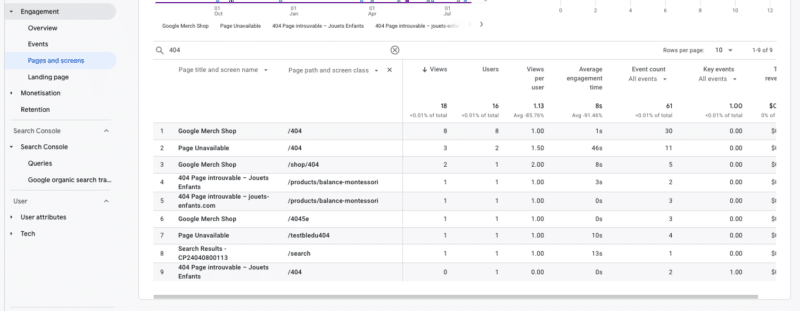
Not only can you analyze URLs with different levels of traffic, but this report also allows you to evaluate the performance of specific, priority URLs within an SEO strategy, such as the 404 page of a website.
Within this report, you can go further to gather not only quantitative data but also qualitative insights.
By including the Page path and screen class dimension, you can study the user’s journey within the website when they land on a 404 page. This allows you to identify where 404s are.
You can replicate this process with any potential website analytics page. This can be automated via the path explorations reports.
Set up events and parameters
Beyond analyzing visits to a website, it’s possible to understand how users interact with it to refine SEO strategies.
This can be done through events, which are metrics that measure specific user interactions on a website, such as loading a page, clicking on a link or submitting a form and parameters that provide additional information about those events.
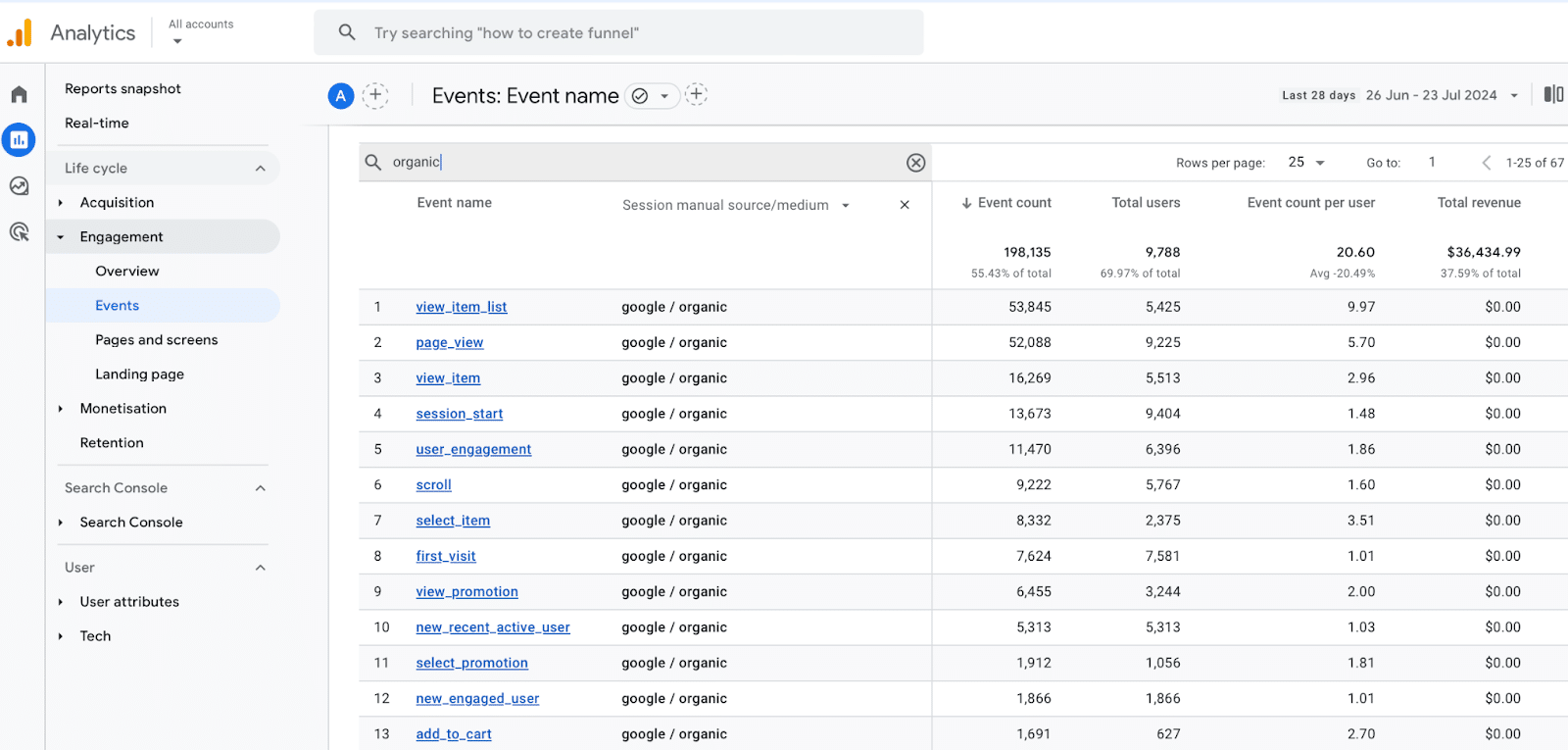
In Reports > Engagement > Events, you can see the total number of events achieved according to the users’ highest priority (such as purchases, form submissions or adding items to the cart).
Find out more on how to track and set up events and conversions in Google Analytics 4 and Google Tag Manager and how to set up event parameters.
Events let you review how strategies are performing and the quality of web traffic. You can also create custom events, such as:
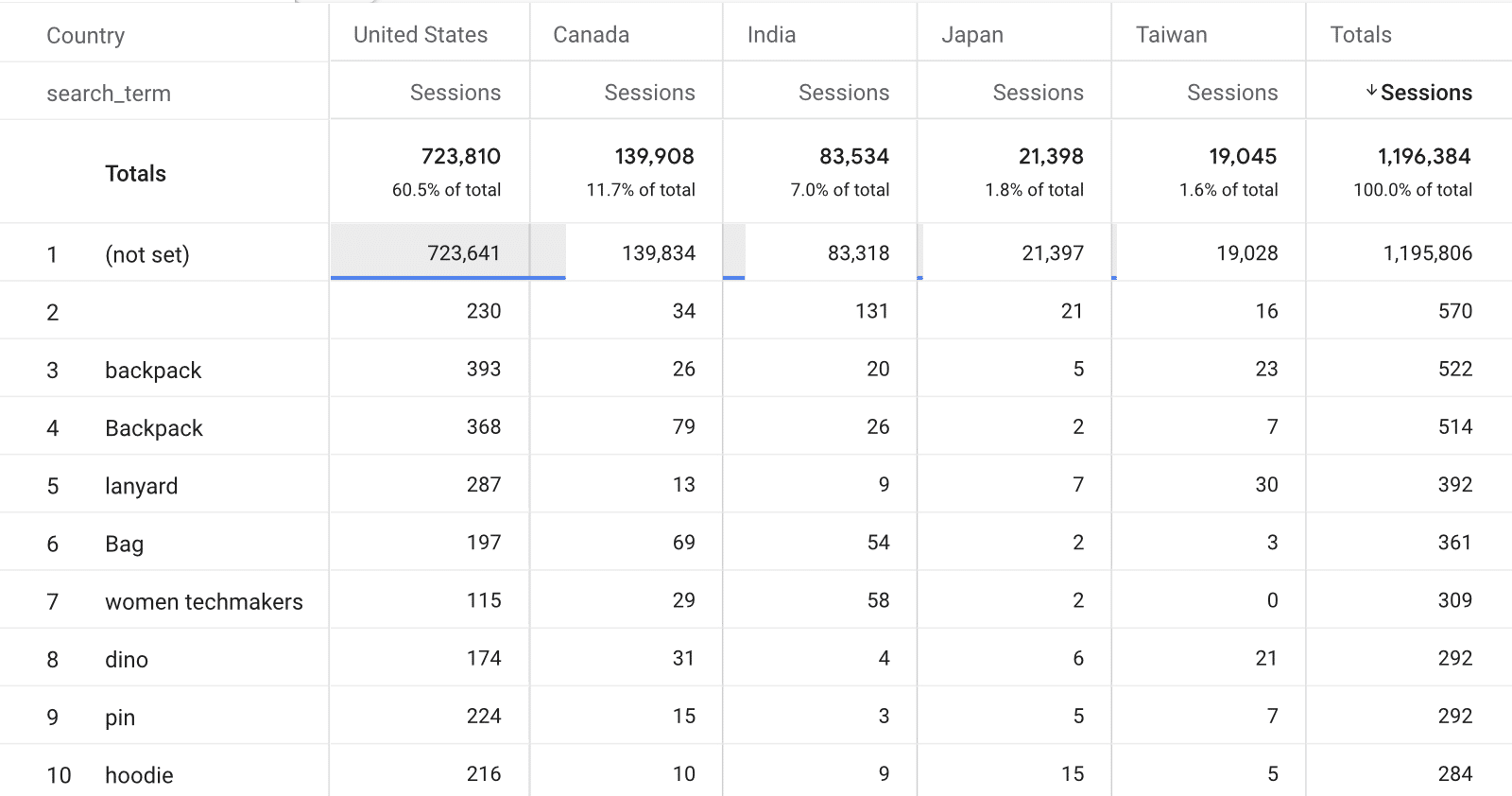
Event: Search results
Analyzing these metrics provide insights into the most popular search terms users look for on a site’s search function.
You can filter according to the users’ country or other interesting dimensions for companies.
This data lets you design content strategies and even refocus the architecture of a website:
Event: Product comparison
If you have a product comparison page, you can create an event to determine which products or features users most frequently compare.
Based on these insights, you can create content (such as blogs, videos, etc.) that responds to their most common actions to resolve their questions.
This might include topics like “What is the difference between Product A and C?” or “Discover the top functionalities of Product B,” if you identify the most popular features.
Leverage other traffic channels to boost SEO
You can use campaign data in GA4 from other channels, which can be useful for designing SEO strategies.
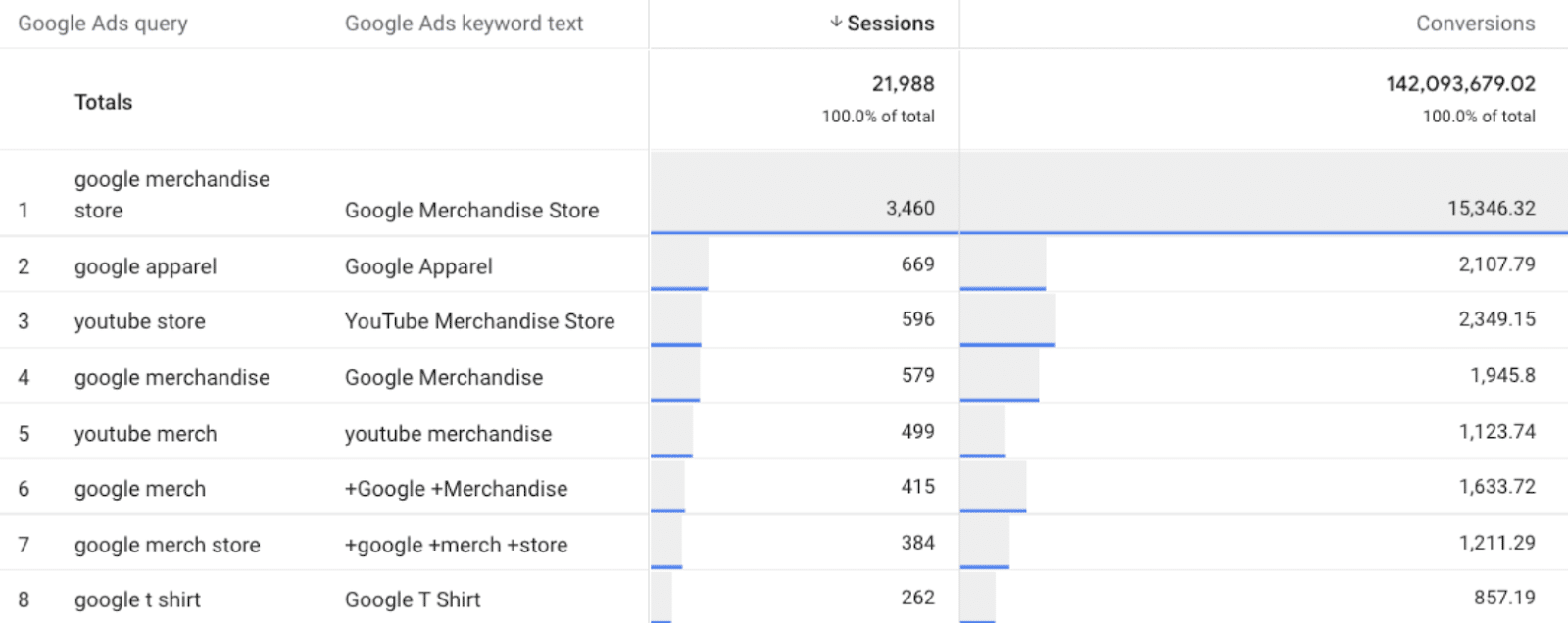
For instance, Google Ads Keywords Reports, created through Exploration, provide valuable insights.
Specifically, the Google Ads query dimension shows the search queries that led to sessions, while the Google Ads keyword text reveals the matched keywords that triggered those sessions.
This data helps you to analyze the results of Google Ads campaigns and find inspiration for new content ideas or keyword clustering strategies on the site.
These examples show that many GA4 reports and metrics can help inform your SEO campaigns. With so much information available, it’s important to have clear objectives to focus on the most important data for analysis.
Courtesy of Search Engine Land: News & Info About SEO, PPC, SEM, Search Engines & Search Marketing
Thursday, August 1st, 2024
Google announced a number of image-related Search features today, including updates to how Google Search handles deepfakes and expanding the About this image feature to Circle to Search and Google Lens.
Deepfakes in Google Search
Google has updated Google Search around deepfakes in two ways; (1) updated its ranking system to help ensure deepfake content does not rank highly in Google Search. and (2) making it easier to remove deepfakes from Google Search.
Show news articles instead. Google’s search ranking system for queries where there’s a higher risk of explicit fake content appearing in the Google Search results. Google is rolling out “ranking updates that will lower explicit fake content for many searches,” Google wrote. When you search for this type of content for people’s names, Google Search will “surface high-quality, non-explicit content — like relevant news articles — when it’s available,” the Search company added. Emma Higham, Product Manager at Google said the changes they made already made improvements in this area by 70%.
Real nudes vs. deepfakes. Google also said it made improvements to differentiating between explicit content that’s real and consensual, such as actor nude scenes, versus explicit fake content such as deepfakes. Google said this is not an easy task but it is “making ongoing improvements to beer surface legitimate content and downrank explicit fake content.”
How does Google do this? Google said it can detect patterns amongst sites and “generally, if a site has a lot of pages that we’ve removed from Search under our policies, that’s a prey strong signal that it’s not a high-quality site, and we should factor that into how we rank other pages from that site,” Google explained. Google thus ends up demoting sites that have received a high volume of removals for fake explicit imagery.
Removing deepfakes. Google also improved the process to remove deepfakes form Google Search. When an individual successfully requests the removal of explicit non-consensual fake content featuring them from Google Search, “Google’s systems will also aim to filter all explicit results on similar searches about them,” Google wrote.
In addition, when someone successfully removes an image from Google Search, Google will scan for, and also remove any duplicates of that image that it has in its index.
About this image expands to Circle To Search and Google Lens.
Google also expanded About this image feature to Circle to Search and Google Lens. About this image launched about a year ago, and it is like the About this result for normal text-based search results. The about this image will show you when the image and similar images were first indexed by Google, where the image may have appeared first and where else you can see the image, such as on news, social or other sites.
“About this image” is rolling out to Circle to Search and Google Lens, “giving you more ways to quickly get context on images that you see wherever you come across them,” Nidhi Hebbar, Senior Product Manager at Google announced.
What it looks like:
Here is what it looks like on Google Lens:

Here is what it looks like on Circle to Search:

About this image does:
- How other sites use and describe the image: You can see how an image is used on other pages and what other sources, like news and fact-checking sites, have to say about it. This information can be helpful to assess the claims being made about an image, and to see evidence and perspectives from other sources.
- An image’s metadata: Metadata is data that gives you more information about an image (such as the creator of the image and some information about how that image may be created). It’s important to remember that metadata can be added or removed by the person who posts an image. When available, you’ll be able to see metadata that image creators and publishers have added to an image, including feilds that may indicate that it’s been generated or enhanced by AI.
- Digital watermark: About this image can identify if the image was generated using AI, provided it contains Google DeepMind’s SynthID watermark embedded within its pixels.
Where is About this image available. About this image is available in 40 languages globally, including French, German, Hindi, Italian, Japanese, Korean, Portuguese, Spanish and Vietnamese. It is rolling out now on Circle to Search on select Android devices, like the latest Samsung and Pixel phones, foldables and tablets and on Google Lens, available in the Google app (Android and iOS).
Courtesy of Search Engine Land: News & Info About SEO, PPC, SEM, Search Engines & Search Marketing
Thursday, August 1st, 2024
Reporting is a crucial part of paid media management for communicating results to stakeholders and informing optimization decisions.
While there are a number of well-made third-party reporting tools, many are pricy and inaccessible to all PPC managers, either due to budget concerns or complex approval processes.
Additionally, various tools have different benefits, with some better suited to spreadsheet-nerd analysis and others for visually friendly reporting.
This article looks at eight free options you can use for PPC reporting.
1. Looker Studio
Looker Studio (formerly known as Google Data Studio) is a full-scale tool for building interactive reports that can be viewed in a browser or downloaded as a PDF.
As Google owns this platform, it integrates by default with most other Google-owned properties, such as Google Analytics, Google Ads, Search Ads 360 and Display and Video 360.
For other platforms, you can export data to Google Sheets and sync it to a report. Several paid third-party tools also allow you to sync directly to a wider range of data sources.
You can create charts, graphs, tables and text boxes or include dropdowns and other elements to allow users to filter data how they’d like.
Advanced users can blend multiple data sources together, such as combining Google Ads data and CRM data or reporting across multiple accounts.
For those just starting out, ready-made templates are free directly from Google and third-party providers to provide a basic reporting structure.
Dig deeper: 3 steps for effective PPC reporting and analysis
2. Google Ads/Google Sheets add-on
With this free add-on developed by Google, you can generate ad reports and then import them into a Google Sheet.
You can customize which columns to show and filter data (such as to show select campaigns or only those with recent impressions).
The tool also allows you to set schedules for refreshing data at regular cadences.
This setup could be useful when sharing with individuals who want to see data in a spreadsheet format or for providing easily exported data tables that you can manipulate for other reporting.
3. Google Ads reports and dashboards
The Report Editor within Google Ads allows you to build reports with the precise metrics you’d like to see and save them for future use. You can effectively make a pivot table populated with the metrics and dimensions you want to include.
In addition, several ready-made templates can help you quickly view performance by ad group, keyword, audience, content or other dimensions.
One handy tip is that you can include custom columns you’ve created, such as for seeing totals and CPA for individual conversion actions.
Additionally, you can create dashboards containing data from multiple reports, scorecards for top-level metrics and notes for commentary. One recent use where I’ve found a dashboard helpful was tracking specific ad tests I’m running.
Dig deeper: How to approach weekly, monthly, quarterly and annual PPC reporting
4. Microsoft Advertising reports
Microsoft also contains its own robust reporting section, where you can view premade reports or build your own.
In addition to showing standard campaign data, a few practical uses for these reports include:
- Publisher reporting to see a breakdown of performance by website URL, which can’t be viewed in the main interface.
- Negative keyword conflicts to remove negatives that may inadvertently be blocking keywords you want to bid on.
- Ad extension reporting at keyword or ad level.
- User location reporting to view actual geography of individuals as opposed to targeted geography.
- Label reporting (useful for reviewing tests where ad variants may be labeled separately).
5. Meta Ads reporting
On the social advertising front, Meta has a built-in reporting section, which can be found under the Ads Reporting section of the menu.
Options include a pivot table feature and the ability to build line and bar charts.
You can save pre-built reports with the specific dimensions, metrics and filters you’d like to include. You can also break down data in various ways, such as by campaign name, device, placement and more.
6. Google Ads Editor
While this may not necessarily be your first thought for reporting, you can see performance data in Google Ads Editor.
When you first open it, you’ll see a graph and selectors for top-level metrics, with the ability to choose a timeframe.
You can also pull data into the editing section via the View Statistics button in the top bar. Choose individual metrics, which you can then populate in a table within the Editor interface.
Additionally, you can view a search term report or see the performance of individual search, display, app, or Demand Gen assets (including images and text).
These features could be useful as an alternative to the web UI for downloading data in spreadsheet format.
7. Microsoft Advertising Editor
Similarly to Google, you can also include metrics when downloading data into Microsoft Advertising Editor.
Use the View Statistics button in the top bar and select the timeframe you’d like to see. You can also view the data directly in the interface or export it to manipulate in Excel or another program.
8. Google Analytics
A properly configured Google Analytics implementation is crucial for any PPC manager’s analysis. You’ll need to make sure website traffic from your ad platforms is being tracked properly (such as by connecting Google Ads and using proper UTM parameters across platforms).
Reports built in GA4 can help show the performance of ad traffic tied together with website behavior metrics.
If you’ve linked your Google Ads account and have auto-tagging turned on, you can view Google Ads data together with key events (events that you’ve marked as priority for your business, such as form completes, sales, etc.) under the Advertising section.
Explorations offer a good starting point for building customized reports that can be segmented to include only specific traffic, such as that from paid channels, along with select dimensions and metrics.
For instance, you can create a funnel report showing how much ad traffic is getting to each step of the purchase process.
An added value of Google Analytics for PPC reporting is the ability to see how ads work together with other channels such as organic search, social, referrals and direct traffic in the conversion process.
The Attribution section lets you see users’ paths across multiple combinations of channels and compare last clicks to data-driven models.
Dig deeper: How to combine GA4 and Google Ads for powerful paid search results
Start reporting
Even if you don’t have the budget for pricier reporting tools, there are many free options available.
If you haven’t tested some of the options reviewed in this article, take the time to check them out, play with features and see what reporting configurations may work for your needs.
Courtesy of Search Engine Land: News & Info About SEO, PPC, SEM, Search Engines & Search Marketing
Tuesday, July 30th, 2024
Google is experimenting with new ad placements in search results, but the frequency remains low. Here’s what you need to know:
By the numbers. As shared by Mordy Oberstein, head of SEO brand at Wix:
- 0.31% of desktop SERPs have ads mixed into organic results
- 0.01% of mobile SERPs have ads mixed into organic results

- 2% of all SERPs have “normal” ad placement at the top.
- Desktop preference: 18% of SERPs with mixed ads place them immediately after a featured snippet.
- Mobile difference: Less than 2% of mobile SERPs with mixed ads follow this pattern.
Why we care. Ads placed within organic results or immediately after featured snippets could potentially capture more user attention than traditional placements. Click-through rates, conversion rates and overall ROI could be affected by these new placements, requiring advertisers to adjust their strategies accordingly.
The big picture. Google is testing various ad placements, including under featured snippets and within organic results.
Ad frequency:
- Desktop: Generally two ads mixed with organic results
- Mobile: Usually one ad mixed with organic results
Between the lines. Google appears to favor the spot right after featured snippets for ad placement on desktop, but this strategy is not mirrored on mobile.
Bottom line. While Google is experimenting with new ad placements, the overall frequency of ads mixed into organic results or placed under featured snippets remains extremely low across all SERPs.
What to watch. How Google’s ad placement strategy evolves and whether the frequency of mixed ads increases over time.
Courtesy of Search Engine Land: News & Info About SEO, PPC, SEM, Search Engines & Search Marketing