Archive for the ‘seo news’ Category
Thursday, October 13th, 2022
NP Digital leads the way in the 2022 Search Engine Land Awards – the U.S. agency is a finalist in a whopping seven categories.
Two other agencies earning finalist status three times are Rocket Agency (Australia) and Logical Position (U.S.).
Meanwhile, 10 agencies are Search Engine Land Awards finalists two times (AEK Media, Amsive Digital, DAC, GA Agency, Megantic, Milestone Marketing, SEMbyotic, Thrive Digital, VMLY&R, Wpromote)
Small Agency of the Year – SEO and PPC
The competition was fierce in most of our categories – but in these two, the winners were clear. So we couldn’t think of a reason to wait to announce them:
- The winner of the Small Agency of the Year – PPC is … Streamline Results.
- The winner of the Small Agency of the Year – SEO is … ANGA Bangkok Co., Ltd.
Congrats to both agencies!
All the other winners of the 2022 edition of Search Engine Land Awards will be revealed this Monday, Oct. 17.
Meet Search Engine Land 2022 award winners at SMX Next
We will be inviting some of the winners of this year’s awards to join us on Day 1 of SMX Next (Nov. 15). We’ll have two Ask Me Anything-style “Ask the Search Engine Land Award winners” panels – one on the SEO side, moderated by me, and one on the PPC side, moderated by Editor Nicole Farley.
If you haven’t yet, make sure to register for free for SMX Next.
Also: a big thank you to our Search Engine Land Awards sponsor, Microsoft.
The full list of nominees
Best Overall SEO Initiative – Small Business
- AEK Media: Content Always Wins…Allegedly – 220% Traffic Growth for Criminal Law Firm in Sydney
- ANGA Bangkok Co., Ltd.: Magnetic maximising the influx in Search post pandemic for Goldelucks
- How Growth Skills built the first media platform targeting cannabis, CBD and alcohol, leading to over 475% ROI via SEO & Content Marketing
- How Logical Position Married Offsite and Onsite SEO To Increase NV Landscape’s Local Organic Traffic by 150% YOY
- How Mickey Llew helped Menstrual Cups Australia win back first place ranking for a key top generic phase in their industry, on a limited budget.
Best Overall SEO Initiative – Enterprise
- Livestrong and Amsive Digital Flex Their Expertise to Bulk Up Major Organic Gains
- First Citizens Bank Gains a Trusted Partner in CB/I Digital after Impressive Growth in Keyword Ranking, Local Search, and Non-Brand Traffic
- GA Agency: 12 Countries, 4 Fashion Brands: Skyrocketing SEO
- Graphite & BetterUp – Premium Content to Drive +2,000% YoY Growth
- NP Digital: Leveraging SEO & content to help build a brand. How we increased organic search traffic by 561% for Lantern.
Best Commerce Search Marketing Initiative – SEO
- Click Intelligence & Anthem Branding – The Journey from Unranked to Page 1
- GA Agency: 12 Countries, 4 Fashion Brands: Skyrocketing SEO
- How Logical Position Helped Palouse Ranches Increase New Organic Traffic by 211% with Just 4 Keywords
- Milestone Inc Helps Sun Outdoors Triple their Conversions and Online Revenue with a New State-of-the-Art Website that made a significant impact on their visibility on search – locally & organically for their locations
- VMLY&R: Driving Visibility and Conversions Across a Diverse Ecommerce Portfolio
Best Local Search Marketing Initiative – SEO
- How 3Q/DEPT increased leads by 330% for Source Capital Funding via Organic Search
- Comrade Digital Marketing Agency: LASIK Goes Local: Growing Organic Traffic by 400+% for Elective Surgical Practice
- Lastmile Retail: Transforming The Digital Local Customer Experience: T-Mobile x Lastmile Retail
- How Logical Position Married Offsite and Onsite SEO To Increase NV Landscape’s Local Organic Traffic by 150% YOY
- Milestone Inc Helps SpeedPro Drive 93% Increase in Local Listing Views and 39% Increase in Online Leads Revenue with State-of-the-Art Local SEO Strategy
Best B2B Search Marketing Initiative – SEO
- How Advarra Outranked Third Party Reviews For Their Software Category
- Finn Partners: Boosting organic traffic and rankings in a saturated in-car technology market
- How LOCALiQ Increased Its Organic Search Traffic by 289% In Just 8 Months With SEO
- NP Digital: Matching WordPress intent.How we increased organic traffic by 514% for a core Nexcess product offering.
- How Tacomi utilised SEO to gain a 1,930% ROI for BMJ Careers
Agency of the Year – SEO
- Dreamscape Marketing: Enterprise Scale Enterprise Outcomes: Performing a website and digital marketing conversion with speed to meet enterprise needs without sacrificing operations and supporting their rapid growth.
- Megantic: No Pain, All Gains with Supplement Mart’s Shopify Migration
- NP Digital: Leveraging SEO & content to help build a brand. How we increased organic search traffic by 561% for Lantern.
- How Sherlock Communications Delivered a 193% Organic Visitor Increase for Betfair Colombia in a Competitive Industry Sector Using a Content First Strategy
- Wpromote: Flying High: How Wpromote Grew Organic Revenue by 550% for Travelpro
In-House Team of the Year – SEO
- How Razorfish exceeded a client target that others considered impossible
- How the T-Mobile SEO team recruited top in-house talent, accelerating innovation and driving business growth
- UPMC: Driving SEO Growth with a Little Help from our Friends
Best Overall PPC Initiative – Small Business
- How Brandastic established our client as the #1 DTG Printer Brand in North America 2021
- NP Digital: Enhancing SEM strategy to elevate returns. How Mann Lake and NP Digital increased paid search revenue by 87% YoY.
- Primal Malaysia Delivered 323% ROI for Easy Consulting
- How Rise Interactive Scaled Cross-Channel Results with Performance Marketing & Closed Loop Reporting
- How Our Agency Vivid Candi Increased Leads by 800% and Sold Out a 6-Figure Housing Product In 3 Months
Best Overall PPC Initiative – Enterprise
- Healthy Paws & Amsive Digital Making it Rain Search Lift (or cats & dogs)
- Bayer Consumer Health: Increasing In-Store ROAS driven by Search Media by 2-3x for a CPG/OTC Brand!
- How Rocket Delivered 331% leads above target for Noggin via Google Ads
- How SEMbyotic Helped Transform TCS By Growing Revenues 500% During the Pandemic
- VMLY&R: United Rentals: Localization Strategy Increases Yearly Revenue by 71% to $18.6 Million
Best Commerce Search Marketing Initiative – PPC
- Beeby, Clark+Meyler: How The Parking Spot paid search program drove a 39% increase in reservations over pre-pandemic Q2 2019
- Katté & Co and SPOKE – quadrupling non-brand revenue for a fast-growing British men’s clothing brand
- How Mad Fish Digital Leveraged Full-Funnel Strategy and Google’s AI to Deliver a 1,058% ROAS for Schoolhouse Electric
- How Thrive Digital bridged the gap in seasonality and restructured the account by prioritizing product profitability based on regions and automated feed-driven product segmentation. As a result, we reached 342% ROAS, exceeding the client’s target of 278%
- Thrive Digital: How Smith Optics scaled revenue from Google channels 120% YoY by expanding tactics and implementing best practices.
Best Local Search Marketing Initiative – PPC
- Adwise & SPAR – 122% uplift in omnichannel ROAS with hyper local digital advertising strategy
- How DAC helped Aqua-tots drive a 300% increase in store visits
- DAC & StorageMart: Driving occupancy with paid media
- Ovative Group: Local Campaigns Drove over 60% of Duluth Trading’s Store Visit Growth YoY
- How Stella Rising SEM Helped Big Y Pivot to Online Grocery Amidst Consumer Behavior Changes
Best B2B Search Marketing Initiative – PPC
- A mid-funnel mindshift. How ConnectWise and NP Digital increased ROAS of paid search by 100%.
- How SEMbyotic Helped Transform TCS By Growing Revenues 500% During the Pandemic
- How Statwax Scaled a B2B SaaS Unicorn’s Search Ad Spend 20X While Improving Profitability & Customer Growth
- The Media Image & LSEG – Doing More with Less at a Global Scale
- How Workshop Digital Generated 2,400% ROAS for Super Radiator Coils’ with a custom PPC-CRM Feedback Loop
Best Integration of Search Into Omnichannel Marketing
- AEK Media: How an Omnichannel Approach led to 130% Month-on-month Sales Growth in Their First Year Online | Tasman Eco
- Automation & crypto, a perfect match. How NP Digital drove omni-channel success for FTX.
- Rakuten Advertising x Vans Omnichannel Bidding
- Rocket & Rezdy | Scaling Software Sales Globally with Digital
- UPMC: Building upon our Health and Wellness Brand to Deliver Timely Content during COVID-19 Pandemic
Agency of the Year – PPC
- How Adviso Delivered a 50% increase in revenue for SAIL via Search
- Horizon Media: Beating the Headwinds with Localized Profitability
- NP Digital: Dynamic conversion value integration in paid search. Optimizing for global profitability across Tektronix’s complex sales journey.
- Rocket & Rezdy | Scaling Software Sales Globally with Digital
- Wpromote & Intuit QuickBooks: Harnessing First-Party Data to Drive Paid Search Success
In-House Team of the Year – PPC
- BH Breaks the Industry Mold with In-House Solution, Saving $500k in Management Fees
- HSBC UK: How an Newly In-Housed Team Delivered Record-Breaking Growth Within a Year’
- Wiley University Services: In-House Media Team Outperforms Industry Trends by Increasing Leads and Enrollment for University Partners
Search Marketer of the Year
- David Grow, Goodway Group
- Heath Hamilton, Megantic
- Melissa Liu, RPA
- Nicolas Villeneuve, Adviso
- Vandana Kumar, Megantic
The post Search Engine Land Awards 2022: Complete finalists list appeared first on Search Engine Land.
Courtesy of Search Engine Land: News & Info About SEO, PPC, SEM, Search Engines & Search Marketing
Thursday, October 13th, 2022
Google has launched a new content suitability center in Google Ads where you can manage your suitability settings for all campaigns on YouTube and the Google Display Network.
Google wrote, “previously, managing suitability settings was done in multiple, segregated sections of Google Ads and the experience differed across Google platforms.” “This led to a time-consuming and cumbersome implementation process, along with misconceptions and misuse of the controls. While exclusions can be helpful tools, brands also want to be mindful of the types of content they choose to exclude. Over-exclusion can negatively impact your cost and reach. It can also unintentionally exclude great, brand-safe content or content relevant to diverse communities,” Google added.
New suitability center. The new suitability center in Google Ads allows you to manage the suitability controls under a single point-of-entry. You can use the content suitability center to easily set your suitability preferences for inventory modes and exclusions across YouTube and the Google Display Network.
Here is a screenshot of it:
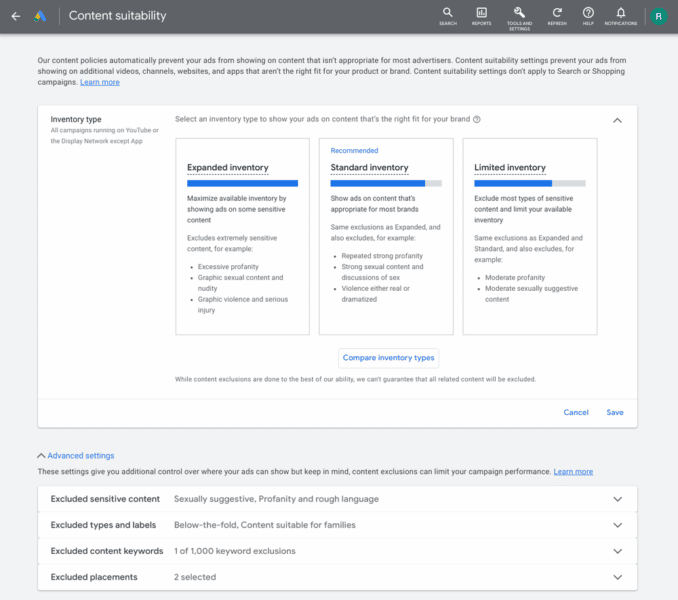
More details. When you enter the new suitability center in Google Ads, you can now select one of the three inventory modes. Inventory modes “cater to your preferences for various sensitive themes, such as profanity, sexual suggestiveness and violence,” Google explained. You can fine-tune additional exclusions from that point. Once you have designated your preferences at the account level, Google Ads will now automatically apply these settings to your future campaigns.
Why we care. This should save you time, reduce errors and improve the management of these controls in a more central place. Google added the company will share more “in the coming months to help you continue to align with what works best for your brand identity and navigate the growing landscape of content.”
The post Google launches new content suitability center in Google Ads appeared first on Search Engine Land.
Courtesy of Search Engine Land: News & Info About SEO, PPC, SEM, Search Engines & Search Marketing
Wednesday, October 12th, 2022
Facebook has rolled out a new Pages experience they say is ideal for small and medium-sized businesses to build connections with customers and other businesses.
The new Pages layout. The new Pages experience has a more “streamlined layout, easier navigation between your personal profile and business pages, a Professional Dashboard to manage all of your activities quickly in one central location and access to a dedicated Feed to more seamlessly interact with people on Facebook as your business.”
Switching between your business and personal profile can be done by tapping or holding down the top right menu icon.
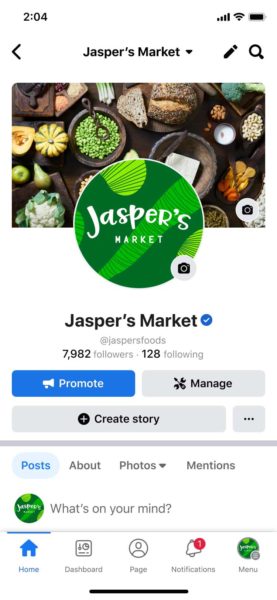
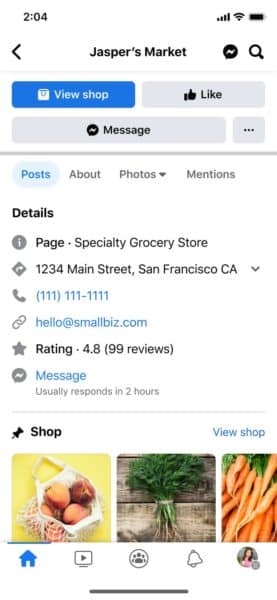
Getting the most out of your Pages. Facebook lays out a few tips to help businesses get the most out of their Pages experience. Let’s dive in.
1. Setting up for success. Complete your basic business profile by adding a profile and cover photo, a description of your business, and contact details like your website, phone number, address and business hours.
Facebook also suggests customizing your page with action buttons and set Page Admins to help you manage it.
2. Grow your audience. Invite friends, family, and existing customers to like your page, post often, and respond to comments to help grow connections.
3. Create better content. Use trending hashtags to get your content discovered by a new and relevant audience. You can also share posts in up to 3 groups and link your Instagram to cross-share to your followers on Instagram. You can also schedule your posts by using the Composer feature.
4. Engage your community. Facebook encourages businesses to engage with the community by joining in on conversations within the business feed and commenting on posts as your page to help build experiences.
5. Safety and security tips. The following safety and security tips can help keep your page secure.
- Set up 2-Factor authentication
- Use comment moderation tools
- Take action on hacked accounts
Dig deeper. You can read the entire announcement from Meta and get more tips on growing your Facebook page here.
Why we care. Love it or hate it, Facebook is still a valuable tool for businesses today. Make sure you’re taking advantage of all of the tools and features available on your page and ensure all of your information is correct and up to date so potential customers can find you.
The post Facebook has rolled out a new Pages experience appeared first on Search Engine Land.
Courtesy of Search Engine Land: News & Info About SEO, PPC, SEM, Search Engines & Search Marketing
Wednesday, October 12th, 2022
Alexa users are suing Amazon over claims that the voice assistant app is targeting users with ads relevant to private recordings of users’ conversations.
The central complaint. The main complaint of Alexa users is that the voice assistant is wrongly using voice recordings captured by Alexa to target ads.
“The central theory of this lawsuit is that Amazon uses Alexa voice recordings (i.e., the captured sound of a user’s voice) to serve interest-based ads to that user. In their complaint, plaintiffs conspicuously never allege facts showing that Amazon uses Alexa recordings to serve interest-based ads (because they have no good-faith basis for that allegation),” the company adds. “The complaint instead uses the intentionally vague term ‘voice data’ for the notion that certain transaction data resulting from Alexa interactions is sometimes used for advertising. Yes, it is, and Amazon widely and clearly discloses that fact.”
U.S. District Court Judge Barbara Rothstein
The plaintiff’s suit. Ohio resident James Gray and Massachusetts resident Scott Horton brought the class-action complaint against Amazon for allegedly using “Alexa-collected voice data” for ad targeting. They raised several claims, including that Amazon violated users’ privacy, and that it engaged in misleading and unfair conduct.
Get the daily newsletter search marketers rely on.
<input type=”hidden” name=”utmMedium” value=”” />
<input type=”hidden” name=”utmCampaign” value=”” />
<input type=”hidden” name=”utmSource” value=”” />
<input type=”hidden” name=”utmContent” value=”” />
<input type=”hidden” name=”pageLink” value=”” />
<input type=”hidden” name=”ipAddress” value=”” />
What Amazon says. Amazon said “it “is not in the business of selling data,” and doesn’t share Alexa requests with ad networks.
The company added: “Similar to what you’d experience if you made a purchase on Amazon.com or requested a song through Amazon Music, if you ask Alexa to order paper towels or to play a song on Amazon Music, the record of that purchase or song play may inform relevant ads shown on Amazon or other sites where Amazon places ads.”
Amazon urged judge Rothstein to dismiss the lawsuit claiming that even if the allegations were true, there wouldn’t be any proof that the company sed voice recordings for ad purposes.
Amazon also said “If a customer buys dog toys from Amazon, that fact can be used to generate interest-based ads, regardless of whether the customer ordered by typing on amazon.com or speaking a voice command to an Alexa-enabled device,” the company wrote. “But records of the customer’s transactions, whatever the input medium, are different from Alexa voice recordings or transcripts themselves.”
They added “When a customer uses a physical keyboard to make a purchase on amazon.com, the data from that transaction is not ‘derived from’ the customer’s typing, nor would anyone argue that Amazon is ‘using’ that person’s keystrokes,” Amazon argues. “Similarly, if someone types a purchase command into the Alexa app, the transaction data associated with that command is captured and might be used for advertising (as Amazon widely discloses).”
Why we care. With cookies disappearing in 2024, privacy is at the forefront of ad platforms and advertisers’ strategies to deliver relevant ads to an audience that may or may not become harder to reach. But Amazon’s blatant disregard for users’ personal space and private conversations goes beyond cookies and into a realm that’s just plain invasive.
I’ll be curious to see if Amazon is held liable for these claims and what the company does to remedy the situation as users become more aware, and intolerant of privacy abuse.
The post Alexa users claim Amazon is using voice recordings to target ads appeared first on Search Engine Land.
Courtesy of Search Engine Land: News & Info About SEO, PPC, SEM, Search Engines & Search Marketing
Wednesday, October 12th, 2022
Actionable search marketing tactics, expert answers to your burning SEO and PPC questions, and engaging discussions with passionate search marketers are a just click away… secure your spot at SMX Next now and join us online, November 15-16, for free!
The agenda is live… be the first to see what’s in store!
Programmed by the Search Engine Land editors, this tactic-rich training features special guest speakers from 1-800-FLOWERS.COM, Inc., M&T Bank, Trupanion, and more exploring the critical search marketing topics and trends, including…
- How to make a smooth transition to GA4
- Understanding and improving your E-A-T
- AI and ML: Setting up your content program for a winning future
- How to stay ahead of Google algorithm updates
- Innovative video marketing trends that drive engagement
- Creating winning Performance Max campaigns for eCommerce
… and that’s just the start. You’ll also unlock two exclusive Google keynote conversations, engage in live Q&A with speakers (Overtime!), enjoy invigorating Coffee Talk meetups, and more.
For more than 15 years, over 150,000 search marketers from around the world have attended SMX to learn performance-enhancing tactics, make game-changing connections, and further their careers.
Don’t miss your opportunity to join them online, November 15-16, 2022! Secure your FREE All Access pass now!
The post GA4. Schema. E-A-T. See the tactic-packed SMX agenda! appeared first on Search Engine Land.
Courtesy of Search Engine Land: News & Info About SEO, PPC, SEM, Search Engines & Search Marketing
Wednesday, October 12th, 2022
Google has just announced three new features for travel and tour booking businesses. The new features are aimed at making it easier for people to book tickets and experiences right from Google, as well as giving businesses the ability to connect with potential customers.
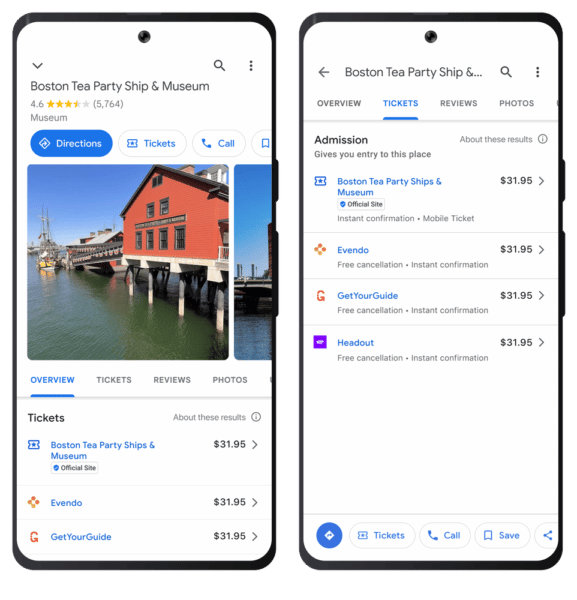
Ticket booking links for attractions. Now available on Maps (mobile & desktop), after first launching on Search in Sept 2021. Visitors can also quickly compare admission prices across different partners.
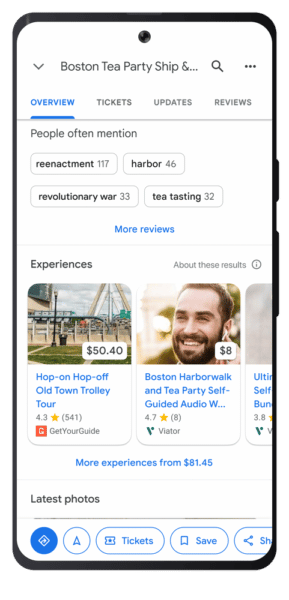
Experiences related to an attraction are now shown separately (e.g. combined Statue of Liberty & Ellis Island tour). This is currently on Search, coming soon to Maps.
In the near future, Google will show ticket booking links on Search/Maps business listings for tour & activity operators (e.g. Joe’s London Bike Tours) just as it is now for attractions.
Edit ticket prices on Google Business profiles. Attraction owners can now edit their ticket prices & booking links directly on their Business Profile (and soon tour & activity operators will have the same option). Previously they had to work through an approved connectivity partner.
Attraction operators can still work with an approved Connectivity Partner to provide travelers with up-to-date information using a data feed if they prefer.
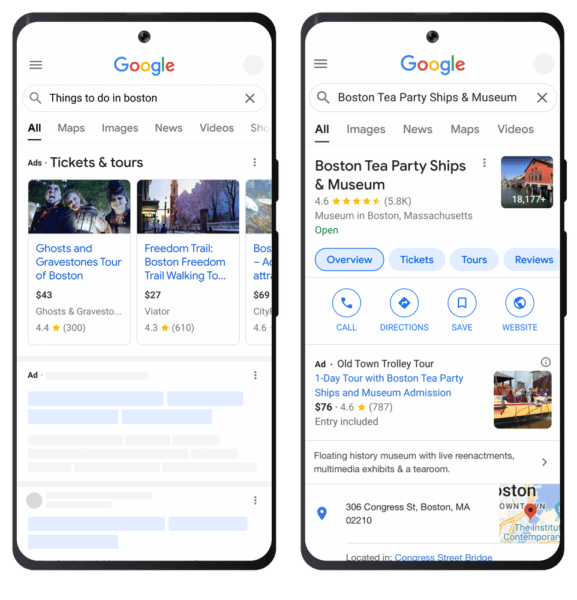
Things to do Ads (also launched Sept 2021). Now surfacing on relevant queries in 24 countries and they can now appear on individual attraction knowledge panels on Search (replacing what would otherwise be a standard text ad)
These ads can be set up using the same data feeds that power the free ticket booking links on Search and Maps.
Get the daily newsletter search marketers rely on.
<input type=”hidden” name=”utmMedium” value=”” />
<input type=”hidden” name=”utmCampaign” value=”” />
<input type=”hidden” name=”utmSource” value=”” />
<input type=”hidden” name=”utmContent” value=”” />
<input type=”hidden” name=”pageLink” value=”” />
<input type=”hidden” name=”ipAddress” value=”” />
Dig deeper. You can read the announcement from Google and find approved Connectivity Partners here.
Why we care. If you have or manage a business in the travel and tourism industry, you can use these features to find and connect with new customers, edit your prices in real time, and give customers additional options for booking.
The post 3 new Google travel and tour booking features appeared first on Search Engine Land.
Courtesy of Search Engine Land: News & Info About SEO, PPC, SEM, Search Engines & Search Marketing
Monday, October 10th, 2022
LinkedIn can be a difficult platform to master, but with the right combinations of targeting and messaging brands can see success in generating results.
Matched audiences allow you to reach people who have engaged with your business in some way and go after lists of “dream companies” that you’d like to work with.
This article provides an overview of how you can get started with matched audiences along with tactics for using them in your campaigns.
Types of matched audiences
LinkedIn allows for a variety of first-party and third-party methods to build audiences. Here are the available categories at the time of writing this article:
- Contact lists: Targeting individual people.
- Company lists: Targeting anyone who works for a particular organization.
- Pixel-based retargeting: Reaching anyone who visited select pages on your website.
- Engagement-based retargeting: Based on in-platform activity, such as:
- Single image ad engagement.
- Video ad views.
- Lead form opens/submits.
- Company page engagement.
- LinkedIn event RSVPs.
Guidelines
The absolute minimum size for a matched audience is 300 to be eligible to serve. This means 300 individuals need to be matched in the platform after uploading and processing the list.
You’ll likely see some drop-off with the platform not being able to match every individual in your original document.
The platform will show a match rate after the list has finished syncing, allowing you to double-check your fields if the match rate seems abnormally low.
However, just because you can target as few as 300 people doesn’t mean you should. Larger audiences generally see more efficient CPCs and CPAs, with a threshold of at least 50,000 individuals being ideal.
For company targeting, LinkedIn recommends including a minimum of 1,000 companies.
For contact targeting, LinkedIn recommends a minimum of 10,000 email addresses. If more than one email address matches with the same user, that person will only be included once.
The maximum file size for either type of list is 20MB or 300,000 records.
When uploading a list, use the templates that LinkedIn provides. You can use just the email field for a contact list or the company name field for a company list if wanted, but the more columns you can include, the more accurate you can expect the matching process to be.
Additionally, you’ll have to wait for LinkedIn to finish processing a list before you can target it in your campaigns. Generally, lists will be ready within 48 hours, but occasionally they can take longer.
Finally, some CRMs and automation platforms allow you to sync lists directly. This compatibility, if available, can reduce the lift necessary to get a list in place while also allowing you to keep it refreshed.
Get the daily newsletter search marketers rely on.
<input type=”hidden” name=”utmMedium” value=”” />
<input type=”hidden” name=”utmCampaign” value=”” />
<input type=”hidden” name=”utmSource” value=”” />
<input type=”hidden” name=”utmContent” value=”” />
<input type=”hidden” name=”pageLink” value=”” />
<input type=”hidden” name=”ipAddress” value=”” />
Layering targeting
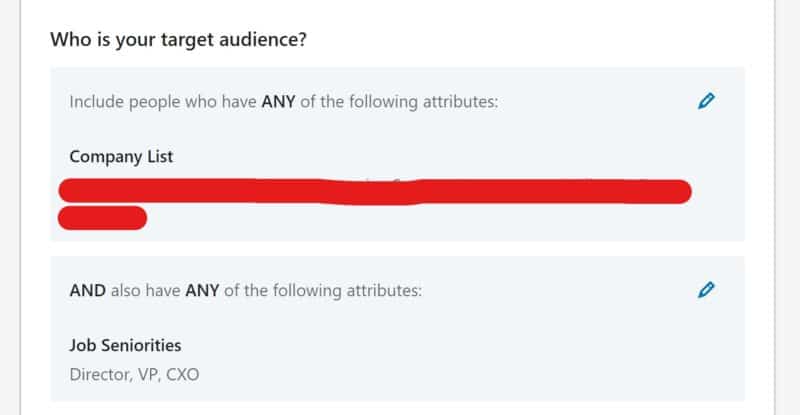
Matched audiences can be used in combination with LinkedIn’s other available targeting. Think about ways you can use your own audiences plus additional layers such as company size, job function, seniorities, titles, or others. Just note that you cannot combine contact lists with interests and traits.
For example, you can target a company list layered with job seniorities of Senior level and up if you’re seeking to avoid junior-level individuals.
Or you can retarget people who visited your website and also work for companies with over 500 employees.
You can use “AND” as well as “OR” targeting when setting up layers. For instance, you can reach people who are members of either list A or list B, and if they also have Director level seniority.
Exclusions
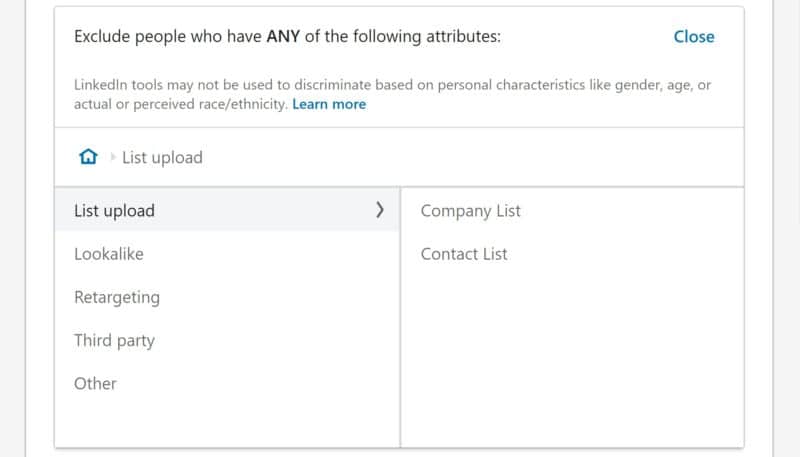
Lists can also be valuable to make sure you’re not wasting spend on individuals you don’t want to target.
For instance, you can upload a list of your current customers and exclude them from campaigns to avoid reaching them. You also should exclude competitor companies so their employees don’t see your ads.
Website retargeting audiences can come in handy for building exclusions as well.
To gate out job seekers, build an audience based on people who visit your “Careers” page.
If your product offers an online experience, you can exclude people who reach the log-in page as those are likely to be existing customers.
Upselling and ad sequencing
If your brand entails the opportunity to upsell customers on additional levels of service, sync lists of current customers based on their tier or existing plans to then serve ads for new products or services.
For example, users of CRM software could be upsold to add marketing automation features to their existing plans.
You can also plan to put different content in front of people after they complete interactions with your brand.
If you’re using lead forms to promote a downloadable buyer’s guide, you can target people who have filled out the form for the guide and promote an opportunity to request a demo.
By controlling which lists you include and exclude from campaigns, you can effectively set up ad sequencing between campaigns to stagger exposure through the course of the sales funnel.
Lookalike targeting
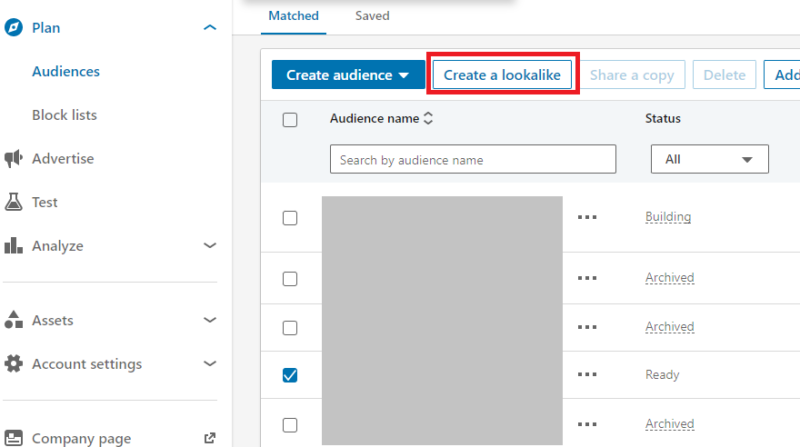
Once you’ve created a matched audience, you can also make a corresponding lookalike audience. This will find people with similar characteristics to those on a particular list.
For instance, if you upload a list of current customers, you can then create a lookalike audience that will include people with similar job titles, group membership, interests, etc.
Be sure to test lookalikes in separate campaigns from your original lists so you can segment results, as you can’t isolate the performance of one specific audience within a single campaign.
Getting data from audiences
In addition to campaign targeting, LinkedIn offers some useful analytics features to see details about the individuals in your lists.
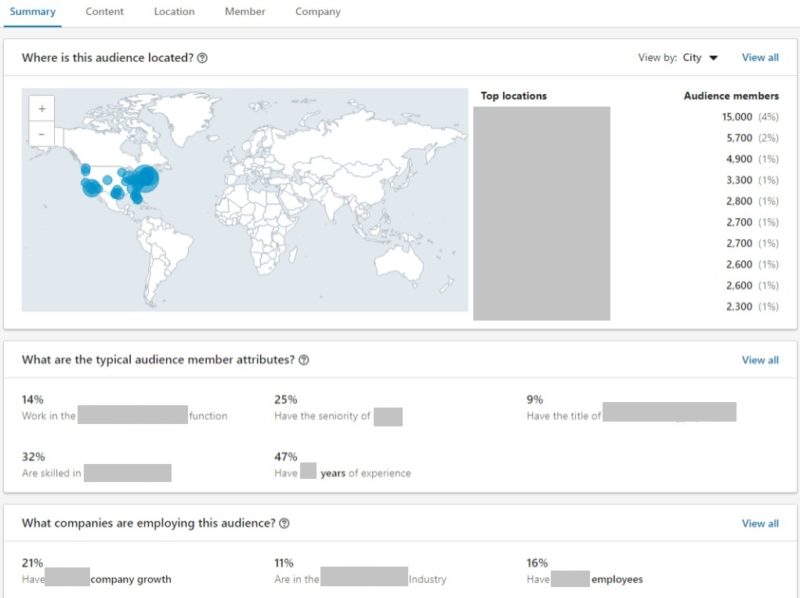
To access this information for a contact list you’ve uploaded, navigate to the Audiences section, select an audience, and click the Insights button in the upper right.
You’ll now see options to view top characteristics, including:
- Interests
- Locations
- Job functions
- Job seniorities
- Years of experience
- Titles
- Companies
- Company size
- Industries
- Growth rates
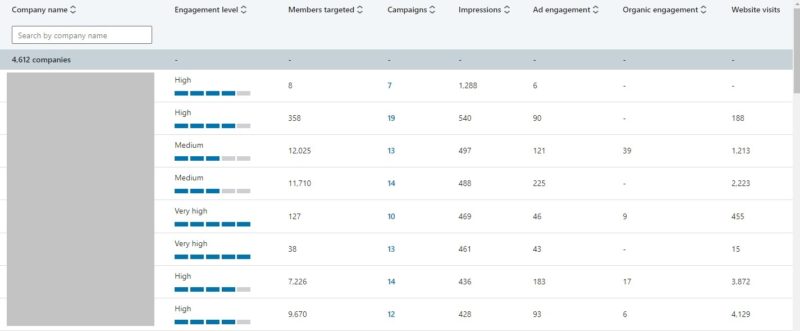
When you select a company list, you’ll see the Company Engagement Report, which shows details on how often people from each company:
- Engaged with ads.
- Engaged organically with your company page.
- Or visited your website.
This report can also be helpful to ensure that your list matched against the proper companies.
If you’ve created website retargeting audiences, you can view similar details by navigating to Analyze > Website Demographics. You can also compare the characteristics of two different audiences.
Start testing audiences
If this article has helped you to identify some matched audiences you haven’t yet tested, start thinking about ways to implement them in your campaigns.
Whether you assemble prospect lists to import into LinkedIn or start building engagement-based audiences to target people who are engaging with your brand, think about content that makes sense for the level of interaction people have had with your brand.
The post LinkedIn matched audiences: How to get started appeared first on Search Engine Land.
Courtesy of Search Engine Land: News & Info About SEO, PPC, SEM, Search Engines & Search Marketing
Monday, October 10th, 2022
A fast website is a crucial part of improving your SEO rank; however, guides will oftentimes give generalized statements of optimization and what it can do for your website, or go in-depth into more technical aspects that might overwhelm some users.
In this article, you will be provided with the most basic steps to improve the performance of your website without getting into the nitty gritty of code.
WordPress websites and optimization
Site speed is more important than ever, end users will leave websites if the load time for pages or assets takes more than a couple of seconds, so every moment counts to capture your audience’s attention and maintain your conversion rate.
One of the most prevalent concerns with a part of the WordPress community is the Content Management System’s (CMS) speed.
This pressure for faster websites was one of the reasons why the Performance Team was created by the community, as there was fear WordPress was falling behind some of its competitors.
While new integrations are being added to WordPress core, the good news is that many of the lightning-fast websites run WordPress as their CMS, and if you are struggling with yours it could be easily fixed with the following tips.
1. Test your site speed often
The first step to improving your website’s speed is to test it to see what can be improved.
There are hundreds of tests to choose from online when checking performance, however, we will focus on Google Web Core Vitals and Lighthouse Reports.
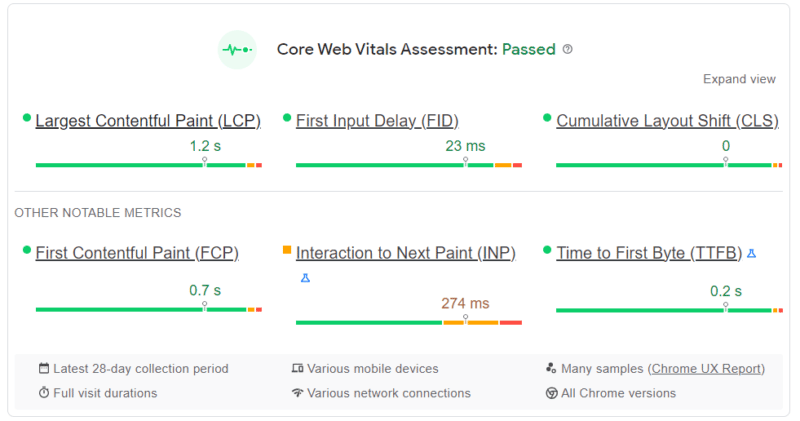
Google Core Web Vitals
Initiated by Google, Core Web Vitals is one of the most important sites for speed tests on the internet currently, giving you information on the different fields that affect your website.
Currently, Core Web Vitals is very focused on user experience, with measurements such as loading performance, interactivity and visual stability; however, it is expressly mentioned that these factors can change in the future.
Lighthouse report
If you are familiar with GTMetrix and other popular free speed test tools, you have been using Lighthouse Report Technology. It is an open-source technology, also by Google, that breaks down your website speed.
Similarly to Web Core Vitals, this report is incredibly thorough and will provide a breakdown of issues that could be slowing down your page, from general performance, accessibility, best practices, and SEO.
2. Change the PHP Version
PHP (Hypertext Preprocessor), is the coding language WordPress is based on. This means as WordPress grows in versions, it will need the latest version of this scripting language.
Thankfully, WordPress has a PHP warning if it believes your current version of the CMS is not compatible or needs a newer version installed.
Currently, it is recommended that you run PHP 8 or PHP 8.1 for a stable version of WordPress, or at the minimum PHP 7.4.
PHP version 7.4 will continue to have security fixes until November 28, 2022. Once a version of software stops receiving security updates, it reaches its “end of life” and is no longer recommended for use.
If your web host does not update your PHP version automatically, you can switch between different versions across sites using cPanel.
3. Choose a host focused on WordPress
Site speed goes deeper than hosting, however, the web host you choose will be the foundation for your website.
A host that is focused on providing you with the best performance for your WordPress site comes down to the server infrastructure.
At InMotion Hosting, we provide our customers with high-performance servers that are fine-tuned for WordPress. Our custom UltraStack configuration is designed to make your server incredibly fast and efficient using NVMe SSD, NGINX, PHP-FPM and Redis. No additional software configuration is necessary for you to see a significant improvement in your WordPress performance.
4. Use a caching plugin
Some of the most popular plugins in the WordPress ecosystem are caching plugins. They are advertised as a sure way to boost your website’s performance, but what do they really do?
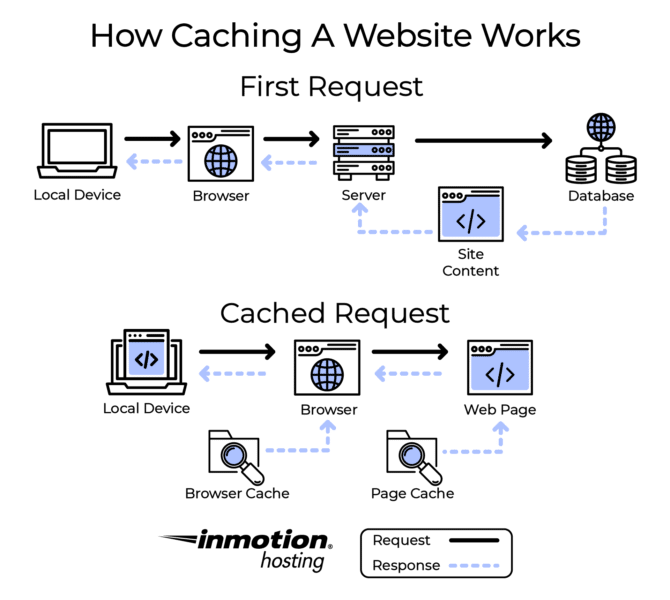
In simple terms caching occurs when your computer remembers frequently used data from a website to save time.
This means when you pull up a website, your computer first looks locally to see if it has a recently cached version to view.
Since WordPress sites are dynamic, every time an end-user requests your website it pulls content from the host. The website will try to load any new data and might be slower because of this.
If you don’t update your website often, using a caching plugin whose main job is to create a static version of your website that can be cached can increase your site’s speed.
These days caching plugins have different ways to increase your performance, from minimizing files to optimizing images and more.
Here are a few popular and free WordPress caching plugins:
- W3 Total Cache: A caching plugin with a large number of options to tailor the caching capabilities of your website. This hosting agnostic plugin improves performance and reduces page load times by offering minification, object caching, database caching, cache-control and more.
- WP Super Cache: This caching plugin from Automatic generates static HTML files from dynamic WordPress files and serves them to site visitors at lightning speeds.
Due to compatibility issues, we do not recommend having more than one caching plugin active at the time, as activating multiple plugins is counterproductive for optimization purposes.
5. Optimize your images
Images can be deceivingly large files. Therefore, when your computer calls for information from the host it can be one of the last things to load.
Optimizing your images can be done before or after the upload then to your website. WordPress supports WebP images which are optimized images introduced by Google that retain the quality of the photo without taking up a lot of space.
Image optimization plugins are also a popular choice for WordPress users. Our recommendations include:
- Performance Lab: The Performance Lab plugin is a great resource to have for WebP image conversion and other optimization settings.
- Smush: One of the most popular plugins in WordPress, Smush automatically compresses and optimizes images as you upload them. You might need to upgrade to premium for bulk editing more than 50 images or compressing files larger than 5MB.
6. Consider lazy loading
Contrary to what their name suggests, lazy loading is a great way to increase your site speed.
A lazy loader will load your content only when it is needed, decreasing the number of asset and server requests to render your website.
Certain optimization plugins now include lazy loading as one of their options, including Jetpack and WP Rocket, though sometimes this perk is offered at a premium price.
7. Use a Content Delivery Network (CDN)
Content Delivery Networks have become a hot topic for web hosting, and for good reason. A CDN is a way for your end-users to access your website at a faster rate due to their servers caching your site data.
Similarly to caching plugins, this helps users load up content without having to request it fresh every time they pull your site.
Having a CDN also heightens your website security, and certain brands even have implementations to protect you from DDoS attacks.
If you are interested in a CDN but do not currently have the budget for one, Cloudflare offers a personal account for free, which has access to its CDN services.
8. Optimize your database
The information stored in your database is the heart of your website. It contains all the important WordPress installation details and files from your plugin, pages and even comments users make.
Because of the way WordPress stores data, your database will need optimization. Database tables store things like post revisions, spam comments and deleted posts. These entries take up space and slow your site down.
Removing these unnecessary files can improve your site speed because the tables where the data is stored will be smaller and data will be easier to process for your end users.
Fortunately, you do not have to go through your database manually to optimize it, you can use a plugin such as WP-Optimize with database optimization capabilities.
Continuing your education
If you are interested in learning more about WordPress optimized hosting and how you can improve your website speed and SEO, check out InMotion Hosting’s WordPress Education Channel for further articles and guides.
Final thoughts
Site speed will always be an important factor for SEO. Ensuring that your WordPress site is up to date and optimized will do wonders for your ranking.
Learn more about how WordPress VPS with UltraStack can help improve your WordPress performance.
The post 8 simple steps to optimize your WordPress site for SEO appeared first on Search Engine Land.
Courtesy of Search Engine Land: News & Info About SEO, PPC, SEM, Search Engines & Search Marketing
Monday, October 10th, 2022
Google has just announced its plans to launch a number of features aimed at helping publishers monetize their websites and increase their emphasis on first-party data relationships. The features include support for ads personalization with publisher first-party cookies in Google Ad Manager and AdSense.
Expanding publisher first-party cookies. Publisher first-party cookies can help publishers deliver relevant ads without tracking users across third-party websites. Publisher first-party cookies have been available to address frequency capping and fraud control previously.
When a publisher allows, Google provides publisher first-party cookies to help improve ad relevance on that specific publisher’s website. The solution uses information from ad interactions that users take on that publisher’s own site. This information cannot be used on any other publisher’s website. The feature also respects people’s ads personalization preferences that they have indicated through AdChoice controls.
Publisher first-party cookies are an especially useful solution for smaller publishers, who may not have the resources or infrastructure to leverage first-party data independently. They require minimal technical work from publishers to use.
The introduction of audience signals. Google announced publisher-provided signals last month to help publishers categorize their first-party data into audience or contextual segments and then share those signals with programmatic buyers. Those signals make it easier for programmatic buyers to “find and purchase audiences based on things like demographics, content interests or purchase intent across multiple sites and apps without tracking people’s activity in apps or across the web.”
What Google says. In a statement to Search Engine Land, Google said:
“As part of a broader suite of tools, we’re helping publishers of all sizes build durable advertising strategies that uphold user trust. This solution is really geared toward supporting the publisher base, especially smaller publishers who may not have as many resources, as they continue to navigate changing privacy expectations.”
Peentoo Patel, Director of Product Management, Google Ad Manager
Launch date. This feature will be available to publishers beginning in November.
Why we care. If you’re a smaller publisher and don’t have the capacity or resources to capitalize on first-party data, this support feature is for you. Additionally, Google’s support of publishers’ use of their first-party data will only enhance their bottom line, as privacy concerns and ad relevance becomes more prevalent.
The post Google to offer publisher first-party cookie support appeared first on Search Engine Land.
Courtesy of Search Engine Land: News & Info About SEO, PPC, SEM, Search Engines & Search Marketing
Monday, October 10th, 2022
Enterprise SEO platform vendors offer numerous capabilities. These range from keyword research
and rank-tracking to backlink analysis and acquisition, as well as competitive intelligence and content
optimization.
Most of the vendors profiled in Enterprise SEO Platforms: A Marketer’s Guide offer the following core capabilities:
- Keyword research and rank tracking;
- Page-level SEO analysis;
- Content optimization analysis;
- Link (also called backlink) analysis and acquisition/removal;
- Site error detection;
- Organic search traffic market share;
- Competitive analysis;
- International search results and rank tracking;
- Internal cross-linking; and
- APIs for third-party data integration and management, as well as for export to other analysis tools.
Enterprise-level platforms may also provide more extensive link and site audits or analytics that include predictive scoring systems to identify potential opportunities to improve page performance or link authority.
Vendors differentiate by offering more frequent or detailed data updates or content marketing features that sometimes require additional investment. These more advanced capabilities may include, but are not limited to:
- Daily or real-time site crawls.
- Features to manage adjacent fields like PPC or social media marketing.
- Search intent-based analysis, perhaps involving artificial intelligence or machine learning.
- Universal search rankings incorporating featured snippets, knowledge panels, reviews, local packs, images, top stories, video, related questions, carousels, tweets and other dynamic displays.
- Analysis and management of Google Shopping feeds.
- Content marketing analysis and performance tools.
- On-page content quality analysis.
- Competitive intelligence and benchmarking.
- Identification of technical issues that can impact rankings (e.g., broken pages, slow loading pages, content duplication, excessive redirects).
- Cross-device attribution.
Here are nine important features of enterprise SEO platforms.
1. Link analysis and acquisition
Links continue to be one of the most important external or “off-page” signals that can help a website rise in search engine rankings.
Most enterprise SEO platforms provide link analysis (i.e., what sites are linking to yours), link building or removal recommendations via competitive analysis and other reports that reveal opportunities for obtaining links (i.e., what sites should you solicit links from) as part of their base platforms.
2. Keyword research/rank analysis
Keyword research – knowing what terms people use to find your website, how your pages rank for various queries and how you should use those terms in your copy – is a pillar of effective SEO.
Virtually all enterprise SEO platforms provide keyword research tools that allow marketers to discover the ways that consumers search for content, and what keywords are driving traffic for competitors.
Vendors source this data differently, however.
Some vendors license data from point solutions or ISPs, due to Google’s restrictions on scraped data in its terms of use and the percentage of search results that are keyword “(not provided).” Other vendors develop and manage a proprietary database of keyword terms.
As a result, reliable keyword data has become less of a commodity and more expensive.
It’s also important to note that rank analysis has grown increasingly complex as Google has upped its use of more dynamic and visual SERPs.
Marketers are no longer satisfied with a simple numeric designation of how their page ranks for a particular query; they want to know if it’s displayed in a carousel, in a knowledge panel, with sitelinks – or any of the other ways in which crawled content is being displayed on the SERPs.
Brands want a sense of how they’re coming across in search generally, even if the brand-related activity is happening on third-party sites. That’s why providers are coming up with their own proprietary formulas for calculating “share of voice” in search
3. Search intent-based analysis
Google’s search algorithms, often powered by artificial intelligence, are focusing less on keyword
matches and more on search intent.
To counter the lack of keyword data, SEO platform vendors are developing more tools that analyze search intent and predict or recommend the most relevant content that would meet the searcher’s needs.
4. Custom site crawls/audits
With content quality becoming the lynchpin for many marketers’ SEO strategies, site crawls or audits are important tools offered by enterprise SEO platform vendors.
Some platforms offer optimization recommendations for keywords, page structures and crawlability. They often prioritize and assign scores for such factors as HTML title tags, body tags and meta tags.
Many enterprise SEO platforms provide daily site crawls; some feature real-time technical data, while others offer updates on a weekly basis.
Ideally, the tool should be able to crawl the entire site, not just random pages. However, some enterprise sites are so large it’s unrealistic to expect a tool to crawl it in its entirety.
5. Content marketing and analysis
SEO and content marketing have become closely aligned, as Google has raised the content quality bar through artificial intelligence as well as its regular algorithm updates. As a result, relevant, up-todate content has become integral to SEO success.
Many vendors have upgraded the content optimization and content marketing capabilities of their enterprise SEO platforms and expanded the tools’ content marketing features. These include:
- Page management tools or APIs to monitor on-page content and errors.
- Reports on content performance and traffic trends.
- Influencer identification and campaign management.
- Real-time content recommendations.
More advanced platforms perform analysis to help improve the depth and quality of content by performing topical analysis of content and comparing it against the competition to identify potentially important gaps and make recommendations for improvement.
One emerging area in which vendors are investing is the ability to automatically and proactively suggest topics that marketers should create content about – eliminating the need to spend lots of time on analysis. Some even aid in developing the type of content that will show up in queries for target keywords.
6. International search tracking
International search coverage has become a critical capability, as the global economy leads more U.S.-based enterprises to conduct business online and offline in multiple countries and languages.
Virtually all enterprise SEO platforms profiled in this report offer some level of international search coverage that crosses borders, languages and alphabets.
The capabilities include international keyword research, integrating global market and search volume data into the platform, as well as integrating global CPC currency data.
7. Mobile/local analytics
Google’s search engine updates are increasingly focused on improving the mobile/local search user experience.
While mobile-friendly sites are now table stakes in the SEO game, appearance in local listings has become more important in the COVID-19 era, which elevated e-commerce and digital communication among local retailers and restaurants, in part to cope with the demand for BOPIS and curbside delivery.
8. Technical SEO crawling
Tools to identify technical issues that may be hindering ranking performance are very important, given that marketers rank technical SEO fixes as their number one priority. These include things like:
- Slow page load.
- Implementation of schema markup.
- Identification of crawling issues.
- The allocation of crawl budget.
- The flagging of duplicate URL and canonical issues.
9. Cross-device attribution
Recognizing that SEO is just one aspect of a brand’s marketing efforts, and also that search traffic (especially on brand keywords) is influenced by paid media, some vendors are developing capabilities that help marketers determine what marketing initiative is driving site visits or sales.
This is becoming increasingly difficult, however, as third-party cookies are no longer being supported by many companies.
Get the full report on Enterprise SEO Tools here
The post 9 important features of enterprise SEO platforms appeared first on Search Engine Land.
Courtesy of Search Engine Land: News & Info About SEO, PPC, SEM, Search Engines & Search Marketing