Archive for the ‘seo news’ Category
Friday, October 21st, 2022
Google’s My Ad Center today will start rolling out to users, globally, to provide control over the kinds of ads they see across Google on Search, YouTube and Discover.
“81% of consumers are more concerned with how their data is being used and 48% are turning away from services due to privacy concerns. At the same time, our research also says that people only want to see ads that are relevant and useful to them,” says Jerry Dischler, VP/GM Google Ads. “To build more trust, we want to continue ensuring that ads respect people’s privacy; and offer transparency, choice, and control. We see these principles as foundational to the future of advertising. It is a key priority for our business – and the foundation My Ad Center was built on.”
New features and controls. The new My Ad Center controls will also allow you to block sensitive ads and learn more about the information used to personalize your ad experience.
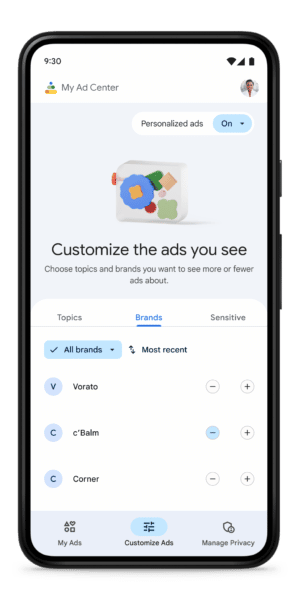
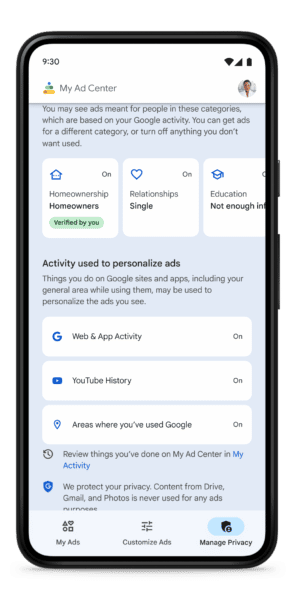
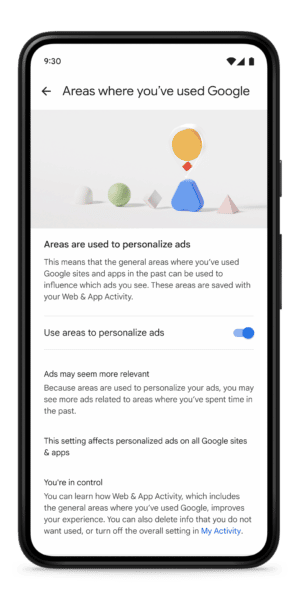
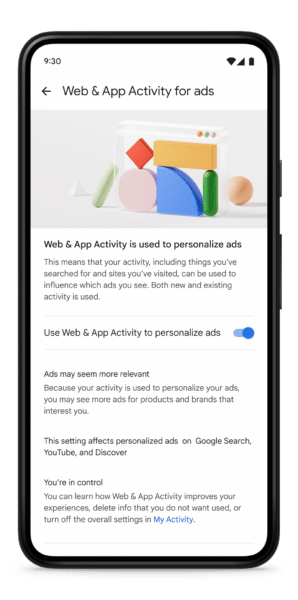
More controls for activities used to personalize ads. My Ad Center expands Google’s privacy controls to allow users more direct control over which data sources — specifically Web & App Activity and YouTube History — are used to personalize your ads across Google Search, YouTube and Discover.
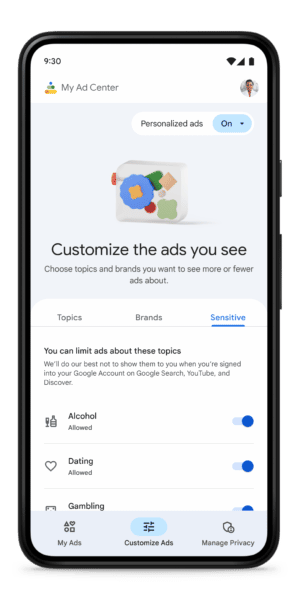
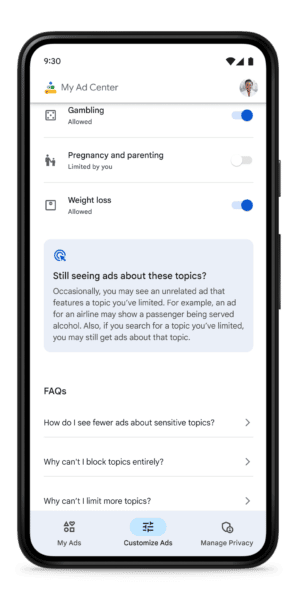
Expanding user control for sensitive categories. In My Ad Center, users have the ability to see fewer ads in five sensitive categories:
- Alcohol.
- Dating.
- Gambling.
- Pregnancy and parenting.
- Weight loss.
Before, this feature affected ads shown on YouTube and Display. Now, it expands to ads shown on Search and Discover.
Advertiser pages. To give people even more transparency, Google is enhancing ad disclosures with new advertiser pages. Users can access these disclosures in the new My Ad Center panel and see the ads a specific verified advertiser has run over the past 30 days.
How it works. In My Ad Center, users can tap on the three-dot menu next to an ad type they want to see less of. They can also choose to see ads about things that they care about, like deals for sneakers or holiday gifts for loved ones, according to examples provided by Google.
Users can also completely turn off ad personalization. Those who choose not to see personalized ads, will still be served ads, but Google says those ads may be less relevant or useful.
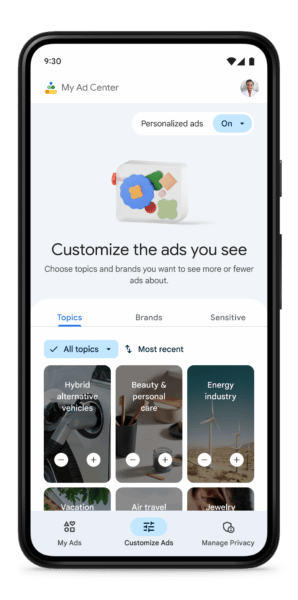
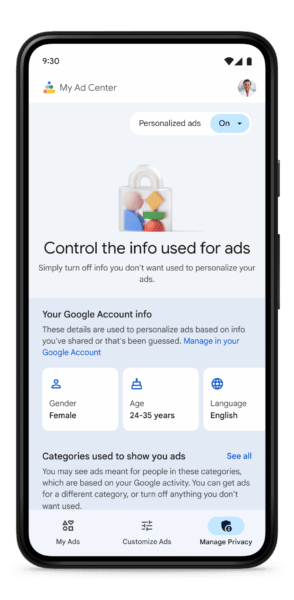
More privacy controls. With the new My Ad Center added controls, you can see what information Google uses and control it based on your preferences. You can decide what types of your Google activity are used to show you ads.
In the past, if your YouTube History was on, it automatically informed how your ads were personalized. Now, if you don’t want your YouTube History to be used for ads personalization, you can turn it off in My Ad Center, without impacting relevant recommendations in your feed.
What Google says. Dischler adds, “I see our role in this evolving industry as innovating through our products. Building products that are secure by default, private by design, and put the control of data in the hands of our consumers. When it comes to advertisers, publishers, and our other partners, we are taking a privacy-preserving approach to advertising, built on first-party data, and unlocked by the benefits of machine learning.”
“We are doing all this because we believe it’s essential to the open web to build a long-term stable ads ecosystem. And we intend to help navigate the industry to a privacy-first, pro-consumer-focused future.”
Dig deeper. You can read more info about the new My Ad Center experience here.
Why we care. Since Google’s announcement of My Ad Center in May, we have been waiting for it to roll out to users globally. With the sunsetting of cookies in 2024, the new privacy features give users their best chance at privacy and having a say in the ads they are served.
Additionally, the new features could be a benefit to advertisers as well since users who take advantage of My Ad Center will have access to the ads and brands they are most interested in. Advertisers will also benefit from higher ad relevance.
The post Google My Ad Center updates give users more, expanded controls appeared first on Search Engine Land.
Courtesy of Search Engine Land: News & Info About SEO, PPC, SEM, Search Engines & Search Marketing
Wednesday, October 19th, 2022
When it comes to collaboration, there is no one-size-fits-all approach. Especially now, as businesses operate in many different ways, the way employees work together is ever-evolving.
Because of this, leaders need to rethink how to collaborate successfully by removing barriers and empowering their teams to do the best work of their lives.
Still, many companies are failing at meaningful collaboration. And if marketers cannot work well together digitally – when they have that chance to hit edit before they hit send – they’re going to have trouble working together again face to face.
Join Patrick Rohlfsen, principal consultant at Wrike, to hear recommendations for collaborating in harmony, in his inspiring MarTech session. He will walk you through the difference between active collaboration (Slack and Teams chatting, instant messaging, etc.) and passive collaboration (responding to emails or phone calls without urgency).
After this session, you’ll be able to:
- Understand the importance of recalibrating technology in the modern workplace.
- Build stronger relationships, have better conversations and build trust.
- Have a better resolution for where technology fits in your collaboration equation.
Tune in to the session and session, and you’ll better understand the potential and value human beings (with the support of technology) have when they are intentional about collaboration. The more thought you give to creating environments and experiences for stakeholders, the better the results you’ll have as project managers.
The post Balancing active and passive collaboration in today’s workspace appeared first on Search Engine Land.
Courtesy of Search Engine Land: News & Info About SEO, PPC, SEM, Search Engines & Search Marketing
Wednesday, October 19th, 2022
Google is rolling out a new search ranking algorithm update targeting the more spammy side of the search results.
The company is calling this update the “October 2022 spam update.” It should take about a week to fully roll out and be noticed in the search results.
Google said this update is global and affects all languages.
What are spam updates. Google wrote:
“While Google’s automated systems to detect search spam are constantly operating, we occasionally make notable improvements to how they work. When we do, we refer to this as a spam update and share when they happen on our list of Google Search ranking updates. For example, SpamBrain is our AI-based spam-prevention system. From time-to-time, we improve that system to make it better at spotting spam and to help ensure it catches new types of spam. Sites that see a change after a spam update should review our spam policies to ensure they are complying with those. Sites that violate our policies may rank lower in results or not appear in results at all. Making changes may help a site improve if our automated systems learn over a period of months that the site complies with our spam policies.”
The announcement. Google announced this on Twitter saying “Today we released the October 2022 spam update.”
Previous updates. Before this, the most recent confirmed Google spam update was the November 2021 spam update. Google also released a two-part Spam Update – on June 23 and June 28 in 2021, as well as the July 2021 link spam update.
Why we care. If you notice large ranking or traffic changes from your organic Google search results, you may have been hit by this spam update. Spam updates target specific guideline violations. Google did not say if this was links, content or other forms of spam, but rather just said it is spam-related in general.
The post Google releases October 2022 spam update appeared first on Search Engine Land.
Courtesy of Search Engine Land: News & Info About SEO, PPC, SEM, Search Engines & Search Marketing
Wednesday, October 19th, 2022

Keyword cannibalization can occur when multiple URLs on your site rank for the same keyword. This can become a problem for your website if you have multiple pages competing for the same keyword and one or more of your pages are underperforming. If you’re concerned your website is experiencing harmful keyword cannibalization, don’t panic!
Join Conductor for a discussion on identifying keyword cannibalization and what steps you can take to resolve instances of harmful cannibalization on your website.
Register today for “An SEO Guide to Finding and Fixing Keyword Cannibalism,” presented by Conductor.
The post Webinar: An SEO guide to fixing keyword cannibalism appeared first on Search Engine Land.
Courtesy of Search Engine Land: News & Info About SEO, PPC, SEM, Search Engines & Search Marketing
Wednesday, October 19th, 2022
Let’s run through a scenario that agencies see from time to time (not just in Q4, but the stakes are higher across the board right now):
On the client side, a main point of contact is relatively new to the team. It’s Q4. They’re feeling stressed.
On the agency side, things seem to be going well. KPIs are in line with established goals, there’s a strategy in place for the next few months, weekly calls haven’t surfaced any concerns, and there’s a healthy test-and-learn methodology in place for creative optimization and channel expansion.
Then the email drops: counter to what the agency is seeing, company data shows that the marketing team isn’t hitting goals.
If things don’t improve quickly, there are going to be some tough conversations about ending the partnership.
What happened? And how could the agency have prevented it?
I’ll dig into the answers in this post.
1. Treat alignment as an activity
Agencies and brands are generally diligent about aligning goals, KPIs, and data sources as part of the onboarding process.
But the agency can’t assume brands will automatically alert all parties when things change internally.
Factors that agencies must plan to solicit regular updates on include:
Goals
Every marketing department I’ve ever worked for or with has changed goals from time to time.
Whether it’s pivoting from lead gen to site traffic or shifting focus from driving growth to improving CPA, change is a constant.
This needs to be reflected in your campaigns and reporting, or you’ll be driving headlong down the wrong road in optimizing the wrong KPIs.
Data sources
Internal dashboards are always a big point of discussion in onboarding and kickoff calls, but the conversation can’t end there.
Attribution models change and improve, tech stacks evolve, internal business intelligence teams build dashboards, etc.
Agencies that aren’t asking for access to that data are flying without a map.
One important component of internal reports that agencies need to know is the fields that client dashboards use to attribute to advertising.
We use UTMs and campaign IDs, but clients may be able to attribute advertising-influenced actions beyond that first touch that we can bake into our reporting and optimization.
If a client is using HubSpot, that can add an extra layer of complication.
HubSpot reports are hard to export and look at in a clean way. The data needs to be analyzed in a native environment in order for agencies to tie campaigns to offline data.
While HubSpot data can be pulled into better reporting environments like Salesforce, which can build reports based on any specified UTMs (e.g., ad group or keyword), any advanced offline insights will rely on client resources to build the reporting.
In short, those conversations, and how to share and reconcile different data sources, are important to have to maintain a similar construct around campaign performance for whatever layer of analysis you’re seeking.
Calendars/pricing
We all know, on the consumer level, that retail discounts are all the rage in Q4 – online, offline, and both.
In the B2B world, it’s common for brands to incorporate an end-of-year sales push, or buyer incentives, that could include more motivation to book meetings.
Agencies that aren’t asking for that information right around now will likely suffer from a lack of lead time in setting up plans, including how to monitor and adjust to pipeline data and funnel flow (e.g., lead-to-meetings booked rates could artificially increase, which could have bidding and budgeting ramifications).
Websites and landing pages
Websites and landing pages change all the time.
Maybe there’s a homepage banner advertising a brand-new report or new CTAs in rotation on a demo-focused landing page.
Or maybe the client has done some brand tweaking to update messaging and value props.
That report would make a great sitelink for brand search ads. Those CTAs and value props should be reflected in ad copy and creatives to keep the user journey as friction-free as possible.
Those might seem minor, but little things can compound over time if you’re not keeping track of a client’s owned media updates.
External campaigns
This is an extreme example, but imagine you’re watching the Super Bowl, and you see a commercial for a client that you had no idea was about to happen. Your search budget could be blown by halftime.
When clients have major campaigns afoot beyond the ones you’re managing, you need to know in order to effectively prepare for any downstream ripples.
Make sure you’re checking with your clients – especially those working with multiple agencies – on whether they have initiatives outside of your partnership that you should be aware of.
This includes things like billboards, radio commercials with discount codes that could make for cool sitelinks, CTV or podcast campaigns, etc.
2. Build – and stick to – a communication cadence
Do not wait for QBRs to bring up big topics like goals. Internal marketing teams don’t plan their strategy around agency meetings.
At my agency, we’re working on a strategic planning template that we’ll review quarterly with clients in 2023, but we’ll supplement that by bringing up goals regularly on weekly calls to build the habit and make those conversations second nature.
Along with reporting on progress to goal, as most agencies do in weekly calls, we’ll manage alignment by:
- Asking if anything has changed.
- Getting context and providing initial feedback on feasibility if goals have changed.
- Openly discussing possible concerns and brainstorming solutions.
Once those steps are completed, we’ll revise the current roadmap or build a new one to make sure we’re fully incorporating the goals into our partnership.
Get the daily newsletter search marketers rely on.
<input type=”hidden” name=”utmMedium” value=”” />
<input type=”hidden” name=”utmCampaign” value=”” />
<input type=”hidden” name=”utmSource” value=”” />
<input type=”hidden” name=”utmContent” value=”” />
<input type=”hidden” name=”pageLink” value=”” />
<input type=”hidden” name=”ipAddress” value=”” />
3. Err on the side of over-communicating
Over-communication can make the consumption of important content challenging, especially in today’s digital environment. (Quick, count the number of log-ins you do daily to keep up with company and external goings-on.)
But under-communicating is a worse option.
Simply put, you can ignore the questions or content you don’t have time to read, but you can’t respond to something if it’s never put in front of you. That’s the approach agencies should take, especially in relatively busy/chaotic times like Q4.
Repeat info. Overshare updates. Ask questions (politely) until you get answers.
In general, assume your client contacts are busy and under pressure and don’t have “keep agency up to speed” first on their list of daily priorities.
4. Work backward and build project plans
As agencies well know, it takes time to plan properly for initiatives like end-of-year software sales discounts and ecommerce promotional calendars – especially since there’s also a lot of daily rigor and optimization that needs to happen in the meantime.
I like to set an ideal endpoint (“We launch on X date”) and work backward to schedule every preparatory step needed to hit the goal.
- Give the client a heads-up that you’re working on a project plan.
- Detail each step and assign rough dates and owners.
- Send the proposal to your clients for review ASAP.
Once their feedback is incorporated and the parties are aligned, make sure you’re tracking and updating the project somewhere common like Asana to keep all parties on track.
Conclusion
For both the client and the agency, the absolute worst time to surface any possible issues is after a long stretch of misaligned perspectives of performance.
Prolonged misalignment often results in the end of a partnership and missed goals on the client side.
It’s especially important for agencies to establish a rhythm of questions and proactive communication in Q4, with the bonus that you’ll condition both parties to keep lines of communication open and enable better longer-term planning.
The post 4 communication best practices agencies must employ early in Q4 appeared first on Search Engine Land.
Courtesy of Search Engine Land: News & Info About SEO, PPC, SEM, Search Engines & Search Marketing
Tuesday, October 18th, 2022
Google just announced three new conversion reporting columns to save advertisers the hassle of applying custom segments to see each individual conversion action and the categories they fall under.
The new columns. The three new conversions columns are:
- Results
- Results value
- Conversion goals
Let’s dig in.
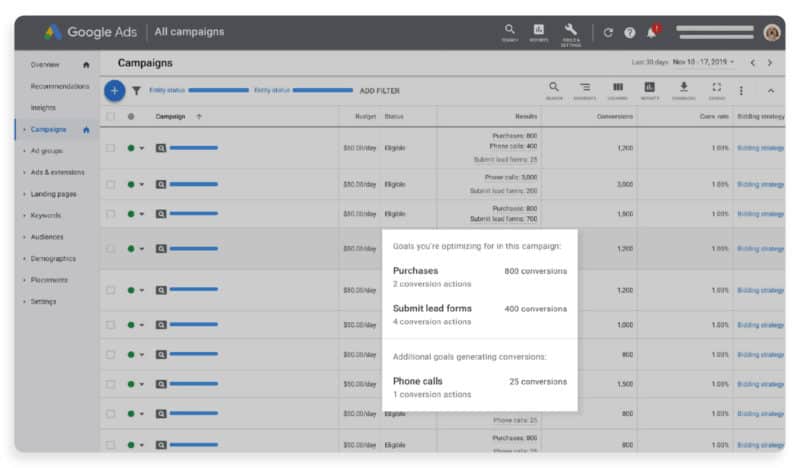
Results
This column shows the number of conversions you’ve received across all primary conversion actions for each of your standard goals. Advertisers will also see the impact this campaign is driving against goals it’s not optimizing towards.
Results value
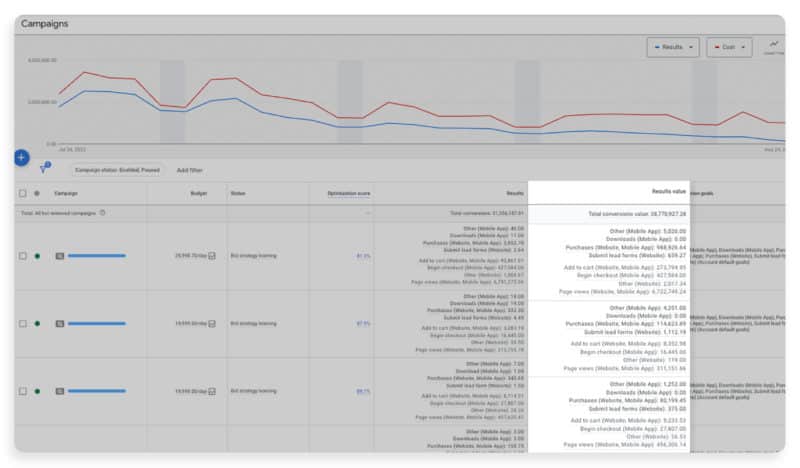
This column shows the calculated conversion values you’ve received across your primary conversion actions for each of the standard goals in your account.
Conversion goals
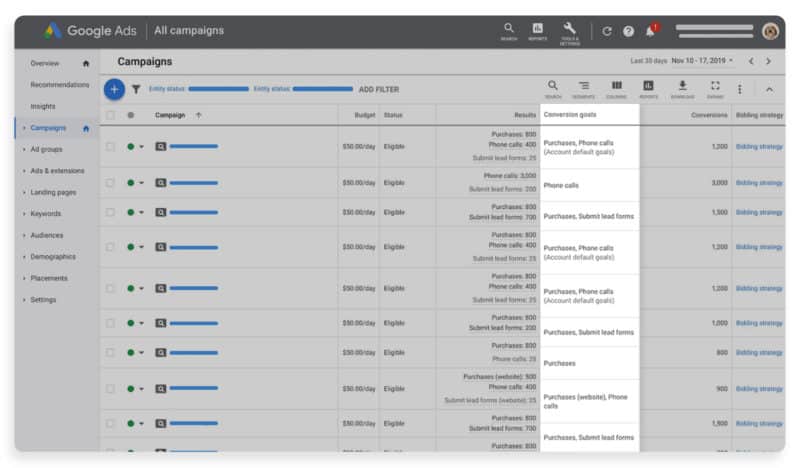
This column will show the goals listed in your campaign-level settings that drive performance.
Dig deeper. For more info on Google’s new conversion columns, you can visit their help center.
Why we care. Advertisers who measure conversions should try the new columns to see which ones offer better visibility into their account goals as well as what they mean for your performance.
The post 3 new Google reporting columns for conversions appeared first on Search Engine Land.
Courtesy of Search Engine Land: News & Info About SEO, PPC, SEM, Search Engines & Search Marketing
Tuesday, October 18th, 2022
TikTok announced a new campaign type for brands to further enhance their performance in the app. The new solution is called Smart Performance Campaigns.
Sounds familiar. If the new campaign type sounds familiar, it might be because it’s almost identical to Google’s smart and Performance Max campaign types which require advertisers to put their full trust into the platform’s AI and machine learning systems.
What TikTok says. From their blog post announcement, TikTok says:
“Smart Performance Campaign is our first end to end automation solution that leverages machine learning to optimize for best performance and marketing goals. In order to reach the right people and maximize results, Smart Performance Campaign is designed to run performance campaigns at scale, while reducing the number of manual steps to drive results.
It’s completely hands off, with minimum input needed from advertisers to get started. Through leveraging machine learning, getting started with Smart Performance Campaign is as easy as it sounds. All you need is a marketing objective, budget, country, and creative assets to get started.”
Who should use Smart Performance Campaigns. TikTok says that the new Smart Performance Campaigns are perfect for advertisers who are new to advertising on the platform, Enterprise or SMB advertisers who don’t have the resources to have hands-on campaign management, performance-oriented advertisers who are looking to optimize, and gaming advertisers launching new titles.
Early testing. In their announcement, TikTok said Bolt ran a 14-day A/B test campaign with Smart Performance Campaign that lowered CPA by 27% and generated 40% more purchase actions. To continue the success, Bolt has rolled out Smart Performance Campaign across additional markets including the UK, Spain, Sweden, Romania, and Portugal.
Launch date. Smart Performance Campaign will be globally available for Android App Promotion campaigns at the end of the month, with more to come later this year for iOS and Website Campaigns.
Why we care. Just like with Google, automated smart campaign types will work better for some brands than others. Advertisers should be cautious and ensure their performance tracking is accurate and pixels installed properly before use. It is worth testing with a small portion of your budget, but it’s not available to all advertisers just yet so keep an eye on your account.
The post A look inside TikTok’s new automated Smart Performance Campaigns appeared first on Search Engine Land.
Courtesy of Search Engine Land: News & Info About SEO, PPC, SEM, Search Engines & Search Marketing
Tuesday, October 18th, 2022

To achieve the most ROI from your customer data, you need a strong foundation. Creating a precise golden record for each consumer with enriched data, a full contact graph and a full identity graph provides the context your brand needs to differentiate based on CX. Precise data includes both first-party data as well as third-party data to enrich your total understanding of each consumer.
If your brand lacks a pristine golden record for each customer, join John Nash, chief marketing and strategy officer at Redpoint, as he discusses the best steps to get started.
Register today for “Steps to Deliver Highly Personalized Experiences With Quality Data,” presented by Redpoint Global.
Click here to view more Search Engine Land webinars.
The post Webinar: Use a golden record of data to enhance customer experiences appeared first on Search Engine Land.
Courtesy of Search Engine Land: News & Info About SEO, PPC, SEM, Search Engines & Search Marketing
Tuesday, October 18th, 2022
Meta will accept a ruling by UK watchdog company ordering it to sell Giphy, the animated GIF library.
What happened. Meta was originally ordered to sell Giphy last year but they appealed. Today, the UK’s Competition and Markets Authority (CMA) announced that Meta had failed on five of the six objections raised in its appeal. The CMA said that the acquisition should be reversed on the grounds that it “could allow Meta to limit other social media platforms’ access to GIFs, making those sites less attractive to users and less competitive.”
An independent panel noted that Meta’s purchase of Giphy would allow it to increase its market power in multiple ways, including blocking off rival social media sites’ access to its library of GIFs, or forcing them to give over valuable user data in exchange for access.
At the time of Meta’s purchase, Giphy had been developing its own advertising services, which were then added to Meta’s offerings. The CMA said this was a competition problem given that Meta already controls roughly half of the UK’s £7 billion ($8 billion) display advertising market.
In the past, the CMA orders sometimes lead companies to sell parts of globally operated companies. But Meta said that it will sell all of Giphy.
What Meta says. “We are disappointed by the CMA’s decision but accept today’s ruling as the final word on the matter. We will work closely with the CMA on divesting Giphy.” When asked if the divestment would apply to all of Giphy’s international operations, a Meta spokesperson said “Yes, this applies globally.”
Dig deeper. You can read the full article from The Verge here.
Why we care. The sale doesn’t affect advertisers directly, but marketers, Meta users, and creators who use Giphy regularly may be able to access the animated short clips on more social media platforms.
The post Meta to sell Giphy, by order of UK competition watchdog appeared first on Search Engine Land.
Courtesy of Search Engine Land: News & Info About SEO, PPC, SEM, Search Engines & Search Marketing
Monday, October 17th, 2022
The new Focused View campaign objective allows brands only pay when users have voluntarily watched an ad for at least 6 seconds or when they interacted with the ad within the first 6 seconds (whichever comes first).
What this means. Focused View is the new Video View campaign type. Selecting the Focused View objective means that ads are shown to users who are truly paying attention and voluntarily engaging with the brand.
Focused View allows TikTok to optimize for two different kinds of engagement:
- Emotional engagement through content consumption: Targeting users who are most likely to view your ad for at least six seconds
- Tangible engagement through interaction: Targeting users who are more likely to actively engage with an ad by liking, sharing, following or clicking
Early adopters. During its Alpha phase, Samsung used Focused View on their Summer of Galaxy campaign, aimed at driving awareness and engagement for their Galaxy products. The 6-second Focused View objective helped to drive:
- +11% increase in ad recall
- +18% improvement in 2-second CPVs
- +53% increase in average watch time per view
- 2.8x increase in completion rate
Release date. Focused View will be available to advertisers, globally, on October 20.
Dig deeper. You can read the announcement from TikTok here.
Why we care. Advertisers who use TikTok to promote their brands can use the new Focused View campaign objective to show their ads to users they know are paying attention. Ideally, this would increase engagement and conversions. With all new features and products, advertisers should test the new campaign objective when it is released.
The post TikTok has a new Focused View campaign objective appeared first on Search Engine Land.
Courtesy of Search Engine Land: News & Info About SEO, PPC, SEM, Search Engines & Search Marketing