Archive for the ‘seo news’ Category
Thursday, August 8th, 2024
Design thinking is an iterative, user-centric approach to product and software development focusing on the person behind the problem.
In enterprise SEO, design thinking seamlessly integrates SEO features into the core site experience. By focusing on people as the central element in addressing both problems and solutions, design thinking leads to future-proof SEO.
Integrating this approach into enterprise SEO encourages team collaboration, ensuring SEO initiatives are practical, technically feasible and aligned with business goals, all while staying cost effective.
Understanding design thinking in the context of SEO
Ingrained into the SEO process, design thinking shifts the focus from blindly optimizing for search engines toward creating value for the end user.
Many SEOs continue to seek to decipher the “200 ranking factors,” focusing on staying upstream of the never-ending slew of Google algorithm updates and guessing the next SERP layout change.
Resulting SEO “strategies” — or hacks — have a short shelf life, good only until the next core update. Focusing on the short-term works for SEO experimentation in high-risk, high-reward environments. But this is hardly the right approach for real businesses with an eye for long-term growth.
Design-driven and growth-oriented SEOs understand that the real and far more rewarding problem to crack is not the algorithm but the user. It requires knowing your audience, what they want and why and how to solve their problem given existing constraints.
Design thinking introduces a creative and systematic element to problem-solving. It involves understanding user needs, challenging assumptions, redefining problems and creating innovative solutions for prototypes and tests.
The classic process typically includes five stages:
- Empathize.
- Define.
- Ideate.
- Prototype.
- Test.
Empathy
Understand users’ needs, behaviors and motivations.
- Who are your users and/or audiences?
- What problems are they looking to solve?
- What’s their immediate need?
- What’s their ultimate need?
Tackle these questions through persona building. For example, your business is a local classifieds site with various verticals. One of your many user segments could be newcomers to your country.
Immediately, they may be looking for a room or an apartment to rent. But ultimately, they are looking to settle down and build a new life. A classified ads site might be well-positioned to meet their needs at multiple stages of the journey.
Define
Clearly articulate SEO problems and goals based on user insights.
The immediate SEO goal here might be identifying the multitude of ways users may be signaling their intent through:
- Internal and external searches.
- Browsing patterns.
- Types of content viewed.
- Pageviews and searches that tend to occur within the same session.
Create a coherent content mapping that provides the right mix of relevant content to help capture the insights needed to address this overarching need.
Ideate
Brainstorm and generate a list of creative SEO strategies and solutions to address the problem.
Collaborate between analysts, designers, tech, marketers and product. This is the time to brainstorm, capture wild ideas, mull over desired outcomes, dream big and envision possible future states.
Ground the discussion in reality with an understanding of resourcing and tech constraints, immediate business priorities and more.
As enterprise SEOs often sit at the intersection of product, marketing, and tech, you can serve as an arbitrator who helps define some of the core requirements and guide the discussion.
Prototype
Develop proof-of-concepts (POCs) for testing and validating ideas. Simple, fast, low-lift POCs are a great way to validate assumptions and refine selected approaches.
Test
Evaluate solutions through multiple tests and qualitative and quantitative data, then iterate.
Any user-facing SEO changes should involve a two-part testing process.
- First, a limited rollout, an A/B experiment to understand the impact on user experience, engagement and conversion.
- The second should be an SEO test rolled out to all users but restricted to a small portion of the site to understand and confirm the impact on SEO performance before a large-scale rollout.
Dig deeper: Enterprise SEO: Why ‘best practices’ won’t cut it and what to do instead
Cross-functional teams for SEO
When SEOs work in isolation and are unsupported, it often results in mediocre strategies and the risk of a Google penalty, as they are forced to deliver results with limited resources while key decision-makers are distracted.
An SEO working as part of a larger design-oriented team equally invested in growth means shared ownership of outcomes and well-balanced, user-centric and SEO-friendly products.
In enterprise context, in addition to key SEO expertise or “Centers of Excellence,” SEO knowledge and responsibilities should be distributed far across various the organization.
Key roles that require at least some relevant SEO training include:
- Product managers.
- UX/UI designers.
- Developers.
- Content strategists.
- Data analysts.
- QA engineers.
Knowledge sharing and celebrating wins elevate curiosity, SEO expertise and morale.
Regular training sessions and detailed documentation will also help maintain acceptable SEO competence across large matrixed organizations.
Dig deeper: How to build an SEO-forward culture in enterprise organizations
Design thinking in action: Building a header navigation
Imagine you’re an SEO expert at a large ecommerce site. You noticed search engine bots struggle to find content and suspect a lack of consistent site header navigation could be the culprit.
The proposal is to introduce a header navigation, but the process makes all the difference.
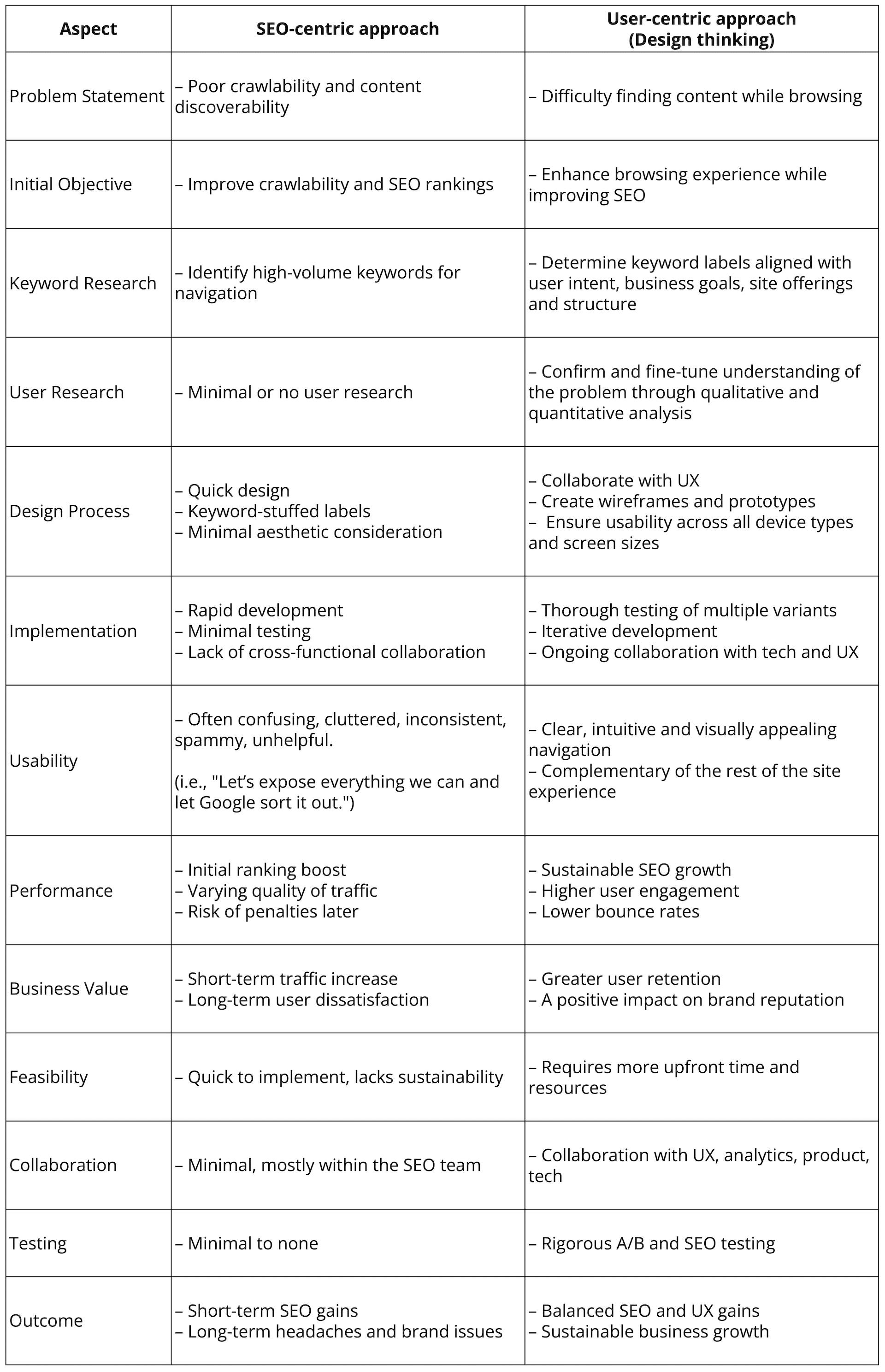
Design thinking enhances enterprise SEO by promoting teamwork and focusing on user-centric solutions. It ensures SEO efforts are practical, feasible, and aligned with business goals.
By using design thinking, you can create sustainable, user-friendly SEO strategies for long-term growth.
Dig deeper: 6 steps to a winning enterprise SEO strategy
Courtesy of Search Engine Land: News & Info About SEO, PPC, SEM, Search Engines & Search Marketing
Thursday, August 8th, 2024
The allure of a personalized shopping experience is undeniable.
You walk into your favorite clothing store in search of the perfect outfit. Unsure of what to choose, a personal shopper comes up to you. They know exactly what would work, because you’ve told them about your past purchases, current preferences, and budget.
They take you by the hand, show you all the options, and – voilà! You’re all set.
When it comes to outstanding customer experiences, face-to-face personalization works like magic.
The science behind the magic
Personalized attention inspires loyalty, higher spending and revenues.
This has been verified in a recent report by Deloitte, in which surveyed consumers confirmed that they spend 37% more than intended when the shopping experience is personalized.
The report also revealed that brands with advanced personalization capabilities are 48% more likely to exceed revenue goals, at a 9.9% average above target in 2023.
The good news is that today, brands can replicate the in-store personal shopper experience online very effectively and reap all the benefits.
Marketers are already interacting with the deft and care of a personal shopper. Today they are fueled to deliver hyper-personalized, relevant customer messages and experiences at the speed of a consumer’s interaction with the brand.
With the backbone of a robust Customer-Led Marketing platform part of the science behind the magic is AI-enabled marketing and generative AI (genAI), which empower marketers to do the following:
- Gain strategic insights.
- Automate high-performing campaigns.
- Personalize experiences at scale.
- Enable the Position-Less Marketer.
The personalized shopping experience, enhanced by AI
In the case of the customer shopping for the perfect outfit, here’s how a Customer-Led Marketing Platform enhanced by AI-automation and genAI ensures a seamless, personalized relevant shopping experience from start to finish:
Rich customer data integration:
As soon as a shopper visits an online store, the platform’s customer data platform (CDP) integrates historical data, browsing behavior, and preferences. It knows the customer’s favorite brands and shopping habits, like buying during sales.
AI-led journey orchestration
AI predicts preferences and likely next steps. It personalizes website content to highlight outfits that match the customer’s style and suggests new arrivals from favorite brands.
Personalized marketing campaigns
The customer receives an email with a curated selection of outfits similar to their past purchases, along with a special discount to encourage exploring the new collection.
Multichannel integration
While browsing, a personalized SMS is sent as a reminder of the special discount, ensuring the offer is not missed, whether being checked via email or phone.
Real-time decision making
If the customer adds an outfit to their cart but hesitates, the platform triggers a real-time action, offering free shipping if they complete a purchase within the next hour.
Journey mapping and automation
If the customer leaves the website without buying, the platform sends a follow-up email as a reminder of the items left in the cart and an additional incentive to complete the purchase.
Actionable insights and reporting
Post-purchase, the platform analyzes their behavior and campaign effectiveness, refining future strategies to continually meet and anticipate each customer’s personal preferences.
Statistically credible multitouch attribution
The platform tracks every interaction with the brand, from initial email to final purchase, helping the retailer understand the most effective touchpoints.
Customer-led approach
Throughout the customer’s journey, the platform keeps preferences at the forefront, ensuring all marketing efforts are tailored to the customer’s unique tastes and shopping habits, creating a personalized and fantastic shopping experience.
In essence, the platform orchestrates every step of the journey, providing personalized recommendations, timely offers and seamless communication across all channels, enhancing the shopping experience and driving loyalty and satisfaction.
AI personalizing communications at scale
Further, AI enables marketers to coordinate and synchronize hundreds of thousands of customer interactions all at once seamlessly and automatically.
These can be executed across multiple channels, including text, push notifications, and email. And when the content is dynamic, the communication can be automatically populated with messages that are tailored to the specific segment or customer.
AI enabling the Position-Less Marketer
By streamlining, automating and elevating so many marketing tasks, AI has paved the way for Position-less Marketers.
Position-less Marketers go beyond typically siloed functions, such as brand manager, content creator, and digital marketer.
Instead, they do the following:
- Transcend traditional role definitions.
- Embrace versatility with a diverse skill set.
- Easily adapt to varying tasks.
- Prioritize collaboration with multiple teams.
- Leverage data to inform strategies.
As a result, Position-less Marketers can move with speed, deft and accuracy to create deep personal connections with customers. For marketers, they are super-powered to meet evolving consumer needs in real-time, thus delivering highly personalized shopping experiences.
In conclusion
Position-less marketers deliver magical personal shopper experiences to their customers online and at-scale. It’s no longer magic – it’s today’s reality: personalized digital shopping experiences at the speed of a customer’s interaction with the brand.
Courtesy of Search Engine Land: News & Info About SEO, PPC, SEM, Search Engines & Search Marketing
Wednesday, August 7th, 2024
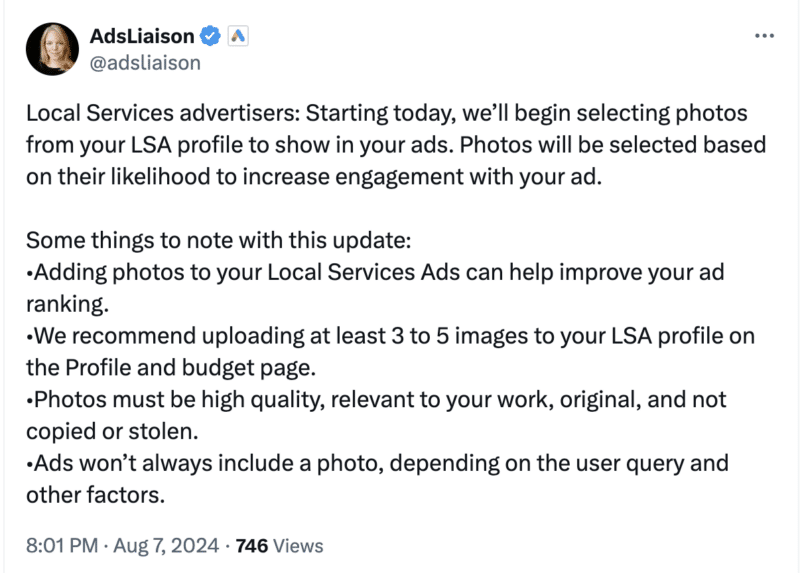
Google is rolling out a new feature for Local Services Ads (LSA) that automatically selects profile photos to display in advertisements.
Why we care. This update aims to increase ad engagement and potentially improve ad rankings for local service providers.
How it works:
- Google will choose photos from advertisers’ LSA profiles based on their likelihood to boost engagement.
- Photos won’t appear in every ad, depending on user queries and other factors.
Key details:
- The feature launches today for all Local Services advertisers.
- Adding photos to LSA profiles can help improve ad rankings.
Google’s recommendations:
- Upload 3-5 high-quality images to your LSA profile.
- Ensure photos are relevant to your work, original, and not copied or stolen.
What to watch. How this change affects ad performance and ranking for local service providers, especially those who haven’t previously focused on visual content in their profiles.
First seen. We were first alerted to this update from Google Ads Liaison, Ginny Marvin’s X:
The bottom line. Local Services advertisers should review and update their profile photos to take full advantage of this new feature and potentially improve their ad performance
Courtesy of Search Engine Land: News & Info About SEO, PPC, SEM, Search Engines & Search Marketing
Wednesday, August 7th, 2024
Amazon and Google have several similarities regarding SEO and advertising. However, they behave very differently in some areas. One crucial area where Amazon stands apart is branded search.
Branded search refers to the specific terms and keywords closely associated with your brand. This includes:
- Your brand name.
- Product names.
- Any other trademarked phrases or slogans your customers associate tightly with your brand and use to identify and find your products on Amazon and different channels.
On Amazon, how you handle and optimize your branded search significantly impacts the visibility and performance of your products.
If you don’t optimize and protect your branded keywords in organic and paid search, your products might lose visibility. Competitors and copycats might outrank you for your primary branded keywords.
Indexing for branded search terms organically on Amazon
Indexing your branded keyword terms on Amazon will naturally occur as you include your brand and product names in the title and other structured data of the product detail pages.
You don’t need to repeat your brand name many times in Amazon listings for SEO. Only do it to give customers a consistent brand experience or to show authority and build brand affinity on the detail page.
Make sure you index for branded terms
To ensure that your Amazon listings index for important branded search terms, incorporate your brand name, trademarks and product names into the structured data, including titles, descriptions and backend keywords.
Dig deeper: 50% of product searches start on Amazon
Ranking for branded search terms on Amazon
Getting indexed is only the first step. To rank organically, you need to make sure your listing consistently converts for your branded search terms so your specific products rank for them.
Remember, there is not built-in authority at a brand level on the Amazon marketplace. This means you need to monitor the ranking of all your products for branded terms individually.
The role of branded search defense
While there are a lot of factors that go into the organic ranking of products on Amazon, we can oversimplify it to say that conversions for a specific keyword phrase over time is what has the greatest impact on organic ranking.
Protecting branded keywords
Maintaining a branded search presence is vital even for brands that don’t consider Amazon as their primary sales channel. Failure to do so could lead to your brand awareness efforts on other platforms inadvertently driving traffic to competing products on Amazon, further eroding your market share.
Even if you are an established brand, defensive use of advertising keeps other brands from drafting on the branded affinity you have built and even possibly outranking you.
“We took the foot off the gas for branded Sponsored Product ads on Amazon while I was at LEGO. A copycat brand ended up with the No. 1-clicked product when people searched for LEGO because they won the top of search so often.”
– Josh Justice, Division Portfolio Manager, Infinite Commerce
If a competitor drives more conversions for your branded keywords, they might outrank you in the search results, even if they sell an inferior or unrelated product. If they aren’t using branded search defensive ads, it can be a highly effective customer acquisition strategy.
“Anyone that actually shops on Amazon would realize that if someone searches for a brand and the entire page of banners and listings are OTHER brands, that some amount of sales will bleed away before people ever scroll down to the first organic listing.
I work with brands that are the No. 1 ORGANIC listing for some of their competitor brand terms.
Those competitors WISH they had invested in brand defense for the last two years.”
– Abe C. Chomali, Founder, XP Strategy
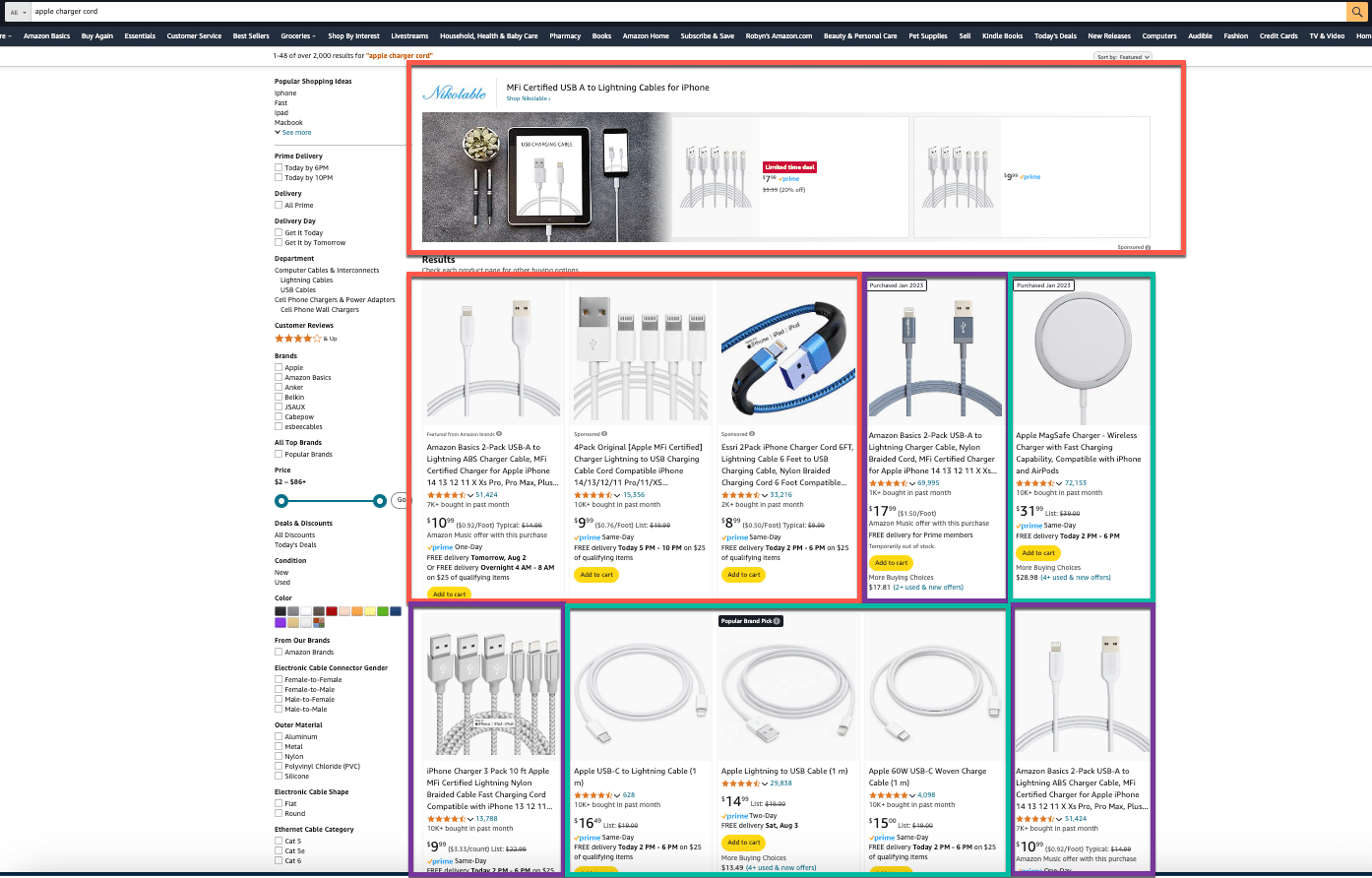 Even a brand like Apple, when not protecting branded keyword terms, competitors can end up dominating both the first sponsored spots as well as organic. Here you can see that out of the top seven organic positions (green and purple), Apple is only holding 4 positions. The red outline items are sponsored spots going to competitors. Out of the 12 products above the fold on this branded search, Apple only holds 4 spots (in green).
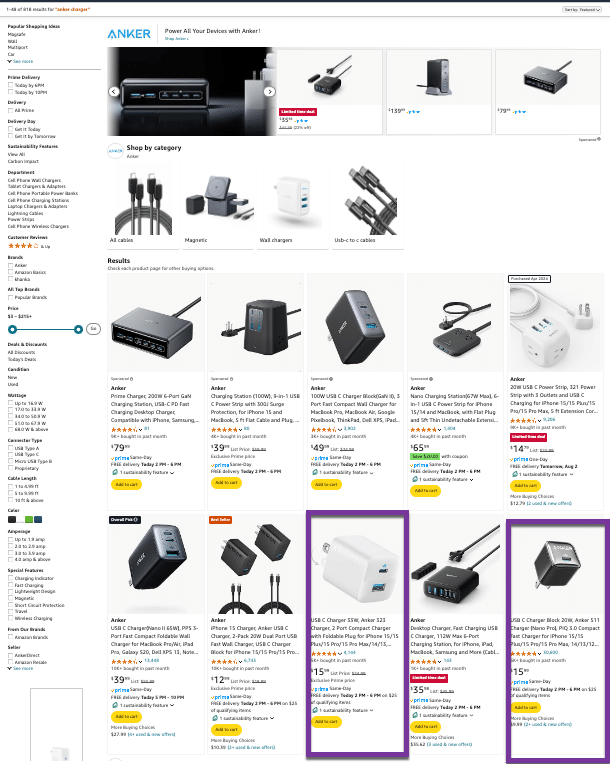 Anker does a great job protecting its branded search, which allows them to dominate the branded SERP for both paid and organic.
Dig deeper: Amazon Ads in 2024: Maximizing Sponsored Brands campaigns
Concerns over wasted spend
We’ve seen how often sellers and agencies want to remove the branded search from their ad campaigns.
For those used to Google Ads, advertising to people already searching for your brand might seem like a waste of money, as they already know your company and products. This creates the concern that branded search ads are simply cannibalizing organic sales.
However, over time, we find that once you remove those branded search terms, you lose those essential keyword searches within several weeks to a few months, and then you start to see a more significant dip in overall performance.
Even if you have a branded search and are ranking well for non-branded terms, keeping at least some branded campaigns in your advertising strategy helps increase overall performance.
While it is essential to periodically test how your ads impact organic sales and whether you’re at a place where you can reduce branded search campaigns, we rarely recommend eliminating them.
“For brands with high consumer awareness and search demand, we’ve tested turning off branded search. Our thought was that if a customer shows high intent to purchase, there was low risk of them clicking on a competitor.
However, we immediately saw sales impacted and competitors’ organic ranks jumped to the top of the page. This validated that branded spend is necessary on Amazon. To limit sales cannibalization, we try to introduce customers to new products or cross-sell rather than leading with hero products.
We also found that investing in top-of-funnel tactics to increase brand awareness on Amazon has paid high dividends. By using DSP, we engaged with in-market customers and used our brand store to inform them of our product benefits. With these tactics, brands should consider measuring branded traffic growth as their KPI rather than RoAS. We also highly recommend using AMC to see full media attribution.”
– Matt Snyder, Founder, Brands Excel
When not actively marketing on Amazon
Even for brands that don’t want to make Amazon their primary distribution channel, a brand defense strategy on Amazon is a must.
Many customers will look on Amazon for reviews and additional product information even if they first see your ad or content elsewhere.
Maintaining a presence on Amazon allows you to ensure customers who only like to purchase on Amazon don’t end up purchasing a competitor’s product.
Remember, Amazon can target branded terms on Google and send traffic to a curated list of competing products.
Putting your products on Amazon and setting up a low-cost brand campaign protects your branded search terms. This ensures you don’t lose traffic to competitors while you build brand awareness elsewhere.
Keeping branded search term campaigns separate
Separate your branded and non-branded search campaigns on Amazon. This helps you:
- See how well each is doing.
- Make better budget decisions.
- Understand how many new customers are buying your products without knowing your brand.
If you group your branded and non-branded search terms, poor-performing ads can hide behind the higher-return branded campaigns.
Let’s say Nike runs ads for “Nike” and “running shoes” together in the same campaign:
- The term “Nike” would probably convert well and have a great return on investment and advertising cost of sales (ACOS).
- However, it could be masking underperforming terms that might be too broad and not be performing well (i.e., “running shoes”).
This separation lets you make better forecasting decisions and allocate your ad spend as you scale.
Launching products on Amazon with existing branded search volume
To see if a brand has enough recognition to use branded search for boosting initial sales, use tools like Helium 10, DataDive or MerchantWords to check if people are already searching for the brand.
If you don’t want to use one of those tools, type your brand name into Amazon search and see if it auto-completes. This gives you a rough idea of whether people are already searching for your brand but not finding your products via branded search.
If people are already searching for your brand on Amazon, advertise on your branded terms at launch. This boosts initial sales, helps Amazon’s algorithms understand your product, increases impressions and improves ad relevance for future non-branded keyword ads.
As you navigate Amazon’s dynamic landscape, remember the unique role of branded search, a critical component of your overall ad strategy. Taking a proactive approach and leveraging your brand’s power ensures your products remain visible, competitive and at the forefront of the search results page.
Dig deeper: 6 Amazon marketing strategies to implement
Courtesy of Search Engine Land: News & Info About SEO, PPC, SEM, Search Engines & Search Marketing
Wednesday, August 7th, 2024
Google introduced new ad budget features for Local Service Ads, including the ability to set a maximum monthly ad spend limit for certain accounts.
Why we care. This update gives advertisers more control over their spending, potentially preventing unexpected budget overruns.
Key features:
- Immediate effect upon setting.
- Automatic campaign stoppage when limit is reached.
- Monthly reset on the 1st of each month.
- Flexible management – can be updated anytime.
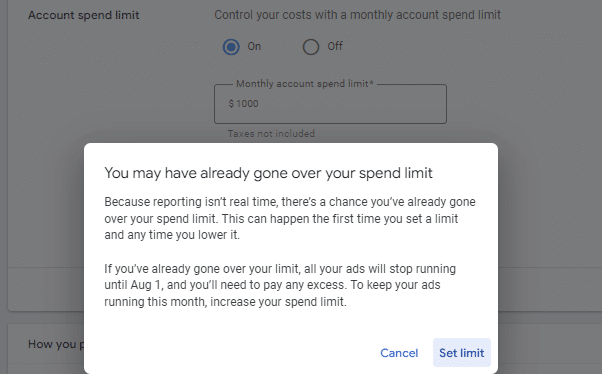
How it works. Advertisers can toggle the account spend limit on or off, set a specific monthly limit, view last month’s spend and monitor current month’s spend and remaining budget through the Local Service Ads interface.
Yes, but. Due to reporting lag, there’s a possibility of exceeding the set limit, especially when:
- Setting a limit for the first time.
- Lowering an existing limit.
Advertisers are responsible for paying any excess charges if the limit is exceeded.
The catch. If the limit is exceeded, all ads will stop running until the next month.
Between the lines. This feature addresses a common concern among small businesses and local service providers who need tighter control over their advertising budgets.
First seen. We were first alerted to this update on Nate Louis’s X:
What’s next. Advertisers should regularly monitor spending and adjust limits as needed to maintain continuous ad visibility, especially when implementing the feature for the first time or making significant budget changes.
Courtesy of Search Engine Land: News & Info About SEO, PPC, SEM, Search Engines & Search Marketing
Wednesday, August 7th, 2024
Despite the significant allocation of Performance Max (PMax) advertising spend toward Shopping Ads, many marketers struggle to leverage its full potential. The key lies in the campaign structure.
At SMX Advanced 2024, Andrew Lolk, founder of Savvy Revenue, shared insights on optimizing Google’s Performance Max (PMax) campaigns for ecommerce businesses.
Below are the key takeaways from his presentation.
The state of Performance Max
Performance Max has become the dominant campaign type for ecommerce, with shopping ads accounting for up to 95% of spend.
Despite initial excitement, Performance Max still lacks crucial insights and control compared to traditional campaign types.
Performance Max vs. Meta Ads
Google’s Performance Max algorithm lags behind Meta’s in terms of ad targeting and optimization without search intent. Lolk said:
- “Why doesn’t PMax do better compared to Meta? So, I think that Google simply just don’t need to. I’m sure they want to, but they don’t need to. Search ads is still such a cash cow.
- “Apparently, it’s not that easy to create an algorithm from an ad perspective, like Meta has done. A lot of other social media companies haven’t been able to do it. Even though Meta makes it seem so easy they’re really light years ahead of Google.
- “PMax struggles to effectively utilize Google’s diverse ad inventory across YouTube, Display and Search.”
Dig deeper: Meta Ads for ecommerce: 7 things to test and iterate
Campaign structures for better performance
Basic setup: Include first-party data and customer lists; be cautious with new customer acquisition settings.
- “You need to add your own onion signals. Meaning your customer list from Klaviyo, from your email list, upload those and your targeting. That’s really what you need from an audience perspective.
- “Don’t touch new custom acquisition unless you know how to do it.”
Consider separating brand and non-brand campaigns for better budget control and performance.
Evaluate whether to include search ads and display/video based on your specific needs and ability to manage potential waste.
- “Should you include search ads? The pros on this is that if you’re not running dynamic search ads, which is basically the search ad component in Pmax, then it’s an easy extra revenue source, and you really should be doing it. It’s super easy. It’s – one ROAS target, one budget is where it’s supposed to be.
- “The cons on the other side is you get really low visibility into search terms and that’s where DSA (dynamic search ads) or search inside PMax can be highly wasteful if you don’t exclude blog, your return policy, informational pages in general, etc.
- “But with very low visibility in PMax, then we can’t actually see how this is happening so it can become highly wasteful. And without insights in Pmax, we have no way to fix it. Then the other side of it, it can be highly wasteful, but it can also just allow for no visibility into whether or not it spends or not.”
Advanced campaign structures
- Hero vs. accessories: Separate campaigns for main products and accessories to optimize budgets and targets.
- ROAS targets: Split high and low performers into separate campaigns to maximize exposure for profitable products.
- Seasonal campaigns: Create distinct campaigns for different seasons or collections to manage budget allocation effectively.
- Expanded ROAS structure: For large catalogs, consider separate campaigns for new products, best sellers and underperforming items.
Standard shopping campaigns
Don’t overlook standard shopping campaigns, which still offer valuable control through priority settings and focused ad inventory.
- “The death of smart shopping is greatly exaggerated. The ability to only get shopping ads clicks, meaning that you’re not mixing in any search and you’re not mixing in any display or YouTube or anything else.”
- “If I’m putting $80,000 a month into this and I bumped that up to $100,000, I am not buying any other ad inventory. I’m buying the same ad inventory as always, and it just performs. That is something that’s invaluable when you scale. So standard shopping for me still works.”
- “Use it when you’re doing a brand and non-brand split, and put non-brand in Pmaxd and brand into a standard shopping campaign.”
Lolk emphasized the importance of tailoring Performance Max campaign structures to solve specific business issues and align with overall marketing strategies.
While Performance Max offers simplicity, advanced structures can significantly improve performance for ecommerce advertisers.
Watch: Maximizing Performance Max: Advanced campaign structures for optimal ROI
To hear all the examples Lolk shared, watch his SMX Advanced presentation here:
Courtesy of Search Engine Land: News & Info About SEO, PPC, SEM, Search Engines & Search Marketing
Tuesday, August 6th, 2024
Yesterday the ruling passed that Google is a monopoly after the 10 week trial that occurred last year.
Here are the key reactions from search advertisers:
Google’s Appeal and the Future Legal Battle
Julie Bacchini, president and founder, Neptune Moon, underscores that while the court ruling declaring Google a monopoly is significant, the real impact will emerge during the remedy phase and Google’s inevitable appeal.
- “Google will appeal (and they said they will in their comically bad statement about the ruling) and that will be a slow process. But it is the remedy phase that will ultimately decide what this ruling will actually mean in practical terms.”
- “Also, this case was as much about setting the table for the Google advertising case that goes to trial in September. This case got A LOT on the record that will likely be used in the upcoming trial.”
- “Monopolistic behaviours have gone essentially unchecked in a lot of industries since the Reagan administration and maybe that hasn’t been such a good idea. These cases are starting to try to act on that. The App store cases run along the same lines.
- “If the Sherman antitrust act had been enforced over even the last 25 years, the business landscape would look very different. It wasn’t and we have what we have.”
- “To be fair too, Google is like any other publicly traded company today – their primary goal is to make sure the meet analysts expectations every quarter. That’s it. And I think we often forget that. Their decisions all come back to that core. And what that makes them do can make it feel like they are a big, kinda evil corporation.”
Oscar Ford, CEO and PPC specialist finds the ruling’s development fascinating and anticipates a prolonged legal battle due to Google’s appeal.:
- “Google are appealing the ruling, so this will roll on for a while longer. I’m not sure what the outcome is, but to break up an existing monopoly the only option surely is to split it into separate companies?”
- “Google’s response to the ruling is amusing but they have a point – they have made the best search engine and nothing else has come close for decades.”
Chris Ridley, Head of Paid media predicts a resolution similar to that of Google shopping in 2017:
- “What I do see happening is an echo of what we saw happen to Google Shopping in 2017. A similar EU ruling regarding Google’s Shopping that led to Google opening up their Shopping space to third-party Comparison Shopping Services (CSS), which were granted a 20% discount on cost-per-clicks (CPCs) to ensure they could fairly compete.”
- “This could lead the way to Google introducing Comparison Text Advertising Services to the Google text ad market to dismantle Google’s monopoly on the text advertising market, which may also benefit from a similar discount on CPCs as a gesture of Google encouraging competition on their SERPs.”
Market Dynamics and Google’s Competitors
Chris Lloyd, B2B SaaS Marketing consultant, points out that Google’s market share has been declining due to its inability to innovate:
- “I think we are already seeing their decline, and it’s not due to regulatory rulings. Google has been losing market share for a couple of years now. Quite simply they can’t build and innovate and will continue to be outplayed by Perplexity, OpenAI, Meta, Apple.”
Sam Tomlinson, Executive Vice President and Digital strategist, criticizes the legal reasoning in the 286-page ruling, particularly the market definition, which he believes won’t hold up on appeal.
- “The market definition was categorically insane to me – something I don’t think gets upheld on appeal”
- “It isn’t like the winner today is always the winner tomorrow. Google even admitted that (and the court agreed) in this ruling, where they highlighted that Google has innovated massively, at great expense, despite having a ‘monopoly’”
- “Every other company, hedge fund, investment bank and PE fund does the exact same thing — which is why this feels ridiculous. It isn’t good or bad, it’s just profit-driven, because profit is an existential imperative for any business”
Navah Hopkins, Brand evangelist and PPC influencer, is disappointed that the US failed to establish search advertising as a distinct market:
- “I am disappointed in the US for not being able to make the case that search advertising is a market (I understand there’s another case in September, but the ruling makes it clear that information just wasn’t presented).”
- “The fact that this case started in 2020 and that’s when PMax began to really take hold speaks to the diversification that was clearly top of mind for Google. As the ruling stated “search text ads are a monopoly” but search advertising was not. PMax gives Google the cover it needs to still have some search without running a foul of the search text ads monopoly rules.”
- “That Microsoft was brought up as a serious competitor felt disingenuous. Though it is interesting to see how CPCs trended after each other (i.e. the market drove up costs not Google itself…which I’m skeptical about)”
- “There are a lot of openings for appeal issues, I agree. But I really think the testimony they got and internal Google documents are going to be a tough hill for Google to climb in the Ads case. So I can’t help but wonder if this case was more about making that one stick?”
Ethical and Practical Concerns
Sarah Stemen, Paid search specialist reflects on her disillusionment with Google and doubts any significant penalties will arise:
- “I need to stop gaslighting myself into thinking Google is great because they built my career. This is a capitalist driven company that lost sight of any values and it sucks.”
- “I think we all remember Microsoft and I would like to think that’s the outcome but I don’t actually think any penalty of any significant difference will happen especially under our current administration and court system.”
Reid Thomas, Marketing strategist, observes that the US ruling aligns closely with the EU’s mandate & questions a meaningful mandate:
- “Our point of views are all very US focused – isn’t this ruling very aligned with the EU ruling from a few years ago that mandated search engine choice?”
- “My question is – ‘What is a meaningful penalty?’. You can’t break google up like the bells.”
- “I also think it’s quite disingenuous to target the distribution agreements with the ‘If Google is so great, why are they paying?’ and the answer is: because this is a competitive market, and others could pay, too.”
The diverse opinions highlight the complexity of the issue and the far-reaching implications of the ruling for the tech industry, digital advertising, and antitrust law. As the legal process continues and potential remedies are considered, many in the industry are watching closely to see how this decision might reshape the future of search and digital advertising.
Courtesy of Search Engine Land: News & Info About SEO, PPC, SEM, Search Engines & Search Marketing
Tuesday, August 6th, 2024
Last week Thursday after reports from several advertisers, it was confirmed by Google that there was a major reporting blackout. Report Editor, Dashboards, and Saved Reports in the Google Ads web interface were down. On top of that Products, Product Groups and Listing Groups pages were down across the web interface, API, and Google Ads Editor.
The glitch, which Google claims affected only “a small fraction” of advertisers, exposed sensitive data across accounts and disrupted normal reporting services.
Advertisers had a lot to say about these issues varying from gratitude that they don’t look after e-commerce and so were not affected to those who found the lack of listing/product group data as a massive obstacle.
Practical Challenges
Greg Finn, Partner at Cypress North, highlighted the practical challenges:
- “The lack of listing/product group data last week was a massive obstacle for those shopping advertisers. Specifically, we have some campaigns (PMax) that feature monthly deals and sale items for some clients and were unable to confirm that campaigns were working correctly.”
- “While I understand that there was an error on Google’s behalf, flying blind without seeing any product data is beyond scary. As an advertiser, I would much rather see a mistake and continue to work than to know that there is a mistake and have no way to view product data.”
Data usage/Breach
Paid Search Specialist, Sarah Stemen, raised questions about data usage in Google’s auction system:
- “Well, we know Google knows prices of all products, profit margin, msrp, sales etc. But seeing the data cross contaminated makes me wonder if data is being leveraged in the auction more than Google will admit.”
Kate Luke, Head of Digital, emphasized the gravity of the data breach:
- “Let’s not gloss over the fact that this sensitive data is paramount to the businesses affected.”
She called for Google to “address those affected directly rather than deliver generic ‘resolutions’.”
Transparency/Timing
Performance and marketing consultant, Meriem Nacer expressed concerns about Google’s transparency:
- “Will they notify affected brands and reimburse them, or only respond if contacted? Many might not check their accounts or know how to. How did this happen?”
Nacer also feels that due to timing, it can’t be completely unrelated to the Merchant Center Next rollout –
- “They claim it’s unrelated to the Merchant Center Next rollout, but the timing coincides with updated PMax reporting and the upcoming migration. Is it just a coincidence, or did someone push that “big red button” we’ve always joked about? The situation raises many questions.”
Mike Ryan, Head of ecommerce, summed up the severity of the situation, with a particular concern that the issue began earlier than Google is claiming:
- “This is a serious potential breach of advertiser confidentiality, and seemingly also a huge billing fuckup. Google maintains that these errors only occurred from July 30 through July 31, however I have team members who state that this may have been occurring for two weeks or longer.”
Automation/Feed security
Julie Bacchini president and founder, Neptune Moon pointed out the broader implications including automation & questions the sanctity of the feed:
- “It definitely raises some questions about firewalls between accounts though doesn’t it? I think that is the most concerning piece.
- “Reporting and data lags happen. But data leaking is a much bigger issue. And taking it a step further, as automation takes over more and more, will we even know if something like this happens in the future?
- “The biggest issue I have is that it impacted feed based campaigns – so the sanctity of the feed is compromised. I would like a detailed explanation from Google Ads as to exactly how another advertiser’s feed data was allowed to infiltrate another account. And what they have done to ensure it can no longer happen.”
Competitive Intelligence
Marketing Director, Scott Frederickson detailed the potential competitive intelligence leaked:
- “The screenshots showing custom label content in the reports were chilling. For those who don’t know, those labels are entirely free-form. I’ve seen them used for margin bucketing, seasonality, stock controls, best sellers, various promotions, vendors, divisions, all kinds of things.”
Finally advertisers like Reid Thomas, Marketing Strategist, viewed the issue as “a tempest in a teapot… because I have never had an account where a even a week of reports being inaccessible would massively change strategy, especially given that real data wasn’t being blocked for automations, etc.”.
Majority of responses however indicated serious concerns about data privacy, competitive intelligence, and Google’s handling of the situation. As PPC specialist Chloe Varnfield, put it, “Trust in Google is low anyways, so it’s just another letdown.”
The incident has left many advertisers demanding more transparency and better safeguards from Google to prevent similar issues in the future.
Courtesy of Search Engine Land: News & Info About SEO, PPC, SEM, Search Engines & Search Marketing
Monday, August 5th, 2024
Google is phasing out an older version of its Structured Data Files (SDF) format used in Display & Video 360, its enterprise-level advertising platform.
Why we care. This change affects advertisers and partners using SDF v6, requiring them to migrate to newer versions to maintain uninterrupted service.
Key details:
- SDF v6 will be deprecated on April 30, 2025
- Users must migrate to SDF v7 or higher before the sunset date
- Google has provided a migration guide for transitioning from v6 to v7
What’s next. After April 30, 2025:
- Default versions for partners and advertisers will automatically update to v7
- API requests using SDF_VERSION_6 will return a 400 error
How to get help. Google has set up a new Display & Video 360 API Technical support contact form for migration assistance.
The bottom line. Advertisers and partners using SDF v6 have about 9 months to plan and execute their migration to avoid service disruptions.
Courtesy of Search Engine Land: News & Info About SEO, PPC, SEM, Search Engines & Search Marketing
Monday, August 5th, 2024
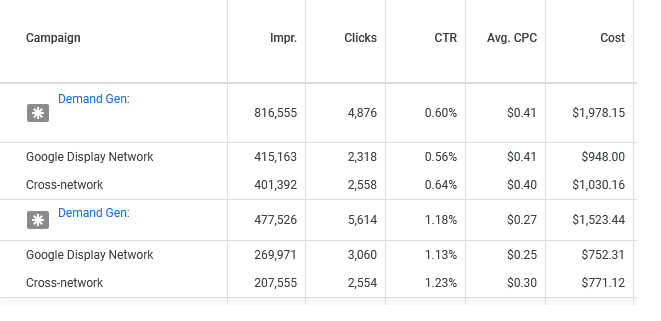
A reporting glitch in Google Ads is causing confusion among advertisers, with Demand Gen campaigns incorrectly showing as Display Network placements.
Why we care. This misrepresentation could lead to inaccurate performance analysis and campaign management decisions for affected advertisers.
The latest. Google Ads Liaison Ginny Marvin has confirmed the issue is a bug, not a feature change.
Details:
- Bug reporting start date: Week of July 8, 2024
- Affected: Demand Gen campaign reporting
What they’re saying. “This is due to a bug that led to the Google Display Network label appearing in error in some Demand Gen campaign reporting,” Marvin stated on X, promising more information to come.
Between the lines. The confusion is ill-timed as advertisers are currently waiting for Google to fix reporting issues as well as product and product listing glitches seeing advertisers unable to edit product groups.
First seen. We were first alerted to this error from Leslie Drechsler’s X:
The bottom line. Advertisers running Demand Gen campaigns should be aware of this reporting error and await further updates from Google before making significant campaign adjustments based on current data.
Courtesy of Search Engine Land: News & Info About SEO, PPC, SEM, Search Engines & Search Marketing