Archive for the ‘seo news’ Category
Thursday, December 1st, 2022
Roughly half of the Twitter DMs I receive are attempts to sell me “high-quality guest link posting.”
The other half are lifelong agency SEOs looking to move in-house, asking me how to make the move and to review their resumes.
While I started my career in a link building agency (the real trenches of SEO) and have the utmost respect for agencies, I’d like to share insights into how I feel about in-house vs. agency life.
Disclaimer: This is my experience and not reflective of everyone’s truth. If you’ve decided to make the switch in-house, I recommend speaking to those who made the move, as this article is just one data point.
The benefits of agency life
Truthfully, I wish every SEO started their career at an agency. Like a boot camp, the pace of agency life early in your career will be very formative.
Being in-house your entire life (especially at just one or two companies) can give you a tunnel-vision view of the world.
The exposure to sites of different sizes and the SEO savviness one can get inside an agency are unparalleled.
Experience is a superpower in SEO, so while now in life I (clearly) enjoy in-house life, I highly recommend SEOs work at agencies, even if just for a few years.
Here are other advantages of working in an agency:
- Exposure to many clients and verticals.
- Learning incredible project management skills.
- Many senior people mentoring you in what you do.
- Quickly learning a repeatable playbook of best practices for each vertical.
- Company incentives (i.e., sending you to SEO events or allowing you to speak).
- A more developed career ladder (i.e., an opportunity to be Director or Sr. Director).
- Fewer meetings and easier transition to consulting.
Exposure to many clients and verticals
One of the biggest shortcomings I see in SEO hires is a lack of experience working across sites of different sizes with different resources.
Even if you can spend your entire SEO career at a highly competitive SEO-driven company (e.g., Tripadvisor, Condé Nast), that won’t necessarily translate well into doing SEO for a new SaaS company with limited resources and no bespoke or custom tooling.
In an agency, you get to use a variety of the clients’ homegrown tools and off-the-shelf SEO tools your clients may already be bought into, so you’ll know the right tool for the job.
Learning incredible project management skills
A lack of project and stakeholder management skills can often cripple your career.
I suggest SEOs focus on these soft skills if they ever want to move in-house.
It’s a survival skill most agency SEOs pick up as they juggle client work and relationships.
Early mentorship and a repeatable playbook
In an agency, assuming SEO is a commonly sold service, there might be a lot of senior SEOs with vast experience around you.
Generally speaking, every vertical has best practices that are fairly repeatable and usually work.
Having this wealth of knowledge and experience around you can quickly uplevel you and compensate for your own lack of experience.
In-house, you might be the only SEO trying to figure it out while teaching yourself.
I’ve often found completely self-taught SEOs to be a little undisciplined if they never received feedback early in their careers from other SEOs.
Company incentives to send you to SEO events or allow you to speak
Public speaking can be an incredible platform to build your SEO career. It’s also great for networking and discussing SEO tactics privately with other SEOs.
Quite frankly, they’re also quite fun if you’re social like me!
But being in-house, it is rare that companies will pay for you to do public speaking or attend SEO events. There’s simply little incentive to do so.
Agencies need new business, so sending employees to events and putting themselves in front of companies looking to learn about SEO makes fiscal sense.
It’s a great way to build your agency’s brand and bring in inbound leads.
Within some organizations, sending SEO employees to speak is sometimes seen as a double negative. Not only is it costly, but the talent is also likely to be poached and they won’t be able to easily anonymize their data.
No company wants their secrets openly shared with the world to live indefinitely on SlideShare, where competitors can easily see them.
The best companies I’ve been in allowed for a single conference each year. Generally, you need to speak about the work of other companies to qualify for speaking engagements.
A more developed career ladder for SEO
If you’re the only SEO in your company or one of a few, and SEO is not a major lever, it is unlikely SEO will have a well-defined career ladder.
For example, you might need to champion the creation of a senior position like Director of SEO – and, likely, it might never happen.
Due to the number of SEOs and the customer-facing aspect of agencies, I feel that agency SEO roles at Director and VP levels are much more common than in-house.
The key exception I’ve seen is for SEO-driven companies, such as Booking, Yelp or Tripadvisor.
Most in-house SEO roles top out at “Lead” or “Head of SEO.”
Some circumvent this by taking on other teams, like SEM. But more commonly, companies will give an SEO team to a paid search lead than give paid search to SEO.
When millions of dollars of budget are on the line, prudent budget spend is generally optimized for rolling search teams under a single search lead.
Fewer meetings because you’re a consultant and an easier transition to consulting
I have a lot of meetings. In my experience with an agency and my own consulting friends, many can have just ~2 meetings maximum per day.
As an SEO lead in a multinational company, it is not unusual for the most senior SEO to be in 5-6 hours of meetings a day. This is especially common as you start taking on more projects or products within the company.
It is also much easier to transition from being an agency SEO into consulting because you:
- Have the playbook.
- Know how to pitch clients.
- Understand the nuts and bolts of running a business that sells SEO.
Consulting is an attractive proposition if you have the best clients. I know many of the best SEOs who easily generate incomes of several hundred thousand a year with just a few clients.
I’ve seen lifelong in-house SEOs struggle with this transition. In contrast, it seemed second nature for my agency SEO friends to begin side hustles and eventually transition into working full-time for themselves.
Get the daily newsletter search marketers rely on.
<input type=”hidden” name=”utmMedium” value=”” />
<input type=”hidden” name=”utmCampaign” value=”” />
<input type=”hidden” name=”utmSource” value=”” />
<input type=”hidden” name=”utmContent” value=”” />
<input type=”hidden” name=”pageLink” value=”” />
<input type=”hidden” name=”ipAddress” value=”” />
The benefits of being in-house
Becoming an in-house SEO has various advantages which I really enjoy. Some of them include:
- Having a better quality of life (for me, at least).
- More opportunities for consistent, deep work.
- Not caring if clients fire you.
- Going into tech or SEO product.
Better quality of life
I know some agencies have a high quality of life. But by their nature, I have always found the work to be more reactive depending on who the client is.
I’ve also witnessed some clients being abusive to agencies, as they can be an easy scapegoat when things go south.
It is almost always painful for me to join a new company. There’s a level of needing to “prove yourself” initially.
Yet over time, I find the familiarity and friendships I’ve built within a company allow me to have a high quality of life I am not confident I could find in an agency with new companies, teams and stakeholders all the time.
This level of peace and comfort usually happens at around the 1.5-year mark, when you’ve had some wins and finally feel “settled.”
My quality of life is pretty exceptional, and I have no complaints at most of the large companies I worked for.
More opportunities for consistent, deep work
When you think about just one customer (your company) every day, getting the buy-in needed for meaty, big multi-year projects becomes much easier.
It also enables you to be a real subject matter expert on your products, allowing you to take on exciting and out-of-the-box SEO ideas and not just execute best practices.
A lot of my agency friends find this lack of variety boring, but I personally love being able to think deeply about a smaller portfolio of products.
Not having to care if your clients fire you
Oftentimes, agencies might have a big client representing a disproportionate share of revenue in the agency. Losing clients like this often can mean layoffs will quickly follow.
This is quite stressful for me because now I have to worry about doing SEO and keeping all of the clients.
Worrying about SEO results and impact is enough for me, and I don’t like having my job security tied too heavily to a single customer.
Going into tech and/or SEO product
Tech has been a career-changer. I get to do what I love in combination with working on products I use daily and receiving some widely lauded industry perks such as:
- Stock packages.
- Generous benefits.
- World-class snacks.
- A fine education in big company vernacular (i.e., “taking a step back” to produce results that really “move the needle”).
I recognize that I got incredibly lucky with my timing at Square. Most tech companies fail, and it’s a highly tumultuous industry at the moment. But I am deeply satisfied and appreciative of my experience in tech, and it’s an incredible way to build wealth.
Working for a tech company also means there is usually a large product management organization.
This means you might be able to join and transfer into a more traditional tech ladder and, eventually, a more well-rounded growth leader who perhaps no longer even does SEO.
If you want to go into product, working for a tech company is likely the easiest way to eventually transfer into this role style (if it doesn’t exist yet).
Improving your chances of getting hired in-house
Interviewing for an in-house role?
The most common mistake I see agency SEOs make is spending too much time discussing new business when in-house companies simply don’t care.
Here are my suggestions:
Change the number of clients to the number of sites you owned
In-house hiring managers don’t care how much you billed or how many clients you managed. They want to know the results you produced for any particular client.
Focus on quantitative growth numbers, the size of the sites, and the tools you have familiarity with. Remove anything related to selling/closing clients.
If you were a team manager, say it!
Mention how many people you hired and/or managed. Hiring is one of your most important jobs as a leader, so if you’re a great people manager, let them know.
Name drop
Big companies like knowing you worked for other big companies, especially if they’re competitors or companies like them.
If you had an attractive client base, let them know, and it will help your resume stick out to the hiring manager.
Don’t be nervous
Remember, the company wants to fill this role the most. It is in their best interest to like you.
If the company treats you poorly, this is not the right company for you, and you should move on.
The post In-house vs. agency SEO work: The pros and cons appeared first on Search Engine Land.
Courtesy of Search Engine Land: News & Info About SEO, PPC, SEM, Search Engines & Search Marketing
Thursday, December 1st, 2022
This month Google is updating its policy regarding Display and Video 360 suspensions at the account level.
The following update was provided by Google and is available on their Advertising Policies Help page.
In December 2022, Google will update the Disapprovals and suspensions page so that there is a dedicated policy article for Display & Video 360. The dedicated policy page will specify that violation of the following policies will lead to an advertiser’s account suspension:
- Circumventing systems
- Coordinated deceptive practices
- Counterfeit
- Promotion of unauthorized pharmacies
- Unacceptable business practices
- Trade Sanctions violation
- Sexually explicit content
The new policy page will also detail that a partner account will be suspended if advertisers within the partner have repeatedly or predominantly engaged in egregious policy violations.
Both partners and advertisers will be entitled to appeal account suspensions, and a link to the appeals form will be included in the new article.
Why we care. Display and Video 360 partners should ensure that their ads comply with the new policies so their accounts are not suspended or in violation.
The post Google is updating its Display and Video 360 Account Level Suspensions policy appeared first on Search Engine Land.
Courtesy of Search Engine Land: News & Info About SEO, PPC, SEM, Search Engines & Search Marketing
Wednesday, November 30th, 2022
In a recent survey led by Yelp and conducted by Material, 2,000 Americans were asked to reveal what they consider to be trustworthy reviews. The respondents said they read, on average, five reviews about a business to inform their spending decisions, and 77% say they’re reading more online reviews now than they ever have before.
Key findings. In their survey, Yelp found the following:
- Respondents say they research and consider online reviews more for restaurants (67%), household repairs/work (57%), car repair/services (55%), medical needs (51%) and professional services (42%).
- When respondents think they’ve spotted a fake online review, they will read other reviews to gather additional opinions (49%), ignore the potentially fake review (34%), find another business (27%) or report the review (24%).
- Only 28% of respondents are looking out for incentivized reviews, but 71% say they would no longer visit a business if they learned the business has fake or compensated online reviews.
- 85% of respondents trust reviews with written text over only a star rating.
- Yelp requires that ratings be accompanied by actual review text.
- 88% of respondents say it’s important that they understand how online review platforms determine which reviews are reliable and which are less trustworthy.
- 79% of respondents would prefer to see all the reviews for a business or product, including those that the review platform believes are fake or untrustworthy.
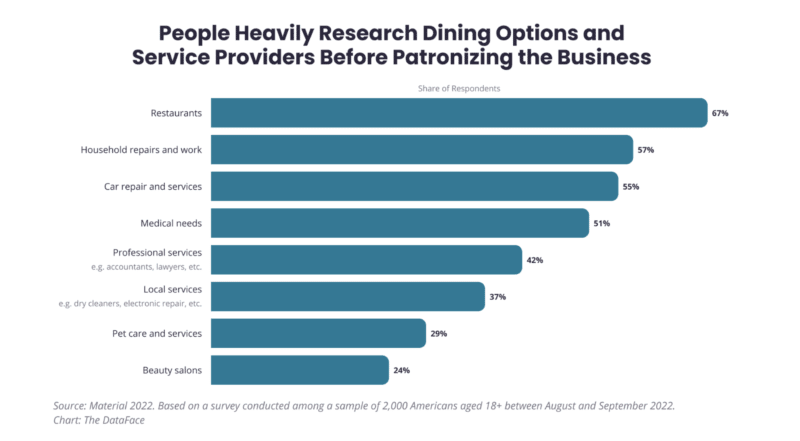
Combating fake reviews. The survey also revealed that of respondents who think they’ve spotted a fake review, 49% will read other reviews to gather additional opinions about the business. 34% ignore the potentially fake review, 27% find another business, and 24% report the review to its respective platform.
85% of those surveyed trust reviews with written text over only a star rating.
Extortion controversy. In the blog article, yelp goes on to mention a Google Reviews extortion scheme that affected numerous restaurants in major cities. These restaurants experienced an influx of one-star Google reviews without any review text, as scammers tried to extort the restaurants for $75 Google Play gift cards to remove their fake reviews. This did not occur on Yelp because of our mandatory review text policies.
But similarly, Yelp also dealt with an extortion controversy of its own several years ago, as well as inconsistencies with its review solicitation rules.
Dig deeper. You can read the full Yelp study on their blog.
Why we care. Local businesses on Yelp should use ethical and legal tactics when asking for reviews. Alternatively, businesses can use paid ads to show higher in the search results, respond to any negative reviews, and keep their pages updated to optimize their business listings.
The post 85% of Yelp survey respondents say they trust written reviews over stars only appeared first on Search Engine Land.
Courtesy of Search Engine Land: News & Info About SEO, PPC, SEM, Search Engines & Search Marketing
Wednesday, November 30th, 2022
There is a lot of fervor in the SEO industry for Python right now.
It is a comparably easier programming language to learn and has become accessible to the SEO community through guides and blogs.
But if you want to learn a new language for analyzing and visualizing your search data, consider looking into R.
This article covers the basics of how you can produce time series forecasts in RStudio from your Google Search Console click data.
But first, what is R?
R is “a language and environment for statistical computing and graphics,” according to The R Project for Statistical Computing.
R isn’t new and has been around since 1993. Still, learning some of the basics of R – including how to interact with Google’s various APIs – can be advantageous for SEOs.
If you want to pick up R as a new language, good courses to learn from are:
But if you grasp the basics and want to learn data visualization fundamentals in R, I recommend Coursera’s guided project, Application of Data Analysis in Business with R Programming.
And then you also need to install:
What follows are the steps for creating traffic forecasting models in RStudio using click data.
Step 1: Prepare the data
The first step is to export your Google Search Console data. You can either do this through the user interface and exporting data as a CSV:
Or, if you want to pull your data via RStudio directly from the Google Search Console API, I recommend you follow this guide from JC Chouinard.
If you do this via the interface, you’ll download a zip file with various CSVs, from which you want the workbook named “Dates”:
Your date range can be from a quarter, six months, or 12 months – all that matters is that you have the values in chronological order, which this export easily produces. (You just need to sort Column A, so the oldest values are at the top.)
Get the daily newsletter search marketers rely on.
<input type=”hidden” name=”utmMedium” value=”” />
<input type=”hidden” name=”utmCampaign” value=”” />
<input type=”hidden” name=”utmSource” value=”” />
<input type=”hidden” name=”utmContent” value=”” />
<input type=”hidden” name=”pageLink” value=”” />
<input type=”hidden” name=”ipAddress” value=”” />
Step 2: Plot the time series data in RStudio
Now we need to import and plot our data. To do this, we must first install four packages and then load them.
The first command to run is:
## Install packages
install.packages("tidyverse")
install.packages(”tsibble”)
install.packages(”fabletools”)
install.packages(”bsts”)
Followed by:
## Load packages
library("tidyverse")
library(”tsibble”)
library(”fabletools”)
library(”bsts”)
You then want to import your data. The only change you need to make to the below command is the file type name (maintaining the CSV extension) in red:
## Read data
mdat <- read_csv("example data csv.csv”,
col_types = cols(Date = col_date(format = “%d/%m/%Y”)))
Then the last two commands in plotting your data are to make the time series the object, then to plot the graph itself:
## Make time series object
ts_data <- mdat %>%
as_tsibble(index = “Date”)
Followed by:
## Make plot
autoplot(ts_data) +
labs(x = “Date”, subtitle = “Time series plot”)
And in your RStudio interface, you will have a time series plot appear:

Step 3: Model and forecast your data in RStudio
At this stage, it’s important to acknowledge that forecasting is not an exact science and relies on several truths and assumptions. These being:
- Assumptions that historical trends and patterns shall continue to replicate with varying degrees over time.
- Forecasting will contain errors and anomalies because your data set (your real-world clicks data) will contain anomalies that could be construed as errors.
- Forecasts typically revolve around the average, making group forecasts more reliable than running a series of micro-forecasts.
- Shorter-range forecasting is typically more accurate than longer-range forecasting.
With this out of the way, we can begin to model and forecast our traffic data.
For this article, I will visualize our data as a Bayesian Structural Time Series (BSTS) forecast, one of the packages we installed earlier. This graph is used by most forecasting methods.
Most marketers will have seen or at least be familiar with the model as it is commonly used across many industries for forecasting purposes.
The first command we need to run is to make our data fit the BSTS model:
ss <- AddLocalLinearTrend(list(), ts_data$Clicks)
ss <- AddSeasonal(ss, ts_data$Clicks, nseasons = 52)
model1 <- bsts(ts_data$Clicks,
state.specification = ss,
niter = 500)
And then plot the model components:
plot(model1, "comp")
And now we can visualize one- and two-year forecasts.
Going back to the previously mentioned general forecasting rules, the further into the future you forecast, the less accurate it becomes. Thus, I stick to two years when doing this.
And as BSTS considers an upper and lower bound, it also becomes pretty pointless past a certain point.
The below command will produce a one-year future BSTS forecast for your data:
# 1-year
pred1 <- predict(model1, horizon = 365)
plot(pred1, plot.original = 200)
And you’ll return a graph like this:
To produce a two-year forecasting graph from your data, you want to run the below command:
pred2 <- predict(model1, horizon = 365*2)
plot(pred2, plot.original = 365)
And this will produce a graph like this:

As you can see, the upper and lower bounds in the one-year forecast had a range of -50 to +150, whereas the 2-year forecast has -200 to +600.
The further into the future you forecast, the greater this range becomes and, in my opinion, the less useful the forecast becomes.
The post How to use RStudio to create traffic forecasting models appeared first on Search Engine Land.
Courtesy of Search Engine Land: News & Info About SEO, PPC, SEM, Search Engines & Search Marketing
Wednesday, November 30th, 2022
Digital content creation and management seem to be more complex than ever. Workflows now need to accommodate remote workers and resources, worldwide offices, and security and privacy concerns, not to mention the growing pressure on content and creative teams to produce more content in less time and with fewer resources.
So how are the most successful teams currently executing production and managing their workflows? To answer this question and find out the best practices for improving efficiency, Canto surveyed nearly 650 professionals in the United States and the United Kingdom involved in the production, management and/or strategy for content and creative assets at their organization.
Tune into this webinar to learn the results of the survey and take an in-depth look at the content strategies, workflows and technologies that have made these organizations successful. You’ll take away valuable tips on how you can revamp your own content programs in 2023 and dive deep into the five areas to improve content workflow and strategy, including:
- Running a content audit for all relevant and current content
- Centralizing your content into a single location and applying metadata
- Building a technology stack that is optimized for collaboration
- Prioritizing your content workflows
- Focusing on brand consistency and speed to market
Planning and creating content is much harder than it used to be, with disconnected teams and a broken digital content supply chain. Watch this webinar so you can plan, create, manage and deliver your best content program in 2023.
The post 5 ways to improve your content workflow and strategy in 2023 appeared first on Search Engine Land.
Courtesy of Search Engine Land: News & Info About SEO, PPC, SEM, Search Engines & Search Marketing
Wednesday, November 30th, 2022
There are many questions about content length in SEO and what ranks the best.
While Google says there’s no specific word count they recommend, some studies have shown that long-form content tends to rank higher than short-form.
If you’re interested in writing long-form content, you probably want to make sure it’s going to rank, get read, and convert so you create an ROI for your effort.
What is long-form content?
Most consider long-form content to be over 1,000 words. It’s a content piece that goes in-depth, offers extra value for the reader and includes more research, insights, and information than a quick read.
Long-form content should leave the reader feeling comfortable with the subject and as if their questions have been answered and they know what to do with the information or how it applies to them.
What should you include in long-form content?
You want to create content that helps your reader. Think about them and what they need or want to learn from this piece. What questions do they have?
It’s your responsibility to anticipate their questions and answer them in your work. If you’re unsure what questions they have, then think about what you want to ensure they know.
Use the following guide questions to identify which information is most important to help them get to the next stage:
- What do they need to know?
- Why do they need to know it?
- What can they do with the information?
- What baseline information should they know to make this make more sense?
- What if they don’t have that baseline knowledge already?
- How does this information impact them?
- What’s their next step?
Don’t write a bunch of unnecessary fluff to try to hit some word count.
You must ensure you’re providing value and helping your ideal customer so they want to consume more of your content.
If you get them to the site but find nothing of value, they’ll be less likely to stay or return another time.
Write to tell a story and provide value rather than writing to an arbitrary word count. Your content will be better in the long run.
Where do you start when creating long-form content to rank, get read and convert?
To start, make sure there’s a conversion path for your reader. Your content pieces need to tie to your products or services to drive revenue and conversions.
If you’re answering questions for your potential customer and providing helpful information, they’re more likely to convert if you offer a solution to their issues. Be helpful, and link to additional information that might help them move to the next step.
If you have an opt-in that ties to this content piece and is the next step for them, offer it in your work. You’re helping them and building your email list at the same time.
If you want your content to convert, you need to make sure there’s a conversion path. Everything you write needs to somehow tie to your core products and services.
I teach my students to choose content pillars that link to their products and services and write about topics related to those subjects.
Creating a long-form content piece and ranking at the top of Google is great, but if it drives irrelevant traffic, it won’t convert, and that’s a waste of your efforts.
Get the daily newsletter search marketers rely on.
<input type=”hidden” name=”utmMedium” value=”” />
<input type=”hidden” name=”utmCampaign” value=”” />
<input type=”hidden” name=”utmSource” value=”” />
<input type=”hidden” name=”utmContent” value=”” />
<input type=”hidden” name=”pageLink” value=”” />
<input type=”hidden” name=”ipAddress” value=”” />
How do you make sure your long-form content ranks?
We all know we have no control over the Google ranking algorithm, but we also know how it works and what’s most important from an optimization standpoint.
First, verify there’s search demand for your topic idea, choose a keyword (or keywords) you can rank for, write for your audience, and finally, optimize your content piece.
Make sure there’s interest in your topic
Start by making sure there’s an audience for your content piece.
It may seem like a great idea to you. However, if no one is searching for information on the subject, it’s unlikely that you’ll get much traffic due to low demand.
That said, search volume is not the most critical factor in choosing a keyword, and we’ll talk more about that.
Brainstorm the topics you think you want to cover, and then go to Google and see what’s there today.
- Who’s written on the subject you’re considering using for your content piece?
- Is there already information on the topic?
- Do you have a new angle, new insights, or something more to add to the conversation?
If not, this might not be the best topic. Search the topic and see what shows up in Google Suggested Search.
Is there something closely related to your topic that Google suggests, or are there questions related to it in the People Also Ask section?
If you see your topic idea in either of those places, that’s good because it means there’s interest in your potential topic.
Research keywords
Once you know your topic is viable, use your favorite keyword research tool to identify the keyword or keywords you want to target for this new long-form content piece.
Long-form pieces can rank for multiple keywords a bit easier than short-form pieces just due to the length of the content piece.
Choose your keywords wisely. Look for a primary keyword with good search volume and the ability for your website to rank on Page 1.
Choose your keywords
Go to Google and see who’s currently ranking on Page 1 for the keyword you’re considering using as your primary one.
- Are the websites similar to yours?
- Are they more prominent brands or companies?
- How in-depth are the articles?
- Can you provide additional insight or value (not just more words) than the sites currently ranking?
If you see other websites similar to yours and content pieces that you feel aren’t as in-depth or are missing information on the topic you want to write about, then you’re probably making a good choice in your keyword selection.
Choose the keyword with the highest search volume that your website has the best chance of ranking for and is the word your Ideal Customer uses when searching for information on this subject.
How to make sure your content gets read
Now it’s time to write. Go back to your brainstorming notes.
What information do you need to include to answer your readers’ questions?
Be sure you have that information. Sort it in a way that it’s easy to follow and understand so your reader wants to continue.
A long-form content piece is a time commitment for someone to read.
Thus, you must provide value, insights, statistics, and things that are unique from something else they might have read on the subject before – or they won’t continue reading.
Format your piece in a reader-friendly way. This is especially important with longer pieces. Consider:
- Using bullets and lists – white space is your friend.
- Using headers (suitable for SEO and your reader).
- Breaking your text up into small, easy-to-read chunks.
- Keeping your sentences and paragraphs short.
It’s better to have many small paragraphs broken up with bullets and numbers than big blocks of text.
People will shy away from reading a piece if the content isn’t formatted in a reader-friendly way.
Your final step is to optimize your content piece
Use your keyword in all of your SEO elements. Make sure it’s in the first paragraph of the copy, which it should be since your keyword is closely tied to your content topic. In most instances, your keyword will be in the title of your piece.
Add your keyword to your URL, image file name, and header tags, and use it throughout your copy.
Focus on providing value, being helpful, and offering information your ideal customer needs rather than how often you use your keyword. You’ll use it naturally by concentrating on your reader.
Done right, long-form content is worth the investment
Long-form content can be a significant time investment. It takes longer to write in-depth pieces than quick bites or short-form.
However, the payoffs can be great. Long-form pieces often rank higher in the search results than short pieces.
And if you’re creating content with an audience, you can rank for and tie to your business, bring relevant traffic to your website, and hopefully, get the conversion.
It’s worth testing long-form content if you haven’t done it yet. Not every piece you write has to be long, but those most important to your business should be longer and more in-depth.
The post How to create long-form content that ranks, gets read and converts appeared first on Search Engine Land.
Courtesy of Search Engine Land: News & Info About SEO, PPC, SEM, Search Engines & Search Marketing
Wednesday, November 23rd, 2022
Google has just started testing a new rewarded ad beta program for publishers to serve their players long-form, playable ads.
How it works. As described by WebmasterWorld.com, “The Rewarded Ad Gate beta program will give you an opportunity to monetize your most engaged users. If a user frequently visits your site, you’ll have a way to collect additional ad revenue.”
1. The Rewarded Ad Gate will be displayed to a visitor on their fifth-page view of each month.
2. If the visitor chooses to view a short ad, a video or image ad will play for 30 seconds or less.
3. A “Thank you” message will appear after the ad is complete and the visitor will gain access to your site.
4. If the user chooses not to view a short ad, they won’t be able to access the site until their page views reset the following month or they choose to view the ad.

Dig deeper. There is no info from Google on the new test, but you can read the post from WebmasterWorld.com here.
Why we care. If you’re a publisher, the new feature could be another option for you to further monetize your content. We’ll update this article with more information as soon as it becomes available.
The post Google is testing new Rewarded Ad Gate beta program for publishers appeared first on Search Engine Land.
Courtesy of Search Engine Land: News & Info About SEO, PPC, SEM, Search Engines & Search Marketing
Wednesday, November 23rd, 2022
Google’s Search Advocate John Mueller – in a rare case of annoyance – said that any SEO advice mentioning “link juice” is not to be trusted. Is it or not?
I wondered about the context and doubted whether it was true. There are different opinions.
After Barry Schwartz shared the news on LinkedIn, a lively debate ensued. Even Moz and SparkToro founder Rand Fishkin chimed in on the comments saying, “Maybe link juice is real after all. Maybe y’all should write more about it!”
On link juice and bad SEO advice
When he dismissed link juice, Mueller was answering a question about outgoing links. He essentially ignored the original question and solely responded to the undesirable “link juice” mention.
While Mueller is usually neutral in his tone this time he came close to a rant on Twitter:
- “Anything that talks about ‘link juice’ should be ignored.”
This is nothing new. He’s just reiterating what he expressed in the past more than once.
Here’s a similar quote from his Twitter account back in 2020:
- “I’d forget everything you read about ‘link juice.’ It’s very likely all obsolete, wrong, and/or misleading.”
So is link juice such a detestable term? Is it akin to the “snake oil” fringe SEO practitioners are still offering? Let’s take a look at the bigger picture.
Snake oil: A popular type of panacea in SEO
There’s a reason why the SEO industry had a bad rep for many years. Metaphorical snake oil has been sold in various ways and many websites have been harmed by misguided SEO advice or tactics.
The proverbial “snake oil” – a synonym for misleading promises of miraculous cures to all kinds of diseases – has often been likened to SEO.
Even in 2022, we see many more #seohorrorstories passed on Twitter and other social media than inspiring success stories. SEO experts themselves, not just outsiders, rather focus on those negative news.
Of course, the SEO industry is not the only one guilty of selling snake oil or spreading the word about it.
I had many clients asking me for unethical SEO practices over the years. To this day, you have to be very firm in your ethics in order not to get caught up in a downward spiral of shady SEO techniques. I also get requests for paid links and other similar offers regularly by mail.
The history of link juice
When Google started out in the crowded and messy search engine market, it had a revolutionary ranking algorithm that used the so-called “PageRank” to determine website authority. It was named after Google co-founder Larry Page, not (just) the actual “web page.”
SEO specialists started to use many different slang terms for PageRank – “Google juice” or “link juice” being among the most popular.
In the early years since its inception, Google performed pretty well by PageRank alone and grew its market share continuously.
First-generation search engines like AltaVista, Yahoo and Infoseek were easily gamed by simply using:
- Keyword stuffing.
- Hidden text.
- Misleading meta tags.
Once Google grew big enough to dominate the market, unethical SEO practitioners mainly focused on artificially inflating the number of incoming links (also called backlinks) so that Google would rank them higher.
PageRank became less and less of a guarantee of high-quality search results leading to Google started adding more ranking signals to the algorithm over time.
As link juice became more abused, Google kept on adding more ranking signals, sophisticated technologies like AI and quality concepts like E-A-T.
Get the daily newsletter search marketers rely on.
<input type=”hidden” name=”utmMedium” value=”” />
<input type=”hidden” name=”utmCampaign” value=”” />
<input type=”hidden” name=”utmSource” value=”” />
<input type=”hidden” name=”utmContent” value=”” />
<input type=”hidden” name=”pageLink” value=”” />
<input type=”hidden” name=”ipAddress” value=”” />
How does link juice work?
We won’t go too deep into the topic of link juice, as others have done before us. An evergreen guide by WooRank is still worth reading to get a quick overview. Their visualizations are especially self-explanatory.
In theory, the website authority of the site linking out is spread more or less equally to the pages it links to.
But in reality, the process is much more complex and link value depends on many other elements including:
- Anchor text (<a href=”example.com”>I’m the anchor text!</a>): Too many keywords are a red flag, not enough pass less value.
- Placement on the page: Footer links count less than content links, for instance.
- Context on the site and page: Irrelevant or off-topic context passes less value.
- Additional attributes: HTML rel attributes such as rel=”nofollow, UGC, sponsored” devalue links.
- The number of links: Link lists with dozens of links may not pass any significant value.
Is content the new link?
By 2019, Google has shifted its messaging to concentrate on quality content. From the outside, the pivot seems to imply that “content is the new link.” Eventually, one of Google’s main SEO documents which largely focused on links was updated to predominantly cover content.
For a long time, Google representatives have been wary of the industry’s emphasis on link building. Instead, they underscore the need for quality content each time the question comes up.
Now, Google tends to overemphasize content in order to make people more aware of it and underrepresent links so SEOs stop obsessing about them.
In Google Search Essentials, the “key best practices” section mentions content six times including on top while links are mentioned only three times:
In my opinion, we have to put both tendencies into perspective and ensure we find the middle ground.
Links are still very important yet their impact will be dwindling over time, while content is steadily growing in importance.
So, is link juice real?
While the colloquial term link juice really sounds a bit sleazy, the concept behind it (Google’s original algorithm) is still valid and used to determine website and page-level authority or value.
It’s a huge oversimplification of the by-now very complex Google algorithm containing numerous checks and balances (as Kaspar Szymanski has summarized) ensuring a proper ranking less prone to manipulation.
At the end of the day, you still have to attract links to your website or else other content of similar quality will outrank you in organic search results. So, while using the term link juice may sound a bit outdated, it’s not yet complete snake oil.
What do the experts say? Fishkin is not the only one to speak about link juice.
Brian Lonsdale, Co-founder of Smarter Digital Marketing Ltd, maintains:
- “If Google doesn’t want you to do something it means that it works.”
WhilePierre Zarokian, CEO at Submit Express / Reputation Stars, added:
- “I will not fall for that. Google algo has been based on link juice since 1998.”
What terms should be used instead of link juice?
You can say many things to refer to link juice without sounding like a drug dealer in a back alley.
Jessica Levenson, Global Head of Digital Strategy & SEO at NetSuite and Oracle, makes it pretty clear:
- “Frankly, no one should use that term. Links and their purpose aside, it’s the worst phrase ever.”
What else can you say instead then? Some of the more professional-sounding terms include:
- Link authority
- Link value
- Link equity
Daniel Foley Carter, Director at Assertive, explains:
- “I call it link equity – irrespective of what Google says – anyone who’s been in the SEO industry knows to take things like this with a big pinch of salt.”
If that’s too boring or technocratic for you, you can follow the advice of Brent Payne:
- “I use ‘link tequila,’ it’s just a lot more fun. And I love tequila.”
Link equity is not enough
When you use a synonym for “link juice” though, remember that the concept is on the way out and doesn’t work by itself as in the early days.
When I started out in SEO in 2004, it was still common to rank empty websites.
You could even get thin content pages to rank for competitive keywords solely by directing link juice to them. In 2022, that’s a rare exception – if at all possible.
Focus on creating great content to attract great links
As always, the truth is found somewhere in the middle. While Google is de-emphasizing links in their algorithm and public rhetoric, its technology still relies to some extent on links.
It’s still very difficult to get organic search visibility on Google solely by way of content. But once that content gets endorsed by links from authority sites, the probability of gaining visibility on Google’s top positions grows significantly.
So how do we get there without buying paid links or otherwise gaming Google? There is a well-traveled path by now. It has worked for many content SEO practitioners.
Create ‘linkable assets’
For many years, website owners wanted to buy SEO services instead of creating content that could actually earn links. I lost many potential clients when explaining that I can’t artificially inflate the ranking of an empty site that only has self-promotional material as its content.
Linkable assets are any kind of comprehensive, valuable and unique resources that are likely to get recommended by other publishers. In-depth guides, unique survey results, and breaking news are some examples.
Attract links naturally
Once you have published content that is worth getting linked to, you ideally just have to sit and wait until people notice and link to you.
This is, of course, the theory. In practice, you will most likely be overlooked unless you are already having an established audience.
In such instances, you have to at least mention experts in your content who already have an audience. They can help you get the ball rolling.
Reach out to ‘linkaratis’
Influencers, journalists and industry experts are usually very busy and once they are established a social media mention may not be enough to get their attention.
Good old email outreach is your tool of choice then. So-called linkaratis are often open to helpful suggestions that match their interests.
When you choose the right people and focus on a few instead of sending mass mailings to hundreds of strangers, you get some initial traction until others notice you organically.
The post Link juice: Is it the new snake oil of Google SEO? appeared first on Search Engine Land.
Courtesy of Search Engine Land: News & Info About SEO, PPC, SEM, Search Engines & Search Marketing
Wednesday, November 23rd, 2022
Even in boom times, marketing budgets are divided among a range of teams, channels, and initiatives.
Going into 2023, with a shaky economy likely to cap many budgets and headcounts far below optimal levels, it will be especially important for marketers to articulate a compelling case for why their area of expertise should get a fair share of resources.
In other words: forecasting how X resources will achieve Y growth is going to be vital.
Because of this, I frequently get the following questions from clients (and prospective clients):
- “How much traffic will we get from SEO and how long will it take?”
- “What can SEO do for our revenue?”
- “What kind of lift are we going to see from this work?”
The beauty and unique challenge of SEO is its blend of art and science. Unlike paid performance channels, where you have CPC and CPM benchmarks that tell you how many clicks and impressions you’ll get for a specific amount of spend, SEO doesn’t have a clear, quantifiable path to cause/effect.
That said, you can do SEO forecasting to give some directional answers to these questions and set traffic expectations for the year (or any specified time frame) ahead. In this article, I’ll explain my approach.
SEO forecasting template for 2023: How to use the tool
We’ve built a forecasting template that I’m happy to share with you here.
Before we get started, note that:
- It’s view-only, so you’ll have to download your copy. The ranges are not recommendations; you’ll need to fill in your own.
- The
randbetween() formulas recalculate with every change to the document, so numbers will not be static. We recommend saving these estimates in another sheet/location for posterity and comparisons.
Let’s break down how the tool works.
Benchmarking your growth data
In this SEO forecasting doc, rows 3-14 give you a year’s worth of monthly traffic history. For the purpose of forecasting a full year to come, you should be able to reference at least a year of historical data for benchmarking.
It’s important to note, though, that reliable forecasting depends on having mature data as a benchmark. Extrapolating growth rates from, say, the first 12 months of a website’s traffic will yield highly skewed projections.
Pick a time period that makes sense for your brand’s traffic history. Make sure you’re accounting for factors that artificially spiked or depressed any particular month’s search:
- A one-off ad campaign.
- A site migration.
- A prolonged site outage.
- Etc.
Once you have your benchmarking data selected, take those numbers and calculate an average month-over-month growth rate (and add to cell L5); this smooths out factors like seasonality.
Get the daily newsletter search marketers rely on.
<input type=”hidden” name=”utmMedium” value=”” />
<input type=”hidden” name=”utmCampaign” value=”” />
<input type=”hidden” name=”utmSource” value=”” />
<input type=”hidden” name=”utmContent” value=”” />
<input type=”hidden” name=”pageLink” value=”” />
<input type=”hidden” name=”ipAddress” value=”” />
Forecasting baseline growth (with no resources)
Your next 12 rows after the historical benchmarking data are where the forecasting begins.
Starting with row 15, Column B takes your benchmarked traffic and simply applies the average growth rate (in L5) over the next year to get a forecasting baseline.
Column D takes the previous year’s data and applies the Google Sheets “forecast” formula, which you can get by entering =round(forecast(A15,C$3:C14,A$3:A14),0) into Column D, Row 15 and dragging the formula down through all applicable cells.
This formula does not produce a flat month-over-month growth rate; as Google describes the formula, it “calculates the expected y-value for a specified x based on a linear regression of a dataset.”
The values in columns B and D are forecasting models for your growth if you applied no SEO resources at all and simply let your growth momentum continue on its own.
Forecasting growth with resources
We really get to the good stuff with Column E, which takes your historical, known SEO data (rows 3-14) and applies a range of expected % of growth given whatever SEO resources you’re projected to have on hand.
It’s up to you to set the two ranges we’ll describe below (which are only included as examples and not as recommendations in the forecasting doc).
To calculate the expected growth ranges:
- Start by analyzing the keywords you want to rank for over the next year.
- Look at the monthly search volume.
- Then apply a basic CTR to get total traffic if you ranked on Page 1 for those terms for approximately nine months (given that it will take a few months to achieve a higher ranking).
Create two ranges: one conservative range for the first three months (to allow momentum to build for newly in-focus keywords) and a more aggressive range for the following nine months.
Once you have your conservative range, add the low end to L6 in the sheet and the high end to M6. Paste the formula =round(D3*((RANDBETWEEN($L$6,$M$6)/100)+1),0) into Column E, Row 15, and drag down for the first three months to get forecasts for applicable cells.
Once you have your aggressive range, add the low end to L7 in the sheet and the high end to M7. Paste the formula =round(E6*((RANDBETWEEN($L$7,$M$7)/100)+1),0) into Column E, Row 18, and drag down for the next nine months to get forecasts for applicable cells.
Now you have your forecasts for traffic without SEO resources (Column D) and traffic with SEO resources (Column E).
Note: I recommend using Column D, not Column B, for comparison purposes because you’ll likely report to your team by month, not by year, and should therefore reference the more accurate monthly forecasts. Subtract the number from Column D from the number in Column E, and you’ll have estimates for SEO growth that you can share with your stakeholders.
Using SEO forecasting to gain directional insights
This is not an exact science because of the nature of SEO. With frequent algorithm and SERP updates that can swing your traffic one way or another, this data will be directional.
It also won’t account for external factors like a planned site relaunch, cuts in top-of-funnel ad spend that may stunt organic growth for brand keywords, etc.
That said, it is a reference point for what’s at stake for teams weighing whether to invest in SEO in the coming months.
All good SEO professionals know how to paint a picture with some data ambiguity, so use those storytelling skills and some Excel formulas to support your cause.
The post Use this SEO forecasting template to gain insights for 2023 appeared first on Search Engine Land.
Courtesy of Search Engine Land: News & Info About SEO, PPC, SEM, Search Engines & Search Marketing
Tuesday, November 22nd, 2022
In an ideal world, guarding your most valuable asset, your brand, would be effortless. But take off those rose-tinted glasses, and you wake up to the reality that competitors are posing threats to your brand in search every day of the week.
You’ve risen to the top of the search rankings. Hurray! But realize your trademarks and brand equity aren’t protected in search. Booo! Thus, competitors can steal valuable clicks from you, diminish your Return on Ad Spend (ROAS) and threaten future budgets.
Does this sound familiar? Are you finding it hard to fend off brand infringements?
You are not alone. Many companies find it increasingly difficult to fend off rivals using their branded terms, trademarks and ad copy in search. For example, software company Sage had over 89,000 infringements from one single partner in one year. The repercussions were more than undesirable, as they inflated CPCs and impressions and damaged the brand. The results tend to be synonymous among all industries.
This article will cover how you could automatically monitor all infringements, guard against competitors and maximize ROAS. Sounds good, right?
Before we get into the technicalities, let’s dive into the problems you may be struggling with in more detail.
What seems to be the problem, marketer?
Adthena’s customer research has revealed that search marketers are experiencing countless challenges in controlling the use of their trademarks.
Two common themes are:
- “The process of controlling trademarks is tedious and time-consuming.”
- “The practical difficulty of finding real-life trademark infringement examples is too difficult to do manually.”
Our research shows that you could waste around eight hours a month on collecting and processing the trademark violation data required to send to Google, as it takes around five minutes to fill out each Google complaint form.
However, there is a way to automate the aggregation and submission of specific infringements across devices at scale, allowing you to confidently protect your brand and save time and effort to boot.
We can sense you edging to the front of your chair, so let’s get to the fun part.
What’s the solution?
Automation is at the forefront of the world of paid search, with Google’s Performance Max solution heading the charge. New products are continually being developed, including a new tool from Adthena called Auto Takedown.
It allows you to map and monitor all competitive and partner activity around your brand terms. You can efficiently respond to trademark infringements and report those examples directly to Google for removal. All with the push of a button inside the Adthena app. Time and effort: saved.

What value does Auto Takedown bring to the table?
The tool adds value in three key ways:
- Automatically monitoring your brand trademark search terms at scale, 24/7.
- Submitting evidence of trademark violations directly to Google for you. Adthena will also keep track of the responses from Google and communicate this to you if there are any questions or resolutions.
- Saving you up to 8 hours per month in manual monitoring, allowing you to focus on strategy and growth instead.
After just five days of using Adthena’s Auto Takedown, Sage saw a 75% decrease in CPCs for brand terms and a 33% decrease in partner impression share.
Protect your trademark today
When the clicks are down, and you know why, take back control and fend off unwanted competitors to protect your valuable assets.
Check out this easy guide, Brand Crashers: 5 steps to optimize your brand in search to get started.
The post Guard your most valuable asset against pesky competitors appeared first on Search Engine Land.
Courtesy of Search Engine Land: News & Info About SEO, PPC, SEM, Search Engines & Search Marketing