Archive for the ‘seo news’ Category
Wednesday, January 4th, 2023
An announcement by Twitter, on Twitter, says that the company is going to relax its ban on cause-based ads (such as those for climate change or women’s rights). They also plan on lifting their own restricitions on political advertising.
We believe that cause-based advertising can facilitate public conversation around important topics. Today, we're relaxing our ads policy for cause-based ads in the US. We also plan to expand the political advertising we permit in the coming weeks.
— Twitter Safety (@TwitterSafety) January 3, 2023
Political ad bans. In 2019, Twitter banned political ads. Last year they also banned political fundraising and started requiring that accounts belonging to government departments, politicians, and political parties be verified.
Cause-based bans. Their current policy surrounding cause-based ads restricts those that educate, raise awareness, and/or call for people to take action in connection with civic engagement, economic growth, environmental stewardship, or social equity causes. Their help documentation states:
- Advertising should not be used to drive political, judicial, legislative, or regulatory outcomes; however, cause-based advertising can facilitate public conversation around important topics.
- Advertising that uses micro-targeting presents entirely new challenges to civic discourse that are not yet fully understood.
So why the change? Unclear. It’s also unknown exactly what will change with the loosening of the policies outside of what’s mentioned in the tweet. But CEO Elon Musk is getting a reputation for shaking things up, implementing policies, then immediately removing them, and has a special penchant for getting the platform’s largest advertisers to jump ship.
Why we care. I’m not sure if lifting the bans will scare away the little remaining advertisers on the platform, bring any back, or draw in more from less-than-credible sources. But if you’re working for a cause-based organization, this can be good news for you- if you can navigate the platform, get verified, and stand out in a sea of would-be fraudsters, political opposition, and/or corrupt accounts.
The post Twitter is lifting its ban on political, cause-based ads appeared first on Search Engine Land.
Courtesy of Search Engine Land: News & Info About SEO, PPC, SEM, Search Engines & Search Marketing
Tuesday, January 3rd, 2023
SEO content writing, what exactly is it? And how does it differ from typical content writing?
Is SEO content writing better than more traditional content writing?
In this article, we’ll answer these questions and a lot more.
You’ll learn:
The key difference between SEO content writing and content writing
The difference between SEO content writing and content writing is that SEO content writing is designed to leverage search engines to fuel the discovery of your content. In comparison, content writing is content only created for humans to read.
If you felt like the above was written by a robot, and for a robot – you’re right. It’s a classic example of a paragraph created for SEO.
I can almost hear my Google home mini spitting that out as a response to a question. It isn’t exciting, but it gets to the point.
I’ll make the rest of the article more “by a human, for humans.” But my first statement is correct.
SEO content is written to leverage the code of search engines.
But which is best?
Which is best? SEO content or regular content?
Over the years, I’ve had a fair amount of success with both forms of content.
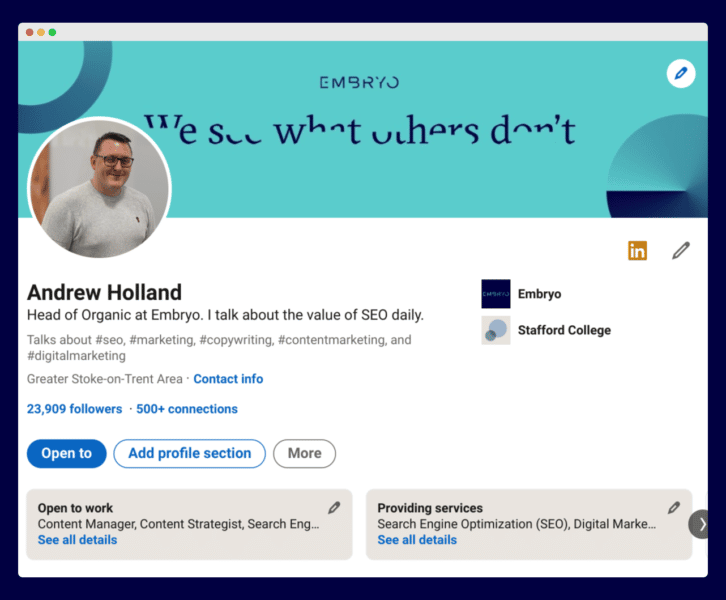
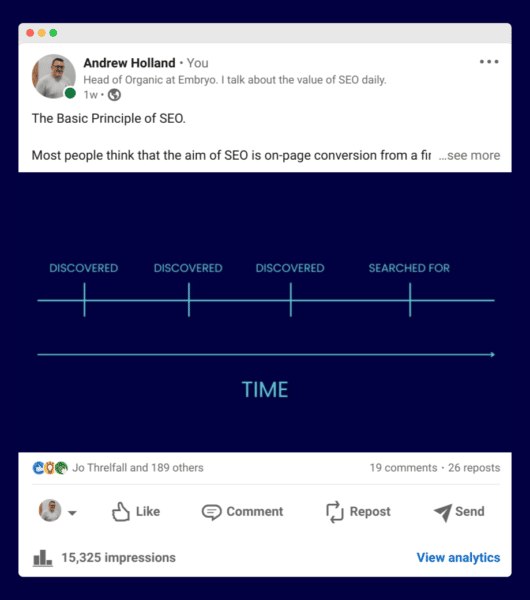
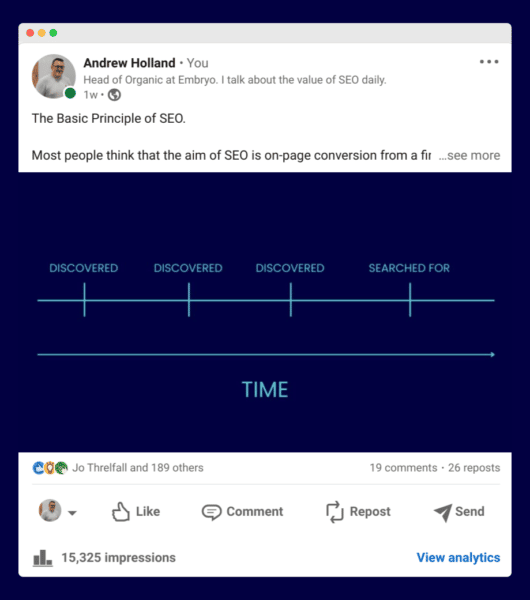
Today, I write daily on Linkedin and have grown a decent following.
But that’s social content leveraging the platforms’ algorithms.
When I talk about regular content, I talk about blog posts with zero keyword research.
They’re written for a human reader, and if Google finds some keywords, great. But that’s accidental.
Regular content is a brave thing to create. It’s risky and a step into the unknown, and unless you have a promotion strategy, the likelihood is high that no one will ever read your post.
It might be your ideas, theories or passion.
In contrast, SEO content has a purpose – to rank.
The simple idea is that you’re writing this for search engines and humans.
You’re ranking the content so the content can be discovered via organic search.
Unless the content is written only with search engines in mind, you’ll struggle to have your content discovered.
Does that make SEO content better? No.
As we’ll see shortly, an abundance of content sticks its fingers up at search engines and does pretty well.
Get the daily newsletter search marketers rely on.
<input type=”hidden” name=”utmMedium” value=”” />
<input type=”hidden” name=”utmCampaign” value=”” />
<input type=”hidden” name=”utmSource” value=”” />
<input type=”hidden” name=”utmContent” value=”” />
<input type=”hidden” name=”pageLink” value=”” />
<input type=”hidden” name=”ipAddress” value=”” />
Human leverage: The focus of content
Okay, so you have two types of content. We’ve seen that one leverages search engines.
But what does the regular kind of content leverage?
Humans.
In particular, human attention and human interaction.
Content for search engines tries to do this. Arguably, that’s the fundamental skill of an SEO-focused content writer – trying to write content that is loved by both search engines and humans. And it’s a real challenge.
On the other hand, content writers are not concerned with these things.
They share ideas, news, thoughts, opinions and information of use.
Unconstrained by the needs and wants of search engines, a certain freedom allows them to focus on one thing, to change the reader’s emotional state.
That state might be that they feel that:
- Their ideal future can be realized.
- Their goals are closer.
- They aren’t failing as parents.
- Life can be better.
- Their business can succeed.
Be it entertaining or educating. Angering or mind-altering.
Great content makes emotional change happen – and it can be powerful.
But which type of writing is right for your business?
‘Content bothism’: A secret weapon for marketing success
A good SEO once told me that one of his first SEO tasks is to kill low-traffic pages.
I get that. But low traffic doesn’t mean low use.
Before you kill content, you need to be sure that the content isn’t of use.
You might test this by promoting on social, even spending a bit of money to boost a post. That way you’ll know if the content is useful to your customers.
The thing is, it doesn’t have to be just SEO content or regular content. It should be SEO content and regular content.
“Content bothism” means using both types of content for your website. You can have the best of both worlds. And very often, that’s how you can build a powerful online presence.
So, what types of regular content can you create for people that don’t leverage search?
3 content tactics you can use to leverage humans
Just because search is excellent, it doesn’t mean we throw regular content under the bus.
Once you know how to leverage human readership, you can create content that drives people to your site because it’s brilliant.
Here are three ways to leverage great content.
Variable reward content
Great blogs keep you coming back for more, as you never know what you’ll read on them. This is known as variable reward content.
Social platforms such as TikTok and Instagram leverage variable reward content, but so do great websites.
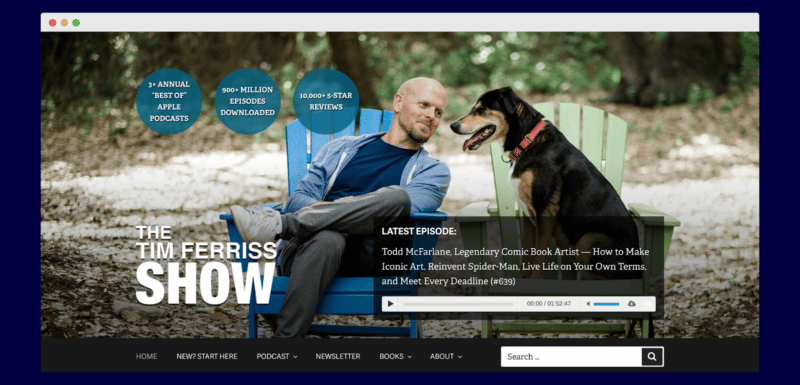
A great example of this is Tim Ferriss. His blog keeps you coming back for more because you never know what you’ve missed.
As a business, this kind of content is excellent because people search for you, not find you serendipitously through search.
The aim is simple – to hook the reader and get them coming back to you, time and time again.
User-generated content
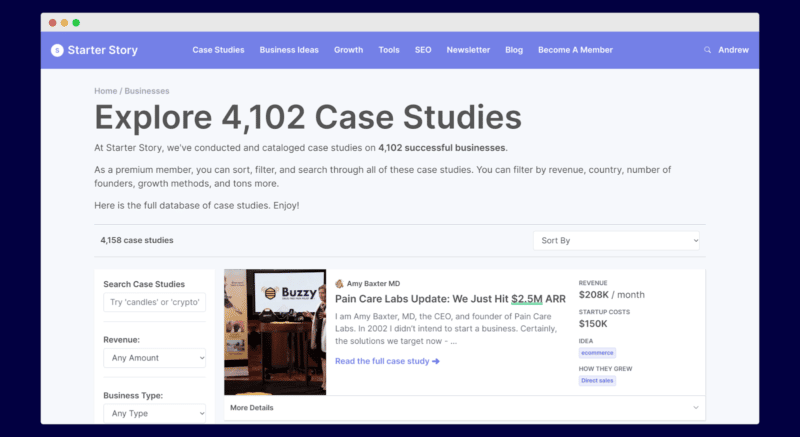
Our next tactic is to get people to create the content for you.
Starter Story has done a super job of doing this.
Through email interviews, their site has hundreds of great start-up stories.
And they haven’t had to write them. This has provided their site with over 4,000 case studies.
Even if you manage to read them all, they keep adding more each week.
None of these are written for search engines, but the volume and the nature of the content are a magnet for readers.
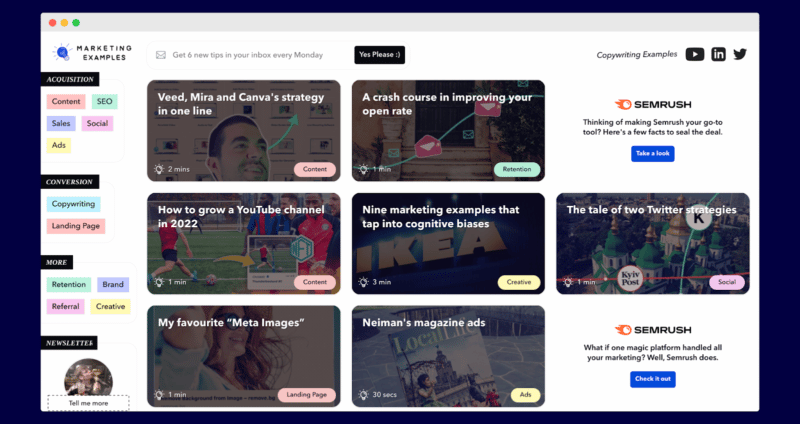
Content curation (with insight)
Content curation is nothing new. Websites have been using content curation for years, and Reddit is arguably the best on the web.
But when you add your unique insight, you tend to create a new version of the content.
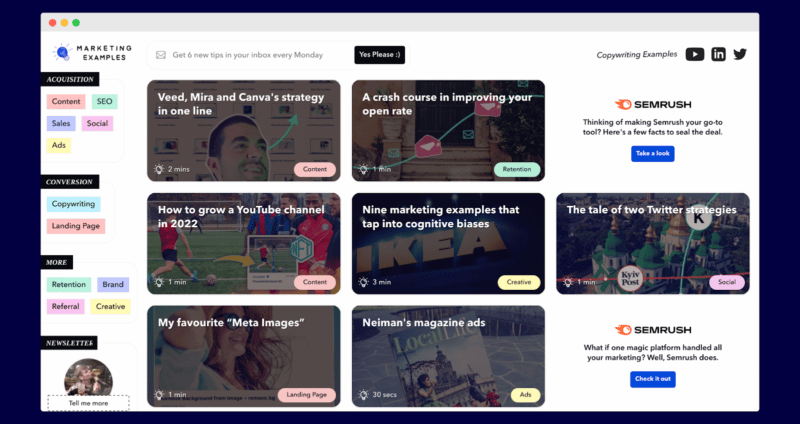
Marketing Examples is an excellent example of this. The best marketing examples are curated in one location, with unique views and images.
But does SEO content have to be dull and robotic?
Not a chance.
SEOs ruined the web – and only SEOs can fix it
We’ve all heard the stories Google is losing market share to TikTok.
We all hate reading an article that is thin and only ranked because of the power of the domain behind it.
Hopefully, recent algorithm updates will change this. But if we want SEO content to be better, SEOs and their content writers need to change this.
So, what do people want from good SEO content?
Good SEO content answers the search query and adds what wasn’t there before.
It’s the proper combination of content writing and SEO content writing. You answer the search query, and then you go beyond.
Seth Godin has some excellent tips for writing blogs that work well.
“Cross out every sentence that could have been written by someone else, every box check, every predictable reference. Now, insert yourself. Your truth and your version of what happens next.”
While we don’t want to cross out every sentence, excellent SEO content must add your unique views, experience and truths.
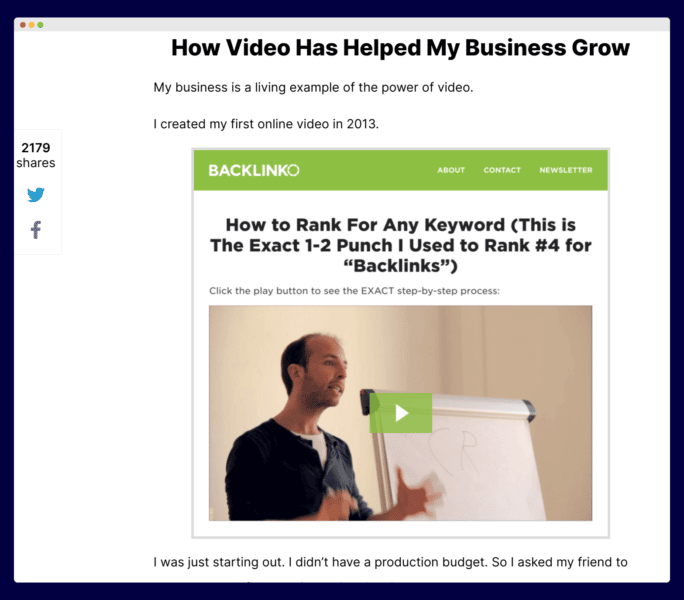
And if you’re struggling to see examples of this in action, look no further than the Backlinko blog.
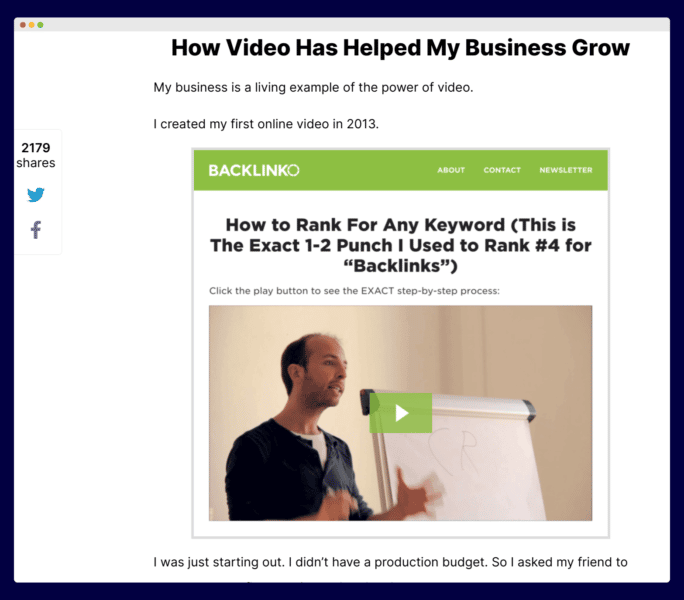
Brian Dean created a blog that didn’t just leverage search. It leveraged both humans and search engines.
Dean creates content for search engines and still adds unique angles and experiences.
It’s why content UX, content design and the insertion of unique views and experiences matter more than ever.
But others also do this well.
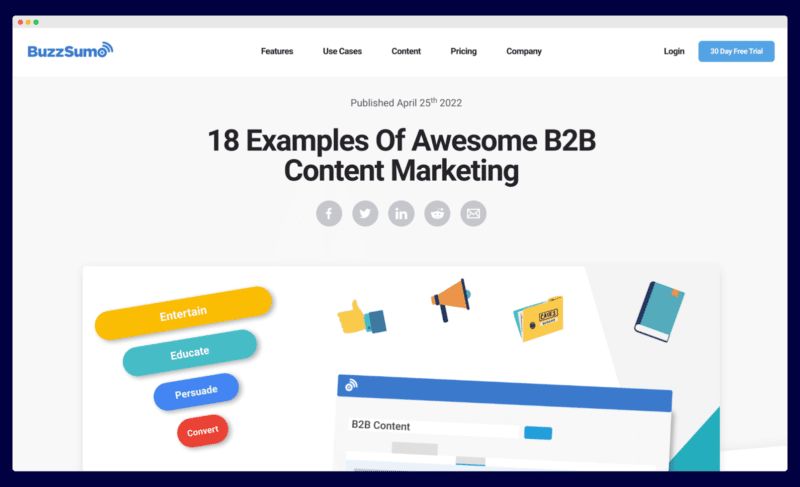
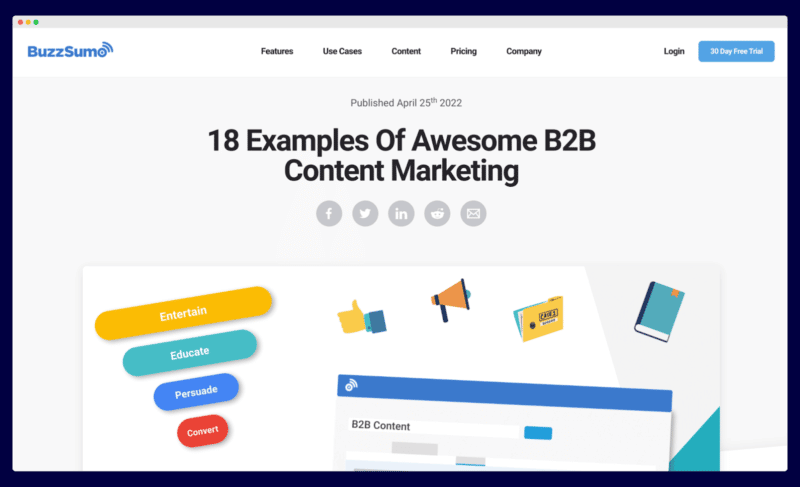
BuzzSumo created an awesome content piece, 18 Examples Of Awesome B2B Content Marketing.
It’s geared toward search and has had some success, but the BuzzSumo team leveraged their own data to produce a great and interesting article.
So, how could you start to make your SEO content stand out?
9 ways to create useful SEO content that humans love
Here are some ways to create helpful content for search engines and humans.
1. Add your own data
We saw how BuzzSumo added its data to create a unique content angle.
What data do you have that you can use?
2. Add design
Brian Dean pioneered content design for SEO, but graphics can add a story to your content that you haven’t thought of.
I get a lot of feedback for my simple graphics that help to explain topics.
3. Add facts
Facts make your content legit and reaffirm what you’re trying to say.
You can get these facts from sites such as Statista.
4. Insert videos
Copywriter Ben Settle used to record himself talking on his phone while walking his dog. He’d then sell these insights as upsells for products.
I’m not saying you should do this, but create a short video, post it on YouTube, and embed it on your page.
Perhaps you can explain something further or add a unique angle. Either way, you’re adding things for humans within your SEO content.
5. Add unique H2s (that don’t feature in the SERPs)
Modern web writing can be a tad regurgitated. People use tools such as Frase and Surfer to analyze the SERPs.
To stand out, aim to add something new to the web, not just combine the best H2s and rewrite them.
What H2 can you add? What is the article missing?
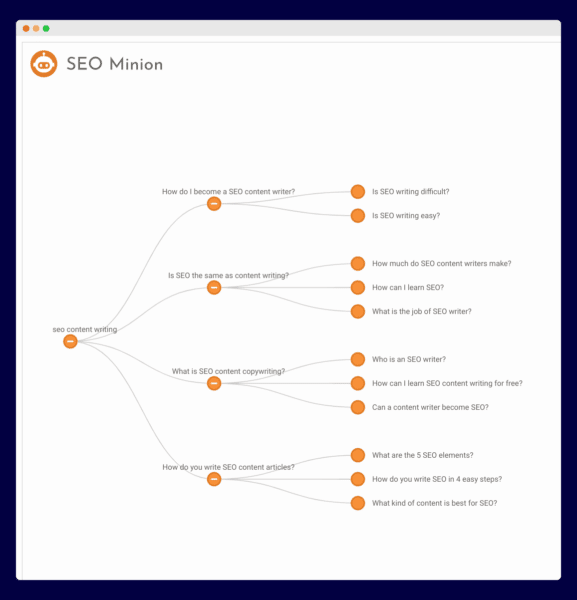
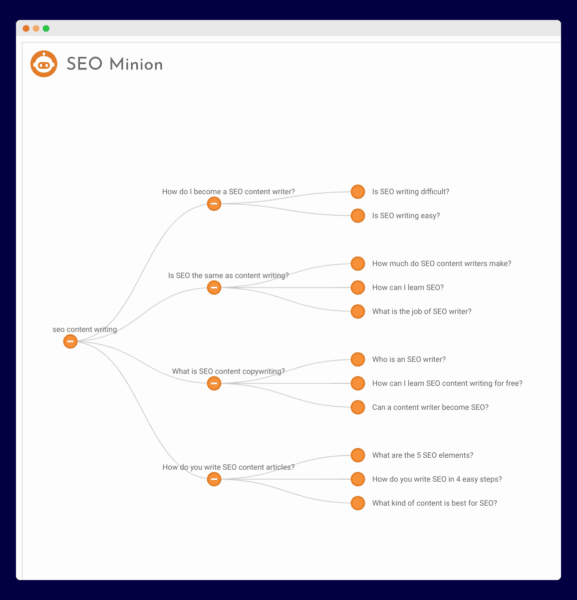
To find out what’s missing, use the SEO Minion Chrome extension, and you can generate relevant People Also Ask questions for any keyword. Then add H2s not listed into your content.
6. Add quick answers
Yes, this is a search issue. We know search loves quick answers.
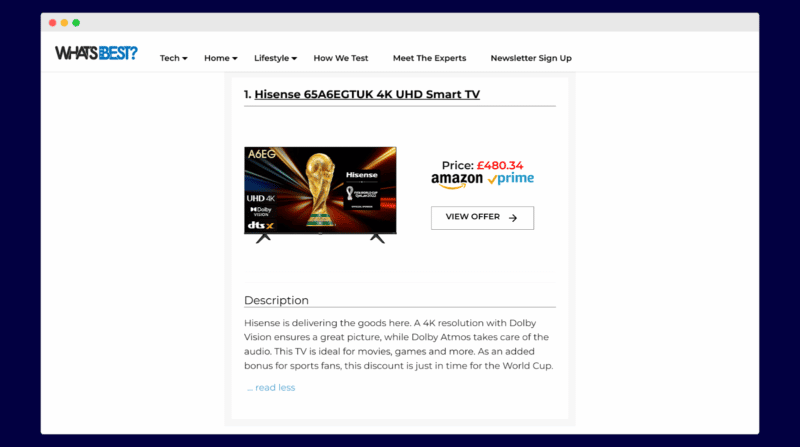
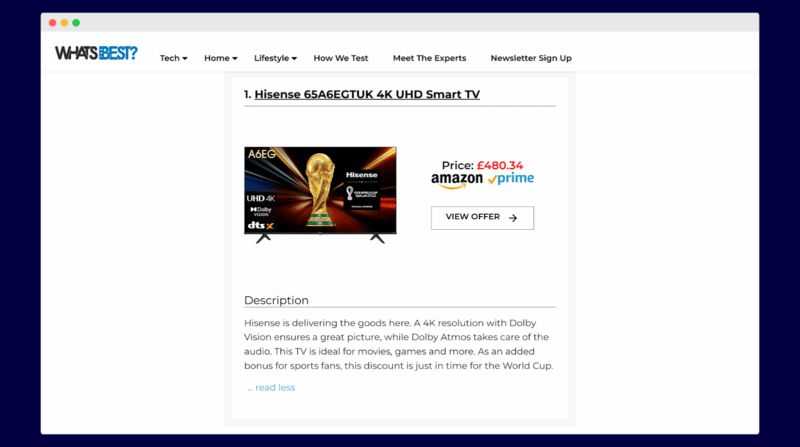
Today, I wanted to know some brief details about a TV I’m thinking of buying. I just wanted the information quickly. Many other buyers are like this, so try and get to the point.
Quick answers can be placed into boxes on your page to assist readers in finding key information.
The above page by What’s Best allowed me to scroll through the best TVs and quickly gain information.
Optimize for the fast reader.
7. Add specifications, details and numbers
With AI on the rise, you must add details because that’s what AI can’t add. Ensure you’re adding relevant product and service data within the body of your content.
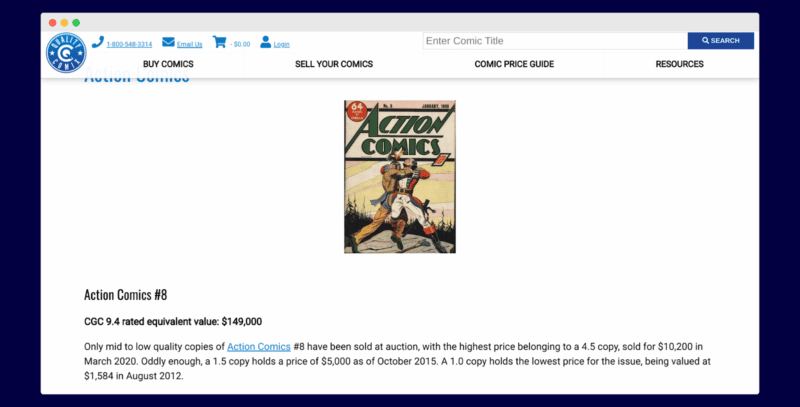
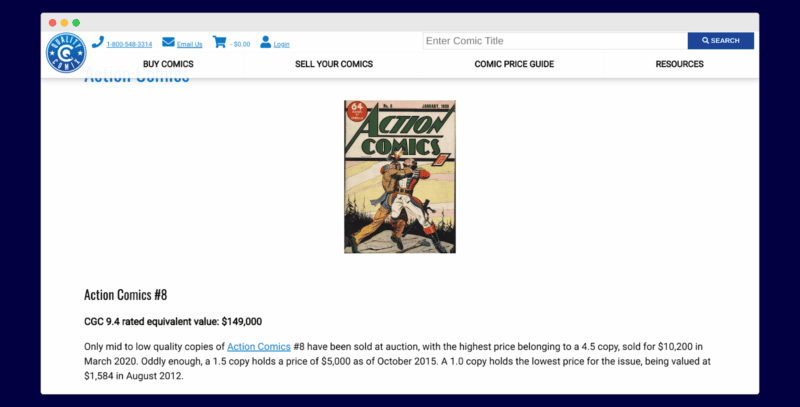
This content by Quality Comix, which rates the 100 most valuable comics, provides key data that no AI program would have.
If you’re using AI to aid in content writing, you need to add more elements that it couldn’t have known or covered.
8. Commit to real answers
Experts give accurate answers to real problems. Quora was built on this.
Again, AI is vague while experts commit. If someone asks whether an air fryer is terrible for your health, answer the question firmly, not vaguely.
Backing up your view with factual data helps, too.
9. Get quotes from business leaders
Businesses have business leaders. Get quotes from them, add them to the content and make your content pop.
Make these quotes stand out on the page using design, and you’ll find that it helps your content to read a lot better.
What you should do next
SEO content is restricted to answering questions your customers have.
Content answers the questions that they don’t know to ask.
Both are needed for a successful content strategy.
Remember, your content is probably not good enough for humans if you wouldn’t pay to promote the content. So go and conduct a review of your content.
Is it good enough? Could it be better? If so, go to work and add some of the elements above.
Be brave. Be bold.
That’s the future of both types of content.
The post SEO content writing vs. content writing: The key difference appeared first on Search Engine Land.
Courtesy of Search Engine Land: News & Info About SEO, PPC, SEM, Search Engines & Search Marketing
Tuesday, January 3rd, 2023
An About Us page is an integral piece of content to have on your website.
Every single successful business has one, no matter their industry or what they sell.
After all, every brand has a story – and your About Us page helps you tell yours.
That’s important because, these days, story and connection matter more than ever to customers.
In a Demand Gen survey, 55% of B2B buyers said content that tells a strong, resonating story is what would make them most likely to talk to sales.
Because your About Us page is one of the first places customers will look to find out about your business and story, it’s a foundational page that deserves time and attention to get right.
Let’s talk about it, including how to write an About Us page.
What is an About Us page?
An About Us page isn’t just where you share the story of your brand. It’s also where you tell your customer what you do for them and how you work to meet their needs in that area.
It isn’t so much “Here’s what we’re about,” but more like “Here’s who we are, why we started, and what we can do for you.”
This page can go by many other names, by the way:
- “Our Mission”
- “Our Story”
- “About [brand name]”
- Or simply “About”
An About Us page can include a wide array of information, but the most common sections to include are:
- Who you serve and what you do for them.
- Your brand story/history, including how you got started.
- Your mission and vision for the company.
- Your brand values, what you believe in, and how you uphold those values in your day-to-day operations.
- Mini bios of the people on your team.
- An explanation of your process, how your services work, or how your products are made.
You can include all of these sections, some of them, or just one or two.
It depends entirely on your business type, including your industry, what you sell, and how unique your products/services are.
On top of that, take into account your brand voice as well as what your customers would be interested to know.
As you’ll soon see, some businesses devote one or two short paragraphs to their About page – and that’s it. Others tell a long story of how they were founded, and yet more have multiple pages within their About page wheelhouse.
For example, if your brand is founded on strict environmental or ethical principles, you’ll probably spend more time explaining how you uphold those standards versus a brand that sells a simple, straightforward product.
How does an About Us page help your business and SEO?
We already mentioned that your About Us page is foundational to your website. That’s because customers expect it and look for it whenever they visit a new-to-them brand online.
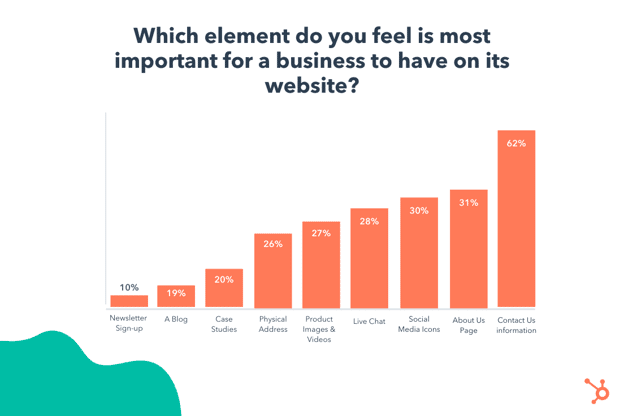
People generally rank the About Us page as the second-most important element on your site (only contact information is rated higher in importance).
For comparison, it rates higher than product images and videos, live chat, social media icons/links, and even a blog.
That’s reason enough to create a great About Us page. However, there are even more benefits to creating one that might not have crossed your mind.
Brand transparency
Transparency matters to customers. They want to know how you operate, what goes on behind the scenes, and that you’re true to your word.
86% of U.S. consumers believe transparency in business matters now more than ever. To that end, your About Us page sets a standard for your transparency as a company overall.
Sharing values
Customers also want to know that the brands they support share their values.
84% of consumers worldwide said they’re more likely to buy from a brand with values that match their own. Your About Us page is the perfect place to lay out those values and what you stand for.
Connecting with customers
Writing an About page also helps you connect with customers, often during one of their first interactions with your brand.
Reading your story, mission, values, and purpose will help them relate to your company.
Boosting your website’s E-A-T
In terms of SEO, creating an About page isn’t necessarily about ranking the page in search.
Instead, it adds a layer of expertise, authoritativeness, and trustworthiness (E-A-T) to your site by explaining your background, your knowledge, and why you’re uniquely qualified to sell what you sell, offer the services you do, or discuss the topics you publish content about.
Get the daily newsletter search marketers rely on.
<input type=”hidden” name=”utmMedium” value=”” />
<input type=”hidden” name=”utmCampaign” value=”” />
<input type=”hidden” name=”utmSource” value=”” />
<input type=”hidden” name=”utmContent” value=”” />
<input type=”hidden” name=”pageLink” value=”” />
<input type=”hidden” name=”ipAddress” value=”” />
How to write an About Us page
Struggling to write an About Us page? Not to worry.
Here are the basic steps to write an effective one, including the details you shouldn’t leave out.
Share the ultimate goal or ‘big why’ behind your brand (your mission)
Why does your business exist? Why does it matter? What’s the ultimate problem in your industry you’re trying to solve?
Ultimately, this is your mission, and you should share it on your About Us page. And, if you’re like many businesses that haven’t clearly defined theirs, now is the time.
Why is stating your mission important?
Because a majority of modern consumers – especially Gen Z – want to know that their purchases align with who they are and that the businesses to which they give their dollars care about the things they care about. (Market research from Alter Agents found that 68% of Gen Z and Millennial buyers believe their purchases are indicative of their personalities and concerns.)
Explaining your mission gives your target audience another reason to align themselves with you. Give them your “big why.”
Explain how you help your customers with what you sell
Now it’s time to dive into the deeper specifics of your business on your About Us page. Lay out:
- What you sell: Tell customers what you sell. If your products/services are unique, explain how they work.
- The problems you solve for customers – both tangible and intangible – with what you sell. Examples:
- Tangible: “We help health food brands create and execute smart marketing strategies.”
- Intangible: “We help health food brands make genuine connections with their customers.”
Again, the key here is to keep your explanations customer-focused. Don’t make the mistake of turning your About Us page into one giant brag-fest. Instead, you should be positioning your business in terms of:
- Why the customer should care.
- How they can relate to you.
- How you help them.
Tell your story
It’s a great idea to tell your brand story on your About page, including how/why you got started.
Were your beginnings humble? Did it all start with a seed of an idea? Did you have a novel solution to a big problem you saw happening? Or was your business a happy accident (or a disaster you turned around)?
Finally, don’t forget to tell the story of where you’re going. What do you hope to achieve? What are your biggest dreams for the future of your company?
Introduce your team
In the spirit of transparency, it’s a good idea to share the names and faces behind your business and the role each person plays. (By the way, sharing photos of real people is a great trust-builder. It helps customers see that you’re not just a disembodied logo, a faceless suit, or words on a screen.)
Additionally, including bios for your team or site contributors gives Google clues about authorship and reputation.
Tell them what to do after reading your About Us page
Lastly, give your audience direction on what to do next after they finish reading your About Us page.
A few well-placed calls to action (CTA) will do the trick. For example, include a CTA button at the bottom of the page that sends them to:
- Check out your services/products.
- Read your blog.
- Sign up for your newsletter.
- Or do some other activity that keeps them engaged with your site and content.
13 About Us page examples
Now that you know how to write an About Us page and which sections to include, let’s look at some examples of About pages done right.
1. Oatly
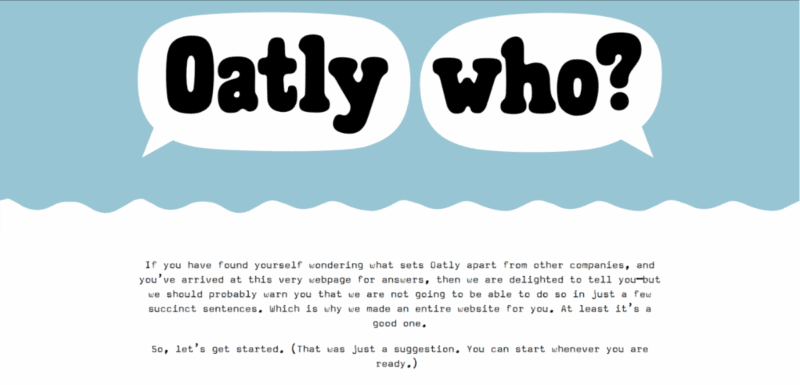
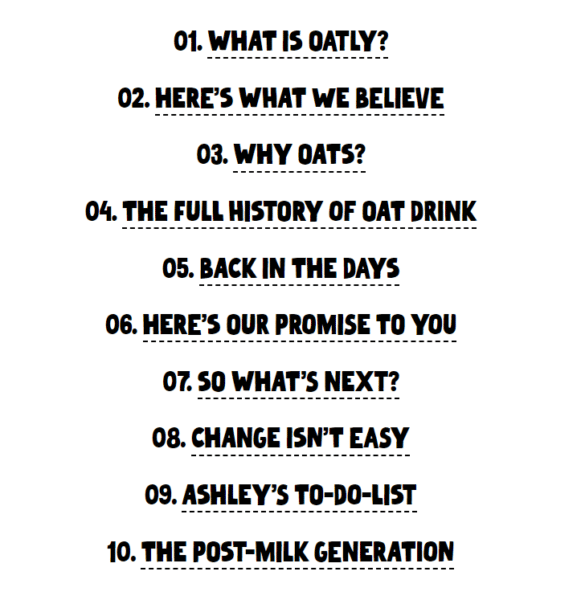
Oatly’s About Us page is a great example of how your brand voice can and should carry over into every piece of your content and website.
Their irreverent tone and devil-may-care attitude are perfectly expressed in every section of this page, which, by the way, still manages to provide a ton of great company information for any curious consumer.
2. NerdWallet
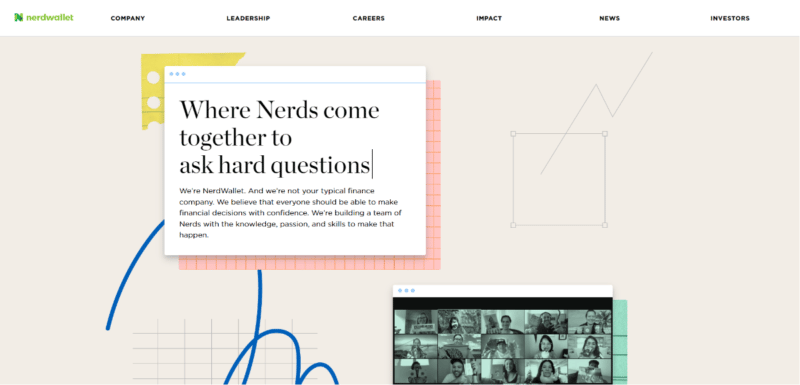
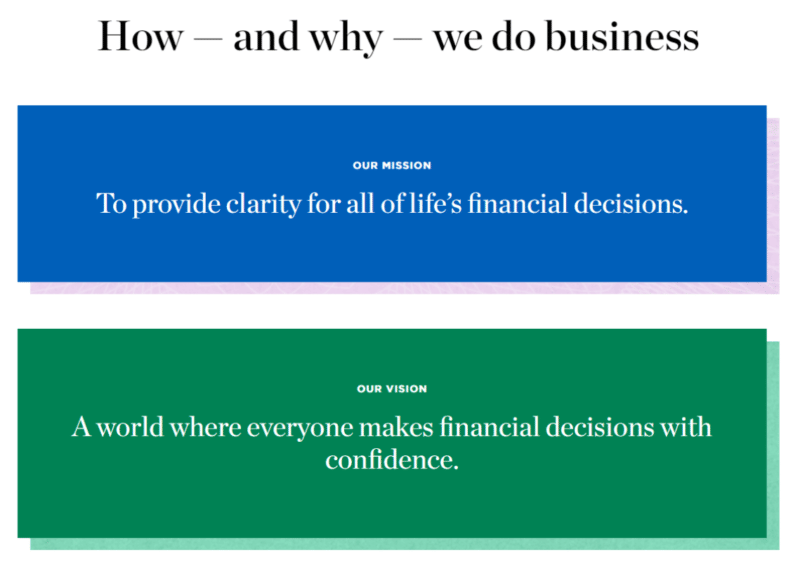
NerdWallet, a financial services company, is a good example of a brand that expanded its About Us page into a multi-page experience, with information covering the company, leadership, impact, and more.
NerdWallet is also a great example of how to state your mission and vision clearly with a focus on the customer.
3. Chronicle Books
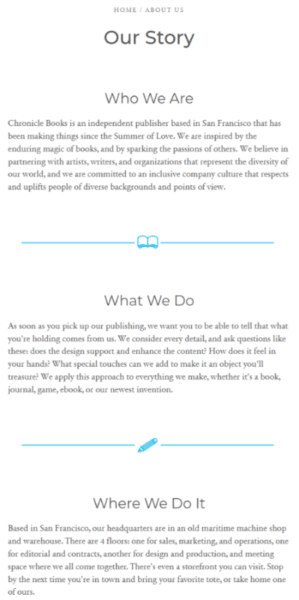
The publisher Chronicle Books has a super simple, text-heavy About page, but it works well due to the clear headlines and charming details added to their story.
For example, the company is headquartered in an old maritime machine shop – sharing that information helps you understand the brand is a little quirky.
4. Healthline
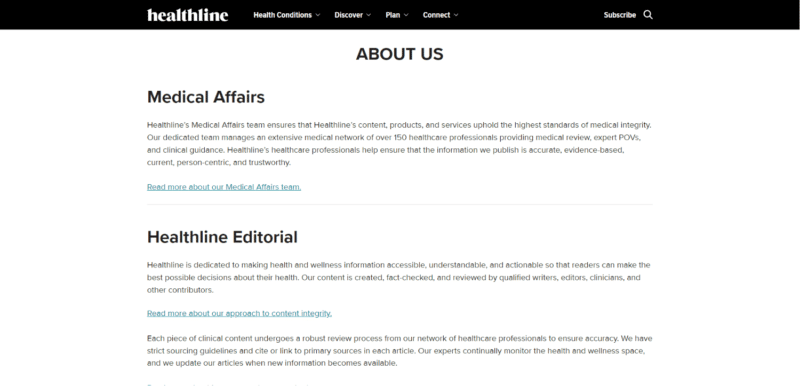
Healthline provides medical information and advice to the masses, so its About page needs some gravitas behind it to help prove they’re a trustworthy source (read: it needs some serious E-A-T).
Sure enough, the page is full of details about how they maintain integrity throughout their content and ensure it stays current and evidence-based.
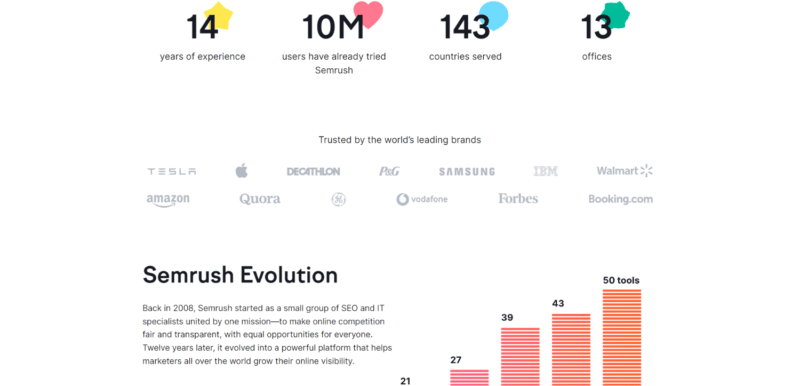
5. Semrush
Semrush, the SEO and content marketing tool, is all about data, so their About Us page reflects that.
The company highlights stats and graphs to show how long they’ve been around and how many people trust their tools.
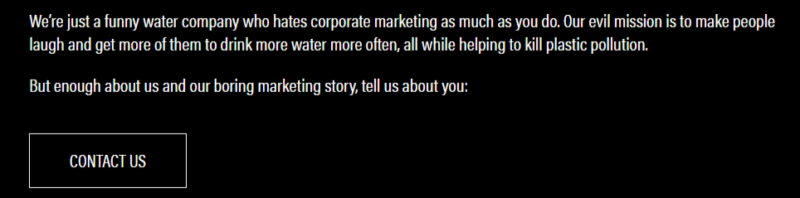
6. Liquid Death
If you’ve never heard of Liquid Death, it’s water packaged in a can. If that sounds weird, well… it kind of is.
Since they have a unique product, you’d think the company would feel the need to explain itself a bit more on its About Us page – but that’s not the case.
Sometimes, your product speaks for itself, and two paragraphs (including a simply-stated mission) and a “contact us” button are all you need on your About page.
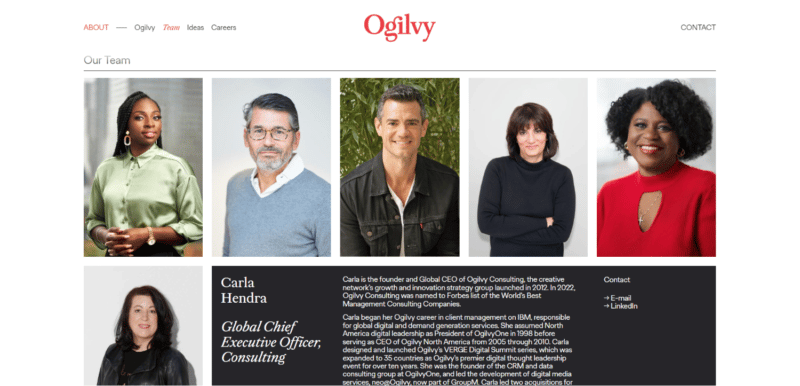
7. Ogilvy
Ogilvy, a high-profile ad, PR, and consulting agency (and the company of the famed ad copywriter David Ogilvy), uses its About page to focus on the talent and diversity of its team.
Since this is a high-performing company that creates ads and other marketing for brands like Netflix and Coca-Cola, that makes sense.
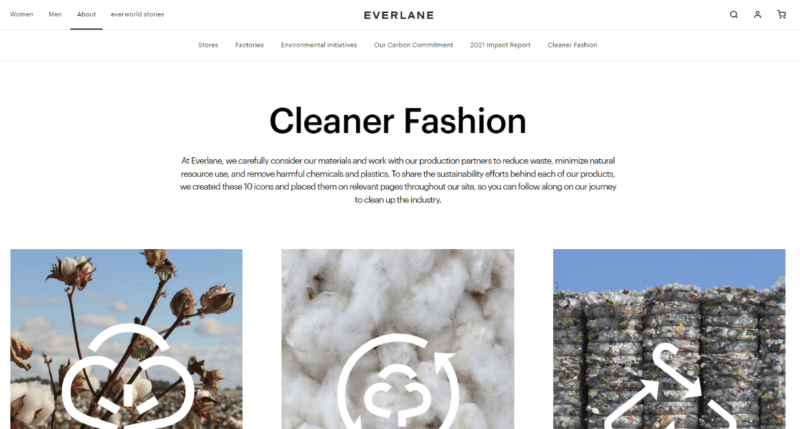
8. Everlane
Everlane, an ethical clothing brand, devotes its About Us page to sharing behind-the-scenes information about how its clothes are made, how they partner with factories ethically, and what materials they use.
Since this is a brand that’s trying to differentiate with ethical practices, they really need to show that in action – and they do.
The company also uses separate but connected pages to further explain its environmental initiatives, carbon footprint, and more.
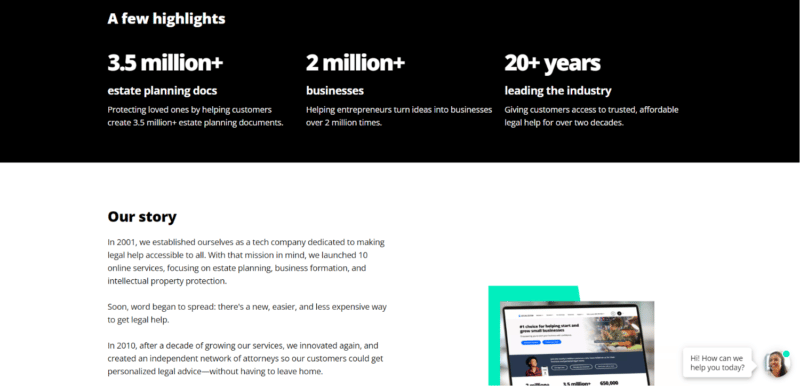
9. LegalZoom
On their About page, LegalZoom provides some impressive data to show their impact over 20 years.
More importantly, the company doesn’t frame their wins in terms of “what we did” but rather how they helped people: “Protecting loved ones,” “Helping entrepreneurs,” and “Giving customers access.”
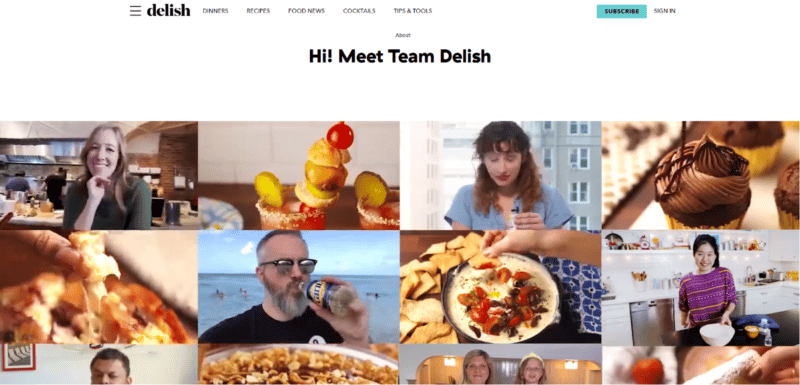
10. Delish
Delish is an epicenter of cooks, chefs, bakers, and foodies sharing recipes and tips, so their About page also centers on the people behind it all.
The first thing you’re greeted with is a grid of gifs of various contributors (and there are a lot of them):
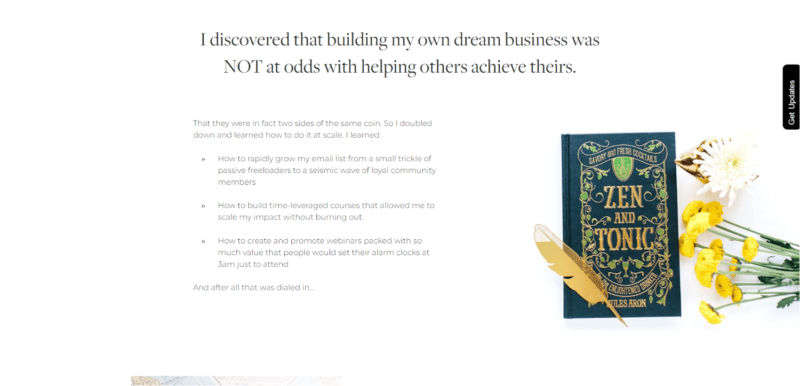
11. Amy Porterfield
Business coach Amy Porterfield’s About page is one long story about how she went from a corporate gig to entrepreneurship, but it also provides proof of why she’s qualified to coach you.
Telling your story like this is a great way to connect with your audience while providing your business background and proof of your expertise.
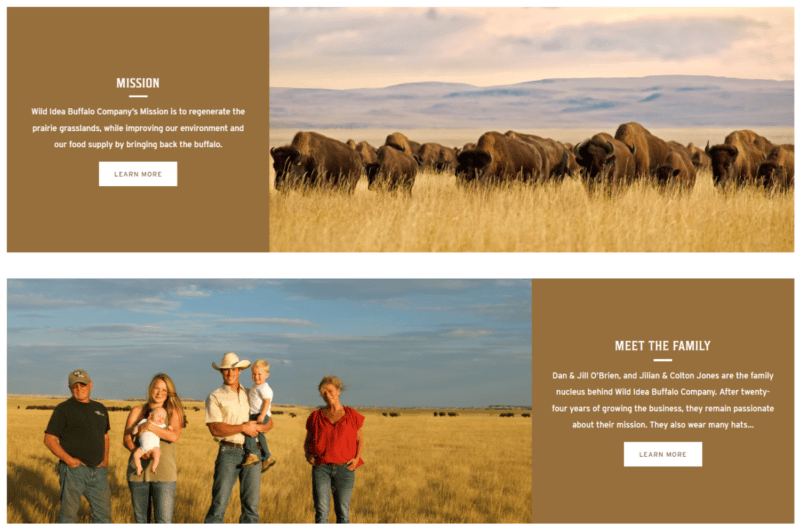
12. Wild Idea
Wild Idea is a family-owned company and ranch focused on humanely-raising buffalo and restoring prairie grasslands.
As such, their mission and family are prominent parts of their About page, as well as their unique process of “humane field harvest.”
Also note the use of panoramic photos to show off both the prairies and the buffalo herds they manage, as well as their down-to-earth family/founders. The right images can play a huge role in building trust while drawing your audience in.
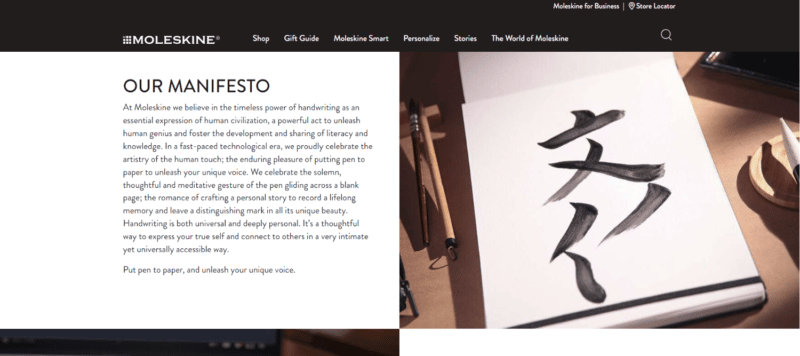
13. Moleskine
If you’re a journaler, an artist, a writer, or a jotter, you’ve probably heard of Moleskine. Their notebooks are highly regarded, and their suite of About pages (called “The World of Moleskine”) reflects that.
Note how they use titles to imply their history and reputation: “Our Heritage,” “Our Manifesto.”
Bonus: If you have a lot of information to share about your company that your audience will care about, take a page from Moleskine and devote multiple website pages to your various company facets.
Write an About Us page to add E-A-T to your website
What’s the common factor tying all of these About Us page examples together?
All of them add necessary proof of expertise, authoritativeness, and trustworthiness (E-A-T) to their respective brand websites.
Where it matters, they add author and creator information, too. (For example, brands who rely on multiple authors across their site have dedicated bios for each of them.)
They answer the questions, “Why does your business exist, and who does it exist to serve?”
And that’s exactly what your About page should do.
Sure, write one because it’s standard practice, but also make sure you write an effective About Us page that will help build trust with your customers and demonstrate why your brand is an authority on what you sell.
Don’t let your About Us page become an afterthought – it’s a foundational website page, and should be created and written strategically.
The post How to write an effective About Us page (with 13 examples) appeared first on Search Engine Land.
Courtesy of Search Engine Land: News & Info About SEO, PPC, SEM, Search Engines & Search Marketing
Tuesday, January 3rd, 2023
SEO content writing, what exactly is it? And how does it differ from typical content writing?
Is SEO content writing better than more traditional content writing?
In this article, we’ll answer these questions and a lot more.
You’ll learn:
The key difference between SEO content writing and content writing
The difference between SEO content writing and content writing is that SEO content writing is designed to leverage search engines to fuel the discovery of your content. In comparison, content writing is content only created for humans to read.
If you felt like the above was written by a robot, and for a robot – you’re right. It’s a classic example of a paragraph created for SEO.
I can almost hear my Google home mini spitting that out as a response to a question. It isn’t exciting, but it gets to the point.
I’ll make the rest of the article more “by a human, for humans.” But my first statement is correct.
SEO content is written to leverage the code of search engines.
But which is best?
Which is best? SEO content or regular content?
Over the years, I’ve had a fair amount of success with both forms of content.
Today, I write daily on Linkedin and have grown a decent following.
But that’s social content leveraging the platforms’ algorithms.
When I talk about regular content, I talk about blog posts with zero keyword research.
They’re written for a human reader, and if Google finds some keywords, great. But that’s accidental.
Regular content is a brave thing to create. It’s risky and a step into the unknown, and unless you have a promotion strategy, the likelihood is high that no one will ever read your post.
It might be your ideas, theories or passion.
In contrast, SEO content has a purpose – to rank.
The simple idea is that you’re writing this for search engines and humans.
You’re ranking the content so the content can be discovered via organic search.
Unless the content is written only with search engines in mind, you’ll struggle to have your content discovered.
Does that make SEO content better? No.
As we’ll see shortly, an abundance of content sticks its fingers up at search engines and does pretty well.
Get the daily newsletter search marketers rely on.
<input type=”hidden” name=”utmMedium” value=”” />
<input type=”hidden” name=”utmCampaign” value=”” />
<input type=”hidden” name=”utmSource” value=”” />
<input type=”hidden” name=”utmContent” value=”” />
<input type=”hidden” name=”pageLink” value=”” />
<input type=”hidden” name=”ipAddress” value=”” />
Human leverage: The focus of content
Okay, so you have two types of content. We’ve seen that one leverages search engines.
But what does the regular kind of content leverage?
Humans.
In particular, human attention and human interaction.
Content for search engines tries to do this. Arguably, that’s the fundamental skill of an SEO-focused content writer – trying to write content that is loved by both search engines and humans. And it’s a real challenge.
On the other hand, content writers are not concerned with these things.
They share ideas, news, thoughts, opinions and information of use.
Unconstrained by the needs and wants of search engines, a certain freedom allows them to focus on one thing, to change the reader’s emotional state.
That state might be that they feel that:
- Their ideal future can be realized.
- Their goals are closer.
- They aren’t failing as parents.
- Life can be better.
- Their business can succeed.
Be it entertaining or educating. Angering or mind-altering.
Great content makes emotional change happen – and it can be powerful.
But which type of writing is right for your business?
‘Content bothism’: A secret weapon for marketing success
A good SEO once told me that one of his first SEO tasks is to kill low-traffic pages.
I get that. But low traffic doesn’t mean low use.
Before you kill content, you need to be sure that the content isn’t of use.
You might test this by promoting on social, even spending a bit of money to boost a post. That way you’ll know if the content is useful to your customers.
The thing is, it doesn’t have to be just SEO content or regular content. It should be SEO content and regular content.
“Content bothism” means using both types of content for your website. You can have the best of both worlds. And very often, that’s how you can build a powerful online presence.
So, what types of regular content can you create for people that don’t leverage search?
3 content tactics you can use to leverage humans
Just because search is excellent, it doesn’t mean we throw regular content under the bus.
Once you know how to leverage human readership, you can create content that drives people to your site because it’s brilliant.
Here are three ways to leverage great content.
Variable reward content
Great blogs keep you coming back for more, as you never know what you’ll read on them. This is known as variable reward content.
Social platforms such as TikTok and Instagram leverage variable reward content, but so do great websites.
A great example of this is Tim Ferriss. His blog keeps you coming back for more because you never know what you’ve missed.
As a business, this kind of content is excellent because people search for you, not find you serendipitously through search.
The aim is simple – to hook the reader and get them coming back to you, time and time again.
User-generated content
Our next tactic is to get people to create the content for you.
Starter Story has done a super job of doing this.
Through email interviews, their site has hundreds of great start-up stories.
And they haven’t had to write them. This has provided their site with over 4,000 case studies.
Even if you manage to read them all, they keep adding more each week.
None of these are written for search engines, but the volume and the nature of the content are a magnet for readers.
Content curation (with insight)
Content curation is nothing new. Websites have been using content curation for years, and Reddit is arguably the best on the web.
But when you add your unique insight, you tend to create a new version of the content.
Marketing Examples is an excellent example of this. The best marketing examples are curated in one location, with unique views and images.
But does SEO content have to be dull and robotic?
Not a chance.
SEOs ruined the web – and only SEOs can fix it
We’ve all heard the stories Google is losing market share to TikTok.
We all hate reading an article that is thin and only ranked because of the power of the domain behind it.
Hopefully, recent algorithm updates will change this. But if we want SEO content to be better, SEOs and their content writers need to change this.
So, what do people want from good SEO content?
Good SEO content answers the search query and adds what wasn’t there before.
It’s the proper combination of content writing and SEO content writing. You answer the search query, and then you go beyond.
Seth Godin has some excellent tips for writing blogs that work well.
“Cross out every sentence that could have been written by someone else, every box check, every predictable reference. Now, insert yourself. Your truth and your version of what happens next.”
While we don’t want to cross out every sentence, excellent SEO content must add your unique views, experience and truths.
And if you’re struggling to see examples of this in action, look no further than the Backlinko blog.
Brian Dean created a blog that didn’t just leverage search. It leveraged both humans and search engines.
Dean creates content for search engines and still adds unique angles and experiences.
It’s why content UX, content design and the insertion of unique views and experiences matter more than ever.
But others also do this well.
BuzzSumo created an awesome content piece, 18 Examples Of Awesome B2B Content Marketing.
It’s geared toward search and has had some success, but the BuzzSumo team leveraged their own data to produce a great and interesting article.
So, how could you start to make your SEO content stand out?
9 ways to create useful SEO content that humans love
Here are some ways to create helpful content for search engines and humans.
1. Add your own data
We saw how BuzzSumo added its data to create a unique content angle.
What data do you have that you can use?
2. Add design
Brian Dean pioneered content design for SEO, but graphics can add a story to your content that you haven’t thought of.
I get a lot of feedback for my simple graphics that help to explain topics.
3. Add facts
Facts make your content legit and reaffirm what you’re trying to say.
You can get these facts from sites such as Statista.
4. Insert videos
Copywriter Ben Settle used to record himself talking on his phone while walking his dog. He’d then sell these insights as upsells for products.
I’m not saying you should do this, but create a short video, post it on YouTube, and embed it on your page.
Perhaps you can explain something further or add a unique angle. Either way, you’re adding things for humans within your SEO content.
5. Add unique H2s (that don’t feature in the SERPs)
Modern web writing can be a tad regurgitated. People use tools such as Frase and Surfer to analyze the SERPs.
To stand out, aim to add something new to the web, not just combine the best H2s and rewrite them.
What H2 can you add? What is the article missing?
To find out what’s missing, use the SEO Minion Chrome extension, and you can generate relevant People Also Ask questions for any keyword. Then add H2s not listed into your content.
6. Add quick answers
Yes, this is a search issue. We know search loves quick answers.
Today, I wanted to know some brief details about a TV I’m thinking of buying. I just wanted the information quickly. Many other buyers are like this, so try and get to the point.
Quick answers can be placed into boxes on your page to assist readers in finding key information.
The above page by What’s Best allowed me to scroll through the best TVs and quickly gain information.
Optimize for the fast reader.
7. Add specifications, details and numbers
With AI on the rise, you must add details because that’s what AI can’t add. Ensure you’re adding relevant product and service data within the body of your content.
This content by Quality Comix, which rates the 100 most valuable comics, provides key data that no AI program would have.
If you’re using AI to aid in content writing, you need to add more elements that it couldn’t have known or covered.
8. Commit to real answers
Experts give accurate answers to real problems. Quora was built on this.
Again, AI is vague while experts commit. If someone asks whether an air fryer is terrible for your health, answer the question firmly, not vaguely.
Backing up your view with factual data helps, too.
9. Get quotes from business leaders
Businesses have business leaders. Get quotes from them, add them to the content and make your content pop.
Make these quotes stand out on the page using design, and you’ll find that it helps your content to read a lot better.
What you should do next
SEO content is restricted to answering questions your customers have.
Content answers the questions that they don’t know to ask.
Both are needed for a successful content strategy.
Remember, your content is probably not good enough for humans if you wouldn’t pay to promote the content. So go and conduct a review of your content.
Is it good enough? Could it be better? If so, go to work and add some of the elements above.
Be brave. Be bold.
That’s the future of both types of content.
The post SEO content writing vs. content writing: The key difference appeared first on Search Engine Land.
Courtesy of Search Engine Land: News & Info About SEO, PPC, SEM, Search Engines & Search Marketing
Tuesday, January 3rd, 2023
An About Us page is an integral piece of content to have on your website.
Every single successful business has one, no matter their industry or what they sell.
After all, every brand has a story – and your About Us page helps you tell yours.
That’s important because, these days, story and connection matter more than ever to customers.
In a Demand Gen survey, 55% of B2B buyers said content that tells a strong, resonating story is what would make them most likely to talk to sales.
Because your About Us page is one of the first places customers will look to find out about your business and story, it’s a foundational page that deserves time and attention to get right.
Let’s talk about it, including how to write an About Us page.
What is an About Us page?
An About Us page isn’t just where you share the story of your brand. It’s also where you tell your customer what you do for them and how you work to meet their needs in that area.
It isn’t so much “Here’s what we’re about,” but more like “Here’s who we are, why we started, and what we can do for you.”
This page can go by many other names, by the way:
- “Our Mission”
- “Our Story”
- “About [brand name]”
- Or simply “About”
An About Us page can include a wide array of information, but the most common sections to include are:
- Who you serve and what you do for them.
- Your brand story/history, including how you got started.
- Your mission and vision for the company.
- Your brand values, what you believe in, and how you uphold those values in your day-to-day operations.
- Mini bios of the people on your team.
- An explanation of your process, how your services work, or how your products are made.
You can include all of these sections, some of them, or just one or two.
It depends entirely on your business type, including your industry, what you sell, and how unique your products/services are.
On top of that, take into account your brand voice as well as what your customers would be interested to know.
As you’ll soon see, some businesses devote one or two short paragraphs to their About page – and that’s it. Others tell a long story of how they were founded, and yet more have multiple pages within their About page wheelhouse.
For example, if your brand is founded on strict environmental or ethical principles, you’ll probably spend more time explaining how you uphold those standards versus a brand that sells a simple, straightforward product.
How does an About Us page help your business and SEO?
We already mentioned that your About Us page is foundational to your website. That’s because customers expect it and look for it whenever they visit a new-to-them brand online.
People generally rank the About Us page as the second-most important element on your site (only contact information is rated higher in importance).
For comparison, it rates higher than product images and videos, live chat, social media icons/links, and even a blog.
That’s reason enough to create a great About Us page. However, there are even more benefits to creating one that might not have crossed your mind.
Brand transparency
Transparency matters to customers. They want to know how you operate, what goes on behind the scenes, and that you’re true to your word.
86% of U.S. consumers believe transparency in business matters now more than ever. To that end, your About Us page sets a standard for your transparency as a company overall.
Sharing values
Customers also want to know that the brands they support share their values.
84% of consumers worldwide said they’re more likely to buy from a brand with values that match their own. Your About Us page is the perfect place to lay out those values and what you stand for.
Connecting with customers
Writing an About page also helps you connect with customers, often during one of their first interactions with your brand.
Reading your story, mission, values, and purpose will help them relate to your company.
Boosting your website’s E-A-T
In terms of SEO, creating an About page isn’t necessarily about ranking the page in search.
Instead, it adds a layer of expertise, authoritativeness, and trustworthiness (E-A-T) to your site by explaining your background, your knowledge, and why you’re uniquely qualified to sell what you sell, offer the services you do, or discuss the topics you publish content about.
Get the daily newsletter search marketers rely on.
<input type=”hidden” name=”utmMedium” value=”” />
<input type=”hidden” name=”utmCampaign” value=”” />
<input type=”hidden” name=”utmSource” value=”” />
<input type=”hidden” name=”utmContent” value=”” />
<input type=”hidden” name=”pageLink” value=”” />
<input type=”hidden” name=”ipAddress” value=”” />
How to write an About Us page
Struggling to write an About Us page? Not to worry.
Here are the basic steps to write an effective one, including the details you shouldn’t leave out.
Share the ultimate goal or ‘big why’ behind your brand (your mission)
Why does your business exist? Why does it matter? What’s the ultimate problem in your industry you’re trying to solve?
Ultimately, this is your mission, and you should share it on your About Us page. And, if you’re like many businesses that haven’t clearly defined theirs, now is the time.
Why is stating your mission important?
Because a majority of modern consumers – especially Gen Z – want to know that their purchases align with who they are and that the businesses to which they give their dollars care about the things they care about. (Market research from Alter Agents found that 68% of Gen Z and Millennial buyers believe their purchases are indicative of their personalities and concerns.)
Explaining your mission gives your target audience another reason to align themselves with you. Give them your “big why.”
Explain how you help your customers with what you sell
Now it’s time to dive into the deeper specifics of your business on your About Us page. Lay out:
- What you sell: Tell customers what you sell. If your products/services are unique, explain how they work.
- The problems you solve for customers – both tangible and intangible – with what you sell. Examples:
- Tangible: “We help health food brands create and execute smart marketing strategies.”
- Intangible: “We help health food brands make genuine connections with their customers.”
Again, the key here is to keep your explanations customer-focused. Don’t make the mistake of turning your About Us page into one giant brag-fest. Instead, you should be positioning your business in terms of:
- Why the customer should care.
- How they can relate to you.
- How you help them.
Tell your story
It’s a great idea to tell your brand story on your About page, including how/why you got started.
Were your beginnings humble? Did it all start with a seed of an idea? Did you have a novel solution to a big problem you saw happening? Or was your business a happy accident (or a disaster you turned around)?
Finally, don’t forget to tell the story of where you’re going. What do you hope to achieve? What are your biggest dreams for the future of your company?
Introduce your team
In the spirit of transparency, it’s a good idea to share the names and faces behind your business and the role each person plays. (By the way, sharing photos of real people is a great trust-builder. It helps customers see that you’re not just a disembodied logo, a faceless suit, or words on a screen.)
Additionally, including bios for your team or site contributors gives Google clues about authorship and reputation.
Tell them what to do after reading your About Us page
Lastly, give your audience direction on what to do next after they finish reading your About Us page.
A few well-placed calls to action (CTA) will do the trick. For example, include a CTA button at the bottom of the page that sends them to:
- Check out your services/products.
- Read your blog.
- Sign up for your newsletter.
- Or do some other activity that keeps them engaged with your site and content.
13 About Us page examples
Now that you know how to write an About Us page and which sections to include, let’s look at some examples of About pages done right.
1. Oatly
Oatly’s About Us page is a great example of how your brand voice can and should carry over into every piece of your content and website.
Their irreverent tone and devil-may-care attitude are perfectly expressed in every section of this page, which, by the way, still manages to provide a ton of great company information for any curious consumer.
2. NerdWallet
NerdWallet, a financial services company, is a good example of a brand that expanded its About Us page into a multi-page experience, with information covering the company, leadership, impact, and more.
NerdWallet is also a great example of how to state your mission and vision clearly with a focus on the customer.
3. Chronicle Books
The publisher Chronicle Books has a super simple, text-heavy About page, but it works well due to the clear headlines and charming details added to their story.
For example, the company is headquartered in an old maritime machine shop – sharing that information helps you understand the brand is a little quirky.
4. Healthline
Healthline provides medical information and advice to the masses, so its About page needs some gravitas behind it to help prove they’re a trustworthy source (read: it needs some serious E-A-T).
Sure enough, the page is full of details about how they maintain integrity throughout their content and ensure it stays current and evidence-based.
5. Semrush
Semrush, the SEO and content marketing tool, is all about data, so their About Us page reflects that.
The company highlights stats and graphs to show how long they’ve been around and how many people trust their tools.
6. Liquid Death
If you’ve never heard of Liquid Death, it’s water packaged in a can. If that sounds weird, well… it kind of is.
Since they have a unique product, you’d think the company would feel the need to explain itself a bit more on its About Us page – but that’s not the case.
Sometimes, your product speaks for itself, and two paragraphs (including a simply-stated mission) and a “contact us” button are all you need on your About page.
7. Ogilvy
Ogilvy, a high-profile ad, PR, and consulting agency (and the company of the famed ad copywriter David Ogilvy), uses its About page to focus on the talent and diversity of its team.
Since this is a high-performing company that creates ads and other marketing for brands like Netflix and Coca-Cola, that makes sense.
8. Everlane
Everlane, an ethical clothing brand, devotes its About Us page to sharing behind-the-scenes information about how its clothes are made, how they partner with factories ethically, and what materials they use.
Since this is a brand that’s trying to differentiate with ethical practices, they really need to show that in action – and they do.
The company also uses separate but connected pages to further explain its environmental initiatives, carbon footprint, and more.
9. LegalZoom
On their About page, LegalZoom provides some impressive data to show their impact over 20 years.
More importantly, the company doesn’t frame their wins in terms of “what we did” but rather how they helped people: “Protecting loved ones,” “Helping entrepreneurs,” and “Giving customers access.”
10. Delish
Delish is an epicenter of cooks, chefs, bakers, and foodies sharing recipes and tips, so their About page also centers on the people behind it all.
The first thing you’re greeted with is a grid of gifs of various contributors (and there are a lot of them):
11. Amy Porterfield
Business coach Amy Porterfield’s About page is one long story about how she went from a corporate gig to entrepreneurship, but it also provides proof of why she’s qualified to coach you.
Telling your story like this is a great way to connect with your audience while providing your business background and proof of your expertise.
12. Wild Idea
Wild Idea is a family-owned company and ranch focused on humanely-raising buffalo and restoring prairie grasslands.
As such, their mission and family are prominent parts of their About page, as well as their unique process of “humane field harvest.”
Also note the use of panoramic photos to show off both the prairies and the buffalo herds they manage, as well as their down-to-earth family/founders. The right images can play a huge role in building trust while drawing your audience in.
13. Moleskine
If you’re a journaler, an artist, a writer, or a jotter, you’ve probably heard of Moleskine. Their notebooks are highly regarded, and their suite of About pages (called “The World of Moleskine”) reflects that.
Note how they use titles to imply their history and reputation: “Our Heritage,” “Our Manifesto.”
Bonus: If you have a lot of information to share about your company that your audience will care about, take a page from Moleskine and devote multiple website pages to your various company facets.
Write an About Us page to add E-A-T to your website
What’s the common factor tying all of these About Us page examples together?
All of them add necessary proof of expertise, authoritativeness, and trustworthiness (E-A-T) to their respective brand websites.
Where it matters, they add author and creator information, too. (For example, brands who rely on multiple authors across their site have dedicated bios for each of them.)
They answer the questions, “Why does your business exist, and who does it exist to serve?”
And that’s exactly what your About page should do.
Sure, write one because it’s standard practice, but also make sure you write an effective About Us page that will help build trust with your customers and demonstrate why your brand is an authority on what you sell.
Don’t let your About Us page become an afterthought – it’s a foundational website page, and should be created and written strategically.
The post How to write an effective About Us page (with 13 examples) appeared first on Search Engine Land.
Courtesy of Search Engine Land: News & Info About SEO, PPC, SEM, Search Engines & Search Marketing
Tuesday, January 3rd, 2023
Google’s sponsored post campaign forces Google to penalize Google Chrome’s home page
In 2012, Google’s sponsored post campaign to promote its Chrome browser produced posts that violated its guidelines against “thin” content and potentially those against buying links.
A day later, we found out what happened, according to Google. In Google: Yes, Sponsored Post Campaign Was Ours But Not What We Signed-Up For, Google told Search Engine Land:
“Google never agreed to anything more than online ads. We have consistently avoided paid sponsorships, including paying bloggers to promote our products, because these kind of promotions are not transparent or in the best interests of users. We’re now looking at what changes we need to make to ensure that this never happens again.”
– Google
Google took manual action, demoting the Google Chrome home page. As a result, searches for [browser] no longer brought up the page.
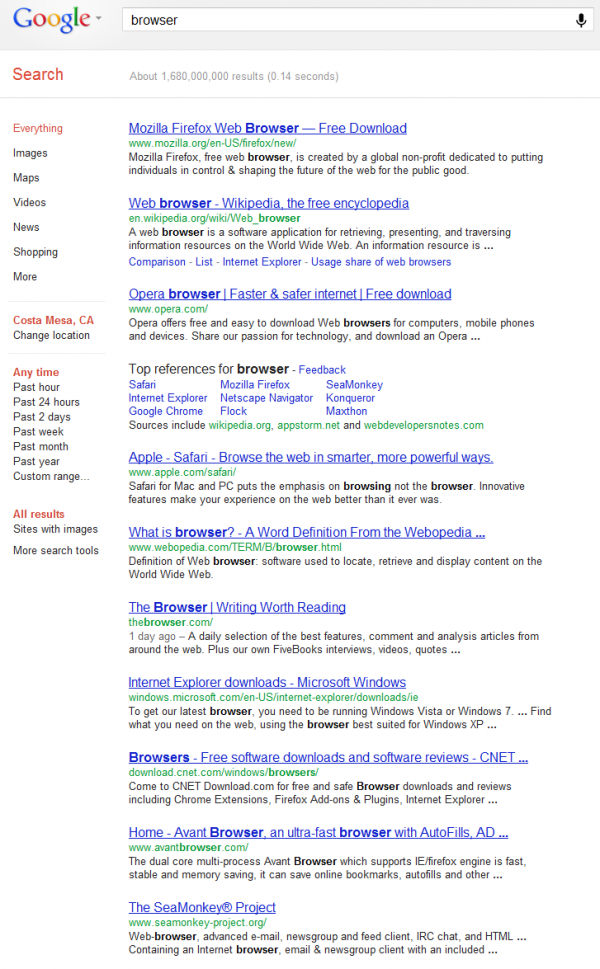
Read all about it in Google’s Chrome Page No Longer Ranks For “Browser” After Sponsored Post Penalty.
Also on this day
2022: “Health causes,” “sexual orientation,” “religious practices and groups,” and “political beliefs, social issues, causes, organizations and figures,” were among the examples of targeting options slated for deprecation.
2020: To enter, advertisers had to complete the Microsoft Advertising Certified Professional (MACP) certification, add a new Microsoft Advertising account, or enroll in the Micorosft Advertising Partner Program.
Get the daily newsletter search marketers rely on.
<input type=”hidden” name=”utmMedium” value=”” />
<input type=”hidden” name=”utmCampaign” value=”” />
<input type=”hidden” name=”utmSource” value=”” />
<input type=”hidden” name=”utmContent” value=”” />
<input type=”hidden” name=”pageLink” value=”” />
<input type=”hidden” name=”ipAddress” value=”” />
2020: Walmart Media Group named four initial advertising partners to support sponsored search campaigns.
2019: Frédéric Dubut, a senior program manager at Microsoft working on Bing Search, said when you create a specific section in your robots.txt file for its Bingbot crawler, you should make sure to list all the default directives in that section.
2018: Google’s parent Alphabet was reportedly considering a sale of reviews publication Zagat. And by March, the deal was done, when The Infatuation bought Zagat.
2014: What people eat at the search engine companies, how they play, who they meet, where they speak, what toys they have, and more.
2013: After 19 months of investigation, political maneuvering, lobbying and intense speculation the FTC has closed its antitrust investigation of Google, which came away largely unscathed from the process.
2013: Bing was changing four of the Deep Links (Bing’s name for what Google calls Sitelinks) under the Google search result and pointing them to completely different domains. See also: Strange Bug In Bing Deep Links Shows Facebook, Craigslist As Part Of Google
2013: The new feature let searchers upload an image of a face and Baidu would then try to return other photos of the same person, with information on the name of the person.
2011: The illustrated guide showed how Google tracked its users and how DuckDuckGo didn’t.
2011: YouTube, and parent Google, became considered TV broadcasters in Italy, according to new rules by the Italian Communications Authority (AGCOM). The rules applied equally to other websites providing video content, provided they also ran advertising.
2011: Android OS achieved a 25.8% market share, putting it within striking distance of Apple’s iOS, while the Chrome browser reached a major milestone, capturing 10% of the market.
2011: A final reminder for search marketers to move their Yahoo Search Marketing account over to Microsoft adCenter.
2011: Once upon a time, Facebook was a private company and made only $2 billion a year in advertising.
2011: A look at how three different Android cousins performed and measured up against the iPhone.
2008: Matt Marlon was arrested for allegedly conning homeowners faced with foreclosure to give the company their homes.
2008: A guide to stealth search start-ups of the time, including Blekko, Powerset, Hakia, Mahalo, Cuill and more.
2008: IAC Search & Media and/or ASK Jeeves advertisers were entitled to a reimbursement for click fraud or other invalid or improper clicks.
2008: It was a location for new publishers to go and get started with AdSense.
2008: The world said goodbye to Yahoo Picks Of The Week & Picks Of The Day after 12 years.
2008: The service sent a text link that opens a mobile page with a map and turn-by-turn directions.
2008: Social search engine ChaCha introduced a new text-based mobile service called “textChaCha” to answer potentially any question from mobile users.
2007: In-car navigation provider Dash and Yahoo Local announced a deal to deliver Yahoo Local content via Dash’s portable “Dash Express” device and system.
2007: Google was looking to hire more people, quicker, and have less standards in terms of SAT score and GPA, but with more focus on how the applicant may fit within the company culture and work ethic.
2007: Google and Earthlink were finally near finalizing an agreement with San Francisco officials to provide free WiFi to the city.
2007: It appeared that Google was testing a feature that allowed AdSense publishers to block ads from showing via a keyword list.
2007: Google, Apple and Napster were all sued by Jonathan T. Taplin’s Intertainer for patent infringement of a 2005 patent that covers commercial distribution of audio and video over the Internet.
2007: Google’s YouTube was hiring six advertising sales representatives, all based in different parts of the U.S.
2007: About 1,000 visitors came from the ad, which generated 70% less page views than the PPC counterpart, 30% less time spent on the site than the PPC counterpart, but the registration rate (his goal) was about the same as the PPC counterpart. Background: Google Newspaper Ads Run Again
2007: When Microsoft paid to advertise its search engine on a competitor.
2007: A robots.txt error was displaying errors based on Google’s cache URL, not publisher URLs.
2007: This fun and cool service let “geeks show they care.”
Best | top | most popular Search Engine Land stories of the year
Early January is a good time to take a final look back at the most popular stories from the past year. Check out what stories earned the most pageviews and social love in prior years:
2022: If your competitors outrank you, there’s probably a good reason for it. At SMX Next, Ashley Segura shared how she uses data analysis to discover those reasons, along with fresh content ideas that can help you close the gap.
Community experts on what successful marketers will do in 2020
Past contributions from Search Engine Land’s Subject Matter Experts (SMEs)
These columns are a snapshot in time and have not been updated since publishing, unless noted. Opinions expressed in these articles are those of the author and not necessarily Search Engine Land.
< January 2 | Search Marketing History | January 4 >
The post This day in search marketing history: January 3 appeared first on Search Engine Land.
Courtesy of Search Engine Land: News & Info About SEO, PPC, SEM, Search Engines & Search Marketing
Monday, January 2nd, 2023
Google’s jaw-dropping sponsored post campaign for Chrome
In 2012, Google – a search engine known for fighting against paid links and “thin” content – seemed to be behind a campaign that generated both on behalf of its Chrome browser.
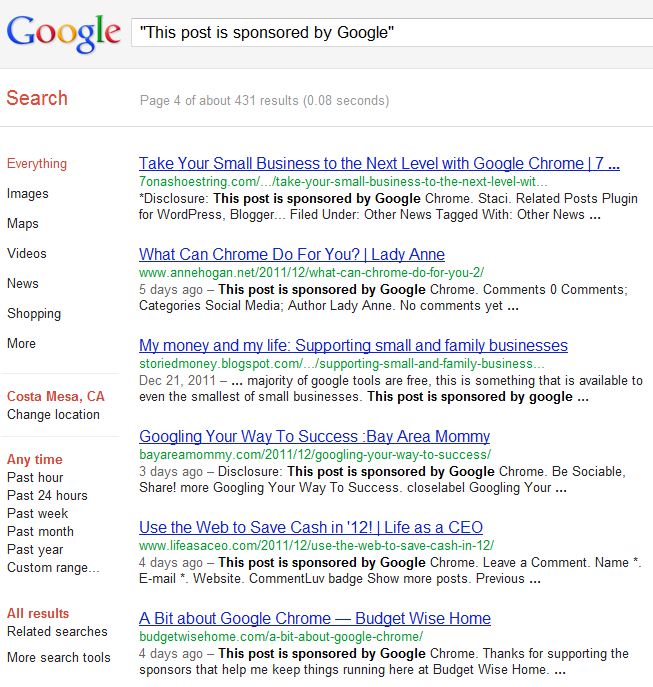
A search for [This post is sponsored by Google] returned more than 400 pages, written apparently as part of a Google marketing campaign:
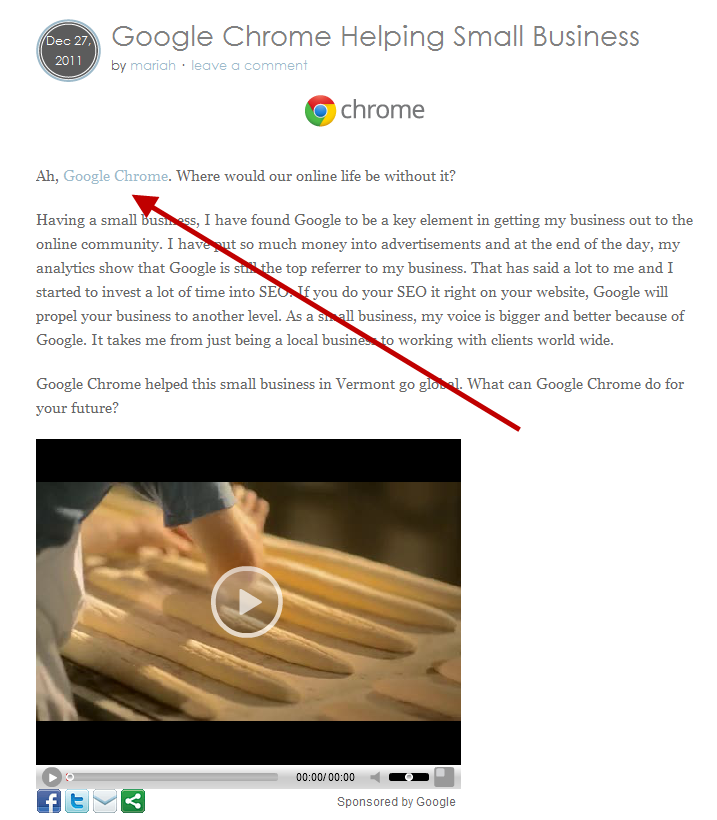
Google? Buying links? It sure looked like it:
It was also hypocritical because Google was paying to produce the same type of garbage that its Panda Update was designed to penalize.
What was Google thinking? This was just the beginning of the story. See Search Engine Land’s follow-up stories:
Also on this day
2020: The IRS revised its Free File agreement with online tax return software providers, requiring them to allow their Free File landing pages to be indexed by search engines and backing out of its pledge not to enter the e-file services marketplace.
2020: Automation, full-funnel campaigns, shoppable ads and privacy-fueled paid search changes in 2019.
2020: Did people click on a paid search ad because it answered a search query, mentioned a familiar brand, was listed above other search results, or had a compelling title, description, or image? Survey says…
2019: The sweepstakes offered incentive for agencies to increase their participation with Bing Ads.
2019: John Mueller, a Google webmaster trends analyst, spent a portion of his New Year’s break responding to concerns and questions around Google search-related issues. Here’s what kept him occupied.
2019: Google was testing a bigger push for the messaging option within the local panel, by using a larger message button.
2019: Google was testing a change in the search results for movie and TV show streaming options, adding more streaming providers and options.
2018: Advertisers didn’t have to do anything special or out of the ordinary to get Google’s algorithms to display their ads. It wouldn’t be until 2021 that Google prohibited advertisers from running ads or monetizing content that contradicted scientific consensus on climate change.
2018: Amazon was reportedly in talks with several large consumer product companies, such as Procter & Gamble, about advertising and sponsorship opportunities through Alexa and voice search. However, Amazon denied the story, saying it had no plans to introduce ads on Alexa.
2018: Similar to the web search quality guidelines, raters evaluated voice responses from Google Assistant for information satisfaction, length, formulation and elocution.
2015: The outage to Yahoo’s dedicated search site lasted more than four hours.
2015: What people eat at the search engine companies, how they play, who they meet, where they speak, what toys they have, and more.
2013: Spoiler alert: Apple didn’t get the crowd-sourced mapping and traffic app. But Google did later in 2013, for $1.3 billion.
2013: Google agreed to change some business practices and settle allegations it misused patents to thwart smartphone competitors.
2012: Why? Because Page “reorganized the company’s management structure, redesigned the face of the company’s products and pushed forward with a multibillion-dollar deal to acquire a cellphone manufacturing outfit.
2012: It was similar to the Google News “Elections” section, but with different filtering options on news content and added data related to this year’s campaigns.
2009: Surprise! Google’s iPhone app had a few extra hidden options in the Settings tab.
2009: An Android OS netbook by 2010? Could it be? Well, actually, it didn’t even take that long, as Acer-produced netbooks were shipped starting in Q3 of 2009. (Dell was also looking at Android for netbook OS.) Oh, what was a netbook? A smaller-than-typical laptop computer (R.I.P, 2007-2013).
2008: Google seemed to be showing a bit too much love to new or very recent pages indexed by Google, ranking those pages extremely well for queries.
2008: A Beijing appeals court upheld a decision that Baidu was not guilty of property rights infringement for displaying links to websites offering illegal music downloads.
2008: The “social search engine” launched its public beta and seemed to be a “feature” rather than a fully developed new local concept.
2007: Matt Cutts called for Google to have more people blogging and monitoring communities interested in their products.
2007: Google Q&A spam was spotted for a search on [how tall is paris]. The results led to an adult site.
2007: An anticipated software release by YouTube to crack down on pirated videos with a “content identification system” software was delayed.
2007: The question was: how many SMBs will sign up directly for paid search and how many must be acquired through a “push” channel (local sales force)? Some were convinced that a sales force is absolutely necessary for Google, Yahoo and Microsoft to acquire any meaningful penetration in the SMB market.
2007: Translating the Googleplex Mountain View office company culture to New York seemed to be working out just fine.
2007: A serious bug was fixed in Google’s Gmail. It allowed websites to retrieve a user’s Gmail contact list through a JavaScript loophole.
2008: Some key stats reveal how Search Engine Land had grown over the past calendar year.
Best | top | most popular Search Engine Land stories of the year
Early January is a good time to take a final look back at the most popular stories from the past year. Check out what stories earned the most pageviews and social love in prior years:
Past contributions from Search Engine Land’s Subject Matter Experts (SMEs)
These columns are a snapshot in time and have not been updated since publishing, unless noted. Opinions expressed in these articles are those of the author and not necessarily Search Engine Land.
< January 1 | Search Marketing History | January 3 >
The post This day in search marketing history: January 2 appeared first on Search Engine Land.
Courtesy of Search Engine Land: News & Info About SEO, PPC, SEM, Search Engines & Search Marketing
Saturday, December 31st, 2022
Happy New Year!
Welcome to the first installment of what will be a daily, ongoing feature here on Search Engine Land in 2023 – This day in search marketing history.
Search Engine Land has been the publication of record for all things search and search marketing since launching in 2006. And the founders of that 2006 team had been reporting on and educating the industry for about a decade prior to that (at Search Engine Watch).
So join us every day, as we rediscover the headlines and history of SEO, PPC and digital marketing from years gone by.
Also on this day
Happy New Year Google Doodles!
On Jan. 1, every year since 2000, Google has consistently given us Doodles, in lieu of any significant news of note to report on. Hey, it is a holiday after all. The editorial team is getting some much-deserved rest (not counting Barry, who is almost always working) and traffic is pretty dismal on New Year’s Day.
It’s been years since we covered Google’s special logos. But once upon a time, Search Engine Land was competing with countless other publishers in the hopes of driving some insanely huge search traffic by covering these celebratory Google Doodles:
2007: A particular bad week for Google resulted in this look back at a number of “tipping points” that Google had survived in prior years, including the infamous Florida Update of 2003.
Best | top | most popular Search Engine Land stories of the year
Jan. 1 can be a good day to take a final look back at the most popular stories from the past year. Check out what stories earned the most pageviews in prior years:
Get the daily newsletter search marketers rely on.
<input type=”hidden” name=”utmMedium” value=”” />
<input type=”hidden” name=”utmCampaign” value=”” />
<input type=”hidden” name=”utmSource” value=”” />
<input type=”hidden” name=”utmContent” value=”” />
<input type=”hidden” name=”pageLink” value=”” />
<input type=”hidden” name=”ipAddress” value=”” />
2009: There were reports that Microsoft was getting ready to lay off 17% of their workforce, on or around Jan. 15.
< Dec. 31 | Search Marketing History | Jan. 2 >
The post This day in search marketing history: January 1 appeared first on Search Engine Land.
Courtesy of Search Engine Land: News & Info About SEO, PPC, SEM, Search Engines & Search Marketing
Friday, December 30th, 2022
Since Search Engine Land launched, we have given SEO experts a platform to share their in-depth knowledge and timely insights – with the goal of helping you solve problems, manage challenges and understand the constantly shifting SEO landscape.
That’s why one of my top priorities this year was to help relaunch the Search Engine Land Subject Matter Expert program, which had been on pause for the most part for the past few years.
Below you’ll find links to the 10 most-read, must-read Search Engine Land SEO columns of 2022 that were contributed by our fantastic group of Subject Matter Experts.
I have to give some recognition to Olaf Kopp, who authored three of the 10 most popular SEO columns of the year. Amazing!
Analyzing the SERPs for these micro intents will help you create the right content that a searcher will want to find. (By Olaf Kopp. Published July 18.)
Google has reframed its definition of YMYL, revamped its definition of low-quality pages and more. Here are the details. (By Lily Ray. Published July 28.)
Gain powerful insights to inform your marketing efforts. Use the following advanced Google search operators and commands to your advantage. (By Jon Clark. Published Oct. 3.)
Is MUM Google’s next step toward becoming a purely semantic search engine? Learn what MUM could mean for the future of SEO. (By Olaf Kopp. Published April 15.)
Want to understand how machine learning impacts search? Learn how Google uses machine learning models and algorithms in search. (By Dave Davies. Published May 2.)
Get the daily newsletter search marketers rely on.
<input type=”hidden” name=”utmMedium” value=”” />
<input type=”hidden” name=”utmCampaign” value=”” />
<input type=”hidden” name=”utmSource” value=”” />
<input type=”hidden” name=”utmContent” value=”” />
<input type=”hidden” name=”pageLink” value=”” />
<input type=”hidden” name=”ipAddress” value=”” />
SEOs may be in for another shakeup similar to Penguin’s launch 10 years ago. Here’s what you need to know about Google’s new update. (By Marie Haynes. Published Aug. 22.)
Want to set up your WordPress site for better traffic and rankings? Make sure you’re following these site settings to improve your SEO. (By John McAlpin. Published Sept. 15.)
See the results of a comparison of four leading SEO tools’ keyword coverage for domains in the pharmaceutical space. (By Tylor Hermanson. Published Sept. 19.)
Learn about some potential signals Google may be using to gauge whether your content and brand have strong E-A-T. (By Olaf Kopp. Published March 18.)
Sometimes the best SEO tools are free. Learn how to use these formulas to save time and reduce manual errors. (By Jackie Chu. Published June 30.)
The post Top 10 SEO expert columns of 2022 on Search Engine Land appeared first on Search Engine Land.
Courtesy of Search Engine Land: News & Info About SEO, PPC, SEM, Search Engines & Search Marketing
Thursday, December 29th, 2022
Since Search Engine Land launched, we have given PPC experts a platform to share their in-depth knowledge and timely insights – with the goal of helping you solve problems, manage challenges and understand the constantly shifting landscape of paid search, paid social and display.
That’s why one of my top priorities this year was to help relaunch the Search Engine Land Subject Matter Expert program, which had been on pause for the past few years.
Below you’ll find links to the 10 most-read, must-read Search Engine Land PPC columns of 2022 that were contributed by our fantastic group of Subject Matter Experts.
Before that, I have to give some special recognition to PPC expert Melissa Mackey, who authored the most viewed column of the year, which published Nov. 9 – 10 things to eliminate from your life to be more productive at work. That article isn’t included on our top 10 list because the insights can apply to anyone really – not just search marketers. Regardless, the article did monster numbers – in large part thanks to Google Discover.
Also, congratulations to Anthony Tedesco for authoring three of the top 10 most-read articles this year on Search Engine Land. Amazing.
Onto the list:
Responsive Search Ads are a huge shift from the ETA format. Learn how RSAs work and get tips on how to get more out of them. (By Mona Elesseily. Published April 14.)
SEO and PPC are often at odds. Yet the things they “bicker over” are actually areas for improved workflow and channel optimization. (By Navah Hopkins. Published June 29.)
Learn the benefits of RSAs, how the transition from ETAs impacts you search strategy and how to write effective RSAs (By Jenny Mallory. Published May 3.)
Google Ads has clarified what identical keywords are. But does this tactic go against what Google has been preaching for years? (By Greg Finn. Published June 29.)
Learn how to use Excel pivot tables to QA bulk sheets, plus some tips and shortcuts to enhance your pivot table skills. (By Anthony Tedesco. Published Nov. 7.)
Get the daily newsletter search marketers rely on.
<input type=”hidden” name=”utmMedium” value=”” />
<input type=”hidden” name=”utmCampaign” value=”” />
<input type=”hidden” name=”utmSource” value=”” />
<input type=”hidden” name=”utmContent” value=”” />
<input type=”hidden” name=”pageLink” value=”” />
<input type=”hidden” name=”ipAddress” value=”” />
Investment in brand keywords is critical because it allows you to directly influence your brand’s presentation on the SERP. (By Anthony Tedesco. Published July 5.)
Getting data and insights from Performance Max can be frustrating. Here are some tips and tricks that will help. (By Menachem Ani. Published Aug. 19.)
Set yourself up for more success. Learn how to take your PPC dashboard from good to great using Google Looker Studio. (By Amy Hebdon. Originally published March 10, updated and republished Oct. 31.)
Maximize your performance with Google Ads Performance Max. Here’s everything you need to know to set up PMax for success. (By Menachem Ani. Published July 22.)
Use these tips to quickly analyze performance data and identify high-impact PPC optimizations that will move the needle. (By Anthony Tedesco. Published Aug. 24.)
The post Top 10 PPC expert columns of 2022 on Search Engine Land appeared first on Search Engine Land.
Courtesy of Search Engine Land: News & Info About SEO, PPC, SEM, Search Engines & Search Marketing