Archive for the ‘seo news’ Category
Sunday, January 8th, 2023
Intent research vs. keyword research
In 2020, Frédéric Dubut of Bing told us: “Keyword research are probably going to become slowly obsolete and you’ll need to switch to intent research as a practice.”
Barry Schwartz asked Google’s John Mueller about Dubut’s statement. Here’s what Mueller said:
- “There’s probably always gonna be a little bit of room for keyword research because you’re kind of providing those words to users. And even if search engines are trying to understand more than just those words, showing specific words to users can make it a little bit easier for them to understand what your pages are about and can sometimes drive a little bit of that conversion process.”
So, is keyword research obsolete yet? In 2023, there definitely has been a significant shift in the way SEOs think about user intent, or the search intent behind a query. But keyword research is still far from obsolete.
Read all about it in Google’s John Mueller on intent research vs keyword research for 2020.
Also on this day
2021: How advertisers responded to the storming of the Capitol and the cases for and against pausing ads in times of disruption.
2020: Search engines continue to get better at understanding intent and rely less on keywords. But Mueller wouldn’t go as far as to say keyword research practices will or should go away anytime soon.
2020: John Mueller said that the Google team goes through reconsideration requests in batches, so sometimes it can feel like there is a backlog.
2020: Page owners could use Bing Pages to aggregate social media links, publish contact details, customize Outlook profiles with images and content and promote social media posts.
2020: In this installment of Barry Schwartz’s vlog series, he chatted with Dean about making good quality videos, the nofollow link attribute change and more.
2019: if you have hundreds or thousands of pages, removing URLs one by one can be time-consuming. What tocan you do? Use temporary sitemaps, according to John Mueller.
2019: Google was working hard to make the Assistant (and by extension, Home) a transactional platform.
2019: Lily Ray on changes to how sites are evaluated, dealing with traffic drops due to algorithm changes, Google’s search quality rater guidelines and more.
2018: Verified users in Google Search Console were about to get access the new Search Performance, Index Coverage, AMP status and Job posting reports.
2018: An investigation revealed an ongoing issue with middlemen bidding on the terms and receiving large kickbacks from the private centers where the searchers were ultimately referred to – a practice called “patient brokering.”
2018: Google called it an “unintentional technical issue.”
2018: Google and Amazon both announced new device partnerships; the Google Assistant would be on new “smart display” devices, more TVs, speakers and in cars.
2018: Google said it was making a change to stop displaying Google URLs, instead of the publisher URLs, in search results served from the AMP cache.
2016: The latest images culled from the web, showing what people eat at the search engine companies, how they play, who they meet, where they speak, what toys they have and more.
2015: Some users were missing their Google Now cards, which they rely on to see if there will be traffic on the way to work, how cold it may be or other useful information for their day.
2015: Google moved the Reach and Frequency report out of the Dimensions tab to the Campaigns tab.
2015: Microsoft’s search engine started displaying a carousel of New York Times best-selling books when searching for specific book genres.
2015: Google France added the “Je Suis Charlie” (“I am Charlie”) badge on its homepage, honoring the lives lost during the Charlie Hebdo massacre in Paris, France.
2014: CEO Marissa Mayer introduced the new news app at CES. Summly was acquired by Yahoo in March 2013 for an estimated $30 million.
2014: Ad network Chitika released a new tool that provided a user percentage or traffic market-share breakdown of PC operating system and search usage on a state-by-state basis.
2014: In How should I address a small duplicate content issue?, Cutts said to use the rel=canonical tag to help consolidate the PageRank of the stories and avoid any issues with Google.
2014: IgnitionOne released its fourth quarter Digital Marketing Report, showing that the paid search market in the US continued to grow.
2013: The URL shown under the definition previously wasn’t clickable. Instead, the only way to click through to the source of the definition was to use the smaller Source link at the bottom of the box.
2013: “As Product Marketing Manager within the search growth team, you will be responsible to developing plans, creatives, campaigns and programs to increase the number of user’s signed in.”
2013: How much does Google figure into the “future of search,” whose advances will largely be determined by mobile and non-traditional devices? That was a hard question to answer.
2012: Danny Sullivan called 2011 “alarming.” Why? Because after years of moving forward, the search engines took a big step back, withholding both linking and keyword data.
2011: A huge collection of trends, predictions and resolutions on paid search, SEO, local/mobile and more.
2010: Several articles speculated about or discussed ads on Google Maps (PC and mobile).
2010: Some of the results would be powered by Yahoo, while the search results in BOSS (Build your Own Search Service – a Yahoo Developer Network initiative to provide an open search web services platform) would be powered from Microsoft Bing.
2010: Said Yahoo CEO Carol Bartz: “It was a little tougher internally than I think I had anticipated, I did move fast, but this is a big job.”
2010: Associated Press stories – hosted by Google itself — were no longer appearing in Google News. Google had not added any new AP content since Dec. 24.
2010: The company’s experimental news reading tool became part of the Google News home page, while also still remaining a Google Labs project.
2009: An annual tradition, Matt Cutts of Google’s Search Quality team asked for feedback on things Google should work on in relation to search spam.
2009: 25% of Rimm-Kaufman’s clients increased their PPC spend 2008 Q4 vs. 2007, while 75% pulled back PPC spend.
2009: Timeframe gave advertisers a new budgeting method that automatically adjusted the daily budget based on traffic to reach a set dollar budget as per the calendar month.
2009: “Sorry, ‘[search term]’ did not return any results”.
2009: Police tracked the girl’s cell phone with GPS and then confirmed her whereabouts in Virginia, using StreetView.
2008: Microsoft got a market-leading enterprise search company and a world-class web crawler (not to mention some of the smartest engineering talent in search).
2008: Matsushita Electric Industrial, the company behind Panasonic, said the TVs would enable users to browse and watch YouTube videos from their TVs.
2008: Search appeared to be a piece of the overall approach but not the core here; community and trusted content sources are emphasized.
2008: Sony announced a deal to provide Google’s YouTube five-minute clips of some of their most popular TV shows, including “Married With Children” and “Newsradio.”
2007: That time when Matt Cutts’s Wikipedia’s page almost got deleted.
2007: A U.S. District Court ruled that the use of keyword-triggered ads and keyword metatags using trademarked terms cannot confuse consumers if the resulting ads/search results don’t display a competitor’s trademarks.
2007: Search marketer Jeffrey Rohrs published an open letter to paid search providers asking critical questions about billing practices, transparency, click fraud and other issues
2007: While second to Google in Web search, the company was hoping it could lead the market for mobile search and associated advertising with a new offering tailored for use on handsets.
2007: ChaCha employed a network of live guides to help answer user queries in real time in addition to providing traditional algorithmic search.
2007: Why were advertisers cutting their PPC ad spend significantly in 2007? Because many of the keyword prices have resulted in advertisers being priced out of profitability.
From Search Marketing Expo (SMX)
Past contributions from Search Engine Land’s Subject Matter Experts (SMEs)
These columns are a snapshot in time and have not been updated since publishing, unless noted. Opinions expressed in these articles are those of the author and not necessarily Search Engine Land.
< January 7 | Search Marketing History | January 9 >
The post This day in search marketing history: January 8 appeared first on Search Engine Land.
Courtesy of Search Engine Land: News & Info About SEO, PPC, SEM, Search Engines & Search Marketing
Friday, January 6th, 2023
2022 marked the first year since 2014 that Google and Meta’s advertising market share dropped below 50%, standing at 48.4%. By the end of 2023, that number is expected to drop to 44.9%.
What’s going on. Amazon, ByteDance’s TikTok and streaming services like Netflix are continuing to increase their foothold. People are spending less time online on sites like Google and Meta, so it’s no surprise that they’re facing hurdles, despite still growing (albeit slower than other digital ad platforms).
Meta and other platforms also suffered from Apple’s iOS14 update in 2021, which required apps on its devices to ask users if they wanted to be tracked. The majority of iPhone users opted not to be. Google was not affected by this update, as it relies on customer intent, revealed by a user’s search terms.
The TikTok effect. Marketers want more options, and TikTok is it. TikTok’s hold on the digital ad market more than doubled in 2022, while Amazon gained market share due to its ad business being able to target users by their purchases and browsing history.
The Washington Post reported that “Supergut Chief Executive Marc Washington said the maker of gut-health products used to spend about 80% of its ad budget on Meta’s Facebook and Instagram platforms, with the rest going to Google. In early 2022, he noticed that the cost of bringing in new customers through advertising on Meta’s platforms was twice as high as it was before Apple’s privacy changes. Supergut shifted about half of what it spent on Meta to TikTok, a short-form video platform popular with younger audiences.”
Insider Intelligence said that TikTok’s command of the digital ad market more than doubled in 2022 and has nearly 100 million U.S. monthly active users. However, its overall share remained small, at just 2% of U.S. digital ad spending.
Amazon continues to grow. Amazon accounted for 11.7% of U.S. digital-ad spending last year and is poised to grow to 12.4% in 2023, Insider said.
“Our advertising is at the point where consumers are ready to spend,” Amazon Chief Financial Officer Brian Olsavsky said on the company’s October conference call.
Other retailers have followed in Amazon’s footsteps by building digital-ad businesses based on their consumer data, known as retail media networks. Combined, Walmart Inc., eBay Inc., Etsy Inc. and Instacart took in about 1.4% of digital-ad dollars spent in the U.S. last year, according to Insider.
Microsoft & Netflix. We can’t talk about Netflix without talking about Microsoft. Last year they announced a partnership to bring an ad-supported subscription plan to Netflix. Vincent Létang, executive vice president of global market research at Magna, a media- investment firm that is part of Interpublic Group of Cos.‘ Mediabrands, called Netflix and Disney’s entry into the market “a game-changing moment” for ad-supported streaming. “They bring a potentially huge number of viewers,” he said, and a wealth of premium video content.
Why we care. Advertisers should be aware of emerging platforms, just as they should be aware of those experiencing a decline. Though most tend to predict these types of trends long before the numbers get published. But reports like this help solidify what many advertisers already know; diversification is key.
The post Google and Meta are losing their edge as TikTok, Amazon, Instacart ads grow appeared first on Search Engine Land.
Courtesy of Search Engine Land: News & Info About SEO, PPC, SEM, Search Engines & Search Marketing
Friday, January 6th, 2023
Google said the two different Google search algorithm updates – the December 2022 helpful content system and the December 2022 link spam update – may take another week or two to complete their rollout.
The helpful content update started Dec. 5, and the link spam update started on Dec. 14.
The algorithm update rollouts were supposed to be completed within two weeks, but clearly that has not happened.
Google’s new statement. Danny Sullivan, Google’s Search Liaison, said on Twitter that these two updates will complete “likely within two weeks, maybe only one” week but he added that it is “not a guarantee” and “timings might change.”
Why the delay? The rollouts are taking longer because of the holidays. Sullivan said earlier on Mastodon, “Both the updates are continuing to rollout. Normally these types of updates would have concluded by now, but rollouts can slow or pause when we get into the holiday periods.”
Why we care. As I said above, both updates are still rolling out at the time this was published. It is very hard to accurately say that one ranking change in aggregate is related to a specific ranking update when both are rolling out at the same time. That being said, it is likely easier to look at individual sites and know if the site was hit by a link algorithm versus a helpful content algorithm, especially if you look at the links and content for that site.
We have some early data on the impact of some of these updates, but this long rollout has made it really hard to measure accurately.
So you will need to do the due diligence and dig into sites impacted by each update on an individual basis. This just shows you that it appears that these updates did show movement and did cause ranking volatility in aggregate.
The post Google’s December 2022 helpful content and link spam updates still rolling out appeared first on Search Engine Land.
Courtesy of Search Engine Land: News & Info About SEO, PPC, SEM, Search Engines & Search Marketing
Friday, January 6th, 2023
Google Webmaster Tools adds ‘unnatural links’ and ‘cloaking’ spam warnings
In 2011, Google Webmaster Tools started sending out two new types of warnings – for “unnatural links” and “cloaking.”
The messages were sent out when Google detected pages on websites that were using techniques that were outside of its quality guidelines.
At the time, Google had been talking about wanting to increase its outreach to webmasters. See this video (published Dec. 18, 2010), in which Google’s Matt Cutts (featuring Danny Sullivan) mentioned that Google wanted to make communication a priority in 2011.
Read all about it in Google Adding New Spam Warnings In Webmaster Tools.
Dig deeper: Google penalties, manual actions and notifications: A complete guide
Also on this day
2022: The Shops section showed three to 10 retailers based on their organic search rankings.
2022: Search marketers entering exact match keywords may have seen an alert toward the bottom of their Google Ads interface stating, “Broad match keywords are on. Keywords will be saved as broad match.”
2021: Lyden acted both as editor-in-chief of Search Engine Land and content lead for our SMX events series. She departed Third Door Media in November 2021.
2020: Microsoft Advertising, which originally said standard text ads would no longer serve after 2019, announced it would allow existing standard text ads to continue to serve until March 31.
2020: In this installment of Barry Schwartz’s vlog series, he chatted with Ghergich about how to scale your SEO agency, understanding human intent and more.
2017: Google said, starting Jan. 19, it “may” show the local retail phone number when that store’s location extension showed in an ad – even if a call extension in the campaign used a different phone number – in order to increase the relevance of ads that featured specific business locations.
2016: William Stanley extorted individuals and companies by threatening to engage in illegitimate SEO work: posting “fraudulent comments and creating negative reviews online, if the victim did not pay him a certain sum of money.”
2016: Google announced they had finally upgraded the App Indexing Crawl Errors report, which had not been working for months, in the Google Search Console.
2016: Claiming to be enforcing Germany’s “Ancillary Copyright” Law, the publishers were suing to get Google to pay them for showing their content in search results.
2015: Bing Ads told advertisers they soon would no longer be able to put a phone number in the headline, body copy, URL or extensions like Sitelinks. As with AdWords, advertisers would need to use location or call extensions for phone numbers.
2014: Pinterest said the acquisition would “help us build technology to better understand what people are Pinning. By doing so, we hope to make it easier for people to find the things they love.”
2014: The site served as an online resource for “all things awards” with background information on nominees, tips for award-themed parties, and winner predictions based on Bing search statistics.
2012: Bing Maps pushed out a major update to their driving directions “routing engine.” The new routing engine was twice as fast as the old one and added more features, such as adding up to three routes in one request.
2012: The latest images culled from the web, showing what people eat at the search engine companies, how they play, who they meet, where they speak, what toys they have, and more.
2011: Google’s AdMob unit reported that it saw more than 2 billion ad requests on a daily basis. Meanwhile, comScore reported that Android passed the iPhone as the number two smartphone platform in the U.S.
2011: The country’s national police agency had determined that Google acted illegally when it gathered personal data as part of its Street View mapping service.
2011: Among its tech and consumer electronics clients in the Americas, paid search spending only rose 1% in the fourth quarter of 2010, as compared to the third quarter, but that’s because growth from the second to the third quarter was 30%.
2011: Twitter started 2011 with a new record: 6,939 tweets were sent at four seconds after midnight in Japan.
2011: Foursquare started limiting the number of friends and friend requests that a user can have.
2010: Contact form extensions provided a contact form directly in the search ad, which a searcher can fill out and the advertiser can then use in the future to contact that lead.
2010: Google was ordered to remove the word arnaque, which translates roughly as “scam,” from appearing as a Google Suggest term on searches for the Centre National Privé de Formation a Distance (CNFDI).
2010: The promotion was found under the search box and read: “Experience Nexus One, the new Android phone from Google.”
2010: Less than 24 hours after the formal unveiling of the Nexus One by Google, we had a collection of differing perceptions and accounts of what was significant (or not).
2009: Google added claims to its Google Checkout Merchant homepage that having Google Checkout as part of your AdWords ads would lead to higher conversions and a better click-through rate.
2009: As it turned out, Google wasn’t doing anything new. On the Google WAP search experience the company had always placed ads at the end of organic text results but before other types of content.
2009: Yahoo emailed their search advertisers about new terms and conditions, including a controversial provision that they are allowed to create ads, remove or add keywords to campaigns and “optimize” accounts.
2009: Picasa was a management system for photo sharing and editing.
2009: The Beijing Haidian District Court ruled that Beijing Guge Science and Technology had to pay Google China 100,000 yuan ($14,624). In addition, Beijing Guge is required to stop using the name.
2009: It was suggested that the art represented an airplane crashing into New York’s former World Trade Center towers on 9/11.
2009: Articles and blog posts filled with forecasts, predictions, and/or resolutions for the new year.
2008: The Mahalo Follow toolbar let you post links to Delicious, Ma.gnolia, Mahalo Social, and Twitter with the click of one button. The sidebar displayed quick tips when you were on sites like Twitter and Gmail.
From Search Marketing Expo (SMX)
Past contributions from Search Engine Land’s Subject Matter Experts (SMEs)
These columns are a snapshot in time and have not been updated since publishing, unless noted. Opinions expressed in these articles are those of the author and not necessarily Search Engine Land.
< January 5 | Search Marketing History | January 7 >
The post This day in search marketing history: January 6 appeared first on Search Engine Land.
Courtesy of Search Engine Land: News & Info About SEO, PPC, SEM, Search Engines & Search Marketing
Friday, January 6th, 2023
We’ve all heard about search engine optimization (SEO), but what about search engine de-optimization?
In one Search Off The Record episode, Martin Splitt, Gary Illyes, and Lizzi Sassman discussed de-optimization – the process of taking a page off SERPs. The goal of deoptimization is ranking the page that is most likely to attract qualified traffic and conversions.
If you’ve ever ranked the “wrong” page for a keyword, this article is for you. Get ready to learn the de-optimization process so you can earn clicks from qualified traffic and increase conversions.
How can you tell if the wrong page is ranking?
The purpose of deoptimization is to remove a page driving the wrong type of traffic to your site. Sometimes you might benefit from removing a page from SERPs entirely. Other times, you might want to replace the page that ranks with a more suitable page.
In the de-SEOing episode, Sassman shares an anecdote where site visitors landing on a particular document, listed on Page 1, were not the right types of traffic.
Sassman said this became clear from feedback coming from users visiting their page. The ranking page caused some misunderstandings. Web users started to submit requests for tasks that were not relevant. As a result, users weren’t satisfied and internal teams were busier handling irrelevant support tickets they could not solve.
The page was generating traffic, but it was the wrong type of traffic. There was a mismatch between what the user was looking for and the page they were landing on.
Ranking the wrong page in SERPs is not unusual. Recognize when you’re ranking the wrong page by looking out for:
- Pages that earn traffic but not conversions.
- Queries from users that don’t make sense for the business offering.
- Pages that were commissioned to achieve a certain goal but are falling short of expectations.
- Articles ranking for conversion keywords that would be better placed on a revenue-generating page (product page, product category, or landing page).
Get the daily newsletter search marketers rely on.
<input type=”hidden” name=”utmMedium” value=”” />
<input type=”hidden” name=”utmCampaign” value=”” />
<input type=”hidden” name=”utmSource” value=”” />
<input type=”hidden” name=”utmContent” value=”” />
<input type=”hidden” name=”pageLink” value=”” />
<input type=”hidden” name=”ipAddress” value=”” />
Which page should you rank anyway?
Before attempting to rank any page in Google’s SERPs, it’s important to understand the search intent behind a keyword. Only then can you decide if the keyword is suitable for you to try and rank for and the type of page you should be creating.
You help determine which page should rank for a keyword by understanding how Google prioritizes pages based on its search intent.
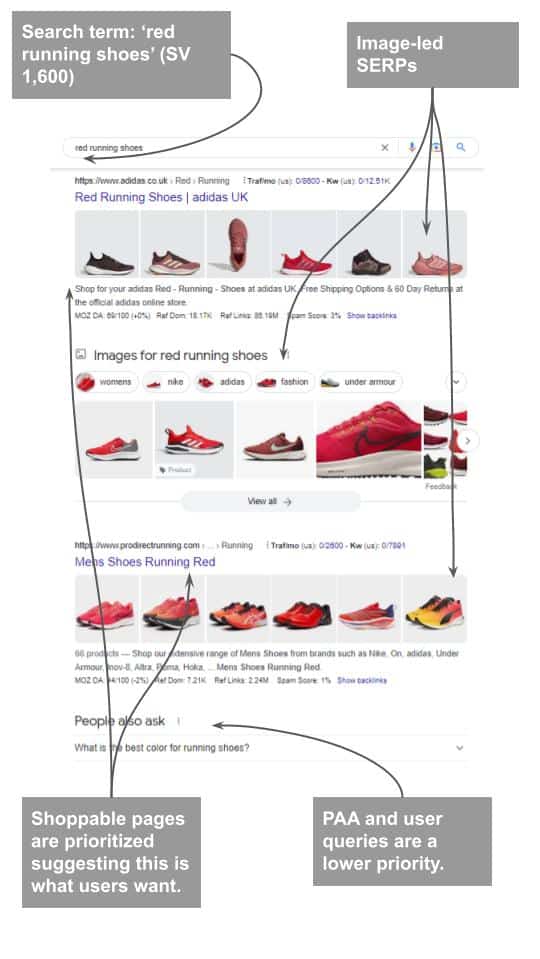
Take a look at the annotated SERP example below. A search for “red running shoes” returns ecommerce category pages and image packs. The SERP suggests that the user is looking to buy red running shoes or view images of them. It’s a product-led SERP.
If ranking for red running shoes is your goal, then you should, at minimum, be able to match the intent in the SERPs by providing page users can buy red running shoes and include images.
Based on SERP analysis, you would not expect an article titled “the best red running shoes” to have a good chance of ranking for the search term ‘red running shoes’ because Google is not prioritizing articles in the SERP. Equally, if an article did rank, you would not expect this type of page to satisfy user intent for this particular search.
If you do have a page ranking that is earning traffic but failing to convert, you might want to consider deoptimization.
Below, we cover how to deoptimize a page in favor of a more suitable one.
Deoptimization explained
So you’ve got a page ranking that isn’t converting and you have another page on your site that would be better placed to rank for the target keyword.
How can you deoptimize a page while removing it from SERPs for the desired keyword and putting another page in place?
At this point, it’s important to note that you are at risk of losing your rank – and the traffic that comes with it – altogether. But the goal of SEO is not just to earn traffic but to earn qualified traffic that supports business goals.
If all you are losing is clicks and impressions you are not really losing anything.
Here’s a step-by-step guide to search engine deoptimization.
Step 1: Choose your desired ranking page
Before you do anything, you need to decide which page will rank for your desired keyword and why.
Start by conducting SERP analysis. Based on the prioritized results, decide which page on your site fits among what’s already ranking.
If the SERPs are full of articles, you likely need to write an article that satisfies user intent. If the SERPs prioritize ecommerce pages then you need to have the product to sell.
Step 2: Assign keywords to pages
For the best chance of ranking any page, you need to be the most useful page on the web.
Make sure you cover a topic in full. Look at what’s ranking and which keywords return the same type of content. You can use this data to inspire sections of content on your page.
You can find related keywords that you should cover by taking a look at what competitor sites are including in their article and ranking for.
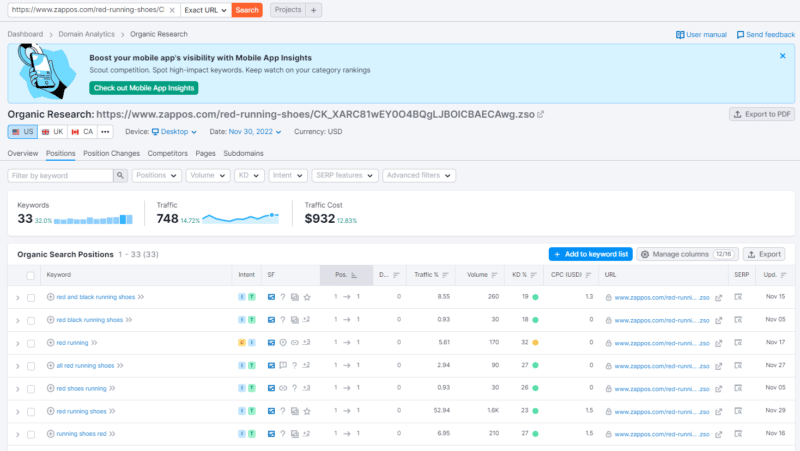
The Organic Research report in Semrush can be a useful starting point to find related keywords.
Make sure you’re using the keywords correctly and in the right places.
The keyword you want to rank the desired page for should be used naturally throughout the article. Go back to SEO basics and check it’s used in the title tag and the URL if it makes sense to do so.
Step 3: Evaluate ranking content vs. your desired content
Compare the page you want to rank to pages that are currently ranking.
What elements do competitors include that your page does not? Make sure your page is ultimately useful and competitive. If ranking pages use high-quality images, you should also use them. If competitive pages include video, add a video to your page.
Aim to do everything competitors do, but don’t focus so hard on competitors that you forget your users and customers.
What more can you add that is genuinely useful to your users? Find out by:
- Speaking with your marketing and sales team.
- Discovering questions customers ask so that you can answer them on your page.
- Digging into reasons for refunds or returns. (Can you be proactive and address issues on the page to save a user from making the wrong purchase or help manage expectations?)
Step 3: Remove keywords from the deoptimized page
One reason for the wrong page ranking can be keyword usage.
Take a look at the page that you don’t want to rank and, where possible, remove keywords that might aid the rank. If you’re using the keyword in your title tag, for example, exchange it for a better keyword that suits this page so your other page can take the rank for the desired keyword.
Naturally, you don’t want to remove all keywords, especially if they’re contextually useful. Instead, remove keywords where you can and work on your internal linking strategy for those that need to stay.
Step 4: Strengthen internal linking
Internal linking is one of the most powerful tools for helping content rank.
Audit the internal links pointing to the ranking page and internal links pointing to the page you want to rank.
You should:
- Have links pointing to the desired page using one of the keywords you want it to rank for as the anchor – be natural about this.
- Link the current ranking page to the desired ranking page using the keyword. On this page, use an exact match as the anchor if you can achieve this naturally.
- Replace links to the current ranking page with links to the desired page as long as it is still contextually relevant.
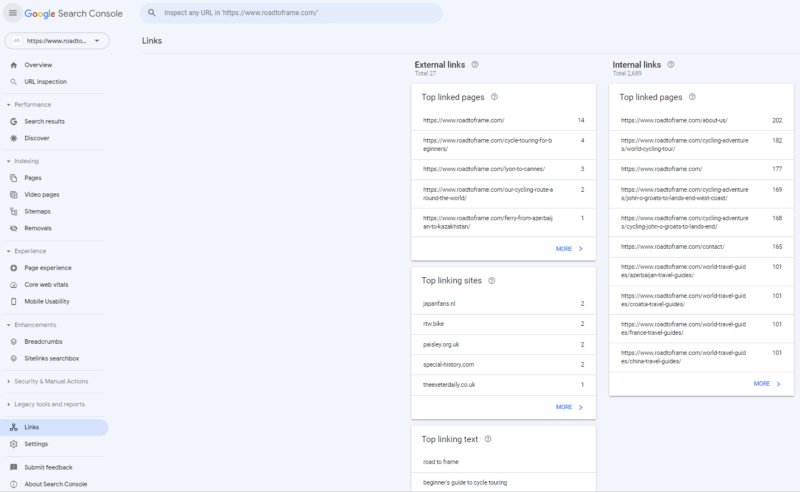
You can use tools like Screaming Frog to audit your internal linking structure or you can do it for free in Google Search Console (GSC). Head to the links report for an overview of your links, including external, internal, top-linked pages and anchor texts. Click on the pages you want to view links to and GSC will give you a list of pages linking to your page.
Finally, build links to the page you want to rank by building your content architecture.
For example, if you’re trying to rank your category page for the search term “red running shoes,” take a look at People Also Ask and see the types of content you can create and link to the category. This builds your authority on the subject and points links to the collection you most want to rank.
Step 5: Submit pages to Google Search Console
Once you’ve completed all of the above, submit your edited pages to GSC and wait for Google to do its thing. You might need to wait a couple of weeks or longer before seeing your edits take effect.
Further considerations to rank your desired page
If you completed all of the steps above, but your desired page still isn’t ranking, here are further steps that you can take.
Check the backlink profile
In a competitive space, you might need to think about increasing your backlink profile. Use SEO tools like Majestic or Ahrefs to see how your backlinks compare to competitors. Aim to close the gap by earning highly relevant backlinks from trusted sites in your niche.
Where natural, you can link directly to the page you want to rank, but if this won’t work, you can link to supporting pages within the content cluster.
Check engagement metrics
Engagement metrics (i.e., conversions, scroll, time on page, etc.) can help you determine whether our page is really helpful to your users.
If your ranking page is long-form content and users scroll to only 25% of the page before they leave, it’s probably not compelling enough to keep the user engaged. Consider a rewrite.
Consider page speed optimizations
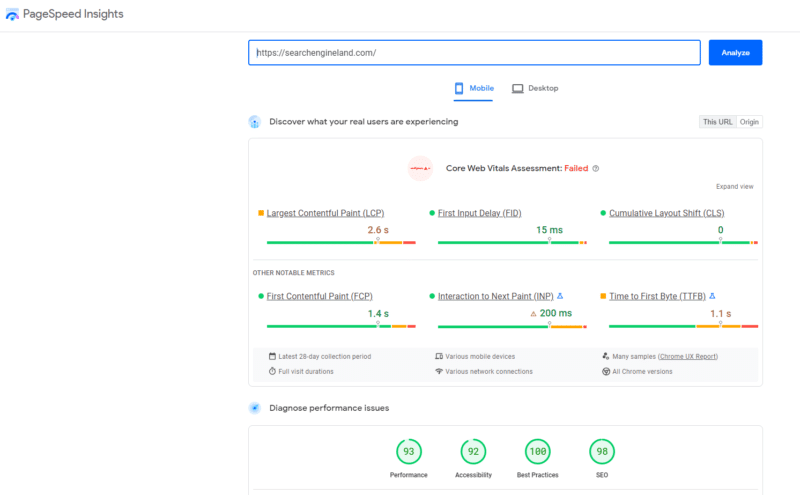
Page speed has become increasingly important and it’s important to stay competitive where you can. In very competitive spaces, page speed could be the difference between your site outranking a competitor.
Google PageSpeed Insights provides all the data about page speed and how to improve it.
301 redirects
If you want to remove your original ranking page in the deoptimization process you must remember to add a 301 redirect.
In some cases, such as in the case of keyword cannibalization, you might want to take a page down to help another rank.
Add 301 redirects, and to be ultimately diligent, go through the links pointing to the old page and edit them so they point directly at the desired ranking page.
Deoptimizing for search
Taking the leap into deoptimization can feel a little scary, especially if you risk losing a lot of traffic.
The thing to remember is that clicks and impressions are meaningless if they’re from the wrong audience or fail to result in conversions.
The post What to do when the wrong page ranks for a keyword appeared first on Search Engine Land.
Courtesy of Search Engine Land: News & Info About SEO, PPC, SEM, Search Engines & Search Marketing
Thursday, January 5th, 2023

When analyzing consumer behavior at scale, decision-makers need to keep up – making consumer insights matter more now than ever. This means staying on your toes with actionable consumer intelligence from continuous social listening is a must.
Join this live webinar and learn how Purdue University’s Center for Food Demand Analysis and Sustainability created a visualization of online and social datasets to help people throughout the food system. You’ll also gain insights into how online data is used to understand human behaviors and industry trends.
Register today for “Analyze Social Media & Consumer Behavior for the Greater Good,” presented by NetBase Quid.
Click here to view more Search Engine Land webinars.
The post Webinar: How to make the most out of consumer and social media data appeared first on Search Engine Land.
Courtesy of Search Engine Land: News & Info About SEO, PPC, SEM, Search Engines & Search Marketing
Thursday, January 5th, 2023
Consumers in a 12-year-long class action lawsuit against Google say that Google shared their queries with third parties without their permission.
What happened. The lawsuit alleged that Google violated both the Stored Communications Act, a federal law that governs access to records held by internet service providers, and state laws in California.
The settlement. Details of the settlement can be found here. In addition to the $23 million payout, which still needs court approval, it also requires Google to provide added disclosures to consumers about the sharing of search terms.
Dig deeper. Read the full announcement from Bloomberg.
Why we care. We’re not sure how or if this will affect advertisers in the future. But privacy issues are still a hot topic as we move into 2023.
The post Google agrees to pay up in 12 year class-action lawsuit appeared first on Search Engine Land.
Courtesy of Search Engine Land: News & Info About SEO, PPC, SEM, Search Engines & Search Marketing
Wednesday, January 4th, 2023
Meta has been fined 390 million euros ($414 million) after European Union (EU) regulators found it had illegally forced users to accept personalized ads.
What happened. According to the New York Times, Meta includes language in its terms of service agreement, the very lengthy statement that users must accept before accessing services like Facebook, Instagram and WhatsApp, which effectively means users must allow their data to be used for personalized ads or stop using Meta’s social media services altogether. Since you need to agree to the terms before using the service, users have no choice but to allow to have their data used for ads.
What happens now. Meta has three months to outline how it will comply with the ruling. The decision does not specify what the company must do, but it could result in Meta allowing users to choose whether they want their data used for such targeted promotions.
Having a large number of users opt-out of sharing their data would put Meta’s ad revenue at risk, since the judgment puts 5-7% of it at stake.
There are no such regulations in the US.
Why we care. EU advertisers could be affected, but any changes that Meta makes as a result of the ruling could affect users in the United States; many tech companies apply E.U. rules globally because that is easier to put in effect than limiting them to Europe.
Meta advertisers should be on the lookout, regardless, for any updates and changes to their targeting.
The post EU rules that Meta’s ad practices are illegal appeared first on Search Engine Land.
Courtesy of Search Engine Land: News & Info About SEO, PPC, SEM, Search Engines & Search Marketing
Wednesday, January 4th, 2023
Don’t lie.
Show of hands.
How many times have you uttered the following in the last year alone?
- “I can’t find any good writers.”
- “No one can create content as well as me.”
- “Content marketing / SEO doesn’t work in our niche.”
- “That agency just doesn’t understand our unique POV.”
- “I can’t publish more than X articles/mo without quality dropping.”
Probably all of them at one point. Amiright?
No fingers pointed. I’ve used them all, too.
But here’s the thing you need to recognize about these oft-repeated clichés:
They’re excuses. All of them.
Excuses and lies we tell ourselves to simultaneously:
- Puff up our ego.
- Avoid doing the hard work of learning how to systemize and build processes and delegate effectively.
Here’s why you’re your own worst enemy when it comes to scaling content creation and SEO, and how to solve it so you get back on track ASAP.
You are your own worst SEO enemy – here’s why (and how to fix it)
The truth hurts sometimes.
And when it comes to content operations, the faster you recognize that you’re the problem, the quicker you’ll get to crushing your next revenue target.
Companies often fail to scale because they lack content operational systems that underpin the creativity layered on top.
Instead, too many teams still operate under this false assumption that they’ll luck out and the perfect unicorn writer or marketer or [insert rockstar role here] will fall into their laps, solving all of their problems in one fell swoop.
You know, the ones that just get “it.”
Without ever bothering to figure out what “it” is, or how to document “it,” or how to specifically recruit and train for “it” so that “it” happens like clockwork, 24/7, 365.
Diagnosing this problem is difficult unless you’ve seen it happen before. So here are the clues to look for:
- You routinely hit self-imposed “glass ceilings.” Quality drops like a rock every time you push quantity or volume up.
- Your editors are rewriting everything your writers deliver because it “doesn’t sound right” or “isn’t as good” as they can make it.
- You have constant issues finding new writers because it takes too long for your most expensive and senior people to review writers. So, instead of hiring only the top 1% of candidates, you’re stuck hiring the top 10% and having to weed through the 9% of junk left over).
- Your team members give contradicting feedback to new hires because each would describe subjective elements like voice and tone in completely different ways.
- Your editors spend multiple hours editing one piece because they have to correct basic image formatting or update primary sources, which means their weekly output is only a tiny fraction of what it could or should be.
Does any of this sound familiar yet?
It should.
And the biggest problem is that these surface-level issues sabotage your SEO success by killing output, slaughtering velocity, and maiming morale.
But don’t stress.
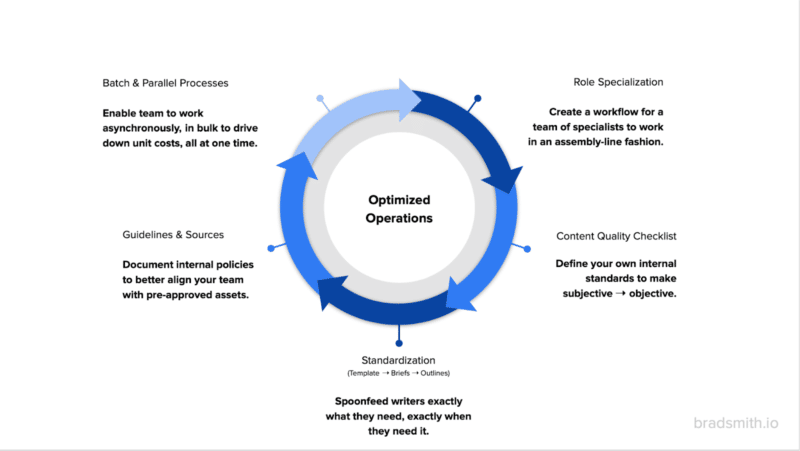
After seeing these issues routinely play out over the last decade (and making the same mistakes ourselves countless times), we’ve been able to come up with a helpful framework to optimize operations.
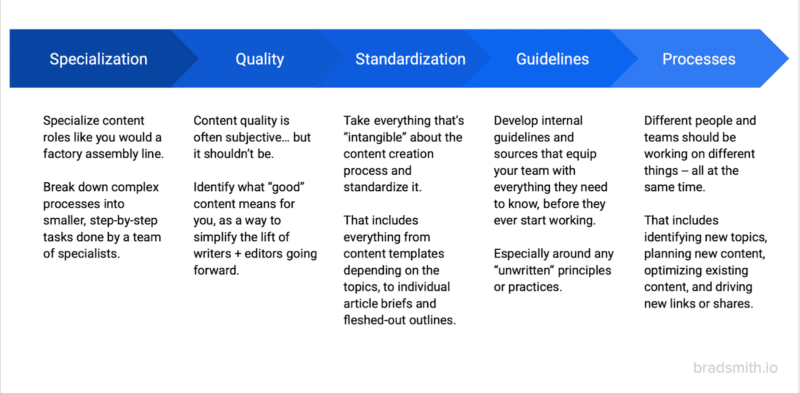
Here’s an overview graphic, and then we’ll dig into each section in detail.
1. Role specialization
The best writers make bad editors and terrible content managers.
Why?
Because the best writers thrive on ingenuity, saying the same thing multiple times in multiple ways.
Editors should be the opposite, in constant pursuit of consistency and uniformity.
Meanwhile, managers are the glue that keeps the other two’s big-picture goals and day-to-day actions aligned.
In other words, completely different skill sets that too many teams try to force into one individual.
It’s the Michael Scott problem. Great paper salesman. Funny television character. Awful regional manager.
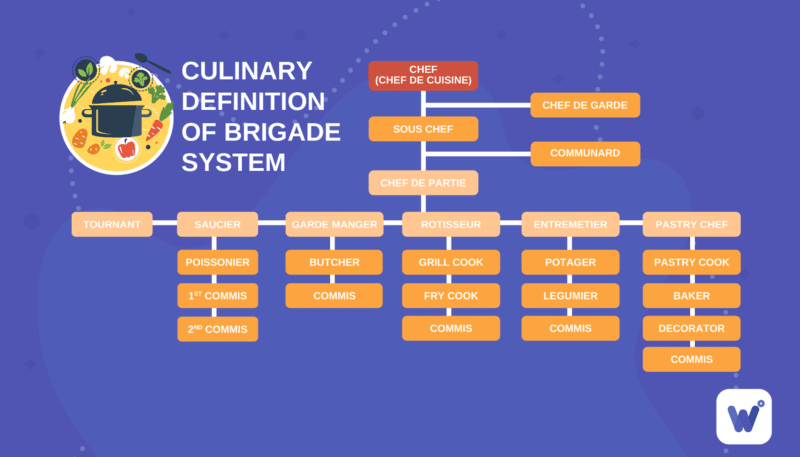
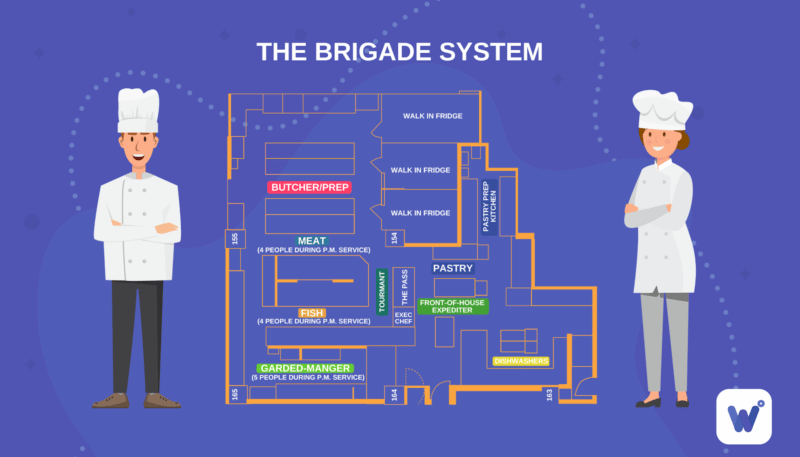
Roll back a few centuries, and the solution comes from the unlikeliest of places: the military.
The brigade management system even influenced the organization of professional kitchens.
It provides the flexibility and coordination to create hundreds of items, all in sync, within minutes of each other, so that all of your table’s food comes out simultaneously with different preparations.
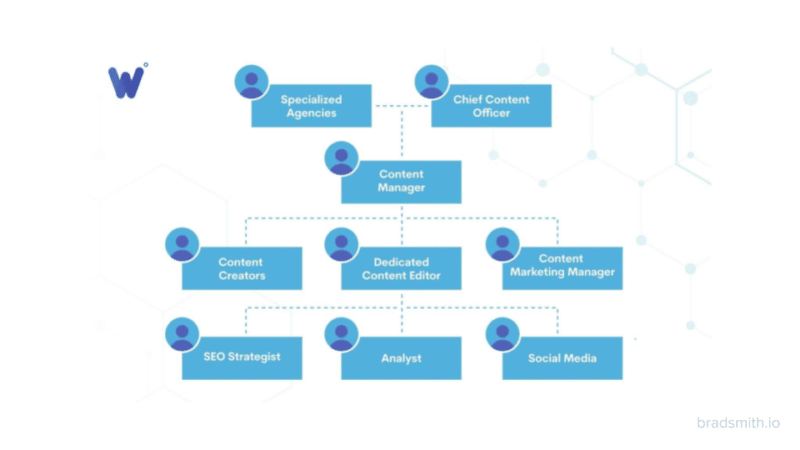
Content teams should be organized in the same fashion.
This starts with separating your writers, editors, and managers.
From there, as you grow in both stature and resources, you continue adding specializations to master each small piece of the much larger content operation machine – like a giant factory assembly line.
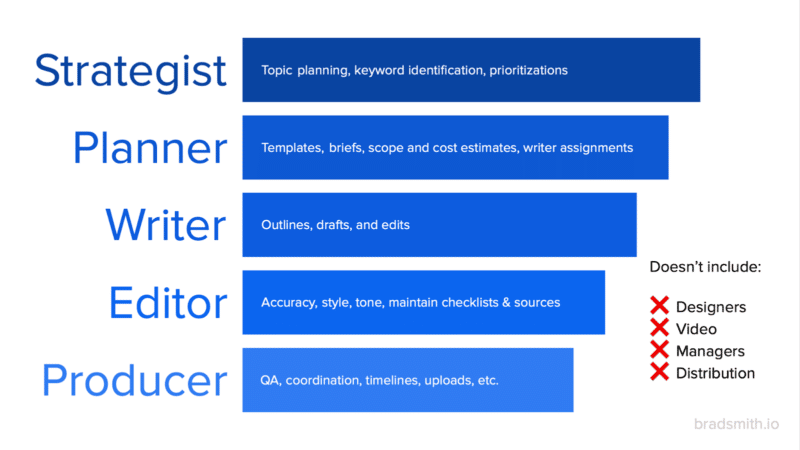
It would help if you also had a well-defined workflow where:
- The strategists work on strategy.
- The planners plan.
- The writers write.
- The editors edit.
- The producers coordinate.
You can add designers, videos, and distribution specialists to the mix as you grow.
Get the daily newsletter search marketers rely on.
<input type=”hidden” name=”utmMedium” value=”” />
<input type=”hidden” name=”utmCampaign” value=”” />
<input type=”hidden” name=”utmSource” value=”” />
<input type=”hidden” name=”utmContent” value=”” />
<input type=”hidden” name=”pageLink” value=”” />
<input type=”hidden” name=”ipAddress” value=”” />
2. Content quality checklists
This shouldn’t be a trick question, but it often is:
How would you define “good” content?
Everyone talks about the importance of “good” content. Yet, no one can define it the same.
Ask 10 people in your organization, and you’ll get 10 different answers.
As you can expect, that answer is not good enough.
Sorry to be blunt. But the longer you fly without radar keeping you on track, the better your odds of a crash landing.
Documenting a specific quality checklist is the bare minimum that needs to happen right now. Not tomorrow or next week.
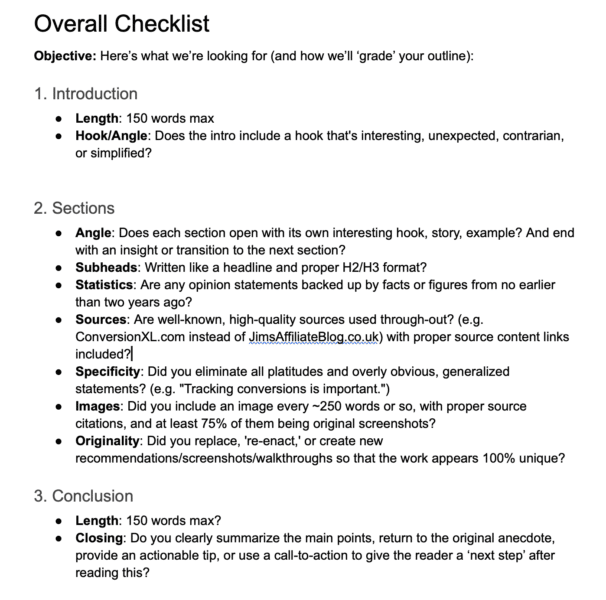
And in it, you should define the overall structure of most content, along with the nitty-gritty details for each sub-section – from word counts to source preferences to image criteria.
The more fleshed out this starting point, the faster you’ll:
- Train writers.
- Reduce editing time.
- Drive up ROI (better results for less investment).
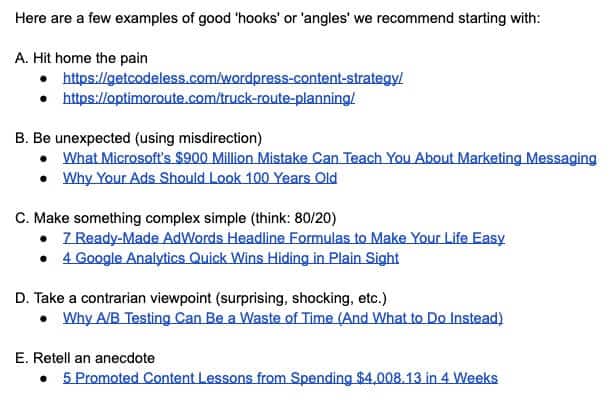
The second lesson here is to show, don’t tell.
A good example is your acceptable angles.
Be specific, laying out the ones you like or don’t like, and listing resources to show writers, editors, senior management, clients, or whoever, exactly what these things should look like.
We’re talking OCD levels of organization here because it gets everyone on the same page.
And when everyone is on the same page, your life becomes easier.
Hiring and firing become almost automatic. Everyone knows the expectations and is aligned. The number of dumb questions or stupid arguments evaporates into thin air.
Who knows. You might even get your weekends back to yourself!
The trickle-down effects are magical.
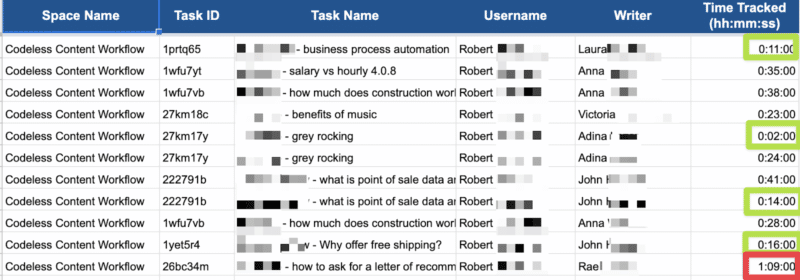
Our senior editors have a one-hour guideline.
They should not spend longer than one hour editing an article. Because if so, that means the writer screwed up. So the problems should be flagged and sent back to them.
Then, we can review an editor’s time across multiple pieces (or clients or writers) and spot operational issues at a moment’s notice.
Too little time spent editing might mean those writers are due a pay increase, while too long spent editing would signal the opposite.
3. Standardized templates, briefs and outlines
Sorry to be the bearer of bad news. But no content or SEO manager can control the results you’re looking for.
Rankings, traffic, leads, and customers are all lagging indicators. They are generated months or even years after doing all the actual work.
That means we need to turn our attention to the leading indicators instead.
Exhibit A. What should you write about?
Well, the answer is whatever people are already looking for!
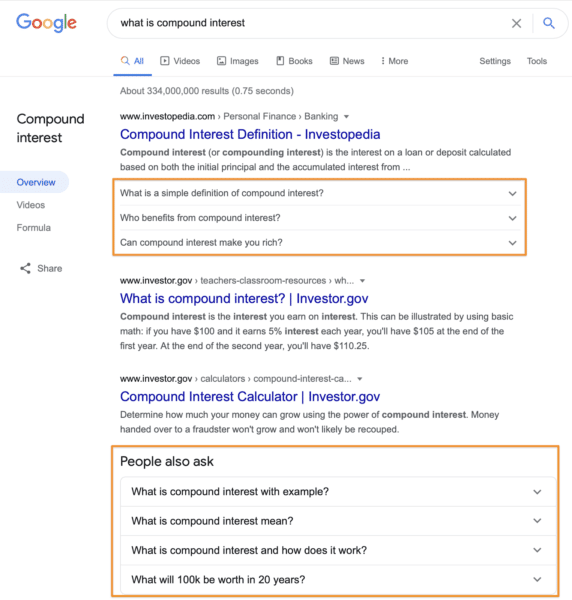
Analyzing search intent helps you understand what people want to read or learn when they type in a specific query. The good news is that Google literally tells you these answers.
Start with People Also Ask questions after typing in a query:
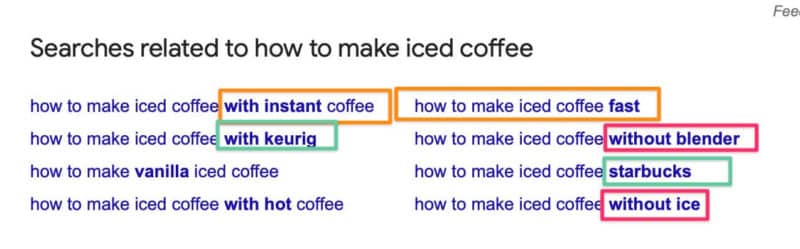
Next, look up Related Searches at the bottom of the SERP to see how the recommendations might line up together to start forming sections with the body of each piece.
You’ll start noticing patterns when you do this a lot across dozens, if not hundreds, of queries in your space.
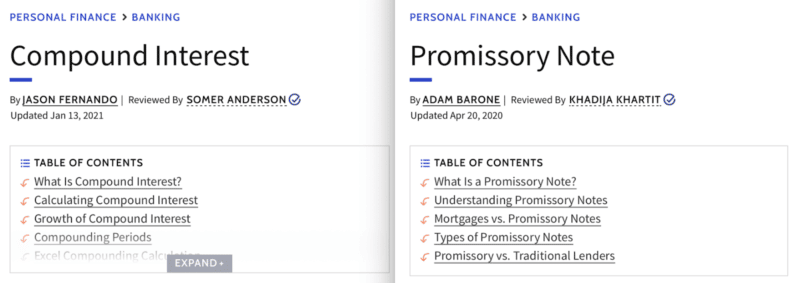
For instance, check out the Table of Contents from these Investopedia pieces on compound interest and promissory notes.
Almost the same structure!
Now, you have your first content template.
These are consistent article structures you can use for different queries (think: “what is…”-style queries that might apply across multiple topics or verticals).
And it also means you can start standardizing article structures across hundreds to thousands.
So if you had 1,000 topics to produce content on over the next year, those could probably be boiled down into 10 groups of 100.
One template now might apply to each of those 10 groups (so 10 templates).
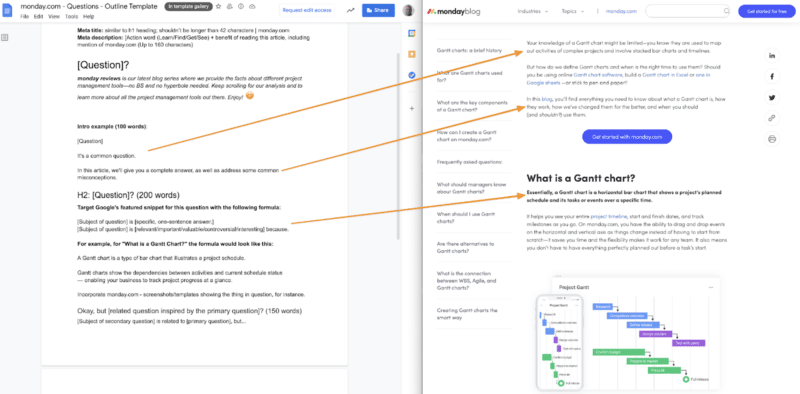
From there, you’ll eventually standardize content briefs, which will form the backbone of your writers’ outlines because they spoon-feed them everything from the subheads to the keywords and even word counts at each stage.
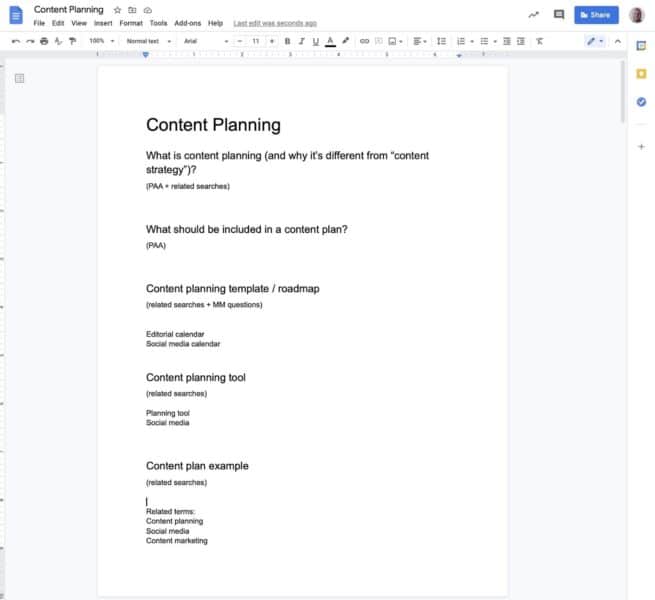
Imagine we’re about to write an article on “content planning.”
Your content brief would be pulled together by referencing all of these different points of information:
- People Also Ask questions.
- Related Searches.
- Reading some of the best content already ranking.
- Semantic keywords from content graders.
- And more.
Standardizing the content planning process like this will make your writers love you because they no longer have to stare at a blank white screen trying to conjure up some fluff.
Your editors will love you because they know exactly how the content should look, read, and sound.
Your SEOs or marketers will love you because you’re performing that difficult balancing act of producing interesting content that will still rank well.
And your bosses, clients or whoever is paying the bill will love you because what you initially planned in the early stages is pretty much exactly what the finished product will look like at the end of the day.
And when you do this consistently over months and years, your ultimate success will be virtually guaranteed.
It’s just a matter of how quickly the Google gods reward your good work.
4. Guidelines and sources
Shades of gray are only for cheesy romance novels and even worse movies.
They have no business in a high-performing content machine.
Take voice and tone preferences. Once again, ask 10 people, and you’ll get ten different answers.
So here’s an easy tip. Sometimes, seeing what you don’t like makes it easier to understand what you do like.
Take the following sentence:
It’s fine. Not great. Kinda generic and boring. But fine.
Now, rewrite that sentence like this:
 “This company is just the latest in a long line to be gobbled up by the massive hosting conglomerate, Endurance International Group (EIG). Or, as it’s also known, Where Good Web Hosts Go to Die.”
Over the top? Probably.
Some might like it, some might not. The vivid language (”gobbled up”) and power words (”Go to Die”) would be great for a conversational or satirical brand, perhaps not for a formal medical one, though.
A good example to model is Mailchimp’s extensive documentation.
From there, you’ll also want to create guides for everything from vocabulary to terminology.
These are the words, phrases or expressions that your brand uses, unique to your point of view on the industry, that would be different than other direct or indirect competitors.
For instance, do you prefer:
- “Profile picture” or “avatar”?
- “Example” or “use case”?
- “Click” or “press”?
It doesn’t matter which one you select. It only matters that you pick one, are consistent, and clear up this gray area for your writing and editing teams.
This supporting documentation should clear up all the intangible or unwritten principles your team already practices – even if they aren’t aware of it.
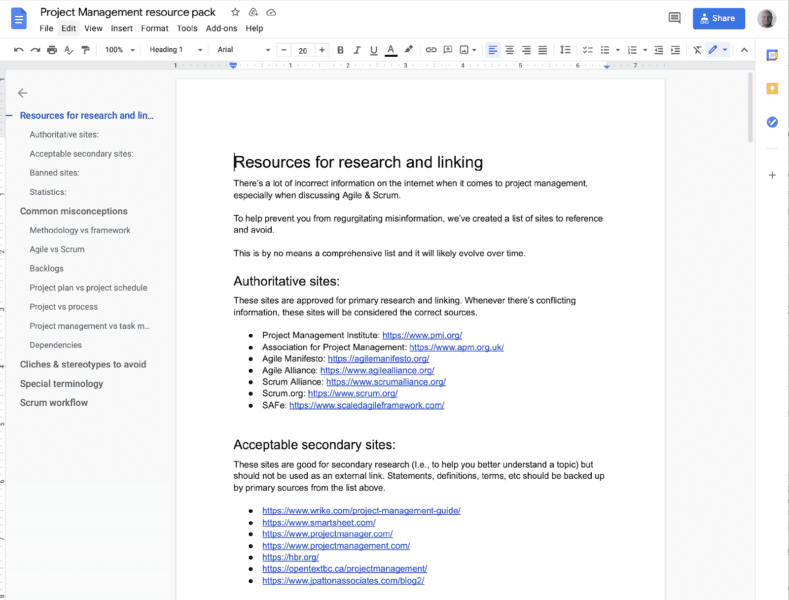
Last but not least, you should create a list of resources your writers can use, and a list of resources they should not reference (because they have published inaccurate, misleading, confusing, inconsistent, or otherwise untrustworthy information).
Stamp out all unwritten or intangible items, one by one, day after day, like a big game of Whack-a-Mole, and pretty soon, the only shades of grey left are the questionable kinky ones in your free time.
5. Batch and parallel processes
Let’s end at the beginning.
The brigade system helps professional kitchens deliver multiple dishes to the same table simultaneously, all cooked to perfection.
They do that by working in batch and parallel processes.
Imagine a line cook at the grill. They might be preparing five different cuts of steak for five different tables at five different temperatures with five different cook times.
Sounds exhausting, right?
So exhausting that they can’t also be cooking pastries or prepping salads at the same time. That’s role specialization in step one above.
Now imagine that 10 different people in a kitchen are each doing their own version of this at the same time.
Taking this back to content operations, it means you might have one team of people (writers, editors, SEOs, designers, etc.) working on one content project while at the same time another team of people (writers, editors, SEOs, designers, etc.) is working on another one.
As the leader of this chaos choreography, your job is to have the right teams in place with the right systems so that your output and quality stay high, even if a bunch of people are working on different things simultaneously.
Now, instead of micromanaging or meddling or trying to control every little detail, you can step back and oversee from a high level while still making subtle tweaks along the way to key stages of the assembly line.
Scale content creation and SEO in 5 key steps
Content is subjective at the end of the day.
You might like short, snappy, snarky sentences. But your boss might prefer formal, flowery, and factual.
Ultimately, it doesn’t matter.
The only thing that matters is that you – and the rest of the people you work with – are all on the same page.
This seemingly simple yet little-practiced point often derails content projects daily and sabotages your SEO results over the long term.
Start by optimizing your content operations with the following five steps:
- Specializing roles within your larger production workflow,
- Solidifying quality standards and examples that illustrate each point,
- Standardizing how production should flow from idea to template to brief to finished product,
- Documenting supporting guidelines and sources to clear up intangibles,
- Implementing batch and parallel processes so everyone knows what they should do at every moment.
It isn’t always easy or fun. It’ll take some getting used to.
But it’s ultimately the only way to break through your self-imposed barriers and generate the long-term success you deserve.
The post A 5-step framework to scale your content operations and SEO appeared first on Search Engine Land.
Courtesy of Search Engine Land: News & Info About SEO, PPC, SEM, Search Engines & Search Marketing
Wednesday, January 4th, 2023
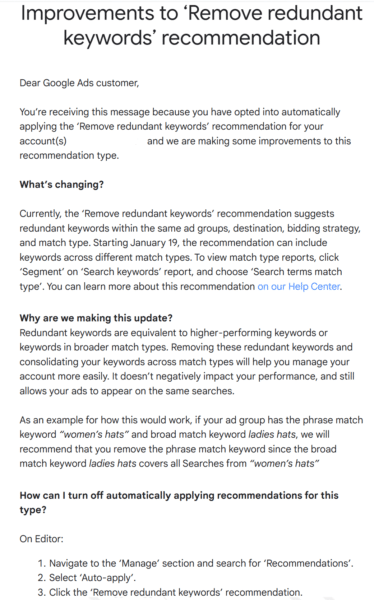
Advertisers running PPC ads on Google may have woken up to an email this morning outlining its new policy regarding redundant keywords.
What’s changed. The “Remove redundant keywords” recommendations suggest redundant keywords within the same ad groups. You may see the notification at the top right side of your ads dashboard. But starting January 19, the recommendation can include keywords across different match types.
Now, Google will start removing redundant phrase and exact match keywords in favor of broad.
Robert Brady first noticed this and posted it on Twitter.
Check your email. @GoogleAds just changed the "Remove redundant keywords" recommendation to prefer broad match. It will remove a phrase match or exact match keyword if a broad match keyword covers it. #ppcchat
— Robert Brady (@robert_brady) January 4, 2023
Why Google is making the change. In their email, Google said:
Redundant keywords are equivalent to higher-performing keywords or keywords in broader match types. Removing these redundant keywords and consolidating your keywords across match types will help you manage your account more easily. It doesn’t negatively impact your performance, and still allows your ads to appear on the same searches.
Stop auto-apply. You can (and should, IMO) turn off auto-apply recommendations in both Editor and the Ads front end by clicking “disable” in your recommendations section.
Dig deeper. You can review Google’s recommendations guidelines here. If you haven’t received the email from Google, I’ll paste it below.
Why we care. This is another attempt by Google to shift accounts to broad-match keywords only. Advertisers and brands should only make the change if they have tested and determined if broad-match keywords work best for their accounts. If you’re unsure bout broad-match, turn off auto-apply and test.
The post Google’s “Remove redundant keywords” recommendations have changed appeared first on Search Engine Land.
Courtesy of Search Engine Land: News & Info About SEO, PPC, SEM, Search Engines & Search Marketing