Archive for the ‘seo news’ Category
Wednesday, January 11th, 2023
Apple has revamped the Apple Business Connect service, where businesses can update what Apple Maps shows about their business. This service initially launched Apple Maps Connect in 2014, and it is similar to how Google Business Profiles works.
Apple Business Connect. Apple said this is a “free tool allows businesses of all sizes to customize the way their information appears across Apple apps.”
In Business Connect, businesses can manage their place card, including adding and updating photos and logos; inviting customers to take actions like ordering food or making a reservation directly from Maps; and presenting customers with special promotions.
Showcases. Apple also added Showcases, a new feature in the Apple MAps place card that helps businesses present customers with offers and incentives. Apple said, “businesses can easily update the Showcase section of their place card through Business Connect.” The feature is available for US businesses today and rolling out globally in the coming months.
New APIs. Apple also now supports a new API named the Business Connect API. This is designed for businesses with dozens of locations and allows those businesses “to easily deliver accurate, up-to-date information to Maps at scale through listing management agencies such as Reputation, Rio SEO, SOCi, Uberall, and Yext,” Apple said.
Businesses registration. If you already have an Apple Business Connect account, you can log in and add the new details about your business to your listing – I already did that before writing this story. Otherwise, businesses can register their business at businessconnect.apple.com and get started today.
Why we care. Apple Maps is becoming more and more popular, and it makes sense for you to register and maintain your business properly and accurately on the Apple Maps ecosystem. So make sure your business listing is verified and up-to-date.
The post Apple Maps relaunches Apple Business Connect appeared first on Search Engine Land.
Courtesy of Search Engine Land: News & Info About SEO, PPC, SEM, Search Engines & Search Marketing
Wednesday, January 11th, 2023
Everyone’s favorite new Google product, Google Analytics 4 (GA4), has just released 12 new item and event-scoped ecommerce metrics and dimensions.
Why we care. Ecommerce advertisers and retailers will now be able to view and analyze specific information about products, services and interactions. You should also be able to see Items purchased and purchases by country, which shows you the number of items purchased and the number of purchases for each country.
ICYMI, Google will sunset Universal Analytics on July 1, 2023.
What’s new. You can now find the following new dimensions and metrics in the Explorations and the Data API:
- Item affiliation
- Item variant
- Items added to cart
- Items checked out
- Items clicked in list
- Items clicked in promotion
- Items viewed
- Items viewed in list
- Items viewed in promotion
- Shipping amount
- Shipping tier
- Tax amount
New naming conventions. Google has also renamed several metrics:
- Add to carts (previously called Add-to-carts)
- Item-list click events (previously called Item list clicks)
- Item-list view events (previously called Item list views)
- Item view events (previously called Item views)
- Items purchased (previously called Item purchase quantity)
- Promotion clicks (previously called Item promotion clicks)
- Promotion views (previously called Item promotion views)
Dig deeper. Review the official Analytics Help documentation here.
The post 12 new Google Analytics 4 ecommerce dimensions and metrics appeared first on Search Engine Land.
Courtesy of Search Engine Land: News & Info About SEO, PPC, SEM, Search Engines & Search Marketing
Wednesday, January 11th, 2023
Although we hesitate to use the term post-pandemic with any confidence, marketing takes place today in a space changed — perhaps irrevocably — by COVID-19. Yes, marketers are making their way back to the workplace; many conferences and expos are back in person; it’s possible to meet and greet prospects face-to-face instead of face-to-video.
But the importance of digital marketing looks unlikely to recede. With it comes increased emphasis on digital content and digital experience, the expansion of ecommerce across almost every vertical and the interest in virtual events.
What does that mean? You guessed it: the growing importance of the digital martech stack.
The “great marketing reboot.” We’re also seeing big changes on the human side of marketing. Many marketing professionals have left the space; others have switched from regular positions to freelance or contract work. There are big opportunities — as well as challenges — for people in the early stages of their careers, whether as marketers or marketing operations professionals.
Data scientist and MarTech contributor Chris Penn calls this the “great marketing reboot.” We’ve introduced a new question into this edition of the survey asking if you’re witnessing the same phenomenon, whether in your own marketing organization or others.
Follow the money. We’re also asking, as always, whether circumstances are impacting salaries, in positive or negative ways, as well as your career trajectories.
As before, we’re partnering with Scott Brinker and chiefmartec.com to field the survey. It shouldn’t take more than a few minutes to complete, and we look forward to sharing the results soon.
Take the MarTech Salary and Career Survey
The post How marketing compensation and roles are changing: Take the MarTech Salary and Career Survey appeared first on Search Engine Land.
Courtesy of Search Engine Land: News & Info About SEO, PPC, SEM, Search Engines & Search Marketing
Tuesday, January 10th, 2023
There are many times during the lifecycle of your website that you will need an expert SEO.
If you don’t enlist the help of a true professional for the following five scenarios, you are risking rankings, traffic and revenue in 2023:
1. Site redesigns
This new year, many are planning to refresh their websites. The problem is that SEO either never enters the conversation during a site redesign or it’s not handled properly. This is a problem.
A site migration is when a website undergoes major changes, such as URL updates, a redesign, or content management system or hosting provider changes.
Any of these changes can negatively impact the website’s performance in the search results when handled well.
And make no mistake – there is a lot to consider. So much so that we usually break up our SEO checklist into pre-launch, launch and post-launch activities when involved in a site migration.
Even when it’s done correctly, it is common for sites to see a temporary drop in organic traffic (80% of SEOs expect it) but it should recover and even excel past previous benchmarks.
When it doesn’t, though, something has gone terribly wrong. The website may never recover and can experience a long-term drop in traffic.
If you’re going to make significant changes to your website, make sure you have the guidance of a seasoned SEO during the entire process. A website design agency may not have the expertise needed.
2. Deep analysis
Even if you are ticking off all the boxes in an SEO checklist, something sinister may be lurking behind the scenes of your website that’s causing a drop in traffic. Only a deep-dive audit can uncover something like this.
It is common for site owners to only focus on the top-performing pages. But that’s only a small representation of your website’s quality. The other 80% of webpages on your site could be harming the overall quality and relevance of it, thus impacting your traffic.
One example? Google’s helpful content update, which looks at the entire website in terms of content quality. If some pages are considered bad, it can impact the whole website.
Let’s also not forget the impact that well-organized, quality content site-wide can have on relevance. According to Google’s Search Engine Optimization Starter Guide:
“The navigation of a website is important in helping visitors quickly find the content they want. It can also help search engines understand what content the website owner thinks is important. Although Google’s search results are provided at a page level, Google also likes to have a sense of what role a page plays in the bigger picture of the site.”
In other words, webpages don’t exist in a vacuum. There are many instances where Google considers the site as a whole when ranking.
There are other hidden issues on a website that can easily be missed without a technical SEO audit. For all these reasons, it’s critical that website publishers get a better understanding of their site through a proper audit.
Get the daily newsletter search marketers rely on.
<input type=”hidden” name=”utmMedium” value=”” />
<input type=”hidden” name=”utmCampaign” value=”” />
<input type=”hidden” name=”utmSource” value=”” />
<input type=”hidden” name=”utmContent” value=”” />
<input type=”hidden” name=”pageLink” value=”” />
<input type=”hidden” name=”ipAddress” value=”” />
3. Ranking for highly competitive terms
Let’s be honest, what keywords aren’t competitive these days? Do a search for any keyword and you will find millions of results. Yet, Page 1 is all that matters.
Some keywords are easier to rank for than others. For example, you might have an easier time ranking for something like “list of top video games in 2022” versus just “games.”
We should know. It took us years to help a client rank number one for the highly competitive term: “games.” But we did it. And it stuck.
Ranking for million-dollar keywords doesn’t happen by just following a checklist. It happens with deep SEO expertise from professionals with decades of experience – those who live and breathe technical SEO and understand what’s happening in search right now.
Sure, you can get SEO guidance from anywhere, but if you’re trying to rank for highly competitive terms, don’t settle. Get an expert SEO.
4. Navigating changes to Google
The search engine results pages are constantly in flux.
In 2021 alone, Google ran more than 700,000 experiments, which resulted in more than 4,000 changes to search. That’s about 11 changes per day. Do you have the time to follow and dissect all the algorithm updates and how they apply to your website?
Algorithm updates lead to page one shake-ups and competitors pull ahead. Maybe they have more resources and bigger budgets, maybe they just did slightly better than you. Now you must figure out what changed and how to get ahead again.
Countless factors influence your rankings in the search results. Trying to figure it out should be left to an SEO professional.
5. Technical SEO
Anyone can do easy on-page SEO, but it takes knowledge and experience to get the technical part right. Things like mobile usability, site speed, structured data markup, robots.txt, server maintenance, page experience and much, much more.
Technical SEO requires the expertise of a professional working in tandem with a website developer or webmaster to ensure the correct changes are done well. One mistake and it can throw SEO results off quickly.
Every website needs to ensure the technical part is right to rank. Why? Because if a site is not crawlable, it won’t rank.
Google’s Gary Illyes once said on a Reddit thread:
“[I] really wish SEOs went back to the basics (i.e., MAKE THAT DAMN SITE CRAWLABLE) instead of focusing on silly updates and made up terms by the rank trackers, and that they talked more with the developers of the website once done with the first part of this sentence.”
Level up your SEO game in 2023
A new year brings new possibilities for your website.
It’s time to seriously consider how you will integrate expert SEO strategies so you have a chance to compete on Page 1.
The post 5 times you’ll need an expert SEO in 2023 appeared first on Search Engine Land.
Courtesy of Search Engine Land: News & Info About SEO, PPC, SEM, Search Engines & Search Marketing
Tuesday, January 10th, 2023
As we begin 2023, it’s a good time to reflect on the macro-level trends we’ve observed last year.
Here are a few trends that I believe have some staying power and should be considered as you build out your 2023 search marketing strategies.
1. A slow economy and heightened focus on efficiency
In case you haven’t heard, the economy has been struggling (that’s a joke). I graduated with a degree in economics, but like most of us, I have no idea how long this downturn will last.
That said, I think many digital marketers are already feeling the impact.
- Budgets are tightening.
- Teams are getting leaner.
- Questions such as “What’s the ROI?” or “What’s the CPA?” are becoming more prevalent.
These environments are tricky to navigate and I certainly don’t have all the answers.
However, the advice I usually start with is leaning into your data. Make sure you have a deep understanding of your top-performing tactics and maximize your investment there first.
An analogy I often use is the concept of a sports team in the playoffs. When it comes to crunch time, a coach will always put their best players in the game for as much time as possible. Those players who are still developing are likely going to be watching the game from the bench.
Take this same mindset when it comes to your search strategies. If your budget is limited, prioritize your investment on the tactics driving the most return.
I’m sure many of you reading this are saying, “Yeah, thanks for stating the obvious.” But when I say this, I don’t mean simply consolidating to a brand keyword strategy. Instead, you should:
- Dig into the various segments of your campaigns’ performance.
- Understand what devices, audiences, geos, times of day/days of week, and campaign types drive the most efficient performance. Focus your investment on those combinations of segments first.
- Consider creating a more granular campaign delineation to more effectively skew spend toward the top-performing combinations.
Get the daily newsletter search marketers rely on.
<input type=”hidden” name=”utmMedium” value=”” />
<input type=”hidden” name=”utmCampaign” value=”” />
<input type=”hidden” name=”utmSource” value=”” />
<input type=”hidden” name=”utmContent” value=”” />
<input type=”hidden” name=”pageLink” value=”” />
<input type=”hidden” name=”ipAddress” value=”” />
2. Automation vs. autonomy
This debate originated well before 2022. However, I do think the heat was turned up a bit last year with:
Machine learning is getting stronger and will continue to be woven into campaign management platforms.
I believe that to be successful in 2023, you must best balance the power of automation with the autonomy required to achieve your stakeholder’s objectives.
Think about when you are setting up an automated bid strategy. Part of that process is providing the algorithm with business-specific guardrails that it should operate between – and toward. The better the inputs you provide, the more closely your results will align with your objectives.
I think that same mindset should be leveraged with applications of AI more broadly in campaign management platforms.
Automation reduces the resources required for foundational tasks. But, we still need to guide it to work toward our business objectives.
More tactically, think about what datasets you can incorporate. The more inputs you’re providing, the more data points that these algorithms can use to inform the optimizations and recommendations.
In addition, think about what levers you need to maintain control over and where you can free up your grasp by relying on machine learning to make the optimizations for you
Lastly, consider how to structure your accounts to allow the automation to perform best.
That balance of automation and autonomy will differ based on the complexity of your strategy.
Advertisers who have the best understanding of what this balance should be for their business stand to benefit.
3. Microsoft on the rise?
What would an article like this be without at least one opinion that is a little “edgy.” Buckle up, folks!
I’ve been pretty impressed with the updates that came out of Microsoft last year. They’ve not only expanded their ad offerings but also their geographic reach by about 70 new markets.
Microsoft Advertising has always touted their lower costs and comparable features to Google, but we are starting to see some innovation (i.e., Multimedia Ads) unique to the platform.
Let’s be clear – I’m not expecting a significant shakeup in search engine market share. However, if you haven’t looked at innovation opportunities on Microsoft Advertising, now might be as good a time as any.
The (generally) lower CPCs make it a solid testing environment and much of the innovation they’ve incorporated can help to improve conversion rates.
Improving conversion rates combined with cheap CPCs sounds like an opportunity worth circling back to in budget-constrained environments.
This recommendation is particularly relevant for B2B advertisers, as Microsoft Bing is an engine where we have seen particularly strong engagement, likely due to research taking place on work devices.
Search marketing’s staying power in 2023
Now is an incredibly exciting time to be in search marketing. The platforms are making plenty of updates that it’s hard to keep up.
Search marketing is one of the most powerful tools in the digital marketing toolbox. Other than search, there are only a few other environments where users indicate their interests so clearly.
I’ve highlighted a few of the trends I’m keeping a pulse on, but in our fast-paced industry, there are likely plenty more trends that you will consider as you build out your 2023 strategy.
The post 3 PPC marketing trends to keep a pulse on in 2023 appeared first on Search Engine Land.
Courtesy of Search Engine Land: News & Info About SEO, PPC, SEM, Search Engines & Search Marketing
Tuesday, January 10th, 2023
Last week Google updated its Help Center to include a new vertical: Dentists.
The change was first noted by Matt Casady who wrote about the update on Local U. Carrie Hill posted about it on Twitter.
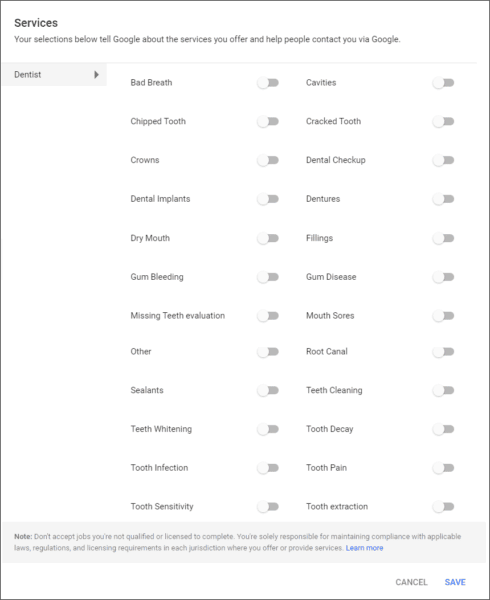
How it works. Prospective dentists will need to complete verification before being eligible to advertise.
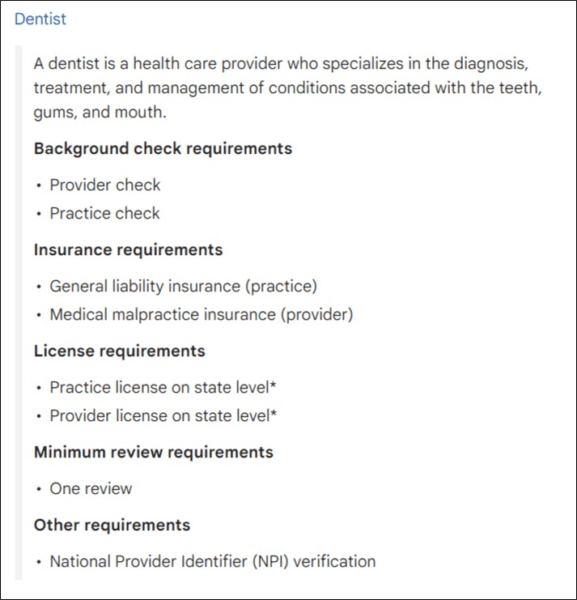
Why we care. If you’re a dentist or you’re running ads for a dentist, start going through the verification process now so you can get your LSA ads up as soon as possible!
The post Google Local Service Ads are now available for dentists appeared first on Search Engine Land.
Courtesy of Search Engine Land: News & Info About SEO, PPC, SEM, Search Engines & Search Marketing
Tuesday, January 10th, 2023
Google’s results got more personal with Search Plus Your World
In 2012, Google’s search results were radically transformed as a new “Search Plus Your World” format began rolling out.
Google started mixing together content from the web with content that had been shared with you privately into a single set of listings.
Search Plus Your World didn’t cover content on Facebook, Twitter, or any social networks where content could be shared to a more limited audience. Really, “Search Plus Your World” was best described as “Search Plus Google+”
Twitter was quick to express concerns, stating that Search Plus Your World was “bad for people, publishers, news organizations and Twitter users.”
Read all about it in: Google’s Results Get More Personal With “Search Plus Your World” and follow-up article Search Engines Should Be Like Santa From “Miracle On 34th Street”.
Also on this day
2022: It let advertisers review and delete policy-violating ads across accounts.
2021: Google subtopics ranking was meant to help deliver search results with a greater diversity of content when searching for something broad.
2020: Advertisers could group and report on campaigns with a hierarchical structure to see performance by business category or marketing strategy.
2020: The company was also starting to make its new on-site search product Microsoft Bing for Commerce available to retailers.
2020: Yelp introduced a new category of consumer alerts intended to flag businesses “that may have received reviews from deceptive review rings.”
2019: Google was making, on average, more than 200 changes to its 7,000 internal websites on a daily basis.
2019: An unconfirmed Google update? Especially around Jan. 5, 6 and 9, the SEO community was discussing both positive and negative ranking changes.
2019: The top legal advisor for the European Court of Justice has recommended that delisting under RTBF not extend outside the EU.
2018: The PageSpeed Insights tool was updated to use data from the Chrome user experience report, which meant the tool was using metrics from real-world Chrome users.
2018: Review extensions stopped showing later in the month and would be deleted entirely in AdWords accounts in February.
2017: Shortcuts to widgets for Weather, Nearby Restaurants, My Events and more began appearing at top of Google Now home screen.
2016: It was the biggest lottery drawing in U.S. history, and neither Google nor Bing showed searchers the winning numbers. Here’s who did.
2014: A small but significant update to the Google Webmaster Guidelines link schemes page: the page now specified the exact type of links that were not allowed within widgets, as opposed to saying any links.
2014: More than a billion queries were performed on the search engine during 2013.
2014: The Berlin square Theodor Heuss Platz was briefly renamed “Adolf Hitler Platz” on Google Maps.
2014: A Virginia state court of appeal ruled that Yelp must disclose the real identities of seven individuals who posted anonymous, critical reviews of an Alexandria, Virginia carpet cleaning business.
2014: The latest images culled from the web, showing what people eat at the search engine companies, how they play, who they meet, where they speak, what toys they have, and more.
2013: Mobile devices accounted for less than 20% of total paid search budgets – and in Q4, tablet metrics grew dramatically faster than those for smartphones.
2013: Foundem was seeking damages for revenue lost as a result of Google’s “anti-competitive conduct.”
2013: While saying he’s “still investigating,” the head of the European Union’s antitrust regulatory body said he was convinced that Google was “diverting traffic” and that it will be forced to change its results.
2012: David Mihm published A Brief History of Google Places, which documented everything from 2004 (when Google launched what was then called “Google Local”) up to the Google Places era of 2012.
2012: Google was at 65.9%; Bing at 15.1%; Yahoo at 14.5%
2012: the Iranian government was looking to form a “national internet” under state control.
2012:
2011: This deal was about getting more product data directly from their sources and expanding the number of specific attributes or features exposed to consumers
2011: Where he would focus on new products and user experiences associated with “mobile, local, and social information.”
2011: Of the voters asked if there was “a need for government regulation of the way that search engines select the recommendations they provide,” only 11% said yes while 12% were not sure.
2011: Google was using a 15-year “preferential use” limit, but a report called for the limit to be cut to seven years.
2011: Spoiler alert: Google Goggles was not the death of Sudoku.
2011: Google and Hulu were still working out a partnership deal.
2008: The average salary fell in the $60,000-$70,000 range and experience was a factor in how much search marketers earned.
2008: Traffic to Mapquest was remained flat year on year and was down 20% in the past 6 months. Meanwhile, Google Maps traffic was up 135% year on year and was up 7% in the past 6 months.”
2008: Do successful search companies have to have CEOs or top execs who “grew up” from the search product side? A look at the major players and where those in charge came from.
2008: Real or fake? What is real: Google had removed ASCII ads shortly after they went live, due to content issues.
2008: Zillow had home valuation estimates for almost 90% of all homes in the U.S.
2008: 48% of internet users said they had visited a video-sharing site (e.g., YouTube) – growth of more than 45% year on year.
2007: The latest junk on Google Blog Search.
2007: Probably not. Also, a review of Google’s policies and how they came to be.
2007: Having your own domain name for your feeds was incredibly easy and cheap to do via FeedBurner.
2007: The folks behind new search engine Cranky.com thought they had just what you needed to avoid search rage and information overload.
2007: Could Google dictate that public domain books that it has scanned and distributed on the web really be subject to restrictions on non-commercial work?
2007: Microsoft announced that it will integrate more than 400,000 square miles of U.S. aerial imagery into Virtual Earth
2007: Looking at the top stories and what made them pop.
From Search Marketing Expo (SMX)
Past contributions from Search Engine Land’s Subject Matter Experts (SMEs)
These columns are a snapshot in time and have not been updated since publishing, unless noted. Opinions expressed in these articles are those of the author and not necessarily Search Engine Land.
< January 9 | Search Marketing History | January 11 >
The post This day in search marketing history: January 10 appeared first on Search Engine Land.
Courtesy of Search Engine Land: News & Info About SEO, PPC, SEM, Search Engines & Search Marketing
Monday, January 9th, 2023
If you’ve racked up awards or accolades for your business, you’re not wrong in wanting to show them off.
Your achievements signify you’re doing a few things right, so why wouldn’t you display them on your website?
The key is to ensure you don’t look too company-focused or braggy – after all, a cardinal sin of content is using too much “I” or “we” language and forgetting to talk to your audience with “you” language.
To strike the right balance, you need to write an awards page that isn’t distracting or annoying, but rather adds credence to your brand and builds trust.
You want customers to say, “Wow, this company is really successful!” Not, “Yuck, this company is obsessed with itself.”
Let’s talk about how to create an awards page, including how having one builds trust with customers.
Why create an awards page on your website?
Awards pages can help establish your authority, giving your SEO a little boost.
How?
Awards are proof that you’re a force in your industry, doing exceptional work. Other people paid attention and recognized you for what you do, and now they’ve given you physical evidence of your company’s prowess.
Thus, those awards are trust signals to prospects and to search engines (E-A-T, anyone?).
For example, the Search Engine Land Awards are handed out yearly to marketers, teams, and agencies that demonstrate excellence in organic or paid search marketing initiatives or campaigns.
How to create an awards page that shows off your achievements – without turning people off (+ 7 examples)
Wondering how to create an effective awards page? Here are six tips with seven examples from real-life businesses that have done it well.
1. Consider creating a separate awards page
If you have earned a lot of awards over the years (good on you!), consider displaying them on a separate awards page.
For example, the University of Dundee in Scotland has a page dedicated to its awards, with additional pages that explain the context of each award.
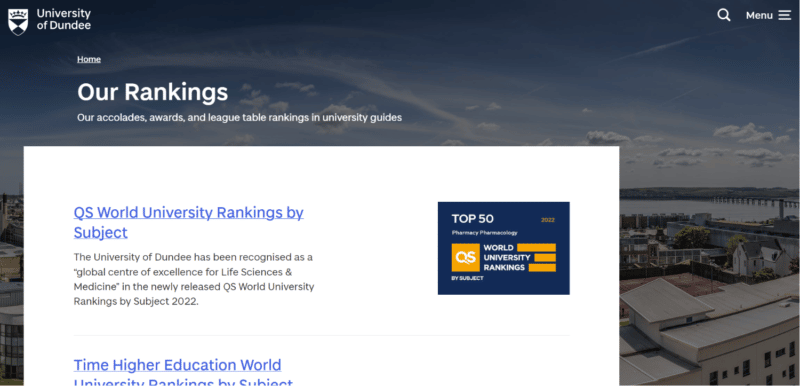
Rankings and awards page
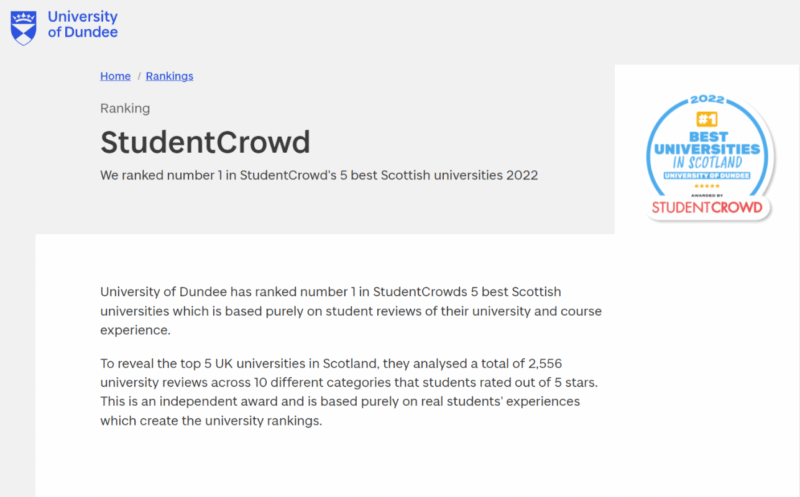
Individual award page
The awards page is linked under their “About” information, which is also a good practice.
This way, people who want to view your awards have an obvious place to click, while people who don’t care won’t be inundated with a long list to scroll through.
2. Include all your important awards, from most recent to least
If you’ve been winning awards for years, that says a great deal about your company and its legacy. If your award history goes back five, 10, 15, or even 20 years, don’t be shy about displaying your pattern of excellence.
That said, also consider the relevance of each award to your audience and whether they’ll care. For instance, if your company won an award for participation five years ago, you can probably leave that one out.
On the other hand, maybe you won “brand of the year” in an industry-wide contest five to 10 years ago – that’s relevant to your customers, your reputation, and your authority. Thus, you should display it on your awards page.
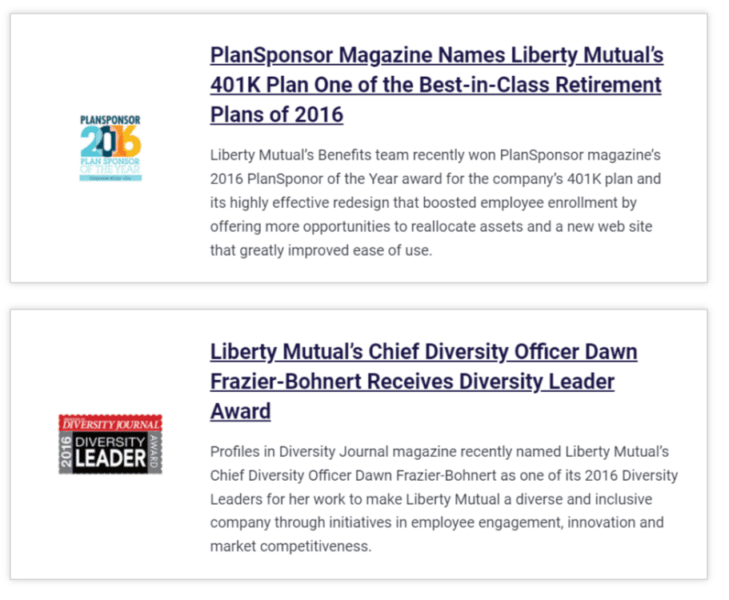
A good example of this in action is Liberty Mutual’s awards page – they have a long list of awards going back to 2016.
3. Include award badges or icons
Most awards come with small badges or icons for displaying on your website. In most cases, it’s a good idea to do so.
Why?
Because many of these badges come replete with their own recognition, especially among those in your industry. Displaying a recognizable (and perhaps coveted) badge is a really easy way for the people who matter to see it and register it in a second.
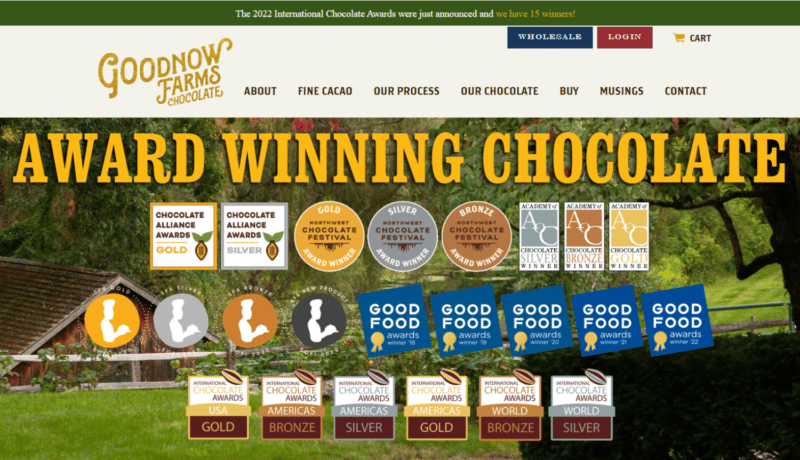
One huge tip – if you have a lot of awards badges, make sure they look clean and organized. Otherwise, your page could look messy and unprofessional, which is the exact opposite of what you want. A good rule of thumb is to keep them on the smaller side and organize them into a list or neat grid.
On the Goodnow Farms Chocolate homepage, they include a tidy list of badges as part of a photo carousel.
4. Briefly describe the context of each award
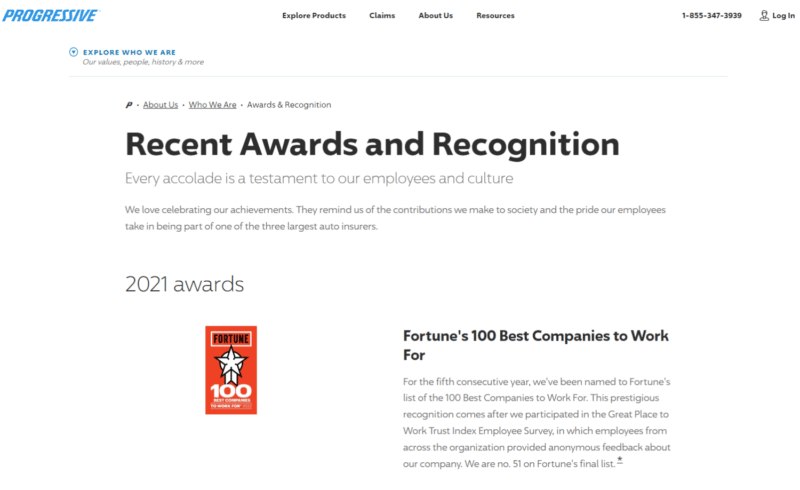
In many cases, simply listing out your awards isn’t enough. Why should customers care if they don’t know what that award means or signifies?
To that end, include a brief description of each award you’ve won, including how you were chosen – especially if customers voted for you (a giant trust signal). Progressive does a good job of this on its awards page:
5. For three or fewer awards, add them to your about page, the sidebar, or the footer
Don’t have a long list of accolades yet? Instead of creating a separate awards page, consider adding your awards badges to a dedicated section on your about page.
This also works if you have more than three awards, by the way, and is a smart strategy to draw attention to them without dedicating an entire page to them.
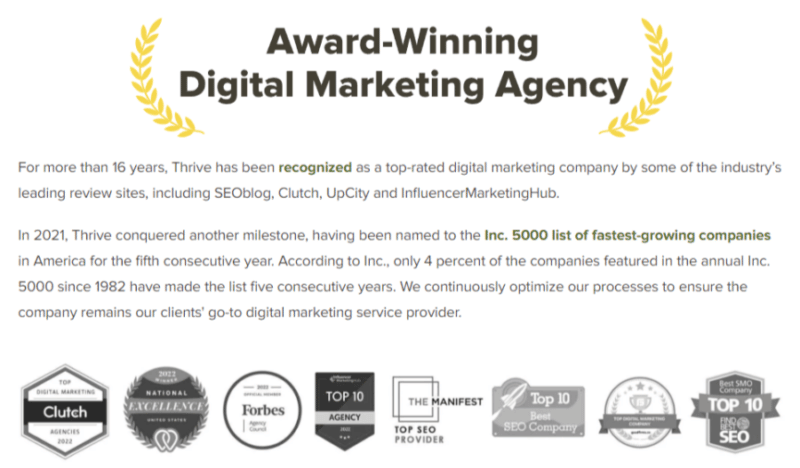
In this vein, Thrive has included a section dedicated to their awards on their about page. They use a simple paragraph to give some context along with an organized row of small badges, and it does the job nicely.
If you have one or two awards to your name, you should consider adding the badges to your sidebar or footer. These are unobtrusive places that benefit from remaining static across your site, so your awards will be displayed on every page.
Remember, you can always create an awards page later if you earn more.
6. More than 25 awards? Create an awards list
Let’s say your business rakes in the awards consistently. That’s incredible, and you have every right to humble-brag a little.
A smart and crafty way to display these awards is to create a list. The more awards you have, the more impressive it will look, especially at first glance.
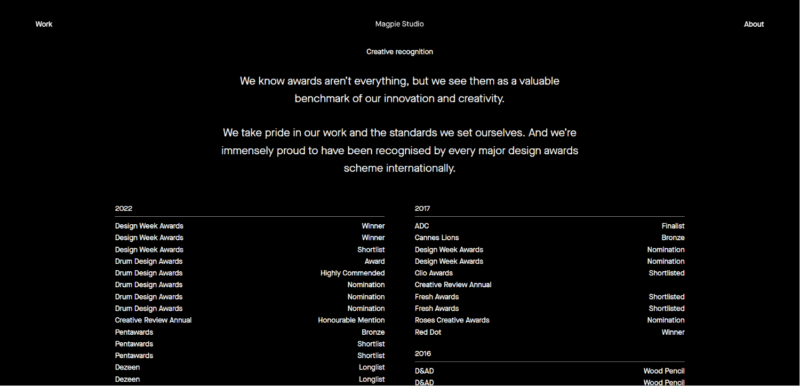
Magpie Studios, a British design agency, does this to great effect. Their awards list is incredibly long and goes all the way back to 2011. Altogether, it makes a lasting impression that this is a company to be reckoned with.
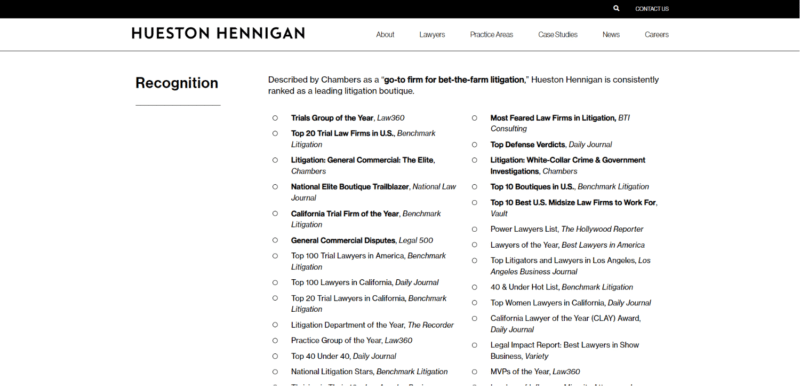
Another company that does this well is Hueston Hennigan, a law firm:
Remember: Awards pages are about authority and building trust
Never create an awards page without intention or a strategy. Just like your other website pages, an awards page has a purpose that will help you build toward reaching your goals.
It’s not about showing off but rather offering proof that your business is credible and trusted. To that end, only display awards your customers will care about and keep your page organized and easy to read.
Ultimately, a well-designed awards page is a good idea as long as you keep your customers, goals, and strategy in mind.
The post How to create an awards page that adds authority to your website (plus 7 examples) appeared first on Search Engine Land.
Courtesy of Search Engine Land: News & Info About SEO, PPC, SEM, Search Engines & Search Marketing
Monday, January 9th, 2023
AdWords Managed Accounts get shared negative lists across accounts
In 2017, Google added the ability to create and share negative keyword lists across accounts for Managed Accounts.
This was welcome news for advertisers who had been adding the same lists of negative keyword accounts manually or using a script to automate cross-account negative lists.
For accounts in a managed account, you could set up a single list of negative keyword in the top-level Shared Library that could then be associated at the account level.
Read all about it in: AdWords Managed Accounts can finally share negative keyword lists across accounts
Also on this day
2020: Bing would appear as an option in the United Kingdom only, while DuckDuckGo and Info.com will appear alongside Google in all 31 EU territories
2020: Agency and corporate customers could request managed services directly within the platform interface.
2019: Google started rolling out a new feature in search named “your related activity” that let signed in Google users pick up on previous searches related to the query they just added.
2019: The trick made it possible to show any site for any query in the knowledge panel area.
2018: Google marked what would have been Har Gobind Khorana’s 96th birthday with a Doodle to celebrate the Nobel Prize winner’s accomplishments in the field of biochemistry.
2017: The call extensions would automatically pull phone numbers featured on landing pages.
2017: Mobile played a significant role, accounting for nearly half of all Valentine’s Day-related searches on Bing.
2016: For its first Doodle of the year, Google celebrated the 41st anniversary of the discovery of “The Mountain of Butterflies,” when a research team located millions of Monarch butterflies that had migrated to Mexico’s easternmost Sierra Madre Mountains.
2015: Google finally seemed ready to launch its long-anticipated comparison site for car insurance.
2015: An analysis showed a gradual but continual losses back to Google, and Yahoo’s share of Firefox 34 clicks dropped from 43% (Dec. 10) to about 36 percent
2015: The latest images culled from the web, showing what people eat at the search engine companies, how they play, who they meet, where they speak, what toys they have, and more.
2014: Google was photographing hotel interiors as part of an effort to enhance its travel content.
2014: A number of Google international homepages celebrated feminist writer Simone de Beauvoir’s 106th birthday with a Beauvoir-inspired Google logo, but there’s no sign of her on Google’s U.S. homepage.
2013: Google offered phone support for businesses having issues with verifying their Google Maps listing.
2013: A striking 36% of respondents thought that search engines “sell users’ personal data to marketers.” Another 29% thought that “companies pay annual dues for use.”
2013: The new APIs let you search for top stories in real time over the Bit.ly URL network.
2012: A lawsuit brought against Google in 2008 over the quality of ads showing on parked or error message web pages was thrown out by the court.
2012: A Korean official asserted that Google has obstructed his agency’s investigation “by deleting key files from PCs and asking its employees to telecommute from home.” Google denied obstructing the inquiry and pledged cooperation with Korean government officials.
2012: Ads for illegal Olympic ticket resellers, ads for cannabis, and ads for fake identification cards and UK passports. All illegal, but all could be found on Google.co.uk
2009: Google’s advertiser growth started at 89,000 in 2003, to 201,000 in 2004, 360,000 in 2005 and 600,000 in 2006. In 2009, one estimate said Google had between 1.3 million and 1.5 million advertisers.
2009: A small but interesting study on how you can improve your chances, by 50 times, of showing up at the top of the Google search results: Utilize Google’s Universal Search by creating videos.
2009: Microsoft CEO Steve Ballmer said that a deal should happen within the next few months, due to Microsoft and Yahoo having new “leaders” in place.
2009: The new icon was inspired by user submissions as part of a contest.
2009: Google/YouTube threw its first party for a U.S. president’s inauguration
2009: Roundup of personnel moves or speculation about who might get the top spot at Yahoo; the ongoing MicroHoo saga; and MSN being branded a “lewd” site in China for user-generated content.
2009: The latest images culled from the web, showing what people eat at the search engine companies, how they play, who they meet, where they speak, what toys they have and more.
2008: The two changes made to this referrals pricing structure only impact referrals to the AdSense product.
2008: Google mapped the results of the New Hampshire U.S. presidential primary by candidate and county for both parties.
2008: New features included Keyword Expansion, Keyword Search Volume Historical and Forecast, Keyword Buzz and more.
2008: The responsibilities included “investigating deviations from company policies or acts against Google as well as collection and analysis of information helping define and assess threats to Google’s operations and assets.”
2008: Users could get maps, news, weather, local events, and other content.
2008: Sky in Google Earth was updated with new content, features, and API integrations.
2008: Safka was previously the CEO of Match.com, IAC’s online dating company, from 2004 to 2007.
2007: After several weeks of rumors, Yahoo has officially announced it has agreed to purchase the MyBlogLog service.
2007: A third of Google’s first 300 employees had left the company, and the culture was getting more conservative
2007: Google had no intention of competing with traditional media by creating content, but many media companies remained wary of Google.
2007: the company was getting involved with the Large Synoptic Survey Telescope. To be built in Chile, the LSST was planned to scan the sky on a continuous basis, allowing for “movie-like” looks at the universe.
2007: Due in part to deal with crushing competition from Baidu.com and portal Sina.com.
2007: The company raised millions in venture capital to help online advertisers identify click fraud using statistics, user modeling, machine learning, and IP forensics”
Past contributions from Search Engine Land’s Subject Matter Experts (SMEs)
These columns are a snapshot in time and have not been updated since publishing, unless noted. Opinions expressed in these articles are those of the author and not necessarily Search Engine Land.
< January 8 | Search Marketing History | January 10 >
The post This day in search marketing history: January 9 appeared first on Search Engine Land.
Courtesy of Search Engine Land: News & Info About SEO, PPC, SEM, Search Engines & Search Marketing
Sunday, January 8th, 2023
The Spam Clock
in 2011, startup search engine Blekko launched a spam clock that estimated 155 million spam pages had been created since Jan. 1 of that year. Blekko said 1 million spam pages were being created every hour.
How bad was Google’s spam problem then? Big. But as Danny Sullivan pointed out at the time, it was hard to judge whether Google’s relevancy had actually decreased, because:
- We expect more from Google than we do in the past, searching for things we might not have in previous years
- We don’t remember all the successful searches, focusing on when things go bad.
- We probably don’t do a comparison check on Bing or Blekko to see if they performed better, nor do we use those services on a regular basis to understand if they’re also “failing” to the degree we might feel Google does.
- Our expectations of Google are higher.
Read all about it in Blekko Launches Spam Clock To Keep Pressure On Google.
In about a month, Google would start making moves to correct its perceived, growing relevancy problems with the Panda Update.
I don’t even want to think about how much spam has been created since the start of this year – especially with the explosion that is ChatGPT.
Also on this day
2022: Google Ads updated its gambling policy to allow ads for sports betting from certified and state-licensed entities in New York State.
2022: After eight months on pause, AdSense publishers could once again create Related search style experiments.
2021: The new reports provided 6 months of data on how people interacted with you (calls and messages) and how people discovered you (the search term used to find your Google business listing in Google Search and Google Maps).
2020: Google was working on fixing a data issue with the URL parameter tool, a legacy tool within Google Search Console that let SEOs communicate to Google insignificant page variations and direct Google to consolidate those URLs.
2020: The user comments appeared in the search results for queries related to live TV shows. It was similar to Google’s live sporting events feature.
2020: The updated Microsoft Bing Search App also had a new look featuring a carousel of common search categories.
2019: You could now edit the code in the rich results test and see what those edits did in real time.
2019: A new “From the manufacturer” section in Google Shopping product pages could feature brand-supplied rich content.
2019: The tool provided an on-the-spot way to take action on performance changes in your accounts.
2019: The digital marketing agency’s new tool helped SEOs test and deploy SEO-related changes on their own without developer overhead.
2019: GMB messaging, voice search optimization, local inventory data, Q&A and the decline of SMB websites are all explored.
2015: Torrent Freak study reveals the number of Google’s takedown notices were up 75% from 2013.
2015: Yahoo saw a nearly 2 point search market share gain in the U.S. in the past month (10.4% vs. 8.6% year vs. year.)
2014: Google’s John Mueller said, “data in the search queries feature will no longer be rounded / bucketed,” and you will start to notice these changes in Webmaster Tools in the next few days.
2014: The tool was refined to give advertisers performance benchmarks within their own industries
2014: The Doodle paid tribute to one of the 20th century’s most celebrated African American female writers.
2014: Calling itself a “new way to search,” ultimately, Jelly would follow the path of social Q&A platform pioneers failures like Ask.com, Quora, Yahoo Answers and Google Answers.
2013: Having mobile-optimized and rendered content was highly correlated with getting organic traffic from Google.
2013: The Library of Congress was working on plans to create a searchable archive of nearly every public tweet ever sent, but the challenges inherent in that task were making it a slow process.
2012: The black-and-white Doodle featured seven characters from “The Addams Family.”
2011: Just in time for the opening round of the NFL playoffs.
2011: Co-founder Charlie Cheever admitted it had been “a big challenge” to maintain Quora’s character while the site has been flooded with new users.
2010: Google sent out its Google Local Business Center updates – but the emails didn’t go to the actual business owners.
2010: AOL’s CEO, Tim Armstrong and former Google executive, said Google (not Microsoft Bing) would get “first dibs” at a search deal.
2010: The two companies reached a settlement prior to judgment, although the terms of the settlement were not disclosed.
2010: Microsoft CEO Steve Ballmer announced that Bing would become the default search engine and MSN the default homepage on HP computers.
2010: Google’s Earthquake OneBox didn’t catch it, but Google was saved by its integration of Twitter results.
2010: President Nicolas Sarkozy was exploring ways to tax Google and other online advertising companies based outside of France.
2010: That was according to Brett Yount, a program manager for Bing, who said “it is well known in the industry that MSNbot is fairly slow.”
2010: Spoiler alert: No, it was not.
2009: Leading Chinese search engine Baidu was sued by Chinese medical B2B marketplace Qmyy.com to prevent its site from being blocked or dropped by the engine.
2009: One tool was named the Search Engine Optimization/KSP tool and the other was a toolbar called SEMToolBar.
2009: Test showed that submitting a sitemap to Google and Yahoo decreased the time it took Google and Yahoo to crawl the page.
2009: Previously if users entered a business name on the Maps client as a directions end point, Google might not recognize it.
2009: Bush should have stopped redirecting requests for his old biography to the current presidential home page. It left that page with a legacy of ranking for failure.
2009: Google and Microsoft were in tight competition for the mobile search partnership.
2009: The latest twist in the Yahoo-Microsoft saga: a new group was trying to takeover Yahoo with Microsoft’s money.
2009: Microsoft CEO Steve Ballmer announced several high-profile distribution deals for Live Search at CES.
2009: Google released “a substantial number” of its contract and temporary employees, but the exact number wasn’t known.
2008: “Widely hyped … it’s really just yet another crappy search service that may, potentially, if all goes well, eventually turn into something useful.” See also: Wikia Search Launches Alpha Version
2008: Why did Google encourage this activity from their employees? Google believed it generated creative ideas from their employees.
2008: David Hirsch, the Director, B2B Vertical Markets Group at Google, was leaving at the end of the month to help invest and advise startups.
2008: There were essentially three pieces to what Yahoo announced: Yahoo Go 3.0, an open mobile widget development platform for third parties, and a redesigned mobile WAP homepage that emphasized personalization and customization.
2008: Google, Yahoo, AOL, and Digg were all sued by Sheldon F. Goldberg for patent infringement.
From Search Marketing Expo (SMX)
Past contributions from Search Engine Land’s Subject Matter Experts (SMEs)
These columns are a snapshot in time and have not been updated since publishing, unless noted. Opinions expressed in these articles are those of the author and not necessarily Search Engine Land.
< January 5 | Search Marketing History | January 7 >
The post This day in search marketing history: January 7 appeared first on Search Engine Land.
Courtesy of Search Engine Land: News & Info About SEO, PPC, SEM, Search Engines & Search Marketing



 (@CarrieHill)