Archive for the ‘seo news’ Category
Tuesday, January 17th, 2023
Google Speed Update: New ranking algorithm designed for mobile search
In 2018, Google announced the “Speed Update” – a new ranking algorithm designed for mobile search – would go live later in the year.
The “Speed Update,” as we’re calling it, will only affect pages that deliver the slowest experience to users and will only affect a small percentage of queries. It applies the same standard to all pages, regardless of the technology used to build the page. The intent of the search query is still a very strong signal, so a slow page may still rank highly if it has great, relevant content.
Google’s Zhiheng Wang and Doantam Phan, Using page speed in mobile search ranking
In 2010, Google said page speed was a ranking factor only on desktop searches. Google promised to look at mobile page speed for years before this announcement.
Starting in July 2018, Google said it would be looking at how fast mobile pages are and use that as a ranking factor in mobile search.
Read all about it in: The Google Speed Update: Page speed will become a ranking factor in mobile search.
Google also answered several questions for Search Engine Land, which we published in: FAQs on new Google Speed Update: AMP pages, Search Console notifications & desktop only pages.
Also on this day
2022: The report offered metrics, such as the percentage of URLs with good page experience and search impressions over time, to quickly evaluate performance and see what improvements were needed for specific pages.
2020: DuckDuckGo, anyone? The new search engine would serve results powered by Bing and run contextual ads rather than behaviorally targeted ads that rely on cookies.
2019: The aggregate link data, using 27,000 queries, showed a strong correlation between links and ranking.
2019: The extended partnership would make all Yahoo search inventory available through the Bing Ads platform. Bing Ads would continue to serve all AOL search inventory.
2019: These 11 tips were largely established best practices – a good refresher, rather than new approaches.
2018: The study suggested there are about 40 million devices in US homes.
2017: Making calls, searching, texting and map lookups were the most common use cases for voice.
2014: Google said it pulled more than 350 million bad ads from its systems.
2014: 1-800-Flowers saw the overall conversion contribution from AdWords rise 7% when counting orders that started on one device and ended on another.
2014: The emails got a similarly clean look-and-feel to the card-style layout that had become prevalent in Google search results, Google Now, on Google’s mobile apps and elsewhere.
2014: The latest images culled from the web, showing what people eat at the search engine companies, how they play, who they meet, where they speak, what toys they have and more.
2013: This included Facebook status updates, comments and shared links in addition to the Facebook content already present (Likes, photos, etc.).
2013: Paid search as a whole had a good holiday season, Adobe found, with spend by online retailers up 16% year-over-year.
2013: The ideal candidate: someone who combined a love for language, wordplay, and conversation with demonstrated experience in bringing creative content to life within an intense technical environment.
2013: They were not the first company to suggest you Google something to click on the first result. But they seemed to be the first to send out personalized messages in this fashion.
2012: Previously, impression share metrics were available only at the campaign level, which didn’t help when advertisers were trying to determine which particular ad group should be allocated more budget.
2012: While Google wouldn’t go dark, Google did link to anti-SOPA information on its homepage.
2012: Yang, who co-founded the company in March 1995, officially stepped down from its Board of Directors and all other positions with the company.
2011: Google began showing links to different video sites and search engines in its search results. The links appeared next to YouTube videos, but only on music-related searches.
2011: Microsoft’s use of its popular portal MSN as a traffic driver for Bing was compromising some of MSN’s partner relationships, angering internal sales staff and even costing the company revenue.
2011: The Spanish data protection authority demanded that Google remove links to articles online (e.g., newspaper articles) that contain defamatory content.
2011: Seznam called the news “misleading” and said they were based on “a rather unobjective interpretation of Toplist statistics.”
2011: Google had a special Doodle on Google.com for Martin Luther King Jr. Day.
2009: Microsoft CEO Steve Ballmer met with Yahoo chairman Roy Bostock, restarting speculation about the on-again, off-again merger/deal talks.
2008: Americans viewed nearly 9.5 billion online videos during the month and Google was the leading destination, with 3 billion videos viewed (31.3% share of all videos viewed), 2.9 billion of which were on YouTube (30.6%).
2008: Yahoo’s 248 million registered users became part of the Open ID system.
2008: The Flickr community was asked to tag photos to help users search for those pictures and give the Library of Congress a more complete and comprehensive method of organizing those photos.
2008: $25 million in new grants and investments to initial partners.
2008: It collected candidate videos as well as commentary and news footage.
2007: Gabe talked about the service, how it had grown, how it operates and future plans.
2007: A rundown on a few linkbait articles and the “to linkbait” or “to link bait” decision we had to make.
2007: Running anything in an ad unit that resembled the AdSense ad unit appearing anywhere on the same site became against the terms.
2007: New Google Checkout customers got $10 from Google to spend at Google Checkout merchants.
2007: From not buying Google, to Panama and more.
2007: It was a bug. Yahoo fixed the issue about a week later.
2007: Yahoo allowed users to vote for their favorite questions by adding a star next to interesting or high-quality questions.
2007: Peter Horan was the About.com CEO until its acquisition by the New York Times. and then headed up small business portal AllBusiness.com
2007: It was built using Google’s Custom Search Engine to find interesting and useful mashups.
2007: It combined aspects of computer automation with community and social commentary and ranking systems to create “box sets” of web-based content for specific topics.
2007: A look at the top stories, along with tips, takeaways and suggestions.
From Search Marketing Expo (SMX)
Past contributions from Search Engine Land’s Subject Matter Experts (SMEs)
These columns are a snapshot in time and have not been updated since publishing, unless noted. Opinions expressed in these articles are those of the author and not necessarily Search Engine Land.
< January 16 | Search Marketing History | January 18 >
The post This day in search marketing history: January 17 appeared first on Search Engine Land.
Courtesy of Search Engine Land: News & Info About SEO, PPC, SEM, Search Engines & Search Marketing
Monday, January 16th, 2023
Top Story
In 2017, Google’s Gary Illyes explained what crawl budget is, how crawl rate limits work, what crawl demand is and what factors impact a site’s crawl budget.
As Illyes explained, most sites don’t need to worry about crawl budget.
“Prioritizing what to crawl, when, and how much resource the server hosting the site can allocate to crawling is more important for bigger sites, or those that auto-generate pages based on URL parameters,” Illyes said.
More from Illyes:
- Crawl rate limit is designed to help Google not crawl your pages too much and too fast where it hurts your server.
- Crawl demand is how much Google wants to crawl your pages. This is based on how popular your pages are and how stale the content is in the Google index.
- Crawl budget is “taking crawl rate and crawl demand together.” Google defines crawl budget as “the number of URLs Googlebot can and wants to crawl.”
Read all about it in Google explains what “crawl budget” means for webmasters.
Also on this day
2022: This impacted Google Ads that were served in Gmail for users accessing their email using the Safari desktop browser.
2020: Google confirmed: “the update is mostly done…”
2020: Some users may have seen a spike in unparsable structured data errors due to an internal Google misconfiguration.
2019: The tool added the ability to see a specific URL’s HTTP response code, the page resources, the JavaScript logs and a rendered screenshot.
2019: Page feeds eliminated the need to create targets for specific URLs or groups of URLs in DSA campaigns, making it easier to set up and manage.
2019: A law passed in 2018 mandated that search engine results be filtered through the federal state information system (FGIS).
2018: Jurado was drawn in a powerful pose against a backdrop inspired by the film “High Noon.”
2017: Google was embedding playable YouTube videos for certain queries.
2017: The Doodle, by guest artist Keith Mallett, captured one of the major themes of King’s speeches and writing: “All life is interrelated.”
2015: Google was sticking with the figure it gave in 2012 but stressed it’s “over” that amount. How much? Google wouldn’t say.
2015: The figure was important because it meant searchers often didn’t need to leave Google to visit a publisher’s site.
2015: Searches for [Oscar nominee] and [Oscar nominations] on Google and Bing delivered results for the best picture candidates.
2014: Local SEOs and people familiar with Google+ Local theorized about on how this happened and shared suggestions o how to guard against future hijackings.
2014: The domain and keywords in that “domain send less and less” ranking signals to the overall Bing ranking algorithm.
2014: Paid search spend among RKG’s retail-heavy client set rose 23 percent year-over-year. Overall click volume increased 19 percent, and CPCs ticked up just 3 percent.
2014: Based on results from their high tech, consumer electronics and retail clients, PPC spending increased 17% year-over-year and 13% over Q3 2013.
2014: The Google Now cards ran through the latest Google Chrome build (Chrome Canary). Users had to be logged into Chrome.
2014: The logo included illustrations of the Silverback gorillas Fossey studied during her time in Rwanda, along with a picture of the Rwanda mountains where Fossey set camp for most of her 18 years with the gorillas.
2013: The non-brand ROI for Google was 22% higher than that for Bing.
2013: The interactive Doodle allows searchers to play the Zamboni game by cleaning the ice after it is being used by children, hockey players and ice dancers.
2012: Google’s advice was to use a 503 HTTP status code to tell spiders that the website was temporarily unavilable.
2012: The Doodle included a couple lines from his famous speech.
2010: Actually … Google’s goal was to acquire one to two companies a month. Not necessarily just small real estate companies.
2009: if you want to find Twitter’s powerful, compelling material, you went to Twitter. Not to Yahoo. Not to Google, the king of search.
2009: From bCentral Keywords, to not purchasing Overture, and its failed attempts to buy Yahoo.
2009: The purpose of this designation was to allow Google to recommend an approved technology partner to AdWords resellers if those partners didn’t have the requisite scalable technology.
2009: Due to technology compatibility issues.
2009: The latest images culled from the web, showing what people eat at the search engine companies, how they play, who they meet, where they speak, what toys they have, and more.
2009: Search Engine Land’s 10 most popular stories from December 2008.
2008: Google responded to some of the most asked questions on the Sitemaps protocol and how Google supported it.
2008: When Google tried to turn college and business school students into search marketers.
2008: Microsoft became the exclusive third-party provider of display, contextual and video advertising for EDGAR Online and its global audience of more than 2 million unique visitors per month.
2008: Media executives at Yahoo were leaving one after another.
2008: “not affiliated with Yahoo!, Inc. the search engine company.”
2007: Previously, a search for an address would have yielded a choice among Google Maps, Yahoo and MapQuest.
2007: When Google had just a 47.3% search market share.
2007: Google added the ability to filter product search results from merchants using Google Checkout – and promoted the new feature within its main search results.
2007: It seemed like Google had moved beyond suggesting spelling corrections to automatically doing them for you.
2007: It worked in a similar manner to the Google define: function, though it tended to be more comprehensive.
2007: A look at the disappointing service along with a revisit to how it was different from Search Wikia.
2007: It offered an interesting model, creating financial incentives for publishers to show polls on their sites and a relatively inexpensive way for marketers to get quick user data.
2007: “33% strongly agree they ‘feel lost’ without their cell phone.”
Past contributions from Search Engine Land’s Subject Matter Experts (SMEs)
These columns are a snapshot in time and have not been updated since publishing, unless noted. Opinions expressed in these articles are those of the author and not necessarily Search Engine Land.
< January 15 | Search Marketing History | January 17 >
The post This day in search marketing history: January 16 appeared first on Search Engine Land.
Courtesy of Search Engine Land: News & Info About SEO, PPC, SEM, Search Engines & Search Marketing
Sunday, January 15th, 2023
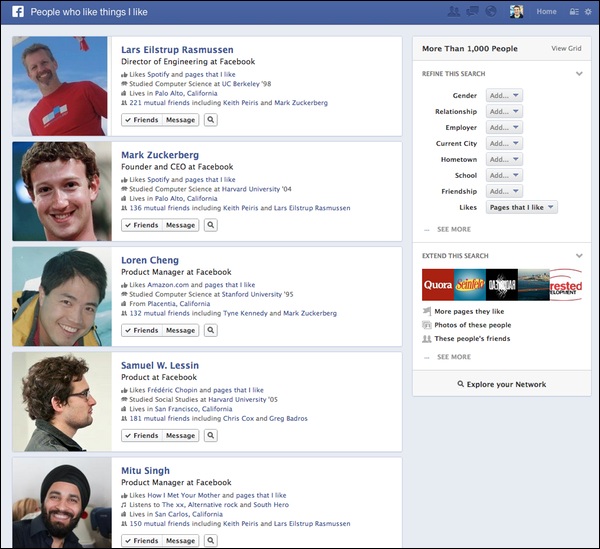
Facebook Graph Search arrives
In 2013, Facebook announced a new experience that it called Graph Search.
Facebook Graph Search relied heavily on Likes and other connections to determine what to show as the most relevant search results for each user.
At launch, Facebook Graph Search only included people, photos, places and interests.
Facebook Graph Search wasn’t a traditional web search engine like Google or Bing. It was a new type of search – a social search engine. Although Facebook was already using Bing for web search results at that time.
Dig deeper:
Also on this day
2021: The courses cover the basics including an introduction to LinkedIn Ads, how to use LinkedIn ad targeting, and reporting and analytics for LinkedIn ads.
2019: Advertisers could opt into automated bidding and tailor bids for the search ads by page placement.
2019: The directive sought to “harmonize” copyright law across Europe.
2019: The company had been using OpenStreetMap.
2018: “Pages that include matching images” section was not showing image thumbnails as it should.
2018: The image was designed by guest artist Cannaday Chapman and created in collaboration with the Black Googlers Network.
2016: In addition to recent searches, Google inserted a “What’s Hot” and “Nearby” option in the pull-down menu.
2016: The latest images culled from the web, showing what people eat at the search engine companies, how they play, who they meet, where they speak, what toys they have and more.
Google began showing the social profile links for Pixar, Apple, Starbucks, Google and many more brands.
2015: Fifty four percent of respondents said search was the top way they found mobile content/websites
2015: Desktop’s influence, while still dominant, continued to wane
2015: Google had a new and improved Structured Data Testing tool, updated its documentation and guidelines, while adding more markup support.
2015: The feature would be eliminated on Feb. 11.
2015: Google asked: “What would you like to see from Google Websearch & Webmaster Tools in 2015?”
2015: Google made four updates to the events knowledge graph, after launching the markup back in March 2014.
2015: Google Maps App added cuisine type filters and more features for iOS and Android users.
2014: Google’s Matt Cutts answered this question: “Are results in different positions ranked by different algorithms?” Spoiler alert: The answer was no.
2014: The end of an era – this was Fishkin’s final day as CEO of Moz.
2014: While still representing the largest share, Experian reported search engines experienced a 13% drop in the amount of upstream traffic sent to retailers when comparing year-over-year traffic data.
2014: Google’s share of search queries was up 0.6 percent in December 2013, to 67.3 percent
2014: EU Competition Commissioner Joaquin Almunia said Google needed to deliver additional, revised proposals within weeks to avoid a formal antitrust proceeding.
2014: What we do know: they answered at least one question about how to mount art on a brick wall.
2013: That time when Matt Cutts blog started ranking for [sreppleasers] in Google.
2013: That growth trend was down just slightly from the 21% annual increase reported for 2011.
2013: That was significantly more than the 13% who began at health portals like WebMD, general information sites like Wikipedia (only 2%) and social networks (1%).
2013: The winner would earn a $30,000 college scholarship, a $50,000 technology grant for their school, and have his or her logo displayed on the Google homepage.
2013: And they called it … PowerListings+.
2011: 13% said they couldn’t find what they were looking for. The answers were there, the “signal” that people want to tune into. They were just surrounded by a lot of noise.
2010: ComScore’s search share figures from December 2009: Yahoo, 17.3%, Bing, 10.7%. (Google? It was at 65.7%.)
2010: Amazon said it would no longer pay referral fees to Associates who sent users via keyword bidding or other paid search on any other search engine or their extended search networks
2010: The launch followed a pilot phase that the company said allowed developers to monetize mobile apps, desktop clients, social search engines and similar applications.
2009: Bartz said her instinct or “gut” was not necessarily to sell, although she would need to immerse herself in the issues and economics to make a better determination.
2009: The cuts were expected to be “far less than the 15,000 positions” first thought.
2009: The Wikipedia SearchMonkey App was turned on by default for all Yahoo search users, which made it the sixth app that all Yahoo searchers would see (with LinkedIn, Yelp, Yahoo Local, Citysearch and Zagat).
2009: TweetNews was a new search engine that used hot Twitter topics to bring more relevance and freshness to news search.
2008: Google Directory scores were much higher than those shown on the Google Toolbar.
2008: Microsoft teamed up with MediaCart to offer in-store behavioral ad targeting and took the concept of “location-based services” to the store aisles using RFID tags.
2008: How candidates, campaign staffers and other third parties were using Google Maps and the Maps API to showcase their messages and organize political volunteers and activists in upcoming primaries.
2008: Among the bidders: Google, AT&T, Verizon and MetroPCS.
2007: Among the findings: search marketers needed to be more concerned about getting into the top five rather than the top ten, if they wanted to be seen.
2007: More searchers were seeing a series of eight suggested searches as links, under the heading of “Searches related to:” followed by the original word you searched for.
2007: “It’s tiring to hear the Microsoft leadership just rip at Google rather than deliver successes that speak for themselves.”
2007: How the various search engines were trying to get users to make them their default choice.
2007: Graywolf’s blog was hacked, then Stuntdubl went down.
2007: “It’s your worst nightmare – someone reads parts of your Google emails, views your docs, modifies your spreadsheets, checks out your reading habits on the Google personalized homepage or Google Reader, and goes through your search history.”
2007: While 98% of Google employee money went to Democrats in the last election, the company-controlled Google NetPAC gave 61% of its contributions to conservative candidates.
From Search Marketing Expo (SMX)
Past contributions from Search Engine Land’s Subject Matter Experts (SMEs)
These columns are a snapshot in time and have not been updated since publishing, unless noted. Opinions expressed in these articles are those of the author and not necessarily Search Engine Land.
< January 14 | Search Marketing History | January 16 >
The post This day in search marketing history: January 15 appeared first on Search Engine Land.
Courtesy of Search Engine Land: News & Info About SEO, PPC, SEM, Search Engines & Search Marketing
Sunday, January 15th, 2023
R.I.P. AMP
In 2022, we revealed what happened when Search Engine Land shut off AMP.
TL;DR: “We have seen very little disruption to our traffic and have reaped the benefit of having a clearer picture of our audience analytics.”
We didn’t see any year-over-year declines in traffic that we could tie to AMP aside from the loss of pageviews to a handful of pieces that routinely spike for organic traffic.
Why did Search Engine Land shut off AMP? As we explained in We’re turning off AMP pages at Search Engine Land, it was due to competition in Top Stories (after AMP was no longer required for inclusion in Top Stories) and waning support by social media platforms.
Read all about it in What happened when we turned off AMP.
Also on this day
2022: It was a widespread issue, not a Google bug, related to a chat feature in Shopify that had this unintended consequence in search.
2020: You could see the projected impact of making bid or budget changes in your campaigns that used these smart bidding strategies.
2020: Pointy had solved a problem that vexed startups for more than a decade: how to bring small, independent retailer inventory online.
2019: Google removed the ability to leave comments on Google Webmaster blog because “most of the time they were off-topic or even outright spammy.”
2016: Amit Singhal, Google’s senior vice president of search, did almost all of his searches for more than a year on mobile devices.
2016: The new features: more competitive insights and benchmarking, customizable ad group and keyword bids, a new source for keyword suggestions and time range customization up to 24 months for keyword search volume.
2016: “It felt like the right time to freshen things up,” said Microsoft spokesperson.
2016: Google documented the attraction with tiny Street View cars as though it were a real place.
2015: In the past, if your images were hosted off your website’s domain, it was very unlikely Google would crawl them for Google News.
2015: Return on investment rose as revenue outpaced the rise in spending.
2015: You could track, over time, what Google Now Cards Google showed you each day.
2015: The update brought both camera and conversation mode translation to the iOS app for the first time, as well as vast improvements to those features on the Android version of the app.
2015: Historically, Google had never allowed for random people to come and visit or tour the offices.
2014: Thousands of hotels listed within Google+ Local appeared to have had links leading to their official sites “hijacked” and replaced with ones leading to third-party booking services.
2014: The feature wasn’t new. You just no longer had to dig into the “advanced image search” features to get them.
2014: Two video parodies make fun of what a Google would be if it was a real guy.
2014: A pop-up alert appeared on a Yelp business profile page and warned consumers that a Yelp sting operation had caught the company trying to acquire reviews by buying them, offering gifts or discounts, or some other way that Yelp doesn’t allow.
2013: Prior to this update, The Wayback Machine provided access to about 150 billion URLs.
2013: Kohn joined us as our Special Projects Correspondent. Marvin joined as a Contributing Writer, focusing primarily on paid advertising topics (she would go on to become Editor-in-Chief from October 2018 to December 2020).
2012: Founder Gabriel Weinberg has been taking feedback and tweaking the design for at least three-plus weeks in the site’s community forum, where he announced the new look and layout.
2011: After six years at the helm of Google Maps, Hanke said he was “restless” and was a bit tired of running a large organization.
2011: Google hit 66.6% – a record high for Google in comScore’s numbers – while AOL hit a historic low of 1.9%.
2011: In the new format, the headline was combined with the first description line, or the two description lines were combined.
2011: Police examined the data that Google collected between October 2009 and May 2010 and determined that it broke two South Korean laws.
2011: Both ads played on the Bing “decision engine” idea by having aspiring actors explain why they decided to get into acting, followed by a message that “pre-congratulates the Golden Globe winners of tomorrow.”
2011: “Q. Is Yahoo! committed to Flickr? A. Hell yes we are! We love this product and team; on strategy and profitable.”
2010: Query suggestions varied based on user location.
2010: Yahoo, Bing, and Ask.com all saw their search share drop from November to December.
2010: Another warning.
2010: Businesses could use their Place Pages to promote time-sensitive (real-time) events – as long as they could find the feature.
2010: As the new Senior Vice President of the Yahoo Search Products team, Seth would manage Yahoo’s Search team and all things related to Yahoo Search.
2010: China’s government suggested it likely wasn’t going to allow Google to operate unfiltered or negotiate with the search engine.
2010: Network Distribution allowed advertisers to select if they wanted to advertise on Yahoo’s entire network or just on either the Yahoo Search network or Yahoo Search Partner network.
2010: The massive number of new tweets coming in was to blame. The search index behind Twitter Search couldn’t hold it all.
2010: Would the entire GoogleHack episode develop into a major reversal for the growth of cloud computing? (Spoiler alert: No.)
2010: The major search engines responded by linking information about disaster relief efforts from their homepages.
2009: New links appeared at the bottom of the ad’s info window: Get Directions, Street View, and/or Save to My Maps.
2009: It used web traffic, log files and other methods to find new or modified URLs.
2009: Google ceased developing a variety of products as part of a continuing move to keep efforts focused on products with greater usage
2009: The program was aimed at developers, hosting companies and others to take on the responsibility of billing, support and training, in exchange for a 20% discount on the services.
2009: Blame the failure on the economic conditions.
2009: A complaint sought to preempt the development of behavioral targeting and profiling in mobile advertising.
2009: The ads were either are false or failed to make legally required disclosures.
2009: Yahoo matched the advertiser’s ads by the contextual relevancy of the page’s content to the keywords the advertisers purchased.
2009: Google implied the cuts would be due to the engineers not being willing or able to relocate to Google’s Mountain View headquarters.
2008: The article generated some serious spam issues for Wired, generated discord within the search marketing community, and injured the search marketing industry in general.
2008: Google CEO Eric Schmidt was a member of the Apple board and was on stage for the iPhone’s introduction.
2008: The 14 million shares came out to about $339.5 million, but gave Liberty Media Corporation about a 30 percent stake in the parent company of Ask.com.
2008: The ban seemed to have caused their stock price to drop 45% in one day.
2008: University of Brighton professor said using Google and Wikipedia doesn’t encourage students to use their “own brains” enough
From Search Marketing Expo (SMX)
Past contributions from Search Engine Land’s Subject Matter Experts (SMEs)
These columns are a snapshot in time and have not been updated since publishing, unless noted. Opinions expressed in these articles are those of the author and not necessarily Search Engine Land.
< January 13 | Search Marketing History | January 15 >
The post This day in search marketing history: January 14 appeared first on Search Engine Land.
Courtesy of Search Engine Land: News & Info About SEO, PPC, SEM, Search Engines & Search Marketing
Friday, January 13th, 2023
When Google announced the helpful content update, many in the SEO industry expected AI-generated content to get hit hard.
I was expecting AI-generated content to get wiped out by this supposedly sweeping update, comparable to 2011’s Panda algorithm update. Yet, no major impact was recorded.
Soon after, Google released the October 2022 spam update and that’s when we saw websites using AI content affected, although not as dramatically.
What happened? Let me take a few steps back.
Another vicious Panda attack?
Back in 2011, content farms were a serious problem. Many companies like Demand Media made a fortune by mass-producing low-quality articles.
They created thin content stuffed with all kinds of keyword variations taken from keyword research tools and generated similar articles for each slightly differing version of a popular search query.
Underpaid and often outsourced workers from overseas wrote about topics they had no idea about, often creating gibberish.
Panda was a significant algorithm update that even legitimate blogs were affected. How do I know? My own popular SEO blog also got penalized. I lost most of my major top 10 rankings for phrases like [url seo], [image seo] or [advanced seo] overnight, and haven’t been able to recover them ever since.
Google was under increasing pressure to deal with content farms, especially as the search engine’s then-contender, the now-defunct Blekko, promoted itself as a content farm-free alternative to Google.
Welcome to the future (of search)
We’re living in 2023 and there are still no proper flying cars and jetpacks. What we do have are breakthroughs in automation, particularly for the manufacturing and services sectors.
On the web, it’s even more obvious. Automation helps us every day with a plethora of repetitive tasks and beyond.
The work we do has changed a lot in recent years. Boring and tedious tasks are being replaced by the creative industries. Many even play for a living by being professional skateboarders or gamers, making money as content creators and influencers.
When it comes to SEO, a lot of tasks can get automated, but the results vary. The overall focus of modern SEO is on human-to-human engagement – think of audience building and outreach.
My content creator bias
As a writer, I’ve become increasingly anxious in recent years due to the rise of AI. My fear stemmed not from an imagined Terminator-like apocalypse (even though that might still happen), but more from AI’s potential impact on my own line of work.
Would AI content soon replace actual writers like myself? We don’t know yet. It hasn’t happened as of now. What we do know, though, is that some bloggers use AI content tools to create content themselves.
Saying that AI might replace writers is like saying that typewriters or computers will replace writers. Can a tool replace the person who uses the tool? Maybe for menial tasks. But is writing a menial task?
In a way, I am already using AI just by writing this article. Google Docs offers suggestions to fix my grammar – although not as many as Grammarly (which was too invasive for me) but more than what Microsoft Word provided in the past.
Get the daily newsletter search marketers rely on.
<input type=”hidden” name=”utmMedium” value=”” />
<input type=”hidden” name=”utmCampaign” value=”” />
<input type=”hidden” name=”utmSource” value=”” />
<input type=”hidden” name=”utmContent” value=”” />
<input type=”hidden” name=”pageLink” value=”” />
<input type=”hidden” name=”ipAddress” value=”” />
A look at automation in SEO
In SEO, there are many ways to automate repetitive tasks and streamline workflows using various tools.
Keyword research
No single person can compile and assess the data for proper keyword research. Even if you do not use AI or conventional keyword research tools, you at least use Google to check those keywords “manually,” while Google uses advanced algorithms, AI and all types of automation to access keyword databases.
There is indeed unethical or questionable keyword research automation, which involves crawling large numbers of Google results without authorization and causing heavy load on their servers.
That said, this is only relevant for large-scale technical SEOs, as most mere mortals will resort to common keyword research tools that might already include AI input.
Auditing websites
You can get a fully automated website audit from many SEO tools. Even though they can’t match the expertise of an SEO consultant, some are very helpful and often free.
Tools like Semrush, WooRank or HubSpot offer website auditing to inform your SEO strategy. Do not shy away from using them whenever they are helpful.
The only drawback is that some tools may cause a heavy load on a website as they crawl it in its entirety by requesting and parsing hundreds or thousands of pages, at once or in quick succession. I’m not aware of AI tools used to audit website issues but they would make sense for this use case.
Checking links (both internal and external)
Checking internal links or external links from sites that link to you and sites you link to is a classic way of using SEO tools long before AI was sophisticated enough to help with SEO tasks. Internal links can break or simply divert website authority to orphan pages or less important resources.
A well-optimized website has a structure that allows the overall authority to flow freely. AI tools could easily find and track links in ways that go beyond “push button” or “cron job” types of checks. As always, it’s important not to cause too much load on other websites.
Checking rankings
Checking rankings is similar to checking links, but with a twist. Google search results must be crawled using automated tools, which is against their terms of use. If you use ranking checkers from your local computer, your IP might get blocked by Google.
Thus, this is quite risky and should only be an option when you have nothing to lose or you’re advanced technology that either balances the usage of Google resources or obfuscates your tracks to cover up where the load comes from.
I know that some SEO tool providers have access to large server farms to fool Google into believing that legit human users are accessing their services. AI could help to alleviate the issue by causing less load or by hiding the activity better.
What about automated content?
Automating content creation is not an ideal use case. AI tools do not have the firsthand experience Google requires and is expected by readers. They merely rewrite existing knowledge using their “own” words.
In the past, lots of spammers have tried to trick Google into believing that they have content-rich sites by spinning articles and rewriting them with synonyms. Google has long since filtered this from the SERPs.
The new generation of content automation tools run by AI
Many AI content tools proliferate in the market. They have well-designed websites, and some even quote SEO experts who recommend them.
I just searched the web for AI content and found lots of services offering it. Some of these tools are.
Proof Content
Proof Content promotes itself with the slogan, “Data-driven content for brands with something to say,” and claims their AI content is “automated,” “tailored,” and “speedy.”
They use “human editors” so content is not 100% automated. One of their results examples highlights success by an “increase of 127% SEO traffic growth YOY.”
Frase
Frase emphasizes speed even more while still promising improved quality, “Better content, faster.”
They also clearly talk to SEO-driven marketers by declaring they can “create SEO content fast with AI,” adding that “going from keyword to SEO-optimized article has never been easier.”
GrowthBar
The GrowthBar AI content generator is even called growthbarseo.com in the domain name so there is no doubt that it is made to create SEO content. It also says so in its value proposition: “Make SEO … content that Google loves with AI”. It also incorporates a keyword research tool and a Chrome extension.
There is no ambiguity when it comes to the most important use case of these tools – content creation for SEO purposes.
What do the quoted experts say?
Brandan Hufford is quoted on the Frase page as saying:
- “I’ve spent a great deal of time comparing tools to get the most out of what I write, and Frase feels like you’re using content marketing cheat codes.”
Kevin Indig is cited on the same page:
- “Frase feels like a next-gen content tool that’s not just exciting for SEOs, but for writers as well. In my mind, that’s more important to create successful content.”
Thomas Melching encourages the use of GrowthBar with the following:
- “Make SEO-perfect content in one click, generate meta descriptions with AI, and keyword research. GrowthBar is game-changing and it has a free trial.”
Mark Sandusky praises GrowthBar, saying:
- “GrowthBar has helped us break into new SEO categories and write content faster. I use the Content Generator almost daily.”
Can they all be wrong? As they also do not hide their usage of AI content tools they are apparently not afraid of their projects being penalized as spam or thin content.
So, is AI content helpful or spam?
Can we clearly say whether AI content is helpful or spam? Well, we can’t. It depends.
In my opinion, AI content can be both helpful and spam.
The motivation and the effort invested in it are some factors to consider. If you invest zero effort and let the AI do 100% of the work, the risk of getting low-level content farm drivel is high.
It really depends on quality over quantity.
One thing is for sure, churning mass-produced, low-quality content makes all your content less than stellar. It doesn’t matter whether you use AI or inexperienced writers to inflate your website disproportionately, the outcome is the same.
Less is more when it comes to content production. Regular publishing is fine as long as it’s not flooding.
WordLift has an in-depth overview of how “generative AI” can work for SEO content purposes and beyond.
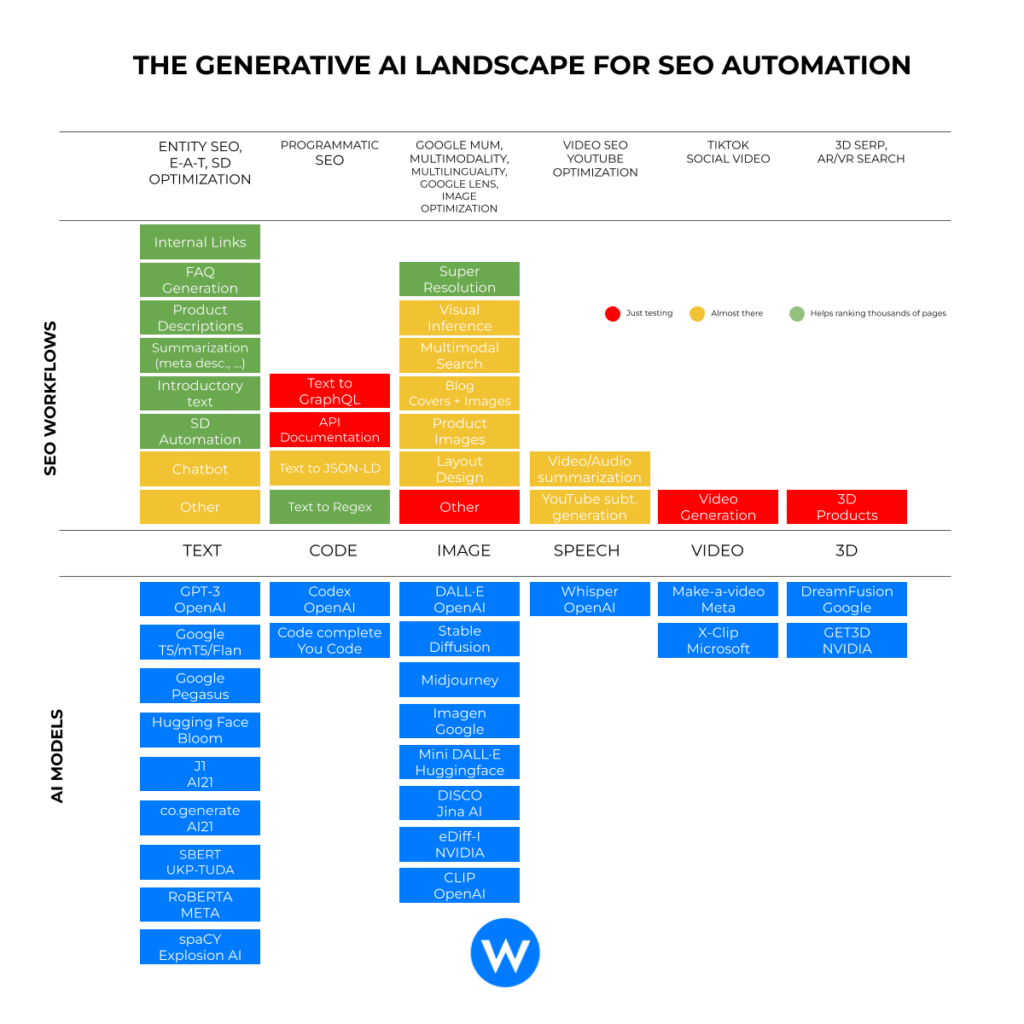 Image credit: WordLift
As of now, it mostly works well for easy content-related tasks (green) like:
- FAQ generation.
- Product descriptions.
- Summarization.
- Introductory text.
Human intervention
The key to making AI work in content creation is to double down on quality.
Implement quality control and ensure editorial content involves actual human editors. Do not let AI write and decide by itself. People must stay in charge.
This is also the feedback I got from SEOs using AI for content creation. Their content is never completely automated and there are quality checks to ensure compliance with Google’s standards.
Google Search Advocate John Mueller has been pretty clear about AI content being “still” against Google’s webmaster guidelines in April 2022.
Using AI ethically in SEO
The question of whether AI content is helpful or becomes spam essentially boils down to the ethics behind it. What is the purpose of the automation process?
Do you want to flood Google with potentially useless content just to make money from ad or affiliate revenue? Well, guess what, you are likely to spam.
Do you want to get your hands free from the menial work of rephrasing the basics that AI can gobble up from the web automatically to make sure your contribution is akin to poetry and one of a kind that nonsentient AI can’t replicate? Bingo!
Can creativity get fully automated?
Only truly intelligent AI could actually create as a human being does. Otherwise, it’s merely combining “facts” from elsewhere.
Many science fiction works have dealt with the possibility of artificial intelligence becoming fully alive. Most of those are scary dystopian visions. Some aren’t.
There is a movie that is somewhere in the middle of those two extremes called “I, Robot” starring Will Smith. Based on a novel by Isaac Asimov, a respected science fiction writer, the film captures both the essence of humanity and true artificial intelligence pretty well. Asimov comes close to answering this question. (You can read the novel on Archive.org for free.)
The post AI content: Is it helpful or spam? appeared first on Search Engine Land.
Courtesy of Search Engine Land: News & Info About SEO, PPC, SEM, Search Engines & Search Marketing
Thursday, January 12th, 2023
Artificial intelligence (AI) has been a scorching hot topic lately, especially since the launch of ChatGPT Nov. 30. Microsoft Bing has plans to add ChatGPT to search. Some have questioned whether it’s a Google killer.
Now we’re seeing more examples of brands using AI-generated content. Bankrate is the latest example. It is having some of its content written by machines but reviewed by human editors.
It’s a bold strategy (let’s see if it pays off for them). And the SEO community wanted to know Google’s policies around these efforts.
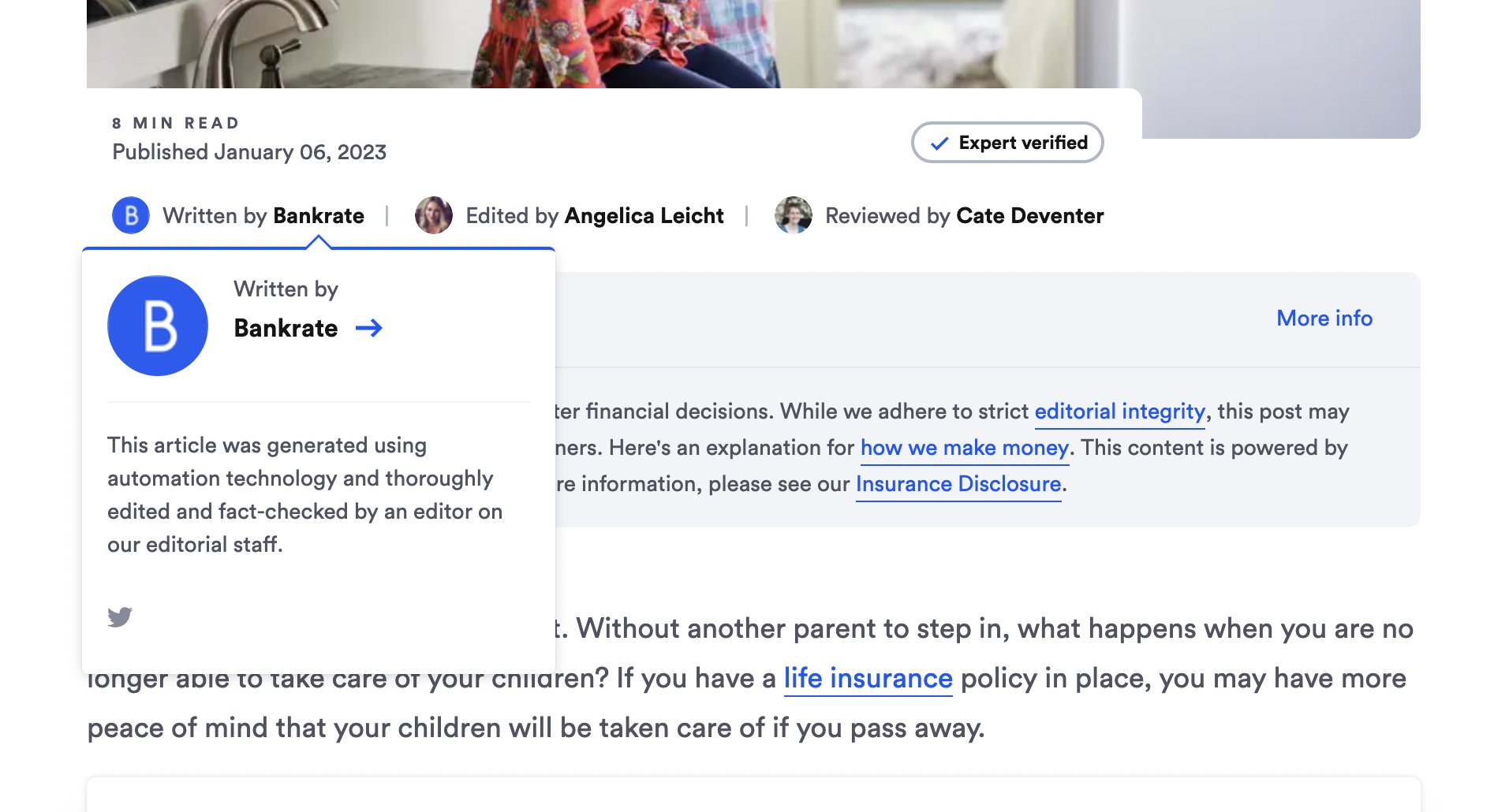
Bankrate example. The example was highlighted by Tony Hill, who posted on Twitter that “BankRate.com, one of the largest finance sites on the web has now started using AI to write some of its content. A big moment in web publishing and SEO.”
The screenshot reads “this article was generated using automated technology and thoroughly edited and fact-checked by an editor on our editorial staff.”
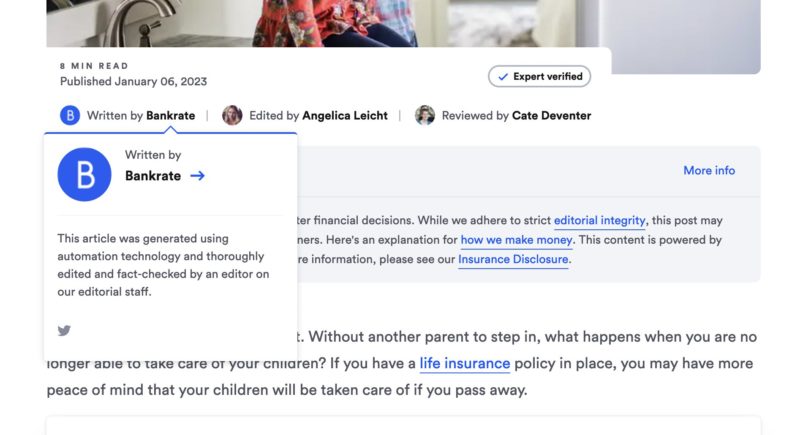
Wondering how Bankrate.com is ranking for these articles? Sistrix did an analysis to find out:
For Bankrate.com, this specific use-case and the current point in time, one can say: yes, it works.
Many , randomly-checked articles rank on the first page for both the main keyword and many other long-tail keywords
“How Bankrate.com is ranking with AI-generated text” – Johannes Beus, SISTRIX
Bankrate isn’t the only example of this. CreditCards.com is also using AI-generated content. The first line of the CreditCards.com Team author page says “Content published under this author byline is generated using automation technology.”
CNET has also quietly been using AI to write entire articles from the ground up since November.
Do a Google site search for [“This article was generated using automation technology”] will reveal dozens of CNET articles in Google’s index. CNET also assures readers that these articles have been “thoroughly edited and fact-checked by an editor on our editorial staff.”
The potential issue. If we can have machines and AI write content for us, then the amount of content that can be produced at incredibly low costs can be somewhat exciting for brands and businesses – more content for a minimal investment sounds like the stuff of dreams.
But, at the same time, mass-generated AI content can also frightening for consumers (what should you spend your time reading?) and search engines (what content should Google be ranking in search?).
So much content is being produced daily already; how much more can we consume, and how much more does Google need to crawl, index, and decide to rank for a given query?
Google’s statement on AI-generated content. Is Google OK with crawling and ranking content written by machines? If not, is Google OK if those AI-generated pieces of content are reviewed by human editors before they are published?
Danny Sullivan, Google’s Search Liason, reiterated some of what was said before about Google’s stance on this topic.
Sullivan wrote on Twitter this morning on the topic of AI-generated content, “content created primarily for search engine rankings, however it is done, is against our guidance.” But he added that “if content is helpful & created for people first, that’s not an issue.”
Sullivan then referenced their guidelines for the helpful content update, saying that the “key to being successful with our helpful content system — and if it’s not helpful content, the system catches that.”
If the AI can write helpful content, then it should be fine, one would assume.
Then Sullivan references the revised E-E-A-T quality raters guidelines, saying, “For anyone who uses *any method* to generate a lot content primarily for search rankings, our core systems look at many signals to reward content clearly demonstrating E-E-A-T (experience, expertise, authoritativeness, and trustworthiness).”
Finally, Google has a spam policy for automated content, which states “generated through automated processes without regard for quality or user experience” which is against Google’s guidelines.
Why we care. We know machine-generated content is not new, but what is new, is that the machines are getting better with the help of AI, in generating human-like, high-quality content. The question is, is it being produced with the intent of helping people or ranking in Google Search. If it is the latter, the helpful content system’s aim is to make sure such content does not rank well.
For the time being, Google wants content by the people, for the people but you can use AI for ideas and help you along the way. If machines and AI can write the content, you’d think similar technology can detect content written by AI.
The post Google search responds to BankRate, more brands using AI to write content appeared first on Search Engine Land.
Courtesy of Search Engine Land: News & Info About SEO, PPC, SEM, Search Engines & Search Marketing
Thursday, January 12th, 2023
Google has confirmed that the December 2022 link spam update is now finished rolling out. The update took 29 days to roll out, starting on December 14, 2022 and ending on January 12, 2023. Google has posted it was completed today, January 12.
What is a link spam update. A link spam update looks to neutralize, or no longer count, links that Google finds to be spammy and against Google’s guidelines. Google wrote that this launch “may change as spammy links are neutralized and any credit passed by these unnatural links are lost. This launch will affect all languages.”
First time using SpamBrain for links. This is leveraging what Google calls SpamBrain, Google referenced it in the 2018 Google spam report, specifically the spam trends section where Google talks about its “machine learning systems” to improve search spam detection.
Google added that SpamBrain can not only “detect spam directly, it can now detect both sites buying links, and sites used for the purpose of passing outgoing links.”
Nullifying link spam. Google used the word “neutralize” links, and in the previous link spam update Google used the word Google used here was “nullifying,” which does not necessarily mean “penalize,” but instead, to ignore or simply not count. Google’s efforts around link spam have been to ignore and not count spammy links since Penguin 4.0 was released in 2016.
Why we care. If you saw ranking declines in Google over this rollout period, it might be related to this new link spam update. Ensure your links are natural and follow Google’s webmaster guidelines. Work on improving your site to naturally attract new links over time.
As Google wrote with previous link spam updates, “Site owners should ensure that they follow the best practices on links, both incoming and outgoing. Focusing on producing high quality content and improving user experience always wins out compared to manipulating links. Promote awareness of your site using appropriately tagged links, and monetize it with properly tagged affiliate links.”
The post Google December 2022 link spam update done rolling out appeared first on Search Engine Land.
Courtesy of Search Engine Land: News & Info About SEO, PPC, SEM, Search Engines & Search Marketing
Thursday, January 12th, 2023
Google has confirmed that the December 2022 helpful content update is now finished rolling out. The update took 38 days to roll out, starting on December 5, 2022 but was first noticeable on December 6th, and ending on January 12, 2023. Google has posted it was completed today, January 12.
As a reminder, Google’s helpful content update is a sitewide signal. It targets websites with a relatively high amount of unsatisfying or unhelpful content, where the content is first written for search engines.
What was new with this update. The December 2022 helpful content update (aka system) is a global update, impacting all languages and not just the English language. This will help Google’s systems detect more forms of low-quality content created for search engines and primarily not for people.
Google also told us this system was updated with additional signals to help Google identify more content created primarily for search engines versus people.
What to do if you are hit. Google has provided a list of questions you can ask yourself about your content. Read through those questions as we posted over here, and in an unbiased manner, ask yourself if your content is in sync with this update.
Please note if this update has hit you, it can take several months to recover if you do everything right and make changes to your content over time.
More on the helpful content update. Google’s helpful content update specifically targets “content that seems to have been primarily created for ranking well in search engines rather than to help or inform people.”
This algorithm update aims to help searchers find “high-quality content,” Google told us. Google wants to reward better and more useful content that was written for humans and to help users.
Content written for the purpose of ranking in search engines – what you might call “search engine-first content” or “SEO content,” has been frequently written about lately and discussed across social media.
In short, searchers are getting frustrated when they land on unhelpful webpages that rank well in search because they were designed to rank well.
Google’s new algorithm aims to downgrade those types of websites while promoting more helpful websites, designed for humans, above search engines.
Google said this is an “ongoing effort to reduce low-quality content and make it easier to find content that feels authentic and useful in search.”
Why we care. If you notice any ranking and visibility changes in Google search over the past two weeks or so, especially if those were big changes, you can likely attribute it to this update. Read Google’s advice, make the necessary changes, and hope for a recovery in the upcoming months.
We hope you all benefited from this update and if not, we hope you recover quickly.
The post Google’s December 2022 helpful content update is now done rolling out appeared first on Search Engine Land.
Courtesy of Search Engine Land: News & Info About SEO, PPC, SEM, Search Engines & Search Marketing
Thursday, January 12th, 2023
A successful SEO strategy includes various must-have components, such as SEO best practices, a proper focus and connection with target audiences and competitive factors.
Best practices and audience aspects are generalized and personal to your brand. Conducting a competitor analysis is also critical, as you want to learn from brands already well-positioned in the space you want to be in.
However, there is a risk of going overboard when we play follow the leader, trying to match what the high-ranking competitor sites are doing.
Ignoring competitors or those currently ranking for topics within your target audience will hurt your chances of reaching and surpassing competitors. But focusing on them too much and copying their SEO strategies can have more damaging effects.
You definitely should know what other brands are doing and match up your strategy with what the search engines are “rewarding” those sites for doing well.
Be mindful, though, of the eight dangers of copying another brand’s SEO.
1. Brand confusion
Most companies want to build a distinctive brand image and identity. Whether it is defined best by creative, messaging, or thought leadership, the goal is to be recognized and known for something.
If your idea of building a brand is by copying another brand’s SEO too closely, you will naturally start looking and sounding like them. This leads to a danger of brand confusion and can result in a lack of awareness of your brand.
Even if you are found in Google search results and get your target audience to click through, you risk not standing out.
Your website will not be distinctive enough if you have many of the same elements as other sites, like page content, pages, navigation structure, and keyword focuses.
If the searcher comes back later and finds your competitor’s site, will they even remember you? Will you stand out?
2. Lack of connection with your audience
Copying another brand’s SEO can also lead to losing connection with your audience.
Even if you are not replicating the competitor’s branded or trademarked content (because you shouldn’t), you will not have much unique content or perspectives if you are driven by copying someone else.
Beyond brand confusion, your content won’t be original and you are less likely to provide something unique and different to your target audience.
If they can get the same content and experience elsewhere, why would they want to give you their money, time, or attention?
Copying a competitor’s SEO will lead you to make trade-offs of unique opportunities you have to authentically engage with your site visitors.
3. Duplicate content and risk of being filtered
Naturally, if you’re literally copying your competitors’ SEO, you’re at risk of copying their copy itself.
Yes, they have some things working for them that might include their web copy and content being ranked well by Google. However, there are so many variables and ranking factors that you can focus on to get ahead.
Plus, when you copy content verbatim or in spurts, expect to see your content filtered from the SERPs. Since you are not the original creator, not in the same authority status as the competitor, or not providing enough unique copy, your site will likely be the one filtered out of Google search results while the competitor continues to rank as the author or originator of the copy.
4. Potential legal action
While I see fewer threats and real legal action in organic search, it can happen.
Copying content, ignoring copyrights and trademarks or harming any business relationships that impact SEO performance can lead you closer to legal action.
I find it hard to come up with a reason to copy another brand’s SEO or to follow what they are doing so closely that you run this risk. Just don’t do it.
Even if you dodge legal action, items 1-3 above should be enough justification for not getting too close to what they are doing.
Get the daily newsletter search marketers rely on.
<input type=”hidden” name=”utmMedium” value=”” />
<input type=”hidden” name=”utmCampaign” value=”” />
<input type=”hidden” name=”utmSource” value=”” />
<input type=”hidden” name=”utmContent” value=”” />
<input type=”hidden” name=”pageLink” value=”” />
<input type=”hidden” name=”ipAddress” value=”” />
5. Being strategically reactive
Having an SEO strategy is necessary. If the primary drivers of the strategy are to copy another site’s SEO, then that’s not really a strategy.
Again, look at competitors and what’s working for them in your efforts. But, don’t follow them so closely that you’re simply reacting to everything they do. Blindly following along will keep you firmly in a position where you’re chasing them or in parody with them.
You want to include proactive aspects like:
- Exploring new content areas.
- Identifying topics to own.
- Establishing your own authority.
Beat them in areas where they aren’t competing. Find white space to fill and have a farseeing approach to get there.
6. Following a competitor’s poor strategy
Related to being reactive, you run the risk of implementing bad SEO. They could be ranking well for a key term that you want to rank for. However, they could also be doing a lot of tactics poorly.
Maybe you misjudged what SEO factors were truly driving that ranking.
What if they were heavily supported by some high-quality links and brand mentions and not propped up by their content quality?
If you copy their content strategy and don’t have those links, you’re likely going to fall flat and look bad at the same time.
Additionally, with the emergence of SpamBrain from Google and how it further evaluates the quality of content, you have more incentive to differentiate than to follow along when it comes to on-page and content SEO strategy.
7. Measuring the wrong performance metrics
While there are some great “spy” tools out there that help with analyzing competitor sites, they aren’t perfect.
You can’t truly know (unless you have CRM and analytics access or other direct sources of the competitor brand) how well the SEO strategy is working for other sites.
What you can likely see is where they are ranked and connect that with the estimated search volume for the specific rankings or queries. Sure, you can overlay some estimated or benchmark conversion data. However, the more data points you’re estimating and adding together, the more inaccurate your numbers will be.
Ideally, your focus is on your end goal. Whether that is some type of conversion to sales, leads, or other meaningful ROI aspects for your business, you’ll want to start there and work backward to know what the traffic and approach should be.
If you focus purely on your competitor’s rankings and getting to their positions, then you’re copying them without having a complete understanding of what gaining their rankings will do for your business in terms of ROI.
You can spend a lot of time and money investing in copying their SEO strategy to find out that it wasn’t worth it for your specific needs, even if it helped you get on par with their rankings.
8. Risk against new competitors
If you’re overly focused on copying another brand’s SEO, you might fail to pay attention to the wider landscape.
I have had clients focused on one or two other companies jockeying for the top spot, answer boxes, and other prime real estate in the SERPs. So focused, that months down the road, a new competitor – or set of competitors – emerged looking much different and leapfrogged the long-established top-ranking sites.
Having the blinders on looking at a single site or two can cause a narrow SEO focus for all the reasons previously mentioned. It also puts you in danger of being overtaken by newer competitors and those with a different and better strategy for building authority status and relevant content.
Develop your own unique SEO strategy
Remember that applying best practices, focusing on your audience, and paying attention to the competitive landscape are all important for a solid SEO strategy. Doing just one or two won’t get you as far in terms of rankings, traffic and conversion goals.
Competitor analysis and reverse engineering can be useful. However, when you know who is ranking well or seemingly doing well in the space you want to own, be mindful of the dangers of copying their brand’s SEO strategy.
There’s a balance between matching up well with competitors on ranking factors, helpfulness to the audience, and gaining visibility without selling out your own brand or getting on the wrong kinds of radars legally.
Plus, you want to be as resistant as possible to their mistakes taking you down or taking your focus off of those coming up behind you. Leverage the information, but include it in your broader SEO strategy to gain the benefits and minimize the dangers.
The post 8 dangers of copying another brand’s SEO appeared first on Search Engine Land.
Courtesy of Search Engine Land: News & Info About SEO, PPC, SEM, Search Engines & Search Marketing
Wednesday, January 11th, 2023
Starting next month, Meta will remove the option for targeting advertising to teen users based on gender. They’ll also end advertisers’ ability to target personalized ads to under-18 users based on their in-app activity, including who they follow on Instagram and what Facebook pages they like.
After the changes take effect, personalized ads on Facebook and Instagram will only draw on a user’s age and location to determine relevance (where location is necessary to assess which products and services are available in a user’s area).
Facebook and Instagram will soon roll out new controls for teen users (kids under age 13 aren’t allowed on those apps — technically). Teens will be given an option to “see less” of a given topic, shaping which ads the platform will serve them.
Why we care. Advertisers will no longer be able to target users under the age of 18 based on in-app activity nor target their age or location, except where relevant. You’ll need to restrategize if you advertise a product or service to users under 18.
Not new. Meta recently rolled out new privacy updates for everyone under the age of 16, or 18 in some countries. Starting in November, teens will default to more private settings when they join Facebook. For teens already on the platform, Meta recommends making these changes manually. The new privacy settings affect:
- Who can see their friends list
- Who can see the people, Pages and lists they follow
- Who can see posts they’re tagged in on their profile
This month Meta was fined 390 million euros ($414 million) after European Union (EU) regulators found it had illegally forced users to accept personalized ads.
Google blocks ad targeting for kids under 18. In 2021 Google updated its policies around minors online, letting those under 18 remove images from search. “Children are at particular risk when it comes to controlling their imagery on the internet. In the coming weeks, we’ll introduce a new policy that enables anyone under the age of 18, or their parent or guardian, to request the removal of their images from Google Image results,” wrote Mindy Brooks, product and UX director for kids and families at Google.
YouTube will change the default upload mode to private for kids aged 13-17. SafeSearch will be automatically turned on for those under 18 using Google Search. Those under 18 will not be able to turn on their location history.
The post Meta introduces new ad targeting limits for teens appeared first on Search Engine Land.
Courtesy of Search Engine Land: News & Info About SEO, PPC, SEM, Search Engines & Search Marketing