Archive for the ‘seo news’ Category
Sunday, January 29th, 2023
Google penalizes French link network
In 2014, Google’s Matt Cutts tweeted, “Today we’re taking action on a French link network that violates our quality guidelines (Buzzea).”
Buzzea was less than thrilled about being called a link network, saying they “oppose this assertion since we never stopped wanting to keep the ethical side of sponsored articles focusing on quality and natural links created.” As a result of the penalty, Buzzea officially called it quits.
Read all about it in Google Takes Down Another Link Network, France’s Buzzea.
This was hardly the first link network Google had gone after:
Buzzea would be just the first of several link networks Google identified and took action against later in 2014:
Also on this day
2021: Citing advertisers’ brand safety concerns, Facebook said the feature would allow marketers to choose whether to show their ads alongside potentially sensitive content.
2020: URLs shown in featured snippets that appeared in the right rail of Google desktop results would continue to be included in the main organic listings.
2020: In this installment of Barry Schwartz’s vlog series, he chatted with Barone about the older days of SEO and then moved on to how her career has changed over the years.
2019: Search marketing experts offered feedback on when to pay for search analytics tools, factors to consider and making the most out of what you buy.
2019: Google added a microphone to the Google.com search field on Android phones to enable mobile web voice search.
2018: A button in the beta Search Console explained why all of the old reports had not been migrated.
2018: Bing and Yahoo saw search ad spend jump 32% year-over-year. Google spend slowed slightly from Q3.
2016: Retail advertising spend on mobile Shopping ads nearly doubled year-over-year in Q4.
2016: The latest images showing what people eat at the search engine companies, how they play, who they meet, where they speak, what toys they have and more.
2014: That was Cutts’ answer to “Should I build links using article directories?”
2014: Two previous antitrust settlements were strenuously opposed and thus defeated by Google critics and competitors.
2014: Google was asked to pay $15.8 million in 2012. The plaintiffs were also seeking ongoing royalties, which the court awarded.
2014: There were also “photos,” “people you follow” and “near you” filters to further refine results.
2014: Bing also measured player searches, with Broncos’ quarterback Peyton Manning winning 72% of the searches over Seahawks’ quarterback Russell Wilson.
2014: iOS and Android users could earn Bing Rewards credits (toward gift cards for brands like Amazon, Xbox and Dominos) by performing searches on their phone.
2013: Those advertisers were rewarded with higher click-through rates and lower cost-per-click than text ads.
2012: Images and reviews were very important in capturing users’ eye movements and clicks.
2011: Google was seeing millions of calls every month and it had become a core part of a large number of mobile search ad campaigns.
2010: When you visited Google Images on a smartphone, you would see “popular images” and a link to browse more popular images.
2010: Google confirmed it was “testing a feature in which text ads on Google search results pages may include star ratings and links to third party sites that have reviewed the advertiser’s business.”
2010: Online Services, which housed online advertising and Bing, reported $581 million in revenue vs. $609 million the prior year ago.
2010: It is a basic search engine, playing on the Google name and Google logo.
2009: The new interface looked similar to the charting/graphing system that Google Analytics used.
2009: The sites you visited most often were listed when you opened a new blank tab in Firefox.
2009: Hitwise research suggested that 72% of the site’s Top 50 search terms from December 2008 were music-related.
2009: You could add it to your Firefox search box manually via the add-on from Live Search.
2009: Google’s TV Ads team announced the addition of new metrics detailing time-shifted ad viewings.
2009: Known widely by his online handle lazerzubb, he was a fixture at various events.
2009: Google said the image was removed because of several requests from users using the Street View image removal option.
2008: Google’s Matt Cutts confirmed the behavior and said Google had already begun reversing it.
2008: This was a huge deal for Microsoft, giving their ad program exposure to 20 million unique users and over 330 million page views per month.
2008: It was “open warfare” between IAC CEO Barry Diller and Liberty Media, one of its largest backers and investors.
2008: A UK woman was convicted of trying to murder her husband after researching methods on Google.
2007: Brin was arguing that some information is better than no information.
2007: ‘Twas a hoax.
2007: Just lots of rumors.
2007: Tribune had struck a deal that had Topix providing content and a back-end platform for general merchandise classifieds on their newspaper sites.
2007: Wikio blended articles from major news web sites and blogs with commentary and tags from Wikio users.
From Search Marketing Expo (SMX)
Past contributions from Search Engine Land’s Subject Matter Experts (SMEs)
These columns are a snapshot in time and have not been updated since publishing, unless noted. Opinions expressed in these articles are those of the author and not necessarily Search Engine Land.
< January 28 | Search Marketing History | January 30 >
The post This day in search marketing history: January 29 appeared first on Search Engine Land.
Courtesy of Search Engine Land: News & Info About SEO, PPC, SEM, Search Engines & Search Marketing
Friday, January 27th, 2023
A former employee allegedly leaked a Yandex source code repository, part of which contained more than 1,900 factors the search engines uses for ranking search results.
Why we care. This leak has revealed 1,922 ranking factors Yandex used in its search algorithm, at least as of July 2022. Perhaps Martin MacDonald put it best on Twitter today: “The Yandex hack is probably the most interesting thing to have happened in SEO in years.”
Yandex is not Google. If you plan to read the full list of Yandex ranking factors, remember that Yandex is not Google. If you see a ranking factor listed by Yandex, that doesn’t mean Google gives that signal that same amount of weight. In fact, Google may not use all of the 1,922 factors listed.
That said, a lof of these ranking factors may be quite similar. So reviewing this document may provide some useful insights to better help you understand how search engines, such as Google, work from a technological standpoint.
The bigger picture. The code appeared as a Torrent on a popular hacking forum, as reported by Bleeping Computer:
…the leaker posted a magnet link that they claim are ‘Yandex git sources’ consisting of 44.7 GB of files stolen from the company in July 2022. These code repositories allegedly contain all of the company’s source code besides anti-spam rules.
Yandex calls it a leak. Because the code appeared on a popular hacking forum, it was first thought that Yandex was hacked. Yandex has denied this, and provided the following statement:
“Yandex was not hacked. Our security service found code fragments from an internal repository in the public domain, but the content differs from the current version of the repository used in Yandex services.
A repository is a tool for storing and working with code. Code is used in this way internally by most companies.
Repositories are needed to work with code and are not intended for the storage of personal user data. We are conducting an internal investigation into the reasons for the release of source code fragments to the public, but we do not see any threat to user data or platform performance.”
Dig deeper. You can find more coverage of the leak on Techmeme.
Yandex ranking factors list. MacDonald shared the full list of 1,922 factors here on Web Marketing School. I highly recommend downloading it, as I fully expect Yandex will try to scrub this information from the internet. There is also a translated version on Dropbox.
Alex Buraks also has an ongoing Twitter thread analyzing the various ranking factors. Many are what you’d expect to see – PageRank, text relevancy, content age and freshness, lots of end-user behavior factors, host reliability and many link-related factors (e.g., age, relevancy, etc.)
Some of the ranking factors SEOs are finding surprising: number of unique visitors, percent of organic traffic and average domain ranking across queries.
The post Yandex ‘leak’ reveals 1,922 search ranking factors appeared first on Search Engine Land.
Courtesy of Search Engine Land: News & Info About SEO, PPC, SEM, Search Engines & Search Marketing
Thursday, January 26th, 2023
Interest in AI technology and, more specifically, OpenAI’s ChatGPT product has skyrocketed in recent weeks.
People are looking for information about both topics.
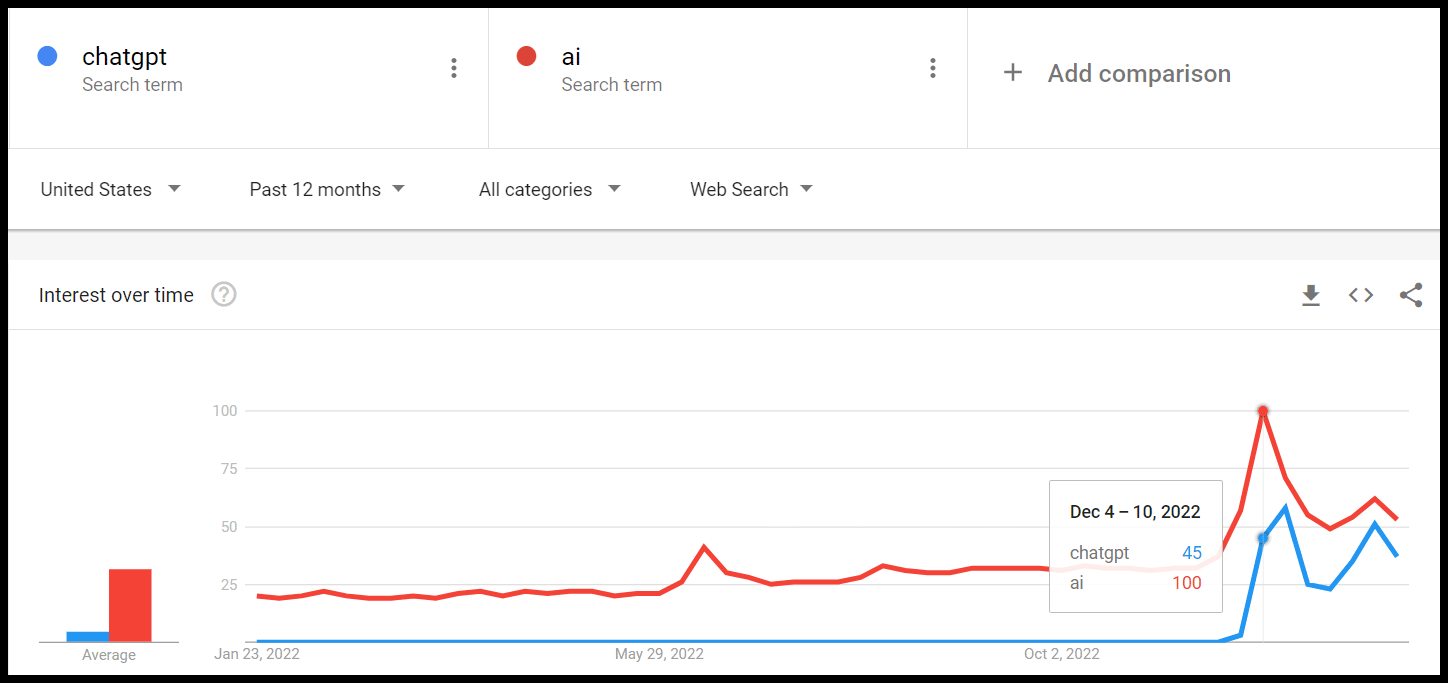
Source: Google Trends
Thousands are writing about ChatGPT across the web…

Source: Google Search
…and talking about it in various communities.
And as you can tell from the graphs, all of this happened quickly.
Whether your Twitter and LinkedIn feeds have been inundated with threads and posts about ChatGPT (like mine) or you’re just stumbling on the topic, you may want answers to two questions before investing your time and energy into learning ChatGPT:
- Is ChatGPT specifically likely to be an enduring product?
- What does it actually do and what can you personally use it for?
In this article, I’ll help you answer these questions by telling you:
What is ChatGPT?
ChatGPT is an AI-powered chatbot created by OpenAI that can be accessed at https://chat.openai.com/.
As of this writing, ChatGPT offers a free version of the tool that users can access, but there have been indications that they will be charging $42/month for a pro version. OpenAI has also indicated that they’ll make an API for the tool available soon.
The interface is simple, with an empty dialog to enter a prompt. The tool can perform various tasks and return text in response. Some examples of tasks ChatGPT can execute include:
- Answering questions.
- Writing things like ads, emails, paragraphs, whole blog posts, or even college papers.
- Writing, commenting or marking up code.
- Changing the formatting on a block of text for you.
ChatGPT launched in late November 2022, on the heels of AI Content Generator Jasper.ai receiving $125 million in funding at a $1.5 billion valuation earlier the same month. The tool reached a million users in less than a week.
ChatGPT launched on wednesday. today it crossed 1 million users!
— Sam Altman (@sama) December 5, 2022
But each session has a specific cost associated with it:
average is probably single-digits cents per chat; trying to figure out more precisely and also how we can optimize it
— Sam Altman (@sama) December 5, 2022
In the interest of helping fund those costs (and further growth) Microsoft invested $10 billion in OpenAI at a $29 billion valuation. A move which, combined with ChatGPT’s growth and word of mouth, might be fueling Google’s reported concerns about ChatGPT as a possible threat.
OpenAI has also indicated that there will be a “professional” version of the tool and Greg Brockman the President & Co-Founder of OpenAI shared a link to a Google Form to get on the waitlist:
Working on a professional version of ChatGPT; will offer higher limits & faster performance. If interested, please join our waitlist here: https://t.co/Eh87OViRie
— Greg Brockman (@gdb) January 11, 2023
Some users have reported seeing an option to upgrade to a $42 free version when logged into their account.
Even with the Microsoft investment, ChatGPT has continued to experience outages and even had to limit new users on the platform:
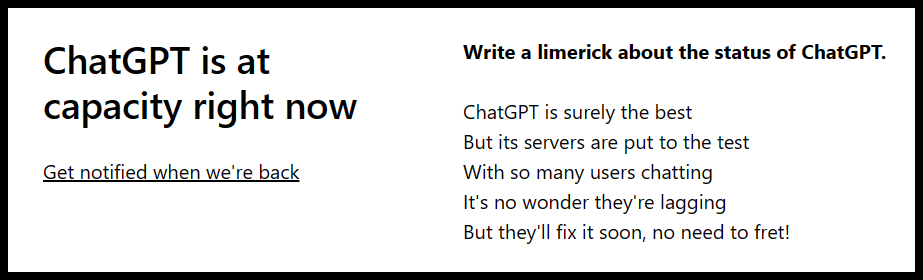
And ChatGPT is starting to face criticisms over the accuracy of some of the output of the tool, while also staring down competition from rivals (which one would have to assume will only increase and intensify in the wake of the platform’s early success).
Now that you know what ChatGPT is, it’s also helpful to understand a bit more about how it works and who built it (and what their goals and motivations may be).
Get the daily newsletter search marketers rely on.
<input type=”hidden” name=”utmMedium” value=”” />
<input type=”hidden” name=”utmCampaign” value=”” />
<input type=”hidden” name=”utmSource” value=”” />
<input type=”hidden” name=”utmContent” value=”” />
<input type=”hidden” name=”pageLink” value=”” />
<input type=”hidden” name=”ipAddress” value=”” />
How does it work and how was it trained?
If you’re an SEO looking for ways to leverage AI in your everyday work, you don’t need to know how to build your own chatbot.
That said, when using tools like ChatGPT, you will want to know where the information it generates comes from, how it determines what to return as an answer, and how that might change over time.
That way you can understand what level of trust to put in the output of ChatGPT chats, how to better craft your prompts, and what tasks you may want to use it for (or not use it for).
Before you start to use ChatGPT for anything, I’d strongly recommend you check out OpenAI’s own blog post about ChatGPT. There they have a nice graphic explaining how it works, along with a more in-depth explanation.
AssemblyAI also has a detailed third-party breakdown of how ChatGPT works, some of its strengths and weaknesses, and a number of additional sources if you’re looking to dive deeper.
One of the most important things to remember about how ChatGPT works is its limitations. In OpenAI’s own words:
“ChatGPT sometimes writes plausible-sounding but incorrect or nonsensical answers. Fixing this issue is challenging, as: (1) during RL training, there’s currently no source of truth; (2) training the model to be more cautious causes it to decline questions that it can answer correctly; and (3) supervised training misleads the model because the ideal answer depends on what the model knows, rather than what the human demonstrator knows.”
Another that’s important to highlight:
“While we’ve made efforts to make the model refuse inappropriate requests, it will sometimes respond to harmful instructions or exhibit biased behavior. We’re using the Moderation API to warn or block certain types of unsafe content, but we expect it to have some false negatives and positives for now. We’re eager to collect user feedback to aid our ongoing work to improve this system.”
As many people know, the ChatGPT was fine-tuned on a GPT model which finished training in early 2022 – meaning it won’t have knowledge of more current events.
It is also trained on a “vast amount” of text from the web, so of course answers can be incorrect. From ChatGPT’s own FAQs:
“Can I trust that the AI is telling me the truth?
ChatGPT is not connected to the internet, and it can occasionally produce incorrect answers. It has limited knowledge of the world and events after 2021 and may also occasionally produce harmful instructions or biased content.
We’d recommend checking whether responses from the model are accurate or not. If you find an answer is incorrect, please provide that feedback by using the “Thumbs Down” button.”
Who built ChatGPT?
Similarly, understanding who built the application and why is an important background if you hope to use it in your day-to-day work.
Again, ChatGPT is an OpenAI product. Here’s some background on the company and their stated goals:
- OpenAI has a non-profit parent organization (OpenAI Inc.) and a for-profit corporation called OpenAI LP (which has a “capped profit” model with a 100x profit cap, at which point the rest of the money flows up to the non-profit entity).
- The biggest investor is Microsoft. OpenAI employees also own equity.
- Former Y Combinator President Sam Altman is the CEO of OpenAI and was one of the original founders (along with prominent Silicon Valley personalities such as Elon Musk, Jessica Livingston, Reid Hoffman, Peter Thiel, and others). Many people ask about Musk’s involvement in the company and ChatGPT. He stepped down as a board member in 2018 and wouldn’t have had any meaningful involvement in the development of ChatGPT (which obviously didn’t launch until November 2022).
Notable elements here if you’re interested in ChatGPT either as an SEO or as a viable alternative to Google are obviously:
- Microsoft’s involvement (with Microsoft Bing being the number 2 search engine – a distant second behind Google).
- ChatGPT obviously isn’t designed to specifically be either an SEO or a content tool (unlike tools like Jasper.ai, Copy.ai and other competitors – many of which are built on top of the GPT-3 framework).
Why should SEOs care about ChatGPT?
While it’s possible that ChatGPT or another AI-powered chatbot could become a viable alternative to Google and traditional search, that’s likely at least far enough away that most SEOs won’t be primarily concerned with the tool for that reason. So why should SEOs care?
ChatGPT has a variety of functionality that can be helpful for SEOs. Additionally, given the platform’s ability to generate AI content, it’s important to understand both what the tool is capable of on that front, and how Google talks and thinks about AI content generally.
What follows are ChatGPT’s use cases for SEO.
AI content generation
By far the “buzziest” early 2023 SEO topic has been AI content broadly, and ChatGPT has been at the center of that discussion since it launched.
From creating blog posts whole cloth to selecting images, generating meta descriptions or rewriting content, there are a number of specific functions ChatGPT can serve when it comes to content creation generally and SEO-focused content creation specifically.
But, of course, an important concern here is how Google thinks about AI content in general.
SEOs need to identify the specific instances where ChatGPT can make them more efficient or enhance their content. At the same time, it’s crucial to understand the potential risks to rankings and organic traffic when using ChatGPT-generated content in different ways (particularly if you’re relying on content created by writers you don’t have a relationship with).
Keyword research and organization
Similarly, there are a number of specific tasks ChatGPT can execute related to keyword research and optimization, such as:
- Suggestions for keywords to target or blog topics.
- Keyword clustering or categorization.
A key consideration for SEOs is how this relates to your current and optimal processes for these tasks.
ChatGPT isn’t designed to be an “SEO tool,” so won’t have the emphasis on search volume, competition, or relevance and co-occurrence that more focused keyword research or organization tools will.
Code generation and technical SEO
ChatGPT is helping people generate code and build things, and it’s no different for specific technical SEO tasks.
Depending on the prompts, ChatGPT can help with things like schema markups, robots.txt directives, redirect codes, and building widgets and free tools to promote via link outreach, among others.
As with any type of content creation, you must QA the code that ChatGPT generates. Your site’s template, hosting environment, CMS, and more can break if the code ChatGPT generates is incorrect.
Link building
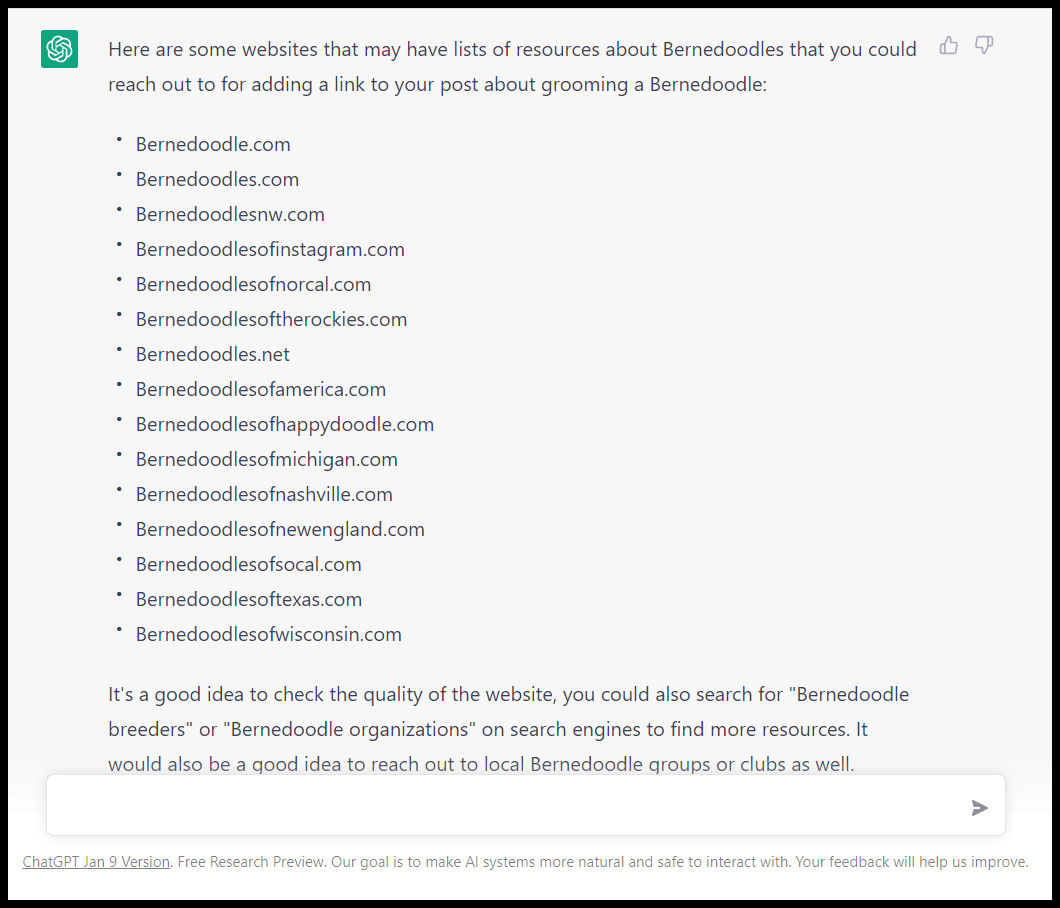
ChatGPT can generate lists of outreach targets, emails, free tool ideas, and more that may assist with link building work.
Here again (you may be sensing a theme) two things to keep in mind:
- Since ChatGPT was not built to be a link building tool, it may not prioritize opportunities or generate ideas that will specifically help with SEO success.
- GPT-3 is trained on old data, so the information you’re getting may be wrong or outdated.
How to think about ChatGPT as an SEO
Ultimately, given its early functionality and reception along with OpenAI’s founding team and investors (and level of investment), ChatGPT is likely to have longevity as a tool.
It’s highly useful, with a high potential for getting folks who misuse it into trouble.
I would encourage SEOs to become familiar with ChatGPT (and tools like it) and get used to carefully checking its output.
The post What is ChatGPT and why SEOs should care appeared first on Search Engine Land.
Courtesy of Search Engine Land: News & Info About SEO, PPC, SEM, Search Engines & Search Marketing
Thursday, January 26th, 2023
Twitter just launched a beta program that’s available to all advertisers called Search Keyword Ads. The announcement was made on Twitter.
How it works. Twitter says “Now advertisers can bid to insert Promoted Tweets solely among specific search results, reaching people with high real-time intent & improving ad relevance.”
“Search Keywords Ads differ from other Twitter Keywords campaigns in that they only reach people who are searching for targeted terms when they are searching, offering a stronger signal of intent.”
Why we care. If you’re one of the remaining few advertisers left on Twitter, give Search Keyword Ads a try. The new ads can be an effective way for marketers to reach their target audience at the right time and with the right message, potentially leading to better conversion rates and ROI.
Additionally, this feature provides more specific targeting options to reach audiences, it can help to improve the effectiveness of campaigns and lower the cost of reaching targeted audiences.
Today we are rolling out Search Keywords Ads to all advertisers as a beta test 
— Twitter Business (@TwitterBusiness) January 25, 2023
Millions of people on Twitter search for what's happening every day.
Now advertisers can bid to insert Promoted Tweets solely among specific search results, reaching people with high real-time intent & improving ad relevance.
— Twitter Business (@TwitterBusiness) January 25, 2023
Search Keywords Ads are a new Conversion 'campaign objective' in the Twitter Ads interface.
For now, these campaigns will optimize only for conversions to advertiser websites, and they require the integration of the Twitter Pixel or Conversion API (CAPI) to maximize relevance. pic.twitter.com/xCowp8yvfL
— Twitter Business (@TwitterBusiness) January 25, 2023
Existing Keywords targeting will still function as before for all other objectives.
Search Keywords Ads differ from other Twitter Keywords campaigns in that they only reach people who are searching for targeted terms when they are searching, offering a stronger signal of intent.
— Twitter Business (@TwitterBusiness) January 25, 2023
We’ll expand this capability to support other campaign objectives soon.
— Twitter Business (@TwitterBusiness) January 25, 2023
The post Twitter has launched a Search Keyword Ads beta test to all advertisers appeared first on Search Engine Land.
Courtesy of Search Engine Land: News & Info About SEO, PPC, SEM, Search Engines & Search Marketing
Thursday, January 26th, 2023
Google strong-armed ecommerce marketers into Performance Max campaigns in 2022 by deprecating Smart Shopping and Local campaigns in favor of fewer levers and more AI-driven results.
As I wrote in a column looking back on Google’s biggest 2022 moves, most advanced search marketers begrudged this direction since more controls provide good marketers more room to outpace their peers, giving their brands a competitive edge.
B2B marketers weren’t nearly as broadly impacted by the move to Performance Max, since their old campaign structures remained unchanged by Google.
There’s no denying, however, that the writing is on the wall. Google is moving hard toward machine learning and AI, which means Performance Max may well be the lay of the entire Google search land in the near future.
So as we get into the teeth of 2023, how should B2B marketers approach Performance Max?
Get the daily newsletter search marketers rely on.
<input type=”hidden” name=”utmMedium” value=”” />
<input type=”hidden” name=”utmCampaign” value=”” />
<input type=”hidden” name=”utmSource” value=”” />
<input type=”hidden” name=”utmContent” value=”” />
<input type=”hidden” name=”pageLink” value=”” />
<input type=”hidden” name=”ipAddress” value=”” />
Failing to plan might be planning to fail
If I were a betting person, I’d put down some money on the idea that Google will begin steering B2B campaigns toward Performance Max this year.
If that happens, marketers who are more aggressive in familiarizing themselves with the ins and outs will have a leg up when Google takes away other campaign options.
If your search campaigns are in a position to do so, I’d suggest you begin to test Performance Max ASAP.
That said, here are some conditions I strongly recommend you meet before you devote any budget to testing:
- You must have fully funded search campaigns to justify moving some discretionary budget to Performance Max. This means that you’ve built out all the keyword themes that make sense and have achieved solid market share for them. In other words, if you have a small budget, don’t compromise the pursuit of your full search opportunity at hand by testing Performance Max campaigns.
- Your account has a healthy volume of conversion data through search.
- For reasons we’ll get into in a minute, you must have reliable offline conversion data syncing to your account.
- To engage the right people, you must have good, rich audience lists and a solid definition of your ICP.
If you meet all these conditions, you’re good to go – with some additional caveats and best practices I’ll spell out now.
1. Stay skeptical
The idea behind Performance Max is that it delivers your ads to the right people wherever they are – Discover, Gmail, Maps, YouTube, Display Network, etc.
You’re using automatic bidding and trusting that Google’s algorithm can discern valuable levels of intent.
That said, Google’s algorithm is still learning, and it has built a history of optimizing for spend over efficiency.
As you approach Performance Max, look for ways to strong-arm the algorithm into doing what you want it to.
2. Get your first-party data ready
CRM data is vital for Performance Max campaigns in general for a couple of reasons, both of which apply in force for B2B – audience quality and offline conversions.
Let’s tackle offline conversions first. If we simply rely on pixels that fire for leads as signals for Performance Max, we’ll set ourselves up for failure.
Consider the lead spam most B2B campaigns have to sift through, then understand that Performance Max will take the path of least resistance to get the “desired” action.
Without integrating a layer of CRM data and telling Performance Max to optimize toward MQLs, SQLs or opportunities (essentially, whatever your most valuable stage is that also carries enough data volume for PMax to use effectively), the system will optimize toward leads, using up your budget to keep bringing in ROI-unfriendly amounts of spam.
On the audience side, remember, Performance Max uses the signals you give to find the right users. Signals might incorporate audience lists like current customers, closed/won opportunities, etc.
Performance Max, like Similar Audiences, isn’t constrained to the audience lists you give Google. It might even be a little broader than Similar Audiences, given that it extends across GDN, Gmail, and YouTube.
So, button up your lists and make sure the common attributes are clear enough for Performance Max to read and react to in its targeting.
The upshot? Google doesn’t have great built-in B2B targeting, so stay away from using their audiences and give it enough volume and clarity to work with.
3. Experiment
When approaching Performance Max setup, keep in mind that you can do experiments.
But there’s a caveat – you only have visibility into results at the campaign level. Thus, I recommend testing at least two Performance Max campaigns, each relying on different audience signals, to see which is more effective.
Note: To make the two-experiment setup work, you’ll have to be able to carve out enough budget to make the findings clear and actionable.
4. Get familiar with reporting – and act on results quickly
One of Google’s better releases in 2022, Custom Columns, allows advertisers to see offline conversions at the campaign level, even for Performance Max campaigns:
Beyond that, Performance Max reporting diverges from familiar ad group-level reporting and breaks everything into asset groups, providing a view of all provided assets and possible combinations.
We’ve found the campaign-level view to be most helpful, which is why I recommend starting with at least two campaign-level experiments.
Once you’re relatively fluent with the reporting structure, keep a close eye on quality and opportunities to add negatives, whether keywords or placement exclusions, to shore up efficiency.
Making Performance Max work for B2B
My overall take on Performance Max is that Google hasn’t yet put much effort into making the product work for B2B or lead gen.
Make sure to keep a close eye on results and quality, using any levers in your control to keep Google focused on your best potential user. Establish clear goalposts and standards for when to pull the plug.
In a best-case scenario, Performance Max will be a pleasant surprise and enable you to access a larger pool of valuable users at reasonable CPLs.
But if you take my advice, even a worst-case scenario with some fruitless spend will give you valuable insights into the future of Google for B2B.
The post Performance Max for B2B: 4 best practices appeared first on Search Engine Land.
Courtesy of Search Engine Land: News & Info About SEO, PPC, SEM, Search Engines & Search Marketing
Thursday, January 26th, 2023
Google is opening access to the local car inventory beta feature to all US dealerships using the cars for sale feature in Google Business Profiles. Greg Gifford reports that Google has opened this beta feature now to all US-based dealerships.
Cars for Sale open. Google has opened up the “Cars for Sale” feature in Google Business Profiles to any product with a vehicle identification number (VIN). “Until this week, only US-based car dealers could list their inventory on their Google Business Profiles. Now, anything that has a Vehicle Identification Number is eligible to be listed. That means motorcycles, RVs, powersports, and Commercial vehicles are all allowed now,” Gifford explained.
What it looks like. Here is a GIF of this cars for sale feature in action while in beta:
More details. Google has a dedicated section about this feature over here, where it is called “vehicle listings.” Google wrote, “Vehicle listings on Google allows businesses to display their for sale vehicle inventory on various Google surfaces, including dealerships’ Business Profiles and Google Search. Google users can then search, filter, and easily learn more about vehicles for sale such as availability, pricing, and key information about the vehicles for sale, potentially directing customers to your business.”
To manage vehicle listings through your Business Profile account, perform the following steps:
- Access your web Business Profile account at business.google.com/locations.
- Select See your profile for the business that you want to change settings for.
- Click Edit profile, and then click Vehicle listings.
To manage your vehicle listings through a Google Search, perform the following steps:
- Search for your business’s name or “my business” on Google Search.
- Click Edit profile, and then click Vehicle listings.
Why we care. You probably want to jump on this feature if you work for an auto dealership. Listing your vehicles in Google Search and the local search results may help you get more customers in your showroom and potentially lead to more sales.
The post Google rolling out cars for sale in Google Business Profiles appeared first on Search Engine Land.
Courtesy of Search Engine Land: News & Info About SEO, PPC, SEM, Search Engines & Search Marketing
Wednesday, January 25th, 2023
Apple recently launched Business Connect to enable businesses to easily claim and optimize their Apple Maps locations. Getting started as a single or multi-location business only takes a few minutes.
Once you have set up and claimed your locations, you will have access to view and edit your Place Cards. This includes:
- Updating your location details.
- Adding photos.
- Publishing showcases.
- Reviewing the performance and engagement of your locations on Apple Maps.
Apple Business Connect offers three different workflows:
- Small businesses.
- Enterprise brands with 25 or more locations.
- Third-party partners that manage data on behalf of other businesses and can submit this data via API.
In this article, you’ll learn how to get started with Apple Business Connect.
Getting started with Apple Business Connect
First, create an Apple ID if you don’t already have one.
Next, go to the Apple Business Connect website, choose your business type (small, enterprise, or third-party partner), and sign in with your Apple ID.
If you are a brand leveraging a third party to submit and access data via API, you’ll still need to set up and claim your first location in Business Connect. You will then have the option to delegate your account to an agency that can add the remaining of your locations in bulk.
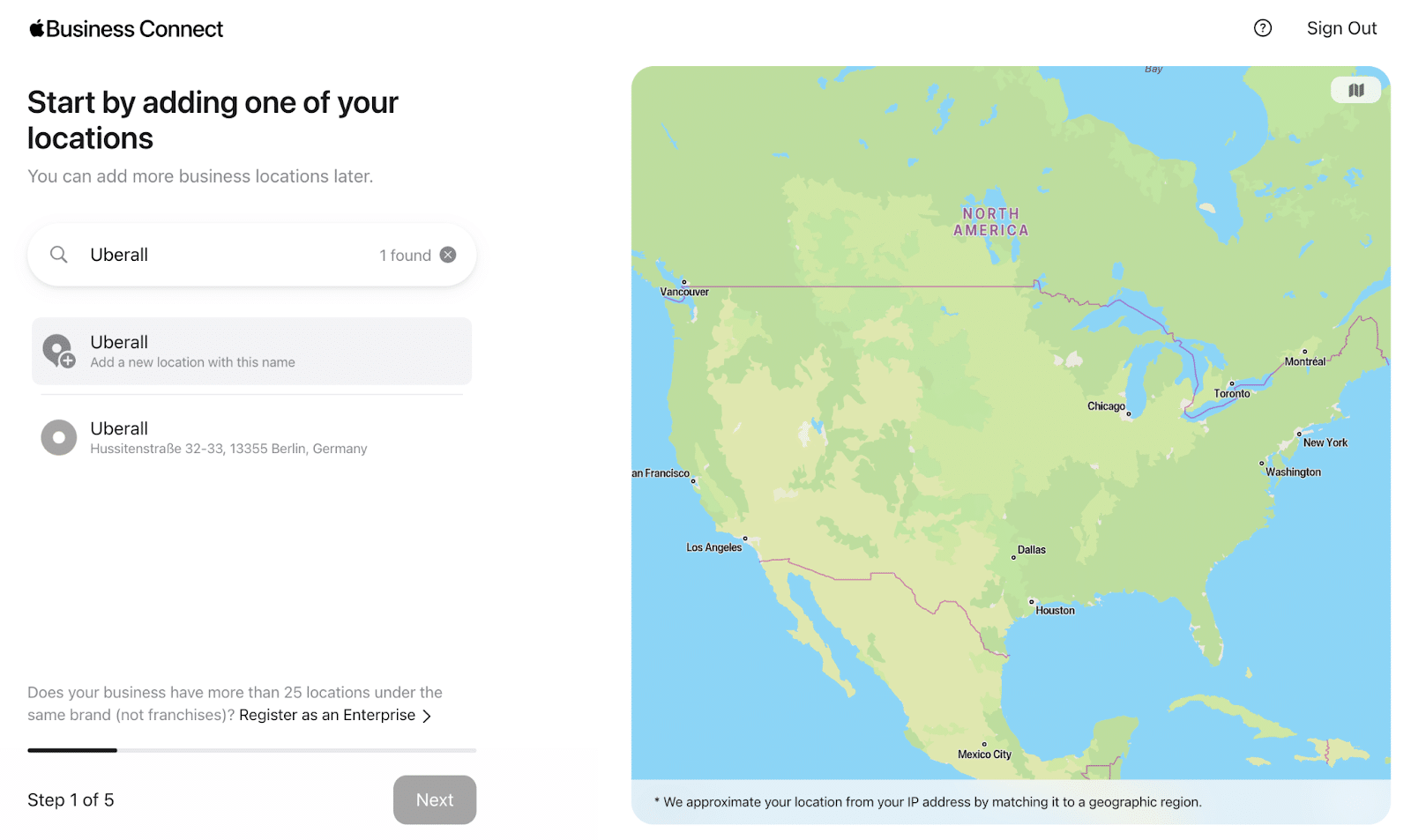
For single locations and small businesses under 25 locations, your first step will be searching or creating your location.
For enterprise businesses, you should click on the prompt at the bottom that says “Register as an Enterprise.”
When you click here, this will take you directly to the Business Verification page where you need to enter your brand information including your D-U-N-S number. (Apple also has a helpful enterprise onboarding guide.)
For small businesses (which Apple considers brands under 25 locations), you will need to search for your location on Apple Maps and either select the matching business displayed in the search results or choose the option to create a new location if your business is not listed.
If you are creating a new location, you will need to add your address details and ensure the map pin is over the entrance of your location. You can add the exact coordinates if needed.
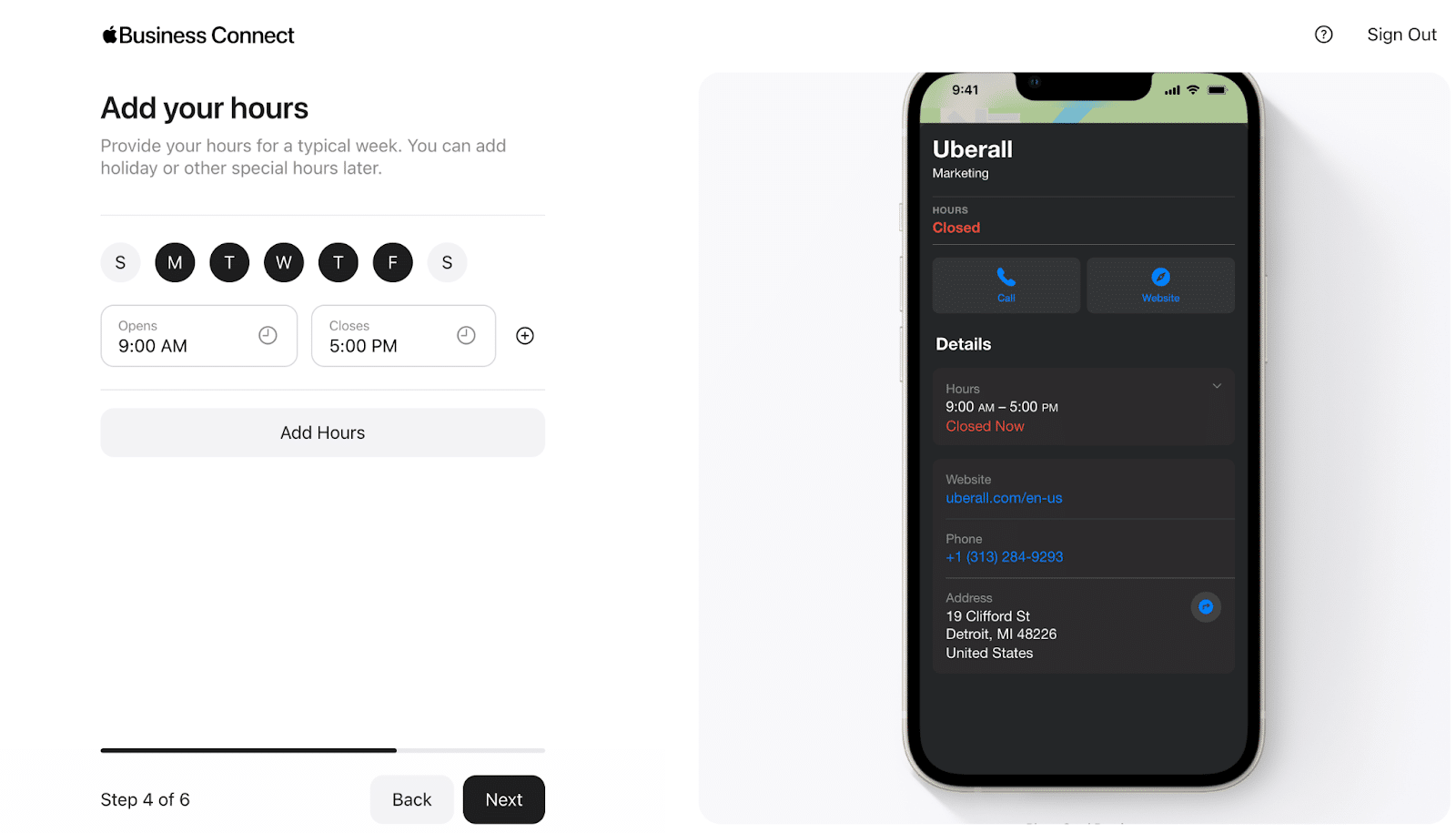
In the next two steps, you will want to add your primary, holiday, and special hours.
Special hours are described as custom or a temporary set of hours, such as periods of time when you have extended or shortened availability.
Then you will need to add your primary and additional categories, website, and phone number. (This is a great resource to find the full list of Apple Business categories.)
Apple states that additional categories help with search and can be unique by location.
Throughout the setup, Apple begins building your place card preview. According to Apple:
“When you change information about a location in Business Connect, it’s shown in this preview. It can take up to three days for your changes to be published on a location’s place card on Maps after you send them to Apple for review.”
The final steps for setup are focused on verification. You’ll next need to add your company details for verification so that Apple can determine whether you are the proper contact to manage this location on Apple Business Connect.
In order to complete the verification, you will need to provide an identifiable business document such as a business registration, utility bill, or lease agreement as well as a document description.
The verification of your business can take up to five days to process.
Once the verification has been completed, you can begin adding additional information to your Place Card including:
- A unique description of your business location.
- Attributes or additional features of your business. The types of attributes vary by business type but include categories such as:
- Payment options.
- Reservation types (appointment only, walk-ins).
- Accessibility features.
- Parking options.
- Restroom types and availability.
- Tech features (wi-fi and air conditioning).
- COVID-19 Testing and Vaccination options.
- Business Models (co-op, non-profit, membership requirements).
- Safety (cooling center, COVID-19 precautions, sheltering).
- Smoking parameters.
- EV Charging availability.
- Atmosphere details (good for kids, couples, groups).
- What types of pets are or are not permitted.
- A link to an app that supports functions like ordering, making a reservation, or booking an appointment.
- Photos of your business including a logo and cover that will stay positioned at the top of your Place Card. Apple advises that photos will be reviewed and can take up to three days before publishing. You can find photo guidelines here.
- Showcases to highlight timely updates, new features and products for your business. Showcases expire after 30 days unless you set it to end sooner and Apple can take up to three days to review and approve your showcase. Showcases include the following elements:
- A photo and an image tag (should be added for accessibility and screen readers).
- A short title of up to 38 characters.
- A description of the showcase of up to 58 characters.
- One or more calls to action, including:
- “Call Now”
- “Get Directions”
- “Website”
- “Share this Place”
- “Add to Favorites”
- “Rate this Place” – This allows users to provide feedback on overall rating, food and drink, customer service, and atmosphere. It also prompts a user to recommend this place to a friend or family member.
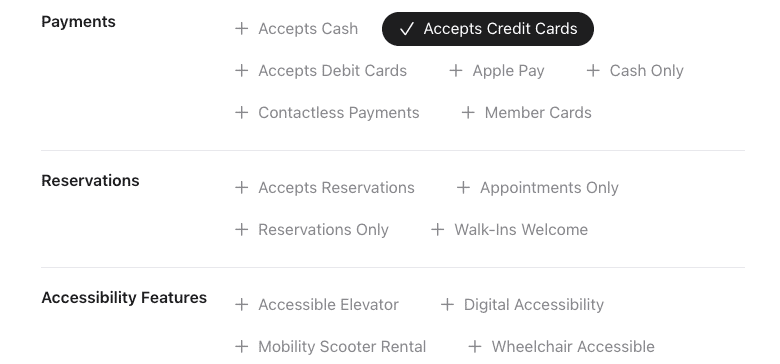
The types of attributes vary by business type.
Note that Showcases are only available to businesses within the United States, but Apple is working to make these available globally in the coming months.

Walmart’s Showcase, Apple Business Connect
If you manage or own more locations, just click the “Add” button in the top right of the dashboard to begin the process again. You can also invite additional users who need access to manage your locations.
More ways to engage with Apple Maps users
Business Connect is an incredibly exciting and much-welcomed innovation from Apple.
It provides a great opportunity for local businesses to engage with Apple Maps users and is designed in a way that makes it easy for businesses of all types and sizes to get started.
You can find more information in the Apple Business Connect User Guide.
The post Apple Business Connect: Your guide to getting started appeared first on Search Engine Land.
Courtesy of Search Engine Land: News & Info About SEO, PPC, SEM, Search Engines & Search Marketing
Wednesday, January 25th, 2023
Millions of people make new year’s resolutions every year, and most fail within the first month. This is not unlike the SEO work we hoped to do last year, but didn’t get done.
Well-meaning businesses often find that there is more work than they expected when they set out on their SEO journey. So they fail for various reasons – lack of buy-in, effort, and so on.
In 2023, resolve to get SEO implemented so that you actually have a chance to compete in the search results. Here are five resolutions to overcome common obstacles to SEO success.
SEO resolution 1: Have a vision you can share
Pointing to an SEO audit and saying, “we have to do this,” is not a strategy. You need to be able to discuss the high-level vision for your SEO program.
This may include things like:
Why you want to make SEO a key initiative
What trends are happening that show SEO as a key marketing activity today? Maybe the fact that there are 5.9 million searches on Google every minute?
The bottom line: It’s not really a question of if you should be on a platform used by almost the entire U.S. population, but do you want to beat the competitors and gain your fair share of organic search revenue?
What goals and KPIs you will set
Show that you’ve thought about the goals you intend to reach and the KPIs you will measure along the way.
How you will you get there
Exactly what are the steps needed to get the program up and running? And whom will you need support from?
SEO resolution 2: Get real buy-in
Do you really have buy-in for SEO? Like the type of buy-in where the CEO would say it’s a key initiative? Without this type of “all-in” attitude, it can be hard to move the needle past your department.
I remember some years ago when my company delivered more than 100 pages of an SEO audit to one of the largest research and review sites in the auto sector.
We proposed radical changes and told them that if they implemented every one of them, they’d see a massive influx of traffic.
It was a big risk for the client. They knew they’d need everyone on board to make it happen, from marketing to IT. So the chairman of the board called a company meeting and said SEO would be a key strategic initiative from that point on.
And guess what? They worked together to implement every recommendation and saw a 900% increase in traffic within the first week after launch. They remain competitive to this day.
Getting this type of buy-in takes preparation. If you want to champion SEO at your place of business, there’s a bit of work to do.
Get the daily newsletter search marketers rely on.
<input type=”hidden” name=”utmMedium” value=”” />
<input type=”hidden” name=”utmCampaign” value=”” />
<input type=”hidden” name=”utmSource” value=”” />
<input type=”hidden” name=”utmContent” value=”” />
<input type=”hidden” name=”pageLink” value=”” />
<input type=”hidden” name=”ipAddress” value=”” />
SEO resolution 3: Build relationships
At the end of the day, a company is not made up of departments or roles, it’s made up of people. Strong relationships can go a long way in business and getting things done.
Once you have identified the critical folks needed to get SEO done, you can start by meeting with them one-on-one or in teams to:
- Show them how SEO can align with their goals: There is rarely a business goal that cannot be met with SEO in some way. Do a needs assessment of their goals and see how SEO can support them.
- Show them they are a critical part of the process in making it work: Most people will not initially know how their day-to-day work can impact SEO or vice versa. How can they be a part of SEO’s success?
SEO resolution 4: Educate about SEO
When you are trying to get everyone on board with SEO, you must remember that most people will have a limited view of what SEO is (outside of your immediate team). Keep it simple.
Wherever possible, you want to validate your SEO advice with Google’s recommendations (see help files from Google Search Central, Google Search Central videos, etc.).
This helps make the connection that SEO is a partnership with Google – not something you do to game the system.
And SEO training can be key. Back when I started my agency, I quickly realized that the best way to get clients to implement SEO was to train them on SEO. That was a big catalyst for launching our SEO training course in 1999.
Since then, we put all of our clients into our SEO training so that we can have intelligent conversations that help move the needle.
Consider SEO training for all the people who will need to be involved (I’m talking about your web developers and IT folks, too). I find that when companies open up SEO training across teams, it creates a shared understanding and motivates people to get things done.
SEO resolution 5: Make the effort
Not everyone will see a 900% increase in traffic the first week, like the company I told you about earlier. In fact, it can take up to six months to start to see big results, depending on factors like the website’s health, the competitive landscape and more.
Some companies may give up when they don’t see the results right away that they expected. This is obviously a mistake – and a result of not understanding how SEO works (see educate section above).
Companies must invest in SEO for the entire lifecycle of their site to stay competitive. Remember, though, once you invest in it, it’s yours (unlike PPC, where if you turn it off, you disappear from the search results – no offense to PPC, you need both!).
That said, there are ways to get quick wins and see results to get people excited about SEO. For example, consider a pilot project which might look like:
- A plan to prioritize the most impactful SEO tasks first and then track and share your results.
- A small SEO initiative with a key team within the company.
With some smaller wins under your belt, you may be able to build momentum. Do remember, though, that sometimes a website’s biggest SEO issues are technical in nature. And resolving those can take some serious effort.
At the very least, you need IT folks, website developers – whoever is in charge of making changes to the website – on your side.
One piece of advice here: You can always submit technical changes to the site as a “bug fix.” Developers and IT professionals care about fixing bugs and want to stay on top.
Make 2023 count
It’s not always easy to get an SEO program off the ground.
If it’s a challenge for you, start small, make the most impactful moves first and celebrate every win. You will see how these steps can build momentum over time.
The post Resolve to get SEO done in 2023 – Here’s how appeared first on Search Engine Land.
Courtesy of Search Engine Land: News & Info About SEO, PPC, SEM, Search Engines & Search Marketing
Wednesday, January 25th, 2023
In 2022, it was estimated that 227 million people in the US played video games and 46% of those were women. With game revenues projected to reach $285 billion by 2027, it’s no surprise that this is a huge opportunity for advertisers.
In-game advertising offers businesses the opportunity to reach out to a very wide demographic with eclectic tastes. Almost any product, catering to any demographic can be promoted effectively through in-game advertisements because gaming itself has become a universal pastime.
Video games and ads have come a long way in the last few decades. Search marketers and celebrities alike are embracing the gaming industry as a huge market to reach their target audience. This is the first article in our new series on why video games as a huge opportunity for advertisers in 2023.
What are video game ads?
If you’ve ever played a video game on your mobile phone, PC, or consoles like Xbox or Playstation, it’s likely that you’ve seen several types of ads. These may be in the form of a short video that plays between levels, a banner at the bottom of your screen, or perhaps one of the player characters is wearing a branded shirt or driving a popular make and model car. All of those examples are types of video game ads.
In addition to brands being able to reach new audiences, grow their community, and sell more products or services, game publishers like ads because it allows them to monetize their content. This is especially attractive to mobile game developers who offer a freemium experience, where the game itself is free to play, but ad spots are sold in exchange for a fee.
Who should consider creating an in-game ad campaign
Any brand or advertiser looking to expand their marketing campaigns outside the normal scope would be a great candidate to invest in an in-game ad campaign. Since gaming platforms have evolved, players have consoles right in their hands, which put ad campaigns in front of them at all times.
An in-game ad campaign can help your brand become more visible on platforms that are relatively low competition. You can also reach very specific audiences by advertising on certain game titles. In 2020 the number of gamers worldwide reached about 3.6 billion, so if you have a brand that can benefit from a large audience, in-game ads are a huge asset. If you know who the typical gamer profile is, and who you are trying to reach with your campaigns, you can tailor your message to reach that exact audience.
Natalie Cooke, group managing director at M&C Saatchi, believes that brands can engage gaming audiences – particularly when it’s done right. She noted that Burger King successfully engaged with Elden Ring players on their own terms by encouraging streamers to only use fire- and flame-based weapons and spells within the game world. Since it was a challenge of the sort that many streamers like to impose upon themselves, it felt authentic and true to how gamers like to create content.
The best type of video game ads for most brands
When most people hear the phrase “gaming consoles” they think of Xbox or Playstation. While advertisers can certainly set up ads within these consoles, the market share of players represents only about 32%, and the demographic tends to be male-dominated.
Mobile games are by far the lowest-hanging fruit and the biggest opportunity for advertisers right now in 2022. Since gamers of all ages play on their mobile phones, this platform represents the largest possible audience.
Mobile apps are also the easiest and fastest to set up. Once you know who your audience is and what mobile games they’re playing, you can create and deploy a campaign within minutes. For mobile campaigns, the KPIs you’re most likely to measure are impressions and clicks, and video completion rate.
The benefits of mobile game advertising for brands
Despite this reach and depth of engagement, marketers have been slow to tap into this attention oasis with advertising in games accounting for less than 6% of total digital ad spend.
Shifts in people’s perceptions of gaming, along with technological advances in the way ads can be inserted seamlessly into games, are helping to ease some of the publisher and consumer resistance to implementing ads in games.
1. Reach
With mobile gaming audiences on course to reach over 3 billion by the end of 2023, it represents a huge segment of the population advertisers can potentially be in front of. In-game ads are also more cost-effective than other forms of marketing.
2. Viewability
In-play ads such as banners run during the entire length of the game versus interstitials or rewarded ads only play during breaks. Ad tech companies are working hard on solutions to enable measurement, even on faster-paced games. With this, advertisers will be able to determine how many views their ads are getting. With measurement in place and extensive ad targeting capabilities, fraud protection, and brand safety measurements, in-game ads are becoming more attractive.
3. Engagement
A report from Tapjoy stated that 64% of consumers are more likely to engage with a retail in-app reward ad than a social media post. That added value of in-game rewards in addition to the transaction makes gamers feel like their money is going further. Additionally, 70% of the gamers surveyed said they were open to trying a new subscription product or service.
4. Brand safety
Advertisers can select the genre of game they want their ads to show. Additionally, ad whitelists prevent their ads from appearing in inappropriate environments.
Advertisers and brands interested in setting up an in-game campaign should speak with an ad tech partner that can help them navigate creative requirements, audiences, placements, cost, and more.
Creating in-game ads
Knowing your target audience
For brands that are interested in creating mobile in-game ads, the first thing to consider is the target demographic. Is it the busy mom playing Candy Crush? What countries are they located in? What do they do other than play games? Are you advertising a product, service, or another game? What platforms will you advertise on? Snapchat? Apple? Discord? Twitch? Consider the demographic you’re targeting and where they’re playing.
Game titles are another factor to consider when looking to advertise in games. For example, users of Candy Crush tend to be over 30, while Fortnite players are under 18. League of Legends and DOTA are popular among younger Asians. Counterstrike players are mostly European and North American males between 20-30. When a brand is considering advertising its product, service, or game, they need to ensure they’re promoting it through the right game titles. If your target demographic is women over 40, you’d be wasting your ad spend having your banner show up in Fortnite because your demographic isn’t ever going to see it. There needs to be a consideration of what games your demographic is playing before creating a campaign.
Contextualization is key when beginning to plan an in-game ad campaign. It’s critical to understand your market, learn the game space, and understand how players will interact with the ad. Brands that are self-aware of where they are advertising will see greater success, as not only age and gender need to be considered, but country, game title, and even some ethnicities. Brands should also consider the motivations of the players they are advertising to. Are they playing to pass the time? Are they competing with their friends? Or are they strictly playing free games and are willing to watch video ads to power up?
Knowing player motivations
Game Refinery identified eight player archetypes to help advertisers narrow down their target audiences. It’s not required to use these archetypes to create an ad campaign, but it helps to know the type of player you’ll be reaching, how they interact with the games you’re advertising on, and what other products and services they may subscribe to. The eight archetypes are:
- Expressionists love to express their identity through gameplay
- King of the Hill players prefer games with a high degree of competition with other players
- Networkers see gaming is a social activity
- Skill Masters are always trying to improve their skills
- Strategists enjoy strategic thinking and planning
- Thinkers enjoy brain teasers, puzzles, and anything that will improve their cognitive skills
- For Thrill Seekers, gaming is all about excitement and action
- For Treasure Hunters, Exploration is the main motivation
Capitalize on any first-party data from apps
First-party data is any information game developers and marketers collect directly from their audience. Many times that data comes from players and customers acquiring, converting, or playing within an app. Companies use that information to create ads, content, and experiences that cater to the players’ interests.
Second-party data is also collected directly, but instead, it is transferred to a partner instead of being used directly. Third-party data comes from outside sources that collect the data from sources, aggregate it, segment it, and then sell it to various companies.
First-party data is valuable because it’s all advertisers have to rely on, since the implementation of Apple’s ATT (App Tracking Transparency). First-party data is also preferred because it’s more accurate (it comes directly from the consumer), advertisers can collect the exact data they need for specific campaigns, and it can be managed in real time so advertisers and platforms can learn and adjust accordingly.
You can use first-party data by creating highly personalized messages and targeting those who are looking for your product or service.
Knowing the answers to these questions and researching your audience’s intentions can help brands create a campaign that motivates people to engage with their ad. “Gaming is very different than any other channel. It is 100% interactive. It is live. It is a high-attention inventory. It is many things that traditional advertising isn’t, so the rules of traditional media planning are not always applicable to in-game advertising” says Julia Rast, Director of Global Solutions and Innovation for the media company Xaxis.
Measuring success with an in-game ad strategy
While navigating the landscape of video game advertising can be tricky, the Interactive Advertising Bureau (IAB) recently put together a group of industry stakeholders to develop new standards of measurement for viewability for in-game ads.
Anzu has also announced a collaboration with Oracle Moat to measure the viewability of in-game ads across inventory and describes it as “first-to-market.” Since in-game ads often take the format of billboards, buildings, apparel, and more, they can be hard to measure. Anzu has developed built-in ray casting features “sending out waves of rays from the player’s point-of-view that help to determine how long ads remain in sight, the percentage of the ads viewable and other essential metrics.”
Current success is typically measured in terms of viewability but is based on how long the ad stays up on the screen, how long the ad was viewed, the speed at which it moves across the screen, and the lighting when the ad is seen.
For banner ads, success can be measured in clicks, downloads, purchases, or any other goal the advertiser has set up. However, it should be noted that if the banner or expandable ad interferes with gameplay, clicks should not be measured as success as many of them can happen by accident.
If a brand’s goal is impressions and viewability, rewarded ads may be the best option, as they typically have the greatest viewability rates because they’re tied to game rewards.
Surveys are another way to measure in-game ad success. The surveys are sent to players to complete in exchange for an incentive to the player. This is a simple and effective method but advertisers should consider the game(s) in which the surveys are going, the native language of the majority of the players, the game titles, and whether or not players are being truthful in their responses.
As gaming evolves, developers, platforms, and advertisers are learning more and more about creating experiences for their players. Viewability is an excellent benchmark to start measuring success, but as technology evolves, other KPIs will paint a more clear picture of effectiveness. For now, brands should focus on awareness and viewability.
The post In-game ads: why brands should be excited appeared first on Search Engine Land.
Courtesy of Search Engine Land: News & Info About SEO, PPC, SEM, Search Engines & Search Marketing
Wednesday, January 25th, 2023
Google defuses ‘miserable failure’ Google bomb
In 2007, Google finally defused a “Google Bomb” that had returned U.S. President George W. Bush as its top organic result since December 2003 when searching for [miserable failure].
Originally, Google was of the belief that “We just reflect the opinion on the Web, for better or worse.” Eventually, however, Google came up with an algorithm change to deal with this and other Google bombing “pranks”:
“People have asked about how we feel about Googlebombs, and we have talked about them in the past. Because these pranks are normally for phrases that are well off the beaten path, they haven’t been a very high priority for us. But over time, we’ve seen more people assume that they are Google’s opinion, or that Google has hand-coded the results for these Googlebombed queries. That’s not true, and it seemed like it was worth trying to correct that misperception. So a few of us who work here got together and came up with an algorithm that minimizes the impact of many Googlebombs.”
Ryan Moulton and Kendra Carattini, A quick word about Googlebombs
How did this Google bomb happen? A campaign encouraged people to link to Bush’s bio using the anchor text “Miserable Failure”.
And while Google defused this bomb, Bush remained in the top organic position for [miserable failure] on Yahoo and Microsoft Live and in second position at Ask.
Read all about it in Google Kills Bush’s Miserable Failure Search & Other Google Bombs and Happy First Birthday, Google Bomb Fix!
Here was the before and after at the time:
Today, here’s what a search for [miserable failure] looks like on Google – with Wikipedia’s Google bombing page in the top spot.
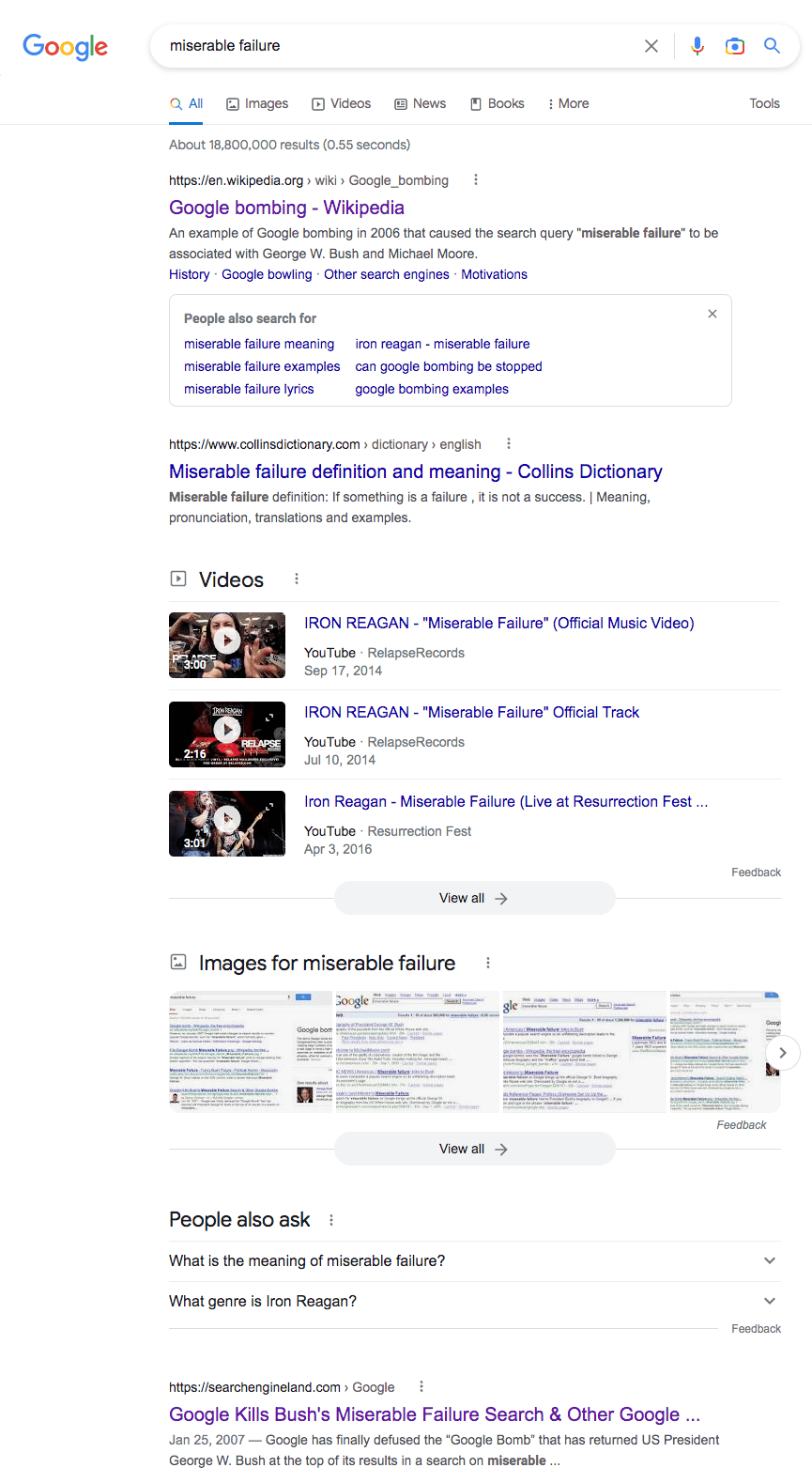
Also on this day
2022: The Topics API would select topics of interest (based on the user’s browsing history), without involving external servers, and share those topics with participating sites.
2022: A Google Ads video “Expert Series: Welcome to 2022” had many confused as to the future of non-value bidding strategies with unflattering and cryptic mentions about the popular bid type.
2021: And FLoC would die a year later.
2021: Google automatically calculated the price drop based on changes to structured data over time.
2021: In this installment of Barry Schwartz’s vlog series, he chatted with Beobide about properly sharing the importance of SEO, and building a good relationship with, your developers.
2019: Plus, Google was working on switching remaining sites to mobile-first indexing.
2018: Google announced more options for users to control the kinds of ads they see.
2018: Google wasupgrading the report.
2018: Mobile search click costs increased by 25% year over year.
2018: The doodle featured the author’s familiar profile.
2018: Efforts to crack down on payday loan ads, ads that look like system errors and “tabloid cloaking” ads were among those that led to an increase in removed ads in 2016.
2018: Google wanted to make it easier for business owners to manage their photos within Google My Business.
2013: Google said there was no time frame for when or if it would be restored.
2013: The latest images showing what people eat at the search engine companies, how they play, who they meet, where they speak, what toys they have, and more.
2012: In the past, they would take all the positions of your rankings and average them together. That changed to averaging only the top positions.
2012: Google updated its URL submission tool page and redesigned its Submit Your Content page.
2012: Google had to pay $500 million after acknowledging that it both allowed and helped Canadian pharmacies sell drugs in the U.S. in violation of federal law.
2012: Google would show emergency alerts in your area on the map, with more details on the alert.
2012: DuckDuckGo reached 700,000+ queries in a day for the first two times.
2011: CEO Carol Bartz called the revenues “encouraging.”
2011: The fflick service analyzed and organized comments about movies.
2011: But the report also cautioned that overall visits to Twitter were down.
2011: Google released a new Chrome extension named Keep My Opt-Outs. Firefox was working on a solution for a new version of Firefox.
2011: SayNow was a platform that allowed voice messaging, one-on-one conversations, and group calls to be instantly integrated into Facebook, Twitter, MySpace, Android, or iPhone applications.
2011: Google’s simpler AdWords program, Boost, got its national roll-out, after a three-month test period.
2011: Google was primed for its biggest hiring year in company history.
2011: Both search engines listed news about the awards at the top of the page.
2011: It took 24 hours and cost $20.
2011: The experience was largely good. Plus, some thoughts on how this gave Android an added boost ahead of Verizon’s iPhone launch.
2010: What could you give to the richest person in the world? Some free SEO advice for his new blog.
2010: “They’ve done nothing and gotten a lot of credit for it.”
2010: The local trends version showed you what tweet topics were hot and trending on Twitter by region, country and city
2010: Ask UK had a new game where you could dress up the lovable Jeeves character.
2010: Factery Labs surfaced the facts behind the day’s trending news.
2010: Google Reader would periodically visit a page and publish any significant changes it found as items in a custom feed created just for that page.
2010: Exempting the US would essentially have rendered the settlement meaningless.
2008: Google began preventing “domain tasting” (the practice of trying out a domain name for a 5 day-period) from participating in the AdSense for Domains (aka Domain Park) program.
2008: 80% said email marketing performs strongly for their company, with search right behind at 70.6%.
2008: Political ads could neither include accusations or attacks relating to an individual’s personal life, nor advocate against a protected group.
2008: The answer appeared to be “no.”
2008: You could watch the edits made to Google Maps in a live viewer.
2008: However, in the “online services” division, which housed search and adCenter, there was a loss of $245 million on increased revenues of $863 million.
2008: Both of these men got fabulously rich off their Google shares – likely north of $800 million apiece.
2008: The latest images showing what people eat at the search engine companies, how they play, who they meet, where they speak, what toys they have, and more.
2007: Searches returned many results from YouTube.
2007: Google would be sharing their debugging and testing experiences with the public.
2007: The premiere was reportedly posted prior to the live airing of the show.
2007: My Publishers tab, ad placement and a message inbox.
2007: A funny mock up of what it would look like if Google added their Google Video ads to the Google search results page.
From Search Marketing Expo (SMX)
Past contributions from Search Engine Land’s Subject Matter Experts (SMEs)
These columns are a snapshot in time and have not been updated since publishing, unless noted. Opinions expressed in these articles are those of the author and not necessarily Search Engine Land.
< January 24 | Search Marketing History | January 26 >
The post This day in search marketing history: January 25 appeared first on Search Engine Land.
Courtesy of Search Engine Land: News & Info About SEO, PPC, SEM, Search Engines & Search Marketing


 Source: