Archive for the ‘seo news’ Category
Wednesday, February 1st, 2023
Google has accidentally removed legit, policy-abiding reviews submitted by Local Guides from Google Maps. Google acknowledged the issue and said it is working on reinstating those reviews over the next few weeks.
What happened. According to Google’s Local Guides Connect blog, Google said they are “constantly improving our moderation system to keep policy-violating content off the map.” With those efforts, Google said its “protections took down more than expected policy abiding reviews from a set of Local Guides.” Google added that they “acknowledge that this change has affected a lot of your accounts,” and is working to restore the reviews that were impacted.
Fixing the issue. Google said, “as part of our efforts to resolve this situation, we have launched an update to our protections to fix them.” Google added that the search company “will also automatically reinstate” any of the policy-abiding reviews over the “next few weeks.”
What if your review is not reinstated. Google said if your policy-abiding review is not reinstated, then you can submit a request through this form to challenge the decision.
Why we care. If you noticed your reviews are not going through as a Local Guide, Google says to continue to post reviews as normal, and they will automatically fix the issues. At least, you can hope Google does, and if not, you can always request Google to manually review your submission.
So you may see a number of reviews previously not listed on your business show up in a few weeks when Google reruns its review protections.
The post Google Maps removed policy-abiding reviews from Local Guides appeared first on Search Engine Land.
Courtesy of Search Engine Land: News & Info About SEO, PPC, SEM, Search Engines & Search Marketing
Wednesday, February 1st, 2023

How do you make sure your SEO team is working on activities that will make the most significant impact on your goals? Have you ever set goals only to realize a month or two later that no one has been keeping track of progress? Have you ever reached the end of a year and felt you’ve made no progress on your organic growth targets? Also, is organic growth the only target to measure?
In this webinar, Craig Bradford, COO of SearchPilot, will show you how to set and achieve better goals using the 4 Disciplines of Execution (4DX) framework.
Register today for “Drive Performance With These 4 Disciplines for SEO Teams,” presented by SearchPilot.
Click here to view more Search Engine Land webinars.
The post Webinar: 4 disciplines for SEO teams to drive performance appeared first on Search Engine Land.
Courtesy of Search Engine Land: News & Info About SEO, PPC, SEM, Search Engines & Search Marketing
Wednesday, February 1st, 2023
OpenAI announced that its highly-anticipated paid version of ChatGPT has launched. Called ChatGPT Plus, it will only be available for people who live in the U.S.
Despite earlier pricing rumors reported in the media, ChatGPT Plus won’t cost $42 a month. It will cost $20 per month.
People who have been on the waitlist for the paid version should expect an invite “over the coming weeks.” The company also said it plans to “soon” offer the service in additional countries.
What you get for $20 a month. OpenAI said the paid version will offer three benefits over the free version:
- General access to ChatGPT, even during peak times
- Faster response times
- Priority access to new features and improvements
Why we care. ChatGPT is a technology that has several use cases in search marketing, whether it’s for SEO or PPC. So if you’ve found yourself unable to use ChatGPT because the service was at capacity, now you have the cure – and it will cost you $20 a month.
The post ChatGPT Plus launches, it costs $20 a month appeared first on Search Engine Land.
Courtesy of Search Engine Land: News & Info About SEO, PPC, SEM, Search Engines & Search Marketing
Tuesday, January 31st, 2023
Internal linking is a crucial aspect of any website, but it is especially important for ecommerce websites.
Internal linking helps improve the navigation and user experience for your website visitors and can also help improve your website’s search engine optimization (SEO).
This article will discuss the best practices for internally linking pages on ecommerce websites. To help illustrate these opportunities, I’ll use some of my favorite examples of ecommerce SEO done well – the portfolio of Williams Sonoma brands. (Disclaimer: I have no affiliation and have never worked on any of these sites.)
But first, let’s lay the groundwork for why these tactics are so important.
What is internal linking?
Internal linking refers to linking one webpage to another on the same website domain. When a user clicks on an internal link, they will be taken to a different page on your website. These links can be words, phrases, or images.
Internal linking is important because it helps people find the information they are looking for on your website and helps them move from one page to another.
It also helps search engines understand the structure and hierarchy of your website, making it easier to find in search results.
What internal linking is not
Internal linking is not the same as external linking.
External linking is when you put links on your website that take users to other websites. This can help them find relevant information from other sources.
Using both types of linking is essential, but they have different purposes.
Why is internal linking important for ecommerce websites?
Internal linking is an important aspect of search engine optimization (SEO) for all websites, especially ecommerce.
While there are probably many more reasons than I’ve listed below, these are the four primary reasons that are always top of mind when working on an ecommerce website with tens of thousands, if not millions, of pages.
- Ecommerce websites often have a large number of pages, including product pages, category pages, and other informational pages. Internal linking helps users navigate these pages and find the information they want.
- Ecommerce websites often have a lot of competition and potentially many vendors offering the same or highly similar products. Internal linking can help improve the SEO of the website, making it more visible in search results.
- Internal linking can help improve the discoverability of ecommerce websites by helping search engines discover and crawl all of the pages on the website. This can lead to more traffic and potential customers for the website.
- Internal linking can highlight promotions and sales, new products, and customer reviews on ecommerce websites. This can draw attention to these items and encourage users to take advantage of them.
It helps improve the visibility and ranking of a website on search engine results pages (SERPs) and improves the user experience by allowing visitors to navigate the website easily.
But, before we get into general best practices, as noted in the items above, it is essential to note the difference between navigational internal linking and in-content internal linking.
Get the daily newsletter search marketers rely on.
<input type=”hidden” name=”utmMedium” value=”” />
<input type=”hidden” name=”utmCampaign” value=”” />
<input type=”hidden” name=”utmSource” value=”” />
<input type=”hidden” name=”utmContent” value=”” />
<input type=”hidden” name=”pageLink” value=”” />
<input type=”hidden” name=”ipAddress” value=”” />
In-content vs. navigation internal linking: What’s the difference?
In-content internal linking includes links within the content of a page (typically a blog post), while navigation internal linking is when you have links in your website’s navigation menu.
For example, if you are writing a blog post about men’s shoes, you may want to link to a page about sneakers. This would help users find additional information related to the current page’s content.
In contrast, navigation internal linking helps people find the main pages on your website and navigate your website more easily.
With that explanation out of the way, here are 9 best practices for internally linking pages on ecommerce websites, broken down by in-content or navigational.
Navigation internal linking best practices
Let’s start with some of the basics for a solid ecommerce website.
1. Sitewide navigation menu
The organization and utilization of your primary navigation are table stakes for a robust internal linking strategy.
When a page is linked from the sitewide menu, it essentially means that it is linked from every page on the site, which can signal to Google that the page is essential. However, it’s necessary to be mindful of not overcrowding your menu.
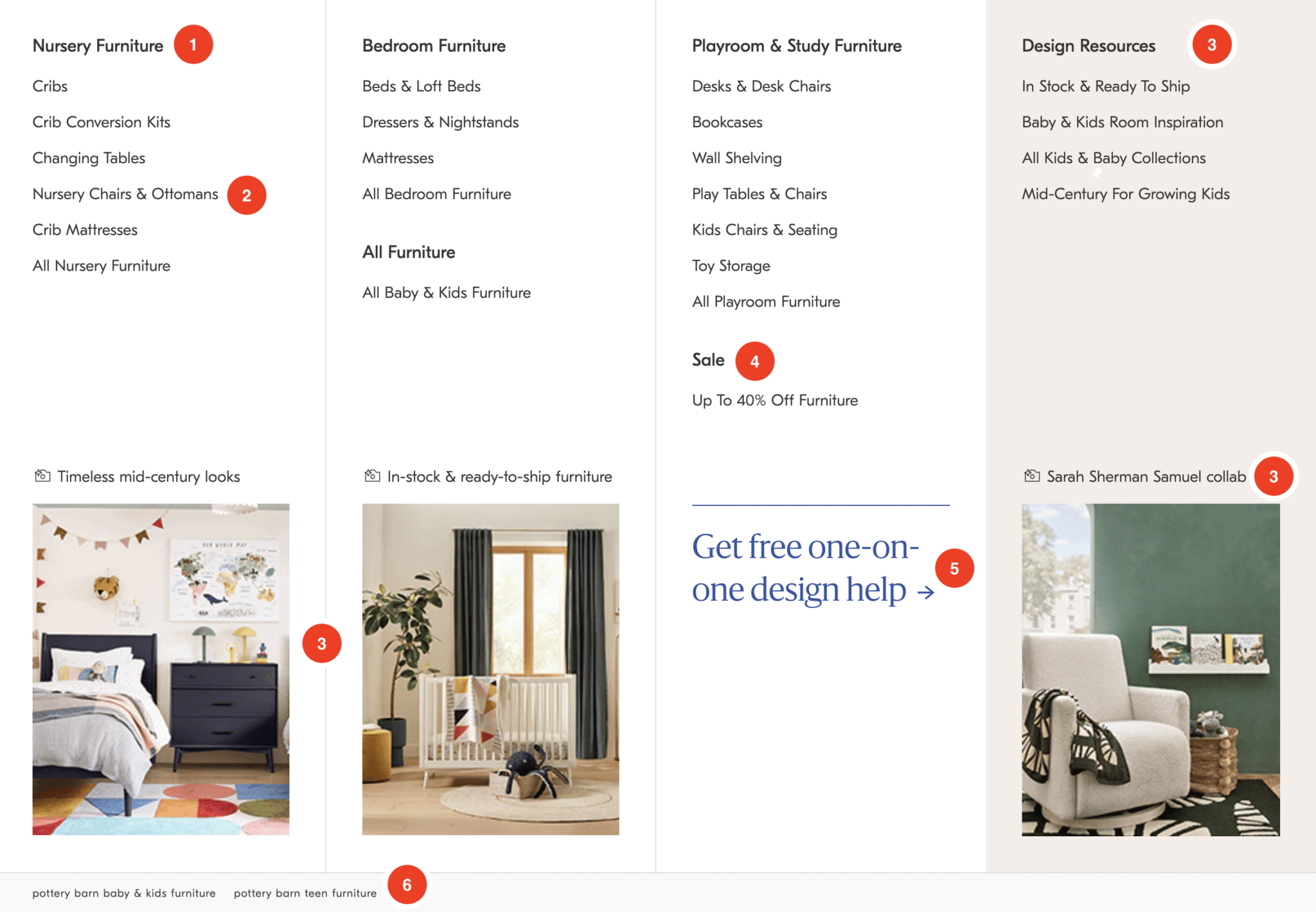
Across the Williams Sonoma portfolio of sites, the main navigation is a master class of effective internal linking strategy. I’ll use the below example from West Elm’s Kids section to illustrate.
1 and 2 – Category / Sub-Category Linking: West Elm links to crucial category pages from the sitewide menu, boosting these pages’ internal authority. The sub-category links assist in providing Google with a better understanding of the organization of the website and the semantic relationships between them.
3 – Focusing on the user journey: Having dealt with this myself, I know design paralysis is a big blocker to purchasing furniture. With the Design Resources section, West Elm not only provides search engines an entry to all products in the category (All Kids & Baby Collections) but also answers common blockers to purchase (inspiration, in stock, etc.).
Ross Hudgens summarizes the additional benefits of including this content more eloquently than I could:
“Integrating content into navigation categories can help drive significantly more outcomes. Most people don’t care to visit “Resources” or “Blog.” This will lead them to ignore dropdowns like that.
They want to solve a specific problem and are more likely to be driven down the path of reading up on it if it’s naturally embedded within each category.
This will help drive users down the funnel, especially for products with a long sales cycle. In the nav, you can link directly to the hub category for the section that discusses that content.
If it doesn’t exist, that’s a hint your content hub could use better architecture around the actual problems people have.
You can see how this powerfully ties together from an internal linking and engagement benefit point of view.”
4 – Internally link to support business priorities: The critical thing to note about this example is the internal link doesn’t just say “Sale.” It is a specific sale (“Up To 40% Off Furniture”) aligned with the category.
As you navigate each sub-menu, you’ll find that the sale references align with the primary category. Great use of deep linking, even within the sale section.
5 – Internal link to support secondary KPIs: In an age where first-party data collection must be a priority, West Elm provides a clear CTA driving users into their design center to schedule an appointment.
While I cannot validate this, I would expect the data collected to be used to fuel additional marketing efforts.
Ultimately, if someone chose to utilize these services, I expect these average order sizes to be much larger (I know it was for me), which is also likely why they can offer these design services at no cost.
6 – Portfolio-wide internal linking strategy: I’ve worked on many ecommerce sites that were part of portfolio companies. The typical approach is to add a bunch of footer links to the portfolio domains and call it a day.
This is the first time I have seen such a focused effort on utilizing an internal linking structure to elevate all domains in a portfolio. The important element to note here is that even the cross-domain internal link is highly relevant (e.g., West Elm Kids Furniture → Pottery Barn Baby & Kids Furniture).
Kudos to whoever sold this enterprise SEO strategy!
2. Sitewide secondary navigation menu
The Williams Sonoma site portfolio uses a mix of global navigation menus. I’ll focus on the two in the screenshot below.
At the top, again, we see a list of external links to ecommerce sites in the portfolio. (Gap also does this well.)
Directly below the logo, Mark & Graham utilizes a row of “quick links” that are updated to support seasonal efforts, promotions and sales, new product categories, and other deep links to category pages that otherwise might not have a home in the fixed navigation menu (i.e., Occasions, Interests, etc.)
This is an excellent example of secondary navigation that adds value to the user (and search engines) beyond just Find a Store, Shopping Cart, etc.
3. HTML breadcrumb navigation
HTML breadcrumbs are typically displayed at the top of the category and product pages. They include a series of links that show the path a user has taken to reach the current page.
There are a handful of benefits of implementing breadcrumbs:
They help users understand where they are on the website and make navigating to previous pages easy.
- Improved crawlability: Breadcrumb internal linking helps search engines discover and crawl the pages on your website and can help minimize orphaned pages. This can improve the overall visibility of your website in search results.
- Enhanced user experience: Breadcrumb internal linking can improve the user experience of your website by making it easier for users to navigate and find the information they are looking for. This can lead to increased engagement with your website and can also help improve your rankings in search results.
- Increased relevancy: By using internal breadcrumb linking to show the relationship between different pages on your website, you can help search engines understand the site structure of your pages – especially when marked up with breadcrumb schema.
A perfect illustration of this is Williams Sonoma’s utilization of breadcrumbs to build natural internal links to essential category pages based on my navigational path to the same product:

Williams Sonoma’s “OXO” brand breadcrumb
 Williams Sonoma’s “mandoline slicers” breadcrumb
 Williams Sonoma’s “all food prep tools” breadcrumb
4. HTML sitemap
An HTML sitemap is a page that lists all pages on your website and provides links to these pages.
For example, you might include a sitemap on your website that lists all of the pages on your website and provides links to these pages, or you could use internal linking to highlight the most critical pages on your website.
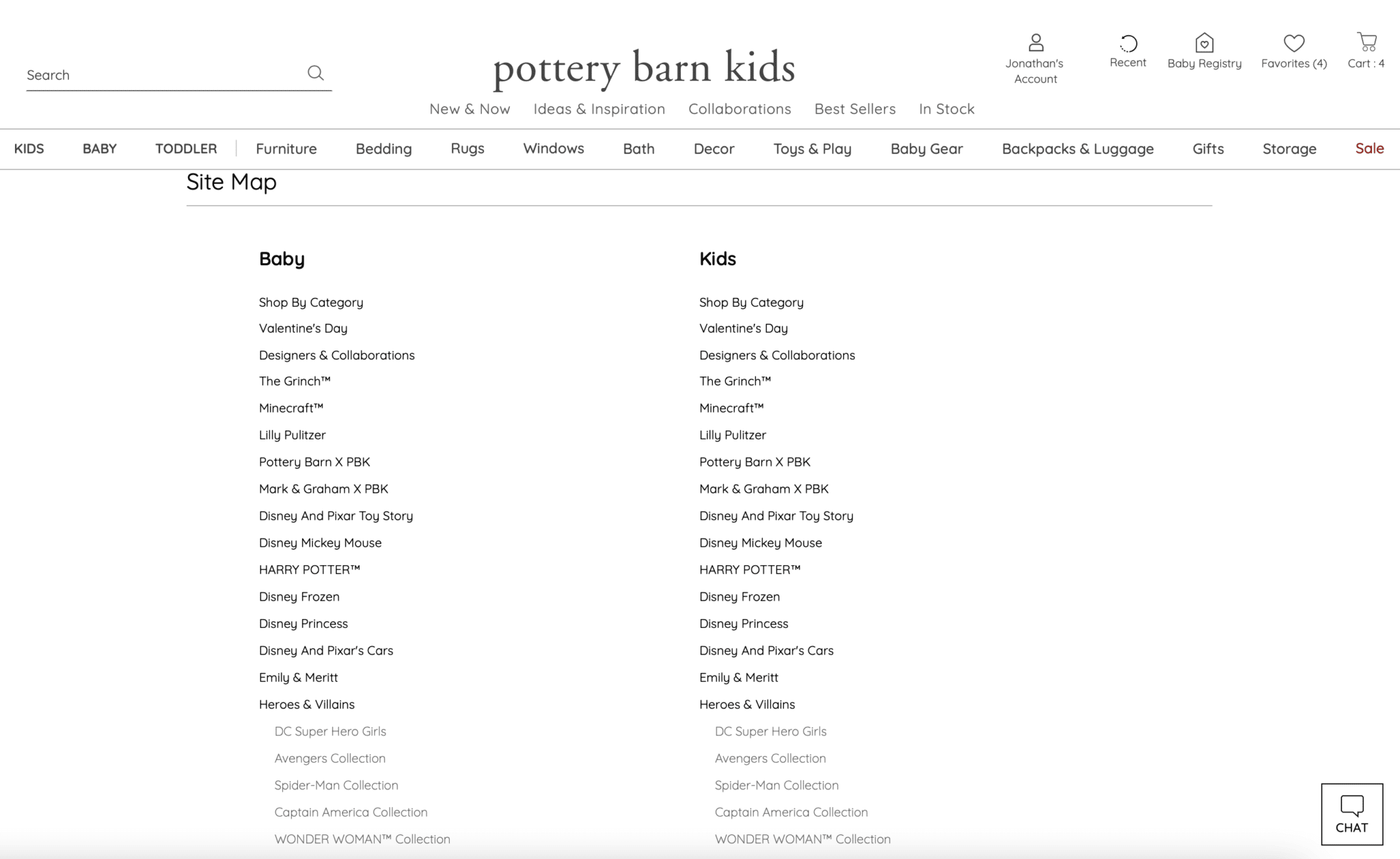
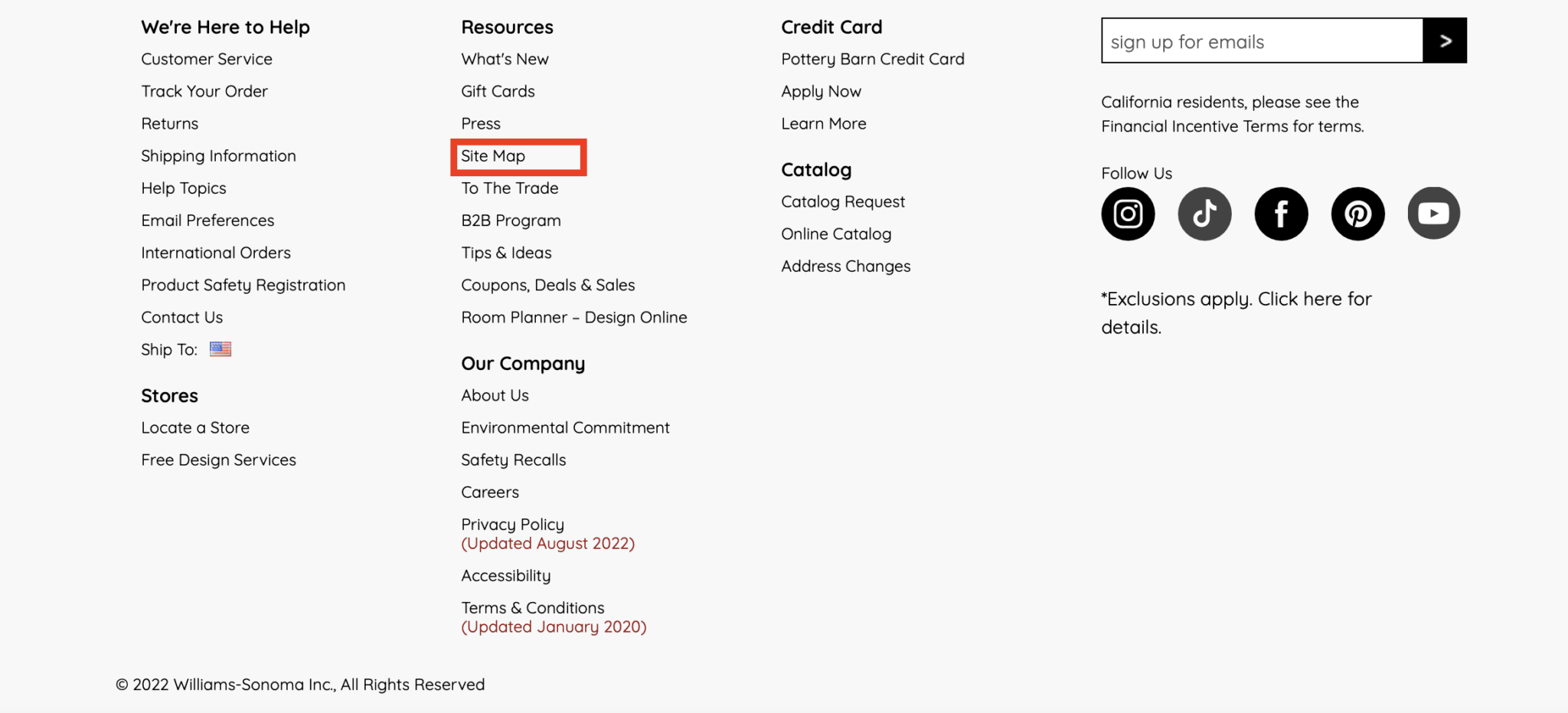
Creating a well-structured HTML sitemap and linking to it from the footer, as Pottery Barn Kids has done, ensures that most site pages are only a few clicks away, which aids in both user accessibility and SEO.
Since search engines crawl sites in a sequential manner and follow contextual cues, it is beneficial to have a single page that links to the site’s primary and secondary pages.
This can be helpful for users looking for specific pages on your website and help search engines discover and crawl all of the pages on your website.
Once created, it is essential to maintain an updated HTML sitemap on the site to ensure users and search engines can reach any page via minimal navigation.
In-content internal linking best practices
Ecommerce sites are notorious for lacking content – especially across category and sub-category pages. As a result, it could be argued some of these examples are “navigational” in nature.
However, I might argue these implementations are less ‘standard’ for navigational purposes and typically buried at the bottom of the page (where content is generally added for category pages).
5. Supporting category page content
There are many ways to build in supporting content on category pages – that could be a separate article.
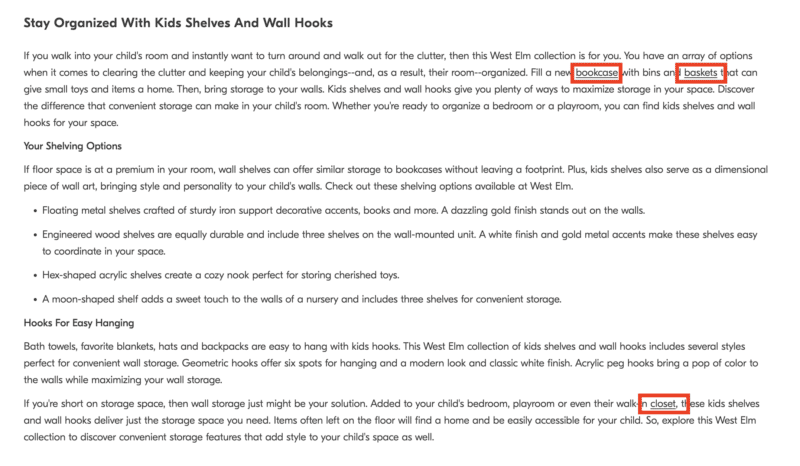
In the example below, West Elm adds a few supporting paragraphs at the bottom of their category pages with additional heading tags and content that adds value to the user experience.
Within that content, they naturally include links to other category and sub-category pages, individual product pages, and even educational/blog content where it makes sense.
6. Internal linking modules
Above the supporting page content, Pottery Barn, Mark & Graham, and West Elm utilize a row of Related Searches (read more about internal link modules here).

Pottery Barn Kids utilizes this same row directly above the footer.

In all cases, these text links take the form of long-tailed keyword-rich internal links to sub-categories and product detail pages (PDPs).
As you can see from the example above, this provides opportunities to build rich anchor text links to pages around color, texture, and even sizing – incredibly valuable for those long-tailed but highly-qualified searches.
7. Related products/browsing
Ecommerce SEO 101 requires a related products widget of some sort. This can help users discover additional products they may be interested in and is one of the foundational tactics for internal link building.
However, what was traditionally reserved for the product detail page, has expanded to category pages, and even the “types” of related products have grown exponentially.
For example, Williams Sonoma uses the standard “Related Products,” while Pottery Barn uses a “Top Picks for You” widget on their category pages.
On product detail pages, this implementation expands to a wide variety of implementations and names, typically with multiple rows per page in a carousel allowing for a more extensive list of internal links per page:
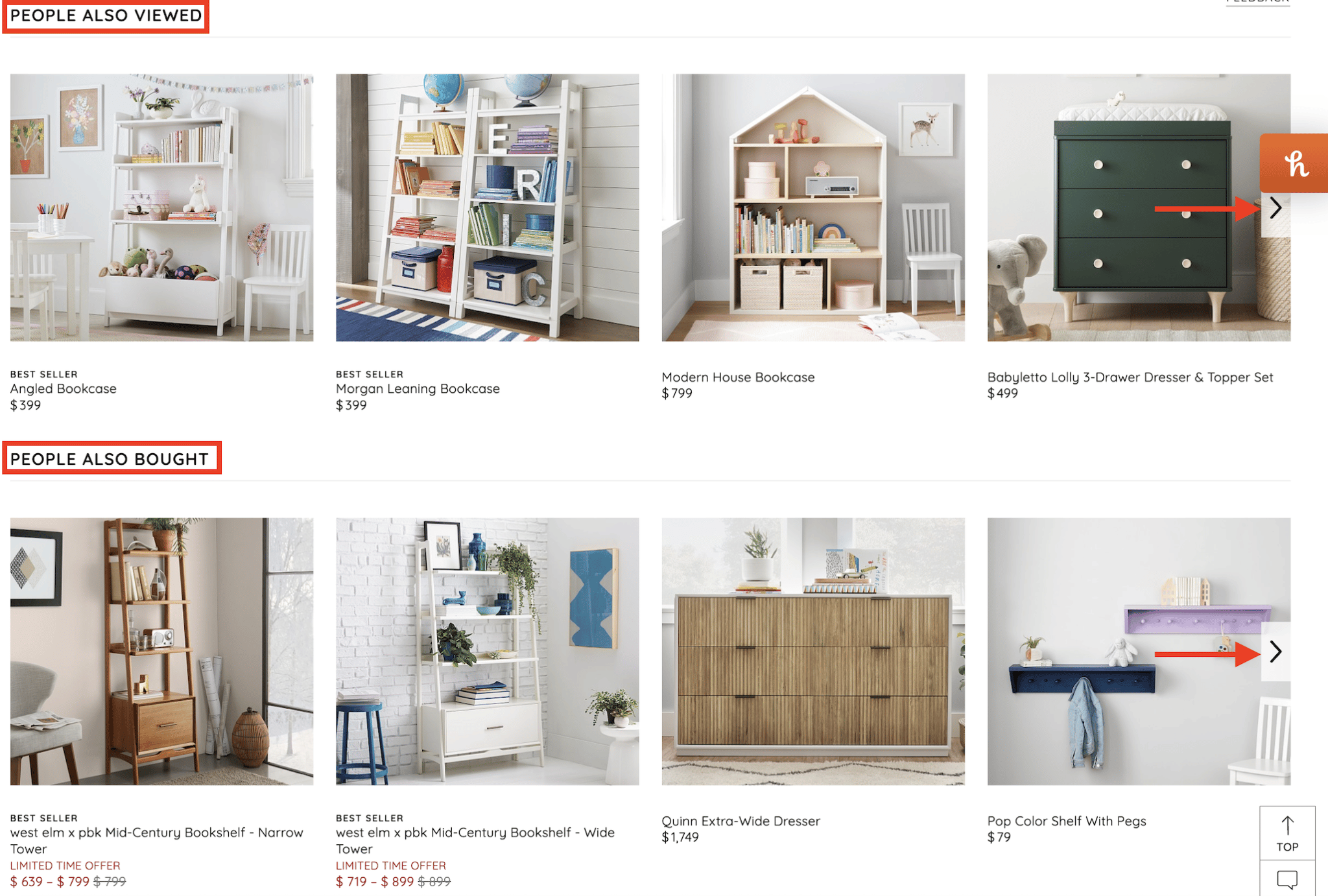
- “People Also Viewed” (Pottery Barn Kids)
- “People Also Bought” (Pottery Barn Kids)
- “Also in This Collection” (Pottery Barn)
- “Pairs Well With” (West Elm)
- “People Also Browsed” (West Elm)
- “Customers Also Viewed” (Williams Sonoma)
- “Customers Also Bought” (Williams Sonoma)
- “Related Products” (Williams Sonoma)
- “You May Also Like” (Rejuvenation)
- And more!
These links are invaluable for cross-selling, upselling, and flattening the overall website architecture.
8. Product attributes
Where breadcrumbs might not be possible, product attributes can fill the void.
When both can be used, they are an effective complement for each other and can reference any/all attributes a product might have:
- Size
- Style
- Color
- Brand
- Flavor
- Texture
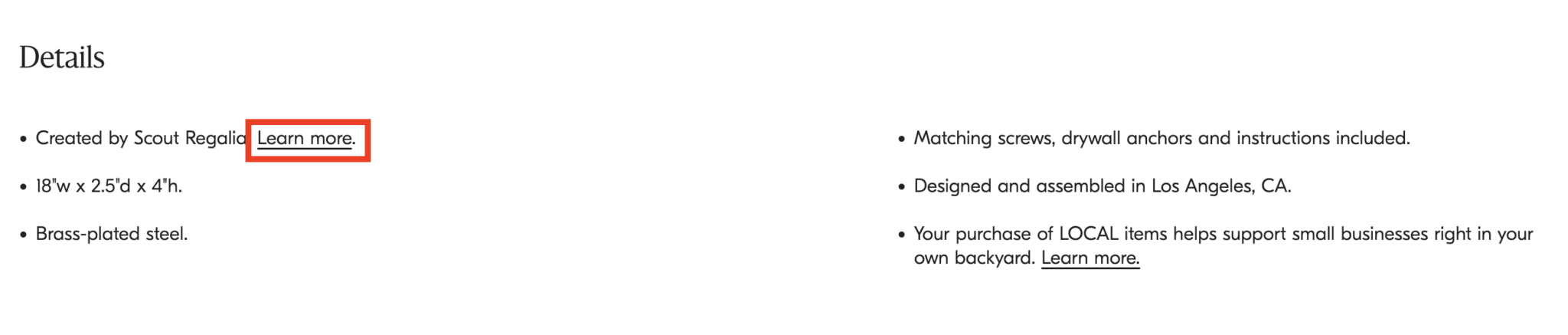
While this type of internal link is perhaps better showcased on another site (check out REI.com), I was able to find an example of this on West Elm:
In this case, “Learn more” links to the collaboration page for Scout Regalia. I would argue that a better anchor text implementation could be done here.
There are broader opportunities across the collective sites to take advantage of interlinking among collaborations and brand pages on product detail pages themselves.
9. User-generated content (UGC)
UGC content can take on many forms:
- Reviews.
- Testimonials.
- Question and Answers.
It’s hard to find fault in Williams Sonoma’s SEO strategy. This, however, is one area where there might be a significant opportunity.
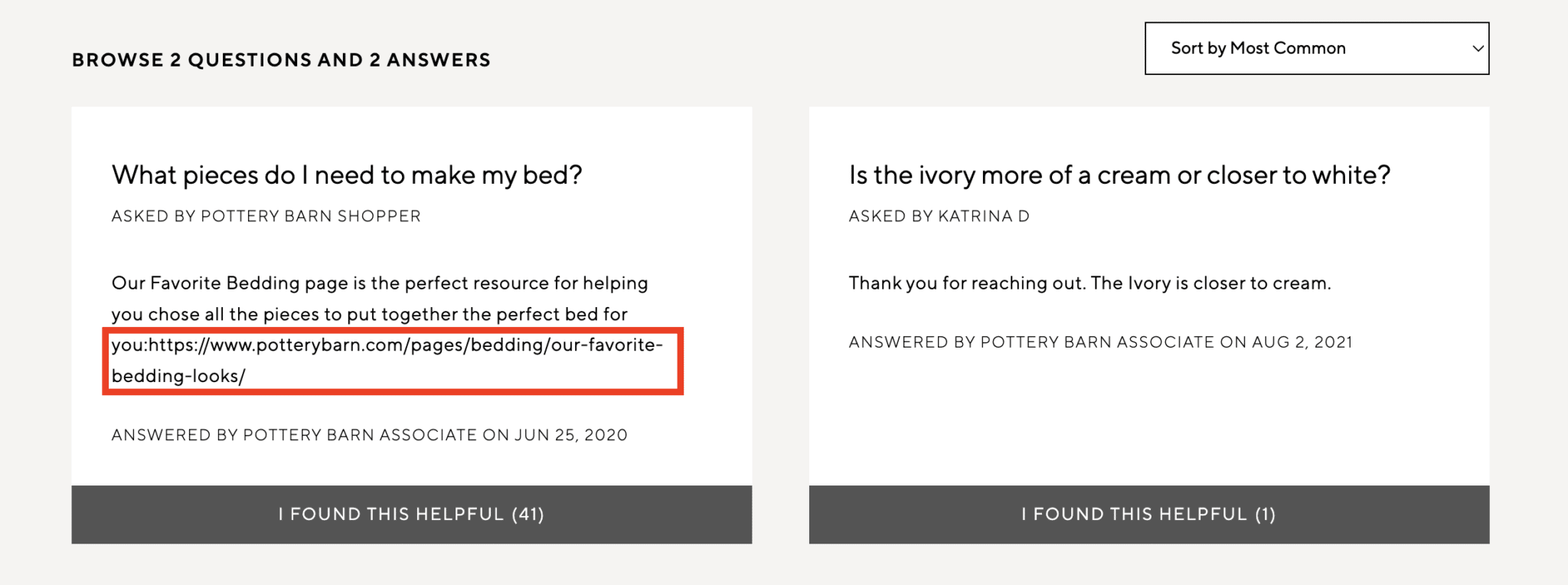
In the example above, a Pottery Barn associate left a response to a comment with a naked URL. However, the link is not clickable.
Generally, the Q&A section across the domains offers many opportunities for internal linking automation.
What are general internal linking best practices?
Now that you have a roundup of the why and where to incorporate internal links, you might wonder “what to do” and “how to do it.”
A myriad of articles outlines these internal linking best practices very well, including Moz, Semrush, and, of course, Google.
I suggest you dive into the links above for a more detailed breakdown. In my opinion, the five most crucial internal linking best practices to follow, in no particular order, are below:
- Link to deep pages.
- Use descriptive anchor text.
- Link to relevant/related pages.
- Link to the canonical version of the URL.
- Don’t use the same anchor text for multiple pages.
How do I implement internal linking on my ecommerce site?
Much of this may require some grunt work and a partnership with your development team to implement these strategies effectively.
The implementation with the most bang for your buck (and potentially the highest level of effort) is internal linking modules. I linked it above, but I highly recommend reading this article from Holly Miller Anderson for more details.
Alternatively, auditing your existing internal links to determine which pages could benefit from increased internal linking is always a great place to start.
Paul Shapiro defines this process as determining “internal PageRank,” which is an intelligent way of thinking about it.
No matter how you define it, the outcome of this exercise will no doubt provide valuable insights to get started.
Maximizing internal linking for ecommerce
Internal linking is an essential aspect of any ecommerce website.
By following the best practices discussed in this article, you can ensure that your website is easy to navigate for users and is optimized for search engines.
The post Internal linking for ecommerce: The ultimate guide appeared first on Search Engine Land.
Courtesy of Search Engine Land: News & Info About SEO, PPC, SEM, Search Engines & Search Marketing
Tuesday, January 31st, 2023
As Instagram and Facebook continue to lead the social platform arena, Meta remains a media channel where advertisers must stay visible and competitive in 2023. Much has changed over the past year, with Meta releasing many new tools and features. Advertisers now have more resources to scale their campaigns faster than ever.
Meta continues to dominate machine learning, launching new automated campaign types proven incredibly efficient. Advertisers have more options to control certain elements in campaigns.
The media giant also improved the experience of working with influencers, a value-add to advertisers who seek to focus on their brand awareness budgets over direct response.
With all the new updates in 2022, several best practices were uncovered through rigorous testing, many of which prove vital for any brand’s long-term Meta advertising strategy.
Here are five recommendations to consider when running Facebook and Instagram advertising campaigns in 2023.
1. Leverage Advantage+ campaigns
Advantage+ campaigns is a new feature Meta released in 2022. I’ve always advocated for Meta’s machine learning because they have mastered it. Advantage+ campaigns are a great addition to app and shopping initiatives.
Meta does the work for advertisers by finding the right audience and the right creative. We have succeeded across app install and shopping (dynamic product ads).
To capitalize on Advantage+ campaigns, it’s essential to ensure you have a healthy amount of creative to get these running effectively. Meta recommends the creative assets they think will perform the best, but marketers can manually select the ones they desire.
Experiment with your options and try a combination of ads known to perform well while also letting Meta choose ads. By testing and optimizing what works, you’ll likely see an improvement in your cost-per-acquisition running with Advantage+ campaigns. Keep your eye on these for 2023.
2. Work with influencers
Not a new tactic, but Meta has recently put forth new playbooks and guides to help advertisers work with influencers.
Influencers are a large part of B2C advertising budgets, and Meta has recognized that marketers want to leverage user-generated content on brand channels with paid media.
The process isn’t perfect, but here are a few key best practices to make your strategy go as smoothly as possible.
- Connect your influencers as partners under your company page’s “Paid Partnership.” This function allows you to promote their content on your brand channels.
- When promoting on Instagram, ensure influencers include the paid partnership label with your brand – “Paid Partnership with [Brand Name].” This is very important as it ensures you can pull the partner’s content onto your own pages to advertise within the ads manager. Make sure each partner specifically includes your brand name in the partnership label because if they only include the generic label that says “Paid Partnership” you will likely run into trouble getting their content promoted and will have to have them edit the post.
- For Instagram Reels and Stories, verify that there are no stickers or copyrighted music in videos created. Otherwise, Meta will not approve your ads. In addition, you’ll have to work with influencers to re-record their content, which can be a major inconvenience if your campaigns are timely. Typically, the quality of content decreases when we have to go back to influencers and ask for last-minute changes to content that was initially in final approval.
Also, keep in mind that if you’re promoting Reels, advertisers can only add links to these if you create a dark post. If it’s important that you have a link, but you don’t want a dark post, Facebook recommends going with the “Story” placement.
Advertisers working with influencers can additionally find success with the “Instagram Explore” placement, so it’s highly recommended to keep an eye on that one for 2023. We’ve seen our lowest CPMs and CPAs from Instagram’s new “Explore” placement and plan to increase spend here on future influencer initiatives.
Get the daily newsletter search marketers rely on.
<input type=”hidden” name=”utmMedium” value=”” />
<input type=”hidden” name=”utmCampaign” value=”” />
<input type=”hidden” name=”utmSource” value=”” />
<input type=”hidden” name=”utmContent” value=”” />
<input type=”hidden” name=”pageLink” value=”” />
<input type=”hidden” name=”ipAddress” value=”” />
3. Set up Meta’s Conversions API
Yes, there are still many pain points and kinks to be worked out when setting up Meta’s Conversion API (CAPI). However, Meta has recently rolled out various setup methods to help more advertisers get up and running.
While CAPI isn’t mandatory, it’s worth keeping in mind since it’s a deeper level of optimization. With the new setup methods, it also appears Meta is (hopefully) working to offer more integrations for advertisers to get set up faster without needing a full dev team.
After successfully getting CAPI set up and launched, we delivered our lowest cost-per-acquisition of the year in Q4. Our CPA decreased by 34% in our first month and 70% in our second month while optimizing for conversions using CAPI. We were able to feed a deeper data point to Facebook’s algorithm.
Stay on the lookout for more Meta updates regarding CAPI setup. This is one feature you don’t want to miss out on.
4. Use ‘open’ and ‘broad’ targeting
Aligning even more with Meta’s machine learning algorithm, “Open” or “Broad” targeting will continue to be king when scaling your campaigns.
Meta’s algorithm can efficiently find the audience most likely interested in your ads and taking action when doing either of these two options:
- Leaving your targeting open, meaning you don’t add any targeting beyond demographics.
- Leaving your targeting very broad, using minimal interest targeting that keeps audience scale in the millions.
Open and broad targeting feeds Meta the most audience data to allow it to make the best optimizations, which is the best way to make machine learning work for your advertising efforts.
5. Make the best of lead gen forms
Long has been the theme of “less is more” regarding lead gen forms. This remains true in many cases. But if you’re struggling with the quality of leads, consider adding more questions to qualify the customer.
We’ve seen this successful when needing to drive quality over quantity. Yes, your front-end cost per lead will likely increase. Still, we’ve found that the quality on the backend significantly improves and decreases the efficiency of qualified leads while driving increased revenue for businesses.
It’s also recommended to test manual fill for first name, last name and/or email address if you’re struggling with the quality. There is a balance to be found when it comes to manual fill vs. autofill so you’ll likely want to test a few variations to find what works best for your business.
Don’t have too many manual fill questions to avoid accidentally increasing the volume of abandoned forms. Consider additionally giving the consumer a short and sweet introduction on the form that details what they will get from filling out the form. This can be a snippet of a whitepaper or a few bullets about the company – whatever makes the most sense for your ad.
Moreover, ensure your thank you page or the landing page you are driving the consumer to is engaging with helpful information and resources. This provides more education for the consumer to make decisions and can help build your retargeting audiences for nurture campaigns.
Lastly, keep the creative for your lead gen forms scroll-stopping. You have seconds to grab someone’s attention in their feed and make them stop to open your form, so be bold!
The takeaway
As Meta continues to evolve and unroll new features, one thing is certain – automation will become a core campaign tactic.
With automation at the forefront, advertisers have more ability to test and learn at a faster pace than ever with tools like CAPI and Advantage+ campaigns.
Furthermore, don’t hesitate to lean into open and broad targeting, where possible, to feed audience optimization.
2023 will be a big year for testing to see where advertisers can uncover additional efficiencies and remain competitive on Facebook and Instagram.
The post Meta advertising: 5 best practices for 2023 appeared first on Search Engine Land.
Courtesy of Search Engine Land: News & Info About SEO, PPC, SEM, Search Engines & Search Marketing
Tuesday, January 31st, 2023
Google has released three new updates for the GA4 dashboard, allowing advertisers to find information about current properties or accounts.
Dig deeper. The following updates were posted by Google on their Analytics Help documentation.
Find data stream details
The following search terms allow you to open the details for a web or app data stream in the property you are using:
- the keyword “Tracking”
- a web stream measurement ID (i.e., “G-XXXXXXX”)
- an app stream ID (i.e., “XXXXXXX”)
Find the current property and account settings
The following search terms allow you to open the settings for the property you are using:
- the keyword “Property”
- the current property ID or property name
The following search terms allow you to open the settings for the account you are using:
- the keyword “Account”
- the current account ID or account name
Go to other Google Analytics 4 properties
The following search terms allow you to navigate to a different Google Analytics 4 property from the one you are using. Analytics shows you up to 7 properties that match the search query.
- the property ID or property name of the other property
- a web stream measurement ID (i.e., “G-XXXXXXX”) in the other property
- an app stream ID (i.e., “XXXXXXX”) in the other property
Why we care. The additional information will help advertisers analyze streams, accounts, and properties in their GA4 accounts.
The post New updates for the GA4 search bar appeared first on Search Engine Land.
Courtesy of Search Engine Land: News & Info About SEO, PPC, SEM, Search Engines & Search Marketing
Tuesday, January 31st, 2023
Google releases URL Inspection Tool API
In 2022, Google released a new API under the Search Console APIs for the URL Inspection Tool. The new URL Inspection API let you programmatically access the data and reporting you’d get from the URL Inspection Tool but through software.
Google’s URL Inspection Tool API had a limit of 2,000 queries per day and 600 queries per minute.
Google provided some use cases for the API:
- SEO tools and agencies can provide ongoing monitoring for important pages and single page debugging options. For example, checking if there are differences between user-declared and Google-selected canonicals, or debugging structured data issues from a group of pages.
- CMS and plugin developers can add page or template-level insights and ongoing checks for existing pages. For example, monitoring changes over time for key pages to diagnose issues and help prioritize fixes.
Within a week, several SEO professionals developed free new tools and shared scripts, and established SEO crawlers integrated this data with their own insights, as Aleyda Solis rounded up in 8 SEO tools to get Google Search Console URL Inspection API insights.
Also on this day
2022: This change may have resulted in seeing more or less errors in your Breadcrumbs and HowTo structured data Search Console enhancement and error reports.
2022: Google Ads also launched auto-applied recommendations for manager accounts and more recommendations for Video campaigns.
2022: Google would combine its advertiser identity and business operations verification programs under a unified Advertiser verification program.
2022: Designed for small and mid-sized enterprises, the app automated weekly site crawls and detects issues ranging from broken pages to content that doesn’t meet best-practice guidelines for SEO.
2022: The augmented reality feature, called “Try On for Home Decor,” let users see what furniture looked like in their home before buying.
2020: The majority of participants also agreed that rich results improved Google search.
2020: LinkedIn sessions grew faster than the previous three quarters, though revenue growth slowed slightly in the second quarter of its fiscal 2020.
2019: Previously you were able to submit up to 10 URLs per day and maximum of 50 URLs per month. Bing increased these limits by 1000x and removed the monthly quota.
2019: Marketing Land’s Digital Agency Survey found the sector was weathering digital transformation well, but the growth of data-driven marketing made it clear where they needed to hire.
2019: Quora introduced three new metrics (Auctions Lost to Competition, Impression Share, Absolute Impression Share) to help advertisers understand how they performed in the ad auctions.
2018: Indexing and ranking are two separate processes – and this specific algorithm had no impact on indexing.
2018: Advertisers had to enable auto-tagging of the Microsoft Click ID in their accounts to get consistent ad conversion tracking from Safari.
2018: They demanded more changes, saying their problems have intensified rather than improved since the EC ruling in June 2017.
2017: Developers could now build their own tools around the mobile-friendly testing tool to see if pages are mobile-friendly.
2017: IF functions arrived to let advertisers customize ads based on device and retargeting list membership.
2017: Ads based on existing ad and landing page content were added to ad groups by Google.
2017: It would roll out to even more AdWords accounts in the next few months.
2017: The 3D printer worked in outer space, and the Majestic Landscape was printed at the International Space Station.
2014: For the prior three years Nadella had run Microsoft’s Server & Tools business. Before that he was in charge of Bing and online advertising.
2014: The sync window showed the total number of changes and the number of those that had been successfully downloaded from or posted to the account.
2014: Google showed the start time at the top of its results.
2014: Volkswagen garnered the top spot with the most ad impressions on Google.
2014: The latest images culled from the web, showing what people eat at the search engine companies, how they play, who they meet, where they speak, what toys they have, and more.
2013: Google added three new measurement features to the AdWords for video reporting interface (Reach & Frequency, Column Sets Tailored to Marketing Goals, Geographic Visualization).
2013: The Doodle honored Robinson for his 94th birthday.
2012: A program that guaranteed top listings for local searches on Google, Yahoo and Bing? An “officially approved” one in “cooperation” with those search engines? Not true, said Google and Bing.
2012: Search ad spend was expected to grow 27% from 2011 to 2012, up from $15.36 billion to $19.51 billion. And by 2016, it was expected to reach almost $30 billion annually.
2012: Cutts managed to singlehandedly convince some government reps to let Googlebot crawl and index their websites.
2011: FairSearch.org opposed any such potential licensing deal.
2011: Google’s relationship with review sites like TripAdvisor and Yelp was as complicated as ever.
2011: More Android handsets were shipped in Q4 2010 than other platforms.
2011: Slashtags and the personalization that Blekko offered were even better suited to the mobile search use case in some respects.
2011: You could analyze domains, Twitter usernames, or keywords — and they can be compared over four timeframes: one day, a week, two weeks or a month.
2011: Wael Ghonim went missing not long after tweeting about being “very worried” and “ready to die.”
2010: “We did not enter the search business,” Jobs said. “They entered the phone business. Make no mistake they want to kill the iPhone. We won’t let them.”
2009: Due to a human error, Google told users “This site may harm your computer” for every website listed in search results.
2008: Google’s Q4, 2007 revenues were $4.83 billion, compared with $3.21 billion the year before.
2008: How the search engine was considering using social data to improve its search results.
2008: The overall industry average click fraud rate rose to 16.6% for Q4 2007. That was up from 14.2% for the same quarter in 2006, and 16.2% in Q3 2007.
2008: A pull-down menu allowed users to narrow or expand results for the same query and more easily discover non-traditional content in Google Maps.
2008: Spoiler alert: Schmidt left Google’s parent company Alphabet for good in February 2020.
2007: Google reported revenues of $3.21 billion for Q4 2006, representing a 67% increase over Q4 2005 revenues of $1.92 billion
2007: Google’s Shuman Ghosemajumdersome said third-party auditing firms don’t appear to be
matching up estimated fraud figures with refunds or even actual clicks registered by advertisers.
2007: The search engines had to make “moral judgments” about international authorities’ requests for information when they do not have to do the same for US requests.
2007: YSM’s public keyword research tool was sporadically offline, but Yahoo had plans to offer a new public keyword research tool.
2007: The account was disabled for 24 hours due to “unusual usage.”
2007: Brand Universe would create about 100 websites built around entertainment brands and pull together content from various Yahoo properties.
2007: Due to a trademark of the term.
2007: Boorah collected reviews from existing local search and content sites, summarized and enhanced the data and built additional features on top.
2007: What was new with Zibb, a B2B search engines, and the opportunities he saw going forward in B2B search.
From Search Marketing Expo (SMX)
Past contributions from Search Engine Land’s Subject Matter Experts (SMEs)
These columns are a snapshot in time and have not been updated since publishing, unless noted. Opinions expressed in these articles are those of the author and not necessarily Search Engine Land.
< January 30 | Search Marketing History | February 1 >
The post This day in search marketing history: January 31 appeared first on Search Engine Land.
Courtesy of Search Engine Land: News & Info About SEO, PPC, SEM, Search Engines & Search Marketing
Monday, January 30th, 2023
Analytics firm Jumpshot shuts down
In 2020, following critical articles about its data collection and sales practices, analytics firm Jumpshot was shut down by its parent company Avast.
Jumpshot was made famous within the SEO industry by SparkToro founder Rand Fishkin’s (heavily criticized and widely circulated) zero-click analysis and presentations.
Articles from Vice, PC Mag and Motherboard claimed that Avast and Jumpshot were “secretly harvesting” users’ browsing behavior, packaging it and reselling without their full knowledge.
Fishkin defended the company and faulted the publications for what he said was incomplete and biased reporting.
Read all about it in With Jumpshot shuttered, where will SEOs get their ‘zero-click’ fix now?
Dig deeper:
Also on this day
2022: This document explained how SafeSearch works and added some troubleshooting.
2020: The new-ish Apple Maps has a range of improved features and content
2020: Early looks at the new campaign type and native ad formats that have had little fanfare since launching in beta.
2019: In anticipation of the old Google Search Console going away, Google moved the security issues into the new version.
2019: Google began incorporating YouTube into its Search Partners network.
2019: While Amazon and LinkedIn cracked the top five, Marketing Land’s Digital Agency Survey found second-tier platforms were much less likely to see spending increases in the coming year.
2019: Microsoft released three location APIs: Bing Maps Location Recognition, Bing Maps Local Search API and Bing Maps Local Insights API.
2018: Google explained what featured snippets are, the various user interfaces and treatments you can get from these featured snippets and how they interact with desktop, mobile and voice search results.
2018: Advertisers could quickly see performance by audience and benchmark against non-targeted users.
2017: A report found that AMP results shown in the Google News section for mobile users had more than doubled in the past several days.
2017: The Doodle featured Korematsu with his Presidential Medal of Freedom.
2015: A new Word Count Query dimension in Analytics let advertisers quickly compare head terms and long-tail queries.
2015: Google Now could now be integrated with 30+ developer apps.
2015: Bing’s search results included original content and almost anything a fan would need to know before the game starts.
2015: The latest images showing what people eat at the search engine companies, how they play, who they meet, where they speak, what toys they have, and more.
2014: That was an increase of 17% compared to the fourth quarter of 2012.
2014: It had been over a year since Graph Search launched.
2014: After attention was drawn to the fact it dropped links to competing financial websites, Google quietly restored the links.
2014: The local business info included basic business information, photos, hours of operation and some data specific to the business type.
2013: The beta was open only to electrical and electronics industries.
2013: 49ers quarterback Colin Kaepernick had 50% more searches than Raven’s quarterback Joe Flacco.
2013: Some people on Google+ have added satirical, fake reviews to locations in North Korea.
2012: Yandex licensed data from Nokia-owned Navteq to offer better and more comprehensive maps coverage around the world.
2012: FAA Mobile Web App, USDA Plant Hardiness Zone Map, National Archives Transcription Pilot Project and more.
2011: Many iOS users on iPhone, iPod Touch and iPad devices reported seeing the instant previews button on the right side of the search result.
2011: Google showed live snow results on the search results for ski resorts. The weather results had a slider and larger real estate for interacting with the weather.
2010: Google Street View was terribly unintuitive on the iPhone.
2009: Rather than fixing its problems and earning more revenue by doing something advertisers actually want, Yahoo seemed more interested in doing manual tweaks to advertiser accounts – without explicit permission – to generate more money.
2009: It enabled search marketers to define various kinds of actions or “conversions” (e.g., newsletter sign-up, ecommerce transactions, email capture).
2008: In particular, Google Universal Search filled more than just 10 spots on the page, while shopping and blog search results were among the new resources being included.
2008: Total revenue in Q4 was $1.83 billion, which represented 8% growth year-over-year ($1.7 billion). Full year 2007 revenues for Yahoo were $6.97 billion.
2008: Searching for [dangerous cult] returned the Scientology website in Position 1.
2008: The US Geological Survey and Google made global earthquake data available in Google Earth as one of the layers under “Places of Interest.”
2007: Conducting searches on Google.com for local-specific information could now return local reviews and business comparisons.
2007: You could now delete URLs from Yahoo’s index with a click of a button.
2007: Anyone could place code on their website to show off the number of links they have to a specific page or to their site.
2007: The industry average click fraud rate in Q4 2006 was 14.2% versus 13.8% for Q3, 14.1% for Q2 and 13.7% for Q1.
2007: The Google Mini would “enable companies to perform searches on intranets as well as internal business applications.”
2007: The feature would let users send SMS messages to their Orkut friends from their mobile phones.
2007: When you received an email in your Gmail account, and it contained a Google Docs or Spreadsheet file, the file would have a link to “Open as a Google Document.”
Past contributions from Search Engine Land’s Subject Matter Experts (SMEs)
These columns are a snapshot in time and have not been updated since publishing, unless noted. Opinions expressed in these articles are those of the author and not necessarily Search Engine Land.
< January 29 | Search Marketing History | January 31 >
The post This day in search marketing history: January 30 appeared first on Search Engine Land.
Courtesy of Search Engine Land: News & Info About SEO, PPC, SEM, Search Engines & Search Marketing
Monday, January 30th, 2023
Yahoo Search seems like it will be making a comeback in the future. Yahoo has been dropping hints over the past couple of weeks related to this return and is also hiring a Principal Product Manager for the Yahoo Search platform to help lead these initiatives.
The job posting. Yahoo posted a job listing for a “Principal Product Manager, Yahoo Search” a few weeks ago. The job posting, in part, reads, “We’re looking for a Product Manager for Search at Yahoo. We are looking for folks that are interested in pushing beyond the status quo to change the way folks interact and use search.”
“As a Product Manager for Search, you will help develop our search strategy and roadmap and lead its execution. The ideal candidate will leverage strong organizational skills and deep subject matter expertise to partner with design, science, engineering, and other key cross-functional teams. You will determine what we prioritize for our customers in our search experiences and bring the vision to life. You will also lead the effort to discover and amplify content from across the vast Yahoo ecosystem to create new and innovative search experiences across surfaces and for our Search App. The role is also responsible for identifying and documenting product and business requirements and taking them from concept to production, while working with a broad set of stakeholders that include marketing, sales, legal, editorial, design, UXR, and other teams,” it continues to read.
Twitter hints. Yahoo has reactivated its Twitter account for Yahoo Search, posting teasers throughout the past couple of weeks. Here are some of those:
Just popping in to remind everyone that we did search before it was cool.
BRB making it cool again.
— Yahoo Search (@YahooSearch) January 20, 2023
The year of the  is said to bring tranquil energy and opportunity for prosperity.

Love that for us.
— Yahoo Search (@YahooSearch) January 22, 2023
Your last Yahoo Search. No cheating.
— Yahoo Search (@YahooSearch) January 27, 2023
Yahoo executives. Brian Provost, SVP & GM, Yahoo, posted on LinkedIn about this job listing and wrote, “There’s going to be so much innovation in Search in the coming years and there aren’t many places where you can immediately have an impact this big. Would love to hear from you if you have a passion for Search and building product experiences.”
Karen Chin, Sr. Director of Product Management, Yahoo, also posted on LinkedIn, saying, “Looking to drive meaningful and innovative experiences for millions of users? We are looking for a seasoned Search Product Manager to take search into the next phase! Share and join us.”
Jim Lanzone, Chief Executive Officer at Yahoo, took the helm of Yahoo in September 2021. Jim has a lot of deep roots in search. He worked at Ask.com for seven years, starting in 2001 as an SVP, Product Management, then in 2004 as the SVP and GM of Ask Jeeves and then taking over as CEO in 2006. After Ask.com, he became the President and CEO of CBS Interactive, then the CEO at Tinder and now at Yahoo as their CEO. It will be exciting to see what Yahoo Search does under Jim’s leadership. He is a creative mind that produced a lot of search innovation at Ask.
Why we care. Personally, I cannot wait to see what Jim and his team come up with for Yahoo Search. I am excited to see what new ideas, interfaces, and concepts the team brings to Yahoo Search. Yahoo was a pretty big player in search in the early days, then the company continued to decline and even Google veteran Marissa Mayer could not save the company.
But now Yahoo has a blank slate, and it will be very exciting to see if Yahoo can compete again.
The post Yahoo is making a return to search appeared first on Search Engine Land.
Courtesy of Search Engine Land: News & Info About SEO, PPC, SEM, Search Engines & Search Marketing
Sunday, January 29th, 2023
Google begins experimenting with featured snippets
in 2014, Google started answering complex questions at the top of its search results with detailed responses (or answers) taken from websites.
Does that sound like featured snippets? It should. Because it was.
We know from Google that featured snippets were introduced in January 2014. We don’t know the official date Google began testing it, but this was the day Search Engine Land first reported on the new search feature.
We didn’t yet know these answers were called “featured snippets” – Google’s Gary Illyes revealed the name in June 2015 – but clearly that’s what we were seeing. All Google would say at the time was: “we’re always experimenting with different types of answers, but we don’t have more details to share at this point.”
Read our coverage of what was then an experimental feature: Google Search OneBox Answers Are Getting More Detailed
Also on this day
2022: Google’s Danny Sullivan said it was “something our systems normally would typically catch, so we’re checking on it to improve.”
2021: Those who knew him, admired him, learned from him and loved him, were left reeling from the loss.
2020: The tool temporarily blocked URLs from showing in Google and showed outdated content and content filtered by SafeSearch.
2020: A look back at how Google had treated ads in search results, from blue shading to the latest version of today.
2020: Immediate indexing and more control over content were the benefits for publishers and site owners.
2020: The changes included more search engine options and an introductory screen aimed at reducing bias.
2019: This was a Google issue and would be resolved.
2019: The search engine’s share was small but some of its metrics were better than Bing’s, according to a third-party analysis.
2016: It expanded on examples about how to help Google find your webpages, how to give them better ideas on what those pages were about and how to make webpages that are good for visitors.
2016: You could check AdWords campaign performance, change bids and adjust budgets from your phone.
2016: They added little value in return for Google giving up its valuable search results space.
2016: With its nearly infinite news stream, Yahoo users no longer needed to open news articles in multiple browser tabs.
2015: Google added support for webpages that dynamically changed their content based on IP origin or language settings.
2015: The updates involved new satellite and ground-level imagery, and a detailed seat map of the stadium itself.
2014: Cutts answers the question, “How can an older site maintain its ranking over time?”
2014: The warning was mostly directed at affiliate sites in the “adult” industry.
2014: 68.8% of participants planned to focus on conversion rates and performance metrics in response to Google’s elimination of keyword data.
2014: You could click on the start and/or end date and a calendar pop up would show up to change your check in and check out dates.
2014: The report showed paid search spend rose 37.4% year-over-year.
2014: “It’s not hard to imagine that machine learning and AI would have broad application across Google, from search and mobile … to advertising, robots, autonomous cars, security and the connected home.”
2014: Five trends from the Super Bowl advertiser ads that ran on Google and the Yahoo Bing Network.
2013: Governments routinely ask search engines like Google for access to user data for various reasons. Google said they take each request incredibly seriously.
2013: Google was apparently trying to cross-promote AdWords Express and Google+.
2013: Over the previous 18 months, ChaCha had seen 2 billion questions and organized 129 million Q&A pairs.
2012: Amit Singhal told Search Engine Land: “… People are judging a product and an overall direction that we have in the first two weeks of a launch … We’re clearly not done. The product is not complete. It will improve.”
2012: It happened 125 years earlier, in Fort Keogh, Montana.
2011: The change to their algorithm was to prevent low quality scraper content in Google’s index. It impacted slightly over 2% of queries.
2011: Online Services, which houses all Microsoft’s online operations including MSN and Bing, posted a $543 million loss. That was up from $463 million in 2010.
2011: Google redesigned the homepage for its AdWords advertiser interface in an effort to bring more relevant, customized information up front for marketers.
2011: Bing’s destination pages let searchers compare several destinations at once in a side-by-side layout.
2011: Did scandals or an antitrust investigation make people less trusting of Google or tarnish its brand? Not at all.
2011: Google and the Connecticut-led coalition of 40 US states would begin negotiations aimed at settling issues related to Google’s collection of personal data over unsecured WiFi networks.
2011: Demos of several tablets were expected
2011: The latest images showing what people eat at the search engine companies, how they play, who they meet, where they speak, what toys they have, and more.
2010: Google tarted personalizing search suggestions that appeared on Google Maps.
2010: That was slightly higher than the 36% of UK consumers who had done so, but far less than in Germany (59%) and France (56%).
2010: Less than 24 hours after Apple announced the Apple iPad, Google announced improvements to the Google Books home page.
2010: It was a call for the price of a click on mobile handsets.
2010: Bing’s “Stocks and Funds page” offered in-depth information for users following or doing research related to stocks and finances.
2010: “We have done business in China for more than 20 years and we intend to stay engaged, which means our business must respect the laws of China.”
2009: Click Forensics estimated the overall average click fraud rate for Q4 2008 at 17.1%, the highest level since they began tracking it in 2006.
2009: The purpose: to help small- and mid-sized advertisers suffering from “performance issues.”
2009: Search was almost equally used by all groups across the board.
2008: Users could get directions or locations of businesses without inputting a destination address.
2008: Google added map view and a new info view that allows you to show different results on the page.
2008: “It’s like dealing with the CIA.”
2008: Google added a new video to its existing series of privacy videos, plus it developed a privacy booklet (PDF) to educate consumers and parents about online data privacy.
2008: DotHomes sought to become “the Google of property search” and was crawling for listings.
2008: The Google logo was made up of legos.
2007: This would give original video creators the ability to earn revenue each time their videos were watched on YouTube.
Past contributions from Search Engine Land’s Subject Matter Experts (SMEs)
These columns are a snapshot in time and have not been updated since publishing, unless noted. Opinions expressed in these articles are those of the author and not necessarily Search Engine Land.
< January 27 | Search Marketing History | January 29 >
The post This day in search marketing history: January 28 appeared first on Search Engine Land.
Courtesy of Search Engine Land: News & Info About SEO, PPC, SEM, Search Engines & Search Marketing