Archive for the ‘seo news’ Category
Monday, February 27th, 2023
Does your brand have a strategy behind its content marketing?
It should.
Planning is integral to achieving that ever-elusive return on investment (ROI).
Even if you’re not a natural planner, you’ll probably agree that most tasks are easier to achieve if you plan first.
For instance, planning your meals for the week vs. winging it. Going grocery shopping with a planned list vs. nothing. Planning a trip vs. stepping off the plane with no idea what you’ll do or where you’ll go.
Some people get excitement from living life in the unknown. But, for most of us, whether we want to save money, eat healthier, or get a seat at that hip restaurant on vacation, planning is essential.
The same is true of content marketing.
Without a strategy, your content marketing efforts are far more likely to go nowhere and do nothing.
I’d argue that profitable content marketing is impossible without a solid content strategy.
To answer the inevitable “why?”, let’s discuss why content strategy matters most.
But first, what is a content strategy?
What is a content strategy?
A content strategy is a plan that lays out how you will ideate, create, publish, promote, and manage content.
A content strategy helps define your brand’s goals, workflows, guidelines, budget, team structure, and content rules. It definitively answers these questions:
- Why are we creating content? (What goals are we trying to reach?)
- Who are we creating content for? (Who is our target audience?)
- How will we create content? (Will we use in-house talent? Hire writers/graphic designers/videographers?)
- What content will we create? (What topics and formats will we focus on?)
- Where/when will we publish content? (On our website? On social media?)
- How will our audience find our content? (How does SEO tie in?)
- Who is in charge of managing, publishing, and promoting our content? (What does our content team look like, and who fills what role?)
All of these questions are vital to answer if you create content. And if you formulate a content strategy, all of them will be addressed before you publish a single article. That’s key.
Why a content strategy is your map to profitable content
If you’ve been paying attention, content strategy is a huge deal.
Why?
Because smart content marketing gets incredible results, and those results will cost 62% less to achieve than traditional or paid advertising.
But to get those results, you need a strategy, because a strategy is a map that will lead you to profitable content that earns ROI. Here’s why.
1. Businesses with successful content have a content strategy
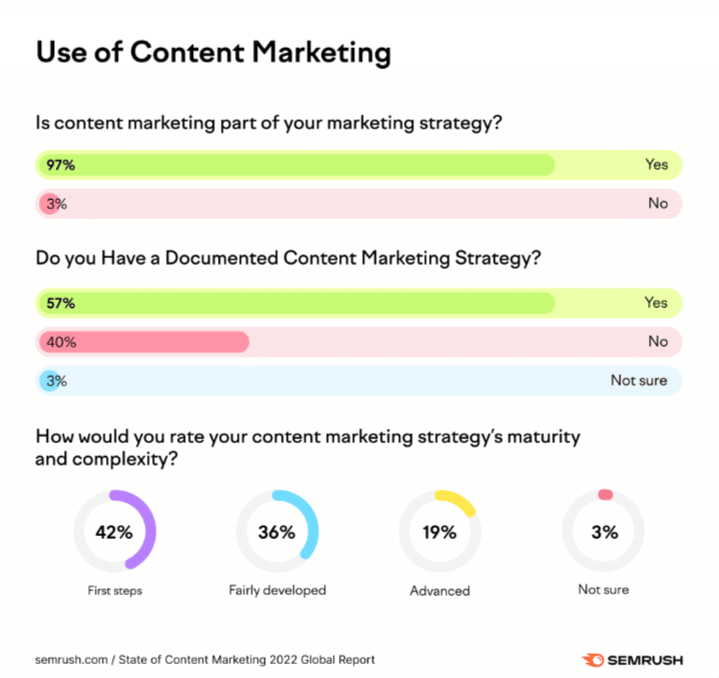
97% of businesses reported using content marketing as part of their overarching marketing strategy, according to a Semrush survey. However, only 57% reported having a documented strategy, and a mere 19% said their strategy was advanced.
The clincher? 78% of businesses who said their content marketing was “very successful” also had a documented content strategy.
What does it all mean?
Most businesses use content marketing, but many aren’t realizing its full potential.
To do that, you need a content strategy. And, you need it documented.
It matters because, without a documented plan, your content efforts will be scattershot. And scattershot efforts lead to scattershot, unpredictable results.
That is, if you earn results at all.
2. No content strategy? No results
Here’s what doing content marketing without a strategy looks like:
A small brand decides to start a blog. One or two staff members who also happen to be creative are tasked with managing it.
They’re not sure where to find topics, so they look at what their competition is doing and follow suit. They post whenever they have time, so publishing is sporadic and scattered. They post about the topics their main competitor posts about with little differentiation. And when the brand gets busy, the blog falls silent for months.
A year later, the brand checks in with the blog results – and finds none. They conclude blogging is a waste of time.
Yes – in this instance, it is. But that’s because the brand in question started wrong from the get-go. They treated content marketing as an accessory that could be done in spare minutes of the day without much effort.
The truth is, if you want content marketing to work, you have to regard it as another vital business activity – and a content strategy helps you get there.
You need to plan how, when and why to do it, and who you’ll do it for. You need to strategize so your brand can post consistently and regularly (because consistency leads to better results) – and that will require more than somebody’s spare time.
Reality check: It will require dedicated effort from someone whose 9-5 work consists of content creation and nothing else.
How will you direct that person? How will you allocate the resources to employ or pay that person? How do you ensure the created content will earn results? You have to plan. You need a content strategy.
3. A content strategy aligns your people, processes, and technology
If you want results from content, you must ensure your entire brand and team are on the same page, working under the same expectations and toward the same goals.
A documented content strategy aligns all those things like puzzle pieces snapping together to form a complete picture.
Think of building a content strategy as laying out your battle plan for increasing brand awareness, drawing in more website traffic, nurturing your audience, increasing conversions and sales, or whatever goal you decide is most important.
Achieving these goals will require many moving parts, different people, and plenty of tools (like a publishing platform, SEO tools, a content calendar, social media scheduling tools, editing tools and content checkers, collaboration tools, and more).
But the strategy accounts for all these pieces and explains how they fit together.
That’s why you and your team should make decisions about and record the who, what, where, when, and why so your content has its best chance of succeeding.
Get the daily newsletter search marketers rely on.
<input type=”hidden” name=”utmMedium” value=”“>
<input type=”hidden” name=”utmCampaign” value=”“>
<input type=”hidden” name=”utmSource” value=”“>
<input type=”hidden” name=”utmContent” value=”“>
<input type=”hidden” name=”pageLink” value=”“>
<input type=”hidden” name=”ipAddress” value=”“>
4. A content strategy helps you win buy-in
As we’ve explained, you need investment to ensure content marketing can work. You don’t just need people who will plan, create, manage, promote, and distribute content. You need people who know what they’re doing. And you need tools your people can use to facilitate all of those stages.
But what if the marketing budget isn’t up to you? Then you need buy-in from higher-ups.
How do you get content marketing buy-in? By laying out a strategy with goals, a trajectory, metrics to track, and a budget.
The strategy serves as proof that you know what you’re doing. Even further, it serves as a detailed guide for other people on how you plan to execute content successfully.
That makes it a powerful document to have on your side when you’re working to earn buy-in from bosses, department heads, clients, executives, and anyone else who holds power to invest.
5. A content strategy gives you a competitive edge
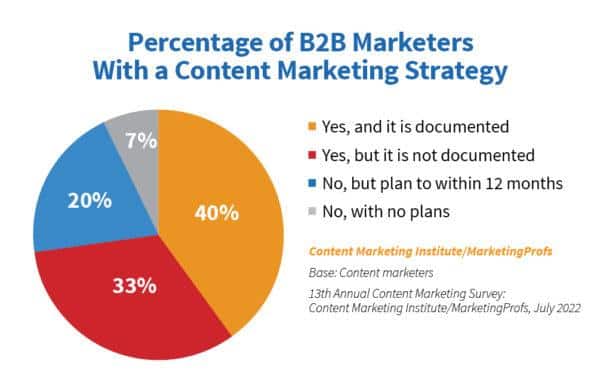
Only 40% of marketers say they have a documented content strategy, according to a recent Content Marketing Institute survey.
This statistic hasn’t budged in the last few years.
But, year after year, marketers with a documented strategy outperform their peers who don’t have one.
For that reason, they have a competitive edge. You need a documented strategy guiding everything you do in your content marketing to earn that edge over the competition.
The power of a content strategy lies in the finished document and the physical act of creating it.
When brands sit down to figure out this content thing, they crystallize key areas vital to success:
- Clarifying and refining their content goals.
- Getting to the heart of who they need to target with content.
- Envisioning what that content should look like.
- Strategizing how to execute with a clear set of actions like a blueprint.
With all this in mind, we shouldn’t be surprised that marketers who strategize content and write down that strategy are regular top performers.
Bottom line: If you want that competitive edge, you’ll join that club.
Your content marketing is more likely to fail without a content strategy
A content strategy at the heart of your content marketing will determine whether your efforts will fly – or fall flat.
Unfortunately, most brands are approaching content marketing with a laissez-faire approach. They might even be getting “okay” results.
But the thing is, “okay” should not be the standard.
That’s because content can achieve great heights for any brand, regardless of industry or size.
Think of that: Content has immense power to grow your brand.
But to tap into that power, you must have a content strategy.
The post Why content strategy matters most appeared first on Search Engine Land.
Courtesy of Search Engine Land: News & Info About SEO, PPC, SEM, Search Engines & Search Marketing
Monday, February 27th, 2023
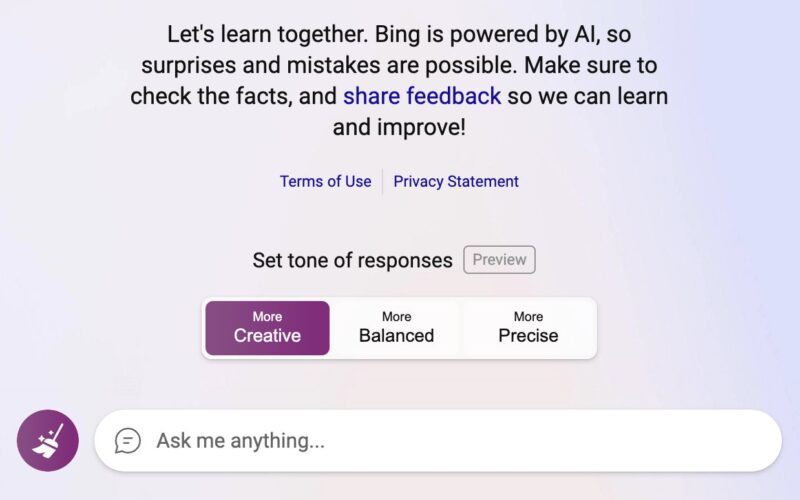
Microsoft is testing a new setting for “tone” in the new Bing AI search and chat experience. You can set the tone to be creative, balanced, or precise to tailor the type of responses you get from the Bing AI chat.
What it looks like. Here is a screenshot posted by Mike Davidson, Corporate Vice President, Design & Research at Microsoft, on Twitter:
What it does. Mike Davidson said, “some users will see the ability to choose a style that is more Precise, Balanced, or Creative.” I personally do not see this feature yet, so I cannot really test it out, but Microsoft is testing it to a subset of those invited to test the Bing Chat AI feature.
By the description, either Bing will respond with a more precise, maybe factually accurate response or a balanced response that shows multiple sides of the argument, or creative, maybe a response that is a bit more out there.
More changes to Bing AI chat. In addition to the above experiment of setting a tone, I noticed other updates to Bing AI chat this weekend.
- New daily limit of 100 queries per day
- Search queries are not included in the limit
- The Edge sidebar limits are a fixed number
- A new tagging system to help Bing disambiguate parts of the query
- Tone of voice changes
- Relaxing some constraints
- And inviting more users to test the new Bing AI chat
Why we care. It is fascinating to follow all these rapid changes from Microsoft on its new Bing AI Chat. Keeping an eye on what Microsoft is doing to improve the quality of the results, how it responds to criticism, and more is something that is not just fun and exciting to stay on top of, but may teach us about how we can leverage these features to garner more traffic to our sites.
The post Bing AI Chat testing setting the tone of the responses appeared first on Search Engine Land.
Courtesy of Search Engine Land: News & Info About SEO, PPC, SEM, Search Engines & Search Marketing
Sunday, February 26th, 2023
Google expands mobile-friendliness as a ranking signal
In 2015, Google announced it would expand its use of mobile-friendliness as a ranking signal, beginning April 21.
This algorithmic change would have a “significant impact” in the mobile search results, impacting all languages worldwide, Google said.
However, when April came, the general consensus was that Mobilegeddon was fairly insignificant, for all the hype and panic their Feb. 26 announcement created.
Google also announced that apps indexed by Google through App Indexing would begin to rank better in mobile search. Google said this only will work for signed-in users who had the app installed on their mobile device.
Read all about it in Mobilegeddon Cometh: New Google “Mobile Friendly Update” To Reward Sites Beginning April 21.
Also on this day
2021: Google published a list of best practices to help ensure that its search engine understood the products that were being referenced.
2020: Google was sending notices to sites that had mobile-first indexing issues.
2020: A tool for those tired of manually weeding through placement reports to exclude inappropriate websites and apps from display campaigns.
2020: Search Console users could download complete information (instead of just specific table views) from almost all reports.
2020: A Burberry bag was showing up with a “view in 3D” option in the Google search results.
2019: Google said you could download the data from the interface or the API before they turned it off completely.
2019: Average position was one of the few constants for more than 15 years. But with the removal of right rail ads, in particular, its utility sharply declined.
2019: The other change was that name of the business would move to the description line.
2018: One tool showed how a site stacks up against the competition on mobile. The other aimed to drive home the impact mobile speed can have on the bottom line.
2018: Google’s John Mueller confirmed a reporting glitch with the crawl stats “time spent downloading a page” report in the Google Search Console for on Feb. 20 and 21.
2018: In a new structure, the Google Shopping business unit bid against other Comparison Shopping Engines in the ad auction to give the competing engines “equal treatment” as mandated in the ruling.
2018: Google added a new feature to help non-English speakers expand their English-language vocabulary.
2016: Google’s John Mueller said you could use AMP to become mobile-friendly, but AMP itself was not a ranking signal.
2016: Google review snippets returned after a bug caused them to drop out of much of the search results for about a week.
2016: Google AdWords reports weren’t downloading or printing. Bing Ads had reporting delays that affected the Web UI, mobile and API.
2016: Users would be able to change the color of the Google logo using a “finger painting-like” feature.
2016: The latest images showing what people eat at the search engine companies, how they play, who they meet, where they speak, what toys they have and more.
2014: Cutts answers the question: “Should I focus on clarity or jargon when writing content?”
2014: Rankings were restored and most traffic was returning to the affected websites.
2014: Even if you moved your penalized site to a new domain name and didn’t redirect the penalized site, Google might still find it and pass along the bad signals.
2014: The company officially announced the launch of Flexible Conversion Counting, and advertisers would see new columns in AdWords.
2014: Google released some case study performance results on the new campaign type.
2014: All you had to do was go to Google, search for [american idol] or [idol] during the voting window, and select from your favorite finalists.
2014: Users could also use the “What’s Here” option to quickly get lat-long coordinates for any spot on the map.
2014: The company announced $1.573 billion in Q4 revenue, a 50.3% increase over 2013.
2014: Beck was Third Door Media’s Social Media Reporter from March 2014 through December 2015.
2013: Edmonson confirmed that Panda “caused a massive loss of traffic and revenue.” But HubPages wasn’t planning to change course; the planned was to improve quality.
2013: It seemed as if Google was testing hiding the search box completely from the Google search results page.
2011: The biggest “content farm” type brand that seemed to have suffered was Associated Content.
2010: Testing would continue until May, when it launched the new user interface.
2010: Google expanded the choices in its Search Options panel with the announcement of a tool to refine searches by location.
2010: Members of the European Union’s data protection group urged Google to make changes to its Street View mapping/photo service and warned that Google might be breaking EU laws.
2009: After testing ads for the past few months, Google News officially rolled out ads on Google News search results to all US based searchers.
2009: The first tweet was in binary and translated into “Feeling Lucky.”
2009: Google added geo-tagged Panoramio photos to StreetView images.
2009: Rimm-Kaufman shared early first quarter PPC data showing the weak trends in retail for search advertisers.
2009: Yahoo eventually did issue a weather report confirming that there are ongoing updates that would be “completed very soon.”
2009: Yahoo announced that Facebook enhanced results were now turned on by default across search results.
2009: “For us working at Yahoo!, it means everything gets simpler. We’ll be able to make speedier decisions, the notorious silos are gone, and we have a renewed focus on the customer.”
2008: Automatic Matching was a way for Google to help advertisers utilize their full budget towards keywords that they may have not been targeting.
2008: Google updated their AdSense terms and conditions to include better verbiage for new products and features, as well as an update to their privacy requirements.
2008: Yahoo CEO Jerry Yang said the Microsoft takeover bid had been “a galvanizing event for everyone at Yahoo.”
2008: Minimum bids could be lower or higher than $0.10.
2008: Yahoo planned to unveil a project code-named “Search Monkey,” a set of open-source tools that allow users and publishers to annotate and enhance search results associated with specific websites.
2008: Yahoo Buzz was a site where “buzz-worthy” news articles were highlighted based on user votes,
searching activity, and email sharing.
2008: The first feature was similar to a live chat box that you could add to any webpage and chat with anyone via your Google Talk or Gmail account.
2008: Google joined a consortium of Asian companies to build an undersea transpacific fiber optic cable that would provide much greater bandwidth capacity between the United States and Japan.
2007: Google’s advertiser reports would begin listing the sites where each ad runs.
2007: Google was giving more detailed reports on the malware issues with a specific site and they were also sending email notifications to webmasters about these malware warnings.
2007: Spotted in the wild.
2007: It appeared that Google registered Google Payment Australia PTY. LTD. in Australia.
2007: The Fair Trade Commission said the contract enabled Google to “one-sidedly cancel advertisement deals” with publishers.
2007: Microsoft plans on building out a specialized search engine focused on delivering medical information to consumers.
2007: The real challenge was figuring out how to work with content owners, not speech recognition.
2007: Pew asserted that roughly 13.5% of U.S. Internet users were accessing the Internet over mobile phones (or their equivalents).
From Search Marketing Expo (SMX)
Past contributions from Search Engine Land’s Subject Matter Experts (SMEs)
These columns are a snapshot in time and have not been updated since publishing, unless noted. Opinions expressed in these articles are those of the author and not necessarily Search Engine Land.
< February 25 | Search Marketing History | February 27 >
The post This day in search marketing history: February 26 appeared first on Search Engine Land.
Courtesy of Search Engine Land: News & Info About SEO, PPC, SEM, Search Engines & Search Marketing
Friday, February 24th, 2023

Google is sunsetting Universal Analytics (UA) on July 1st. Starting in March, Google will automatically create Google Analytics 4 (GA4) properties for any customer who does not set up a GA4 property with basic settings.
If you do not opt-out of auto migration by February 28, 2023, Google will transition your UA account to GA4 without any custom strategy. To ensure accurate tracking and analysis, you should make the switch to GA4 now and customize the setup as needed.
GA4 is much more than just a new “version” of Google Analytics. It’s a completely new platform – built from the ground up to collect, process, and report on data differently than before. Migrating to GA4 is a complex and integral process that requires strategic planning and expert implementation.
Need help? This 5-minute GA4 preparation guide from MoreVisibility will provide the insight and assistance you need to get started. Visit Digital Marketing Depot to download the GA4 Preparation Guide.
The post The GA4 migration deadline is right around the corner appeared first on Search Engine Land.
Courtesy of Search Engine Land: News & Info About SEO, PPC, SEM, Search Engines & Search Marketing
Friday, February 24th, 2023
Google is sunsetting Universal Analytics (UA) on July 1st. Starting in March, Google will automatically create Google Analytics 4 (GA4) properties for any customer who does not set up a GA4 property with basic settings.
If you do not opt-out of auto migration by February 28, 2023, Google will transition your UA account to GA4 without any custom strategy. To ensure accurate tracking and analysis, you should make the switch to GA4 now and customize the setup as needed.
GA4 is much more than just a new “version” of Google Analytics. It’s a completely new platform – built from the ground up to collect, process, and report on data differently than before. Migrating to GA4 is a complex and integral process that requires strategic planning and expert implementation.
Need help? This 5-minute GA4 preparation guide from MoreVisibility will provide the insight and assistance you need to get started. Visit Digital Marketing Depot to download the GA4 Preparation Guide.
The post The GA4 migration deadline is right around the corner appeared first on Search Engine Land.
Courtesy of Search Engine Land: News & Info About SEO, PPC, SEM, Search Engines & Search Marketing
Friday, February 24th, 2023
SEOs upset over Google dropping attribution in featured snippets
In 2019, SEOs were not happy about a Google featured snippet format that didn’t immediately show the source of the content.
For the Found on the web card, searchers had to click to expand the featured snippet and then scroll through various sources to see the publisher.
Danny Sullivan, Google’s Search Liaison said Google’s support of the overall ecosystem (searchers, advertisers and publishers) is important. “We don’t thrive & users don’t thrive unless the ecosystem thrives.”
This is an incredible search result from Google:
• Answers a fairly complex question
• Takes the copy of many 3rd party publisher to create its own independent web page
• Zero visible on-page links to the publishers who provided the data
This is the future of Google Search pic.twitter.com/txNU2Z7HB5
— Cyrus (@CyrusShepard) February 23, 2019
The future of Google search, indeed! Amazingly, you could write a very similar tweet in 2023.
Google’s recent preview of its generative AI search results featured answers to complex questions that were made possible after being trained on content created by third-party publishers, with a grand total of zero links to publishers. Déjà vu!
Read all about it in Controversy over Google Featured Snippets stealing publisher traffic reignites.
Also on this day
2022: Duda, All in One WordPress SEO plugin and Rank Math SEO plugin gained IndexNow support.
2022: The pilot program included shows about topics such as technology, recruiting and mental health, from external experts as well as its own in-house news team.
2020: Google would instead show product, recipe, video, and soon, licensable labels in place of that dimensions information.
2020: Google posted an explainer for its AMP (accelerated mobile pages) status report.
2020: A “Made in USA” label accompanied by a flag icon appeared to be the latest automated ad extension test by Microsoft Advertising.
2019: Test My Site (which launched in 2016) was rebuilt with more features details on a site’s mobile site speed.
2019: Survey found the flag affected user behavior and brand perceptions.
2019: The company also was adding local search suggestions in Messages.
2016: Google Webmaster Trends Analyst John Mueller explained how the Search Console reporting works and why it may seem delayed for some of the reports.
2015: The slow label would indicate if a particular webpage was slow and warn the user before clicking over to the site that it may load slowly.
2015: Google said expect more experiments with the colors of the stars in the search results over the next few months.
2015: 19.45% of the 850,000 search queries looked at in the study triggered rich answers.
2015: Firefox deal powered the second straight month of growth for Yahoo search.
2014: His sole job at Google was to make the company’s computers as smart as humans – smarter, actually – when it came to natural language understanding.
2014: When you searched for [marquee html], the results count would scroll from right to left on the page.
2014: Bing showed smarter results when you searched for [tax forms], [IRS forms], or even specific forms like [irs form 1040].
2014: Quixey, which described itself as a search engine for apps rather than an alternative app store, announced deeper “functional search” within apps.
2013: A look at what happened to some Panda’s losers.
2013: There was no more dilution of PageRank with a 301 redirect when compared to using a normal link.
2013: Any possibility of swift action in Europe appeared to be fading.
2013: YP said it had “over $350 million in advertising revenue [in 2012] attributable to mobile, making it the number two company in the US mobile advertising industry.”
2012: The Wall Street Journal has been keeping some stories out of First Click Free for over half-a-year.
2011: Demand Media said its properties were not negatively impacted by the newest Google algorithm change (which would eventually become known as the Panda Update).
2011: After doing a Google search, the “Show only businesses open now” filter appeared above the search results.
2011: Negotiations intensified in the waning days of the Justice Department’s investigation into the antitrust implications of Google’s potential acquisition of travel software company ITA.
2011: Social ad network OneRiot introded the ability to target mobile audiences by interests, demographics and influence on its ad network of Twitter clients.
2010: Google said Caffeine wasn’t live on Google.com, was only at one data center and you couldn’t easily see it for yourself.
2010: Google confirmed that they placed these ads and that they were always looking for ways to promote their products.
2010: A Foundem complaint/brief with the FCC argued that Google favored its own products and thus “search neutrality” was required to prevent Google from harming competitors.
2010: 84% of Chinese scientists surveyed said that losing Google would “somewhat or significantly” hamper their research; 78% said that international collaborations would be impacted in the same way.
2010: Google had a lead comparable, almost exactly, to its market share on the PC in the U.S.
2010: Yahoo announced a fairly substantial overhaul of how Yahoo Answers looked and worked.
2009: This toolbar, when installed, added the Google Quick Search Box to the task bar of Windows computers.
2009: Google’s move to some degree reflected how important it considered Chrome and its adoption to be in the long term for the company.
2009: Hundreds of Microsoft researchers from around the world gathered at company headquarters to share ideas and show off their latest creations.
2009: Yahoo had seen the mobile space as strategic and made a massive global business development effort with carriers and device makers to embed Yahoo services and search on millions of handsets.
2009: Study also found that 35% of queries did not result in any ad clicks ad all.
2008: When asked “How should Google treat the NOINDEX meta tag?” 240 chose “Don’t show a page at all.”
2008: Microsoft was second in this survey.
2008: A group of hackers launched a search tool powered by Google to help see if your sites were vulnerable to a hacking attempt.
2008: The Pakistan ban of YouTube not only caused Pakistan ISPs to block YouTube, but also spread worldwide and stopped users even in the U.S. from accessing YouTube.
2008: Yahoo was being sued again for allegedly leaking personal information and aiding the Chinese Communist Party in Internet censorship and the persecution of dissidents.
2008: Ask.com was displaying five sponsored results for many keyword searches.
2008: You coud set up monitoring across a variety of sites on a set of keywords at a much lower price than reputation management firms generally charged.
From Search Marketing Expo (SMX)
Past contributions from Search Engine Land’s Subject Matter Experts (SMEs)
These columns are a snapshot in time and have not been updated since publishing, unless noted. Opinions expressed in these articles are those of the author and not necessarily Search Engine Land.
< February 24 | Search Marketing History | February 26 >
The post This day in search marketing history: February 25 appeared first on Search Engine Land.
Courtesy of Search Engine Land: News & Info About SEO, PPC, SEM, Search Engines & Search Marketing
Friday, February 24th, 2023
SEOs upset over Google dropping attribution in featured snippets
In 2019, SEOs were not happy about a Google featured snippet format that didn’t immediately show the source of the content.
For the Found on the web card, searchers had to click to expand the featured snippet and then scroll through various sources to see the publisher.
Danny Sullivan, Google’s Search Liaison said Google’s support of the overall ecosystem (searchers, advertisers and publishers) is important. “We don’t thrive & users don’t thrive unless the ecosystem thrives.”
This is an incredible search result from Google:
• Answers a fairly complex question
• Takes the copy of many 3rd party publisher to create its own independent web page
• Zero visible on-page links to the publishers who provided the data
This is the future of Google Search pic.twitter.com/txNU2Z7HB5
— Cyrus (@CyrusShepard) February 23, 2019
The future of Google search, indeed! Amazingly, you could write a very similar tweet in 2023.
Google’s recent preview of its generative AI search results featured answers to complex questions that were made possible after being trained on content created by third-party publishers, with a grand total of zero links to publishers. Déjà vu!
Read all about it in Controversy over Google Featured Snippets stealing publisher traffic reignites.
Also on this day
2022: Duda, All in One WordPress SEO plugin and Rank Math SEO plugin gained IndexNow support.
2022: The pilot program included shows about topics such as technology, recruiting and mental health, from external experts as well as its own in-house news team.
2020: Google would instead show product, recipe, video, and soon, licensable labels in place of that dimensions information.
2020: Google posted an explainer for its AMP (accelerated mobile pages) status report.
2020: A “Made in USA” label accompanied by a flag icon appeared to be the latest automated ad extension test by Microsoft Advertising.
2019: Test My Site (which launched in 2016) was rebuilt with more features details on a site’s mobile site speed.
2019: Survey found the flag affected user behavior and brand perceptions.
2019: The company also was adding local search suggestions in Messages.
2016: Google Webmaster Trends Analyst John Mueller explained how the Search Console reporting works and why it may seem delayed for some of the reports.
2015: The slow label would indicate if a particular webpage was slow and warn the user before clicking over to the site that it may load slowly.
2015: Google said expect more experiments with the colors of the stars in the search results over the next few months.
2015: 19.45% of the 850,000 search queries looked at in the study triggered rich answers.
2015: Firefox deal powered the second straight month of growth for Yahoo search.
2014: His sole job at Google was to make the company’s computers as smart as humans – smarter, actually – when it came to natural language understanding.
2014: When you searched for [marquee html], the results count would scroll from right to left on the page.
2014: Bing showed smarter results when you searched for [tax forms], [IRS forms], or even specific forms like [irs form 1040].
2014: Quixey, which described itself as a search engine for apps rather than an alternative app store, announced deeper “functional search” within apps.
2013: A look at what happened to some Panda’s losers.
2013: There was no more dilution of PageRank with a 301 redirect when compared to using a normal link.
2013: Any possibility of swift action in Europe appeared to be fading.
2013: YP said it had “over $350 million in advertising revenue [in 2012] attributable to mobile, making it the number two company in the US mobile advertising industry.”
2012: The Wall Street Journal has been keeping some stories out of First Click Free for over half-a-year.
2011: Demand Media said its properties were not negatively impacted by the newest Google algorithm change (which would eventually become known as the Panda Update).
2011: After doing a Google search, the “Show only businesses open now” filter appeared above the search results.
2011: Negotiations intensified in the waning days of the Justice Department’s investigation into the antitrust implications of Google’s potential acquisition of travel software company ITA.
2011: Social ad network OneRiot introded the ability to target mobile audiences by interests, demographics and influence on its ad network of Twitter clients.
2010: Google said Caffeine wasn’t live on Google.com, was only at one data center and you couldn’t easily see it for yourself.
2010: Google confirmed that they placed these ads and that they were always looking for ways to promote their products.
2010: A Foundem complaint/brief with the FCC argued that Google favored its own products and thus “search neutrality” was required to prevent Google from harming competitors.
2010: 84% of Chinese scientists surveyed said that losing Google would “somewhat or significantly” hamper their research; 78% said that international collaborations would be impacted in the same way.
2010: Google had a lead comparable, almost exactly, to its market share on the PC in the U.S.
2010: Yahoo announced a fairly substantial overhaul of how Yahoo Answers looked and worked.
2009: This toolbar, when installed, added the Google Quick Search Box to the task bar of Windows computers.
2009: Google’s move to some degree reflected how important it considered Chrome and its adoption to be in the long term for the company.
2009: Hundreds of Microsoft researchers from around the world gathered at company headquarters to share ideas and show off their latest creations.
2009: Yahoo had seen the mobile space as strategic and made a massive global business development effort with carriers and device makers to embed Yahoo services and search on millions of handsets.
2009: Study also found that 35% of queries did not result in any ad clicks ad all.
2008: When asked “How should Google treat the NOINDEX meta tag?” 240 chose “Don’t show a page at all.”
2008: Microsoft was second in this survey.
2008: A group of hackers launched a search tool powered by Google to help see if your sites were vulnerable to a hacking attempt.
2008: The Pakistan ban of YouTube not only caused Pakistan ISPs to block YouTube, but also spread worldwide and stopped users even in the U.S. from accessing YouTube.
2008: Yahoo was being sued again for allegedly leaking personal information and aiding the Chinese Communist Party in Internet censorship and the persecution of dissidents.
2008: Ask.com was displaying five sponsored results for many keyword searches.
2008: You coud set up monitoring across a variety of sites on a set of keywords at a much lower price than reputation management firms generally charged.
From Search Marketing Expo (SMX)
Past contributions from Search Engine Land’s Subject Matter Experts (SMEs)
These columns are a snapshot in time and have not been updated since publishing, unless noted. Opinions expressed in these articles are those of the author and not necessarily Search Engine Land.
< February 24 | Search Marketing History | February 26 >
The post This day in search marketing history: February 25 appeared first on Search Engine Land.
Courtesy of Search Engine Land: News & Info About SEO, PPC, SEM, Search Engines & Search Marketing
Thursday, February 23rd, 2023
Google Search remains the top platforms for U.S. adults to research major news events but Gen Z seems to be more inclined to head to TikTok than other generations, according to a new survey.
Why we care. For publishers, TikTok is the new Facebook. As happened with Facebook years ago, publishers flocked to Facebook, only to slowly watch Facebook squeeze the life out of referral traffic and engagement.
Regardless, TikTok right now may be a legitimate path for publishers to reach the so-called Generation Z (or those born 1997 or later). We’ll see if TikTok follows a similar path as Facebook did with publishers, and whether users end up flocking to the “next TikTok,” assuming one emerges.
Google Search and news, by the numbers. Broken down by generation, here’s how many respondents said they start researching a major news event on Google:
- Baby boomers: 48%
- Gen Xers: 47%
- Millennials: 45%
- Gen Z adults: 39%
Gen Z and TikTok. 14% of respondents said they start researching a major news event on TikTok. This was was significantly higher than all other generations – only 1%.
Does this truly mean it’s past the “wait-and-see phase” for publishers, as the survey indicates? Many large publishers (e.g., the New York Times, Wall Street Journal) have accounts but aren’t super active, while many other publishers (eg., Financial Times, Axios) simply don’t have a presence on TikTok.
Could AI chat in Google/Bing search drive more publishers to TikTok? Anything is possible. We know very little about what Google’s AI chat in search will ultimately look like (perhaps Google is intentionally sitting back a bit to let Bing be the first one through the AI wall and avoid some of the early mistakes?) and whether it will alter the way people search or impact organic traffic.
But as the survey notes:
“As search engine referrals may eventually become scarcer, publishers can’t be too conservative in restricting their most compelling coverage to their websites. This means investing more resources into repurposing portions of paywalled content into posts for social platforms, whether that be vertical videos on TikTok or even video podcasts on YouTube.”
– Kevin Tran, TikTok Really Is Becoming Gen Z’s Google, and More on How Gen Z Gets Its News
About the survey. Morning Consult conducted the survey Feb. 3-5. Results were based on responses of 2,199 U.S. adults, with an unweighted margin of error of +/-2 percentage points. You can read it in full here.
The post Google Search remains the go-to news discovery platform appeared first on Search Engine Land.
Courtesy of Search Engine Land: News & Info About SEO, PPC, SEM, Search Engines & Search Marketing
Thursday, February 23rd, 2023
TikTok has just released a “Top Products” element to its Creative Center.
This data provides insights into the popularity of particular products on the app, as indicated by the frequency of ads featuring the item, as well as metrics such as impressions, view-through rate, comments, and likes. Essentially, all the relevant data points are available to analyze the performance of each product.
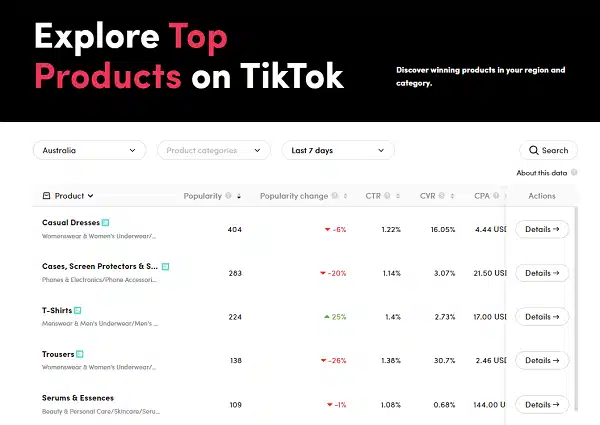
How it works. Utilizing the filtering options provided allows narrowing down the Top Products listing according to specific regions and product categories. You can also view the data for the last day, 7 days, or 30 days.
To gain a deeper understanding of a particular product, click on the ‘Details’ element on the far right of the listing. This will provide you with a comprehensive product overview, including data such as CTR, CPA, impressions chart, and more.
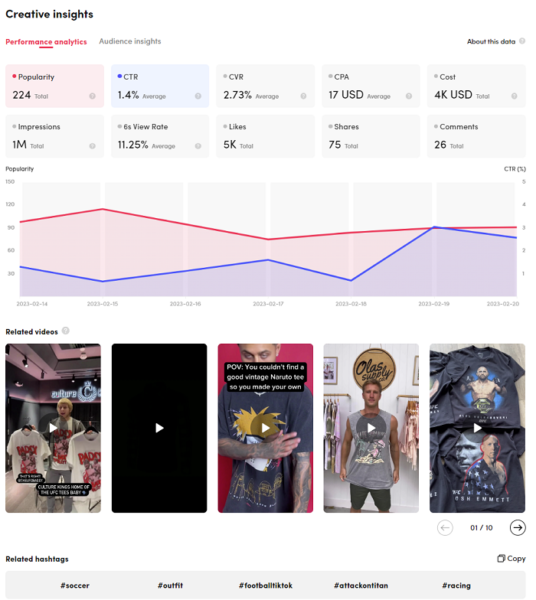
The ‘Audience insights’ element allows you to see an age bracket breakdown of who’s engaging with these ads, along with related interests, providing key data for analysis and planning efforts.
Dig deeper. You can check out the Creative Center here.
Why we care. This could allow advertisers to make informed decisions about new strategies. By analyzing the performance of specific products based on metrics such as impressions, CTR, CPA, and more, advertisers can determine which products are popular and which are not, and adjust their advertising efforts accordingly.
This data can also help advertisers identify trends in consumer behavior, which can inform their future product development and marketing campaigns. Ultimately, the insights gained from analyzing this data can lead to more effective and efficient advertising strategies, resulting in increased sales and revenue for the advertiser.
The post Leveraging TikTok’s ad content to get valuable insights on top-performing products appeared first on Search Engine Land.
Courtesy of Search Engine Land: News & Info About SEO, PPC, SEM, Search Engines & Search Marketing
Thursday, February 23rd, 2023

Research has shown time and time again that existing customers are 50% more likely to try new products of yours and spend 31% more with you when compared to new customers. So how are you fostering these relationships and delivering repeatable and measurable revenue?
In this session, marketing experts will share how you can build customer relationships that not only scale but drive revenue for 2023 and beyond.
Register today for “3 Ways to Strengthen Customer Relationships and Drive Revenue,” presented by Sendoso.
Click here to view more Search Engine Land webinars.
The post 3 ways to strengthen customer relationships and drive revenue appeared first on Search Engine Land.
Courtesy of Search Engine Land: News & Info About SEO, PPC, SEM, Search Engines & Search Marketing


 TikTok releases "Top Product" in the Creative Center! A Game changer?
 What the CPA is
 TikTok (@michaelgrowth)