Archive for the ‘seo news’ Category
Thursday, March 2nd, 2023

Digital marketing talent—especially those specializing in SEO, content, email marketing, and PPC—remains in top demand. If you’re looking to advance your career, change jobs, or expand your digital marketing team, Conductor’s 2023 Digital Marketing Salary Guide has you covered.
Visit Digital Marketing Depot to download Conductor’s 2023 Digital Marketing Salary Guide & Hiring Trends Report for access to:
- Exclusive salary range benchmark data
- In-depth hiring trend research
- Additional recruiting trends and retention strategies
The post 2023 digital marketing salary guide & hiring trends report appeared first on Search Engine Land.
Courtesy of Search Engine Land: News & Info About SEO, PPC, SEM, Search Engines & Search Marketing
Wednesday, March 1st, 2023
Google will start automatically configuring your Universal Analytics properties to Google Analytics 4 (GA4) for you. But you actually do not want to do this for many reasons.
Is your GA4 already set up? You might still be subject to “auto-migration.” Read on for more details about it and how to opt out.
Making the switch to GA4
On February 9, Google sent an email saying they will soon start configuring Google Analytics 4 for users starting in March (as early as this week).
This means that if you have a Universal Analytics (UA) property but haven’t migrated to GA4, Google will create a GA4 property for you based on many of the settings you have in UA, such as your goals, audiences, Ads links, users, and more.
But what is Google’s definition of “haven’t migrated”?
Scenario 1: You have a UA property and have not set up a GA4 property. The UA property is not opted out of the auto-migration setting.
This will be a common scenario for people who haven’t had the time or don’t want to set up GA4. This is essentially the “long tail” of customers Google wants to keep on GA.
If you just didn’t have the time or desire to do the migration, perhaps this isn’t a bad option for you. But be aware that your data may look quite different. (More details on how the migration works below.)
Scenario 2: You have created a GA4 property but haven’t linked it to a UA property. Google doesn’t know it’s the same as your UA property and doesn’t consider this migrated.
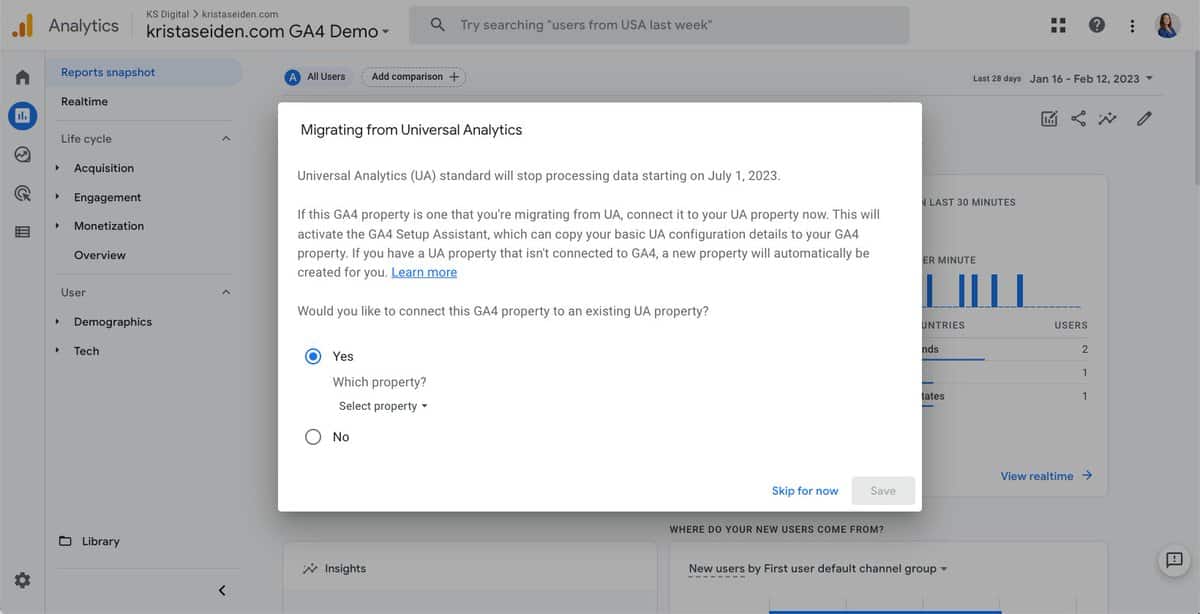
Have you seen this popup modal in GA4? Likely yes, because it pops up every time you log in or refresh.
What does linking do? It tells Google that you have created a GA4 property tied to a UA property.
Will that stop Google from automigrating you?
Not necessarily.
That will depend on how much of the GA4 setup assistant you have completed (more on that in a moment).
Scenario 3: You have created a GA4 property and linked it to a UA property but haven’t completed all GA4 Setup Assistant steps.
If you’re not opted out of migration in UA, then Google will start filling in the gaps for you in this scenario.
Get the daily newsletter search marketers rely on.
<input type=”hidden” name=”utmMedium” value=”“>
<input type=”hidden” name=”utmCampaign” value=”“>
<input type=”hidden” name=”utmSource” value=”“>
<input type=”hidden” name=”utmContent” value=”“>
<input type=”hidden” name=”pageLink” value=”“>
<input type=”hidden” name=”ipAddress” value=”“>
Using the GA4 Setup Assistant
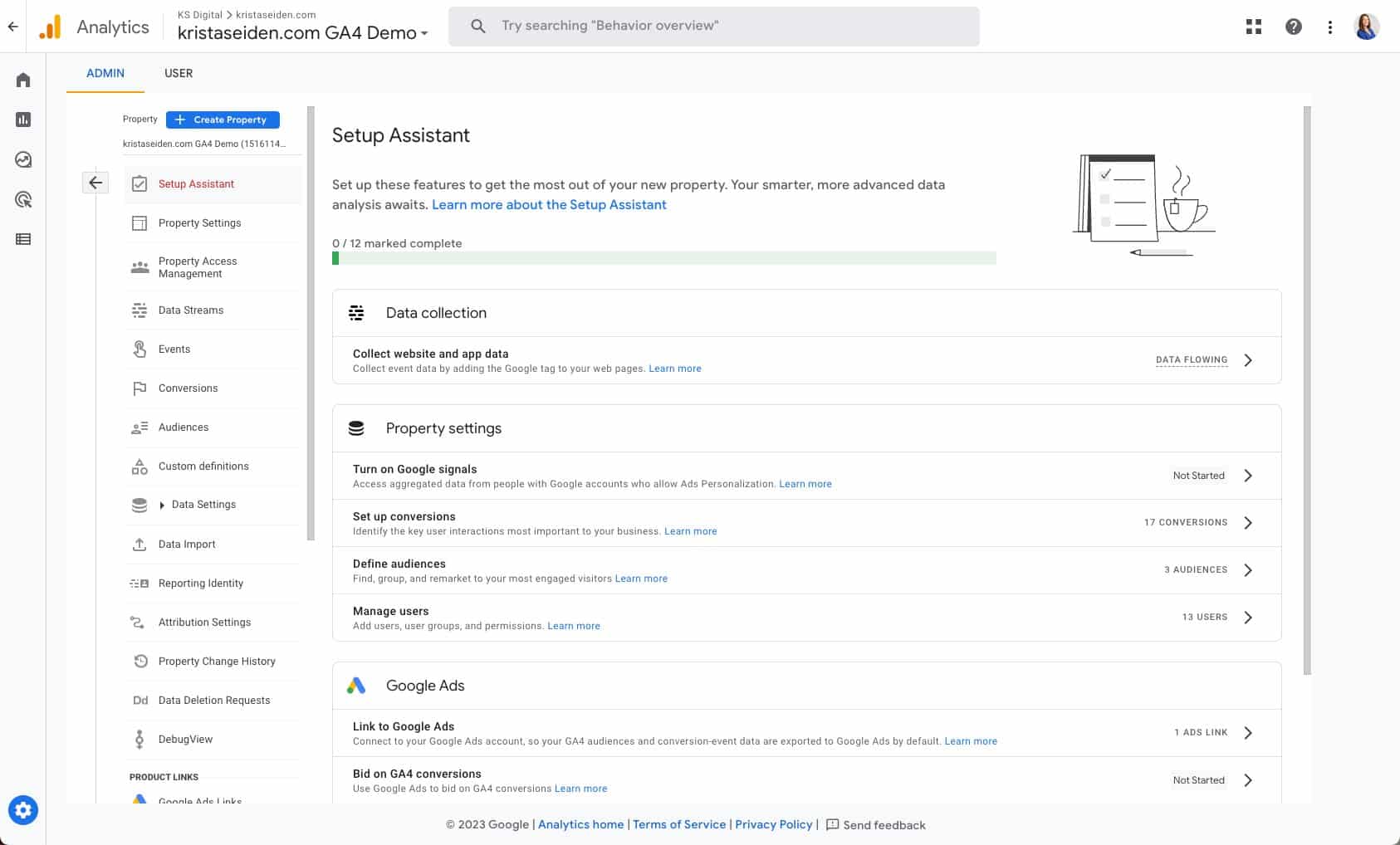
The GA4 Setup Assistant is a 12-step tool that helps you track your GA4 migration progress.
It has some pretty useful tools included, such as help with audience migration and a more straightforward process for Google Ads linking.
Ads linking
Generally, you must have dual admin access, meaning you must be an admin on both the Analytics and Ads accounts to link. It can be frustrating and time-consuming to ensure you have the right access levels.
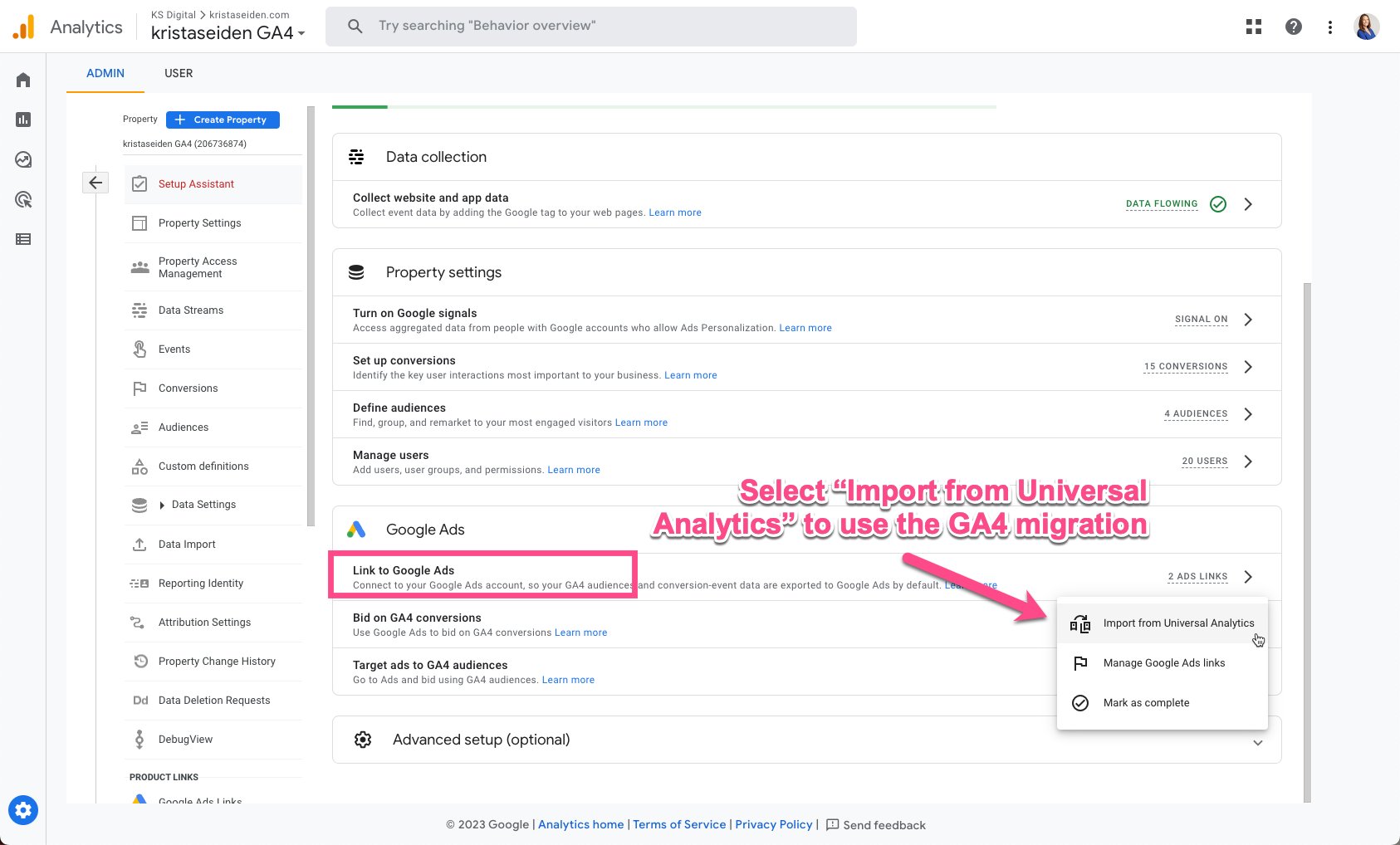
The setup assistant tool references the links you have in UA and does not require admin access to Ads to link. This is great if you are having someone not typically involved in Ads helping you migrate, such as a contractor or agency.
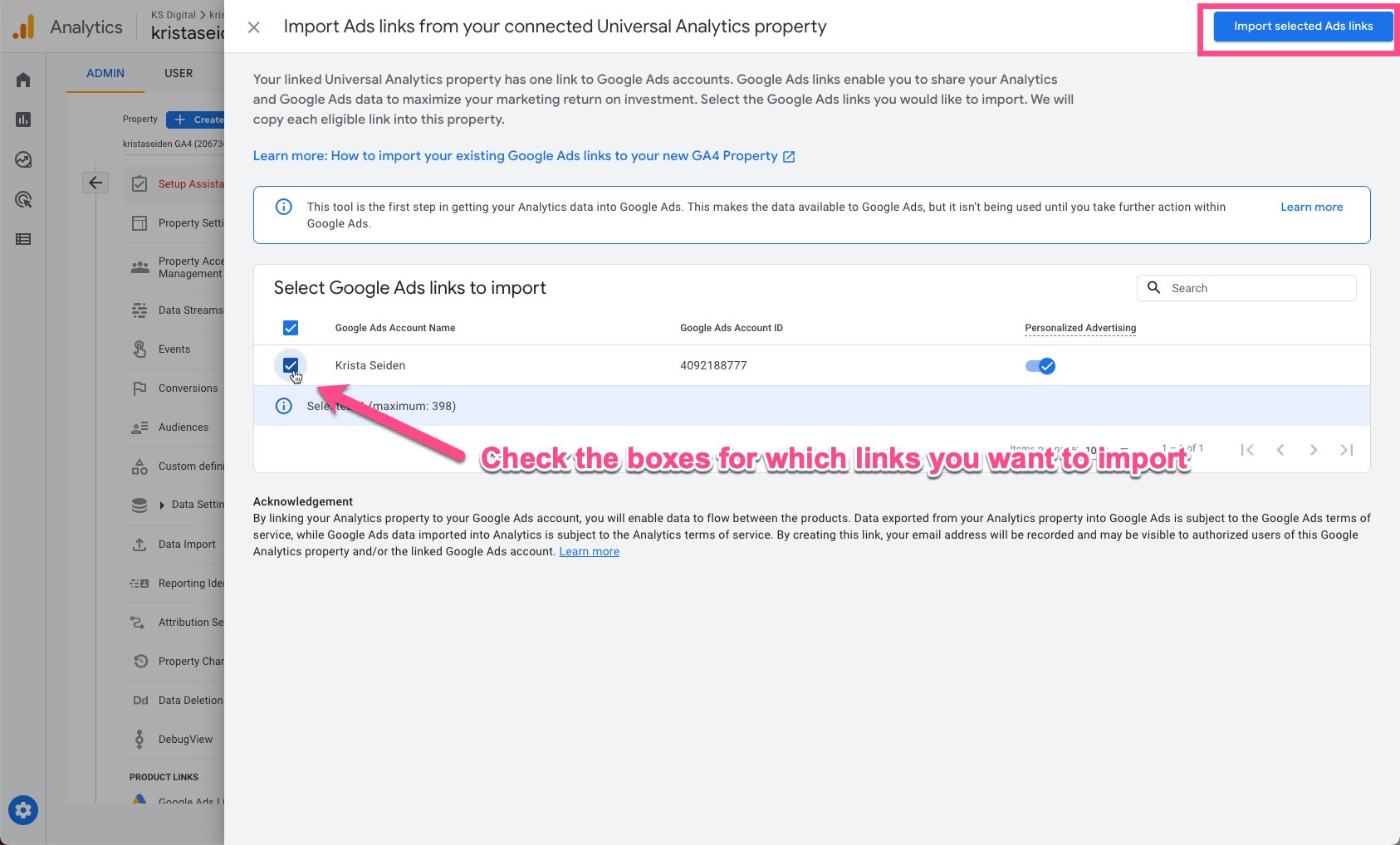
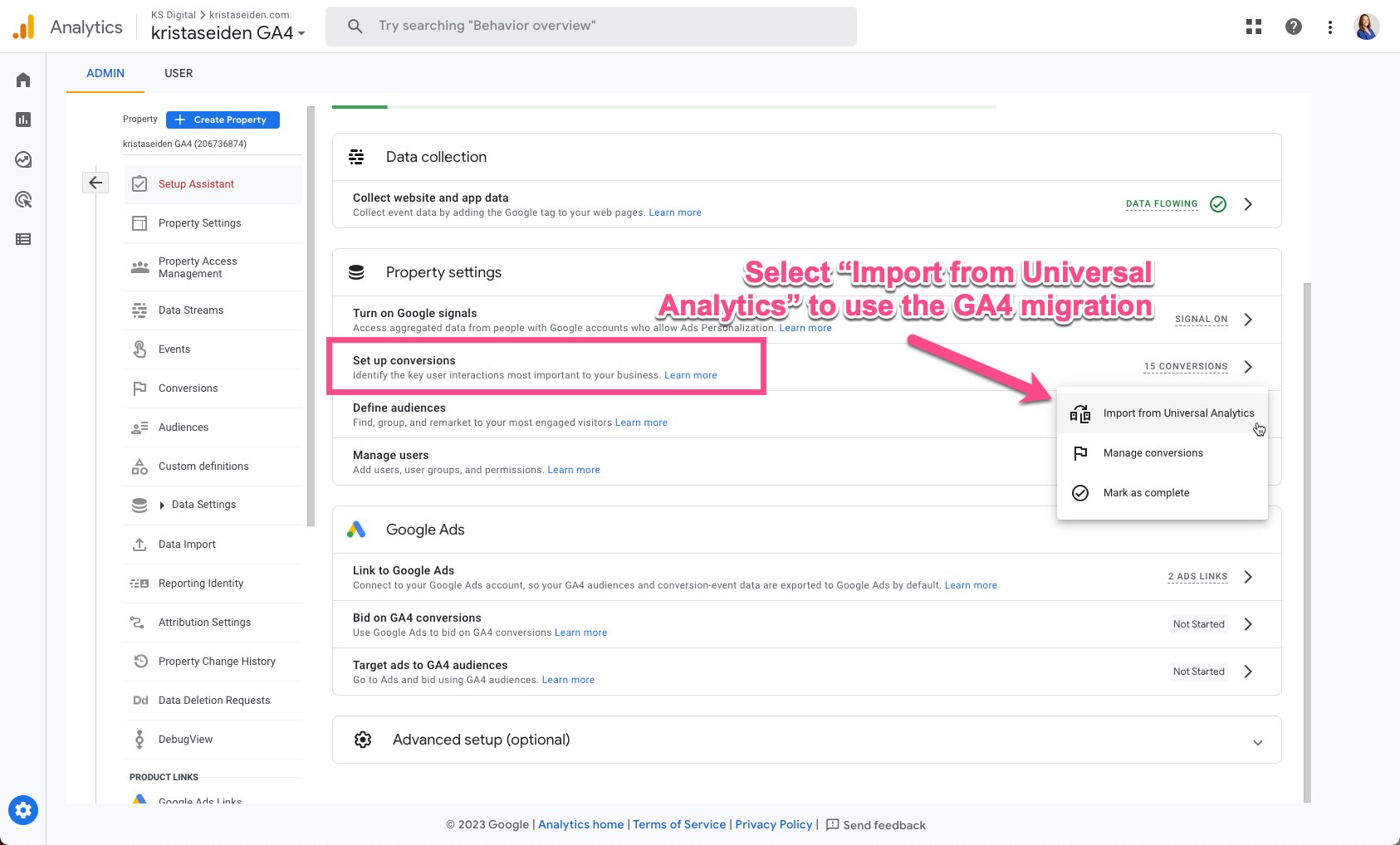
Once you click Import from Universal Analytics, a new screen shows you all of the Ads links you have set up in UA.
You can check or uncheck the boxes for what you want to import to GA4 and then hit Import selected Ads links. It’s as easy as that.
Conversions
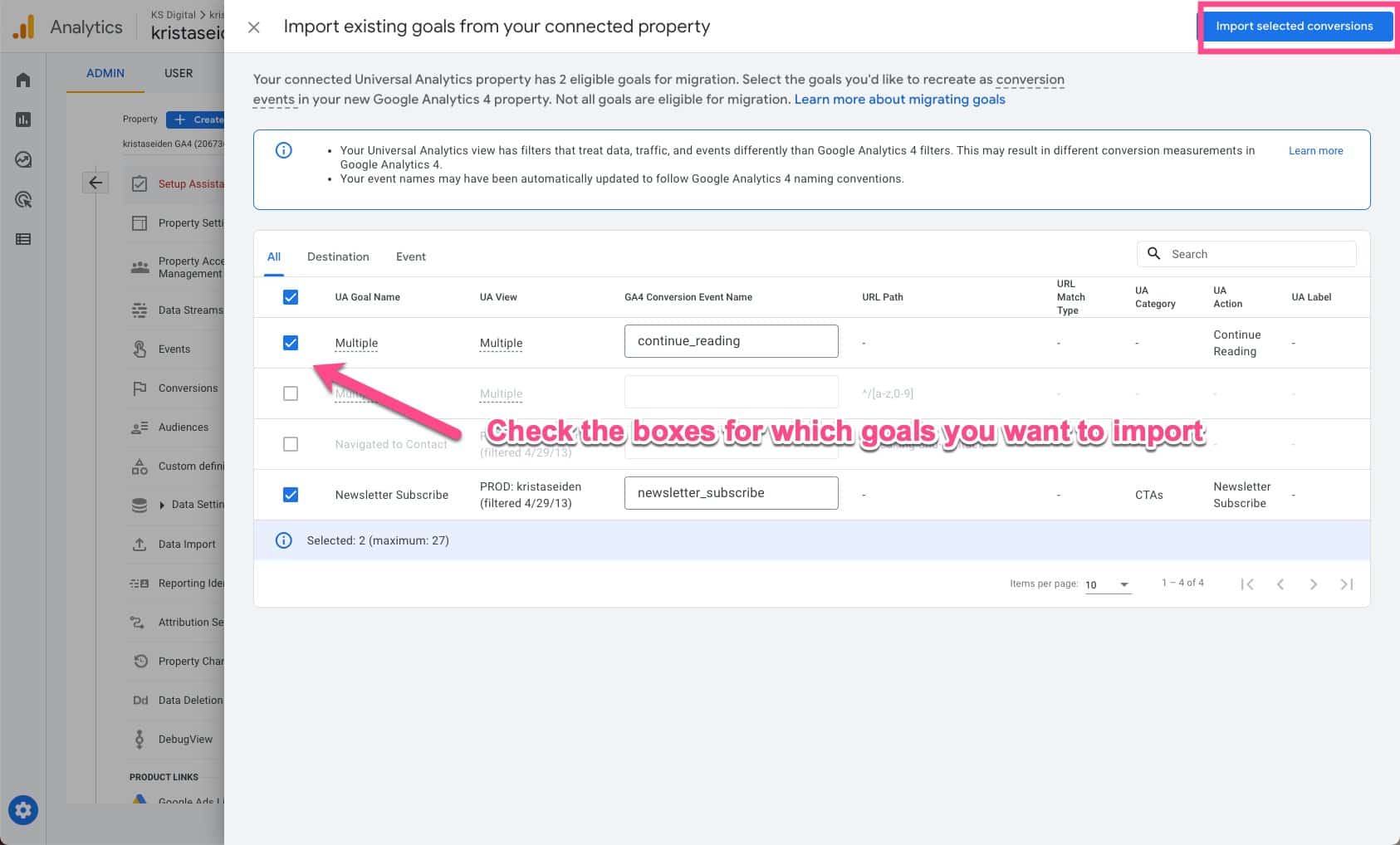
The tool will reference your conversions in UA and check if they are eligible (i.e., event or destination goals) for migration to GA4.
Goals using other goal types or regex are not currently eligible for migration, but maybe in the future.
This migration screen is similar to the Ads linking screen. Check the eligible goals you want to migrate to GA4 conversions. Ineligible goals will be grayed out.
You have the option to change the name of the conversion. I recommend leaving it in the underscore format.
Users
This one isn’t as flashy, but if you have a lot of users with access to your UA property that you want to copy to GA4, it may be the most helpful tool.
When you select Import from Universal Analytics, it will send you to a help center article detailing the process.
You will need to use a Google Sheets Add-on tool for this. It sounds like work, but it’s quite quick and painless. The help center article gives great step-by-step instructions on how to use it.
Why some users might want to opt out
Back to the warnings I have in store for you…
Let’s say you fall into Scenario 3 (that is, you have created a GA4 property and linked it to a UA property but haven’t completed all GA4 Setup Assistant steps).
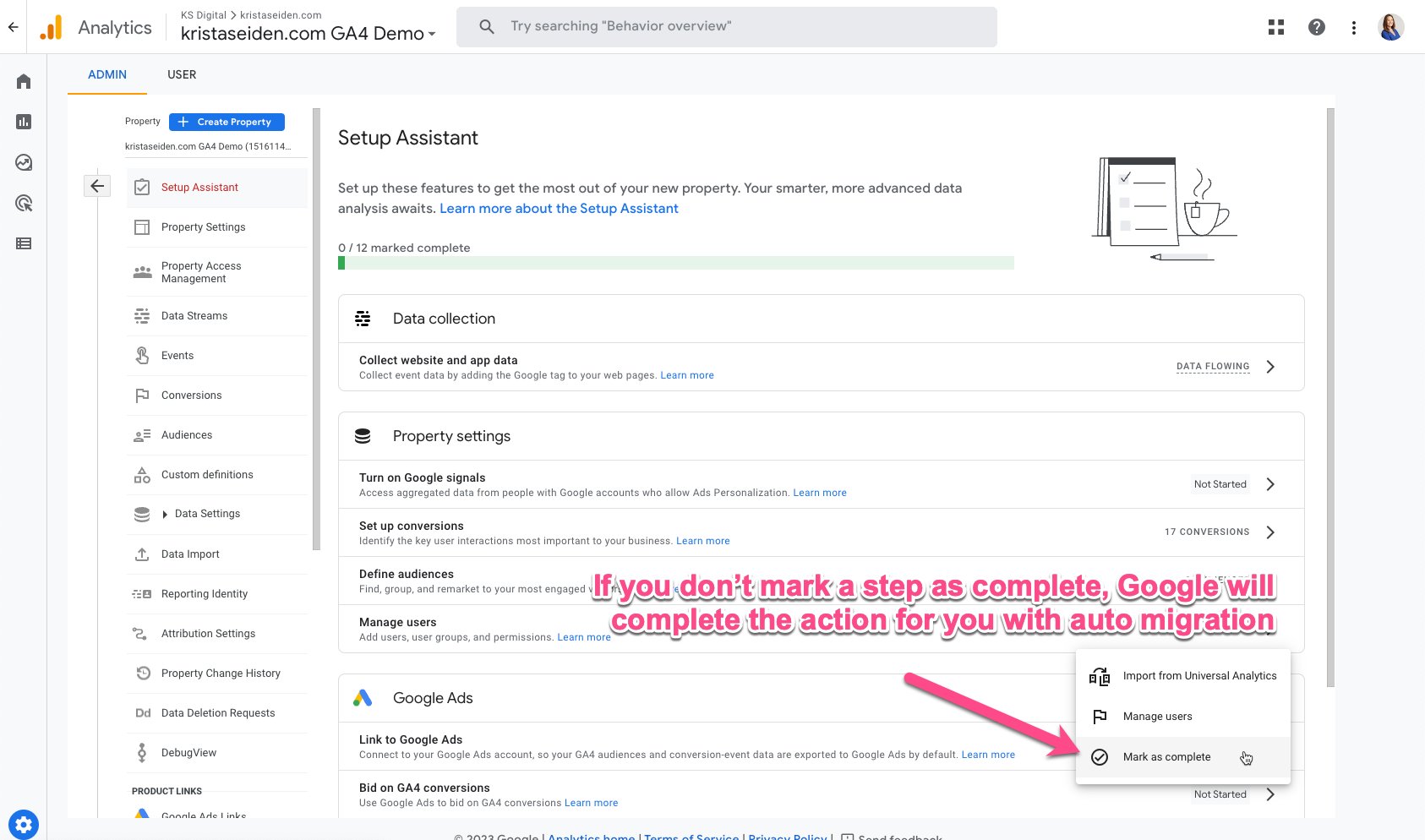
Whatever you have not marked as complete in the GA4 Setup Assistant tool will be done for you.
This is where, in my opinion, things can get pretty sketchy fast.
Yes, I just told you the Setup Assistant has some useful tools. But they are helpful because you can control the migration yourself.
For all 12 steps in the Setup Assistant, you must mark them Complete even if you have not done them – unless you want Google to do it.
This is especially important for these seven steps:
- Turning on Google Signals.
- Setting up Conversions.
- Defining Audiences.
- Managing Users.
- Linking to Google Ads.
- Bidding to GA4 conversions.
- Targeting ads to GA4 audiences.
Let’s break a few of these down:
Linking to Google Signals
Google Signals is required for remarketing/retargeting with Google products. But some countries may have legal implications or restrictions, so I’d suggest checking with your legal team to be sure.
Managing Users
I just said how much I like this feature. But with great power comes great responsibility. You should check the access being granted, as there may be users you do not want to migrate. If you let Google do it, they’ll migrate everyone from UA.
Bidding to GA4 conversions
This is where the real danger begins. If you let Google migrate your conversions for you, and you haven’t checked them, you’re taking their word that you are still considering the actions from UA that they could migrate to be important.
Then, if you let Google bid to those conversions in Ads, they are changing the goals from UA to GA4 conversions that you are spending real money against.
If you didn’t set up those conversions, you risk an automated process spending your money in a way you may not want or that is not optimized toward your current goals.
Targeting Ads to GA4 Conversions
Same concerns as above. You would have Google migrate audiences for you, hoping they are good enough, and then bid toward them with your money. Your oversight is taken out of the process.
So what will migration look like?
For some things, like conversions, they may append a UA_ to the name of the conversion in GA4 to indicate that it came from UA. Other things may not have any indication of where they came from.
Convinced? Here’s how to opt out
So are you convinced yet that you should opt out of automigration? Here’s how.
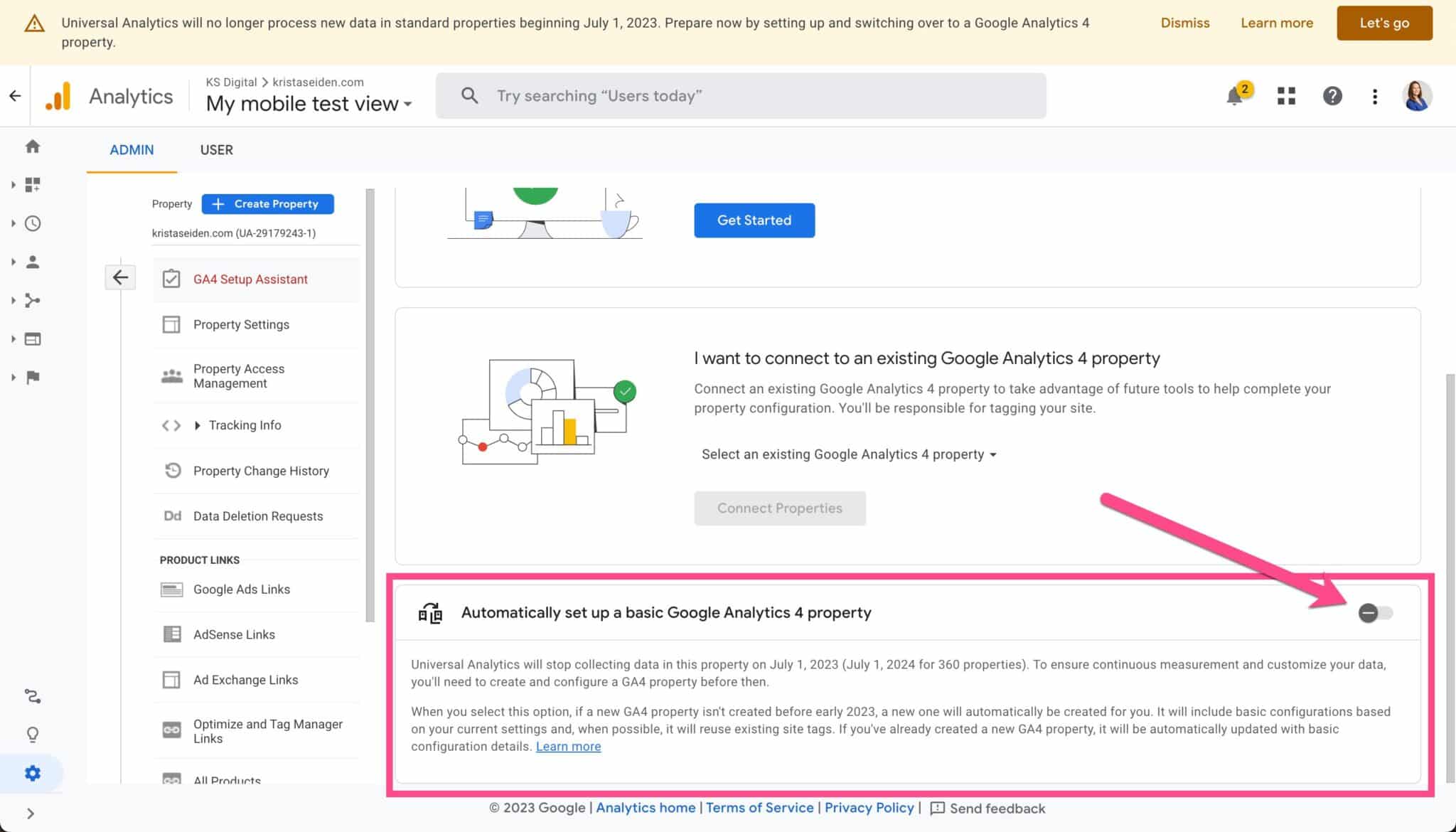
In your Universal Analytics account, go to Admin > Property column > GA4 Setup Assistant.
Scroll to the bottom and toggle off the switch for “Automatically set up a basic GA4 property.”
Opting out will prevent the UA property from being migrated.
If you don’t opt out but are linked (that popup modal we keep getting), then you will need to Mark as complete all 12 steps (or whatever you don’t want automigrated) in the Setup Assistant in your GA4 property.
If you do not opt out or do not mark all as complete, Google might migrate some or all of your UA property to a GA4 property starting as early as this week.
The more complicated your UA property, the later it will be migrated since they’ll likely start with simpler properties.
The post GA4 ‘auto-migration’: Here’s why you should opt out appeared first on Search Engine Land.
Courtesy of Search Engine Land: News & Info About SEO, PPC, SEM, Search Engines & Search Marketing
Wednesday, March 1st, 2023

Research has shown time and time again that existing customers are 50% more likely to try new products of yours and spend 31% more with you when compared to new customers. So how are you fostering these relationships and delivering repeatable and measurable revenue?
In this session, marketing experts will share how you can build customer relationships that not only scale but drive revenue for 2023 and beyond.
Register today for “3 Ways to Strengthen Customer Relationships and Drive Revenue,” presented by Sendoso.
Click here to view more Search Engine Land webinars.
The post Why do customer relationships matter now more than ever? appeared first on Search Engine Land.
Courtesy of Search Engine Land: News & Info About SEO, PPC, SEM, Search Engines & Search Marketing
Wednesday, March 1st, 2023
In today’s digital age, video games have become a massive industry with millions of players worldwide. As the industry continues to grow, so does the competition among game developers and publishers to attract more players. As we have discussed, one way they achieve this is through advertising. However, measuring the success of video game ads can be a challenge.
This is the fifth article in our series on why video game advertising is a huge opportunity for brands in 2023. Here, we’ll discuss how to measure success with video game ads.
Different video game ad types
Before delving into the metrics used to measure the success of video game ads, it’s important to understand the different types of ads used in the industry. There are several types of video game ads, including:
Pre-roll Ads – These are ads that appear before a player begins playing a game. They can be skippable or non-skippable and are typically 15-30 seconds long.
In-Game Ads – These ads appear within the game itself and can take various forms, such as billboards, product placement, or branded items within the game.
Mobile Ads – These ads appear within mobile games and can be banner ads, interstitial ads, or rewarded video ads.
Measuring success
Now that we’ve discussed the types of video game ads let’s move on to measuring success.
Impressions
Impressions are the number of times an ad is displayed to potential viewers. Measuring impressions can give you an idea of the reach of your video game ad campaign. If you’re looking to maximize the exposure of your ad, then measuring impressions is essential. This metric is particularly useful for pre-roll and mobile ads.
Click-Through Rate (CTR)
Click-through rate (CTR) measures the number of clicks an ad receives divided by the number of impressions. CTR is a good indication of how engaging your video game ad is. If your CTR is low, it might be time to rethink your ad creative. CTR is an important metric for all types of video game ads.
Conversion Rate
Conversion rate measures the percentage of users who clicked on an ad and then went on to perform a desired action, such as downloading a game or making an in-game purchase. Conversion rate is an important metric for in-game ads and mobile ads. A high conversion rate means that your video game ad is effectively driving users to take the desired action.
Cost Per Click (CPC)
Cost per click (CPC) measures the cost of each click on an ad. This metric is particularly useful for mobile ads, as it can give you an idea of how much it costs to drive users to take a specific action, such as downloading a game. CPC is an important metric for video game ads because it allows you to track your ad spend and ensure that you’re getting a good return on investment.
Return on Ad Spend (ROAS)
Return on ad spend (ROAS) measures the revenue generated from an ad campaign divided by the cost of the campaign. ROAS is a good indication of how profitable your video game ad campaign is. If your ROAS is low, it might be time to rethink your ad creative or targeting. ROAS is an important metric for all types of video game ads.
Engagement Rate
Engagement rate measures the number of interactions an ad receives divided by the number of impressions. Interactions can include actions such as likes, shares, and comments. Engagement rate is a good indication of how well your video game ad is resonating with viewers. A high engagement rate means that your ad is generating interest and sparking conversation.
View-through Rate (VTR)
View-through rate (VTR) measures the percentage of viewers who watched an ad in its entirety. VTR is particularly useful for pre-roll ads, as it can give you an idea of how engaging your video game ad is. A high VTR means that viewers are interested in your ad and are more likely to take action. VTR is an important metric for all types of video game ads.
Brand Lift
Brand lift measures the impact of an ad on brand awareness and perception. It’s important to measure brand lift for video game ads, as it can give you an idea of how well your ad is resonating with your target audience. Brand lift can be measured through surveys, focus groups, or other market research methods.
Play Rate
Play rate measures the percentage of viewers who interacted with an in-game ad by clicking on it or engaging with it in some way. Play rate is an important metric for in-game ads, as it can give you an idea of how effective your ad is at engaging players within the game. A high play rate means that your ad is generating interest and sparking interaction.
Completion Rate
Completion rate measures the percentage of viewers who watched an entire video ad. Completion rate is important for pre-roll ads, as it can give you an idea of how engaging your ad is. A high completion rate means that viewers are interested in your ad and are more likely to take action.
Why should brands try video game ads?
Brands should try video game ads for several reasons. Firstly, the video game industry is one of the fastest-growing and most lucrative industries in the world. According to a report by Newzoo, the global video game market is expected to generate over $200 billion in revenue by 2023. This means that video game ads have the potential to reach a massive and engaged audience.
Secondly, video games have a diverse and loyal fan base that is receptive to advertising. A study by Nielsen found that gamers are more likely to purchase products advertised within a game. In fact, 44% of gamers said that they have purchased a product as a result of an in-game advertisement.
Thirdly, video game ads provide brands with a unique and interactive way to engage with their audience. In-game ads, for example, can take many forms such as branded items, product placement, or billboards within the game environment. This means that brands can integrate their products or services into the game world and create a more immersive and memorable advertising experience for the player.
Lastly, video game ads offer brands the opportunity to target their audience with precision. Video game ads can be targeted based on a player’s demographic, behavior, and location data. This means that brands can reach the right audience at the right time, increasing the likelihood of conversion and engagement.
Score your success
Measuring the success of video game ads is essential for brands to understand the effectiveness of their ad campaigns. The different types of video game ads require different metrics to measure success, such as impressions, CTR, conversion rate, CPC, ROAS, engagement rate, VTR, brand lift, play rate, and completion rate. By tracking these metrics, brands can gain insights into how well their ad campaigns are resonating with their target audience and make necessary adjustments to improve their success.
Video game ads provide brands with a unique and interactive way to engage with their audience, and the video game industry’s growth and receptive nature of gamers towards advertising makes it a valuable addition to a brand’s marketing mix. With precise targeting options and the potential for high engagement rates, video game ads offer brands a promising opportunity to reach a large and engaged audience. By measuring the success of video game ads, brands can continue to improve and optimize their ad campaigns to achieve their desired outcomes and goals.
ICYMI, don’t forget to check out the other articles in our series on why brands should be creating video game ad campaigns in 2023.
The post Level up your video game ad strategy: A guide to measuring success appeared first on Search Engine Land.
Courtesy of Search Engine Land: News & Info About SEO, PPC, SEM, Search Engines & Search Marketing
Wednesday, March 1st, 2023
Google Analytics 4 offers a robust, event-based approach to tracking website activity.
However, the deprecation of Universal Analytics has forced many marketers to relearn their favorite analytics platform, using a dramatically different interface and walking through a new setup process.
Event and conversion setup also comes with a higher learning curve.
Thankfully, Google Tag Manager (GTM) can ease the process of setting up GA4 on your site and reduce the dependency on needing to customize code.
This article will show you how to deploy the basic GA4 tracking code through GTM, along with how to create custom events for more comprehensive data.
How to set up the main GA4 code
The gtag.js tag is the basic tracking code you need to place on your site. Once you fire this for all pages, you’ll start recording all the default data GA4 tracks for website visitors.
GTM makes setting up this tag as simple as a few clicks and pasting in an account ID.
Note: If you already have a Universal Analytics tag (analytics.js) firing on your site, you can keep it active alongside GA4. However, per Google, Universal Analytics will stop recording data on July 1, 2023 (GA360 properties will record through July 1, 2024). Data will be accessible for at least six months after this point.
Step 1
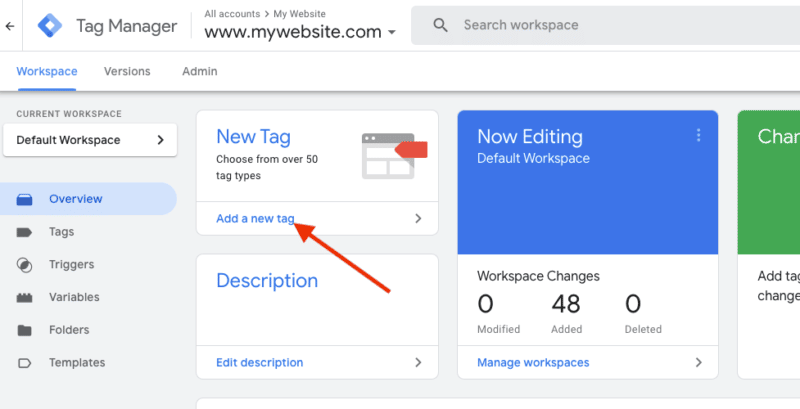
To start setting up your GA4 tag, navigate to your desired account and container within GTM and select “Add a new tag.”
Step 2
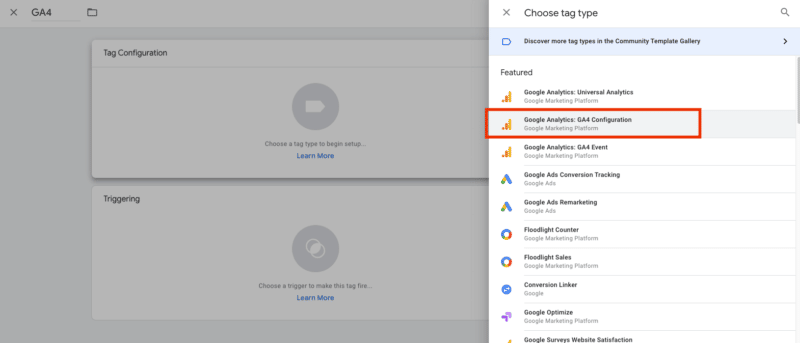
Now, click on “Tag Configuration” to see the options for various types of tags. Select Google Analytics: GA4 Configuration.
Step 3
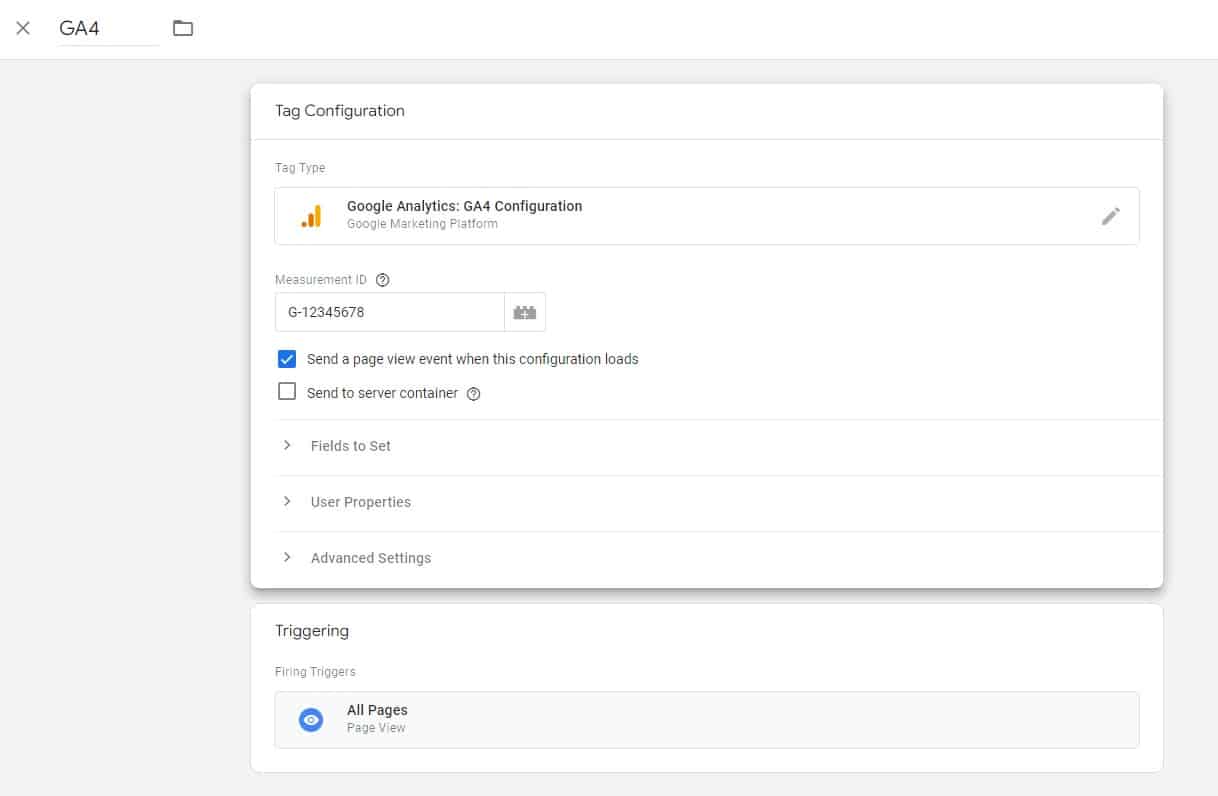
You’ll see a field to enter your Measurement ID. Find your Measurement ID in your account, and paste it here.
Once you’ve saved this tag, you’ll be able to select it from a dropdown in the future when setting up GA4 events instead of having to manually hunt for the ID each time.
For most users, you’ll want to leave the box checked to “Send a page view event when this configuration loads.” This will ensure that each time a user visits a new page, a pageview is tracked on GA4’s end.
There may be some more advanced instances where you don’t want to fire a pageview. (For instance, if you’re using a tag to set properties for a logged-in user or a customer completing a transaction without the page URL changing.)
Step 4
Click within the “Triggering” box to choose where you want the tag to fire on your site. In most cases, you’ll likely want GA4 to fire on all pages.
However, depending on your setup, you may want to exclude certain pages, such as private login sections.
You can create rules based on URL paths, clicks on specific page elements, and more to customize exactly where the tag fires.
Step 5
Save your tag and publish your GTM container to push it live. You should now see GA4 firing on your site.
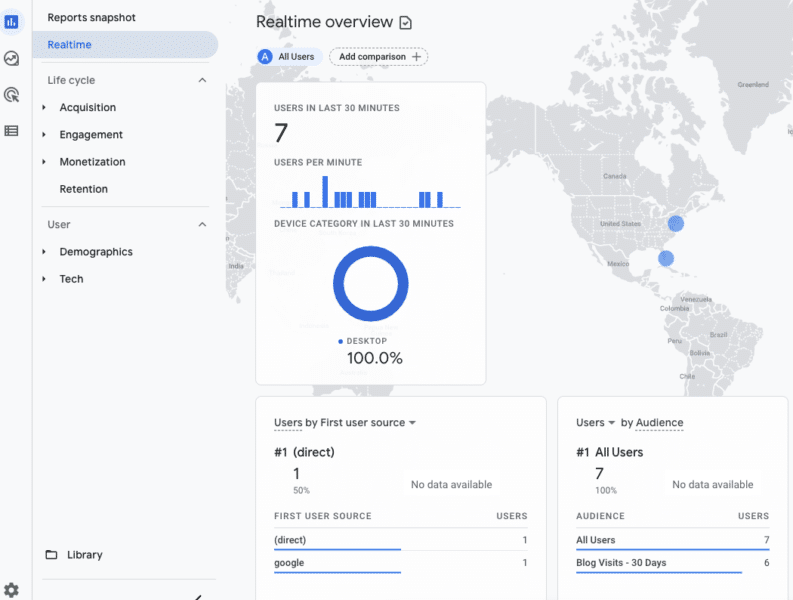
To double-check that you’re actually tracking sessions, check the Realtime section of Google Analytics. You should see your own visit reflected here soon after hitting the site.
With the basic gtag.js tag in place, you can set up additional customization, such as adding events.
Get the daily newsletter search marketers rely on.
<input type=”hidden” name=”utmMedium” value=”“>
<input type=”hidden” name=”utmCampaign” value=”“>
<input type=”hidden” name=”utmSource” value=”“>
<input type=”hidden” name=”utmContent” value=”“>
<input type=”hidden” name=”pageLink” value=”“>
<input type=”hidden” name=”ipAddress” value=”“>
Setting up event tracking for GA4 in Google Tag Manager
Building off of its core focus on event-based measurement, GA4 comes with built-in event tracking for a few site interactions that previously required custom setup in Universal Analytics.
Directly within the GA4 interface, you can enable Enhanced Measurement to fire events for scroll activity, outbound clicks, file downloads, and video views.
However, note that there are still limitations to these events compared to more advanced tracking options you can set up through GTM.
For instance, the scroll tracking option simply triggers a “scroll” event once the user reaches the bottom of the page (measured at the 90% point). By default, you won’t be able to track when the user starts to scroll to earlier points of the page.
However, using GTM, you can fire events with specific parameters for different scroll thresholds on the page (such as 25% / 50% / 75% / 100%) for a more comprehensive analysis.
The beauty of GTM lies in the ability to easily fire events for a vast array of actions that users could take on the site.
We’ll use scroll tracking as an example event setup here, but note that you can use the GA4 Event tag to create events for any triggers available in GTM.
Step 1
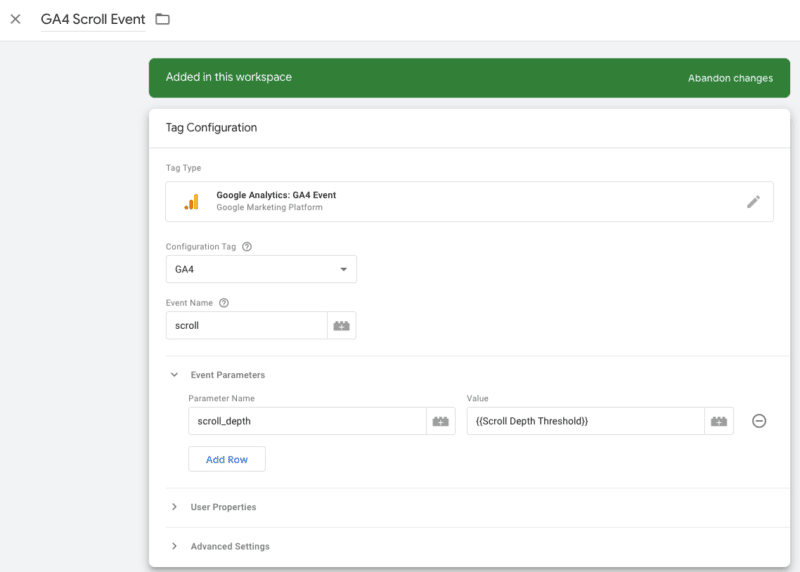
To start, create a new tag with a Tag Type of “Google Analytics: GA4 Event.” Choose your GA4 ID under “Configuration Tag.”
Step 2
Next, enter the Event Name that you’d like to appear within the Google Analytics interface. In this case, we’re using “scroll” to align with the existing “scroll” event that GA4 tracks.
Step 3
Click on the Event Parameters section to expand it. Here, we can add a custom parameter to send further details about the event to Google Analytics.
In this case, we’ll send through percentage values for when people scroll to specific points on a page.
Step 4
We’ll use “scroll_depth” for the Parameter Name.
Next, the value will be {{Scroll Depth Threshold}}, a variable within GTM that will pull in the scroll percentages as people interact with the page and data is sent back in.
Step 5
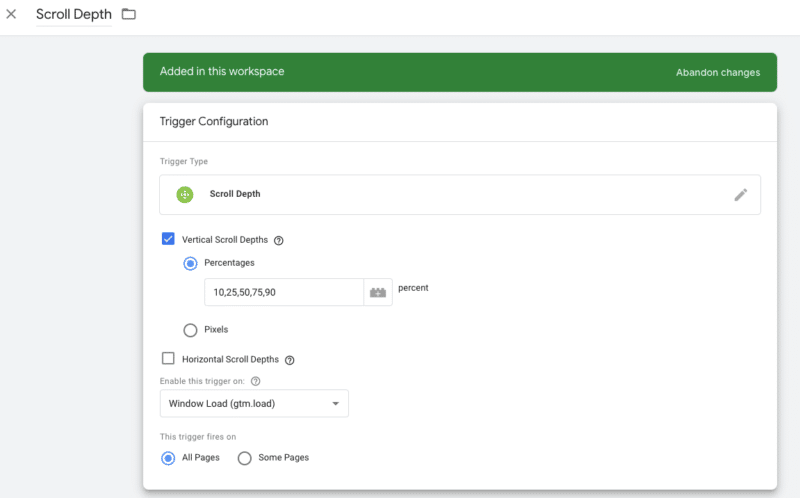
We’ll need to create a trigger to determine the values we want to track. Click in the bottom Triggers section to start a new trigger, and select Scroll Depth Trigger.
You can then choose vertical or horizontal scroll depth and select between tracking based on percentages or pixel depth.
With the variety of screen sizes people may be browsing from, the percentage option is likely your best bet here. Add the numbers for the scroll points you want to track, separated by commas.
Step 6
Save the trigger, save your tag, and publish it live.
You should now see more detailed scroll data populate when you look at the Events section in Analytics.
You can use the same basic model presented above to fire additional events into Google Analytics.
Either pull from default GA4 events or create custom event names. Add parameters to include additional details and variable data points.
Setting up GA4 and GTM is easier than you think
Start setting up GA4 with GTM now. As GA4 has entered the mainstream, getting a properly configured property up and running is crucial for any business looking to track performance online.
GTM provides the simplest way to deploy a GA4 setup that’s also easily customizable. If you have GA4 active, think through the actions you’d like to track on your site and set up events for those.
The post How to set up Google Analytics 4 using Google Tag Manager appeared first on Search Engine Land.
Courtesy of Search Engine Land: News & Info About SEO, PPC, SEM, Search Engines & Search Marketing
Tuesday, February 28th, 2023
Microsoft Bing will upgrade Bing Webmaster Tools to add reporting and tools around the new Bing Chat feature and a new index coverage report. This was announced by Fabrice Canel, Principal Product Manager at Microsoft Bing, this morning in a keynote given at PubCon Austin.
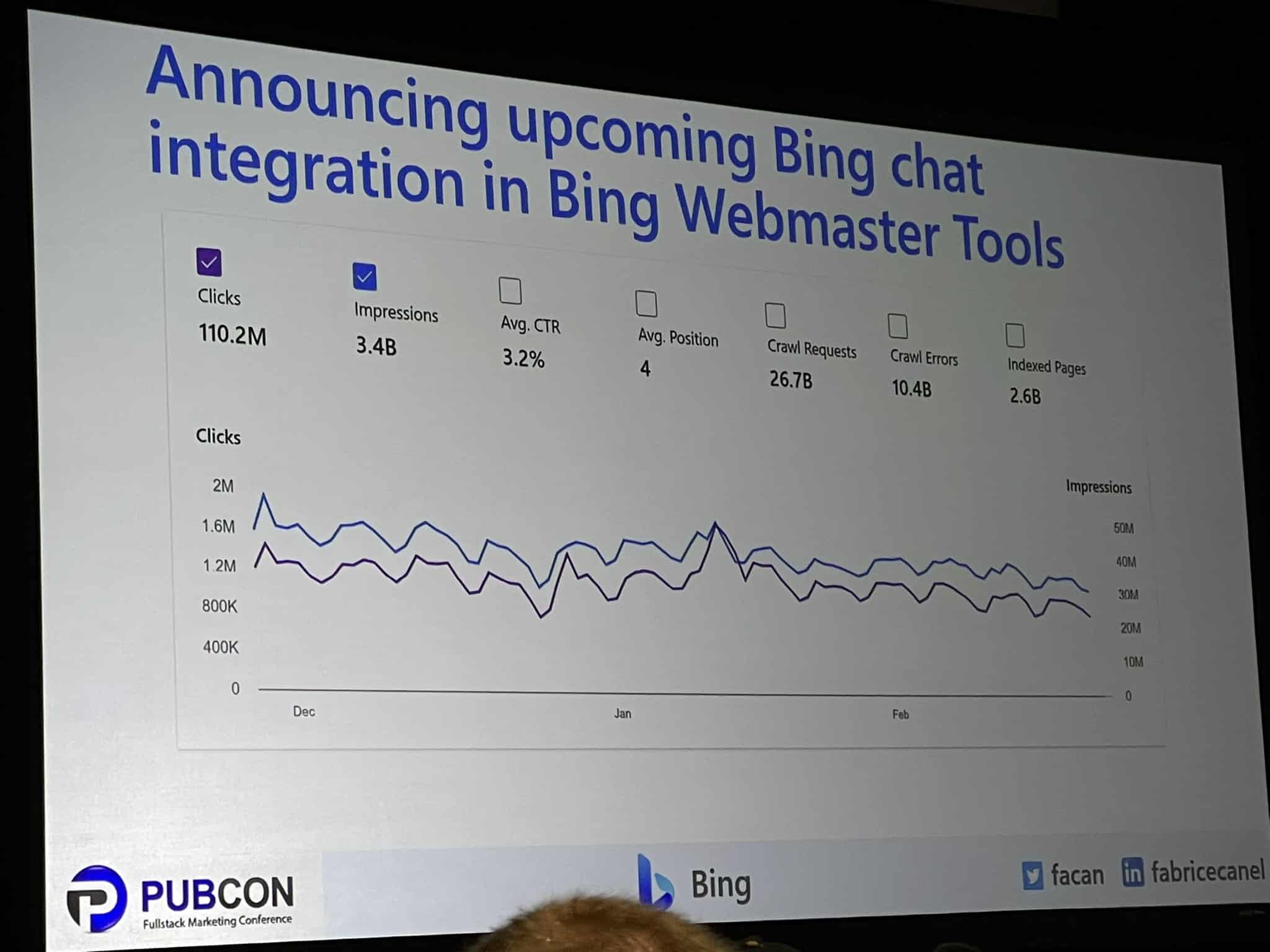
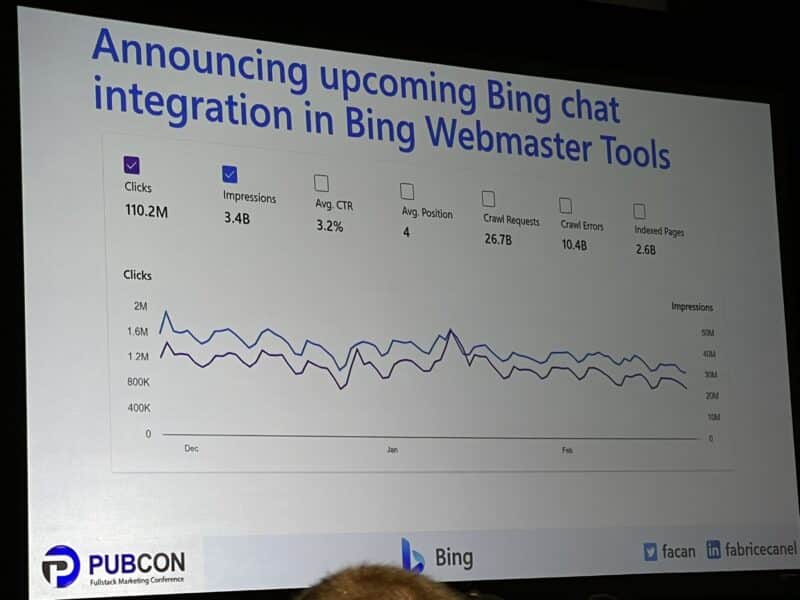
Bing Chat in Webmaster Tools. Bing Webmaster Tools should be adding Bing chat integration to allow publishers, content creators and site owners to see how much traffic the chat feature is sending their sites. It will be part of the Bing performance report and show impressions, clicks, click through rate and more.
Here is a photo of this report from Jennifer Slegg on Twitter:
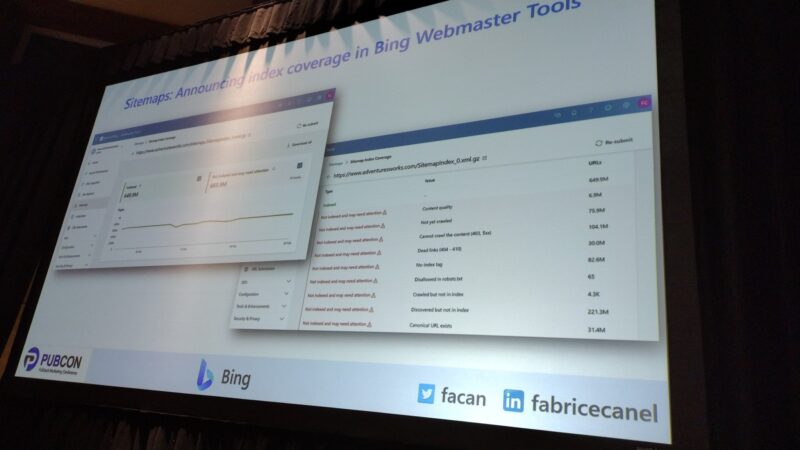
Index coverage report. In addition, Fabrice also announced a new index coverage report coming to Bing Webmaster Tools. This report will show how your pages on your site are being indexed by Bing Search. If pages are being excluded or if pages are having issues being indexed.
Here is a photo of this report from Patrick Stox on Twitter:
Why we care. With all the concern, confusion and stress around these new chat AI features, having a report that shows how many people see our links, click on our links and visit our sites will be helpful to publishers, content creators and site owners. In addition, the new index coverage report can help site owners understand which pages are not being indexed, so they can work on improving indexing through IndexNow, sitemaps or other means.
The post Bing Webmaster Tools to gain Bing Chat and index coverage reporting appeared first on Search Engine Land.
Courtesy of Search Engine Land: News & Info About SEO, PPC, SEM, Search Engines & Search Marketing
Tuesday, February 28th, 2023
Starting from March 29, 2023, the Google Ads API v11 will no longer be available. Developers still using v11 after this date will notice API requests failing.
Depreciation and sunset timetable. Typically, major versions are supported for approximately 12 months, while minor versions have a support lifespan of 10 months.
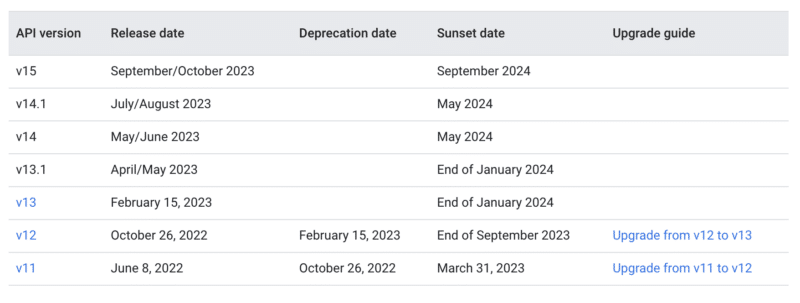
Migrate asap. To migrate to the newest version, visit the Google Ads API documentation here.
Dig deeper. Read the announcement from Google here.
Why we care. New API updates directly affect the functionality and performance of advertising campaigns. Once a version is sunset, all API requests using that version will fail, potentially causing disruptions to campaign management and optimization. By staying up-to-date with the latest version of the API, advertisers and developers can access new features and improvements, ensuring your campaigns are running efficiently and effectively.
The post Last call for Google Ads API v11 appeared first on Search Engine Land.
Courtesy of Search Engine Land: News & Info About SEO, PPC, SEM, Search Engines & Search Marketing
Tuesday, February 28th, 2023
The Google local pack, the map results, you see Google often display in the search results seems to have gone missing. I assume this was a bug, but no one was able to trigger a local pack to show up in Google Search for a 20-minute period.
Examples. Try searching for [barber near me] and you won’t get that local pack. You just get the standard ten blue links, without the map.
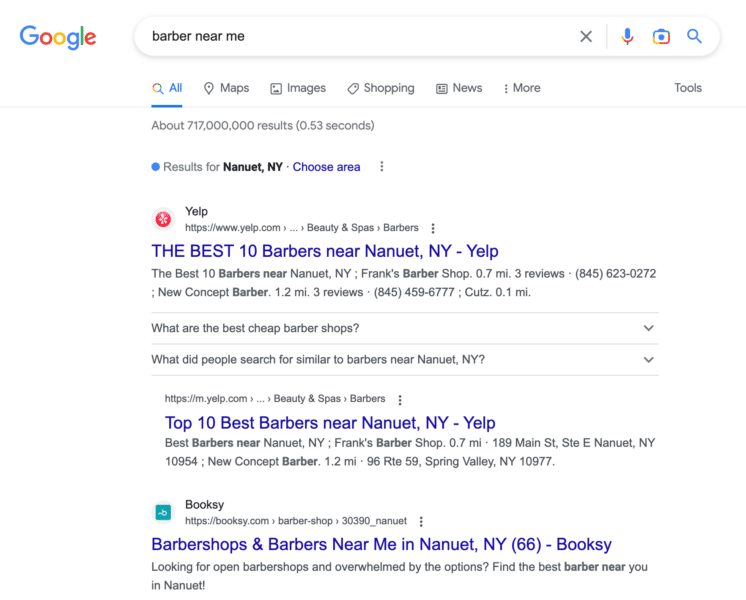
This seems to have stopped working at around 11:30 am ET.
And now has returned about 20 minutes later, I now see the local pack:
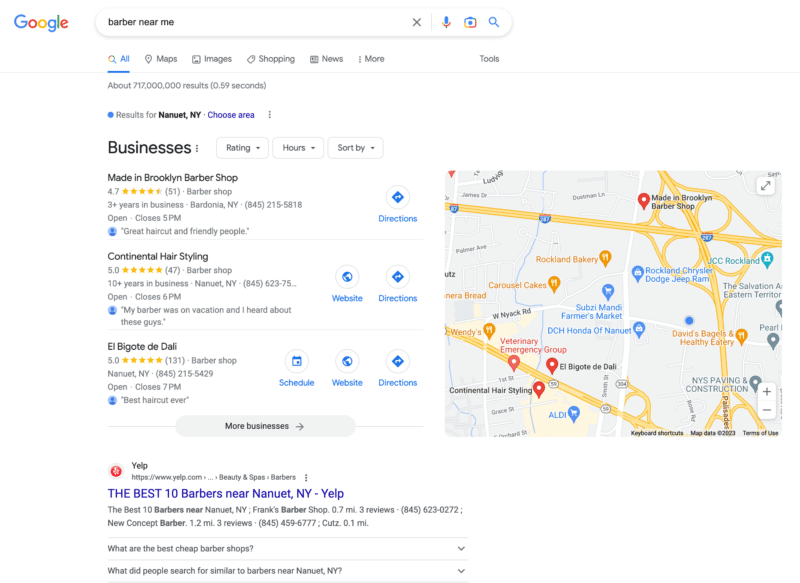
Why we care. The local pack drives a tremendous amount of traffic to local businesses. It going away, even for a short period of time, can be a huge loss for those local small businesses.
This appears to have been a bug and is now resolved.
The post Google local map pack goes missing in search results (now fixed) appeared first on Search Engine Land.
Courtesy of Search Engine Land: News & Info About SEO, PPC, SEM, Search Engines & Search Marketing
Tuesday, February 28th, 2023
Don’t get it twisted. The machines are taking over.
It’s only a matter of time until we’re all serving aluminum overlords’ every beck and call.
Fortunately for all of us simple humans, that day is not today.
Despite being a regurgitating raconteur, AI is still a glorified mansplainer – like the Wizard of Oz, minus the fancy haberdashery.
It kinda sucks at basic math.
It can’t wrap its dumb little head around anything subjective.
It’s eye-wateringly expensive to run. Orders of magnitude more than Google Search. As if that weren’t bad enough, AI content also makes a mockery of E-E-A-T.
And its source material is probably (definitely) stolen, infringing on others’ copyrights and fair use intellectual property rights.
Promising? Sure. Ready for prime time? Not quite.
So don’t fire your whole writing team just yet (unless they already sucked to begin with).
There are still a few things AI can’t do and won’t be able to do for years to come.
1. Google has already been disrupting top-of-the funnel content for years
Microsoft made waves with a massive $10 billion investment into OpenAI.
That’s a lot of cheddar. But there’s only one problem…
Nobody uses Bing.
Seriously, no matter how you slice or dice the data, they have less than 10% of the market to Google’s ~80-90%+.
So will AI help? Sure. I mean, it can’t hurt! It was already a ghost town to begin with.
I’m not (just) being flippant. I’m making a point.
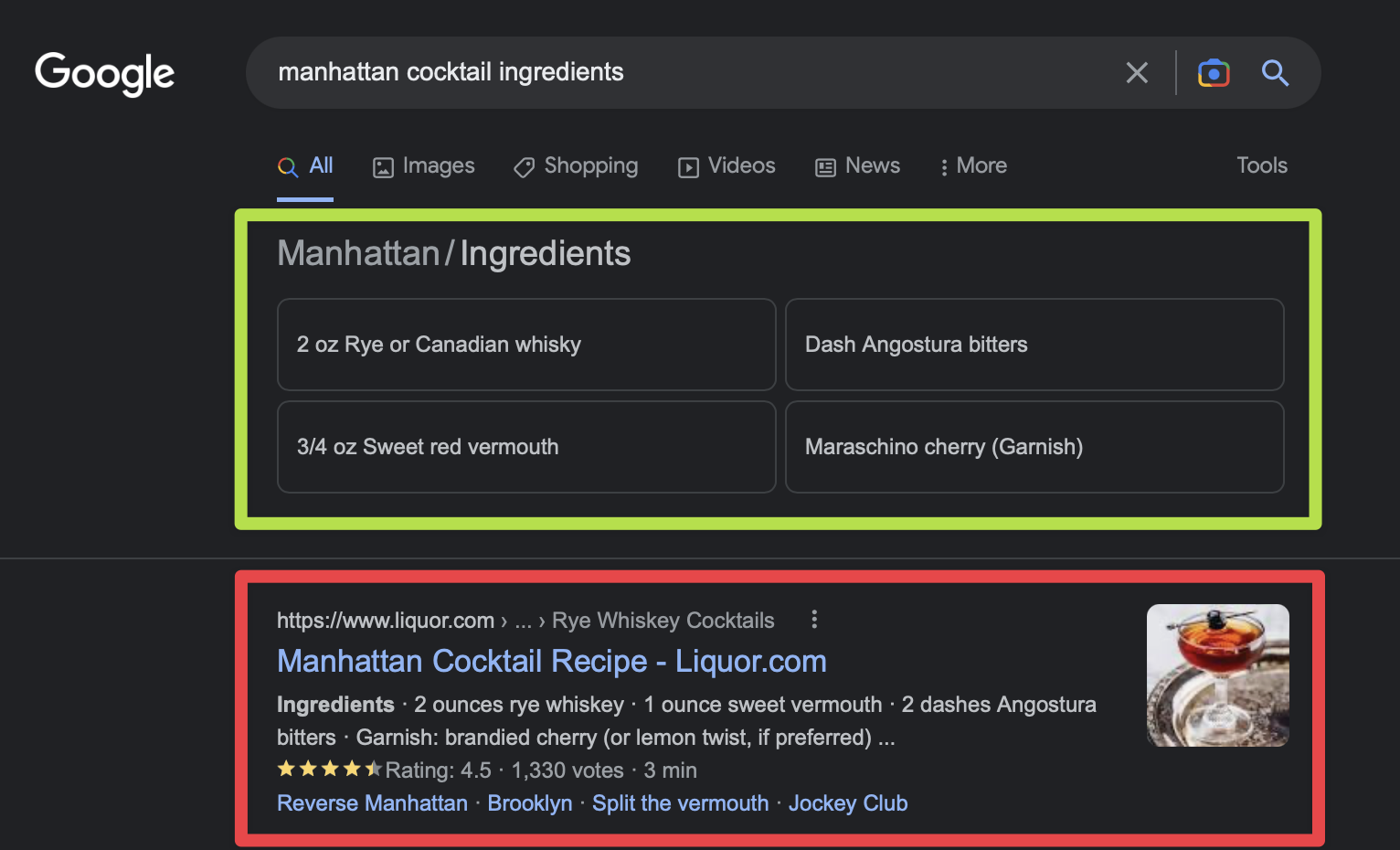
Google has already been disrupting SERPs – for years! – with a proliferation of featured snippet and knowledge graphs, and instant answers that give you exactly what you’re looking for… without requiring a single click.
That means U cAn GeT yUr DrInK oN without ever clicking on poor liquor.com below (and giving them some “ad cents.” (Get it?)
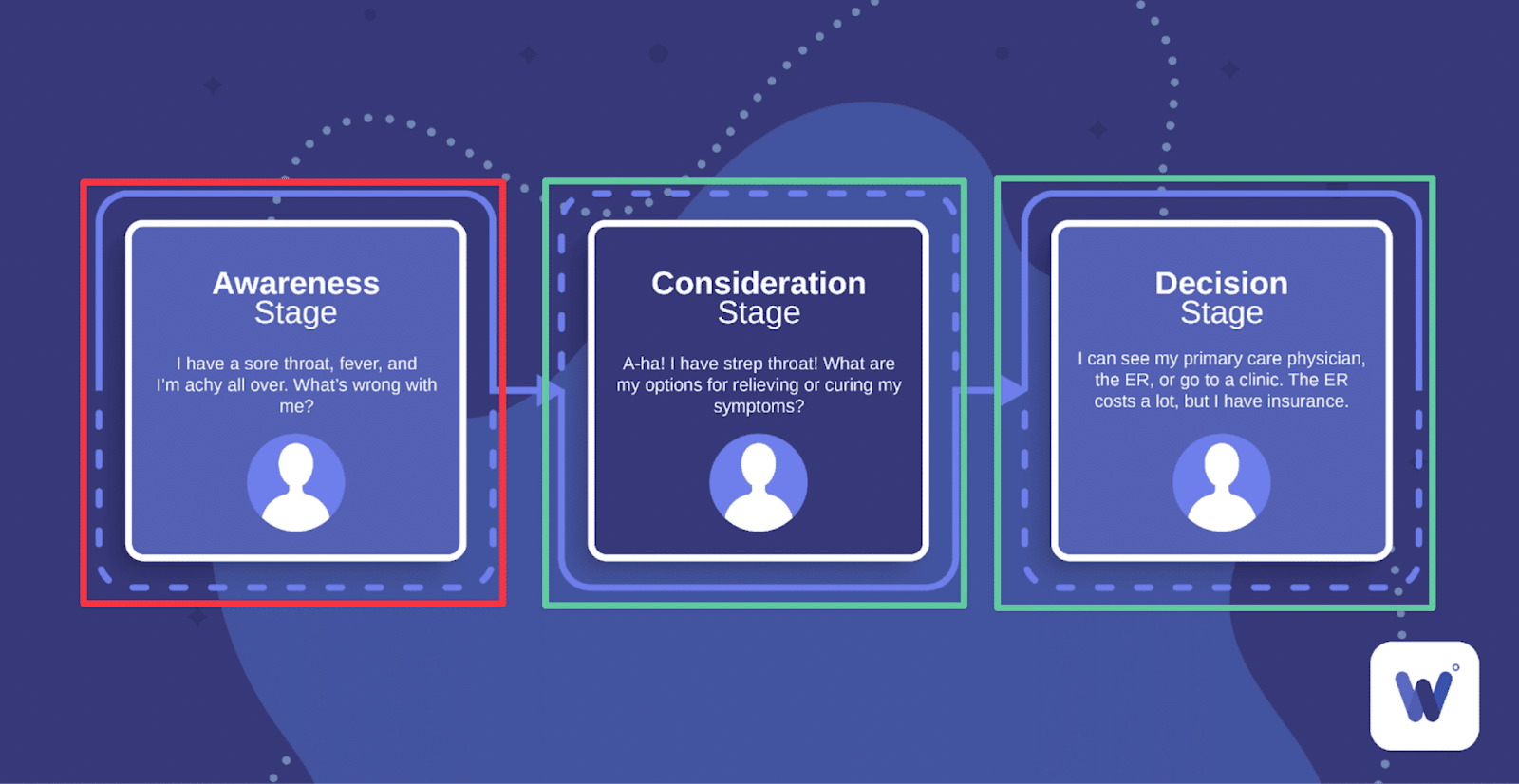
2. Spend more time on MOFU and BOFU content (i.e., the less disruptable stuff)
Despite Google SERPs + AI already cannibalizing your top-of-the-funnel (TOFU) content, it’s less destructive for middle or bottom-of-the-funnel (MOFU/BOFU) stuff.
You know, the kind that actually compels people to do something – click, opt-in, add to cart, start a trial, create an account, or just hit the Buy button.
AI content will be similar for the foreseeable time, because the underlying technology relies exclusively on pretrained models.
It’s why machine can often beat Grand Masters at chess. They can scan and store information (read: patterns and moves) and then make decisions based on that data faster.
Like “garbage in, garbage out,” it associates data points that often show up together, then spits it back out again when called upon – without actually understanding what it’s saying.
So while AI content can do a passable job at a simple, black-and-white query like “What is Advil?” and similar, it’s less useful for figuring out if you need Advil or if you should go to the ER.
Which brings us to the next subplot:
AI content is notoriously wrong. Not, like, some of the time – but, like, all of the time.
3. Great content is often written by subject-matter experts, with quotes and nuance to add color to a topic or angle
The world we live in is not black and white. It’s all shades of kinky, messy, sweaty grey.
That’s also why the best content is done by or with subject-matter experts.
‘Cause said experts rely on primary research and verifiable facts or stats vs. baseless claims to properly prepare persuasive points.
That’s not what you get with AI content.
Plus, it’s easy to spot, like the nerdiest game of whack a mole. A new version of ChatGPT is released, a few weeks later, Turnitin can spot it with 97% accuracy.
Take even the title of this article. It was initially going to be a straightforward “how-to,” but I knew turning it into a Top 10 listicle would get more attention.
Knowledge of the audience should even inform the content structure.
But that isn’t all.
The very definition of “content” continues to evolve as more and more stuff shows up in today’s SERPs.
4. Better structure content types around the Query + SERP layout
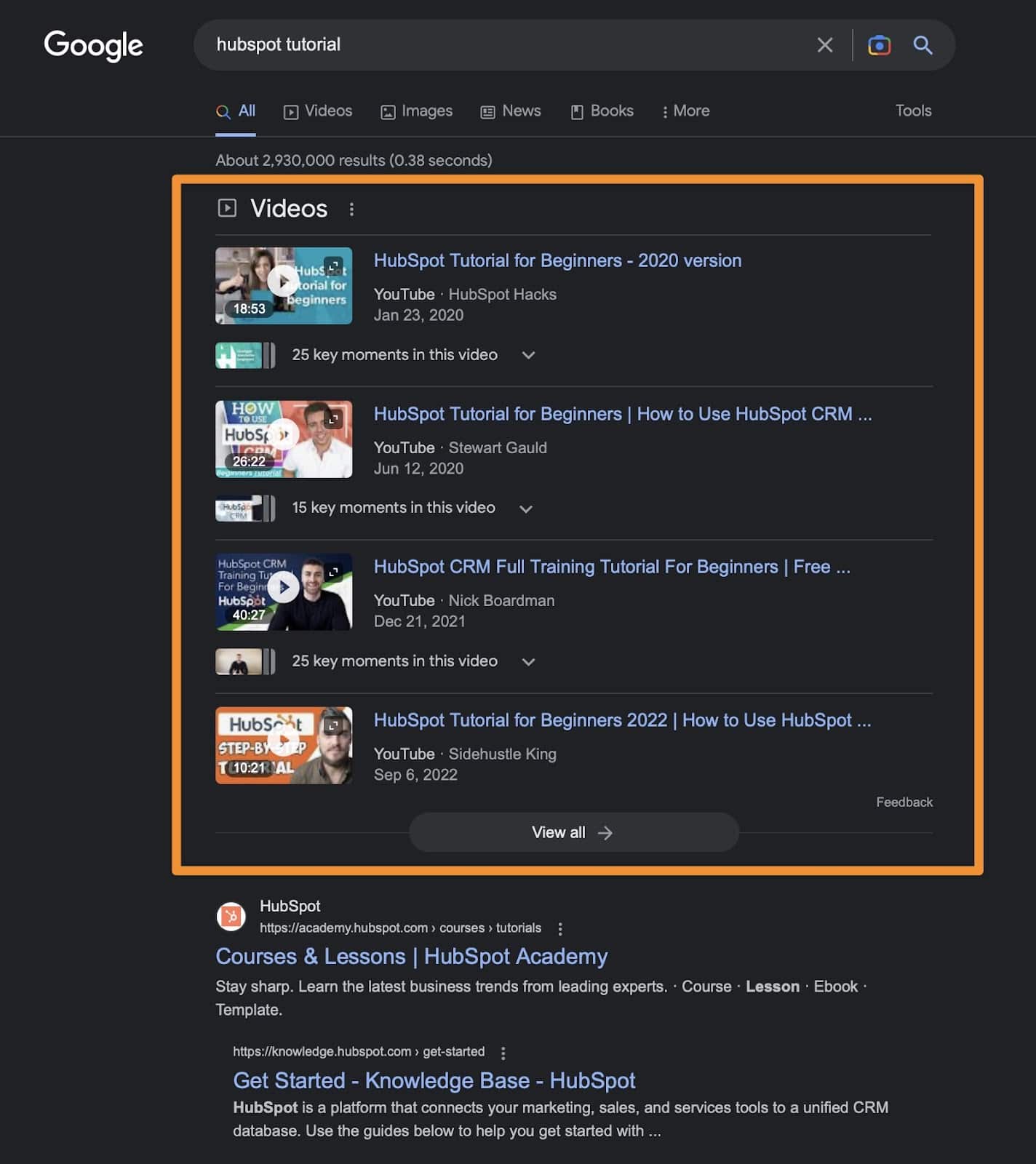
Google “HubSpot tutorial” and here’s what you won’t see first:
- PPC Ads.
- HubSpot.com.
- People Also Ask questions.
- Traditional organic listings.
- Knowledge Graph.
Give up?
Videos!
C’mon, OpenAI. Where’s your vlogging game at?
This is a perfect segue (if I do say so myself) because the one thing that video often has over plain text is personality.
The delivery of the content in video is arguably just as (if not more) important than the actual content.
But. That shouldn’t necessarily be the case.
It just is. Because most writing on the web suuuuuuuuuuuuuuccccckkkkssss.
Take the obnoxious-as-hell introduction of this article.
I’ve worked with hundreds of brands in the past decade. And I can only count on one hand the number that would let us usually get away with something like that.
Most want to play it safe. Water it down. Make it more generic. Make sure the Oxford comma is just so.
You know, because customers really care how you format em dashes. (Wait. No, they don’t.)
Get 10+ writers to drone on and on and on like the same nameless, faceless, Company, Inc. that’s been the content strategy over the past few years.
Yet, over the next few, it will die an excruciatingly-violent, Squid Games-esque death.
‘Cause AI content is already the faceless master of the universe.
5. Think more recurring columns from individuals with personalities vs. lots of generic writing that all sounds the same
Cue Bourdain.
God, I love him. And miss him. Because he would drop bombs on the regular like so:
“If you are easily offended by direct aspersions on your lineage, the circumstances of your birth, your sexuality, your appearance, the mention of your parents possibly commingling with livestock, then the world of professional cooking is not for you.”
From the thought-provoking:
“Travel changes you. As you move through this life and this world you change things slightly, you leave marks behind, however small. And in return, life—and travel—leaves marks on you.”
To simple quips:
“When dealing with complex transportation issues, the best thing to do is pull up with a cold beer and let somebody else figure it out.”
What do you call that? Journalism? Satire?
No clue. I just call it endlessly readable. Can’t-take-my-eyes-off-it watchable. Literally-LOL listenable.
AI can’t do that. Because AI ain’t got no soul.
It can’t make counterunitive arguments. It can’t weave a narrative that builds on itself.
Not yet, anyway. And not over the next few years at this rate, either.
Those things are self-referential. They build arguments with one brick after another, which requires leaps in logic.
Or they’re completely counter to what “most” acceptable norms might suggest on a particular topic or category.
Remember: garbage in and garbage out. AI can’t process nuance like this yet.
Get the daily newsletter search marketers rely on.
<input type=”hidden” name=”utmMedium” value=”“>
<input type=”hidden” name=”utmCampaign” value=”“>
<input type=”hidden” name=”utmSource” value=”“>
<input type=”hidden” name=”utmContent” value=”“>
<input type=”hidden” name=”pageLink” value=”“>
<input type=”hidden” name=”ipAddress” value=”“>
6. Mixed media increases persuasion, consumption and even memory recall
When people say “content,” their minds drift to “text.”
But the lines between content types have already evolved. And for a good reason.
Imagery is proven to increase memory recall. Meanwhile, scanning and skimming is the new reading.
That’s why showing people what something looks like will always, unarguably, be better than walls of text.
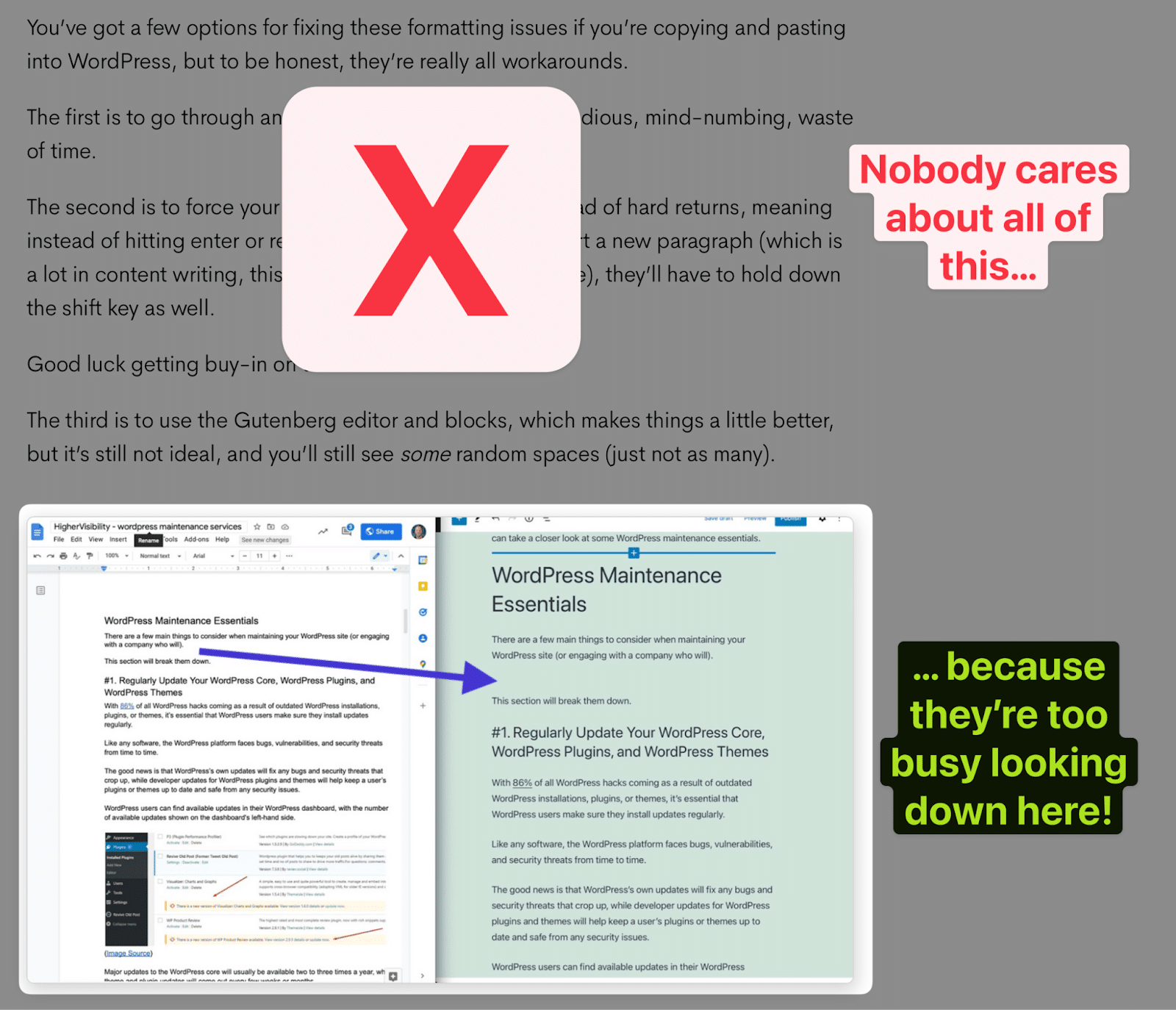
You might as well be dropping 300 words of Lorem Ipsum when an image comes into view, like so:
Mixed media helps break up content, actually encouraging more scanning and scrolling, which your crack fiend-like audience is already accustomed to online.
This should include everything from:
- Featured images.
- Charts and graphs.
- Visualizing a process or explanation.
- CTAs.
- Even graphics that could be repurposed for social channels, video thumbnails, and more.
And it means anytime you explain some visual process, show it!
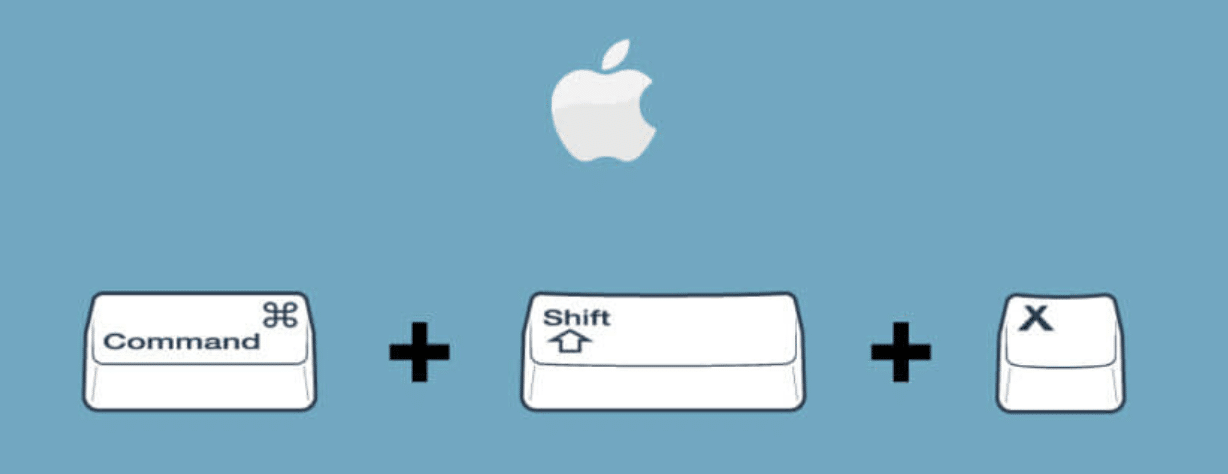
It’s better to show people exactly how to “add a strikethrough in Google Docs,” as an example, than to ramble on and on and on and bury the good stuff in walls of text around it.
7. Create long, in-depth content that can easily be repurposed into more audio and visual mediums
You don’t need another statistic to explain video’s importance to marketing. No one does.
So let’s skip the foreplay and focus on the important point:
The very same long, in-depth, nuanced, interesting content that AI can’t do also lends itself really well to another human-friendly element: audio and video.
A basic element is to take in-depth content and create audio summaries. Or, simply include thematically related discussion-style podcasts into related articles. The Economist does both.
But you can and should do the same with video, especially as YouTube continues to eat away at traditional television + streaming time while also eating away at organic SERP placements, too. (See point #4 above.)
So take your top content, or most competitive “head” terms, and create everything from product-focused walkthroughs to in-depth reviews or even motion graphics.
Just remember that we’re shooting for what AI can’t do = which often means more human inclusion with some talking-head elements, too.

8. Illustrate stories with interactive content and data visualization
The theme over the last few tips here is to focus less on the actual content itself and more on how you deliver it.
Specifically, make it more interactive so it is easier to grasp and more interesting to focus on for a few minutes.
Data visualization is the natural extension, then. Again, take a cue from top publishers like The Economist, which has recently been churning out interactive content pieces like this overview of worldwide weather systems.
9. Lean into nuance and subjectivity by comparing alternative solutions for different audiences
AI doesn’t waffle. It can’t, by definition. It’s programmed to spit out facts like that supremely-annoying know-it-all in your office. (Err, Slack Watercooler.)
The good news is that this dovetails nicely with the fact that online audiences are also becoming savvier. Meaning: if you just spew BS, they’ll see right through it.
Nowhere is this clearer than affiliate-related SERPs. Sure, you can still pull the wool of the eyes of rubes in the “make money online” space.
But generally speaking, people are smart enough to know that there is no #1 right answer 100% of the time.
Instead, you often compare different options for different people based on a wide range of factors.
For instance, what’s the best dive watch you can buy right now?
The answer is entirely dependent on budget!
What’s “nice” at $100 isn’t at $1,000, $10,000, or even $100,000. (Much to my bank account + wife’s chagrin.)
But the point is that you can and should lean more into subject-style content.
At the very least, take a more balanced and nuanced approach to the kind of searches that might realistically work for multiple parties.
Once again, you can up the ante here by using better design, presentation, and even development to highlight these subjective differences clearly.
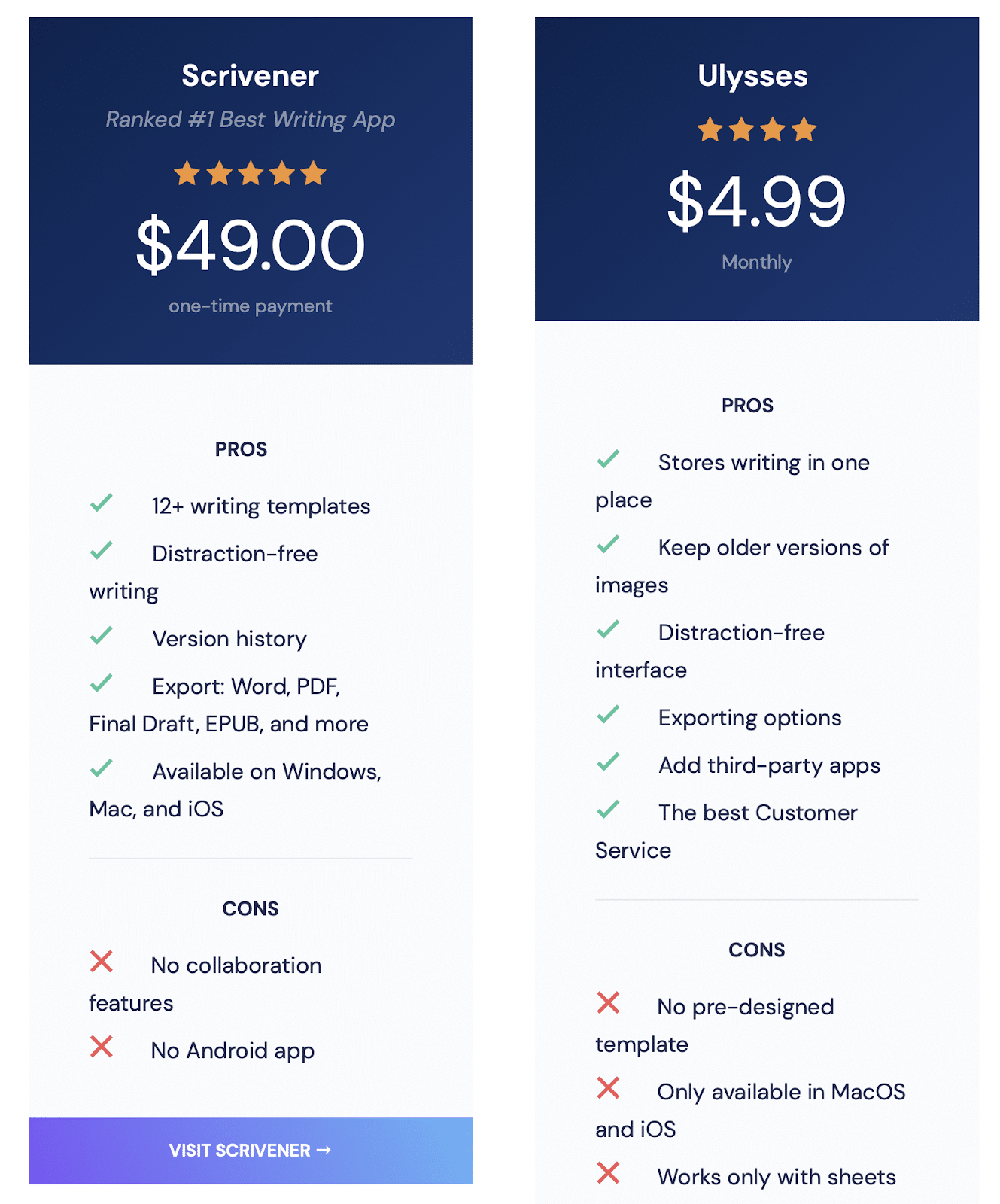
Think: comparison charts and graphics. Showcase pros vs. cons or which alternative is better depending on their budget, goals, and preferences.
10. Demonstrate how things works, not just what they’re capable of
You should always strive to go the extra mile.
Sounds trite. But it’s true.
If the competing content has zero images, you should have five. If they have 10 stock images, you should have 10 custom ones.
Your content will need a competitive “moat,” made up of all these elements we’re talking about today, to “future-proof” your content as much as possible.
My last favorite example includes calculators, tools, quizzes, and other embeddable elements.
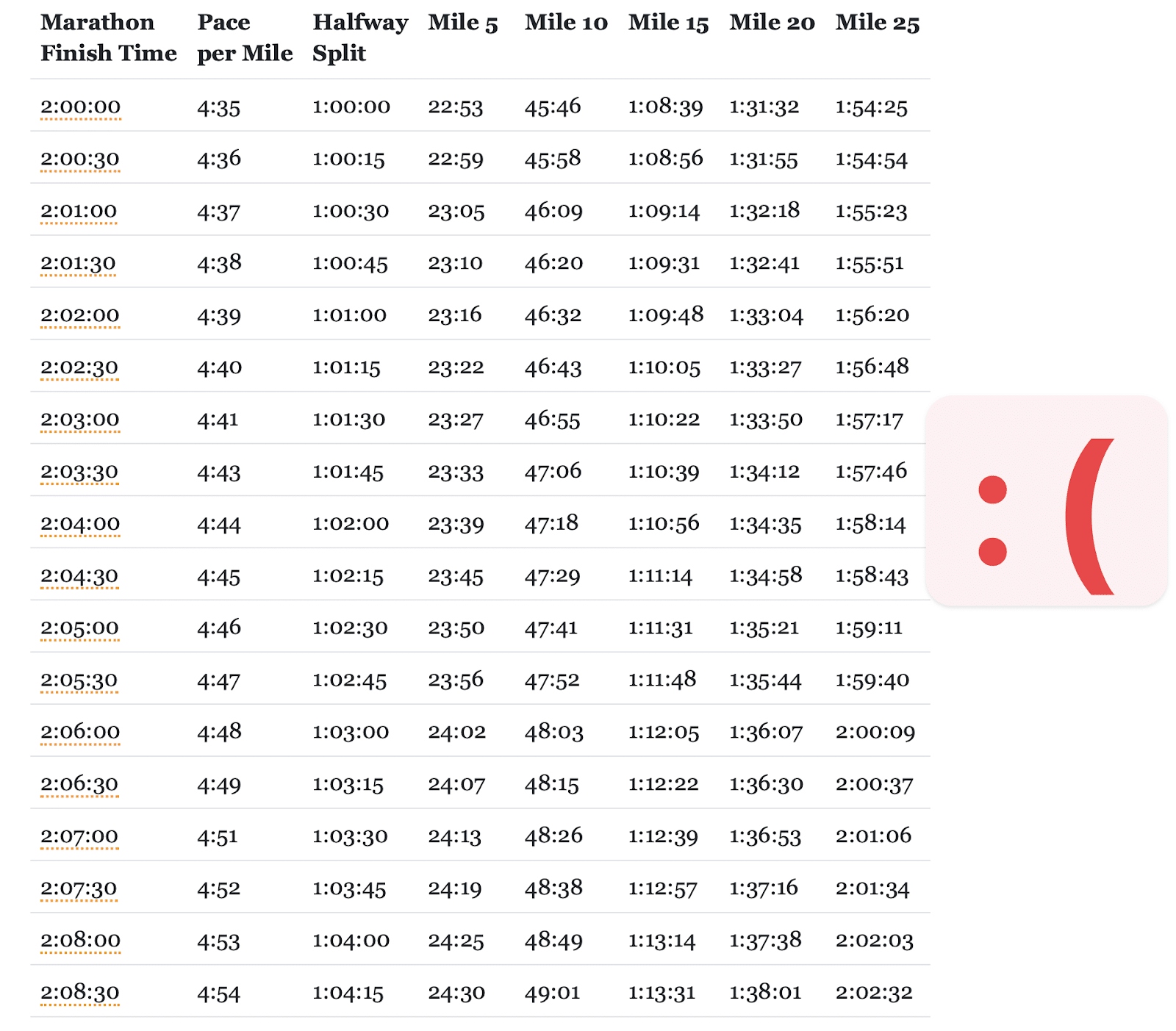
Let’s literally and figuratively go that extra mile now. Say you have two ways of determining your expected finish time in a marathon.
You can:
- Painstakingly look up your mile time on the leftmost column of a huge chart, using both fingers to draw lines between that and your distance time…
- Or, you could punch in two numbers and get an instant answer:
(Hmmm. That latter example even kinda sounds like what AI is doing, anyway?  )
)
Remember that “content” doesn’t always mean “text.”
Yes. You will often need text to start. A script is the nucleus of a video.
But the actual presentation, format, delivery, or interaction will continue to matter more and more over the next decade.
Double down on what AI can’t do
The cat is out of the bag.
AI will only continue getting better and better and better.
Pretty soon, we’ll have no choice but to build digital pyramids in the metaverse in its honor.
Thankfully, that day isn’t today. Or tomorrow. Probably not five years from now, either.
AI can do lots of things better than you and me. However, it’s embarrassingly bad at a slew of things.
Compete on those latter things. On the things that aren’t easily reproducible and aren’t likely to change anytime soon. Especially the human bits that are already hardwired into our internal hard drives.
Machines might be able to beat you at chess. But they won’t ever at intangibles like instincts or intuition.
Or any other “i” word to complete the cheap alliteration joke that confirms there’s a living, breathing human typing this after all.
The post AI can’t write this: 10 ways to AI-proof your content for years to come appeared first on Search Engine Land.
Courtesy of Search Engine Land: News & Info About SEO, PPC, SEM, Search Engines & Search Marketing
Monday, February 27th, 2023
Keyword cannibalization happens when you have two or more pages ranking for the same keyword. It is generally considered undesirable.
This article will help you decide whether you have a keyword cannibalization problem and, if so, how to solve it.
Is keyword cannibalization always problematic?
Before fixing keyword cannibalization, check whether it is a real problem for your site.
Sometimes, two pieces of content ranking can be favorable, especially with an indented SERPs.
For Delish, these two pages ranking on page 1 are beneficial. In one search, they’ve got two pieces of content ranking. The indented SERP gives Delish more space in the page and increases their chances of a click.
A quick browse of these two pages will show similarities in ranking keywords. For example, according to Semrush, both pages rank for:
- “quick easy healthy lunch”
- “easy healthy lunch ideas”
- “easy healthy lunch”
- “easy and healthy lunch ideas”
You don’t have to take action on two pages ranking when there are indented SERPs. Leave them especially if you’re getting clicks and conversions.
Identifying keyword cannibalization that needs fixing
If you don’t have access to software to help spot cannibalization, you can find potential issues with Google site search.
Use the following when searching:
- site:example.com “keyword”
The screenshot above shows how Google has listed content on and around “healthy” and/or “lunch” published on the Delish website.
If you have similar results, look at the pages and investigate if they are problematic.
To identify problematic cannibalization problems, look for the following:
A sudden drop in clicks or impressions
This can happen when you publish a new piece of content and Google prioritizes the new piece over what was already ranking.
This can return to normal after a while, but if it doesn’t, look at the next section on fixing keyword cannibalization.
Struggling to rank despite your best efforts
Two pieces of content targeting the same SERP intent can be “confusing” to Google.
It indicates that your content strategy isn’t as robust as it should be.
Pages ranking for a keyword that isn’t supposed to
If you’ve worked on your content strategy, but the wrong page still ranks, then you’re almost definitely cannibalizing yourself.
In this situation, follow our tips on what to do when the wrong page ranks.
Get the daily newsletter search marketers rely on.
<input type=”hidden” name=”utmMedium” value=”“>
<input type=”hidden” name=”utmCampaign” value=”“>
<input type=”hidden” name=”utmSource” value=”“>
<input type=”hidden” name=”utmContent” value=”“>
<input type=”hidden” name=”pageLink” value=”“>
<input type=”hidden” name=”ipAddress” value=”“>
Fixing keyword cannibalization
How you fix keyword cannibalization will depend on the problem it’s causing and the solution most useful for your readers.
Here are some keyword cannibalization solutions to consider.
Internal linking
An internal linking strategy is a good first effort to resolve keyword cannibalization.
Here, you won’t be taking pages down or redirecting content – a fairly safe option if you feel nervous about the consequences.
How to fix keyword cannibalization with internal linking
Internal linking is a powerful tool for SEO. It’s useful for readers to find relevant sources and related content. It also gives Google a directive on what a page should rank for.
If you’re doing content the right way, you know what the two pieces of content should rank for.
So you can use an internal link from one piece to the other to reinforce where they sit in website architecture and what people might search to find the piece.
In this instance, opt for an exact match keyword or something close to it.
Review your internal links and identify links pointing to the two ranking pieces. You might be pointing to the pages with the same anchor text.
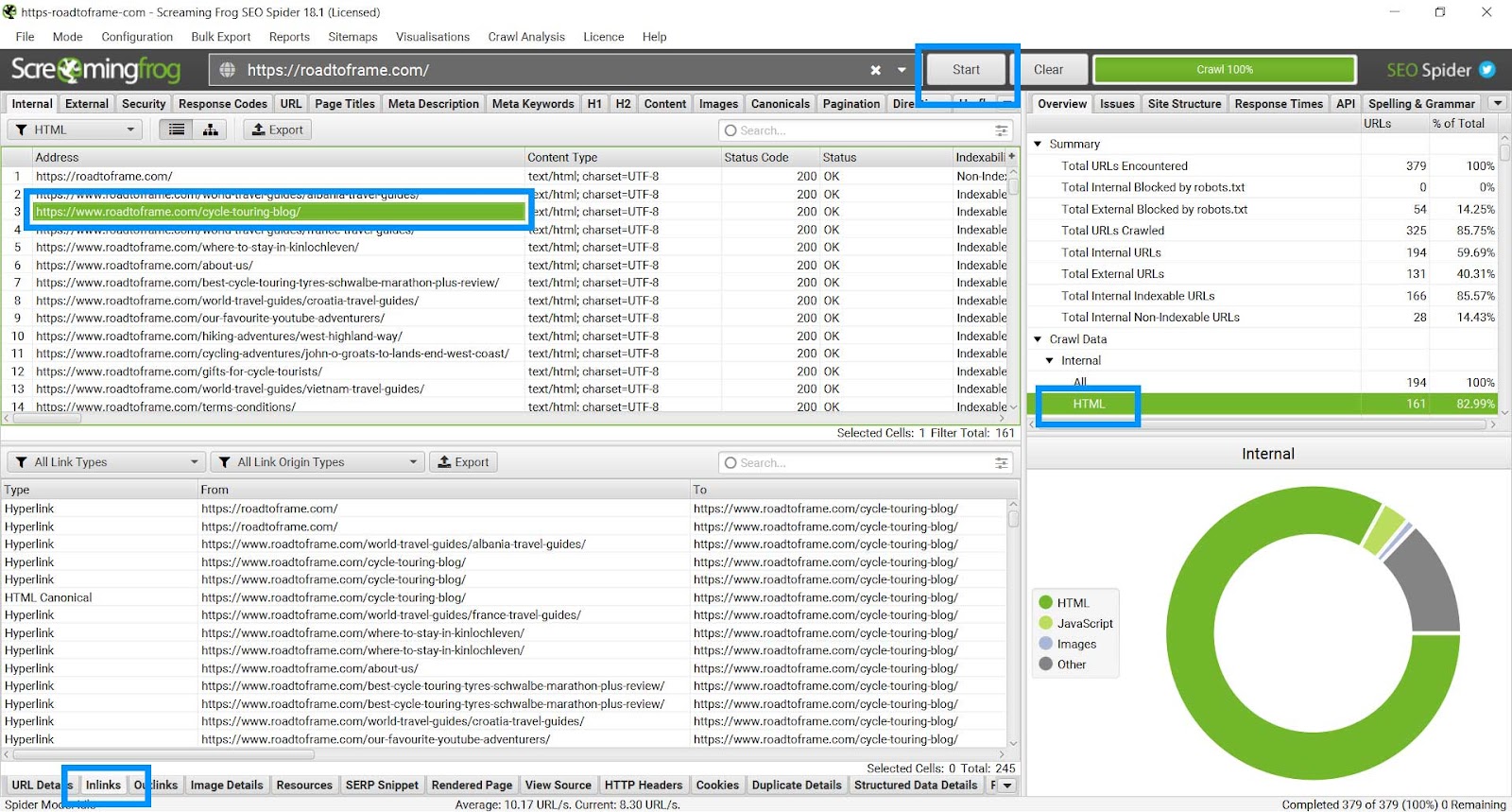
You can get a good idea of what anchor text you’re using to link to pages with Screaming Frog.
Open Screaming Frog, then click crawl your site. Filter by HTML, click the page you want to view, then hit inlinks.
You’ll see which pages link to your page and with what anchor text. With a quick edit you can straighten out your internal linking strategy.
Pro tip: When building a content plan, prepare a content database (like a Google Sheet) where you can pick a keyword from the cluster to use in your anchor links. This process prevents writers from adding random internal links in their articles.
Refining keyword clusters and establishing clear search intent
Perhaps you’ve identified keyword cannibalization but want to keep the two pages. In this case, you might need to give each piece a defined purpose.
To do this, develop a keyword cluster and establish clear search intent. Each piece of content must do something unique.
Using the Delish example from above, we can see that although similar, the two articles have clear search intent.
- One article recommends lunch ideas for work.
- The other recommends packed lunches.
Taking a packed lunch to work is synonymous with a work lunch, but it isn’t just for work purposes.
Content consolidation and 301 redirects
It’s fairly intuitive when you need to do a content consolidation and a 301 redirect. Mostly, you can tell immediately if a page is targeting the exact same keyword.
Going back to the Delish example, although similar, the two pages on healthy lunches have two different intents. As mentioned, one article focuses more on lunches for work, and the other is about packed lunches.
Although nuanced, the two content pieces can co-exist assuming they’re not causing issues behind the scenes.
However, if the two articles were “55 Healthy Lunches” and “The Best Healthy Lunches,” there is an issue.
The target keyword is clearly similar – “healthy lunches” and “best healthy lunches.” Sounds like the same thing, right?
To confirm, a quick search of “healthy lunches” and “best healthy lunches” returns almost the exact same SERPs.
So, these articles would be consolidated, and one would be redirected to the other.
How to fix keyword cannibalization with content consolidation and a 301 redirect
Before consolidating two (or more) articles, do your due diligence. Use data to help you decide which URL you’re keeping and which one you’re redirecting.
- Consolidate the content in the two articles. When you do this, make sure you give it a thorough edit. You’ll do more bad than good if you end up with Frankenstein-esque content. To succeed with this tactic, your content must be high-quality and well-written.
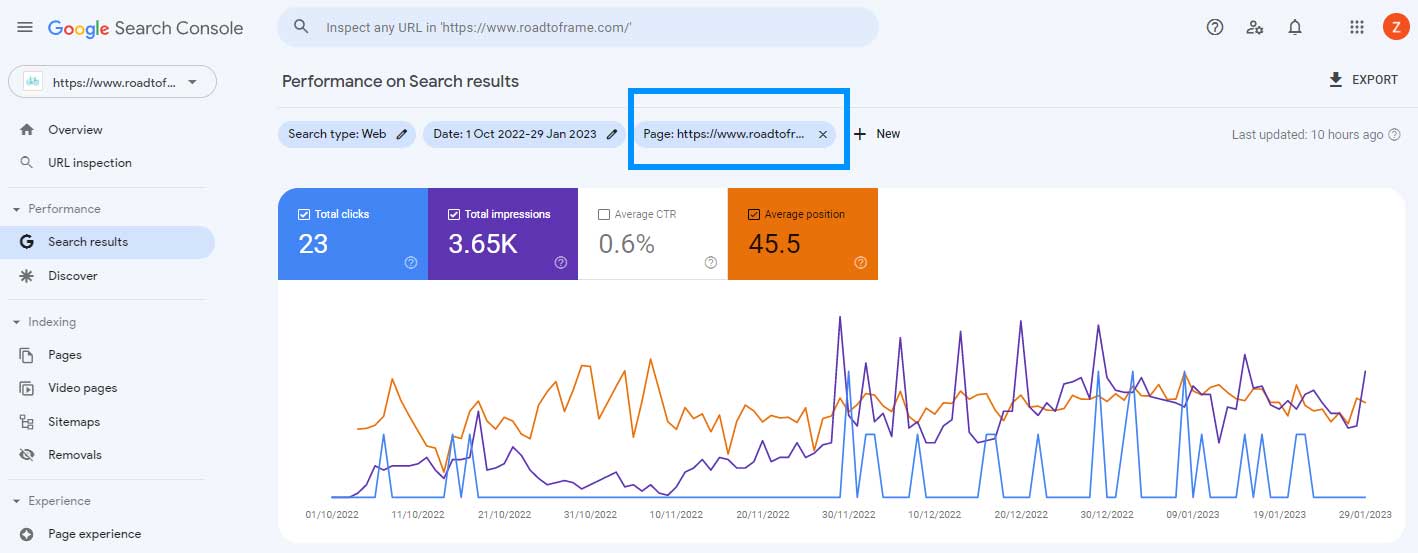
- Find the most successful URL by looking at Google Search Console data. Filter by page to see which URL receives the most clicks, impressions and average position. Generally, one will supersede the other a lot, so the choice will be obvious.
- If the winning URL doesn’t jump out at you by this point, check the backlink profile. Although you will redirect one link to the other and carry over those backlinks, keeping the content on the URL with the strongest backlink profile would be better.
Add a canonical
If the two pages need to exist but you don’t want Google indexing both, you could add a canonical.
This method is useful on ecommerce websites, particularly Shopify sites, where the same product exists on multiple URLs.
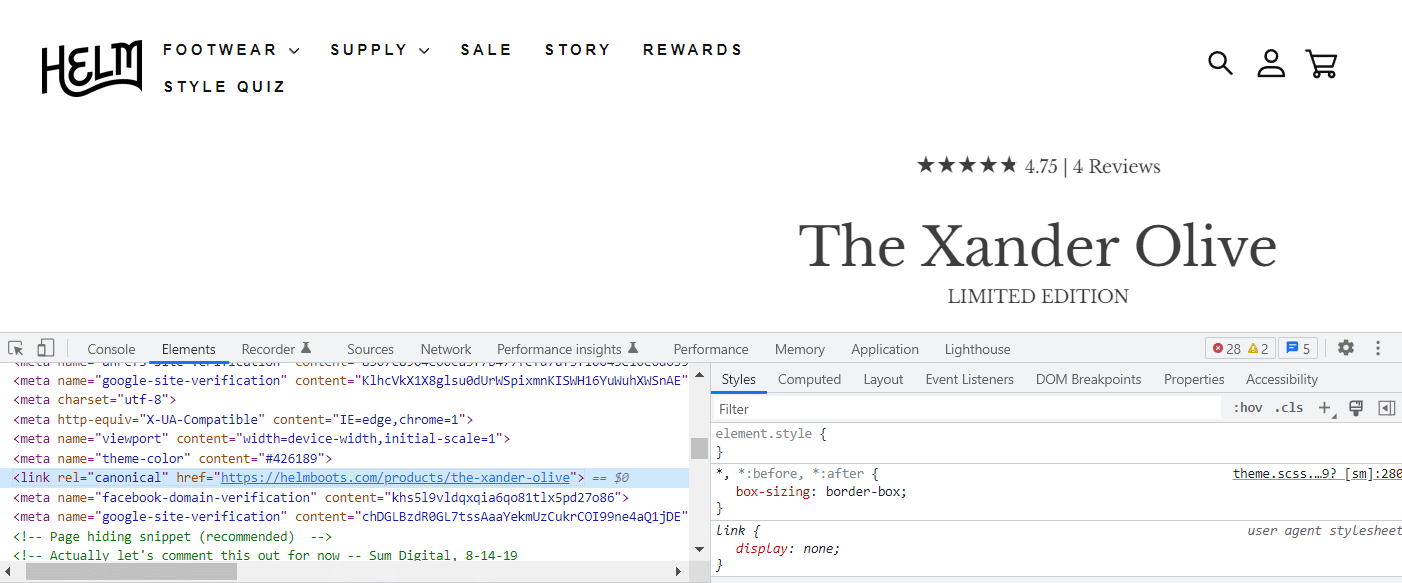
We can see the canonical in action on Helm’s Shopify website.
Their Xander Olive shoe exists on two URLs:
- https://helmboots.com/products/the-xander-olive
- https://helmboots.com/collections/the-xander/products/the-xander-olive
A search within the code of the /collections/ URL shows the canonical pointing to the product.
How to avoid cannibalization in the future
Cannibalization issues occur when there’s no clear plan for content production. Without a plan, well-intentioned writers can deliver similar pieces of content.
To avoid cannibalization, keep a content log and monitor the following:
- Focus keyword: Assign one to each piece of content.
- Keyword cluster: Detail all other keywords the piece should rank for.
- Content pillar/topic: This helps visualize all content under a certain topic.
The closer you are to your content and its purpose, the less likely you are to create cannibalizing content. It helps to have a strategic SEO professional to guide the process so they can correctly assign keywords.
If each piece of content fits within a specific pillar or topic, you can filter content by that topic and double check you’ve not already created content before you write it.
Or, you can use your content research process to identify content that could be edited instead of recreated. Sometimes, a good edit on an existing article can do wonders for your SEO.
The post A guide to keyword cannibalization in SEO and how to fix it appeared first on Search Engine Land.
Courtesy of Search Engine Land: News & Info About SEO, PPC, SEM, Search Engines & Search Marketing