Archive for the ‘seo news’ Category
Monday, March 6th, 2023
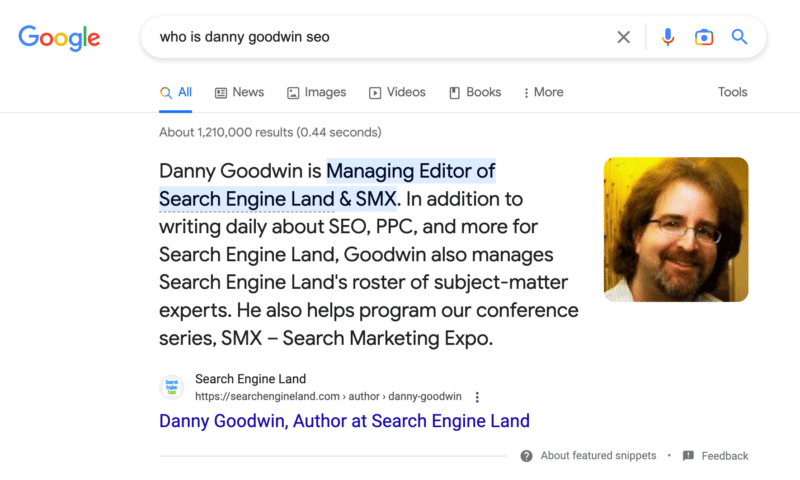
Google seems to have rolled out a new blue highlight feature for some featured snippets in the Google Search results. Google may highlight specific text that is important in answering your query, directly in the featured snippet result. Also, the font size of the featured snippets with blue highlighted text is larger than featured snippets without blue highlighted text.
What is looks like. Here are some screenshots of queries that generate the new blue highlighted text featured snippet in Google Search:
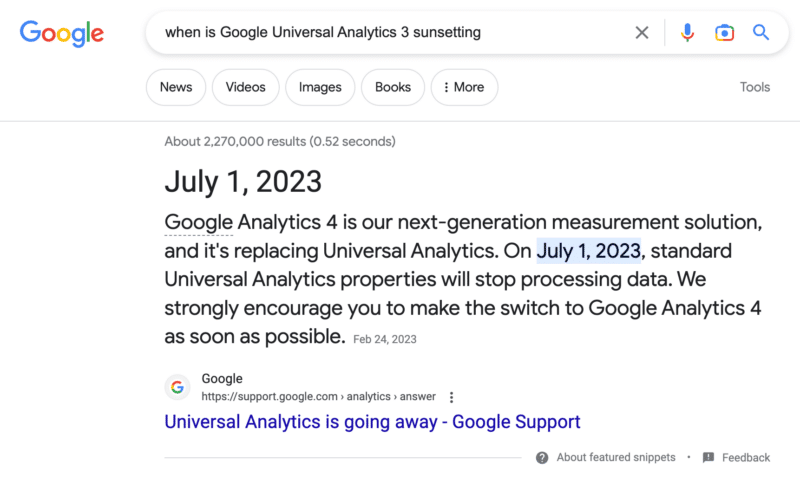
Previous tests. Back in September 2022, Google tested this feature with both yellow and blue highlighted text. It seems Google has gone with the blue highlights, as all the examples I have seen are in blue and not in yellow.
Why we care. Will featured snippets that highlight the answer more prominently with these blue highlights reduce the click-through rate from a typical featured snippet? Will these maybe drive more clicks because of the highlighted text?
You may want to audit some of your more popular featured snippets to see if you are noticing more or less traffic after this change – that is, if the change impacted your results.
The post Google featured snippets gain blue highlighted text appeared first on Search Engine Land.
Courtesy of Search Engine Land: News & Info About SEO, PPC, SEM, Search Engines & Search Marketing
Monday, March 6th, 2023
So you’re ready to document your content strategy.
You think you know what that entails – you need to write this down somewhere… right?
OK, you’ve got a blank Google Doc waiting with a blinking cursor. Now what?
What pieces should be recorded in your strategy document?
What information is a must to include?
Most importantly, why does it matter?
Whether you have nothing more than a verbal understanding across your brand or team about your content strategy and you’re finally writing it down, or you’re creating a strategy from scratch and documenting as you go…
We’ll cover it all in this guide, including:
- Why you should document your content strategy.
- Where to document your strategy.
- Why you should create a document that can be shared and read across teams, departments, and roles.
- What you should include in your content strategy document to guide your content marketing toward success.
What is a content strategy document, and why do you need one?
A content strategy is a plan that governs all of your content marketing activities, including:
- Researching and ideating content.
- Creating content.
- Publishing content.
- Distributing and promoting content.
- Tracking and measuring your progress toward your content goals.
- Maintaining your content.
That means a content strategy document is the written form of this plan.
Why do you need to write it down? Why can’t you just start creating content, already?
Because content created without a plan is destined to fail. And writing that plan down helps you integrate content seamlessly into your brand. You’ll create content strategically, anticipating your audience’s content needs and filling them vs. randomly creating content and hoping it works.
43% of businesses don’t have a documented content strategy or aren’t sure if they do. But, ultimately, the most successful brands and marketers create a strategy and document it.
More reasons why you should document your content strategy
Without a steady, solid plan behind you, your content marketing actions will be random guesswork. You’ll most likely create content based on assumptions rather than data. Your output will be inconsistent as a result, and so will your content quality.
Marketers who proactively plan are 3x more likely to report success than those who don’t.
Why is that? Without a strategy guiding your actions, you won’t have or understand:
- The deep why behind your content marketing – and what you’re ultimately trying to achieve.
- The specific metrics you should be tracking to reach your goals.
- A deep understanding of what your audience needs and wants from your content.
- The content types and formats that will bring the best results for your specific situation.
- When and where to post for the best visibility and engagement with your particular audience.
- Defined processes and workflows for creating, publishing, and distributing content – and who is responsible for each step.
- And so much more.
Lastly, a finished content strategy is a fantastic asset in your business and marketing, but it’s not the whole point of creating one. (Wait, what?) It’s true.
Instead, the process of planning you go through to create that strategy is just as important. It requires research, thought, ideation, mapping, and plotting, which help you get crystal clear on the above items.
That’s why all the work that goes into strategizing is worth it. It will make your content marketing 1,000x more powerful!
Where should you create your content strategy document?
A content strategy document can solve many problems and challenges you might face with content marketing. For that reason, you should think carefully about where you’ll document it.
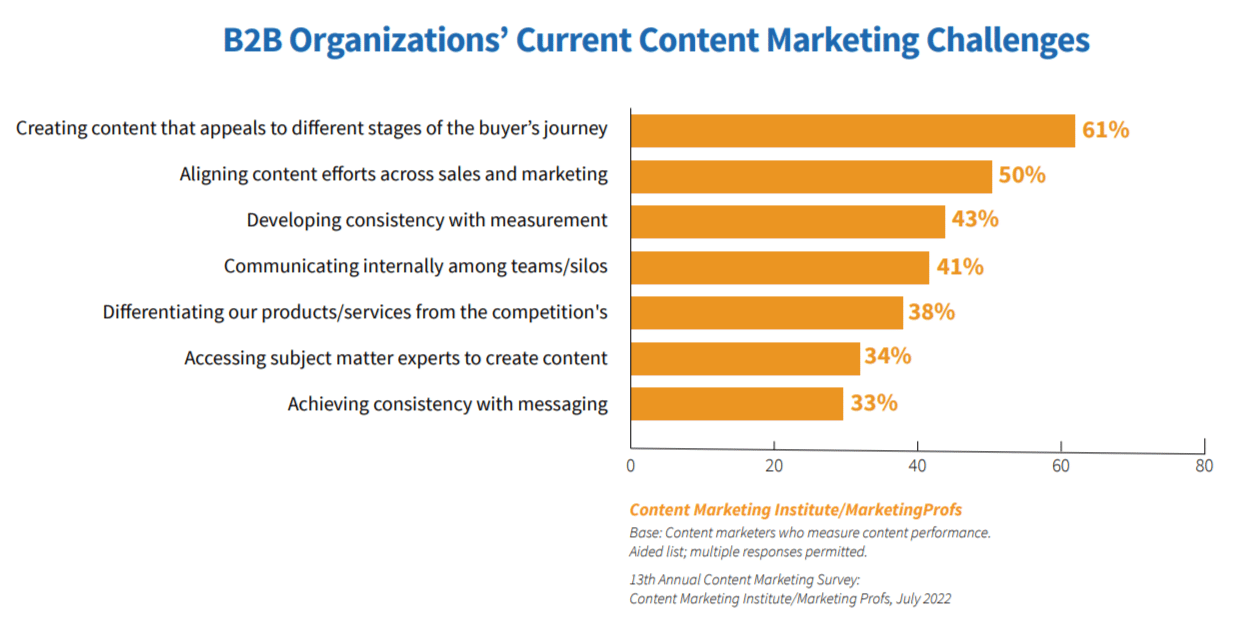
The top content marketing challenges organizations struggle with include:
- Creating content that appeals to different buyer stages. (61%)
- Aligning content efforts across marketing and sales. (50%)
- Developing consistency with measurement. (43%)
- Communicating internally across teams and silos. (41%)
But a documented content strategy solves all these problems. The act of strategizing answers the above questions (how do we create content for different buyer’s journey stages? How do we align content between marketing and sales? Etc.).
But – you must write it down. That’s the key.
You need a written, centralized document that people and teams across your business can access and reference. You need to solidify the strategy to be shared, learned, and implemented repeatedly – and easily.
That means if your strategy is currently nothing more than a nebulous verbal agreement between your team, you’re sitting on a big opportunity to make it real and better.
If you’ve never talked about strategy at all and are currently just “doing content marketing” – that’s insufficient. You could be getting so much more from content.
For these reasons and more, sit down and strategize. Create an organized strategy document that’s easy to read and access.
Tips for creating a content strategy document
- Create your content strategy document in a shareable format, like in a shared Google Doc, or upload your document to Dropbox, Google Drive, or some other file-sharing platform. Ensure anyone on your team who needs access to the strategy can find it.
- Create sections for each major element of the strategy. Format your strategy for ease of reading and finding specific information.
- Include extra information like tools to use at different stages, links to those tools plus account/password information, screenshots of tasks and how they should be completed, links to templates and examples, links to related documents (like brand style guidelines), and anything else that helps your team execute the strategy.
Let’s be real: This will be a lot of work. You won’t be able to create a content strategy in a single day. It might take weeks or even months to complete.
But the difference between having vs. not having a strategy is quantified in light years. If you want real results from content, you’ll invest the time.
10 pillars to include inside your content strategy
Let’s get down to brass tacks. What exactly do you need to include when you document your content strategy?
- Err on the side of including more information than you need. If you’re unsure whether you should put it in your strategy – do it.
- Don’t get discouraged if this task seems neverending. You’re doing all this work now to save yourself later with a streamlined, set content process that brings in more and better results.
With all that in mind, here are the categories and questions your content strategy needs to answer definitively.
1. Goals: Why are you creating content?
Answer with: Your content marketing goals, including how they connect to your larger marketing and brand goals. What do you want your content to do, ultimately?
As you set goals, don’t be vague. Get specific about exactly what you want to see happening, thanks to your investment in content.
For example, don’t just say, “grow brand awareness.” That’s a fluffy goal that’s hard to measure. Yes, you can do that with content, but how are you defining brand awareness? What does that mean for your business, specifically?
Get more specific. Instead, say, “grow brand awareness by increasing our following on social media by 15% in 3 months and earning top rankings in Google for relevant keywords in 6 months to 1 year.”
2. Audience: Who are you creating content for?
Answer with: The audience you plan on targeting with content.
What do they look like? What do they do? What are their interests and preferences? What are the biggest problems your brand solves for them with your expertise and products/services? Where are they searching for information online? Where do they congregate on the web?
Note: As you move through each piece of your content strategy, give yourself time to research and analyze your findings. Then record those findings in the strategy.
For example, audience research will require a few weeks of study, from social listening to conducting surveys, to setting up interviews and sitting down with your potential prospects.
If you already have a defined audience, return to your data on them and make sure it’s still accurate.
3. Platform: Where will you publish content?
Answer with: Your main content platform of focus.
Will you create a blog on your website? Will you post content on social media? Will you create a YouTube channel? Consider your goals and resources and plan accordingly.
For instance, to drive more traffic to your website, you should focus on creating an SEO blog.
4. Content: What content topics will you cover, and what types and formats will you create?
Answer with: The main topic areas you will lock into for content. They should be relevant to what you sell and what your audience wants. Then, choose the content format that you have the means to produce consistently and that your audience most wants to see.
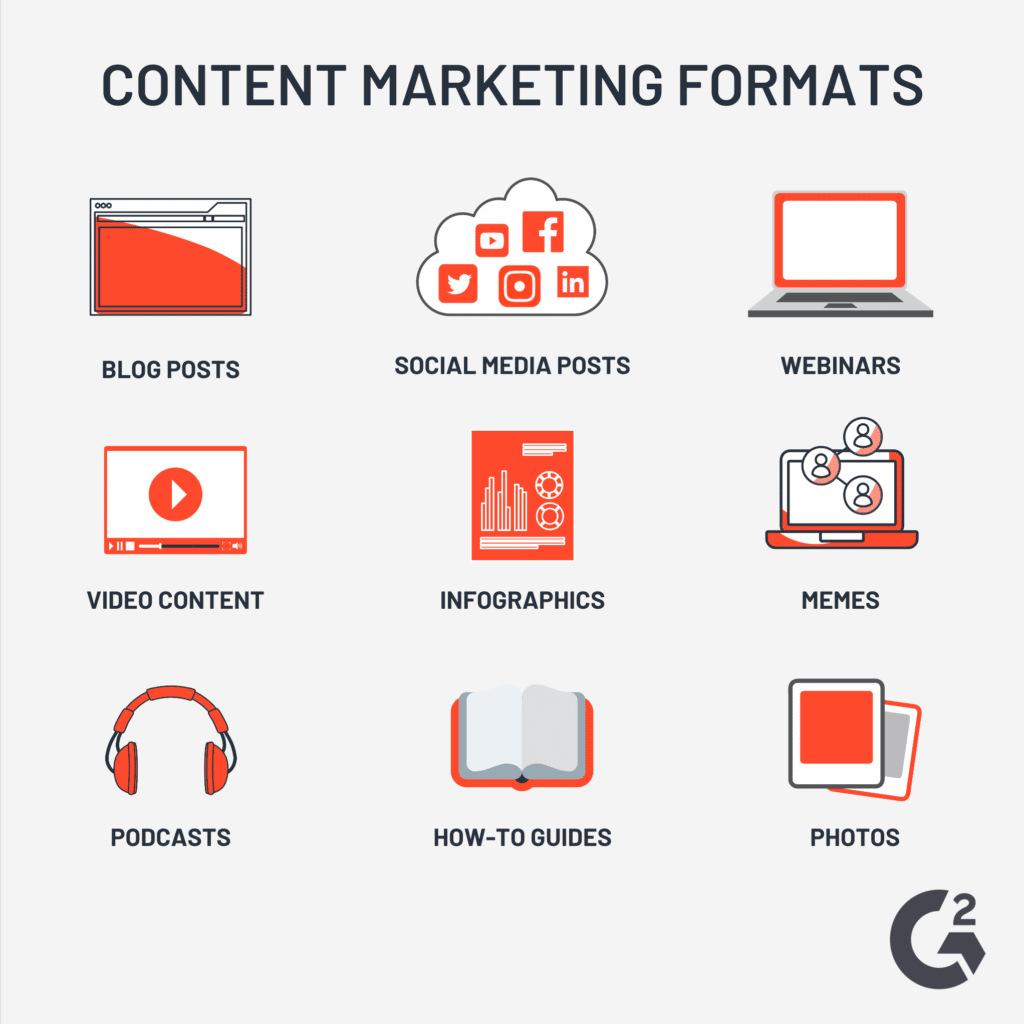
Videos, blog posts, podcasts, webinars, infographics, whitepapers, ebooks, case studies, and more are all possibilities. Keep in mind you may need to diversify to more than one type.
At this point, it’s helpful to create content templates for the formats you want to focus on. These can be used repeatedly for anyone who writes or creates your content, which builds consistency in your content.
5. Team: Who will create your content? Who will manage, publish, promote, and maintain your content?
Answer with: The person, team, agency, or freelancer who will be responsible for your content, from the seeds of ideas to finished pieces.
If you have a team of people working on content, break each task down by who is responsible for what. (Who’s writing the content? Who’s editing it? Who’s posting and publishing it? Who’s promoting it?)
If you’re a team of one, use this section to brainstorm how you can streamline content tasks and make them easier on yourself. Consider adding scheduling, editing, and optimization tools to your lineup. You can also create a timetable or schedule for yourself for completing various content tasks.
Get the daily newsletter search marketers rely on.
<input type=”hidden” name=”utmMedium” value=”“>
<input type=”hidden” name=”utmCampaign” value=”“>
<input type=”hidden” name=”utmSource” value=”“>
<input type=”hidden” name=”utmContent” value=”“>
<input type=”hidden” name=”pageLink” value=”“>
<input type=”hidden” name=”ipAddress” value=”“>
6. Schedule: How often will you post content, and to what channels?
Answer with: A rough content schedule, including how many blog posts you’ll publish to your main channel(s) each week or each month.
Consistency, consistency, consistency. Planning out a posting schedule helps you establish and keep it going. Be flexible because things can and do go awry, but plan for a general cadence of posts that will help establish your brand online.
7. Promotion: How will you promote and distribute content?
Answer with: A rough plan for promoting your main content on social media and email.
How will people discover your content? What are ways you can bring new audience members into the fold?
Make your promotion plan with your resources in mind. Posting links to your new content on social media is one of the easiest, low-cost ways to do this. If you’re more advanced and already have an established audience, including email subscribers, leverage that list and promote your content to people most likely to read it!
Lastly, don’t forget about organic search. This is another low-cost but highly effective way to increase your content’s visibility while bringing in ultra-targeted leads.
8. Tools: What tools will you need to execute every step of content marketing?
Answer with: The tools you or your team needs to execute content planning, creation, publishing, promotion, and maintenance.
At a base level, you’ll need a content management system (like WordPress), a keyword research tool, an analytics tool, and an editing tool.
Add information about what tools you have in your tech stack. You could also use this section to keep track of your subscriptions and monthly costs.
It’s also helpful to return to earlier sections and list the tools you’ll use for each. For content creation, you could include links to your Grammarly, Canva, or Google Drive accounts.
9. Progress tracking: How will you track content metrics and KPIs? How will you measure results?
Answer with: Map your content goals to key performance indicators (KPIs).
In a nutshell, this means making your goals actionable by attaching them to measurable metrics. For example, one way to track a vague goal like brand awareness is through measuring likes, comments, and brand mentions on social media over time.
Detail how you’ll track and measure your goals: what metrics you’ll focus on and what tools you’ll use to monitor them over time.
10. Budget: What’s your content marketing budget?
Answer with: What you plan to invest in your content marketing actions. Calculate your costs in terms of people, tools, processes, and technology.
Put it all together and document your content strategy
There are a lot of moving parts to a content strategy. But they connect to the moving parts of your content marketing activities and processes, guiding them strategically toward success.
If you don’t have a strategy documented yet, mountains of untapped potential for your content are waiting in the wings.
That also means if you’re doing content marketing and not seeing the results you’d like, there’s hope.
For better content that grows your brand, sit down, strategize, and document.
The post How to document your content strategy appeared first on Search Engine Land.
Courtesy of Search Engine Land: News & Info About SEO, PPC, SEM, Search Engines & Search Marketing
Monday, March 6th, 2023
With the popularity of social media came the rise of “link in bio” tools which allow users to create a landing page featuring multiple links they want to share with their audience.
Initially designed to get around Instagram’s one-link rule, many brands and influencers now use them in other social media networks to easily share content with one link. Some even consider their link-in-bio page as a website replacement.
But, are they good for ranking in search engines? This article will look at ‘link in bio’ platforms from an SEO perspective.
‘Link in bio’ platforms from an SEO perspective
Also known as “link list page” apps or “social media landing page” tools, these platforms have virtually proliferated overnight.
They are characterized by short, trendy names that often combine with their unique top-level domains to create easily understood, phonetically spelled word-grams (like “linktr.ee” and “hoo.be”).
Surprisingly, many popular social media influencers opt for these simplistic link pages when they can afford to have custom, standalone websites built to do whatever they wish.
But, websites can be challenging to maintain, so these one-page platforms have filled a significant market niche.
That said, convenience and ease of use are not the only considerations when it comes to your online presence. Search engine optimization (SEO) still matters for improving a brand’s visibility in search results.
Popular and higher-quality web content tends to rank higher in search results, and one of the many ways search engines determine popularity is by analyzing links.
In addition, popular social media profiles are likely to have already accrued large amounts of “ranking weight” as Google analyzes the link graph within the social network where the account is located.
Also, popular social media accounts may be mentioned in other social networks’ posts and on many webpages (i.e., news articles and elsewhere).
If you have a big following on Instagram, YouTube, TikTok or elsewhere, your link-in-bio platform may affect how effectively your link weight flows to other accounts where you are less popular or webpages you link to.
So while you have many factors to consider when choosing a platform, don’t overlook the SEO element.
A comparison matrix follows to help determine which link list page platforms are the best, primarily from an SEO perspective.
‘Link in bio’ platforms: A comparison
The best ‘link in bio’ platforms ranked with the best at the top and the worst at the bottom.
| Site |
Custom Page URL Form |
Are Links Followed? |
# Pages Indexed |
Additional Notes |
| linktr.ee |
linktr.ee/[yourname] |
Yes |
4,010,000 |
One of the most-used link-in-profile services, Linktree has JavaScripted construction, but it appears to be engineered to be search-engine-friendly. |
| taplink.cc |
taplink.cc/[yourname] |
Yes |
332,000 |
The site has JavaScript content delivery but appears well-engineered for search engines. Formerly contactin.bio. |
| carrd.co |
[yourname].carrd.co |
Yes |
317,000 |
|
| instabio.cc |
instabio.cc/[random ID] or paid option: instabio.cc/[yourname] |
Yes |
277,000 |
Some themes appear optimal. Some may be JavaScript content delivery only. |
| carbonmade.com |
[yourname].carbonmade.com |
Yes |
61,100 |
|
| solo.to |
solo.to/[yourname] |
Yes |
48,400 |
|
| direct.me |
direct.me/[yourname] |
Yes |
30,600 |
|
| withkoji.com |
withkoji.com/@[yourname] |
Yes |
18,000 |
The site has JavaScript content delivery but appears well-engineered for search engines. |
| wlo.link |
wlo.link/@[yourname] |
Yes |
10,300 |
|
| lynxinbio.com |
lynxinbio.com/[yourname] |
Yes |
8,570 |
|
| 8b.io |
[yourname].8b.io |
Yes |
7,820 |
|
| hoo.be |
hoo.be/[yourname] |
Yes |
6,710 |
|
| my.playbookapp.io |
my.playbookapp.io/[yourname] |
Yes |
6,230 |
This is more of a rev-share app for athletes/trainers/coaches. But, a nice format for those in that niche. |
| contactin.bio |
[yourname].contactin.bio |
Yes |
4,530 |
|
| url.bio |
url.bio/[yourname] |
Yes |
1,740 |
All identical page titles (“Link In Bio Tool – One URL. Unlimited Links. | url.bio”). The site has JavaScript delivery but appears well-engineered for search engines. |
| tapkit.com |
tapk.it/[yourname] |
Yes |
500 |
The site has JavaScript content delivery but appears well-engineered for search engines. |
| about.me |
about.me/[yourname] |
No |
1,270,000 |
Good construction – so many pages Google might ignore the nofollows. |
| msha.ke |
msha.ke/[yourname]/ |
No: rel=”UGC” |
148,000 |
|
| shor.by |
shor.by/[yourname] |
Yes, but links 302 redirected. |
82,800 * |
All links appear to be automatically replaced by shor.by 302 temporary redirects. The redirected links make it more difficult to see how many actual shor.by pages Google has indexed vs. mere redirects. It’s likely one-fourth to one-half as many as reflected in our count here. |
| beacons.ai |
beacons.ai/[yourname] |
No |
82,400 |
Weirdly, beacons.ai pages have robots meta tags that instruct “index, follow,” but the individual links have rel=”nofollow.” The result is still nonoptimal. |
| campsite.bio |
campsite.bio/[yourname] |
No: rel=”UGC” |
35,800 |
|
| lu.ma |
lu.ma/[yourname] |
No |
20,500 |
Lu.ma is more of an online event-hosting facilitation service than a link page provider. |
| elink.io |
elink.io/p/[yourname] |
No |
19,000 |
JavaScript page construction may render content invisible to search engines. |
| tap.bio |
tap.bio/@[yourname] |
N/A: JS links |
13,100 |
Nonoptimal JavaScript content delivery. |
| linkin.bio |
linkin.bio/[yourname] |
N/A: JS links |
8,390 |
All identical page titles (“Linkin.bio”) and nonoptimal JavaScript content delivery. |
| biolinky.co |
biolinky.co/[yourname] |
No |
8,230 |
|
| skedsocial.com |
sked.link/[yourname] |
N/A: JS links |
1,300 |
Nonoptimal JavaScript content delivery. |
| c8ke.com |
[yourname].c8ke.com |
N/A: JS links |
809 |
|
| getsl.ink |
www.getsl.ink/[yourname] |
N/A: JS links |
700 |
JavaScript page construction may render content invisible to search engines. |
| visitstore.bio |
visitstore.bio/[yourname] |
N/A: JS links |
700 |
Microsites provided by Sprinklr, this cleverly associates a thumbnail of each of your Instagram posts with a link to the page on your website or elsewhere, enabling people who see your Instagram post to rapidly browse in your visitstore.bio page to find the thumbnail to click. Unfortunately, the JavaScript page construction may render content invisible to search engines. |
| hypage.com |
hy.page/[yourname] |
N/A: JS links |
600 |
JavaScript page construction may render content invisible to search engines. |
| iglinks.io |
www.iglinks.io/[yourname] |
N/A: JS links |
408 |
Nonoptimal JavaScript content delivery. |
| bio.fm |
bio.fm/[yourname] |
Yes |
165 |
Googlebot useragent appears to be blocked from bio.fm, as profiles reflect a 503 status code. |
| manylink.co |
many.bio/[yourname] orlinksto.info/[yourname] |
N/A: JS links |
67 |
No HTML page titles. All content JavaScripted. The linksto.info links 301 redirect to a parallel many.bio link. |
| shopinbio.com |
shopinbio.com/[yourname] |
Yes |
60 |
Provides small, multi-page/product shops. Appears to be more Kazakhstani-oriented and does not appear to be fully baked yet. |
| linkinprofile.com |
linkinprofile.com/[yourname] |
No |
7 |
Tempting to use because after setup, all you need to do is add a URL in an Instagram post and it will create a parallel post on the linkinprofile.com page! Unfortunately, those pages are all noindexed and links are nofollowed. |
| t.me |
t.me/[yourname] |
N/A |
4,760,000 |
Telegram Messenger provides t.me landing pages. They are not exactly link-in-bio pages, but people use them as they are. There is no provision to add links to other sites, but people add links in plain, unclickable text. With no links, these are less-than-optimal so sending this to the bottom of the list. |
Notes on the SEO assessment
The sites ranked highest in the list enable users to add “follow” links.
Years ago, Google recommended that sites allowing users to add links should add a rel="nofollow" in the code, which tells the search engine that the website is not endorsing the link. This halted the flow of any link weight value to the pages linked to.
However, Google has recently stated that they will sometimes count the link weight.
They also added other attributes: rel="ugc" for user-generated content and rel="sponsored" for paid advertising or purchased links.
Despite the blurriness of Google’s stance, assuming they will not count it is safer.
The next criterion was whether the link-in-bio provider allows users to customize the URL.
This is an expected feature among all providers as they have allowed users to include their handles as part of the page URL – as signified in our list with [yourname].
(You should use a sequence that most closely imitates your main brand name. Example: As my name is “Chris Smith,” an ideal handle/username would be “chrissmith.”)
Shorter URLs are generally more advantageous in organic search rankings, but this is such a marginal impact compared with other elements that we did not count it.
By the nature of the business, most link-in-bio providers have formulated nicely short URLs already.
Next, we considered the number of profile pages the platform has indexed.
Indexability and popularity may indicate how well they are likely to perform in search engines.
Also, the more pages a platform hosts, the more likely Google is to try to understand and use its signals and content.
Finally, we also looked for other issues which limit the pages’ performance in search, including:
- JavaScript-dependent links and content that Google is not interpreting.
- Robots.txt that are blocking search engines from crawling the pages.
As you can see, a number of these sites are highly JavaScript-dependent. While Google interprets some JavaScript successfully, it still has issues rendering such content, resulting in poor performance.
I considered whether Google shows the page content in cached version and text-only cached version.
Sometimes, the sites with JavaScript content delivery showed blanks, meaning Google likely may not see the executed page content.
In other, worst instances, JavaScripted sites showed all identical, generic snippets, further indicating Google did not see the unique page content.
However, in a few instances, the content was fully rendered and seemed to be seen by Google.
Those sites may have adequately executed the JavaScript to be more machine-friendly and will likely perform well – assuming they have good titles, text, and links.
Based on all this, my top 10 are:
- Linktr.ee
- Taplink.cc
- Carrd.co
- Instabio.cc
- Carbonmade.com
- Solo.to
- Direct.me
- WithKoji.com
- Wlo.link
- lynxinbio.com
Get the daily newsletter search marketers rely on.
<input type=”hidden” name=”utmMedium” value=”“>
<input type=”hidden” name=”utmCampaign” value=”“>
<input type=”hidden” name=”utmSource” value=”“>
<input type=”hidden” name=”utmContent” value=”“>
<input type=”hidden” name=”pageLink” value=”“>
<input type=”hidden” name=”ipAddress” value=”“>
What does Google say about link-in-bio pages?
To my knowledge, Google personnel have not said anything about link-in-bio pages.
In general, Google is platform-agnostic. They are unlikely to take exception to anyone using such websites unless people are using the tools to try to manipulate rankings.
Using a link-in-bio page as a hub for your social media profiles is not breaking the rules.
Google likely wants individuals and companies to interlink their primary identity assets online for their knowledge graph.
If a subject has consistently interlinked between their social media sites and websites, it becomes easier to identify those items as part of the same entity.
Google search advocate John Mueller recently advised someone that when linking to your own social media profiles, they should not be nofollowed as you would likely trust links to your own profiles.
To nofollow the links is to convey that you do not trust or endorse links to your own properties.
Mueller further recommends that when you link to your own social media profiles from your website, it is a best practice to use rel="me" to convey that the properties linked are related to one another and that they are the authoritative ones for your identity.
Based on all this, an implicit corollary could be that Google would generally prefer that your main link page should not have nofollow in the links to your other profiles. (I’m intentionally being jokingly disingenuous here with this deductive reasoning.)
The implications of link-in-bio pages on search
For those operating link-in-bio page platforms, there is an argument for not imposing nofollow on the links of those creating their one-page websites with you. Or, possibly, the appropriate parameter combo for links would be to use rel="me ugc" instead of nofollow.
But, an even more critical issue is that the pages must be accessible to search engine spiders to work right on the web.
- Robots.txt files must allow the link-in-bio pages to be crawled.
- JavaScript-dependent sites need to be constructed so that search engines can easily parse the content of pages.
- If the links added to pages are being passed through a redirect URL for analytic purposes, those links ought to be 301 redirects.
For influencers and brands looking to use link-in-bio pages as part of their overall web presence management, the pages’ SEO-friendliness should be a key consideration over visual design options, costs, and other features.
If you are building your social media presence, choosing a platform that considers proper SEO elements will help maximize your marketing efforts.
Your followers can easily find all your accounts, which may rank the highest they can for all the topics and keywords you focus on.
The post ‘Link in bio’ platforms: Which is best for SEO? appeared first on Search Engine Land.
Courtesy of Search Engine Land: News & Info About SEO, PPC, SEM, Search Engines & Search Marketing
Monday, March 6th, 2023
Google Webmaster Tools adds user administration
In 2012, Google Webmaster Tools added a much-wanted feature: user administration.
Site owners could finally give people access to their Google Webmaster Tools account without having to share their own usernames and passwords or make them go through the verification process.
Site owners could grant three types of access: Owner, Full or Restricted.
Read all about it in Google Webmaster Tools Finally Adds User Administration.
Also on this day
2020: Overall, the study found a blended desktop and mobile zero-click percentage of about 44%.
2020: Survey found that U.S. consumers wanted severe financial penalties for retailers that didn’t protect review integrity.
2019: Google announced that Pixel phone users could use Duplex via the Google Assistant to book restaurant reservations over the phone in 43 U.S. states.
2019: A conversation with Moz’s Russ Jones about what had changed.
2018: Google said Gboard for Android covered 74% of the world’s population.
2018: Users could now virtually tour almost every inch of Disney’s many theme parks.
2018: It would now be able to manage customers’ physical and digital presence.
2017: The conversion window would default to one day at the end of March.
2017: The new program would be integrated with Google Merchant Center.
2017: Google looked to show you more AMP top stories by adding a query expansion feature in the mobile search results.
2017: Google Assistant was officially available for many Android phones, but the rollout would take time.
2015: Google was experimenting with breaking out certain ranking signals on a mobile versus desktop basis.
2015: Automated extensions displayed content from ad landing pages.
2015: Google was looking into ways to improve app discovery through App Indexing in web search, as a way to help searchers discover helpful content within apps that they didn’t yet have installed.
2015: Google quickly changed its keyword-rich anchor text in a recent blog post to avoid controversy around link spam and link schemes.
2015: The latest images showing what people eat at the search engine companies, how they play, who they meet, where they speak, what toys they have, and more.
2014: Google was sending out notices of the duplicate place listings conflict via email to those impacted.
2014: Improved maps were part of Yahoo CEO Marissa Mayer’s overall effort to boost search usage.
2013: Google was demoting the rank of the search result for the phrase [Pirate Bay], the well-known BitTorrent tracker, on the UK version of Google.
2013: A new reporting tool made it easier to see what location targets triggered your ads and where your users were when they saw your ads.
2013: ViralSearch analyzed news, videos, and photos shared within Twitter to see how many shares there were throughout the user base, over time and over generations of users.
2013: Upgrades to the Twitter mobile app included an improved relevancy engine for top tweets, improved auto-completion for search and an easier web browser for results.
2012: AP would supply the feed of vote results and subscribers would be able to use Google Maps to display on their websites or on other platforms.
2011: Despite the Israeli government’s apparent enthusiasm for the service, there were reports that Google would move slowly in Israel.
2009: Anyone could go in and request that a business listing be permanently removed because the location was, allegedly, permanently closed.
2009: The judge said, “I don’t think I have the power here in Palo Alto small claims court to make you reinstate his account, but I think you owe this young man $721.”
2009: If the users wouldn’t go to Live Search for Cashback, Cashback would go to users. At least their toolbars.
2009: Many Twitter users were noticing the new search bar and trends tab.
2009: As part of her new job, a woman discovered that how people search — and maintaining a search friendly website — was an essential part of the content process.
2009: The latest images showing what people eat at the search engine companies, how they play, who they meet, where they speak, what toys they have and more.
2008: Improvements included more “granular” U.S. neighborhood data for 300 cities and 12,000 neighborhoods.
2007: Meanwhile, four top Google executives each received a $250,000 raise.
2007: Google said they were “just at the beginning of our ability to target ads. There are many new technologies coming.”
2007: The more Microsoft painted itself as some type of pure protector of copyright, the harder it would fall as people found examples where it failed to meet expectations.
2007: Apparently Google’s increased investments in China were paying off.
2007: Google acquisitions and partnerships, plus the Google & Orange talks and Google & Samsung partnership, with some insider information, led many to believe Google was working on a mobile phone.
Past contributions from Search Engine Land’s Subject Matter Experts (SMEs)
These columns are a snapshot in time and have not been updated since publishing, unless noted. Opinions expressed in these articles are those of the author and not necessarily Search Engine Land.
< March 5 | Search Marketing History | March 7 >
The post This day in search marketing history: March 6 appeared first on Search Engine Land.
Courtesy of Search Engine Land: News & Info About SEO, PPC, SEM, Search Engines & Search Marketing
Friday, March 3rd, 2023
Sheryl Sandberg named Facebook Chief Operating Officer
In 2008, Facebook announced Sheryl Sandberg as its new Chief Operating Officer.
At the time, Sandberg was Google’s vice president of global online sales and operations, responsible for online sales of its advertising and publishing products. Sandberg joined Google in 2001.
Sandberg would join Facebook on March 24, 2008 and be responsible for helping the company scale its operations and expand its presence globally.
Why the change?
“For me that is part of the excitement,” Sandberg said. “I’ve loved being part of the process of helping to build Google. The opportunity to help another young company to grow into a global leader is the opportunity of a lifetime.”
Sandberg would remain COO of Facebook, later Meta, for 14 years. She announced her departure in June 2022 and officially transitioned out of her COO role by August.
Read all about it in Facebook’s New Chief Operating Officer, Ex-Google VP, Sandberg.
Also on this day
2022: Google said “the Home page surfaces information that’s relevant to you based on your behavior in Analytics.”
2022: The platforms already had suspended ads from Russian state media. As the conflict in Ukraine intensified, they were stopping all ads from serving to Russia-based users.
2022: Ad Creator and its built-in photo editor could help advertisers that didn’t have access to a design team save time.
2021: You could now see device and platform breakdown in your Google My Business performance reports.
2021: The updates could help advertisers keep tabs on the metrics that are important to them and notify them of significant performance changes.
2021: Microsoft Bing updated recipe results, similar-looking items, expandable carousels, infographic panels and local answers design.
2020: Half of those responding to a survey said they had been working in the industry for more than a decade and 11% had been working in local SEO for 20 years or more.
2020: Marvin also discussed her career, PPC versus SEO, natural language in search and some controversial topics in Google Ads.
2019: Google allowed up to 10 unique offers in the local listing carousel.
2019: The production-ready v1 of the Google Ads API was available and ready for use.
2019: Google’s SVP of Global Affairs Kent Walker urged changes in language ahead of ratification.
2016: Google would ensure those within a country where a RTBF request was granted could not find censored content, regardless of what Google edition they used.
2016: Experimental feature allowed local businesses to promote specific content, which could be shared directly from the “card carousel.”
2016: Searching for [animal noises] would bring up a carousel of animals with a speaker icon next to each one to listen to the sounds/noises that specific animal makes.
2016: A local business was spotted using the equivalent of Candidate Cards to add content directly into Google’s search results.
2016: The latest images showing what people eat at the search engine companies, how they play, who they meet, where they speak, what toys they have and more.
2015: Google said the change was meant to help local searchers, but did the Right To Be Forgotten play a role?
2015: Google tested how searchers would react to not seeing a snippet description in the search results.
2015: This was the first time Google had launched a native app for monitoring and managing AdWords campaigns.
2015: YP built ypSearch Marketplace, a paid-search, bidded marketplace that tapped into the company’s 80 million monthly users.
2014: The feature let searchers save URLs and searches to their personal Bing/Microsoft account, in order to build an index of their own saved searches.
2014: Cortana was intended to help users discover and search for information as well as providing Google Now like personalization and “predictive search” capabilities.
2013: Microsoft’s “Scroogled” ad campaign, which attacked Google over paid inclusion in shopping and Gmail over privacy, was coming to an end.
2011: This auto-completion was happening on long-tail terms where Google Suggest had stopped giving suggestions.
2011: Revenue-per-click was showing a modest improvement.
2011: Google was showing a user’s latest tweet as the snippet. It was even keeping links from the tweet active in the snippet.
2011: The company announced a local marketing campaign aimed at upping usage of Google Places and Hotpot. Google gave away 10,000 free Las Vegas Monorail tickets.
2011: Features included the ability to run reports across clients, better filtering, improved geo-targeting, and the ability to deploy and measure “experiments,” or A/B split testing.
2011: Google and Microsoft joined forces to fight a common foe: a small company in Texas that held a potentially sweeping mapping patent.
2011: The two travel search engines announced a formal partnership to provide searchers with more comprehensive results.
2011: The Live Link Roll was a widget that displayed a site’s most recent inbound links “as they happen in realtime.”
2011: Clicker raised roughly $19 million from investors.
2011: The concept of “local” as a meaningful way to segment audiences was gradually becoming obsolete.
2010: Google was asking for user feedback and ideas for its Google Buzz product, and had set up an ideas forum using Google Moderator.
2010: How small changes snowballed into an entirely new meaning. Related: Does SEM = SEO + CPC Still Add Up?
2010: 73% had never heard of real-time results before participating this study.
2009: Expandable ads are those annoying banners/graphics that expand and cover up the actual page content.
2009: Google planned to spend up to $8 million on newspaper and print magazine advertising to alert copyright holders about the settlement.
2009: Two new tools would help users share their medical information with trusted friends, family members, or medical providers.
2009: Google added an Earthquake OneBox result for a search on [earthquake].
2009: Offers.com entered an already crowded space of coupons/deals sites.
2008: Google’s “Search Within A Site” search box feature.
2008: Google ranked at number four while Microsoft ranked at 16. Yahoo did not make the list.
2008: Yahoo announced a new mobile application called “onePlace” that appeared to be an elegant, highly customizable mobile bookmarking system and RSS reader.
2008: Ask.com was being refocused to build out an engine that answered questions tailored to women searching on health and entertainment.
2008: Some cloaking history plus an honest plea to get past this stupid, stupid issue.
From Search Marketing Expo (SMX)
Past contributions from Search Engine Land’s Subject Matter Experts (SMEs)
These columns are a snapshot in time and have not been updated since publishing, unless noted. Opinions expressed in these articles are those of the author and not necessarily Search Engine Land.
< March 3 | Search Marketing History | March 5 >
The post This day in search marketing history: March 4 appeared first on Search Engine Land.
Courtesy of Search Engine Land: News & Info About SEO, PPC, SEM, Search Engines & Search Marketing
Friday, March 3rd, 2023
Pinterest is currently conducting alpha testing of a new ad offering that enables companies to reach customers from a more prominent location within the mobile app.
The new format, tentatively named the “Premiere Spotlight” ad, gives advertisers access to a premium placement on the Pinterest app’s search page for a 24-hour period. As a result, they can reach Pinterest users while they utilize one of the app’s critical features: searching for pins, inspiration, and concepts.
Early testing. The latest version of the Pinterest mobile app features the new ad style with a Kohl’s promotion. The ad includes a brief video with overlaid text and a button that directs users to Kohl’s website, which opens within the Pinterest app, rather than a separate tab.
Pinterest users can then view the retailer’s product recommendations, search for additional items, add them to their shopping cart, and complete the purchase, just as they would if they visited Kohl’s website directly.
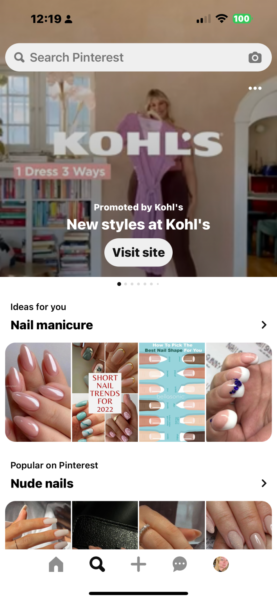
How it works. As an alpha test, the pricing for the ad is not presently available as it may alter before a more widespread release. Pinterest will probably select specific brands and creative types for this feature. Additionally, all ads will employ Pinterest’s maximum-width video format.
Pinterest did not say when the new ad format would be available more broadly.
What Pinterest says.
“We’re constantly looking for ways for advertisers to reach the people who come to Pinterest with commercial intent,” a spokesperson said. “As we continue to build a suite of products to drive performance across the full funnel, we’re exploring a new takeover feature that showcases a brand in a new premium, exclusive placement.”
Keeping up with demand. In recent years, Pinterest has been adjusting to the increasing demand for video content from both advertisers and users. Initially a platform for sharing image-based collections, the company transitioned to video with the introduction of Idea Pins in 2021, which provides creators with a TikTok-like experience. In 2022, the platform allowed marketers to transform their Idea Pins into advertisements. Additionally, Pinterest expanded its short-form video offerings this year by partnering with Condé Nast to produce 160 exclusive videos for the site featuring top brands such as Vogue and Architectural Digest.
In its Q4 earnings call the previous month, Pinterest stated that it had increased its video content supply by 30% compared to the previous quarter. The company noted that providing high-quality content would enhance user engagement, especially among Gen Z.
Why we care. Pinterest has a user base of over 450 million people, and the platform is particularly popular among women and younger demographics. The new advertising format allows advertisers to occupy a prime position on the search page, which is a key feature of the app. Furthermore, Pinterest’s emphasis on high-quality video content aligns with the trend of increased demand for video advertising.
The post Pinterest is experimenting a new premium video ad format appeared first on Search Engine Land.
Courtesy of Search Engine Land: News & Info About SEO, PPC, SEM, Search Engines & Search Marketing
Friday, March 3rd, 2023
LinkedIn has introduced Collaborative Articles, what it is calling an all-new way to share knowledge. I’d highly dispute that, as this really feels like an elevated take on classic roundup articles designed to feature the “wisdom of the crowd.”
Why we care. LinkedIn is touting this as a way to grow your following, boost your reputation and help the community. All those are potentially true – but the big thing to also watch will be “collaboration spam.” I fully expect some people will try to boost their visibility by “collaborating” on as many of these articles as often as possible.
What is a LinkedIn Collaborative Article? Here’s how LinkedIn describes them:
- “Collaborative articles are a new type of article, published by LinkedIn with insights from the LinkedIn community. These articles begin as AI-powered conversation starters, developed with our editorial team, but they aren’t complete without perspectives from experts like you. We’re inviting you to share your own ideas, examples, and personal experiences directly into sections of the articles, so our members can learn from you.”
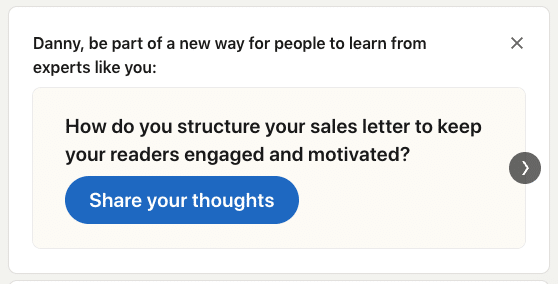
LinkedIn said you can either search or browse for articles. Collaborative articles will also show up in your feed or as pop-up notifications in the coming weeks. Here’s what the notification looks like:
How it works. Let’s walk through an example. You can start by going to any LinkedIn Skill Page, such as Social Media.
Right now, there is post to a Collaborative article on how to measure the ROI of influencer marketing campaigns. Clicking on that post opens up the actual article, How do you measure ROI of your influencer marketing campaigns?
You’ll see a note under the headline: “Help unlock community knowledge with us. Add your insights into this AI-powered collaborative article.” Along with LinkedIn’s explainer about Collaborative articles.
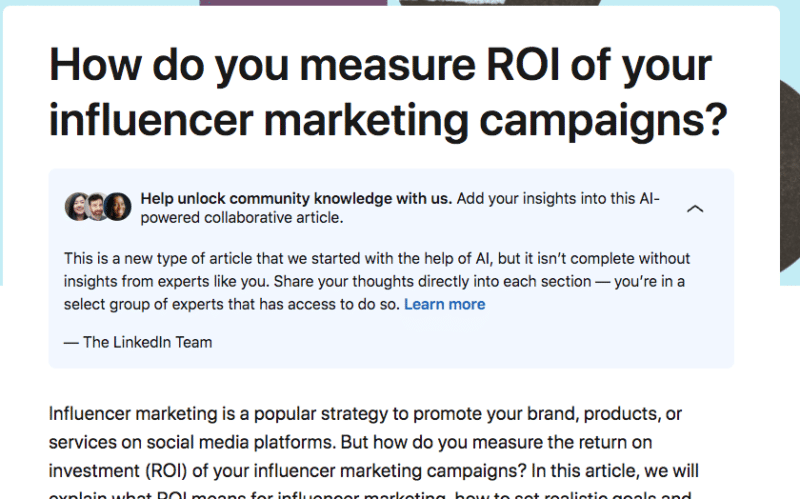
Scroll down in this article and you’ll see multiple prompts to “Share an example”.
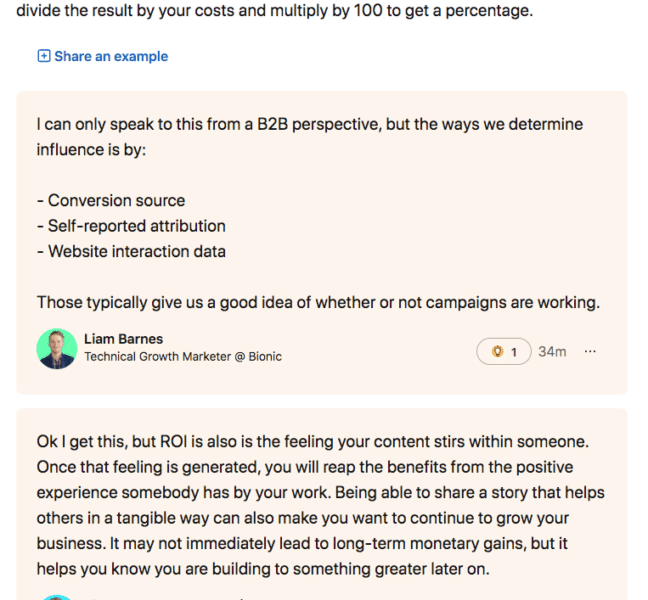
When you click to share an example, a field will appear that gives you some prompts to get you started (“One thing I’ve found…”; “Actually I disagree with…”; “An example I’ve seen…”).
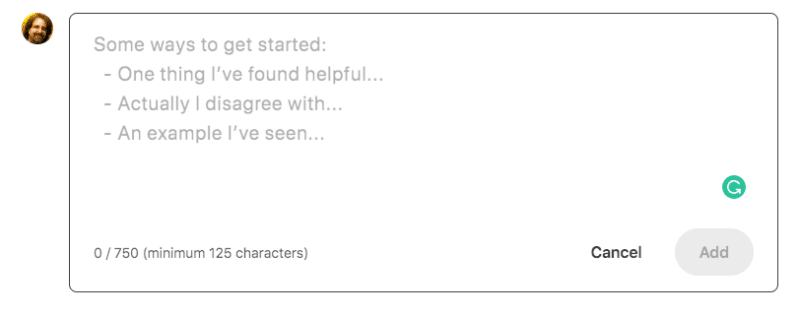
The minimum response is 125 characters. The maximum response is 750 characters.
LinkedIn seems to show only one contribution by default. You’ll have to hit Load more to see other contributions. Presumably, the contribution that gets the most “Insightful” reactions will get that featured slot.
New badge. As a reward for sharing their knowledge, perspectives and experience, LinkedIn members can earn a new Community Top Voice badge for their skill areas. The badge could appear on your LinkedIn profile and next to your article contributions.
Not available to everyone. LinkedIn said it plans to expand access in the coming months. I got an early access invite today, so check your email to see if you might have gotten early access.
Dig deeper. You can read LinkedIn’s announcement: Unlocking nearly 10 billion years worth of knowledge to help you tackle everyday work problems.
The post LinkedIn launches collaborative articles for users to share insights and advice appeared first on Search Engine Land.
Courtesy of Search Engine Land: News & Info About SEO, PPC, SEM, Search Engines & Search Marketing
Thursday, March 2nd, 2023
If you’ve used ChatGPT for any period of time for tasks like creating content for SEO, you’ve likely noticed a few things:
- It’s great and a major time-saver for some tasks.
- It’s much worse than what you already do for other tasks.
- To get the most out of it, you must understand how it works, be willing to refine your prompts (sometimes several times), and QA the platform’s output.
All of these things are true when using ChatGPT for keyword research. To help you navigate the process, let’s explore:
- Keyword research functions ChatGPT is good at (with specific prompts).
- Keyword research functions ChatGPT is not good at.
- How to QA your keyword research output from ChatGPT.
You’ll leave this article with specific keyword research applications for ChatGPT, plus a framework for incorporating the tool into your SEO processes.
How to use ChatGPT for keyword research
An important thing to understand off the top: ChatGPT does not have access to search volume and other metrics the way keyword tools like Google Keyword Planner, Ahrefs and Semrush do.
That said, ChatGPT can be highly useful for several keyword research functions.
Keyword brainstorming and topic ideation
One downside to traditional keyword research tools is that your competitors (and often more authoritative sites than yours) are using the same tools and targeting the same keywords.
As you build out a list of topics and keyword targets, the right ChatGPT prompts can help you find largely untapped pockets of keywords.
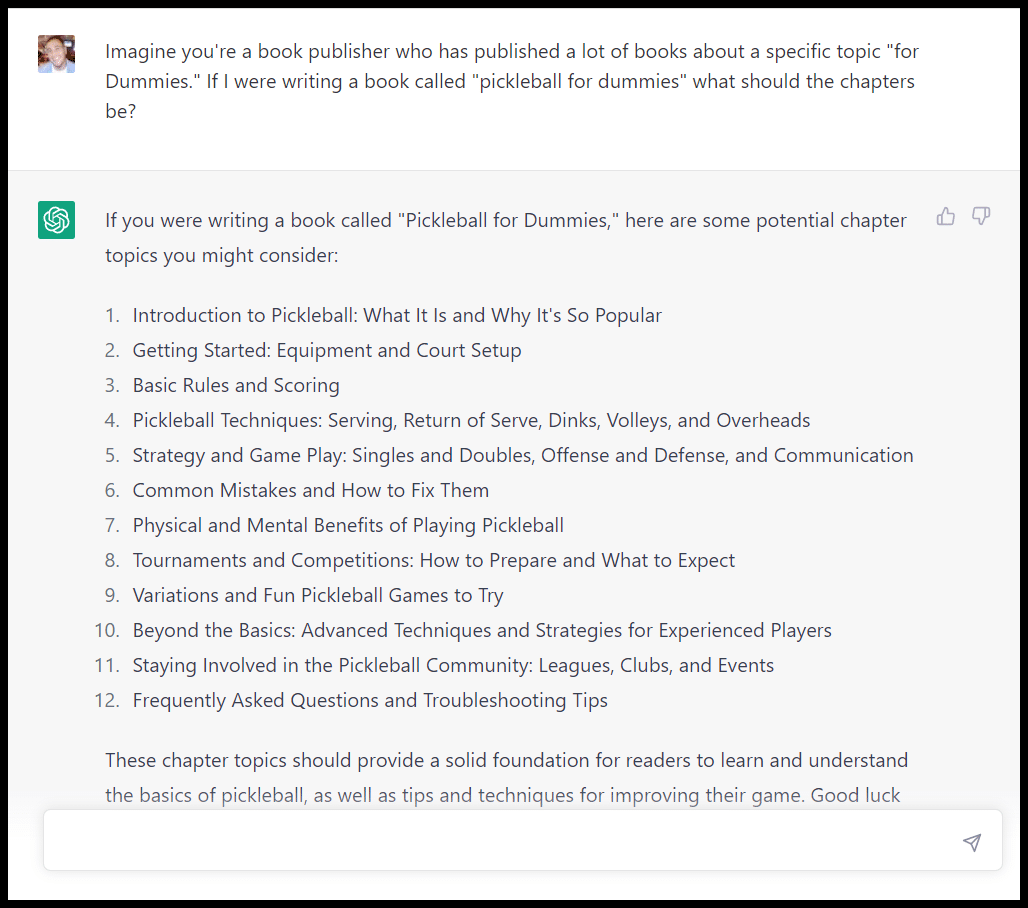
{Topic} for dummies
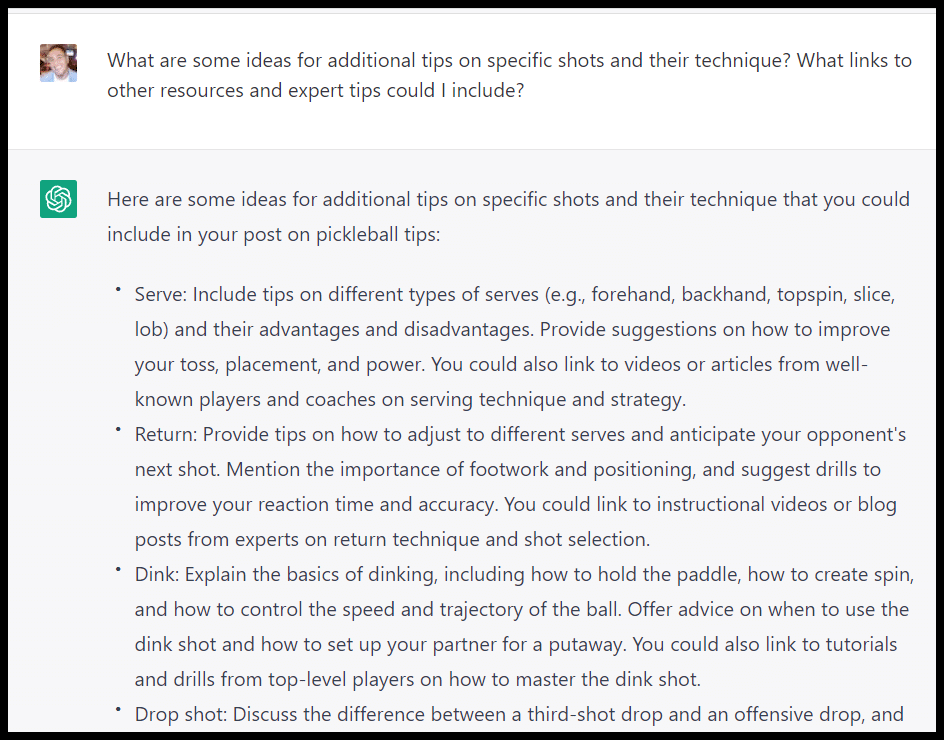
If I were starting a website about pickleball and wanted to get some broad ideas for what to write about, I could use some creative prompts to get ideas from ChatGPT on where to start:
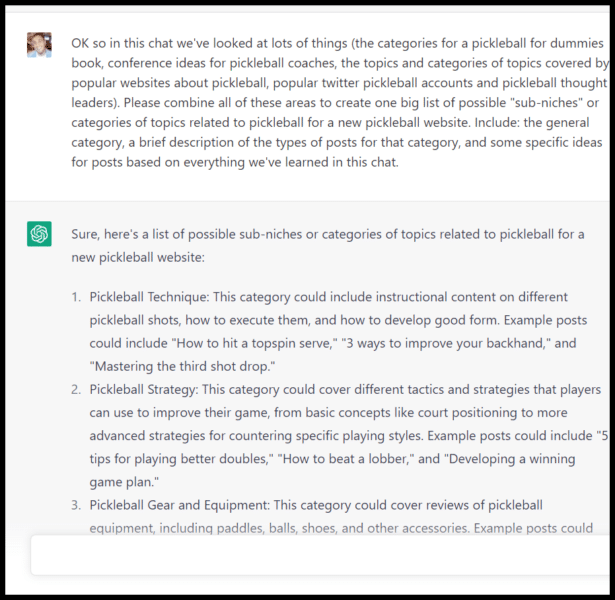
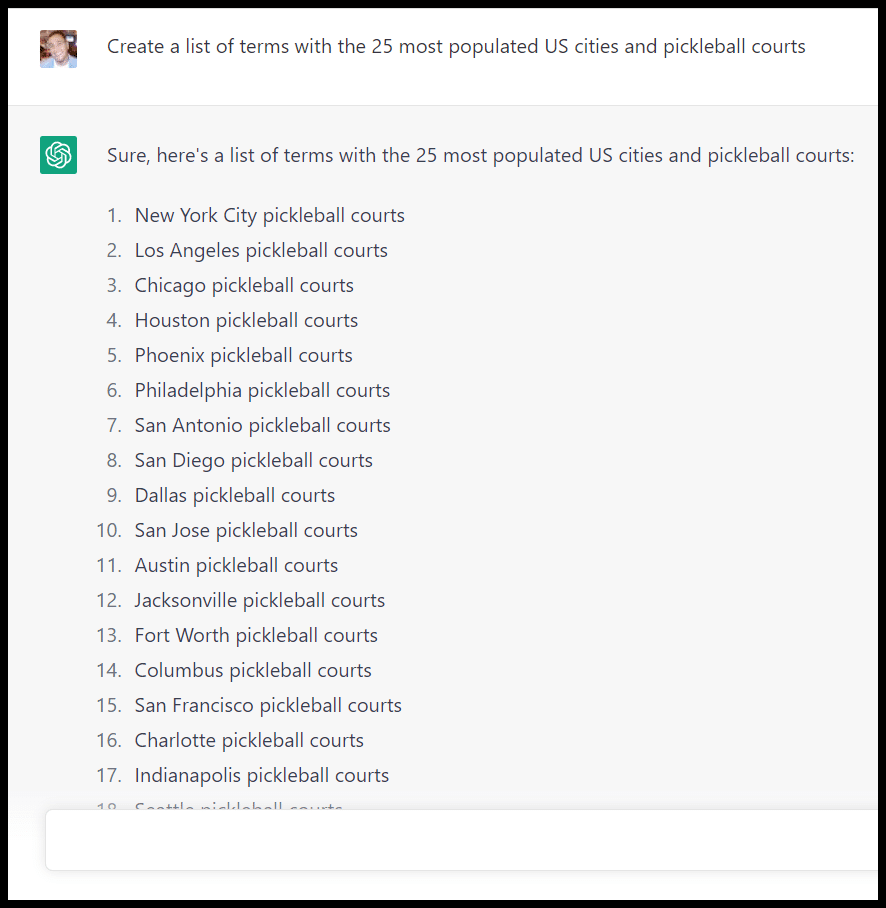
Obviously, this isn’t a list of keywords, but it could function as a general site structure and gives me ideas for keyword clusters to build.
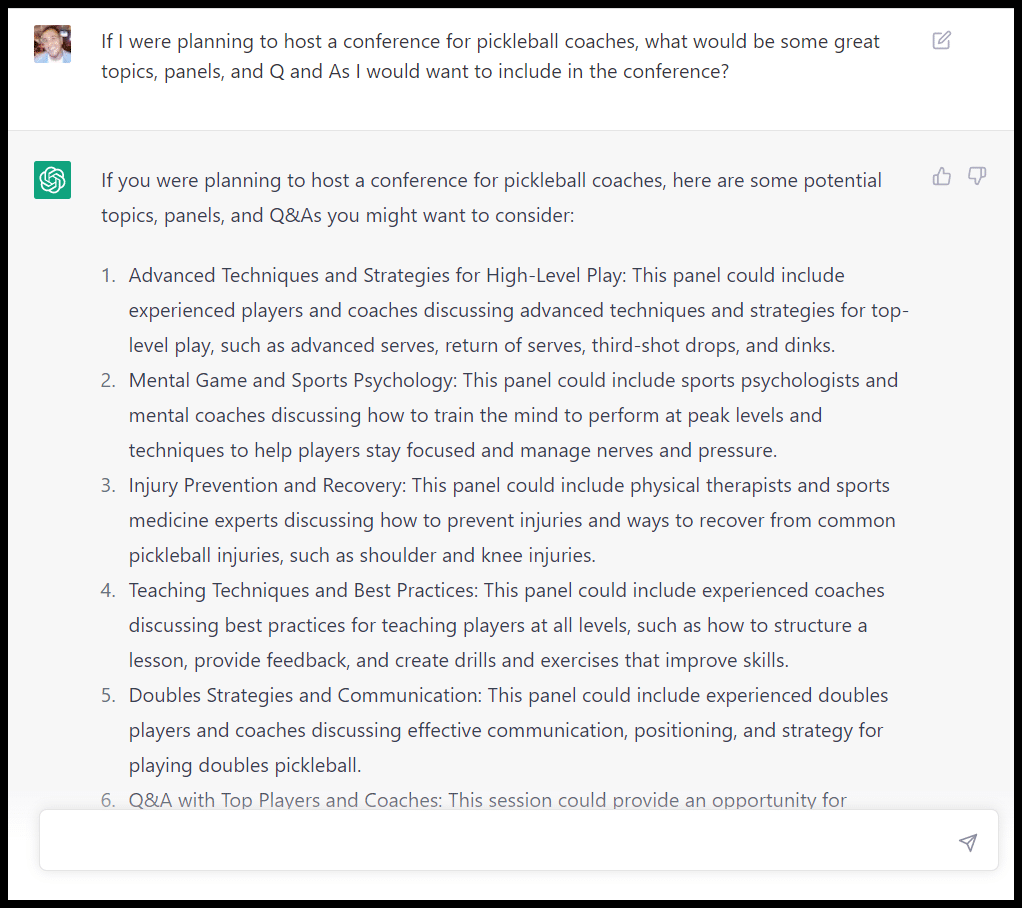
{Topic} conference agendas
Similarly, asking ChatGPT for conference topics targeting a specific persona in my niche provides some interesting ideas:
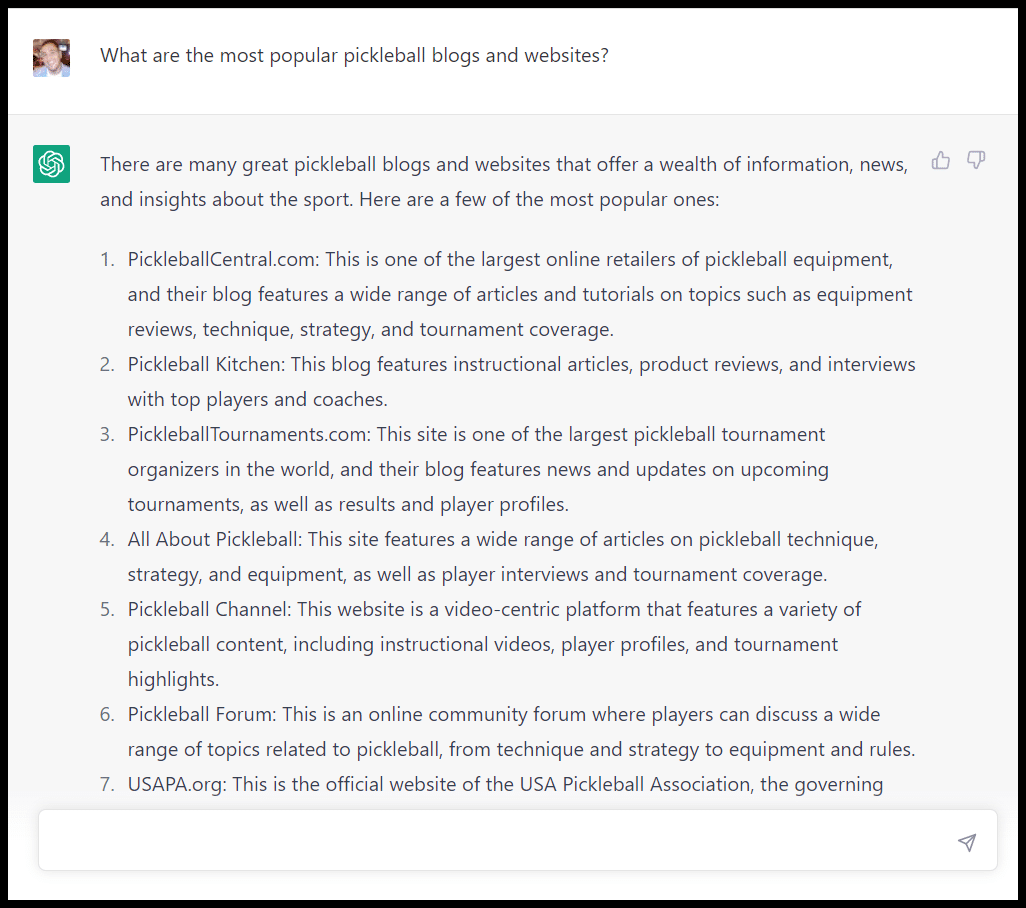
Quick and dirty competitive research
ChatGPT doesn’t have the most recent data and isn’t a comprehensive keyword research tool. But it can help me gain a quick sense of a niche’s competitive landscape and get started with high-level ideas:
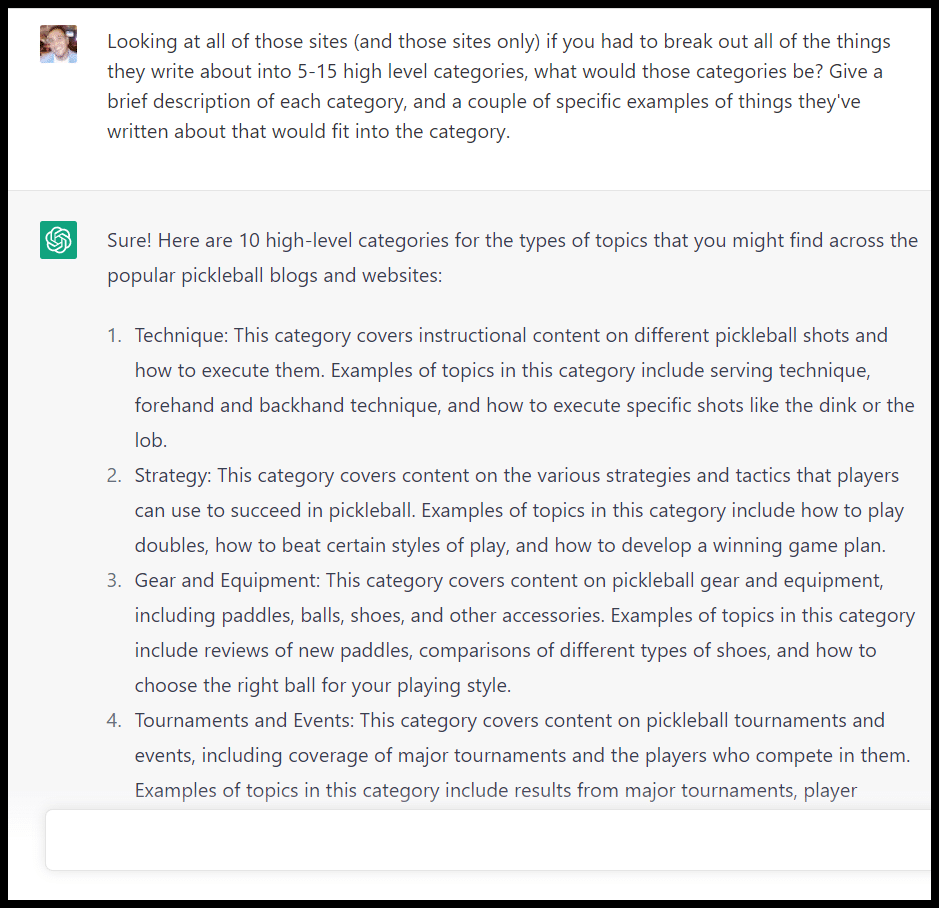
Plus, more ideas for different topics and sub-niche:
Social media and influencer research
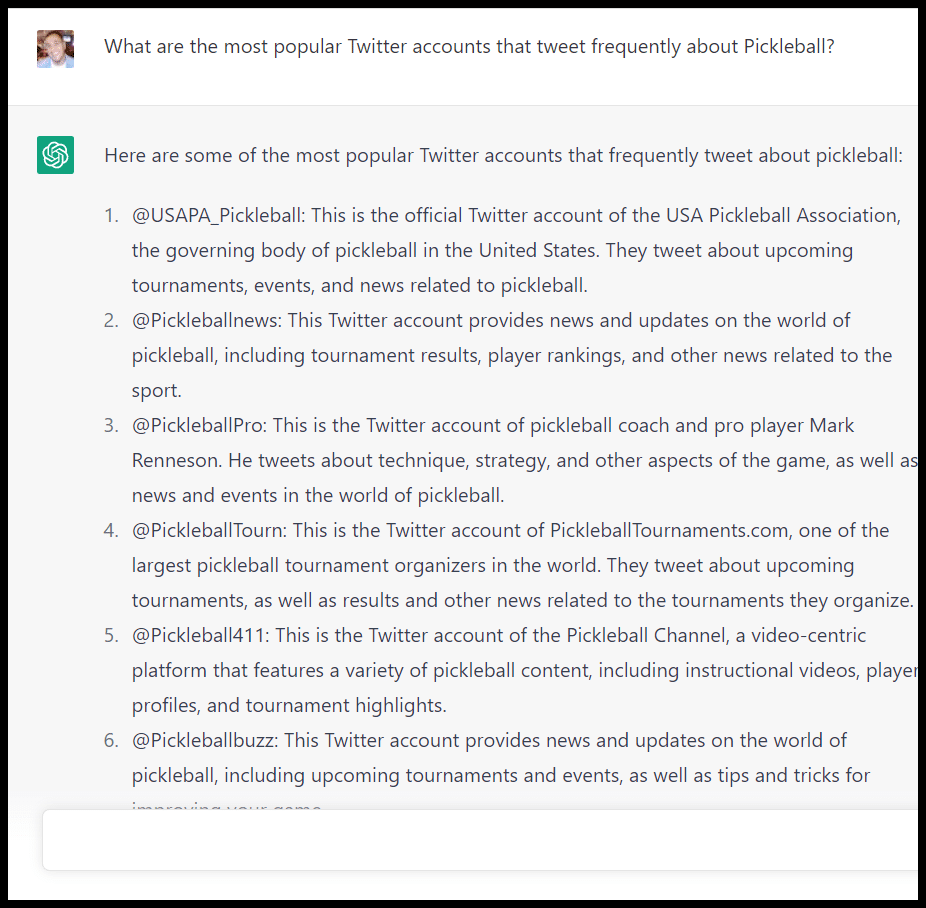
I can continue to get a lay of the land in this niche by looking at social media accounts on platforms like Twitter:
Though keep in mind this data is from the GPT-3 training set, which isn’t current. Twitter also paused access as of December 4, 2022:
Not surprising, as I just learned that OpenAI had access to Twitter database for training. I put that on pause for now.
Need to understand more about governance structure & revenue plans going forward.
OpenAI was started as open-source & non-profit. Neither are still true.
— Elon Musk (@elonmusk) December 4, 2022
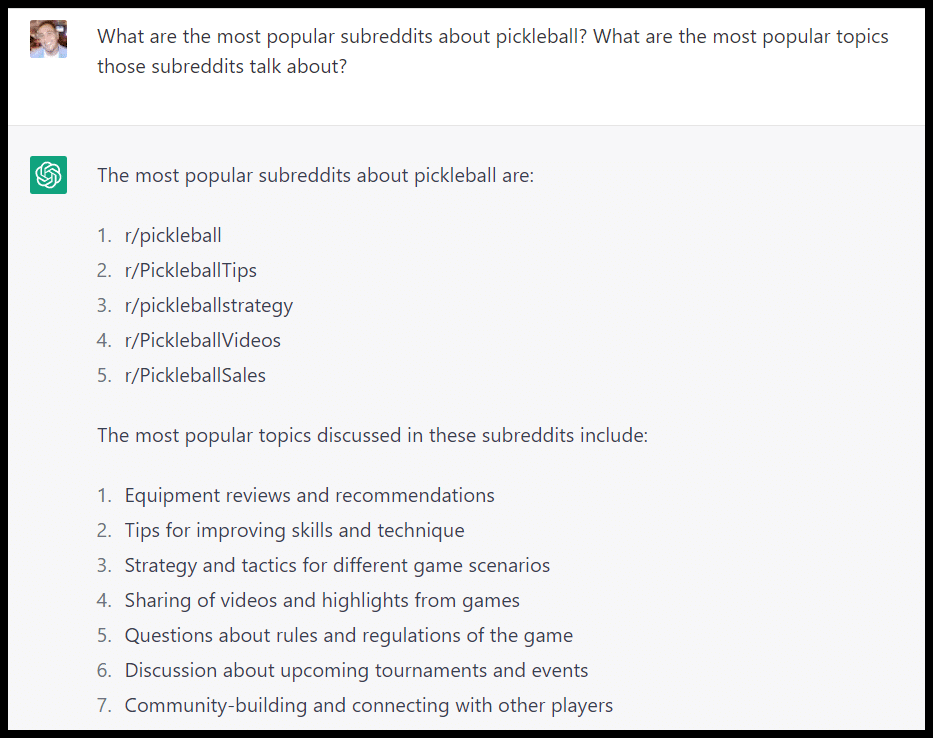
I can also look at Reddit:
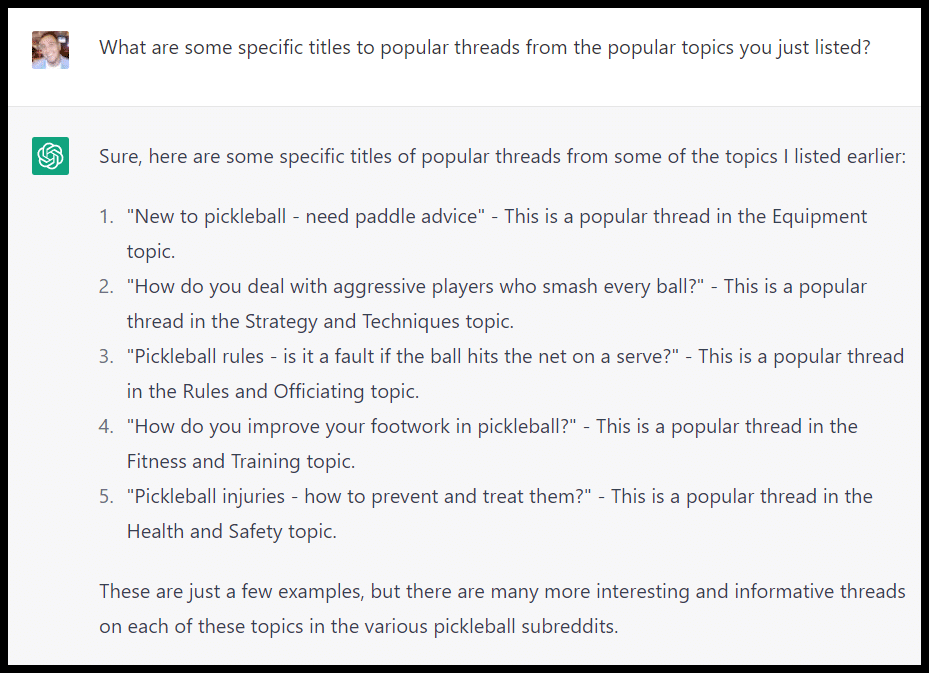
This can be even more useful if you dive a little deeper:
The output is great as specific angles for articles or FAQs.
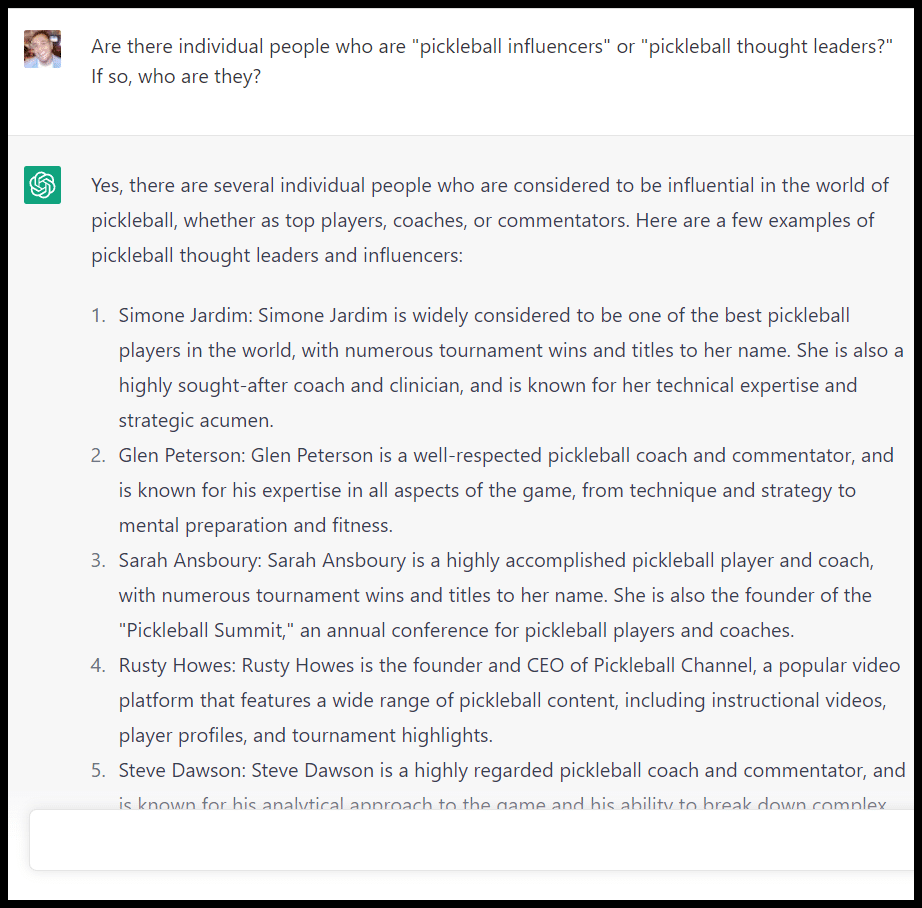
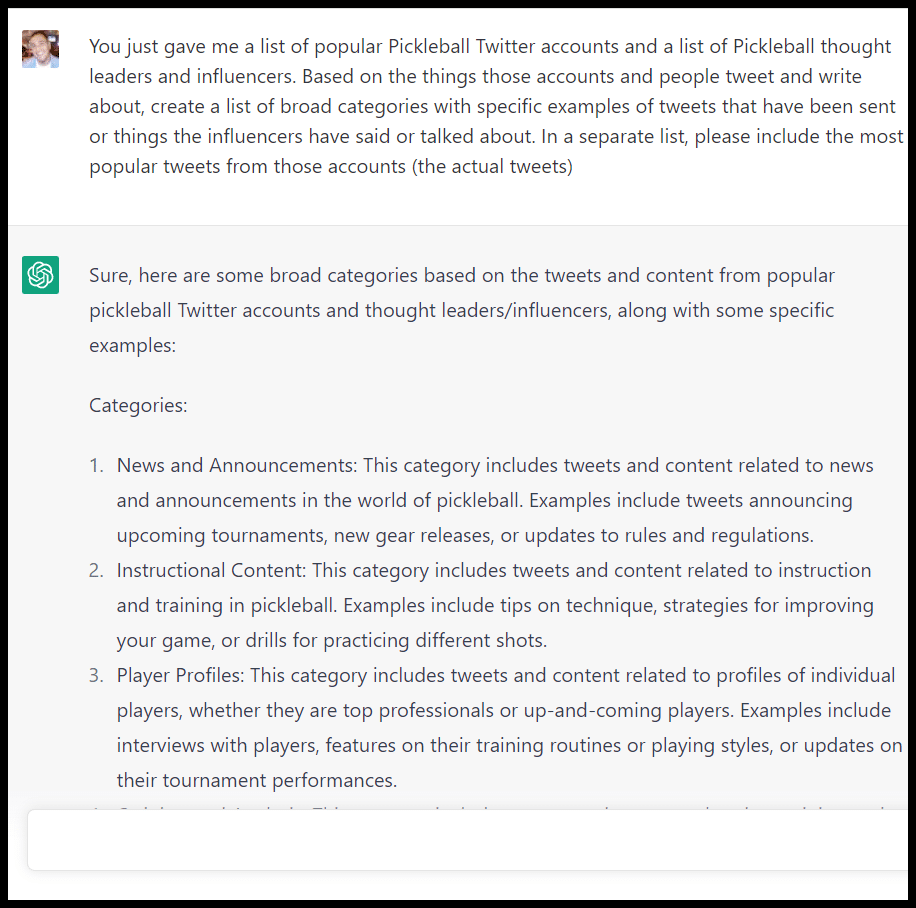
You can also get a quick view of influencers and thought leaders:
Then I can dive into more topic ideas and learn the topics they tweet and talk about:
Next, I can start to pull this all together by combining prompts and asking ChatGPT to give me a summary of its research:
I’ll be honest: I run a lot of ChatGPT prompts, and some of the output is infuriatingly bad.
However, if you hired a VA to spend a few hours researching a niche and asked them to give some high-level topic and category ideas for a new site, it would be acceptable if they came back with this.
Brainstorm actionable keywords
We now have interesting high-level category and “sub-niche” data. So how do we convert that into an actual list of target keywords?
ChatGPT can’t give you estimated search volume and keyword difficulty data. While they aren’t perfect metrics, you can waste time and resources if you’re “flying blind.”
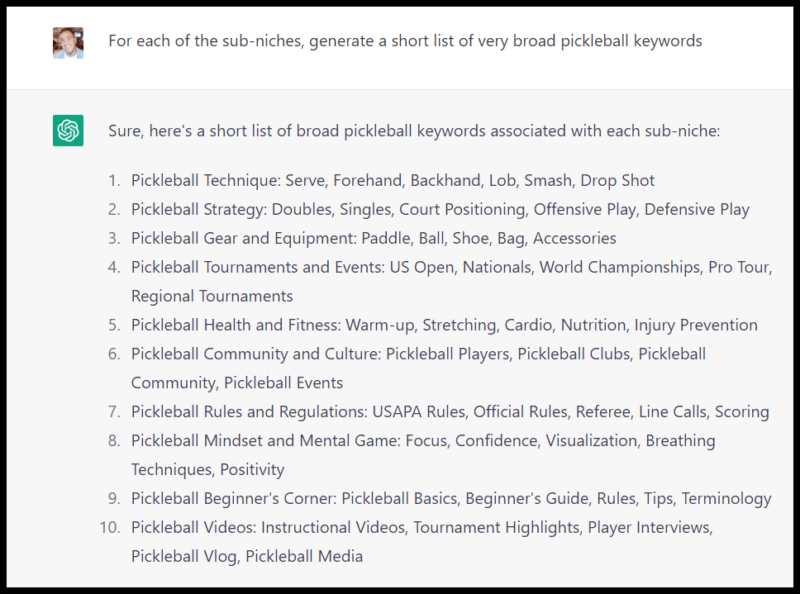
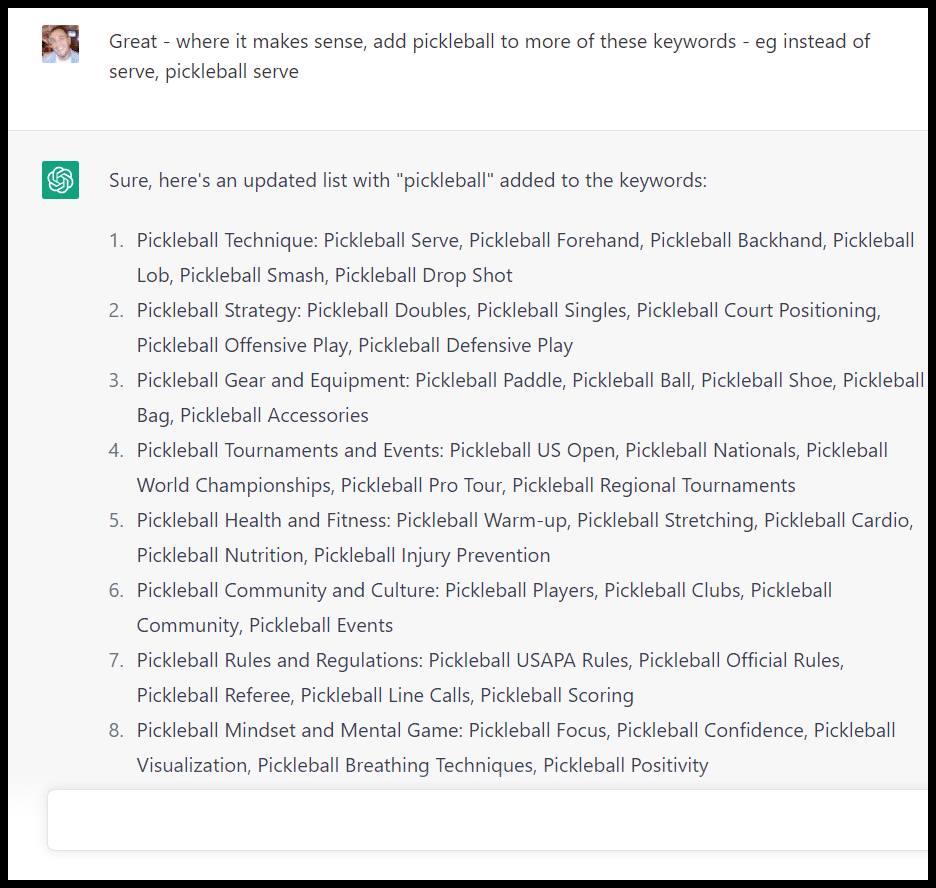
We can use ChatGPT to prepare a list of “seed keywords” to run against our favorite keyword tool:
Depending on what you get back, you can then refine:
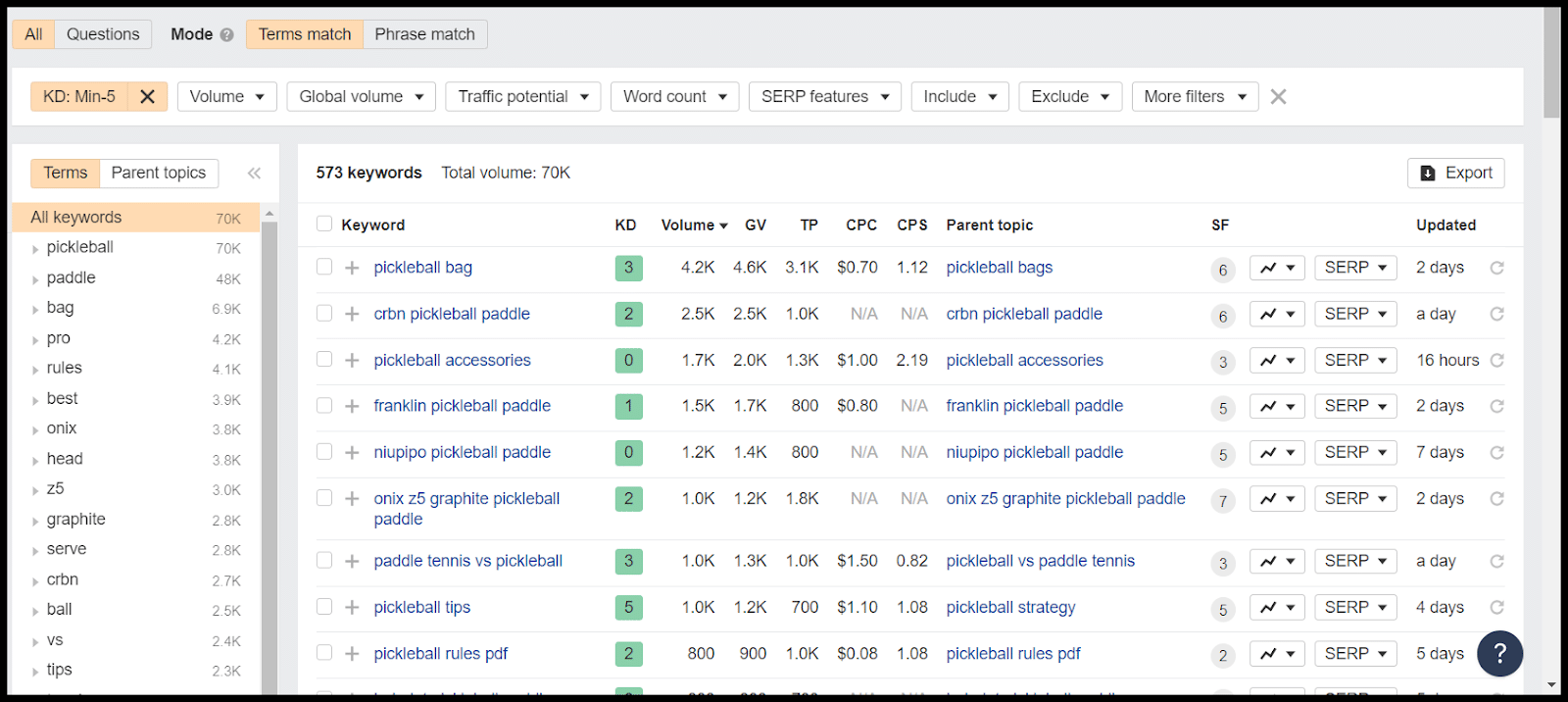
Next, I used a prompt to clean up the list (“Perfect, take these keywords and convert them into a list of just the keywords that I can easily copy and paste.”) and dropped them all into Ahrefs, looked at matching terms, and filtered for terms with a keyword difficulty of 5 or lower for my new site:
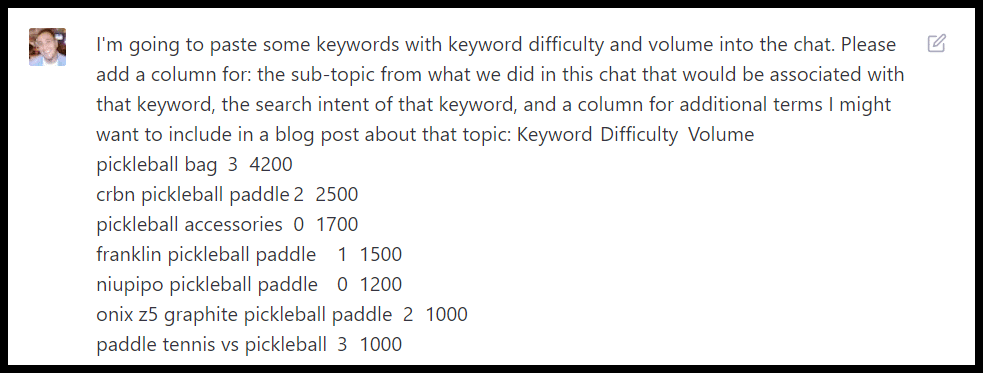
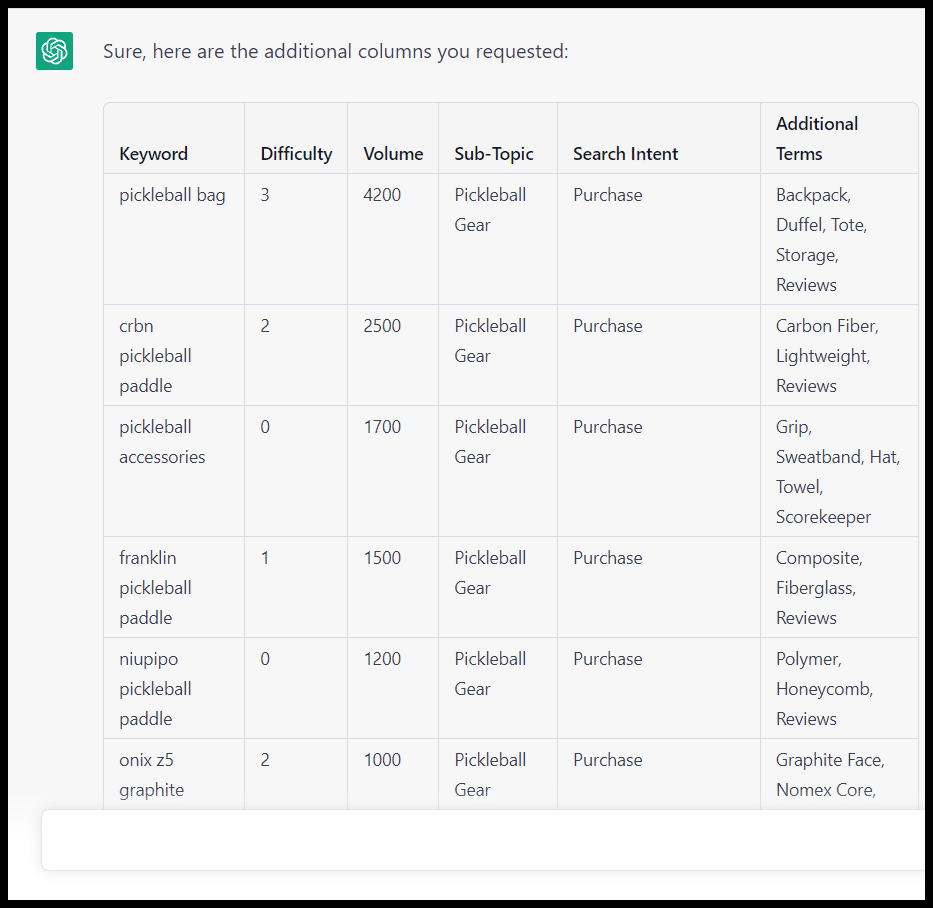
Now that I have some terms with difficulty and search volume, I can go back to ChatGPT to help add some information for these terms:
The output is pretty impressive:
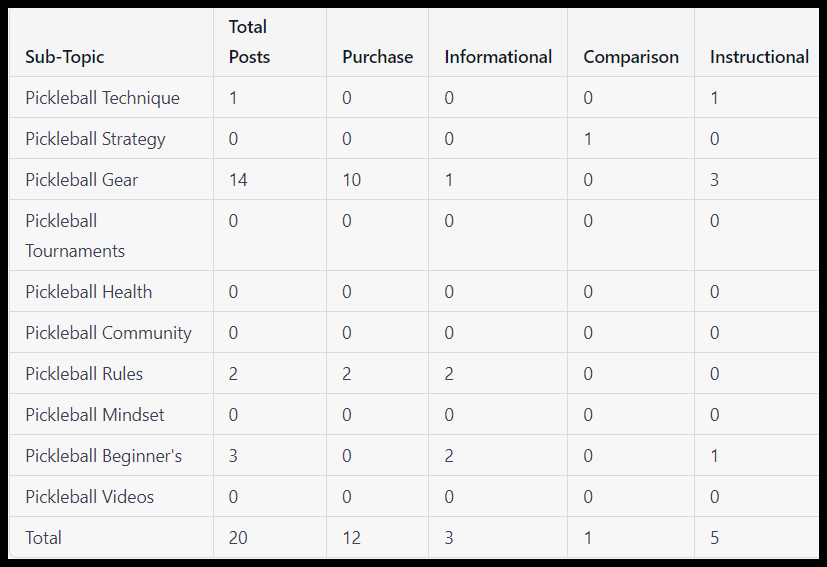
Now, I can also get some other interesting keyword data on my new list of terms by asking, “Can you tell me how many posts are in each sub-topic and how many fit into each level of search intent?”
Many times you may balance your content output across categories, business lines and support for different tools or products. This is a handy way to sum up that information quickly.
Keyword list generation, expansion and cleanup
Finding specific keywords to target and appending different modifiers to your terms to grow your list are critical aspects of keyword research.
A common application is to generate a list of geo-modifiers and marry those with a target term:
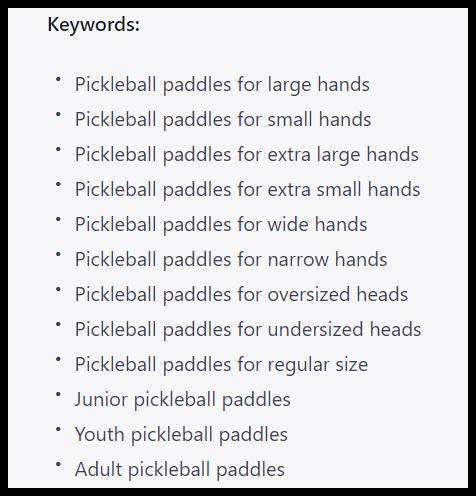
You can also get a list of size modifiers and apply that to different terms:
The output has some interesting ideas:
If you have some seed lists of modifiers, the mash-up process can be even more straightforward here.
Page-level keyword research
Many tools will create content briefs and grades for your content based primarily on what’s currently ranking well in search engines. I use multiple of these tools in my day-to-day work, and they can be pretty expensive.
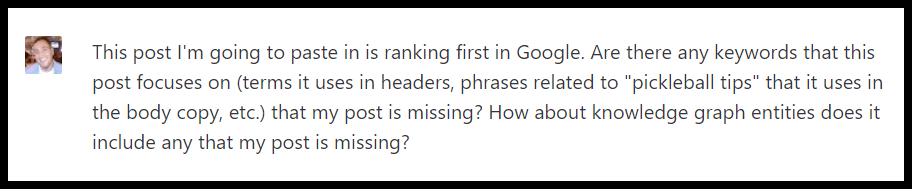
We can use ChatGPT to compare our article to whatever is ranking for specific terms. Again, it is not a native SEO tool, so data will differ from what those tools use.
Unfortunately, ChatGPT doesn’t crawl URLs (yet), so you have to copy and paste both your article and the article ranking first into the chat to have it analyze them. This can be a pain since the character limit is 2,000 words.
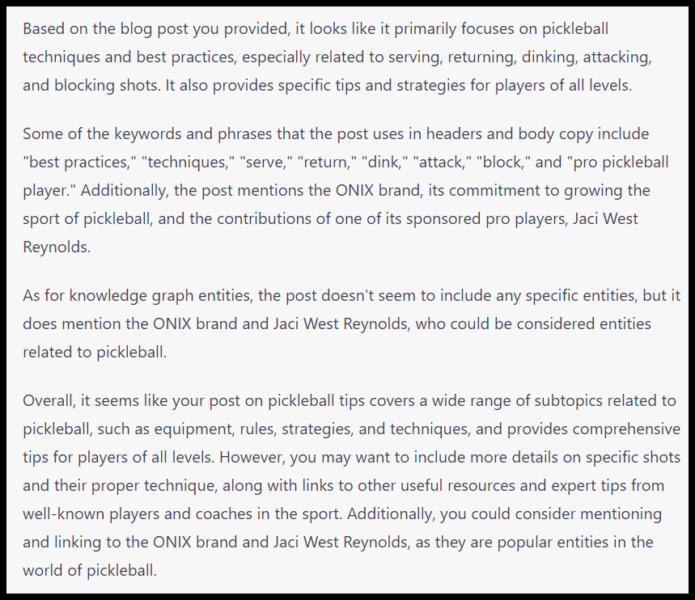
And here is the analysis:
And you can get more specific advice with a follow-up prompt:
Take advantage of ChatGPT’s ability to remember previous prompts within a specific chat.
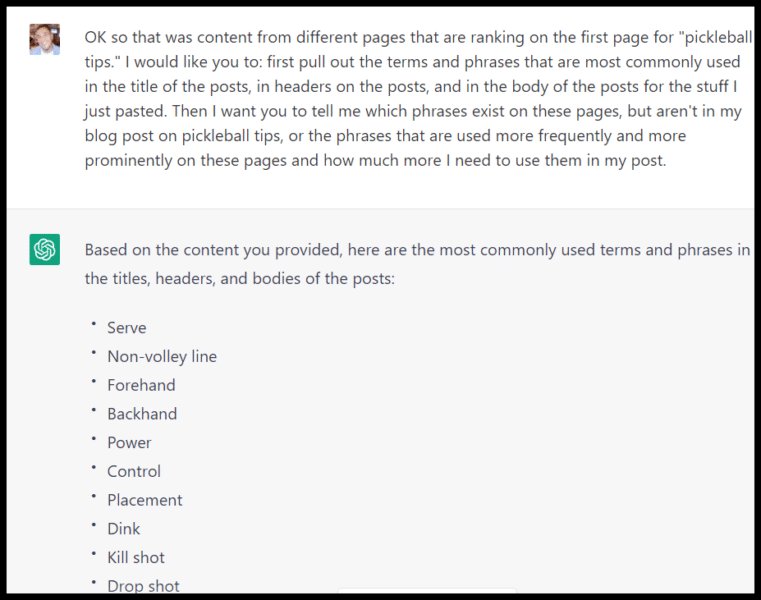
Here, I could run through multiple articles ranking on the first page for this search term, ask ChatGPT to pull out themes and common terms used in the headers for each, and then surface the most popular phrases across the articles:
This is pretty clunky to do manually since some articles or pages will exceed the 2,000-character limit. ChatGPT will try answering you before the content is all posted.
As you can see above, it’s not exactly answering my question. The tools that are specifically designed for this are undoubtedly much slicker.
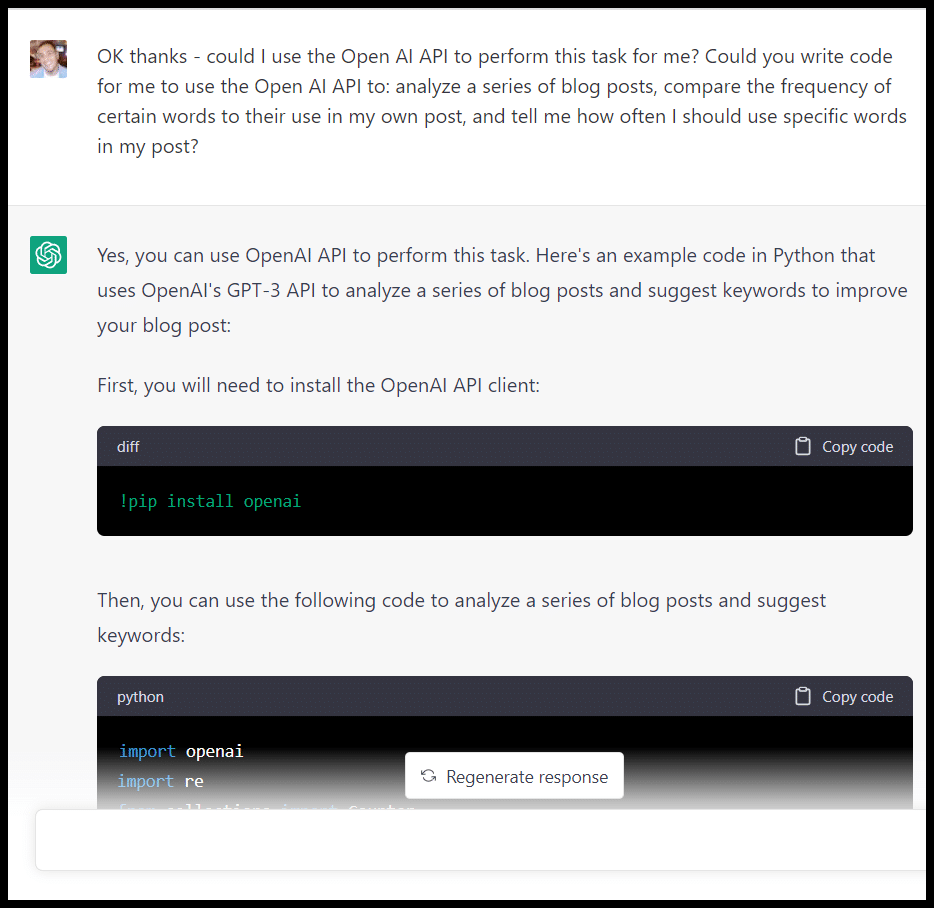
For a smoother and more scalable experience in prompt-heavy tasks, use the Open AI API. Have ChatGPT generate the code for you:
ChatGPT prompts for keyword research APIs
Reminder: Proceed cautiously when dealing with programmatic APIs that cost money or credits. QA everything the tool spits out.
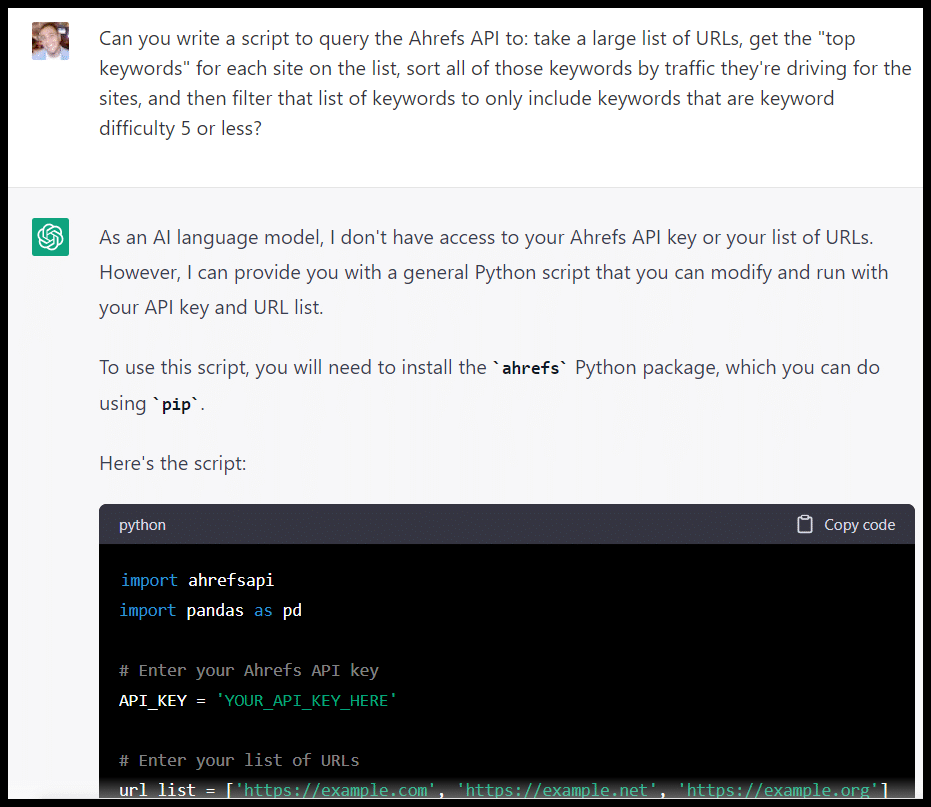
Another keyword research function for ChatGPT is to help SEOs interface with different keyword tool APIs:
For my new pickleball site, I could grab an extensive list of low domain authority sites ranking for some pickleball terms and then run them through this script.
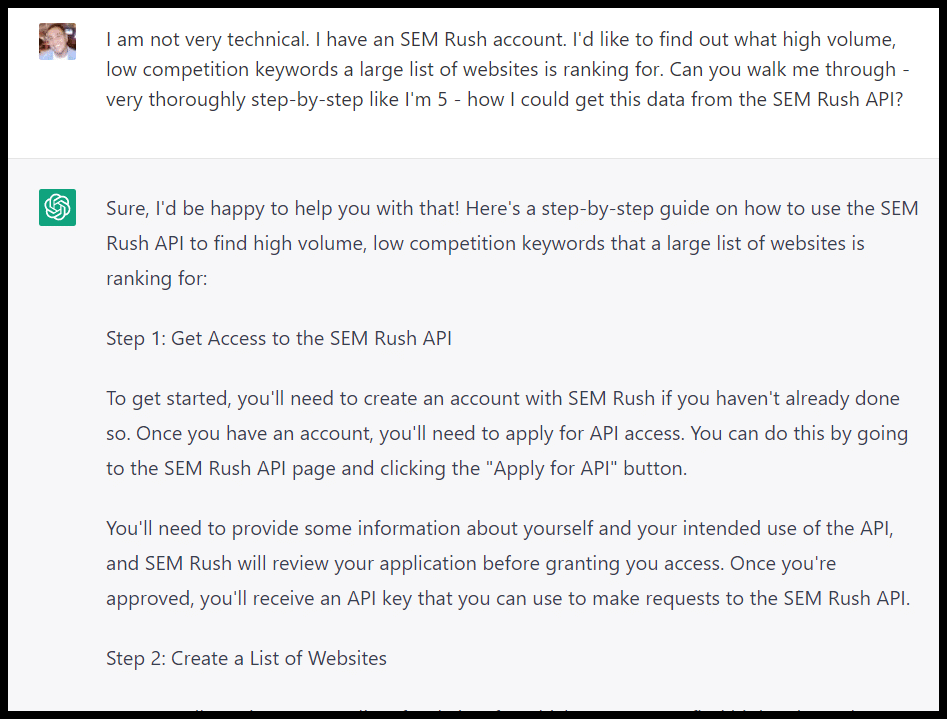
If you’re not very technical, you can get step-by-step instructions and ask the tool how to complete a generic task:
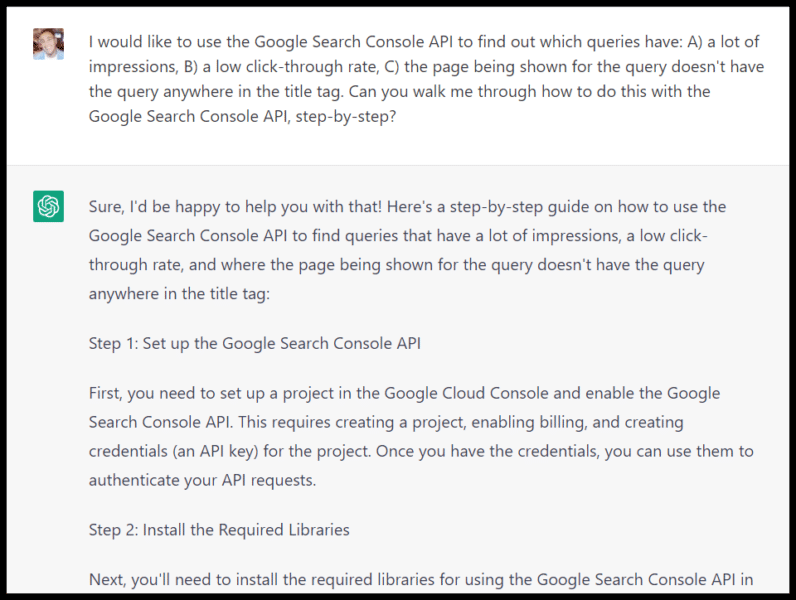
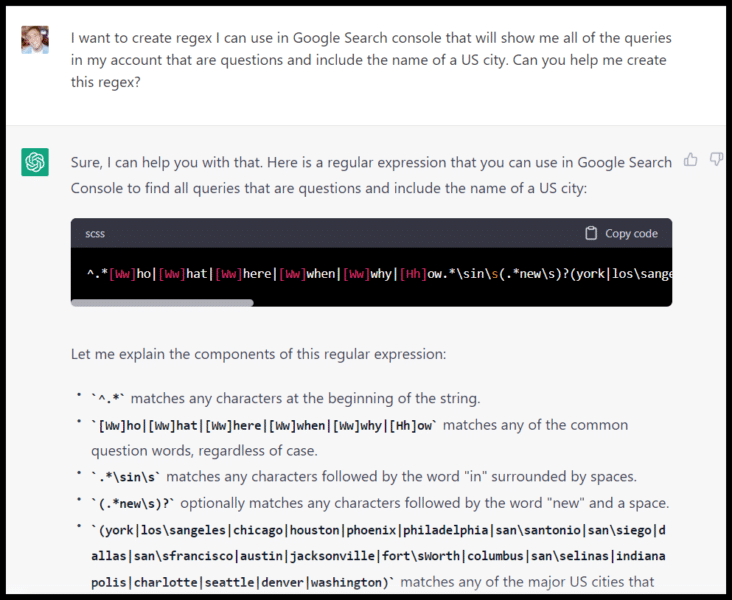
Not relevant for my new pickleball site, perhaps, but if I want to do some keyword research on my data, I can get ChatGPT’s help with the Google Search Console API to find search queries that may need their page or article:
The GSC API isn’t the only way to get keyword data using ChatGPT.
ChatGPT keyword research regular expressions
Like the GSC API, using regular expressions (regex) within Search Console can be a great way to unearth keyword targeting opportunities:
Build your own tools
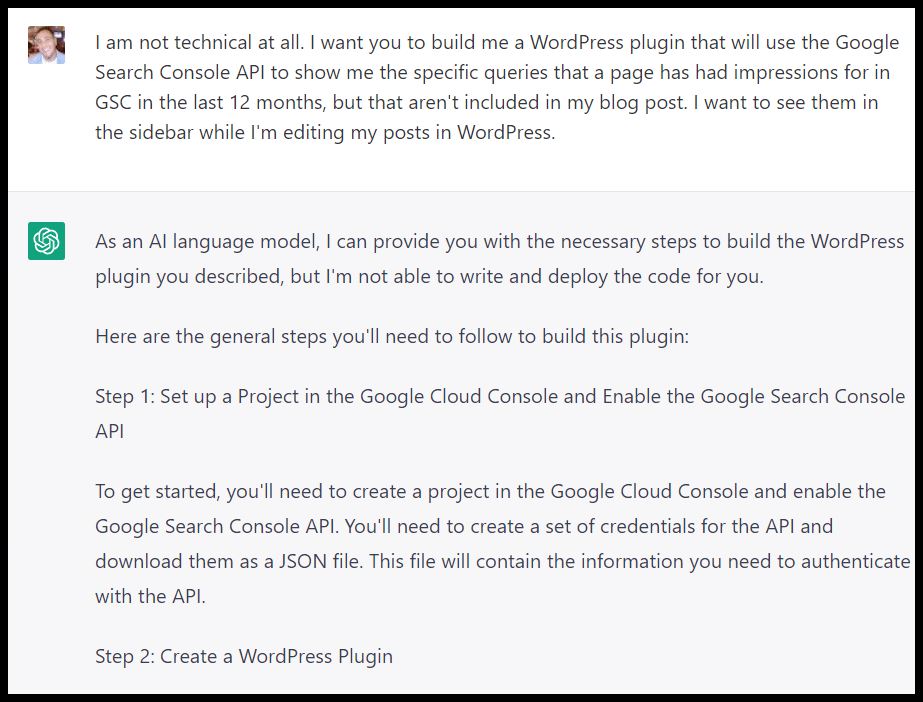
ChatGPT can instruct you on how to build specific tools for keyword research. (Again, always QA and proceed with caution!)
ChatGPT keyword research QA tips
The examples above demonstrate how valuable ChatGPT can be for keyword research. The price is free to $20 a month, so it is worth trying out.
In my experience, the platform tends to fall flat in three core areas of keyword research:
- Not search-specific: ChatGPT is a native keyword research tool. It does not have direct access to keyword data and can’t perform key functions for keyword research.
- Confident but wrong: The platform occasionally provides answers emphatically that aren’t true, delivering data presented as a fact but is flat-out wrong.
- Broken code: ChatGPT’s code doesn’t always work. If you rely on it to interface with an API or build a tool to automate certain aspects of your process, assume there will be bugs and issues.
Here are a few specific suggestions to help:
- Ensure you use dev environments and sandboxes when working with ChatGPT code or instructions.
- Check any keyword suggestions against search and competition data to confirm you’re not spinning your wheels on subjects that don’t make sense for your site and your bandwidth.
- If you’re asking the tool to analyze something, take the output with a grain of salt. Remember that ChatGPT could be wrong, cannot crawl URLs and has an outdated data set.
Broader ChatGPT keyword research strategies
Caveats aside, SEOs will likely find useful keyword research applications with ChatGPT. Ask yourself these questions to determine how to use the platform best:
- How can you leverage the ChatGPT API?
- If the chat character limit keeps you down or you have a larger-scale keyword or topic ideation task, you can use the API for various functions.
- Are there other applications or APIs you want to use but can’t dedicate the time and energy to? What about a mash-up of multiple APIs (marrying data from e.g., GSC, Ahrefs or Semush)?
- What are your more tedious and time-intensive keyword research tasks? Can ChatGPT help with these?
Think of ChatGPT as a virtual assistant. Understand that you’re ultimately responsible for the implementation of any data or code it generates. Consider the tasks you need to complete, the things it’s likely capable of and try them out when it makes sense.
The post How to use ChatGPT for keyword research (with actual prompts) appeared first on Search Engine Land.
Courtesy of Search Engine Land: News & Info About SEO, PPC, SEM, Search Engines & Search Marketing
Thursday, March 2nd, 2023
In the coming months, Google Analytics 4 audience builder will be integrated into Google Ads, making it easier to create and apply audiences from Google Analytics 4 to Google Ads campaigns.
To enable this feature, Google Ads is introducing a new cross-product access management model. This model allows a Google Analytics 4 property Admin to grant explicit permissions to users in a linked Google Ads account. The Google Analytics admin can assign roles to the different permissions available in Google Ads, such as Administrator, Standard, or Read only. These roles will determine access to Analytics features embedded in Google Ads, including the ability to create Analytics audiences directly in Google Ads.
Levels of user access in Google Analytics. Google Analytics offers four levels of user access: Account Owner, Property User, View User, and Analyst. Each level has different permissions, ranging from full control to read-only access.
- Account Owner: The Account Owner has full control over the Google Analytics account, including the ability to manage users, create properties and views, and link AdWords and other accounts. There can only be one Account Owner per Google Analytics account.
- Property User: The Property User has access to a specific property, allowing them to view and manage data for that property. They can create views, manage filters, and link AdWords and other accounts to the property. Property Users can also manage users for the property, but they cannot add or remove other Property Users.
- View User: The View User has access to a specific view within a property. They can view and manage data for that view, including creating custom reports and setting up goals. View Users cannot create or delete views or modify filters.
- Analyst: The Analyst has read-only access to a specific view within a property. They can view data, but they cannot make any changes to the account or data.
Managing user access in Google Analytics. To manage user access in Google Analytics, follow these steps:
- Sign in to your Google Analytics account and navigate to the Admin section.
- Click on the Account, Property, or View that you want to manage.
- Click on User Management under the Account, Property, or View column.
- Enter the email address of the user you want to add or remove.
- Select the level of access you want to grant, ranging from Account Owner to Analyst.
- Click Add or Remove to add or remove a user.
- Click Notify this user by email to notify the user of the changes.
Best practices for user access management in Google Analytics. Here are some best practices for managing user access in Google Analytics:
- Limit access to sensitive data: Only grant access to users who need it. This includes limiting access to personal or sensitive data, such as user IP addresses or financial information.
- Use Google groups: Create Google Groups to manage access to your Google Analytics account. This makes it easier to manage access and ensure that the right users have access to the right data.
- Use two-factor authentication: Enable two-factor authentication for all users to ensure that only authorized users can access your Google Analytics data.
- Audit user access regularly: Regularly review user access to ensure that users have the appropriate level of access and that no unauthorized users have access to your data.
Dig deeper. Read the announcement from Google here.
Why we care. Managing user access in Google Analytics critical to the security and accuracy of your analytics data. Proper user access management ensures that only authorized users have access to their data and limits access to sensitive information.
Additionally, with the upcoming integration of Google Analytics 4 audience builder in Google Ads, mastering user access management will be important for creating and applying audiences from Google Analytics to Google Ads campaigns.
The post New Analytics user access management changes in Google Ads appeared first on Search Engine Land.
Courtesy of Search Engine Land: News & Info About SEO, PPC, SEM, Search Engines & Search Marketing
Thursday, March 2nd, 2023
TikTok faces further setbacks as the US House Foreign Affairs Committee grants President Joe Biden authority to prohibit the Chinese-owned app, depending on his evaluation of the situation, amidst ongoing security concerns regarding its possible links to the CCP.
The US government has already declared a complete prohibition of TikTok on all government-owned gadgets, following comparable measures in more than 30 American states. Likewise, European and Canadian authorities have enforced a similar ban on official devices, as tensions between China and Western nations persist, partly due to the Ukraine conflict.
What TikTok says. TikTok responded with this comment on Twitter.
Not so fast. Although today’s declaration is not a complete endorsement for Biden to enforce a ban on the app, it signifies that the US Senate’s approval is still necessary before such a move can be executed. Nonetheless, it is another stride towards the impending phase, which seems more likely to result in a TikTok prohibition or at the very least, a substantial shift in direction for the app.
In 2020, President Donald Trump signed an executive order banning TikTok from the US, citing an investigation in 2019 over national security concerns. TikTok’s response: the order was issued without any due process.
Why we care. A TikTok ban would eliminate a significant platform for brands and digital marketers alike. TikTok has emerged as a popular social media platform, particularly among younger demographics, with over one billion active users worldwide. It has become a go-to platform for influencer marketing and creative advertising campaigns, which have proven successful for brands.
If the app were to be banned, advertisers would lose access to this large and engaged audience, which could impact their reach, engagement, and overall return on investment. Advertisers would need to look for alternative platforms to promote their products and services, which may not have the same level of popularity or effectiveness as TikTok. A TikTok ban would require advertisers to rethink their digital marketing strategies and adjust their budgets accordingly.
The post Biden approved to decide fate of TikTok as US ban nears appeared first on Search Engine Land.
Courtesy of Search Engine Land: News & Info About SEO, PPC, SEM, Search Engines & Search Marketing