Archive for the ‘seo news’ Category
Thursday, March 23rd, 2023
In a wildly dramatic and painful-to-watch session, TikTok CEO Shou Zi Chew testified before Congress in a hearing that will determine the future of the social media app.
Just as US user adoption hit 150 million, the CEO faced tough questions from out-of-touch congresspeople about safety, privacy, selling data, and security concerns. Here’s what happened:
“Mr. Chew, you are here because the American people need the truth about the threat TikTok poses to our national and personal security,” Committee Chair Cathy McMorris Rodgers, a Republican, said in her opening statement. “TikTok has repeatedly chosen a path for more control, more surveillance and more manipulation.”
Privacy and security. Let’s remember there is no evidence that TikTok has shared U.S. user data with the Chinese government, but policymakers fear that the Chinese government could compel the company to do so. Chew says legacy U.S. data in Virginia and Singapore servers are being deleted. “We expect that to be complete this year. When that is done, all protected U.S. data will be under the protection of U.S. law.”
Chew says the company has created “what amounts to a firewall that seals off protected U.S. user data from unauthorized foreign access.” “American data stored on American soil by an American company overseen by American personnel.”
Chew made 4 commitments to U.S. lawmakers:
- Prioritizing safety for young users
- Firewall protection for U.S. user data
- The app will remain a place for free expression & ‘will not be manipulated by any government’
- Transparency
Surveillance concerns. When asked about surveillance, Rep. Cathy McMorris Rodgers (R-WA)”Can you say with 100% percent certainty that neither ByteDance nor TikTok employees can target…Americans with…surveillance techniques?” Chew said, “I disagree with the characterization of surveillance.”
While Chew does not deny employees at TikTok’s parent company in China have access to Americans’ sensitive user data, so does every other social media platform. Chew says he believes that TikTok doesn’t collect any more data than any other social media platform.
Rep. Richard Hudson (R-NC) asks TikTok CEO Shou Chew: “Does TikTok access the home WiFi network?”
After a five-minute rant from Rep. Kat Cammack (R-FL), Chew asked to respond to questions and comments but was told, “No. We’re going to move on.”
Save our children. Rep. Gus Bilirakis (R-FL) showed a compilation of TikTok videos encouraging suicide and death and told Chew, “Your technology is literally leading to death.” After the video, Chew asked to say a word about the death but was promptly cut off mid-sentence in what seemed more like a show than an effort to extract any meaningful information.
Rep. Castor (R-FL) blamed the CEO for people’s algorithms causing them to commit suicide. She also reminded us that Facebook and Instagram sat in the same seats and told congress they knew of the issues and did nothing to prevent kids from self-harm.
Here’s what Twitter thought. An overwhelming majority of people watching and live Tweeting the hearing are noticing that congress isn’t letting Chew respond to questions and accusations.
I just want Shou Zi Chew ( TikTok CEO ) to say to out of touch congress “what’s killed more people – TikTok, or guns?” #TikTokTrial
— HM (@HMTV92) March 23, 2023
Got a hold of the script for the TikTok hearing.
Politicians: <Insert Rant here try to avoid citing your sources>. "Yes or no?"
Don't let him answer any questions.
Politicians: Stop being evasive!
All theater, folks.
— Danny Goodwin (@MrDannyGoodwin) March 23, 2023
They're blaming the TikTok CEO for body dissatisfaction, anxiety and depression, like our country doesn't give us a mass shooting every other day, economic uncertainty, elected officials taking us back to Jim Crow and trash-ass "food" on our shelves! The hypocrisy is INFURIATING!
— Marlissa Collier | iThink  iSpeak
  (@iDrankPolitics) March 23, 2023
Watching the TikTok CEO testify before congress is wild. They're just allowed to accuse and say what they want and then not let him respond and move on to the next person. What's the point?
— Hallie M. (@pockkets_) March 23, 2023
Tiktok CEO is being put through a kangaroo court. I'll be one to admit that the app is addictive and social media in general is harmful, but being constantly interrupted because the answer to these geriatric cuck's questions is more complicated than "yes" or "no" is embarassing
— Mr. Shazboto (@MrShazboto) March 23, 2023
Congress isn't even giving the TikTok CEO a chance to speak. They make a point at him and when he tries to respond they don't like his answer and cut him off. They have an agenda and just are holding this hearing as a formality and to say they tried when they really havent
— hunty 
 (@huntys_pov) March 23, 2023
Dig deeper. Watch it live. If you have the patience.
Why we care. A TikTok ban could have a significant impact on the future of the popular social media app, and therefore their advertising strategy. If TikTok is banned or faces severe restrictions, it could affect the app’s user base and potentially make it less attractive to advertisers.
Additionally, if the hearing reveals serious security or privacy concerns with the app, it could lead to a loss of trust among users and advertisers alike. On the other hand, if the hearing goes well and TikTok is allowed to continue operating with minimal restrictions, it could present a valuable opportunity for advertisers to continue reaching a large and engaged audience on the platform.
The post TikTok CEO faces congress over security concerns appeared first on Search Engine Land.
Courtesy of Search Engine Land: News & Info About SEO, PPC, SEM, Search Engines & Search Marketing
Thursday, March 23rd, 2023

Every marketer measures the impact of their activity but do they truly know the effectiveness of their activity and advertising spend? For the majority of marketers, the overwhelming answer is no. On average, marketers estimate they waste over one quarter of their budget (26%) on ineffective channels and strategies, according to a study by Rakuten.
Though marketing attribution may seem like a difficult task, in a world where ROI is king, accurate marketing attribution needs to be at the forefront of every marketer’s mind to maximize the efficiency of their activity in 2023.
This guide deep dives into how marketers are successfully moving the needle and implementing true multi-touch algorithmic attribution to measure and optimize their activity.
Don’t miss out on the opportunity to make sense of your marketing attribution and get to value quickly with our easy-to-follow guide. Visit Digital Marketing Depot to download the 101 Guide to Marketing Attribution from Snowplow.
The post Make sense of your marketing with the 101 Guide to Marketing Attribution appeared first on Search Engine Land.
Courtesy of Search Engine Land: News & Info About SEO, PPC, SEM, Search Engines & Search Marketing
Thursday, March 23rd, 2023
Most of the talk surrounding generative AI and SEO centers on content creation. But tools like ChatGPT can help with other specific functions beyond cranking out whole blog posts at scale.
Editing and refreshing content is a vital part of the SEO content lifecycle. This article determines various ways ChatGPT can aid with content editing for SEO.
Editing content with ChatGPT
Before anything else, here are a few caveats to consider when using ChatGPT to edit content:
- ChatGPT often generates answers that may sound accurate (particularly if you’re unfamiliar with a topic) but are completely wrong. A human must constantly review the tool’s outputs before publishing.
- ChatGPT is trained on data from 2021 and prior. It can’t crawl the web as of this writing, so the information it generates may be dated.
- Google has stated there’s no explicit penalty for using AI content as long as it’s helpful. However, a lot of AI content is readily detectable, and there’s no guarantee that that will be Google’s stance forever.
All that said, let’s dive into what ChatGPT can do despite these limitations.
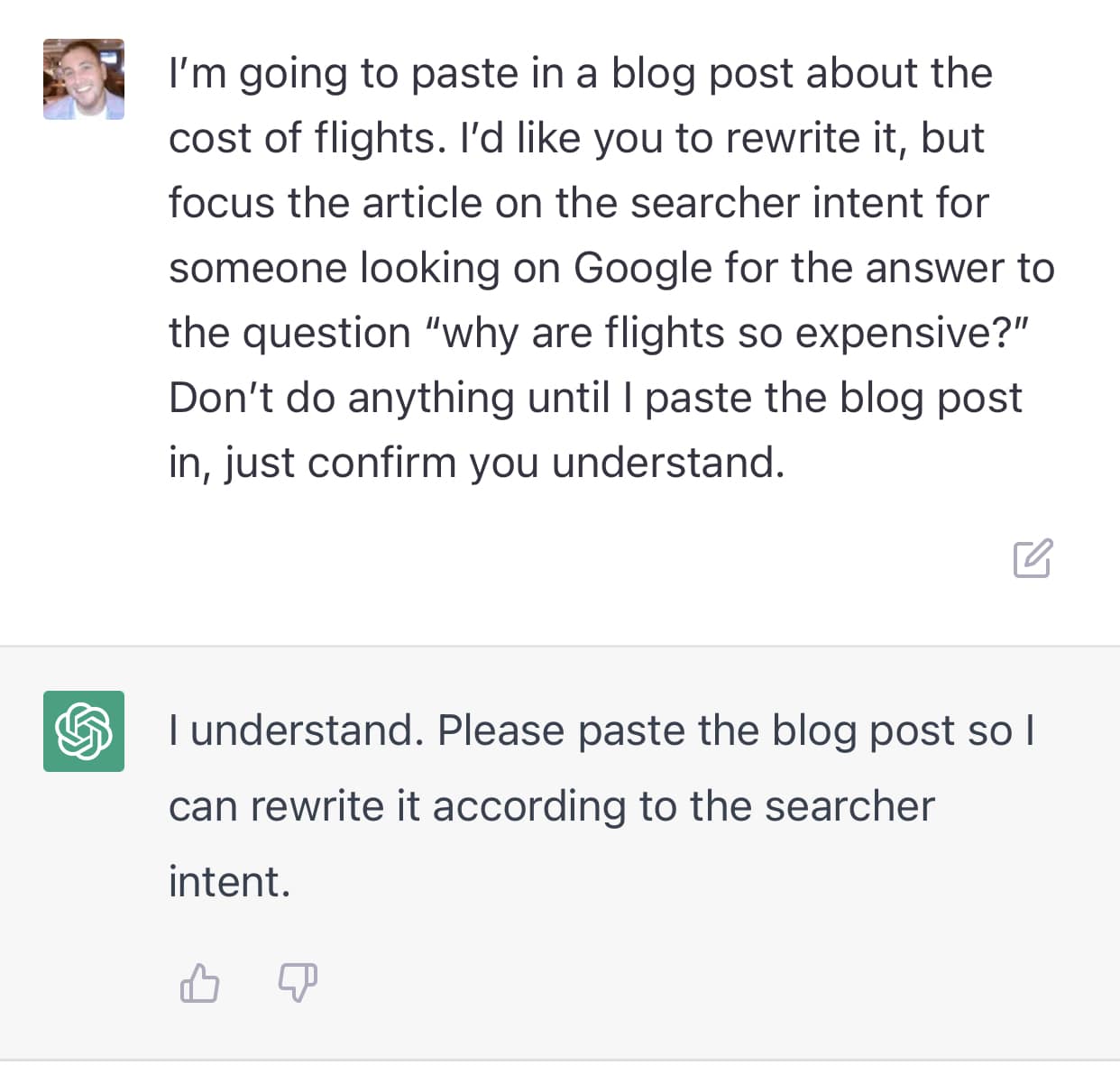
Rewriting for search intent
Let’s imagine our site is focused on the travel industry. A writer just finished a new article on flight costs, and we want it to rank well for the query “Why are flights so expensive?”
We could ask ChatGPT to rewrite the blog post with more of a focus on searcher intent:
Here is the before and after of what the first paragraph looks like:
If we wanted to dial in the intent a bit more, we could do some things to give ChatGPT more context, like:
- Share the title tags for the top 10 results for the search query to give ChatGPT a better sense of what Google is returning for the search query.
- Share the content (or a summary of the content) for the first result or the first few results Google is returning in the SERP.
- Share some of the search suggestions Google returns when you type the topic into Google.com, or some People also ask questions or related searches.
Remember, if you feed this much information to ChatGPT, the platform can only remember 3,000 words from a conversation. You may have to limit how much information you give in one go.
One option would be to try each of these in their own chats and then compare the results to see which version you feel is the best result.
Applying best practices to your intros
Another thing we can do with ChatGPT goes a step beyond searcher intent. Let’s use the article introduction as an example.
Let’s use Jamie I.F.’s framework for writing introductions:
THIS is how we write intros for our $1.5M-value blog portfolio
You're missing out on conversions if you don't use the SPEAR Framework (with examples)

S – Search (User) Intent
P – Pain Points
E – Expertise
A – Audience
R – Rapport
— Jamie I.F. (@Jamie_IF) November 22, 2022
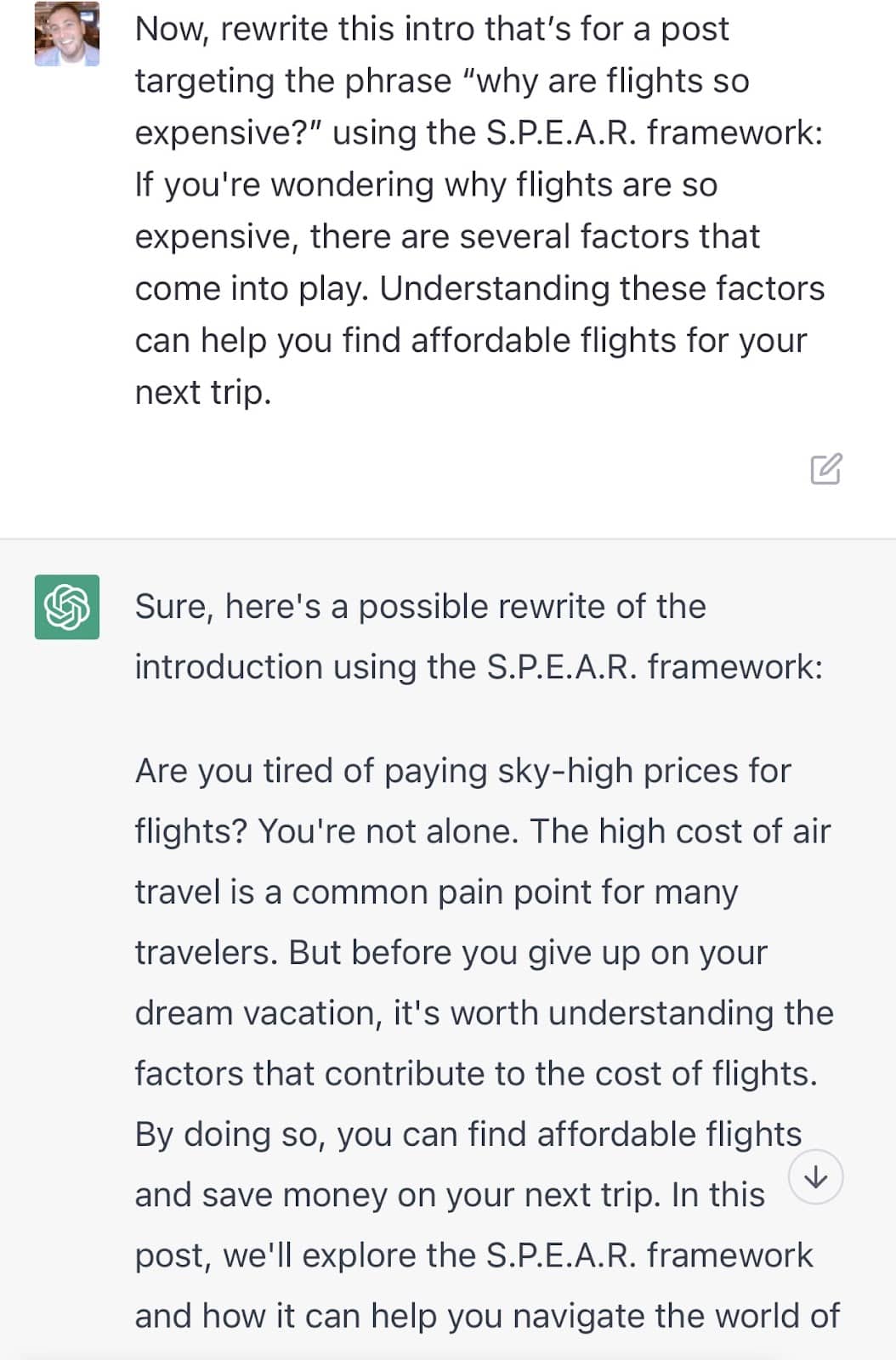
Let’s try getting ChatGPT to rewrite our newly search-intent-focused blog intro using the S.P.E.A.R. method:
Uh-oh! ChatGPT seemed to grasp the basic idea of the framework out of the gate, but then it went off the rails and mentioned the framework.
My experience is that when ChatGPT gives something this far off, you probably overloaded it with information or made your prompt too complex. (Think of it almost like an overtired or overwhelmed employee!)
Aim to simplify and break your prompts down.
This is also a great reminder to always always always carefully review and edit your ChatGPT output!
Optimizing for featured snippets
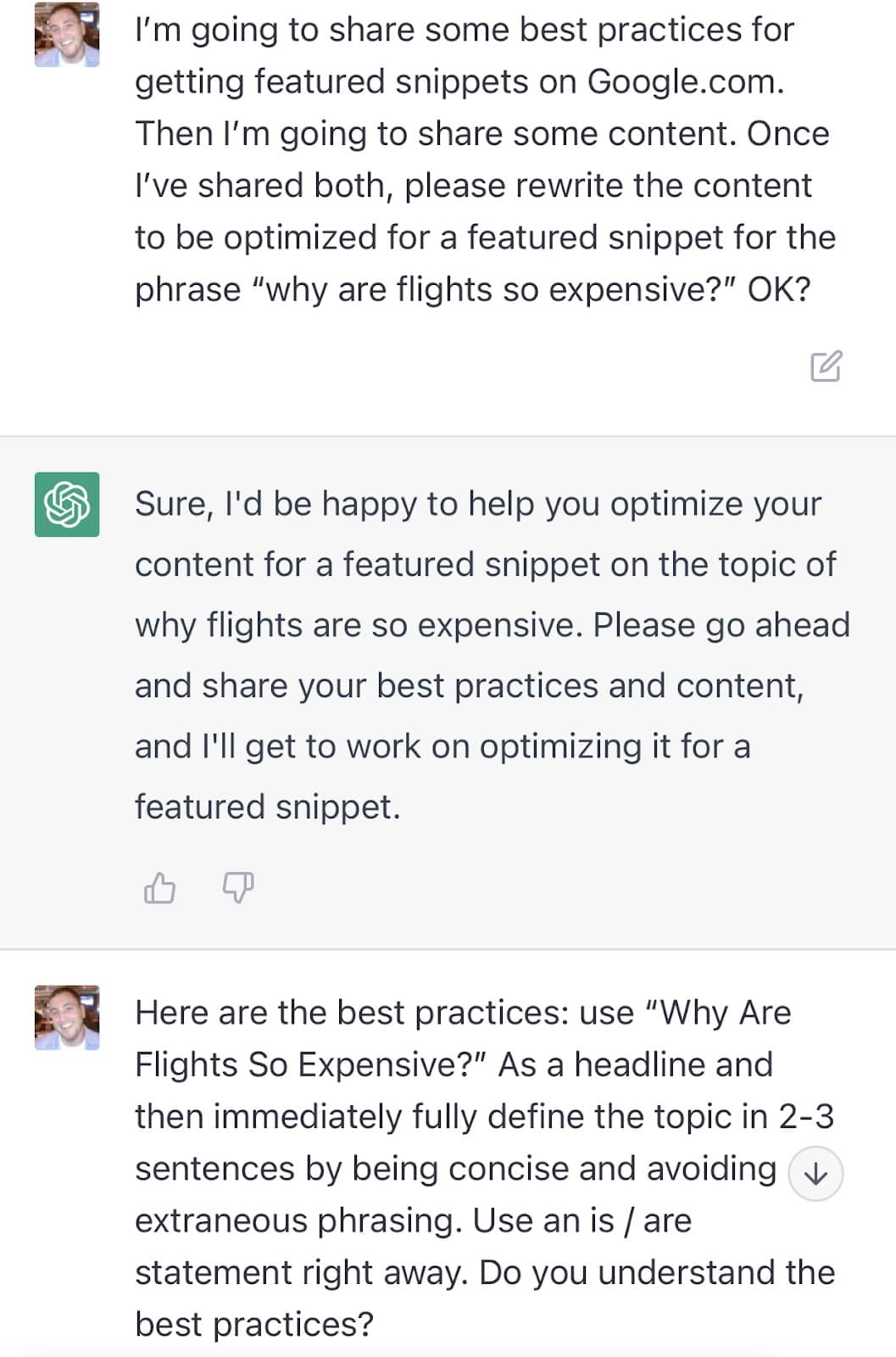
I can also share some best practices for optimizing content to get featured snippets with ChatGPT and ask it to rewrite my content:
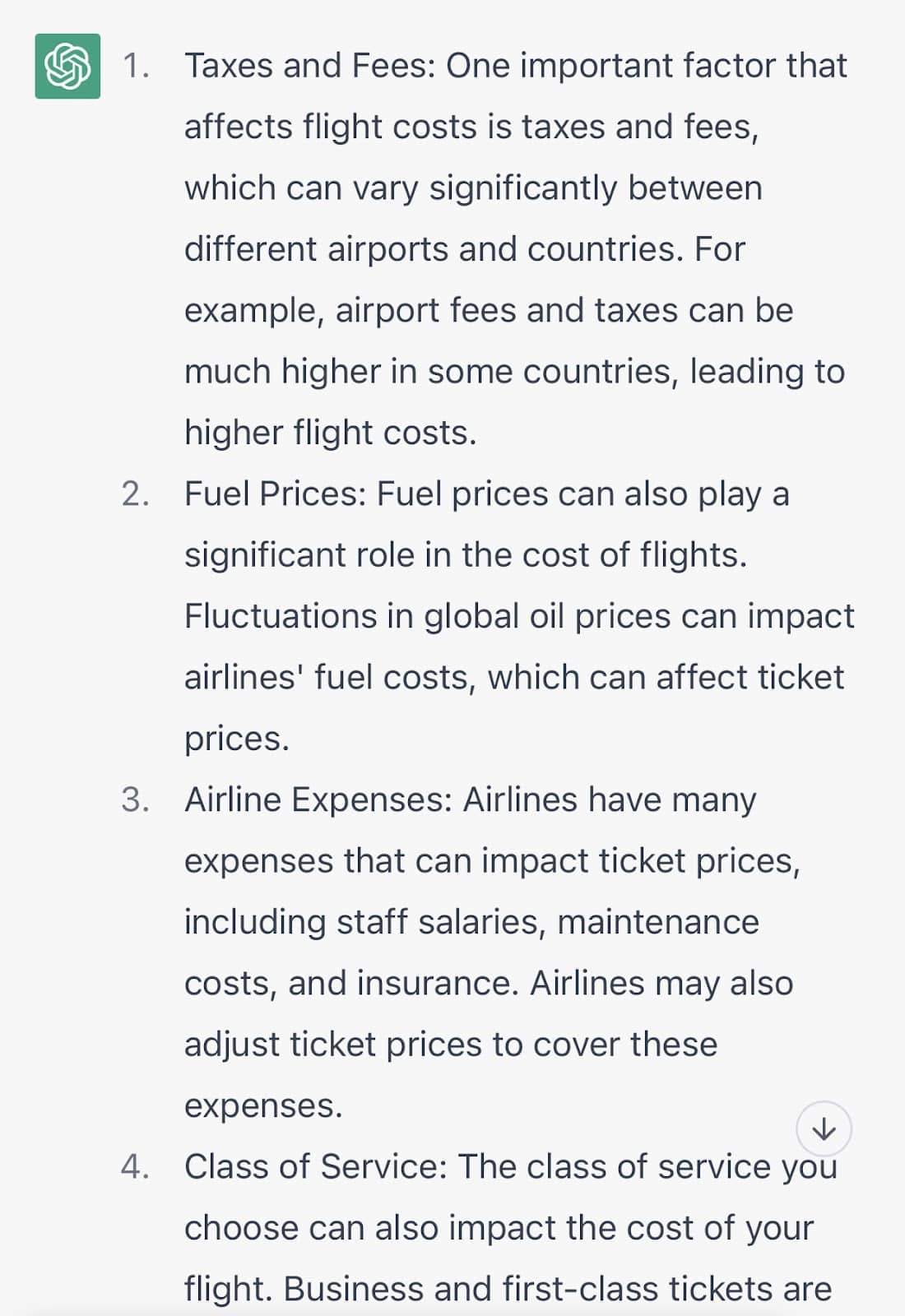
Let’s take a look at the output here:
Again not exactly something I can grab and run with, but this may give me an idea for how to structure a paragraph here.
Adding formatting
A common issue with blog content is that you may receive an article that’s not broken up into subsections and doesn’t use skimmable formatting.
This can lower your content’s engagement and cost you opportunities to optimize for additional keywords.
ChatGPT can help here:
Here is the body of the updated article, which had previously been a few walls of text:
Ideas for additional topics to cover
You can also get ideas from ChatGPT on what your article may be missing. (Of course, ChatGPT isn’t an SEO tool, so these ideas won’t be driven by search suggestions. As long as the subsections are relevant for your readers, they may be helpful.)
You can also find topics or questions specific to your audience.
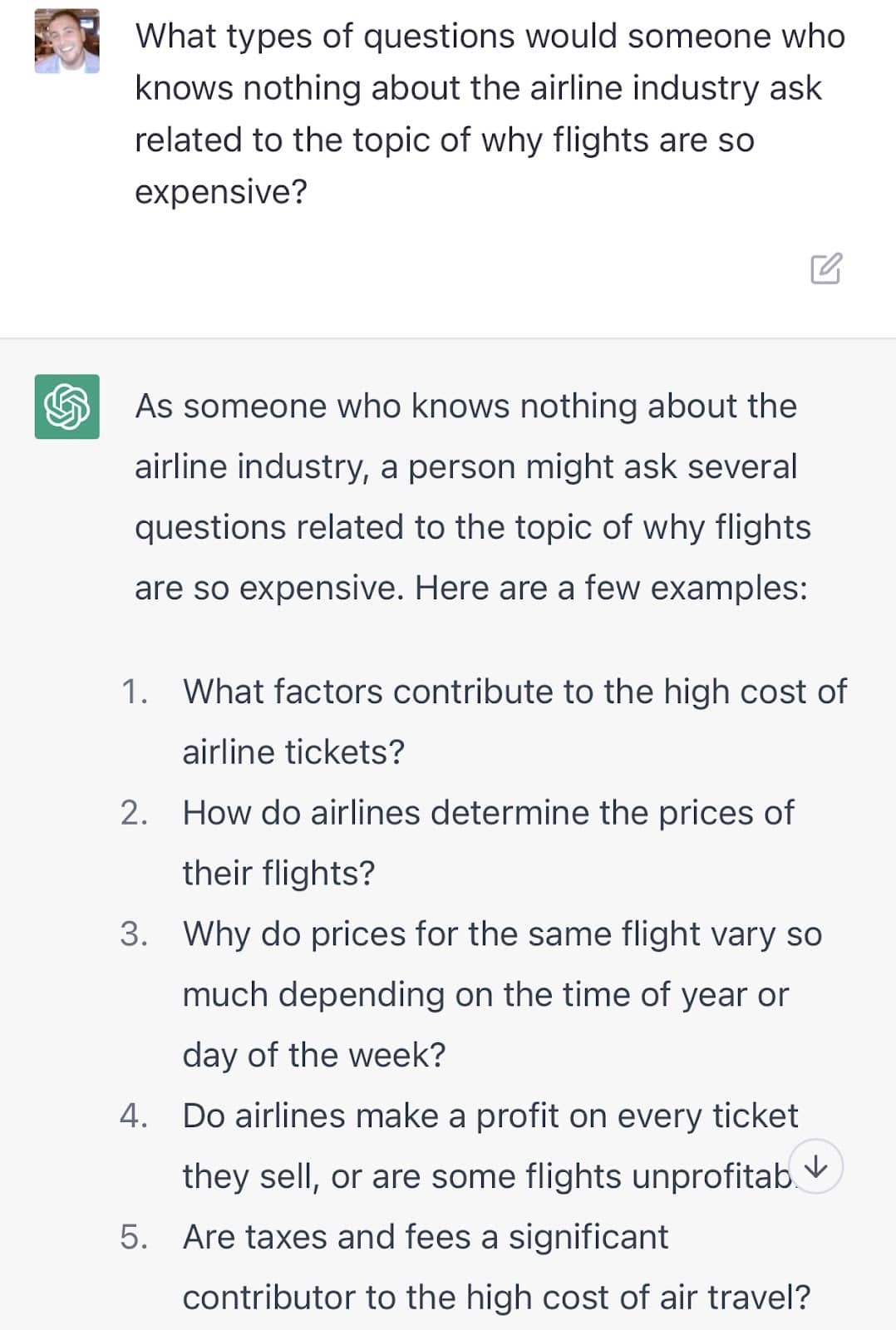
Look at how different the outputs I get are when I ask for questions someone who doesn’t know anything about the airline industry would ask:
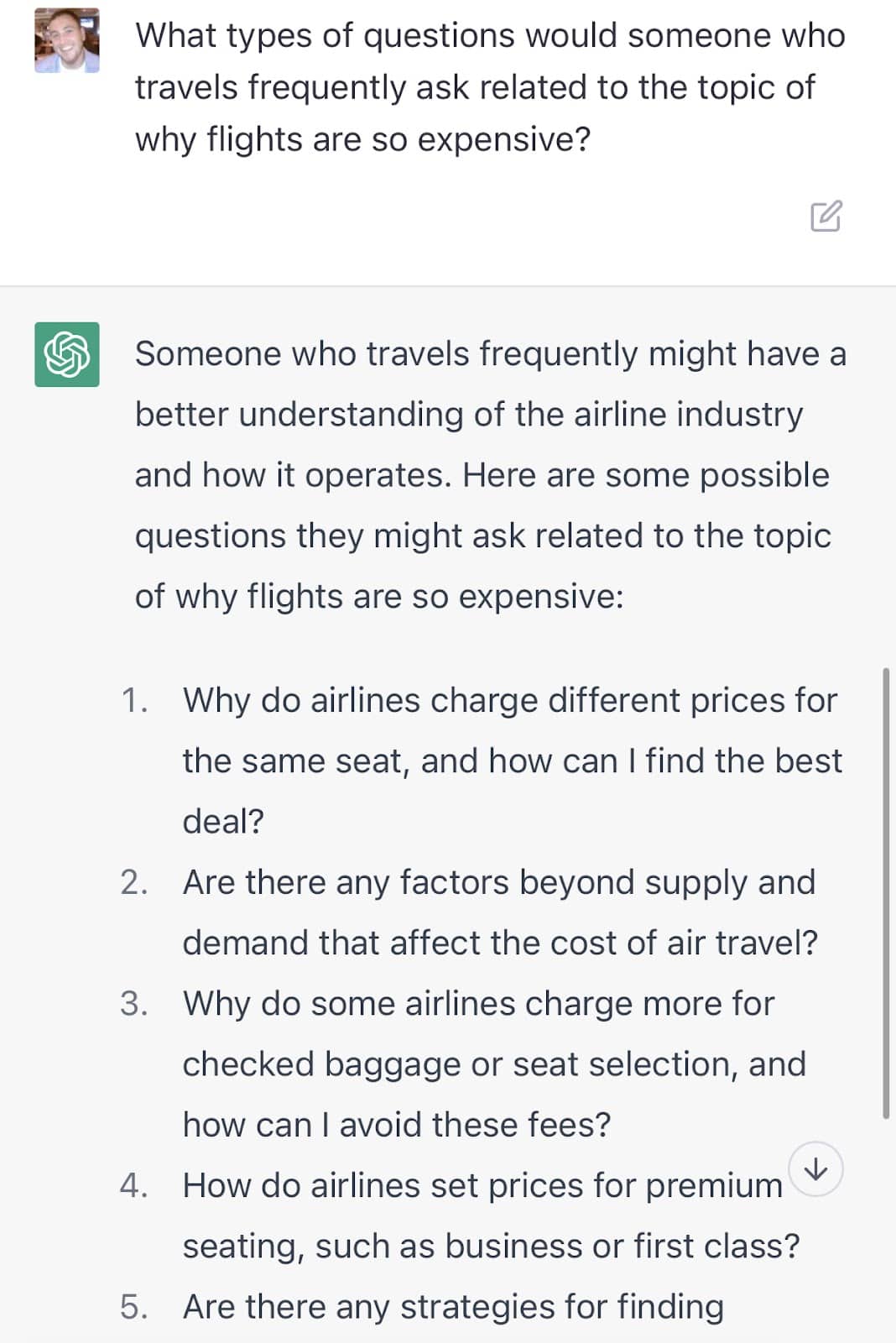
Versus someone who is a frequent traveler:
Adding new subsections to the article
Assuming you’re prepared to review and edit the content, you can also use ChatGPT to create short subsections of content.
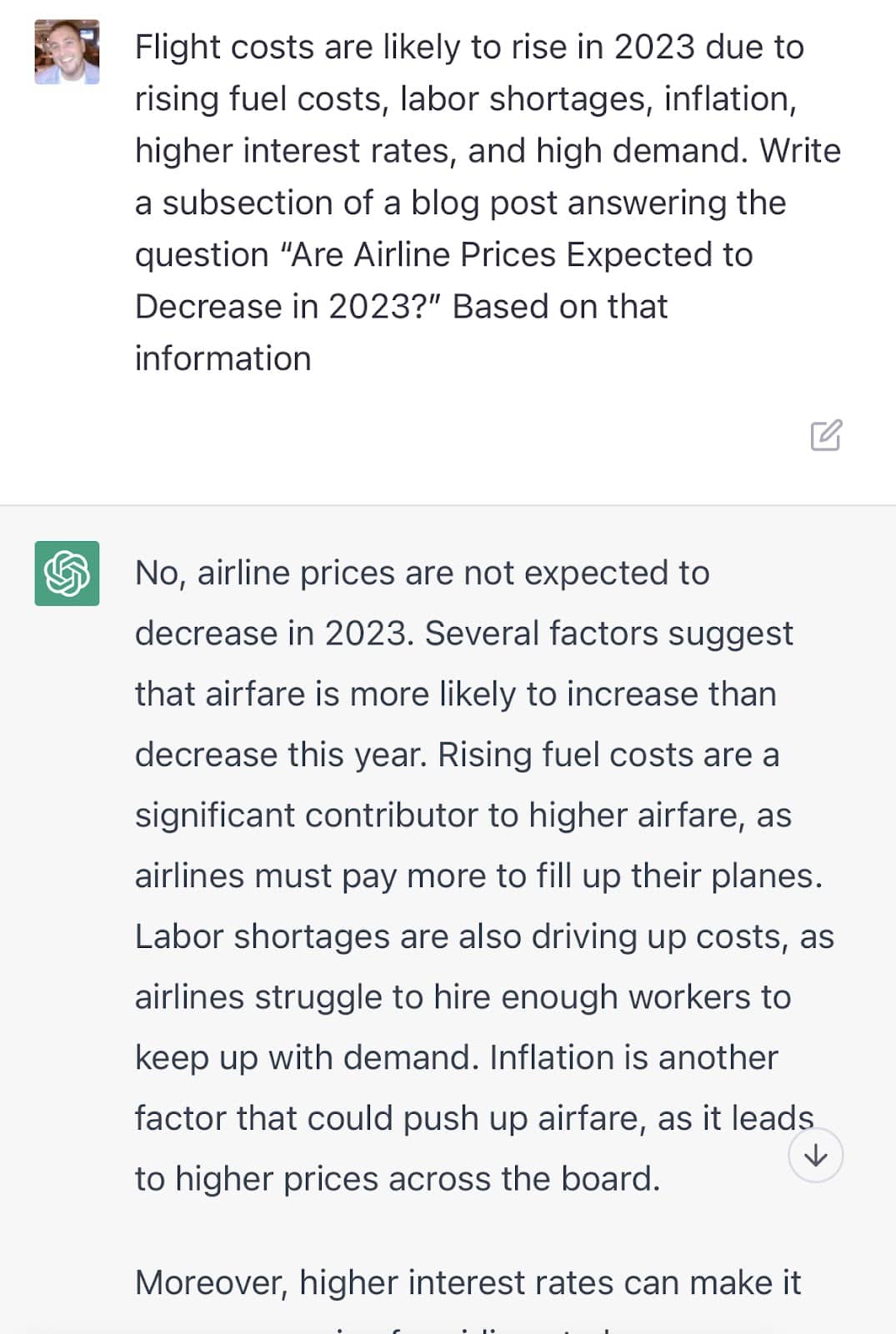
Let’s say we wanted to add a subsection to our article about whether airline prices are expected to go down since people are asking and searching for that.
We actually wouldn’t likely want to leave this one with ChatGPT completely since it’s using outdated information, but we could “give it the answer” and ask it to write something for us:
Adding FAQs and FAQ schema
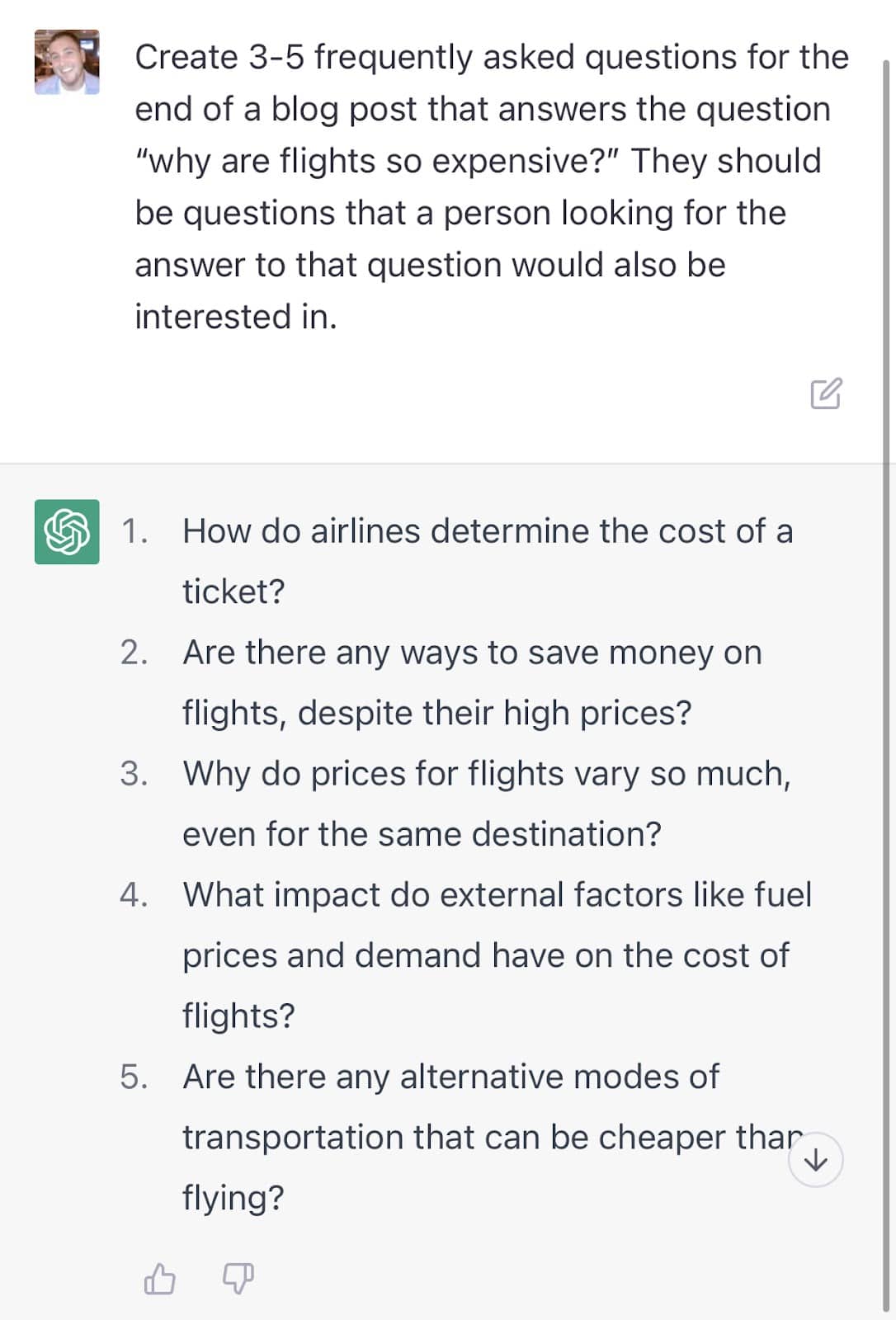
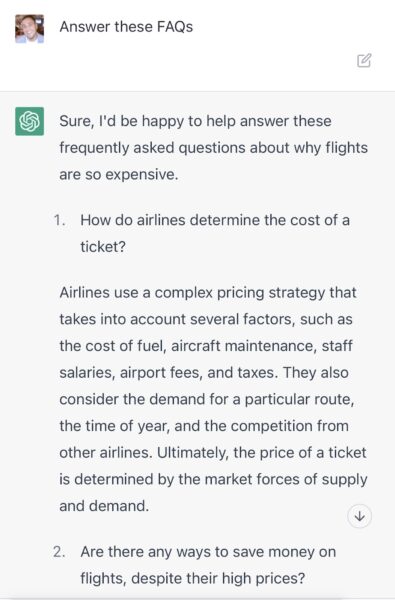
If the author of your blog post hasn’t created an FAQ section already, you can add some FAQs in editing:
You can also ask ChatGPT to answer these questions for you (always be sure to fact-check):
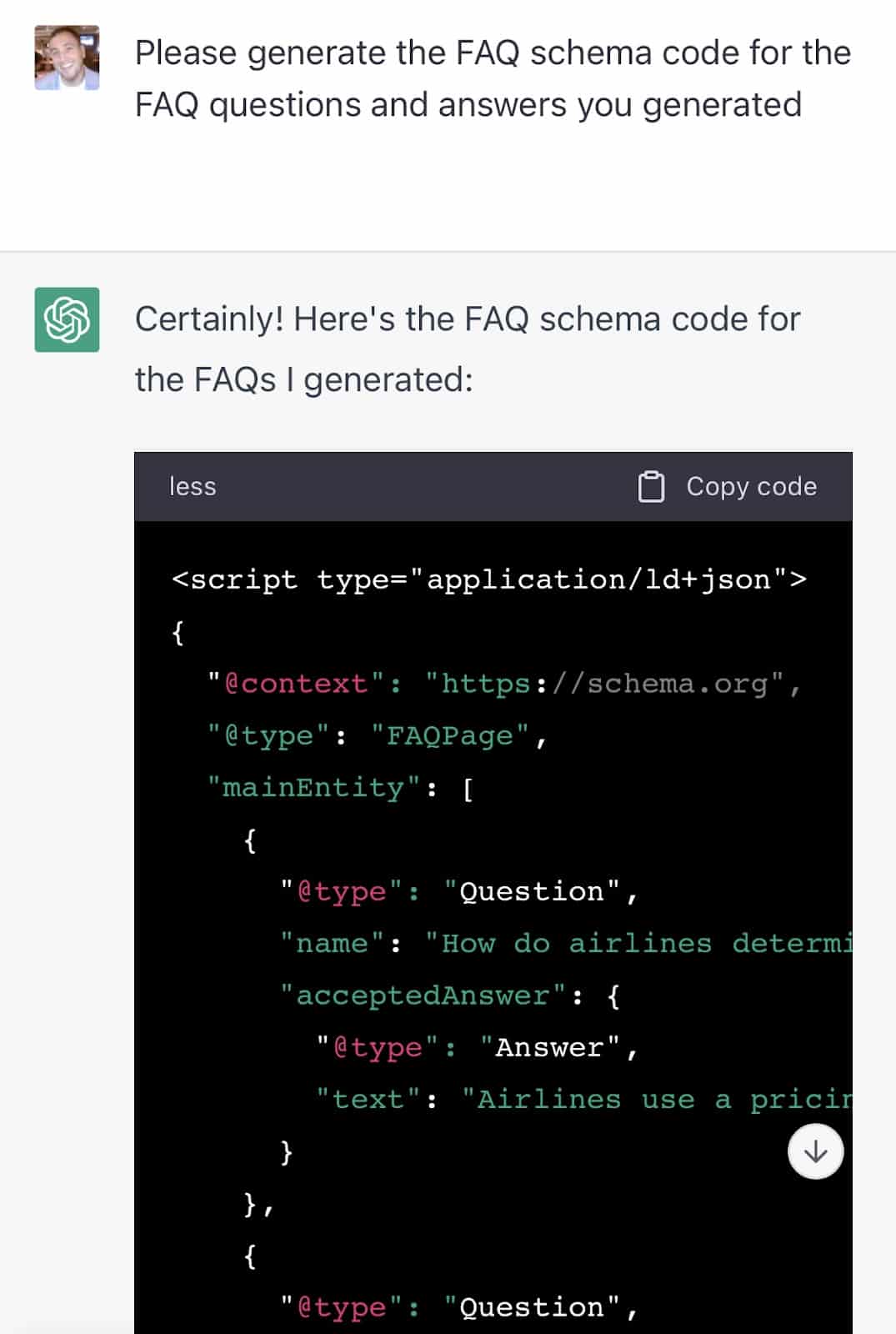
And finally, you can ask the tool to generate the FAQ schema for you:
This can help add relevant search-friendly content to your article while giving you extra SERP real estate with FAQ search features.
Beefing up E-E-A-T
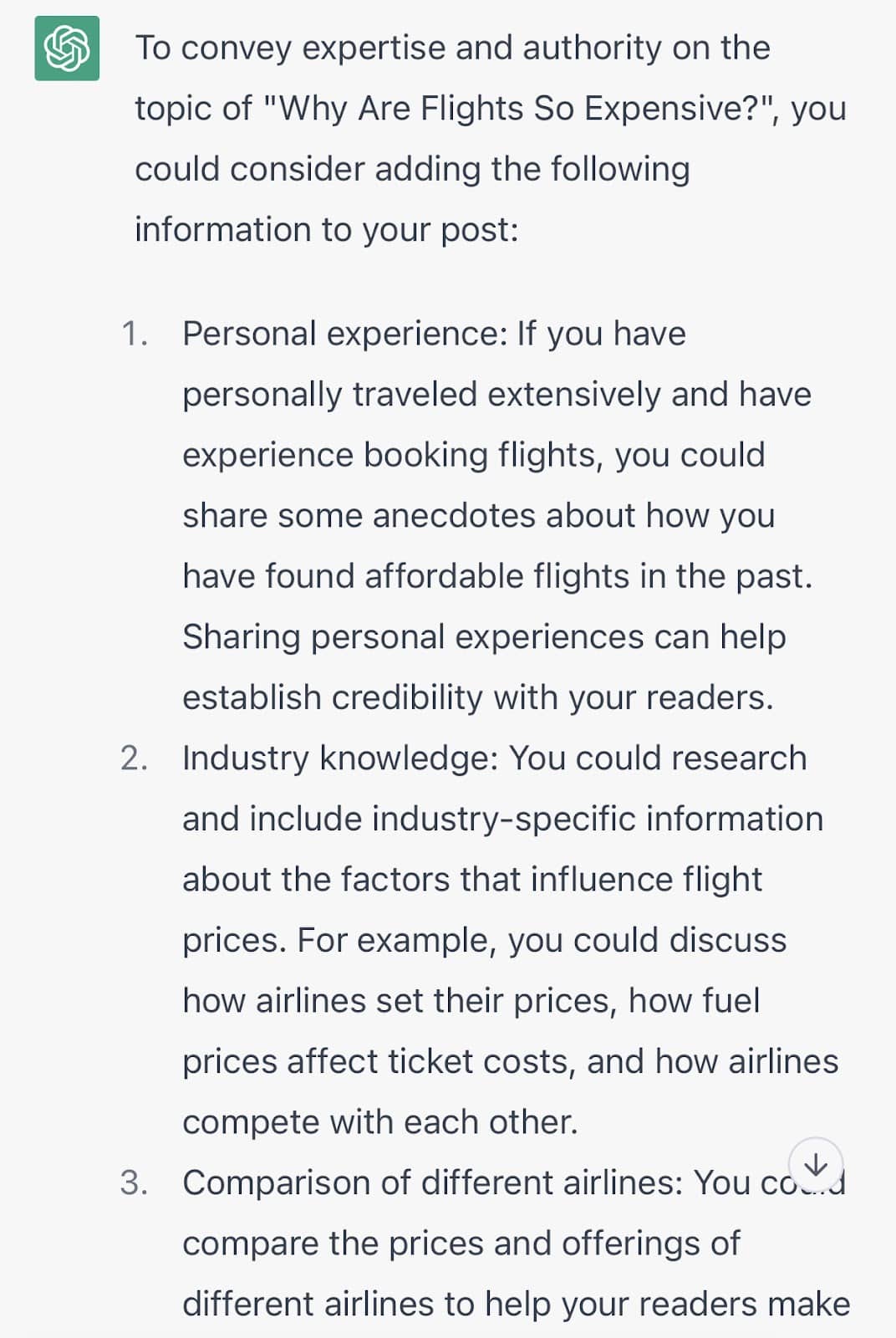
Short of training ChatGPT on the quality rater guidelines, you can still get some ideas for making your article more credible:
These aren’t the most innovative E-E-A-T ideas, but they may be good reminders of different options. What if I have ChatGPT just edit the article to add some E-E-A-T for me:
So ChatGPT punted on the first E in E-E-A-T altogether but then told the reader about all my experience in the travel industry.
Except I never told ChatGPT I worked in the travel industry, and it was never mentioned in the original article!
The rest of the article is pretty similar to the original one, so it doesn’t look like ChatGPT is much of an E-E-A-T editor.
(Of course, the update from E-A-T to E-E-A-T happened after the training period for GPT-3, so ChatGPT won’t be aware of that outside of the context I gave it).
Updating outdated information
Since ChatGPT’s training data is from before 2021, updating outdated information won’t suit the platform.
But there are some specific instances where you could use the tool for this purpose, such as:
- Report summaries: Asking ChatGPT to read and summarize a new study could infuse fresh data into an older article.
- New version of an old report: Similarly, if a page references an older report that’s been updated (e.g., the 2017 State of Air Travel), you could find the newer version and then swap that out in place of the reference to the older report.
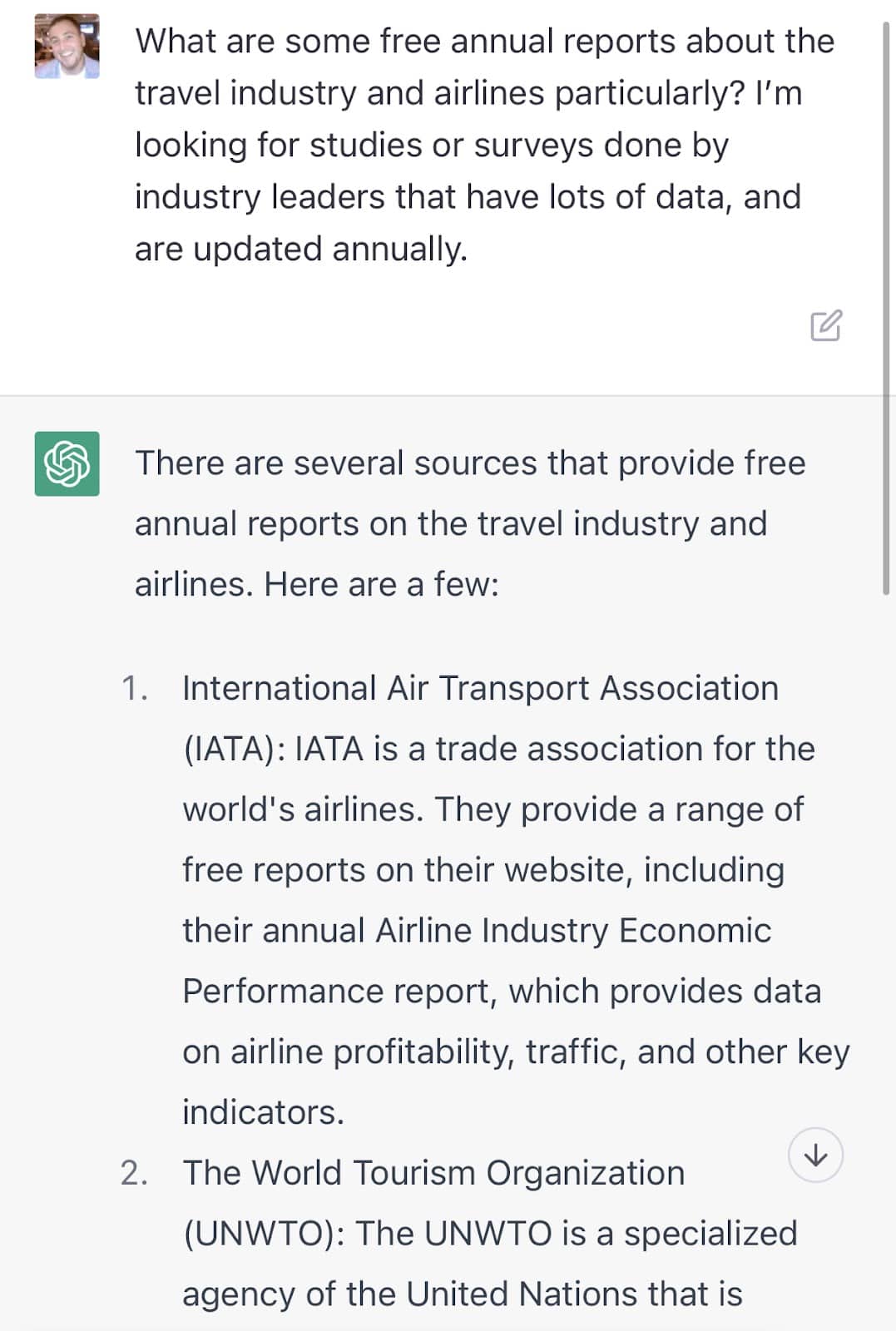
- Annual reports: While ChatGPT can’t necessarily find you fresh data or studies, one workaround for this is to ask the tool to surface reports that are produced annually. That points you in the direction of the report so you can go and grab the latest version.
Rewriting for style
Finding the right tone or sentiment may help a piece of content get shared, have better engagement metrics, or convert better.
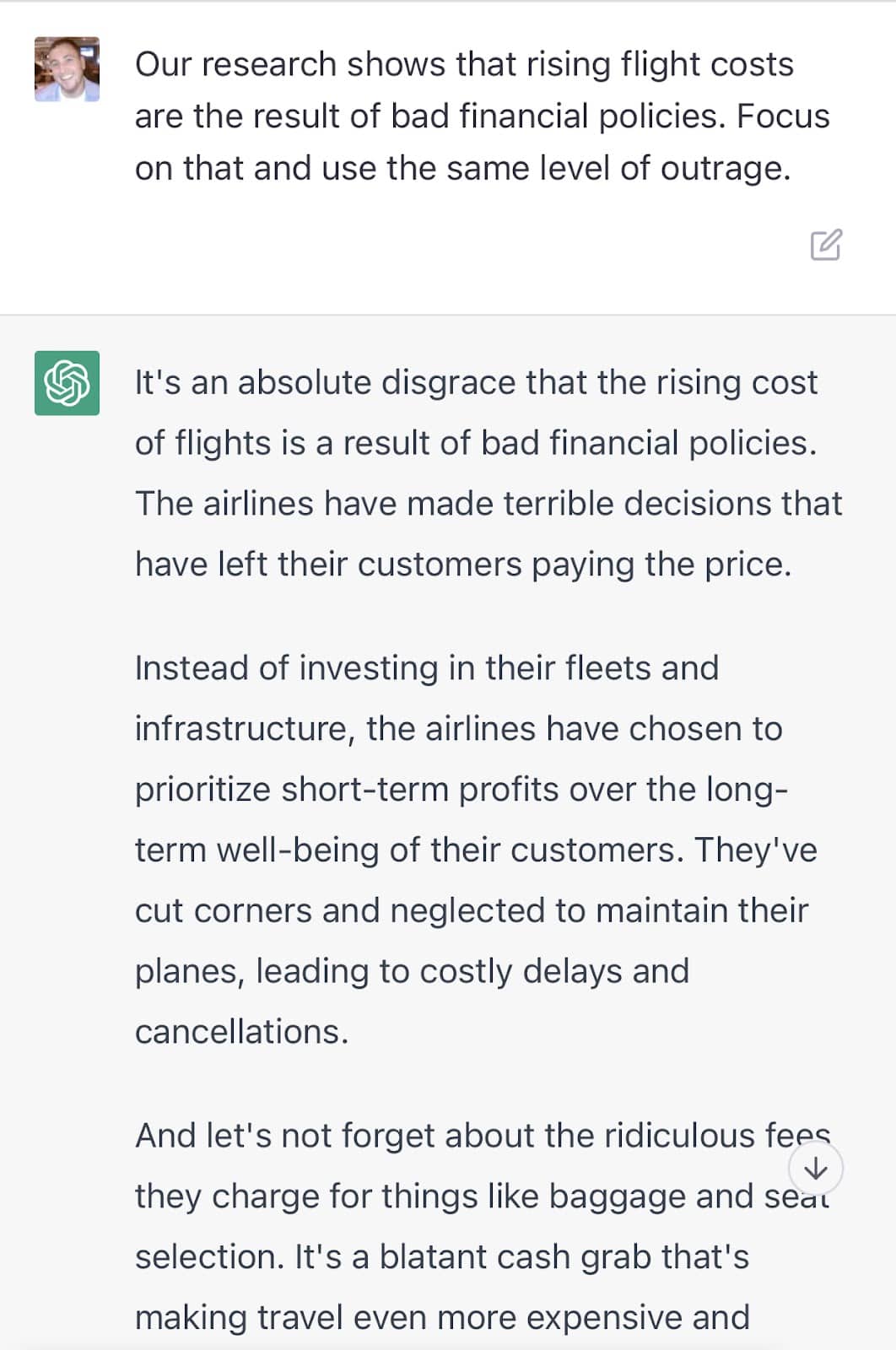
If I want to make my content more sensational, I could ask ChatGPT to turn up the outrage:
Or, disturbingly, I can point ChatGPT’s outrage at whomever I’d like:
You could also pivot the article to have a specific perspective and a more sympathetic sentiment to try to relate to visitors:
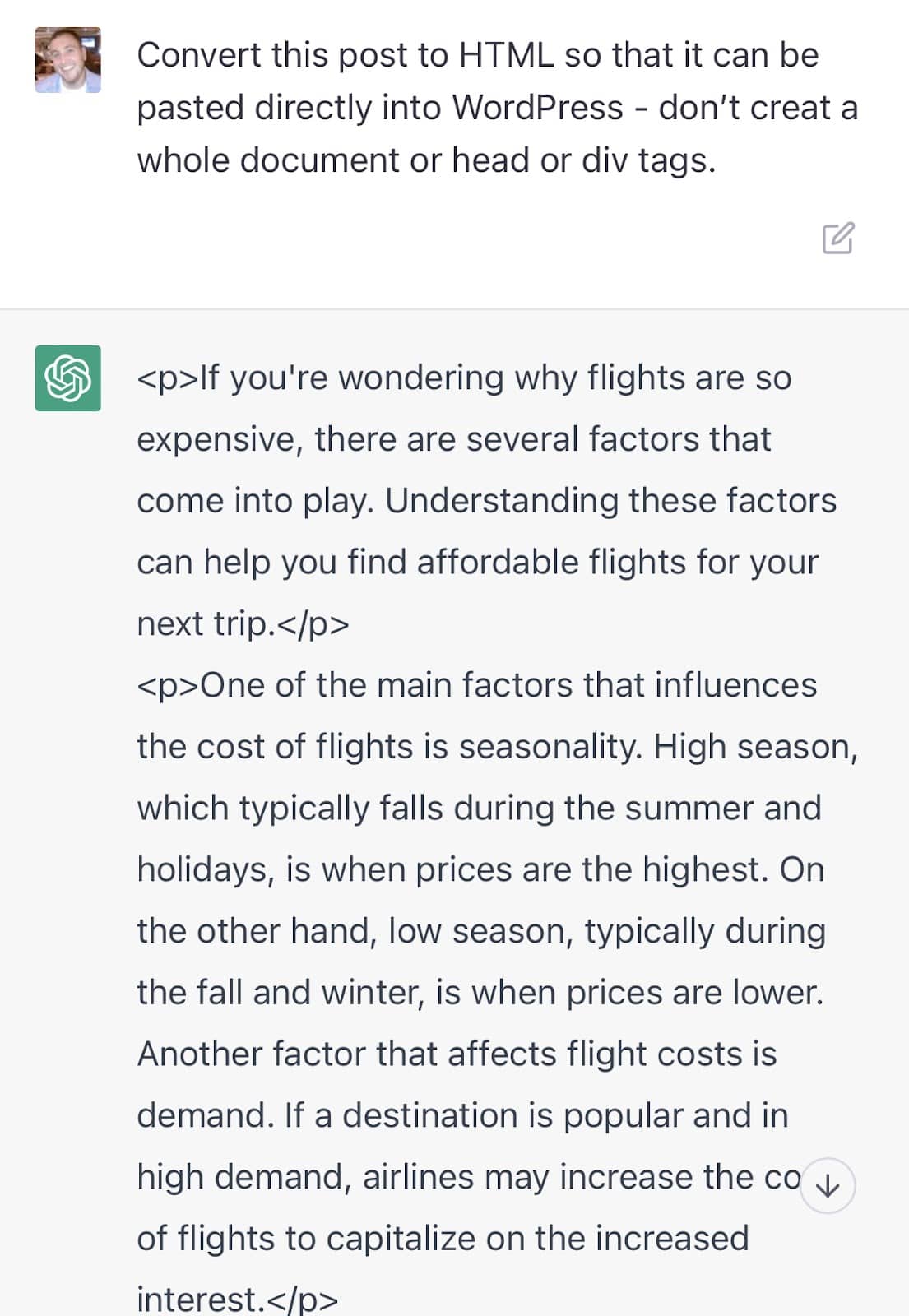
Convert post to HTML and add internal links
Converting posts from a Google Doc or Word Doc is often part of the editorial workflow. ChatGPT can often accomplish this task very quickly:
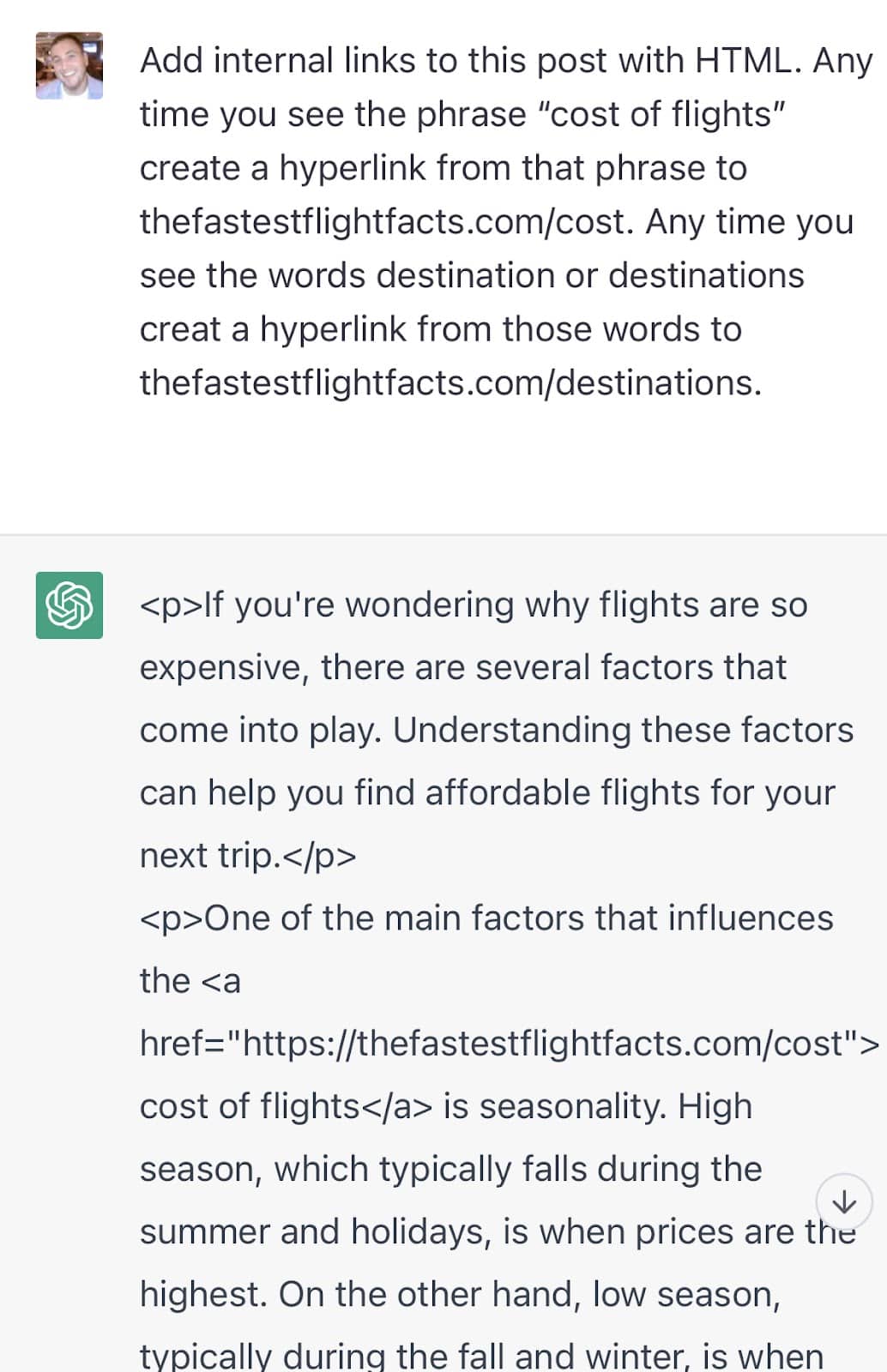
From there, you can get ChatGPT’s help with another common SEO editing task – adding internal links to an article:
If you have a longer form article and know the URLs and associated anchor text you want to focus on, this can help create those links quickly.
Obviously, this isn’t a substitute for both knowing which pages you want to link to from your new article or for identifying the best pages to have link to your new content (or the piece you’re updating).
Translations
Are you translating content from one language to another to capture more traffic from search in different languages? ChatGPT can help.
As always, it’s a good idea to have someone who knows the language you’re publishing to your site QA the output here before you push it live.
Bonus: Video and podcast transcriptions
This isn’t something ChatGPT can help with strictly speaking, but Open AI did recently announce that both ChatGPT and Whisper now have APIs.
Whisper is an automatic speech recognition system that can take transcriptions from audio in multiple languages.
You can use the Whisper API to add a transcription of your video or podcast to generate crawlable text from your audio content:
Downloading YouTube videos and transcribing their text with AI?
Whisper can do it and it's free!
 Download YT videos
Transcribe their text
Study them!
[Free #Python code included]
Basic coding will get you far…
— Marco Giordano (@GiordMarco96) March 9, 2023
When to use ChatGPT for SEO editing tasks
While some of these functions may be things that ChatGPT can do, it doesn’t mean it will be the best option for that specific task for your piece of content or your workflow.
There are a few factors that help determine how “qualified” ChatGPT will be for a job:
- If you have a topic or task that requires freshness or recent info it’s likely not a fit.
- If you have a complex prompt – something that requires ChatGPT to execute multiple tasks at once or will require you to “feed” the platform more than the maximum 3,000 characters in a chat, then it’s likely not a fit (or at the very least you need to determine a way to break up your tasks).
- If you need ideas or variations of something or are just stuck and need some inspiration to get moving on things like a new section of an article, title ideas, etc. ChatGPT can be very useful.
If you find the tool useful in some areas but not others, I’d also encourage you to keep a running “wish list” of tasks where it’s close but not good enough.
Open AI quickly releases new versions of the underlying GPT technology and various Open AI APIs. Simultaneously, they also make rapid platform updates.
Its limitations (i.e., character limits through the API or web interface, how much ChatGPT can remember in a conversation, data freshness, and the number of tasks it can perform through a complicated prompt) will likely improve.
Keep an eye on what’s changing in future updates and how that may impact your not-quite-there-yet task.
The post Is ChatGPT your secret weapon for SEO content editing? appeared first on Search Engine Land.
Courtesy of Search Engine Land: News & Info About SEO, PPC, SEM, Search Engines & Search Marketing
Wednesday, March 22nd, 2023
I had a financial accounting professor back in college who refused to give an “A” on an exam, even if you got all the answers right if the way you got to the answer did not align with her methodology.
For her, it was less about right and wrong. It was more about how you came to the answers.
The same rule applies to your enterprise SEO strategy.
Most C-level executives find sitting through an enterprise SEO strategy presentation comparable to being on hold with an automated system. Read: boring and irritating.
That’s because too many “SEO gurus” are spewing out SEO terminology like “CWVs” or “E-E-A-T” in the form of broems during their enterprise SEO strategy meetings instead of showcasing how they arrived at their answers.
This isn’t an enterprise SEO strategy.
This is you enjoying hearing the sound of your own voice.
As an SEO director, within my first 90 days at a job, I shared my SEO findings with key stakeholders, including the C-suite, as I uncovered them through a weekly email.
Once I finish my audits, my list of “key stakeholders” grows exponentially within those 90 days, with people wanting to know more and forwarding my emails to relevant team members.
They didn’t just like the data I was sharing. These people become invested in your SEO.
As more people in the company understand what exactly SEO is and how it impacts their work, it illustrates how SEO and other channels can partner. It establishes trust, authority, and buy-in across departments before pitching to your C-suite.
As you take off on your own, consider incorporating these steps into your next pitch for a successful enterprise SEO strategy.
1. Use data and research to sell your strategy
The first step in creating an enterprise SEO strategy is to compile the data based on your research.
You don’t want to walk into a room of millionaires pitching your enterprise SEO strategy based on assumptions and experience.
Have you seen what happens on “Shark Tank” when people don’t know their data? Cringe-worthy.
Protect yourself with data. Pretend you’re a German Shepherd sniffing out drugs at an airport.
Here’s what you should have before developing your enterprise SEO strategy:
- Competitor research
- Market segmentation
- Benchmarks
- Product marketing roadmap
- Budget
As Glinda, the Good Witch, said to Dorothy in “The Wizard of Oz”:
- “You’ve always had the power, my dear. You just had to learn it for yourself.”
Use your research combined with your SEO budget to tell your plan’s story.
2. Make magic with your metrics
Unfortunately, the SEO community is filled with “SEO gurus” who have forced business leaders to call BS on SEO professionals pretending to have all the answers.
People can smell when something is fishy – except for the folks kneeling in more ways than one to the “guru” Yogi Bhajan.
Businesses need a data-driven approach. If you make a bold statement, you better be able to back it up.
But your job as an enterprise SEO professional is to make magic with your data and research.
If a data wizard and a creative wanna-be artist had a baby, it would be an SEO professional.
Think of your strategy as a short story. Our brains think in stories.
Uri Hasson, professor of psychology at Princeton, explained the impacts of storytelling in a TED Talk.
“When the woman spoke English, the volunteers understood her story, and their brains synchronized. When she had activity in her insula, an emotional brain region, the listeners did too. When her frontal cortex lit up, so did theirs. By simply telling a story, the woman could plant ideas, thoughts and emotions into the listeners’ brains.”
I start my SEO strategy presentation with revenue numbers to grab my audience’s attention immediately.
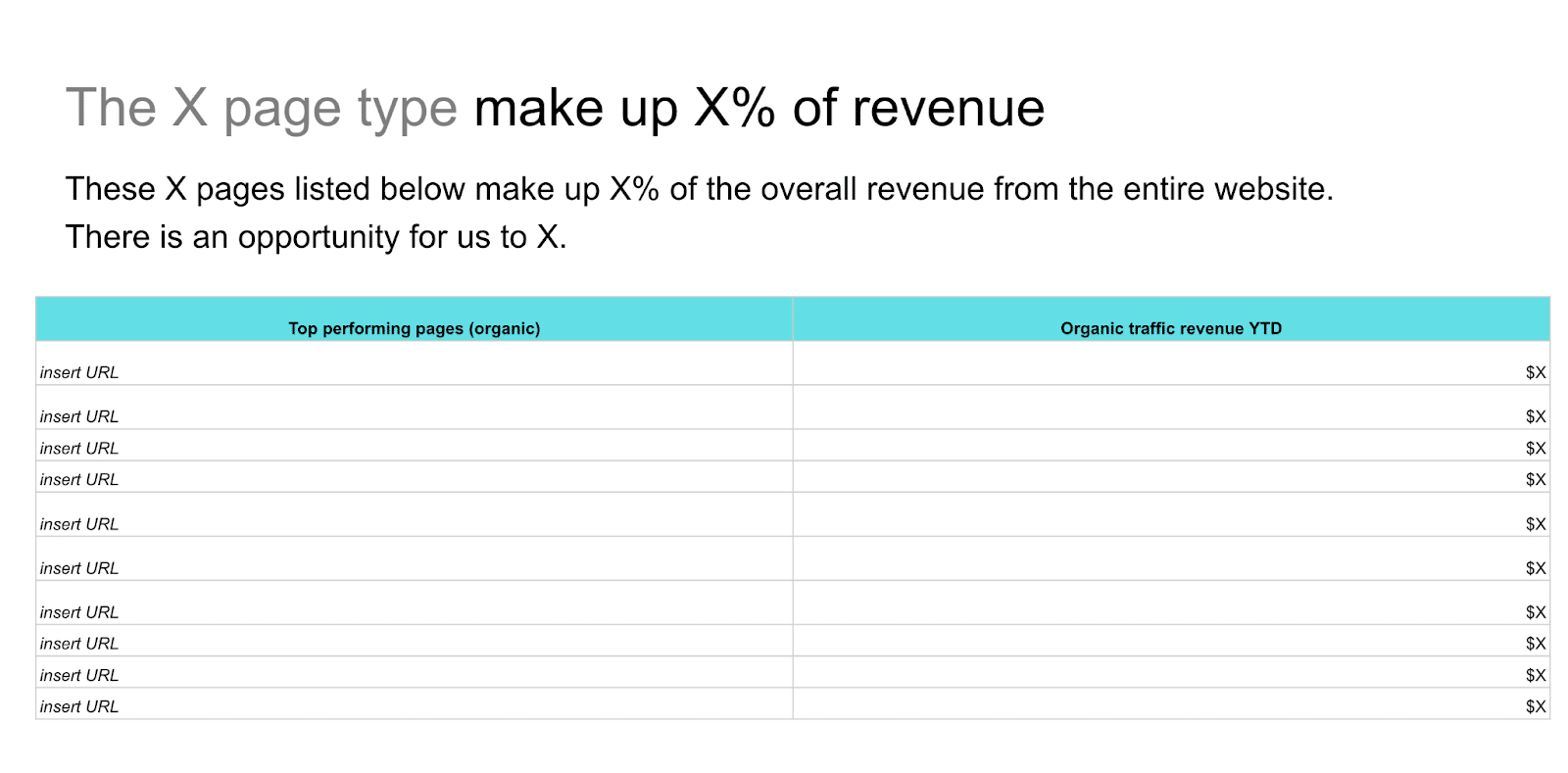
I follow this slide by sharing what pages are driving the most revenue.
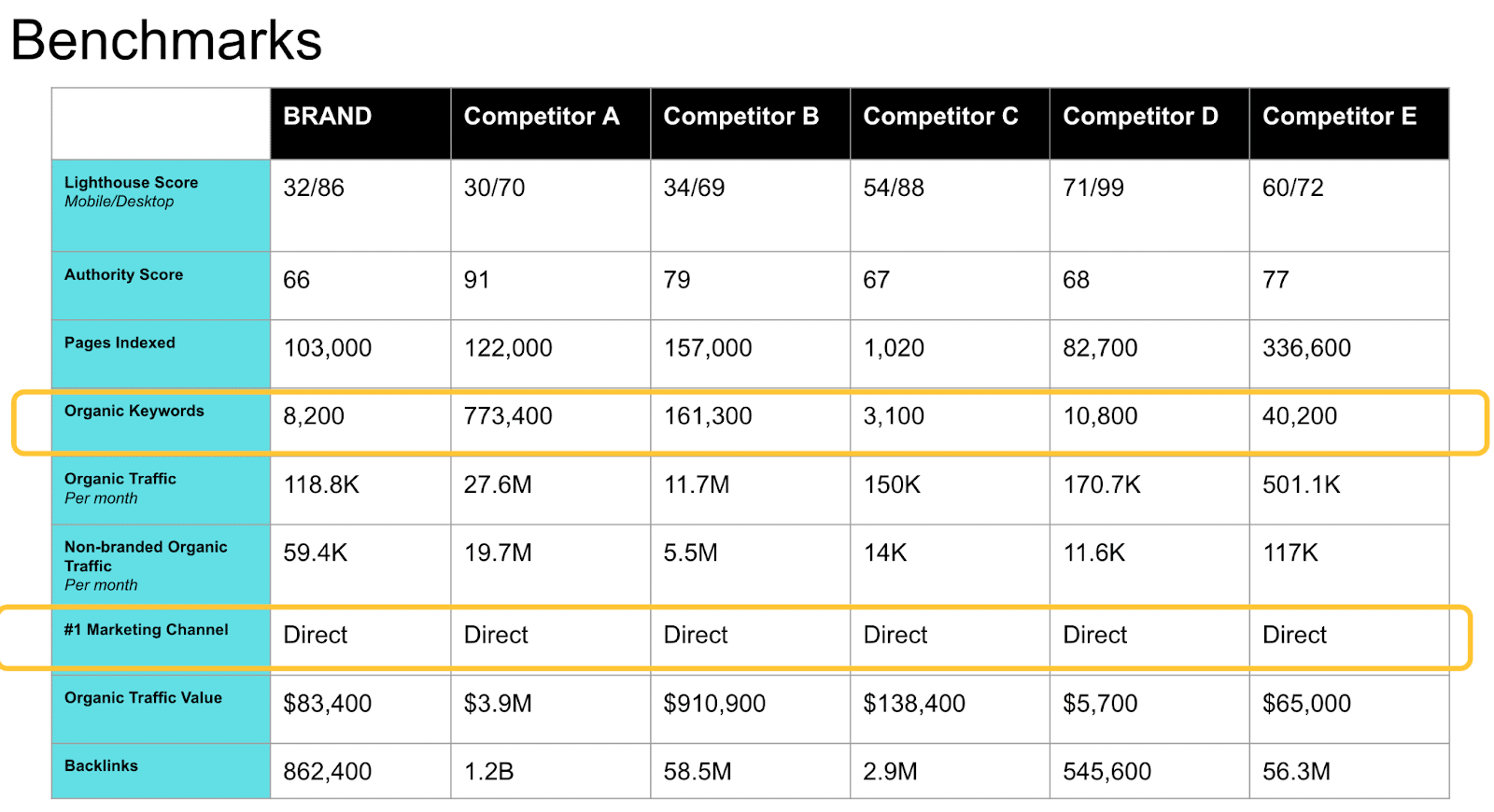
After this, dive into your high-level benchmarks.
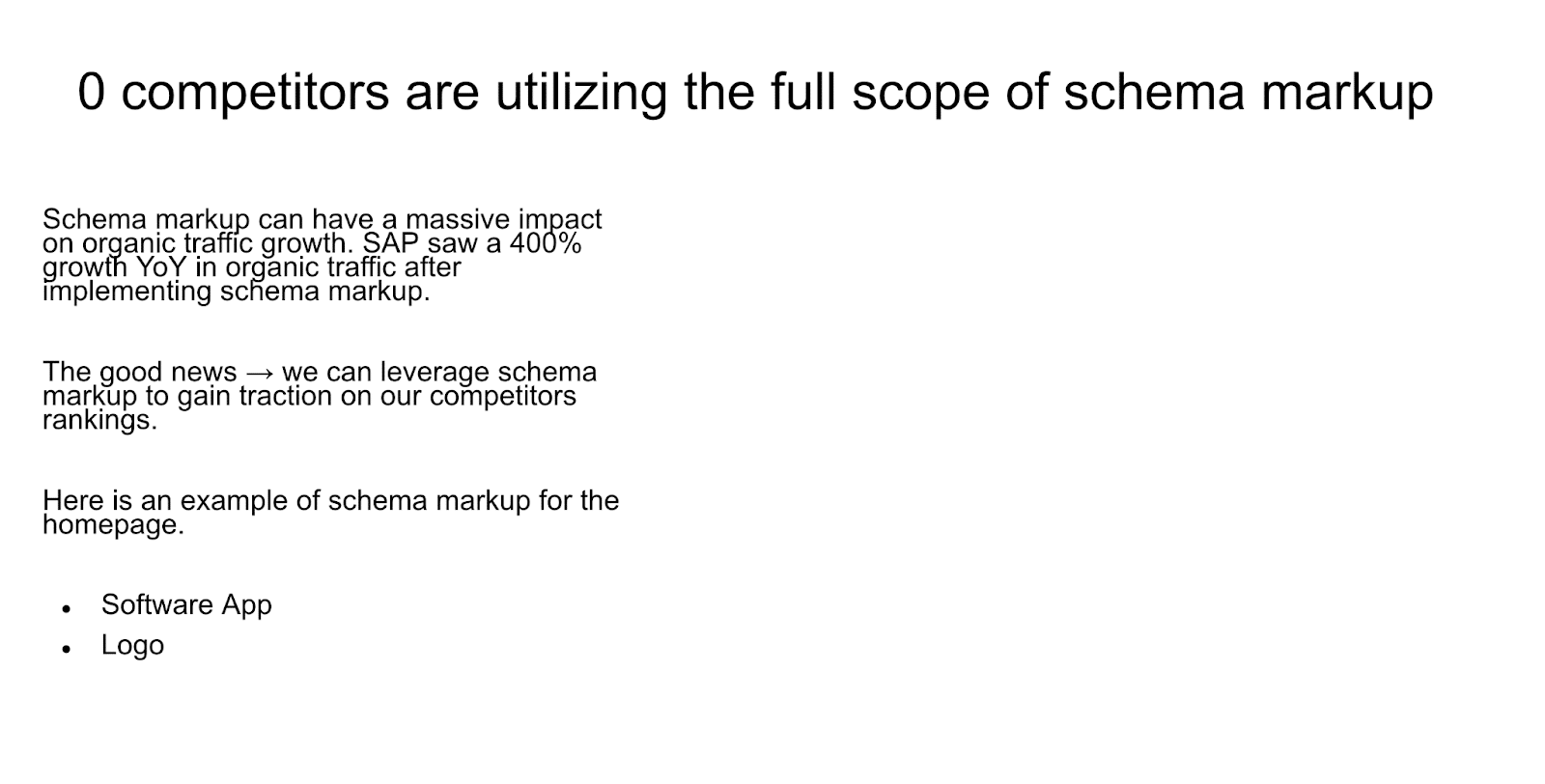
Finally, bring the wow factor by identifying key components your competitors are missing.
Turn your enterprise SEO strategy into a story to help your boss make better business decisions.
3. Incorporate your findings into recommendations
Making recommendations for an enterprise website with millions of webpages is not as easy as asking Alexa.
At an enterprise company, one of the first things SEO professionals must do is engrain SEO into the culture by educating people on what SEO truly means.
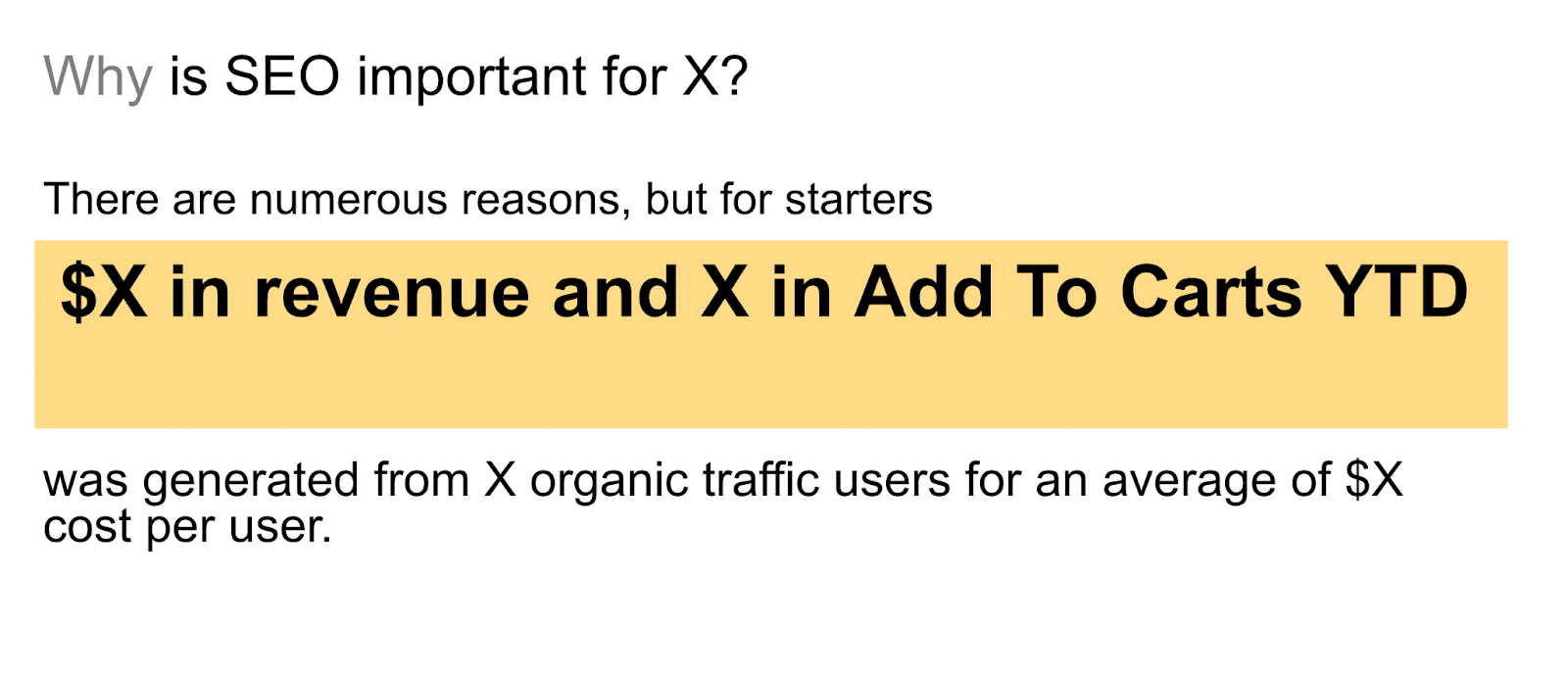
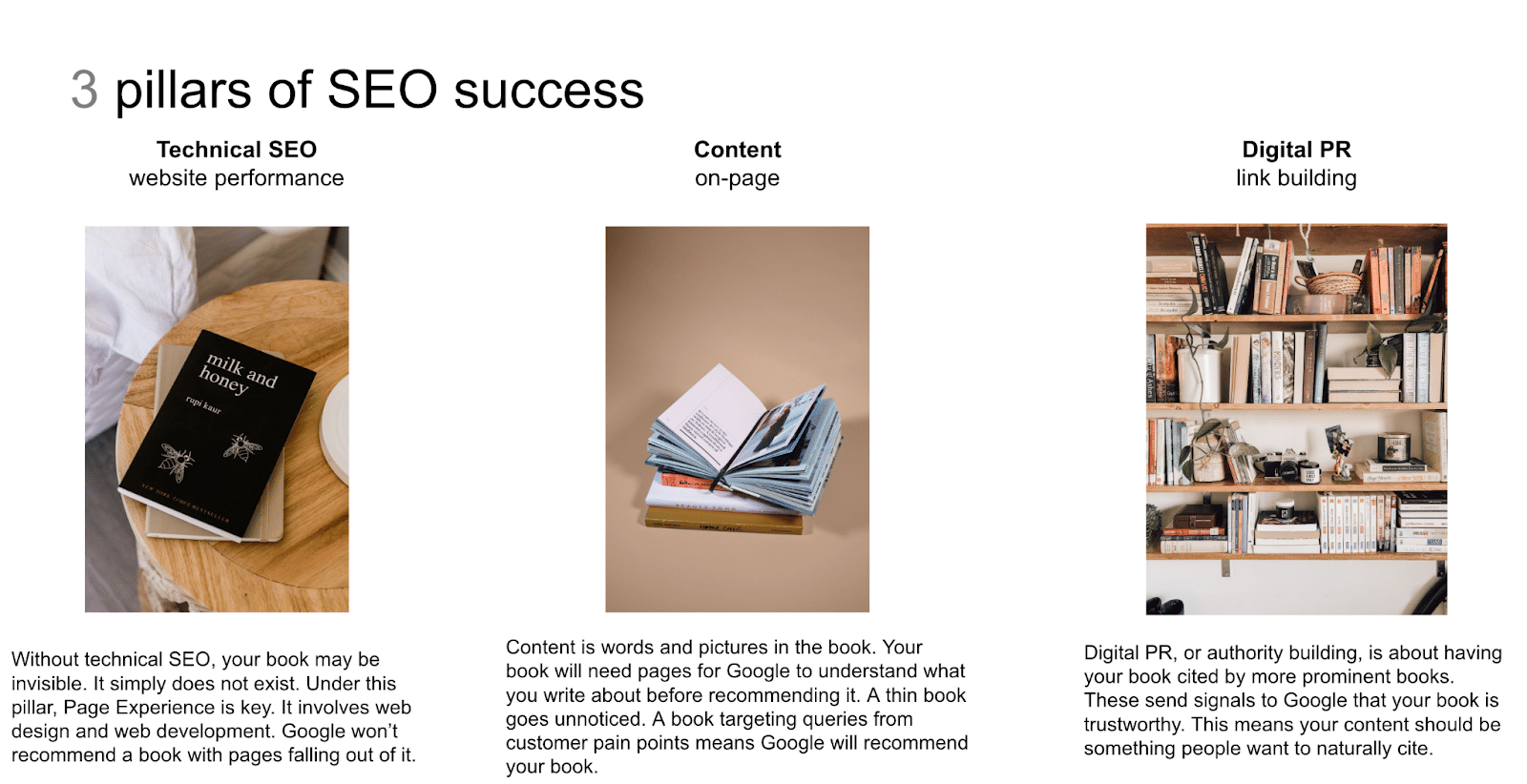
Here is an example of how I explain SEO.
I build my strategy following these three pillars, understanding that all of them will overlap in execution.
My deck will dedicate three sections for:
- 3-5 technical SEO recommendations
- 3-5 content recommendations
- 3-5 link building recommendations
What you uncover in your audits will determine how many recommendations you share and if you even have time to dedicate to link building.
Get the daily newsletter search marketers rely on.
<input type=”hidden” name=”utmMedium” value=”“>
<input type=”hidden” name=”utmCampaign” value=”“>
<input type=”hidden” name=”utmSource” value=”“>
<input type=”hidden” name=”utmContent” value=”“>
<input type=”hidden” name=”pageLink” value=”“>
<input type=”hidden” name=”ipAddress” value=”“>
4. Goals give your strategy meaning
Get page speed score to 80+.
Increase organic traffic sessions by 20%.
Watch the last 25 hours of Letter Kenny by Saturday night.
Break down my monthly budget to see how much money I spend on breakfast burritos.
Hey, goals are goals.
C-suite executives love talking about goals, forecasting, and OKRs. Give them what they want.
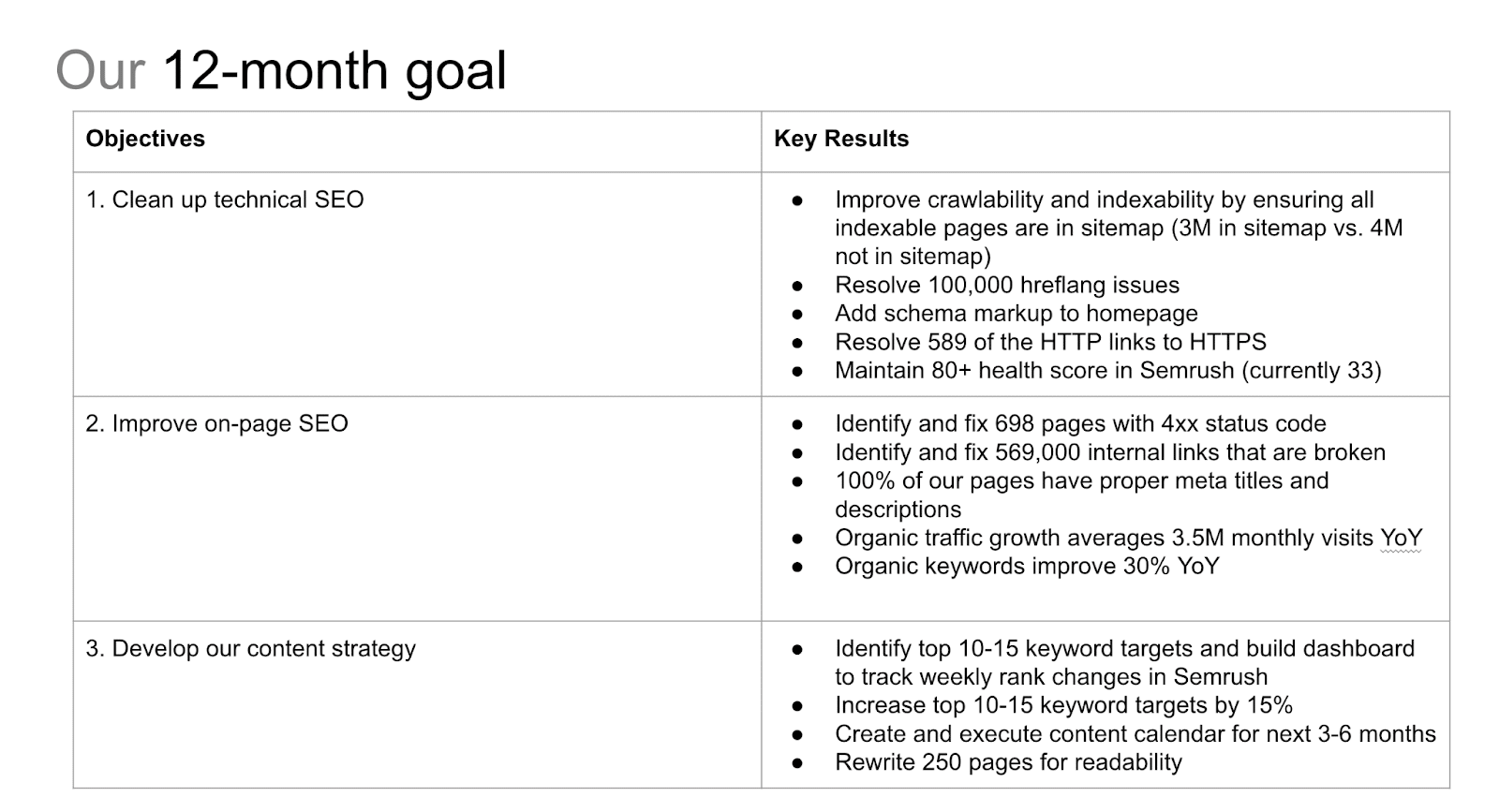
Here is an example of my 12-month goals.
5. Walk through your roadmap
Your SEO roadmap is a guide to the success of your enterprise SEO strategy. It showcases accountability to your vision and acts as a plan for execution.
I use Asana for our SEO roadmaps broken down by months and quarters to roll up to a full-year roadmap.
This is often a big win when presenting to executives. Remember to keep it short and sweet by clustering topics into themes.
For example, I bucket all content topics for the month into one section and tags. This way, if I want to display all the content work for the year, it’s a quick filter.
Be open and honest about any hesitations on your delivery to avoid disappointments at the end of the year.
6. Close with the next steps and Q&A
Always leave at least 15 minutes at the end of your presentation to discuss action items for everyone on the call and open the floor for questions.
Make your enterprise SEO strategy legendary
There are many paths to becoming a legend at your company.
Some people summit Everest.
Others become brown nosers of the right people.
And some lead by example, like you will if you follow these steps when creating an enterprise SEO strategy.
Luckily, showing your work costs you nothing but time.
The post 6 steps to a winning enterprise SEO strategy appeared first on Search Engine Land.
Courtesy of Search Engine Land: News & Info About SEO, PPC, SEM, Search Engines & Search Marketing
Wednesday, March 22nd, 2023
Microsoft has just announced a non-targeting solution to help brands to leverage keywords without the constraints of traditional keyword targeting. The approach aims to maximize reach and performance for advertisers while simultaneously increasing advertising revenue for retailers.
The limitations of traditional keyword targeting. Keyword targeting has long been the go-to approach for search advertising in retail media. However, exclusively focusing on keywords can limit a campaign’s performance and spend-through, thereby constraining the revenue potential for retailers. This is because shoppers on retail websites often browse through categories rather than searching for specific products, which renders keyword targeting less effective.
The potential of category-based targeting with keywords. In response to the challenges posed by traditional keyword targeting, Microsoft PromoteIQ developed a solution to target shoppers based on the categories they browse while using keywords as a booster for campaign bids. This hybrid approach allows advertisers to tap into both audience behaviors, resulting in improved performance for both retailers and advertisers.
The benefits. Advertisers can utilize this new solution to boost bids with keywords for shoppers searching for specific products, increasing the likelihood of converting purchase intent into a sale.
Retailers, on the other hand, can optimize their site experience by using product taxonomies and categorization, making it easier for shoppers to find what they want. By integrating category-based targeting with keyword boosting, Microsoft’s AI-driven algorithms can deliver more relevant ads, enhancing the overall shopping experience.
Efficiency in Campaign Management. Unlike traditional keyword targeting, which necessitates extensive research and the creation of a comprehensive keyword list for each campaign, the new solution only requires advertisers to test and retain a few high-performing keywords. This streamlined process should ideally result in greater demand for retailers, as they no longer have to deal with exhaustive keyword lists.
Early testing. “Tests have shown that applying this unique solution has delivered impressive results. Campaigns that boost bids by keyword while targeting by category exhibit 320% higher click-through-rate (CTR) than the campaigns without boosting bids by keyword,” Microsoft says.
Dig deeper. Read the announcement from Microsoft here.
Why we care. This latest development in category-based targeting with keyword leveraging is supposed to maximize revenue and sales for both retailers and advertisers, while also delivering an exceptional experience for shoppers. Interested advertisers should test the new
To learn more about this cutting-edge solution, visit the Microsoft PromoteIQ website or inquire about their services.
The post New Microsoft Ad solution targets shoppers based on categories, uses keywords as “boosters” appeared first on Search Engine Land.
Courtesy of Search Engine Land: News & Info About SEO, PPC, SEM, Search Engines & Search Marketing
Wednesday, March 22nd, 2023
Understanding macro trends is crucial for making informed decisions within your PPC account. This is why businesses must create a holistic monitoring plan that takes all relevant data points into account.
3 ways to stay on top of PPC performance covered how to monitor your paid search performance comprehensively.
This article will demonstrate how to set up monitoring and analysis processes for macro-level events that impact your overall PPC performance and business.
Contextualize your PPC performance with macro-trend monitoring
Various external factors may impact your paid search efforts. Thus, your PPC monitoring plan should help you surface emerging trends in your industry so you can adapt your advertising strategies accordingly.
Tracking news cycles, PR, and competitor activity can provide valuable insights into your industry and how your advertising performance compares.
Here are some benefits of macro-trend monitoring for PPC:
- Crisis management: Monitoring PR through Google alerts can help you quickly identify negative press or publicity. You can then immediately mitigate potential damage to your brand reputation.
- Opportunity identification: When you are on top of competitor activity, you’ll know what’s working and not in your industry. Use this to determine new growth opportunities and develop strategies to differentiate your brand from competitors.
- Benchmarking: Comparing your PPC campaigns to your competitors’ also provides benchmarks for campaign performance. Clear benchmarks set realistic goals and expectations for your advertising efforts and specify areas that require optimization.
- Cost savings: By monitoring macro-trends, you can optimize your ad spend based on industry trends and market conditions.
This can result in significant cost savings and help companies to achieve a better return on investment (ROI) for their advertising efforts.
Tools for monitoring macro trends
These monitoring tools are useful for staying on top of PPC macro trends.
- Google Analytics: This free web analytics tool provides data on website traffic, user behavior, and conversions. It helps you track and analyze your paid search campaigns’ performance and identify improvement areas.
- Google Search Console: Tracking organic search metrics, such as impressions, clicks, and click-through rates, can inform your paid search strategy.
- Google Trends: This free tool tracks search trends and patterns across different regions and languages.
- Google Alerts: You can customize this to track mentions of keywords or phrases in a specific language, region, or source, such as news, blogs, or videos. Choose the frequency of alerts, ranging from “as it happens” to “once a day” or “once a week.”
- Earnings reports: You would be surprised at how informative earnings reports for publicly traded companies can be. If you have a client in this category, you should attend their earnings calls.
Get the daily newsletter search marketers rely on.
<input type=”hidden” name=”utmMedium” value=”“>
<input type=”hidden” name=”utmCampaign” value=”“>
<input type=”hidden” name=”utmSource” value=”“>
<input type=”hidden” name=”utmContent” value=”“>
<input type=”hidden” name=”pageLink” value=”“>
<input type=”hidden” name=”ipAddress” value=”“>
Anticipate potential trends and fluctuations with projections
Year-over-year (YoY) projections based on historical data can set realistic expectations for your campaign result.
YoY projections improve forecasting accuracy, enable you to make data-driven decisions, facilitate long-term strategic planning, and improve accountability.
Tools to build performance projections
A few free resources can help you build projections based on your historical PPC performance.
Microsoft Advertising, Google Ads and Google Sheets
Download your historical performance data directly from the ad platforms (Google and Microsoft) to create month-to-month projections for the upcoming year.
You will want to adjust your forecasts by excluding data impacted by specific strategies or changes in your PPC accounts.
For example, your company may have run a one-time sale over the summer, which boosted sales. But this is not an annual sale, so it should not be built into your projections model.
Google Performance Planner
Performance Planner is a free tool offered by Google Ads that helps advertisers create and forecast the performance of their Google Ads campaigns.
You need to input essential information about your campaign, such as your target location, ad format, bidding strategy, and budget.
You’ll also need to list keywords you plan to target in your campaign. Once you’ve entered this information, the Performance Planner will analyze historical performance data from your Google Ads account and use machine learning algorithms to project how your campaigns will perform in the future.
Paid tools
If you want to develop a more robust projections program, you could check out the following tools:
- Optmyzr: Optmyzr has a forecasting feature where you can estimate the potential performance of your Google Ads campaigns based on your budget and other key metrics.
- AdStage: AdStage lets you estimate the potential performance of your campaigns across multiple advertising channels, including search engines.
- NinjaCat: Ninjacat’s ability to forecast PPC performance involves using historical data to predict future outcomes. The platform can analyze past PPC performance data, including clicks, impressions, conversions, and other relevant metrics.
Competitor monitoring informs your macro-level analysis
Regularly checking your competitors’ advertising activity can give you a better understanding of what’s working for them and what isn’t.
Tools to help with competition monitoring
Discover competitive insights with the core PPC platforms. Google and Microsoft provide tools that offer insights into competitor activity.
Google Ads Auction Insights
Google Ads Auction Insights is a free tool that compares your performance to other advertisers in the same auction.
You can use it to see how often your ads are shown alongside your competitors’ ads and identify areas where you may fall behind.
Microsoft Advertising Competition Tab
The Competition Tab provides valuable competitive insights for your campaigns. Their Auction Insights reports can give an overview of your competitors’ performance metrics and how they compare to yours.
Google Alerts
You can use Google Alerts to monitor your company, but it’s also an excellent strategy to set up alerts for your main competitors. They may make significant announcements that would be insightful for your campaigns.
Earnings reports
If you have critical competitors in your industry, you should also consider attending their earnings! You can gain valuable insights from these calls. Companies provide earnings reports, strategic initiatives, and more.
Paid tools
Some helpful paid subscription tools can help inform your competitive monitoring practices. Check out the tools listed below if you need more than the free tools.
- Semrush allows you to analyze your competitors’ organic and paid search strategies. You can use it to determine which keywords your competitors rank, what ad copy they use, and their budget.
- SpyFu specializes in competitive analysis for PPC advertising. It lets you see your competitors’ ad history, top-performing keywords, and ad copy variations. You can also use it to identify negative keywords that your competitors use, which can help you optimize your campaigns.
- SimilarWeb: SimilarWeb provides insights into your competitor’s website traffic, including where their traffic is coming from, what pages are performing well, and what channels they use to drive traffic.
Stay on top of macro trends
Numerous external factors can impact your PPC performance. Therefore, you should prioritize campaign performance and optimize based on that data.
Understanding your competitive landscape and monitoring trends and competitors will help provide you with a slight edge.
The post How to keep up with macro trends that impact PPC performance appeared first on Search Engine Land.
Courtesy of Search Engine Land: News & Info About SEO, PPC, SEM, Search Engines & Search Marketing
Wednesday, March 22nd, 2023

In the modern e-commerce world, personalization is everything. It’s what engages customers, inspires them, and keeps them coming back. As the global economy remains uncertain, it’s important to apply those personalization tactics to your tried-and-true customer communication strategy — email marketing.
Simply put, first-party data is the fuel you need to drive successful email personalization initiatives and strategies in e-commerce. Specifically, first-party data is customer information that your company collects directly via its own channels and sources with the customer’s consent. These channels include email, mobile apps, websites, social media, SMS and more. Since you are collecting this data yourself, it makes the data unique, as no other company can collect these specific data points. Advancements in modern marketing technology make it possible to centrally access this information and use it in marketing automation campaigns.
You can comfortably rely on this data for one massive reason — you’ve sourced it yourself. You know you’ve collected it compliantly and can now use it to strategize and scale winning customer journeys with your brand.
Building your email personalization around first-party data guarantees that your personalization efforts are all-encompassing. It ensures that your company is using its collected customer data to transform the customer experience and drive brand loyalty meaningfully.
Perhaps the most important right now, relying on the channel (email) consistently recognized as the highest-ROI medium for any marketing team is the most financially savvy move your company can make. Creating personalized email campaigns with the right all-in-one platform will allow your company to generate fast ROI at scale without adding additional resources and overburdening your team and can also save your practitioners time when creating those emails. An all-in-one platform will be especially essential if your company needs to cut ties with outside agencies and start handling all marketing initiatives in-house, all while cutting back on advertising spend across the board.
Just because recession-like conditions are on the horizon, that doesn’t mean that your company’s marketing and revenue-generating efforts must suffer. Investing more of your budget into email can result in your company getting significantly more in return. Find out more about preparing your marketing for economic uncertainty by reading this insightful guide.
The post Email is key to marketing in an unpredictable economy appeared first on Search Engine Land.
Courtesy of Search Engine Land: News & Info About SEO, PPC, SEM, Search Engines & Search Marketing
Tuesday, March 21st, 2023
rel=next/prev was not found on Google. That’s an error.
In 2019, we learned Google had stopped supporting the rel=next/prev markup it had introduced in 2011.
Worse than that, Google hadn’t been using it for indexing for a “number of years,” according to Google’s John Mueller.
All the while, Google continued to recommend using it, so SEOs, publishers and developers invested resources into implementing and maintaining the markup – all for no benefit.
Google apologized for the “oversight” a day later.
Also on this day
2022: The update also included support for custom actions and action triggers, conversion goals, shared audiences and more.
2019: But no, this didn’t confirm Google was using engagement metrics in rankings.
2019: Neural matching helped Google better relate words to searches, while RankBrain helped Google better relate pages to concepts.
2019: The company also announced new fact-checking tools and other efforts to stop the spread of ‘misinformation.’
2019: The latest upgrades made to Bing around voice, image and answer search.
2019: Alexa devices dominated, but higher Google Home NPS scores suggested it would have better word of mouth and could gain market share.
2019: The buy reportedly required a minimum $35,000 budget.
2018: Google was able to crawl, index and rank them.
2018: Subscribers would see articles from their subscribed publications higher in the search results and be logged in to those publications across devices.
2017: The shortcuts offered quick answers on weather, sports and entertainment info.
2014: From the keyword tab, advertisers could add several columns to their reporting from the Bid simulator section offered in the Customize Columns menu.
2014: 33 of 50 participants in a usability study preferred the “clean,” “fresh” and “uncluttered” new version.
2014: You could tell Google you only wanted alerts for specific keyword phrases within a specific region or country or a specific language.
2014: It mocked searchers, Google Doodles, Google Glass and Bing.
2014: The latest images showing what people eat at the search engine companies, how they play, who they meet, where they speak, what toys they have, and more.
2013: When you searched for [Angel Tompkins], the image shown for her was from a site that appeared to be a spam blog with nude images of people.
2013: Another open letter about how poorly the service was working.
2013: Bing expanded Satori to include more people, places and things.
2012: It would further reduce the ability for publishers to know how people find their sites in Google — except for Google advertisers.
2012: Google gave AdWords users a new way to figure out whether their ads are approved, or not, and why.
2012: Enhancements would include broad match modifier, AdCenter Express and more.
2011: An annual study ranked Google the top place for young working professionals to work at.
2011: Google was the No. 1 source of traffic for 26 of the 35 properties analyzed (74%), and Google traffic had increased or stayed the same since last July for 24 of them (69%).
2011: Google implemented changes to Google Partner Search to make it easier for the two parties to get in contact.
2011: This was the first fine/penalty any country had levied against Google over the WiFi data collection.
2011: A Berlin court vindicated Google Street View operation in Germany.
2011: Use the wrong spelling, and your story might go missing. Could search tell us the “right” one?
2011: Google blamed the Chinese government for “politically motivated attacks” that had disrupted Gmail service for some Chinese users.
2011: If approved by US regulators, AT&T would have become the largest wireless carrier by a wide margin.
2011: The company shared a new video, new website, blog posts, and had a national TV appearance on tap.
2008: The reports within the benchmarking feature included visits, pageviews, pages/visits, bounce rates, average time on site and new visits.
2008: Google had implemented this feature as a default on other non-U.S. based search engine home pages but never as the default at Google.com.
2008: LinkedIn, with help from BusinessWeek’s CapitalIQ, added a company directory and related factual information to its business network.
2008: A fascinating inside glimpse into Wikipedia’s finances, and the people responsible for both raising money and spending it. And more.
2008: The latest images showing what people eat at the search engine companies, how they play, who they meet, where they speak, what toys they have, and more.
2007: Google won the case brought against them by KinderStart over Google downgrading their rankings.
2007: You could add a snippet of code on your site to show off the most popular queries performed by your readers.
2007: Google pushed back on earlier reports of building its own cell phone.
2007: “I’m totally all smiles,” Semel said about Panama.
2007: A quick roundup of some local search news.
2007: Bourdoncle co-founded Exalead with the goal of revolutionizing the search engine software market by providing users with a unified technology platform to access information in the enterprise.
2007: Rebranding itself somewhat as a “community” search engine, PreFound, like others, was trying to build a human-edited layer on top of general (in this case Google) search results.
From Search Marketing Expo (SMX)
Past contributions from Search Engine Land’s Subject Matter Experts (SMEs)
These columns are a snapshot in time and have not been updated since publishing, unless noted. Opinions expressed in these articles are those of the author and not necessarily Search Engine Land.
< March 20 | Search Marketing History | March 22 >
The post This day in search marketing history: March 21 appeared first on Search Engine Land.
Courtesy of Search Engine Land: News & Info About SEO, PPC, SEM, Search Engines & Search Marketing
Tuesday, March 21st, 2023
This truly is an unprecedented time in the life of the marketer: Groundbreaking generative AI technology, increasing customer expectations of personalized experiences, a growing emphasis on respecting user privacy… the list goes on.
Attend MarTech, online March 28-29, for free to explore these critical trends – and the solutions, strategies and tools you need to stay a step ahead of the competition.
Tune in live for Overtime – extended Q&A with select speakers, your chance at a free book giveaway from keynote speaker Sangram Vajre, and engaging Coffee Talk networking meetups on ChatGPT, GA4 and MOps!
Can’t attend live? On-demand access is included with your free pass so you can explore at your own pace.
Grab your FREE pass now!
The post ChatGPT. GA4. Privacy-First CX. Explore it all online – next week – for free! appeared first on Search Engine Land.
Courtesy of Search Engine Land: News & Info About SEO, PPC, SEM, Search Engines & Search Marketing
Tuesday, March 21st, 2023
To get results from paid search, you’ll need to deliver better campaigns and increase your bids, which drives costs up.
However, increasing your bids won’t always mean more clicks. Eventually, you’ll reach a point where increased bids will only return little to no gain.
This is the law of diminishing returns at play. When running PPC campaigns, you are contending with this concept and many other factors outside your control.
In this article, we’ll explore the law of diminishing returns and various factors making paid search even more demanding today. This will help you set better expectations when assessing your PPC performance.
The law of diminishing returns
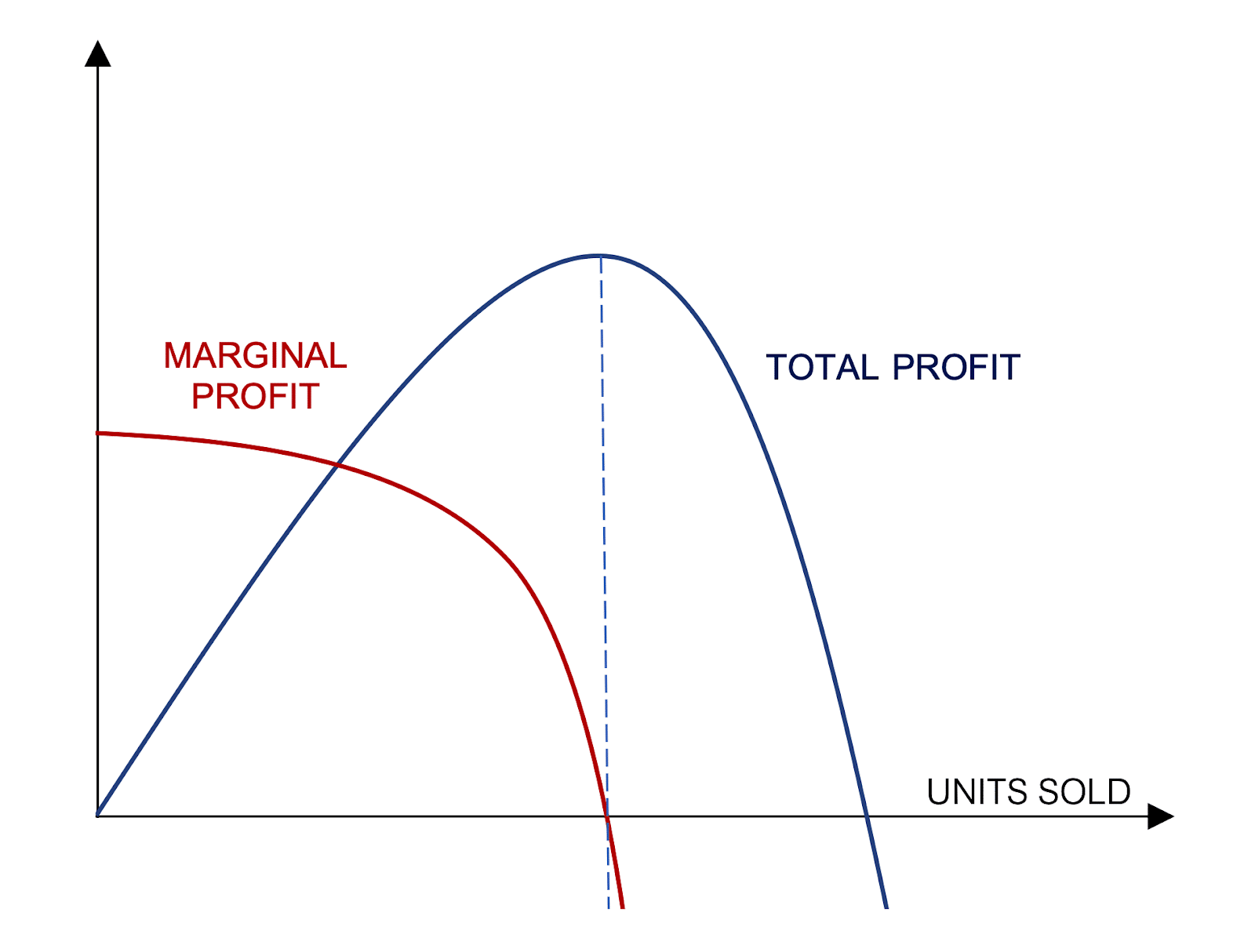
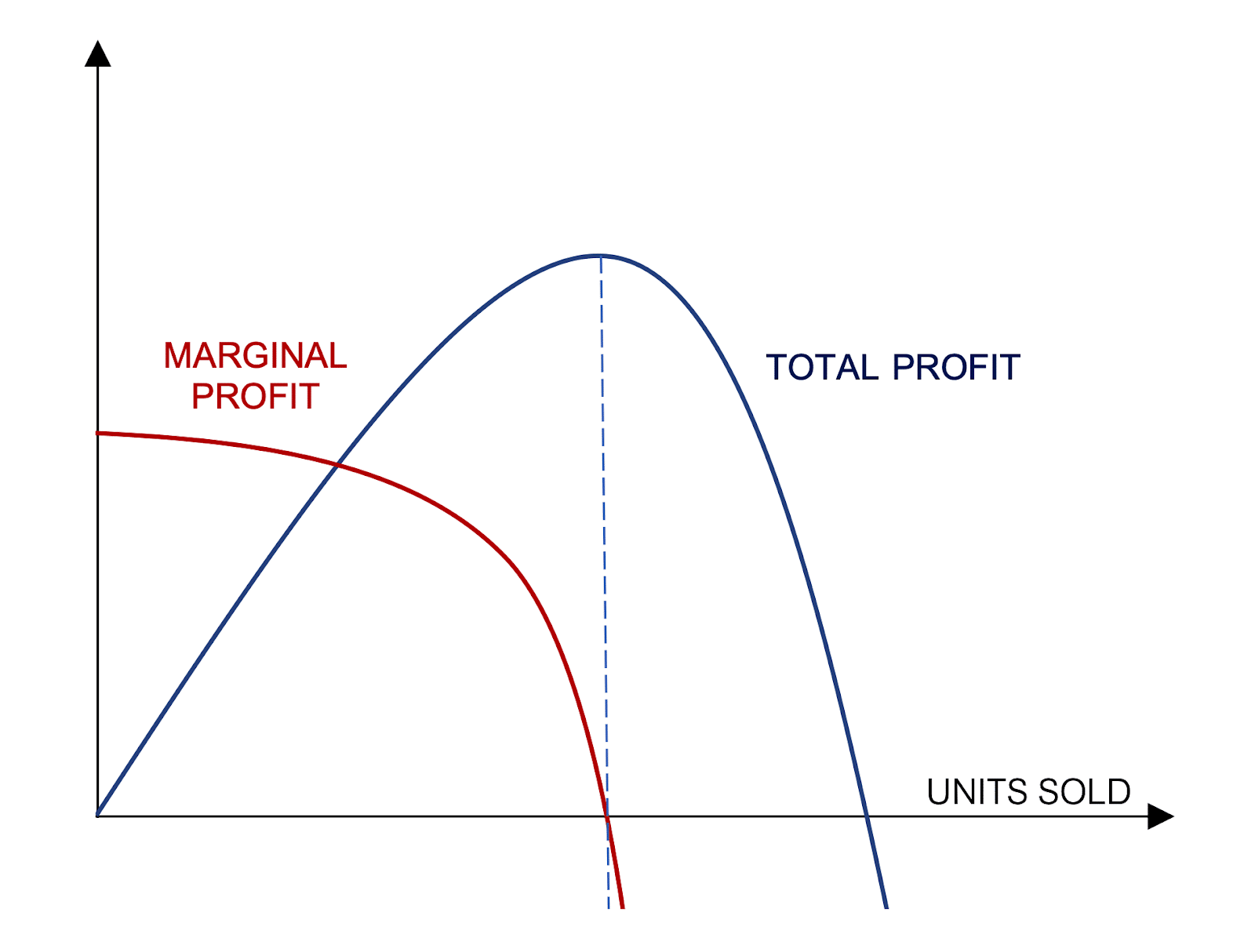
In economics, the law of diminishing returns states that as an organization increases its investment in a specific area, the rate of profit generated by that investment will eventually reach a point where it cannot continue to rise, assuming that all other variables remain constant.
For this reason, additional investment in that area will result in a decreased rate of return. At a certain stage of expansion, the return on investment that applies to additional units produced (marginal ROI) reaches a negative value.
Beyond this point, the total outcome will start declining. Even if it remains positive, it is not as high as the maximum.
This principle highlights the importance of finding the optimal level of investment to maximize the overall profit. The “sweet spot” is where the marginal ROI changes from positive to negative, specifically where the marginal return equals zero.
As every resource is limited, we observe that the supply shows decreasing responsiveness to the price change, and eventually does not matter how high the price is. The supply won’t be higher. This phenomenon is described as the law of diminishing elasticity.
Price elasticity (E) measures the responsiveness of the demand or supply to a change in the price of a good or service. It is calculated as the percentage change in the quantity of a good or service demanded or supplied in response to a percentage change in its price.

Sometimes the symbol of increase “∆” is replaced by “d” to indicate that it refers to a small change.
If the price elasticity is greater than one, the demand or supply is said to be elastic, meaning that a slight change in price leads to a relatively larger change in the demand or supply. If the price elasticity is less than one, the demand or supply is said to be inelastic.
Get the daily newsletter search marketers rely on.
<input type=”hidden” name=”utmMedium” value=”“>
<input type=”hidden” name=”utmCampaign” value=”“>
<input type=”hidden” name=”utmSource” value=”“>
<input type=”hidden” name=”utmContent” value=”“>
<input type=”hidden” name=”pageLink” value=”“>
<input type=”hidden” name=”ipAddress” value=”“>
Why are CPCs so high?
The laws of diminishing returns and elasticity apply to advertising.
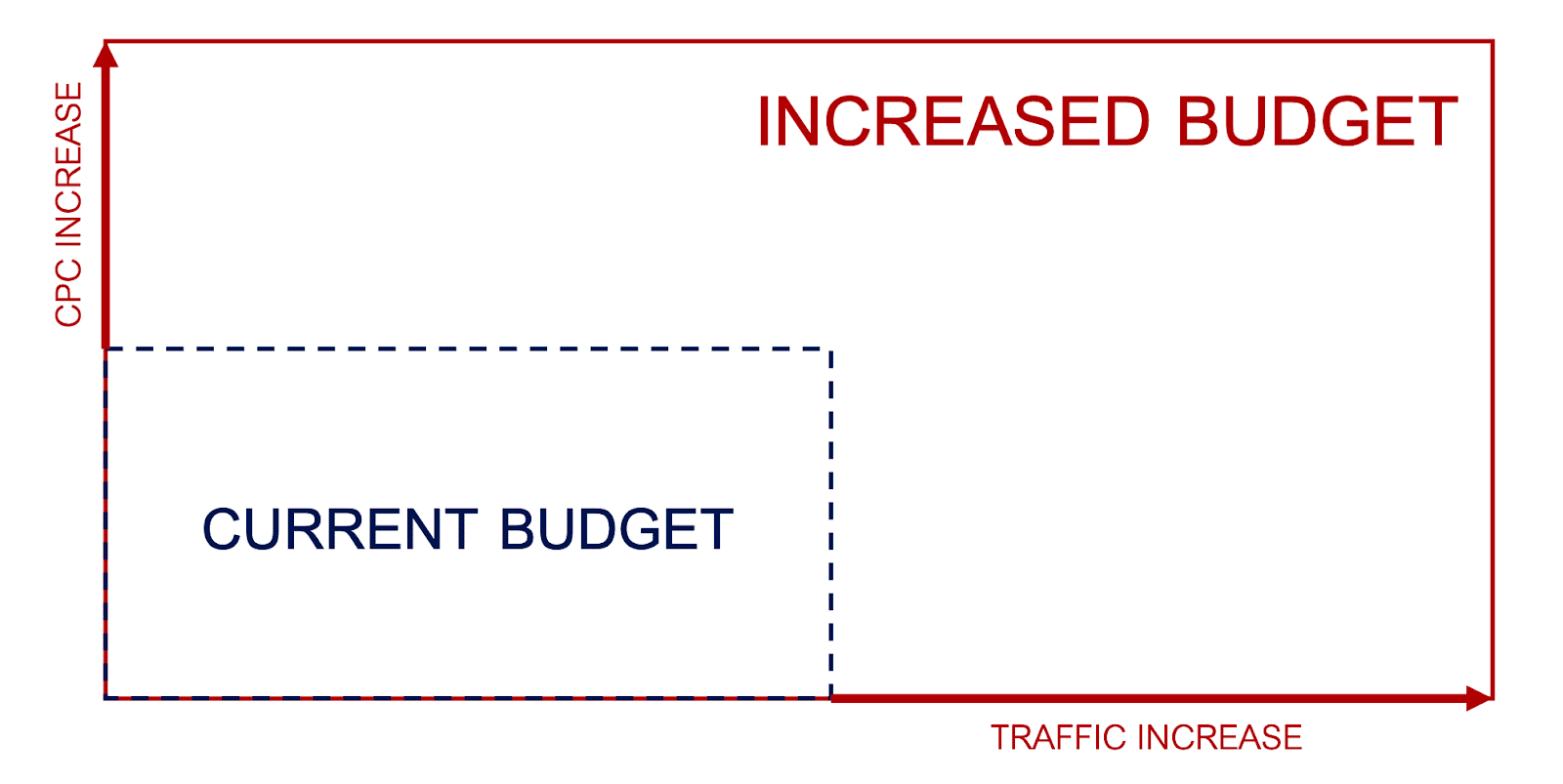
To generate more traffic and conversions through PPC, you have to be more aggressive and competitive, increasing bids and, in turn, accepting higher conversion costs.
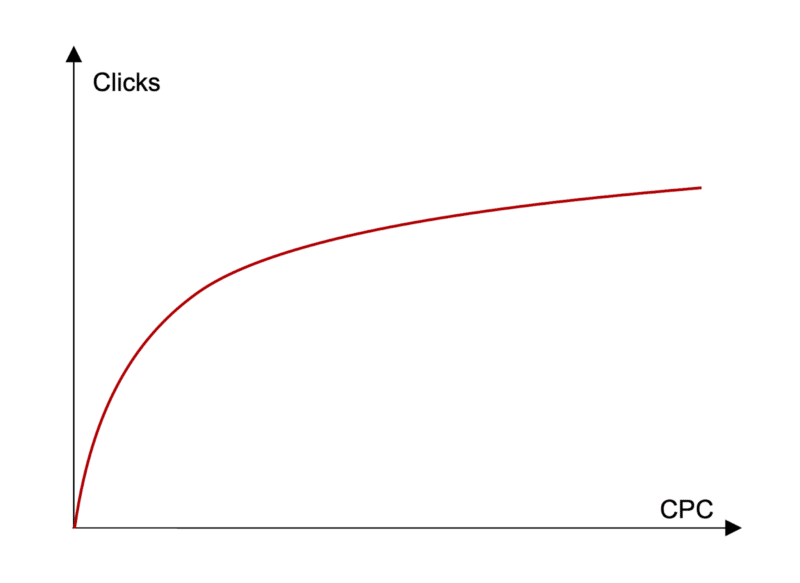
Increasing cost per click (CPC), however, leads to smaller and smaller increases in traffic. Eventually, you’ll reach a point when there’s no chance to get more traffic from a specific keyword (i.e., if the ad ranks #1 for all searches with 100% impression share).
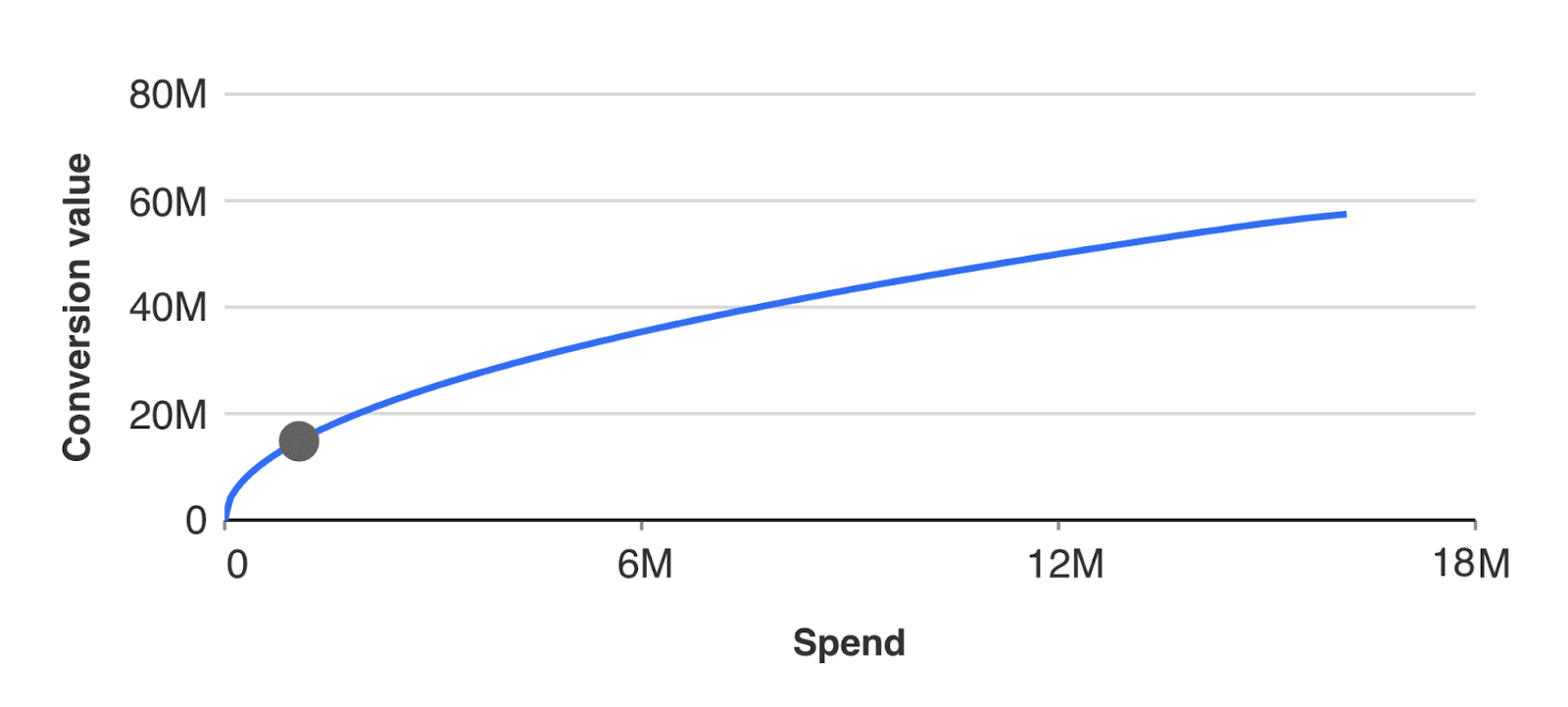
The law on diminishing returns is also reflected in the total budget. You can see how these costs can change in the Google Ads Performance Planner, as shown in the illustration below.
In most cases, the relationship will be fairly straightforward for campaigns that are not under or overinvested. To get 10% more traffic, you need to accept a ~10% higher conversion cost or a ~10% lower return on ad spend (ROAS).
This means that Google’s typical price elasticity of supply (the relative ratio of traffic increase to CPC increase) is 1.
Why is this the case? If a vendor increases their margin by 10% and loses 20% of their customers, this operation will result in a loss, and prices will likely be too high.
If a 10% increase in margin only causes 5% of customers to leave, the seller will increase their profits, and previous prices were too low.
The point at which the price is most optimal for the seller is where a 10% increase in margin results in a 10% decrease in the sales volume, making the change neutral for profits. In other words, the sales profits are highest if the price elasticity of demand is 1.
For Google, the sales margin virtually equals advertising revenue because the variable costs of the ad impression and click are negligible.
To maximize their profits, they should maintain a price elasticity of 1 – which explains how the auction algorithm works and why this regularity exists on the market.
Why does it cost so much?
In PPC, the natural consequence of the law of diminishing returns is a non-linear increase in budget to scale the campaign.
With elasticity E=1, which is typical for the market, doubling the traffic and sales volume is associated with doubling the CPC, resulting in a four-fold increase in budget.
At other levels of elasticity, these proportions will be different. But it is unrealistic to think that doubling the budget will lead to doubling sales in a given channel.
Marketing and business plans often reflect such expectations, only to fall through later. Expansion is costly, and the truth is even more bitter than this.
Google and Meta are here to do business
The cost of acquiring an additional click (i.e., the marginal cost per click or CPCm) is almost always higher than the actual CPC. By definition:
Also, by definition, the elasticity:
Therefore:
It means that at E=1, buying additional clicks is twice more expensive than the current cost per click. The same calculations apply to Effective Revenue Share (ERS = Cost / Revenue)
Advertisers benefit from investing in advertising as long as the marginal cost is lower than their profit margin (i.e., they get additional profit through advertising).
When the marginal effective revenue share reaches ERSm=1, advertising costs consume the entire revenue. Further, expansion will have negative marginal revenue and the total revenue will start to decrease. Thus, the campaign generates maximum total profit when:
That is:
As ROAS = 1/ERS = ROI + 1, this formula can be written as ROAS = 1 + 1/E or ROI = 1/E.
A simple formula can define the areas of under and overinvestment and the optimum level.
If E = 1 (the typical market elasticity), the maximum total profits from advertising occur when ROI = 100% or ERS = 0.5.
It means that, on average, advertisers increase their profits until they spend 50% of their profit (without considering fixed costs) on PPC ads.
Of course, particular advertisers who advertise more or less aggressively may be in a different area of elasticity than E=1. Therefore, the ERS/ROAS/ROI maximizing advertiser profits will be higher or lower.
For every $1 invested in Google search, U.S. companies earn $2. This is how Google wants to see it, but it also means that companies give half their profits to these tech giants.
There’s no way around it
The laws of economics and the free market put businesses in a situation where Google, Meta and other ad platforms get half their sales margin before fixed cost.
Whether we like it or not, these are the rules of advertising. Understanding how the system works makes it easier to create realistic expansion plans and avoid disappointments.
The post PPC is a tough game – you have to accept it appeared first on Search Engine Land.
Courtesy of Search Engine Land: News & Info About SEO, PPC, SEM, Search Engines & Search Marketing