Archive for the ‘seo news’ Category
Wednesday, April 5th, 2023
It’s one of the most popular marketing and sales channels, but email isn’t as easy to leverage as it seems. For your emails to convert, it takes more than writing a few lines and hitting send. Everything plays a role in your email success, from the health of your email database to your copywriting skills.
If your email marketing feels stale, these tactics are sure to help you:
- Understand how email deliverability works – and how email verification helps
- Craft emails that feel tailor-made for your ideal prospects
- Improve your metrics and increase email revenue.
How to make more sales with email: assess your current performance
Before you drastically change your email marketing strategy, it pays to take a step back and assess how your emails have been performing. That will allow you to identify what resonates most with your audience so you can create more similar emails.
Take a close look at your metrics and notice what stands out. Your past three to six months’ performance will be a good indicator. Plan to double down on those approaches to boost engagement and conversions. Then, consider these tactics below to ensure your email marketing has the highest chance to succeed.
Are your emails reaching the inbox? Check your email list
You might be spending significant resources on email marketing. Writing and designing great emails isn’t easy. But are those emails landing in your prospects’ inboxes? Low engagement can often be caused by an outdated email list and a poor sender reputation.
Your sender reputation is a score that internet service providers assign to you as a sender, much like a credit score. Everything you do determines your score, but your email list health dramatically impacts it. For instance, whenever your bounce rate exceeds 2%, your score takes a hit. Spam complaints and fake emails also affect your reputation. When that happens, your newsletters and campaigns will go to the spam folder.
If you’ve never scrubbed your database, consider using a free email validation service first. With ZeroBounce, you can check 100 email addresses for free every month to ensure you’re adding only genuine contacts to your list.
Segment your database for higher engagement
Your email subscribers are in different stages of their buyer journey with your company. While some may be long-term customers, others are still on the fence about purchasing. Each segment has different needs and expectations, and creating emails that speak directly to these groups should be high on your list.
Segmentation can be challenging for many marketers, but you can start with basic filters. Use criteria such as gender, location, and purchase history, then think of ways to engage these prospects with the most relevant offers. Personalize every email campaign using available data, and remember that one email is usually not enough to make a sale. Drip campaigns are more effective as they periodically nudge your prospects and build familiarity with your brand.
Make your emails highly educational
When email conversions drop, many marketers tend to try a more aggressive approach – more emails, more direct offers and higher discounts. But could you benefit more from inbound tactics instead?
Instead of pushing for sales, inbound marketing focuses on attracting prospects with relevant, helpful resources and experiences. Creating content that answers questions, solves problems, and makes people’s lives better is a great way to strengthen your brand.
Even if you’re running a direct marketing campaign, you can still present your offers in an educational way. Instead of leading with a “buy now” approach, focus on the benefits of your products and services. Build loyalty with your audience by establishing your brand as a reliable, relevant source of information and education.
Bonus tip: send your emails consistently
One final tip to increase sales with your emails is to providea steady sending schedule. Whether you set up automated drip campaigns or send a newsletter, be consistent in your efforts. Sending emails regularly helps your reputation, boosts email deliverability, and keeps your business relevant to your prospects.
So, if you have an email newsletter, remember to send it on time, ideally on the same day every week or month. Your nurturing campaigns should also be timely – check and update your automations to confirm each trigger works correctly. Staying on top of these details and sending useful emails to a healthy email list will boost your email marketing results quickly.
Explore ZeroBounce’s email validation and deliverability tools.
The post 3 ways to drive sales with email appeared first on Search Engine Land.
Courtesy of Search Engine Land: News & Info About SEO, PPC, SEM, Search Engines & Search Marketing
Tuesday, April 4th, 2023
The staggering amount of global change in the past years has presented search marketers with an unrivaled amount of challenges… and opportunities. Customer expectations are sky-high, user experience is more important than ever before… and the critical rise of generative AI is changing the face of search marketing as we know it.
Explore these and more essential issues and the actionable tactics you need to tackle them head-on… online at SMX Advanced for free. No expense reports. No airline ticket. No kidding.
Registration is open! Secure your free pass now!
Unlock the entire SMX Advanced program, including expert-level sessions, invaluable community networking, hours of live Q&A with industry legends, a personalized certificate of attendance, and more — all for free.
This is the only conference designed by advanced search marketers for search marketers. Don’t miss your once-a-year opportunity to join us at SMX Advanced and learn sophisticated, brand-safe, actionable tactics that can help you deliver more qualified traffic, drive revenue, and stay a cut above the competition.
The agenda will be posted in early May… stay tuned for some program sneak peeks!
The post SMX Advanced registration is open… grab your free pass now! appeared first on Search Engine Land.
Courtesy of Search Engine Land: News & Info About SEO, PPC, SEM, Search Engines & Search Marketing
Tuesday, April 4th, 2023
People who rushed to download the Microsoft Edge browser to try out the New Bing Chat experience – ironically – ended up using Google Search on Edge, according to new data from enterprise SEO platform BrightEdge.
Why we care. We’re watching closely for any data indicating whether the New Bing is starting to chip away at Google’s massive lead in search. What we see here is more evidence that Microsoft is driving more traffic to sites – in a twist, they’re doing it via Edge instead of Bing.
What the data shows. Google fairly consistently sent more than 3 million visits to websites since the start of 2023. Starting around Feb. 19, however, there is a noticeable uptick in Google traffic coming from the Edge browser. That number grew to roughly 3.7 million visits by the week of March 12.
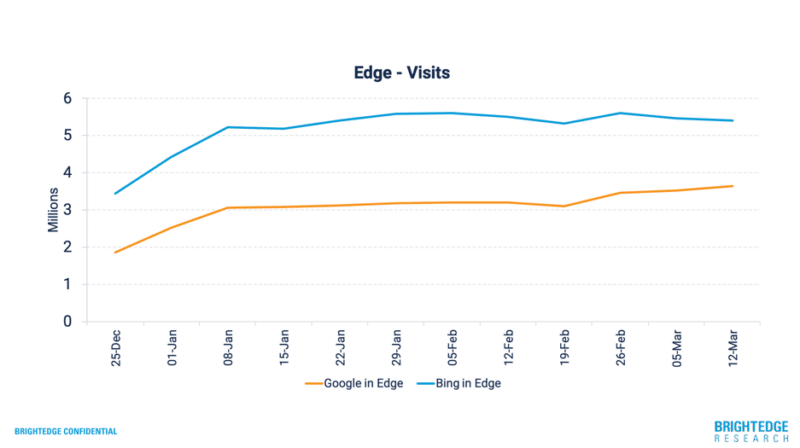
Meanwhile, traffic from Bing in Edge also showed some growth since the start of the year (from just over 5 million to about 5.5 million as of the week of March 12), but the data seems to show that as more traffic started coming from Google in Edge, less came from Bing in Edge.
For its analysis, BrightEdge examined more than 600,000 million visits to websites across all major industries, comparing U.S. traffic from Google and Bing, by browser (Chrome vs. Edge).
Google gains an Edge. More than 1 million people signed up within the first 48 hours to try out the new Bing in February, but ended up stuck on a waitlist, in some cases for weeks.
So all those people who downloaded Edge stuck with it. But when it came to searching, rather than using Bing, many started using Google Search on Edge.
One big question we will be better able to answer months from now is whether limiting the integration of GPT-4 into Bing Chat solely on the Edge browser was a missed opportunity. We just don’t have that data yet.
“It is still early to predict how Google and Bing will evolve and if there is a significant market dominance shift,” said Lemuel Park, BrightEdge co-founder and CTO. “However, Bing will undoubtedly increase in popularity as more and more people experiment with its new capabilities.”
More data. The new Bing making (small) gains on Google Search has some additional data, including page visits on Bing rising 15.8% and Bing becoming a more significant referral source for some publishers.
The post New Bing attracts new Edge users – who then use Google Search appeared first on Search Engine Land.
Courtesy of Search Engine Land: News & Info About SEO, PPC, SEM, Search Engines & Search Marketing
Tuesday, April 4th, 2023

Measuring campaign success is critical now more than ever.
Calculating the incremental lift and the resulting value that campaigns provide is a great way to assess the impact of your marketing tactics and improve the performance of channels and ROI.
So, what is incrementally, and how do you measure campaign effectiveness using incrementality testing and optimize them for success?
Register today for “Demystifying ‘Incrementality’ for Marketing Success,” presented by iQuanti.
Click here to view more Search Engine Land webinars.
The post Spend your marketing budget wisely with incrementality measurement appeared first on Search Engine Land.
Courtesy of Search Engine Land: News & Info About SEO, PPC, SEM, Search Engines & Search Marketing
Tuesday, April 4th, 2023
Implementing hreflang can be a challenging task for many SEOs. The countless syntax variations across several languages can be difficult for those with little understanding of more than one language.
There’s also the added complexity of understanding specific language nuances and regional targeting which would only typically be understood by a native speaker or someone who had thoroughly studied the language.
Incorrect hreflang implementation can cause many complications (i.e., duplicate content, erroneous indexing and poor SERP visibility) detrimental to SEO performance.
It’s imperative to implement hreflang with care. Thankfully, hreflang is well-documented and related issues can be identified through various SEO tools.
Hreflang errors study
To determine how widespread hreflang issues are and which ones are more common, I partnered with NerdyData, which gave me access to their database of websites that contain hreflang code.
NerdyData provided a list of 18,786 websites that contain at least one instance of hreflang declaring an alternate within the source code. Thus, this study only accounts for hreflang implemented in the <head>, not through XML sitemaps or the HTTP header.
I carried out the study by:
- Running crawls in Screaming Frog to validate the presence of hreflang on the homepages.
- Removing GEO-IP redirects so the complete list of URLs resolves in 200s.
- Utilizing HreflangChecker.com and Visual SEO Studio to process the URLs in batches to identify common issues identified by the tools.
31.02% of websites contain conflicting hreflang directives
My findings show 31.02% of websites serving multiple languages have conflicting hreflang directives. Conflicting hreflang can happen when a webpage has various hreflang tags for different languages and geographical targeting.
Put simply, more than one URL has been assigned to an individual language or region, sending confusing signals to search engines. For example:
- <link rel=”alternate” href=”https://example.com/” hreflang=”en” />
- <link rel=”alternate” href=”https://example.com/en-uk/” hreflang=”en-gb” />
- <link rel=”alternate” href=”https://example.com/en-us/” hreflang=”en-gb” />
- <link rel=”alternate” href=”https://example.com/en-au/” hreflang=”en-au” />
Such confusion potentially leads to complications around duplicate content and incorrect ranking and indexing, making it difficult to place well in the SERP.
Even if users find your webpage among those performing well, they will suffer poor user experience if they are served the incorrect version of the page.
16.04% of hreflang clusters are missing self-referencing tags
Self-referencing hreflang happens when a page includes a hreflang tag pointing to its URL.
In essence, the page indicates it is available in various languages, including the original language of the page.
Despite initially appearing as a redundant tactic, it’s good practice for international SEO. Unfortunately, 16.04% of sites with multiple languages have no self-referencing hreflang tags.
Search engines can better understand the relationship between different versions of the same page when self-referencing hreflang tags are used, including pages available in different languages.
Given that hreflang contributes as one of approximately 20 canonicalization signals, it’s an important signal to include.
47.95% of websites don’t utilize x-default
The x-default attribute signals to search engines that a page doesn’t target a specific language or location, defining it as a default language version of the page.
It’s especially useful when a page is available in multiple languages but doesn’t deliver content in the user’s preferred language.
The x-default attribute isn’t necessarily needed in hreflang. Up to 47.95% of multilanguage sites are currently not using it.
However, it can be beneficial to use in cases where a user searches for a page in a specific language that isn’t available, as it helps search engines find the most appropriate version of the page to display.
It’s important to note that the x-default attribute should only be used if another language isn’t available. Where other available languages exist, each should be specified with a hreflang tag.
Additionally, x-default should not be used on pages specific to a particular language or location.
8.91% of hreflang clusters contain at least one instance of invalid language codes
It is essential to use the two-letter ISO-639-1 format within hreflang attributes.
Unfortunately, it’s common for language codes to go wrong, causing multiple issues that can affect the international targeting of a website.
My research found that 8.91% of sites targeting more than one language currently contain unknown language codes.
It could simply be a confused approach to combining language and location codes, but many common issues might be the cause.
Some language codes don’t quite match the spelling of a country.
For example, you might expect the language code for Croatian to be “cr,” but it’s actually “hr.” Because the code isn’t obvious, it’s easy to make mistakes when implementing language codes.
1.6% of hreflang clusters contain at least one instance of invalid region codes
Contrary to the previous statistic, relatively few hreflang clusters contain invalid region codes.
While using the two-letter ISO-3166-1 region codes isn’t required, it does help when targeting the same language between two or more countries with different spelling rules. Doing so provides more context to search engines, looking into user location and language.
To return to my previous example, you must use the code “en-US” to target users in the United States. If it is set to “en-GB,” you will only target British-based users, missing your intended audience entirely.
Common errors here include:
- <link rel=”alternate” href=”https://example.com/en-gb/” hreflang=”en-uk” />
- <link rel=”alternate” href=”https://example.com/en-eu/” hreflang=”en-eu” />
Here, the entries all target English but also intend to target the UK and Europe. Both UK and EU are invalid codes as it’s GB (Great Britain), and you can’t target Europe as a continent.
Spanish targeting can also be problematic in Latin America, with cluster trying to target es-la, es-lx and es-419 in an attempt to target the region as a whole when you should be targeting individual countries – or leaving Spanish as a general language.
22.46% of hreflang clusters contain irregular/unusual language-region combinations
There is a range of benefits to targeting countries without native languages with hreflang, with a major one being to improve the user experience for non-native speakers.
For example, Dutch is the native language of the Netherlands, but an estimated 95% of the population also speaks English. There are also around 97,8000 British nationals who live in the Netherlands.
With such high numbers of English speakers, targeting users in the Netherlands with your English website pages makes sense.
However, not all combinations make sense. For example:
- <link rel=”alternate” href=”https://example.com/en-vn/” hreflang=”en-vn” />
- <link rel=”alternate” href=”https://example.com/es-ie/” hreflang=”es-ie” />
- <link rel=”alternate” href=”https://example.com/zh-zm/” hreflang=”zh-zm” />
While the three examples above will pass a hreflang test and are technically accurate, Zambia’s number of Chinese speakers will likely yield little to no results in having this alternate version.
Creating alternate versions that make little sense creates additional and unnecessary crawl demand and versions that Google may likely deem to be duplicated, overriding the canonicals.
The post Study: 31% of international websites contain hreflang errors appeared first on Search Engine Land.
Courtesy of Search Engine Land: News & Info About SEO, PPC, SEM, Search Engines & Search Marketing
Monday, April 3rd, 2023
A new lawsuit alleges that Google abused its dominance in display advertising since 2014 and seeks £3.4 billion ($4.2 billion) in damages for all UK publishers.
The bigger picture. Google is facing similar scrutiny in the U.S. The Department of Justice and eight states sued Google in an effort to dismantle its ads division. Google had hoped to avoid that by offering to restructure its ad tech business. And due to EU scrutiny, Google offered to show ad rivals on YouTube.
Why we care. The outcomes of ongoing lawsuits and antitrust investigations could eventually result in meaningful changes for online advertisers, impacting publishers (ad revenue) and advertisers (reach). So we will continue to watch as these developments unfold.
The lawsuit. It was filed by journalist Charles Arthur, a former technology editor for UK news publisher The Guardian on behalf of all UK publishers of websites and apps in the UK’s Competition Appeal Tribunal (CAT). At issue:
Charles claims that Google has breached competition law by abusing its dominant position in online advertising through Google, for example, giving preferential treatment to its own ad tech products (e.g. Google Ad Manager). As a result, market-wide prices for all ad tech services were increased and businesses and individuals who sold ad impressions on websites and apps using these services received less compensation than they would have absent Google’s breaches of competition law.
– FAQ, Google Ad Claim.
Google’s response. The company called the lawsuit “speculative and opportunistic,” adding that “those of our many adtech competitors, help millions of websites and apps fund their content, and enable businesses of all sizes to effectively reach new customers,” the BBC reported.
The second such lawsuit. Ofcom director Claudio Pollack filed a similar lawsuit, seeking up to £13.6bn in damages, in November 2022.
Opt-out. Because both of these lawsuits are collective claims (the equivalent of a U.S. class action lawsuit), “both legal claims ask the court – the Competition Appeal Tribunal – to certify their claims as “opt-out”, meaning every relevant publisher would be automatically included in the case unless they choose otherwise,” according to the BBC.
The post UK publishers sue Google for $4.2 billion in lost ad revenue appeared first on Search Engine Land.
Courtesy of Search Engine Land: News & Info About SEO, PPC, SEM, Search Engines & Search Marketing
Monday, April 3rd, 2023
Did a Twitter account get a blue checkmark by paying for Twitter Blue or is it a legacy verified account? Right now it’s nearly impossible to tell.
Why we care. Twitter’s designation for “notable” accounts was supposed to disappear April 1. Some have (e.g., The New York Times lost it) but many others have not yet lost the designation. And with April 15 approaching, Twitter CEO Elon Musk has said that “only verified accounts will be eligible to be in For You recommendations” starting April 15.
What it looks like. On all blue checkmarks, Twitter now says: “This account is verified because it’s subscribed to Twitter Blue or is a legacy verified account.”
Before April 2, Twitter showed a different message: “This account is verified because it’s subscribed to Twitter Blue.”
The addition of “or is a legacy verified account” has made it impossible to tell who paid for their checkmark and who didn’t. Probably the hope is Twitter will drive more sign-ups for Twitter Blue.
And before April 1, on legacy verified accounts you would see the message “This is a legacy verified account. It may or may not be notable. Learn more“:
Many search marketers have said they won’t pay for Twitter Blue, so they are voluntarily giving up the blue checkmark. Such as Google’s Ads Liaison, Ginny Marvin.
“Twitter has been an integral aspect of my professional life for more than a decade,” Marvin tweeted. “I don’t need a blue check mark for that to continue.”
Twitter has been an integral aspect of my professional life for more than a decade.
I don't need a blue check mark for that to continue.
But my case is not why the verification program has been so important for the health of Twitter. https://t.co/eBjlnIotPU
— Ginny Marvin (@GinnyMarvin) March 31, 2023
Twitter Blue. About 180,000 U.S. accounts (approximately 290,000 worldwide) had signed up for the $8 per month (or $11 on mobile) service, as of mid-January, according to documents obtained by the Information (warning: paywalled).
Furthering the confusion. Twitter’s top 500 advertisers, as well as the 10,000 most-followed organizations with prior verification, reportedly will continue to have verified accounts – without paying – under the new Verified Organizations program.
The post Who’s verified? Who’s not? Who knows, it’s Twitter appeared first on Search Engine Land.
Courtesy of Search Engine Land: News & Info About SEO, PPC, SEM, Search Engines & Search Marketing
Monday, April 3rd, 2023
On March 3, LinkedIn introduced collaborative articles, a new type of content that LinkedIn publishes with the help of AI and LinkedIn users.
While it was marketed as an initiative to surface the expertise of LinkedIn users (i.e., “Unlocking nearly 10 billion years worth of knowledge to help you tackle everyday work problems”), it is also a brilliant AI-driven SEO play.
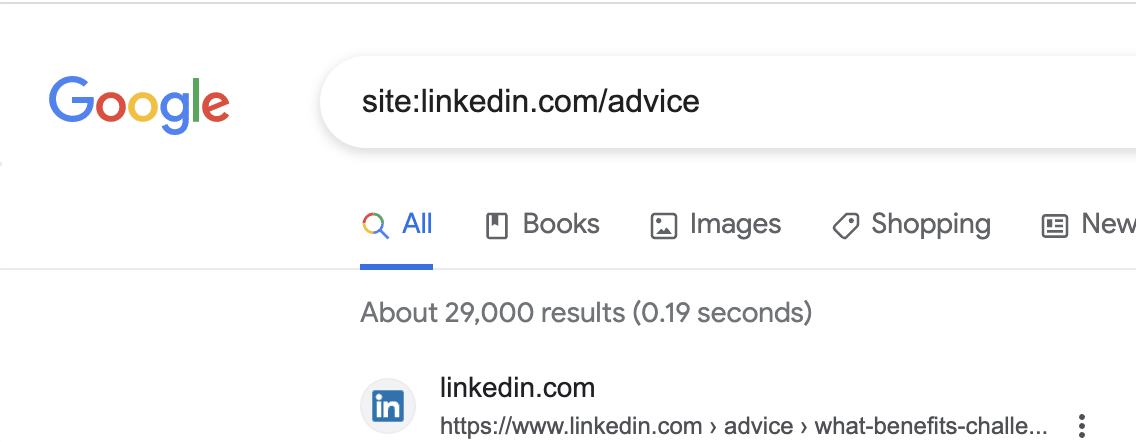
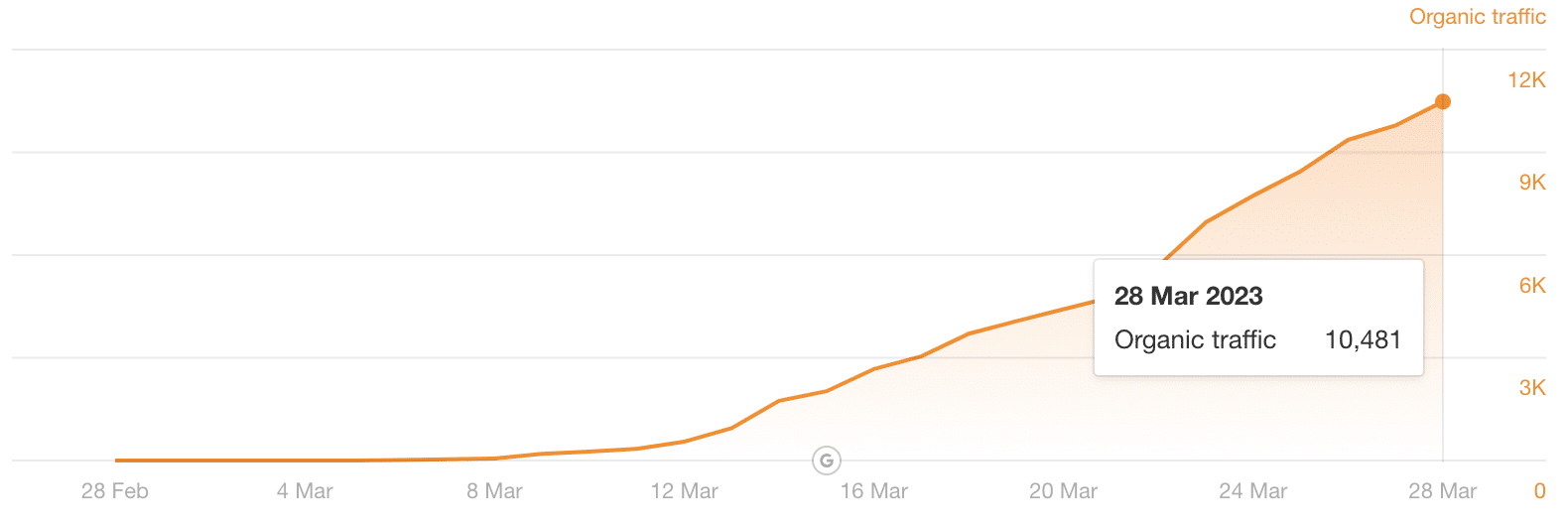
In less than three weeks, the content hub /advice/ launched almost 30,000 articles (9,000 in the last week).
LinkedIn also gained 17,658 keywords and is estimated to gather thousands of organic sessions per Ahrefs data.
This article explores how LinkedIn’s latest AI- and member-assisted content initiative works and its impressive performance in Google search.
What is a LinkedIn collaborative article?
Collaborative articles on LinkedIn are created with AI and edited by human experts.
It allows LinkedIn to scale its content efforts with AI while maintaining quality through community insights. (Similar to how Wikipedia allows users to create and edit content.)
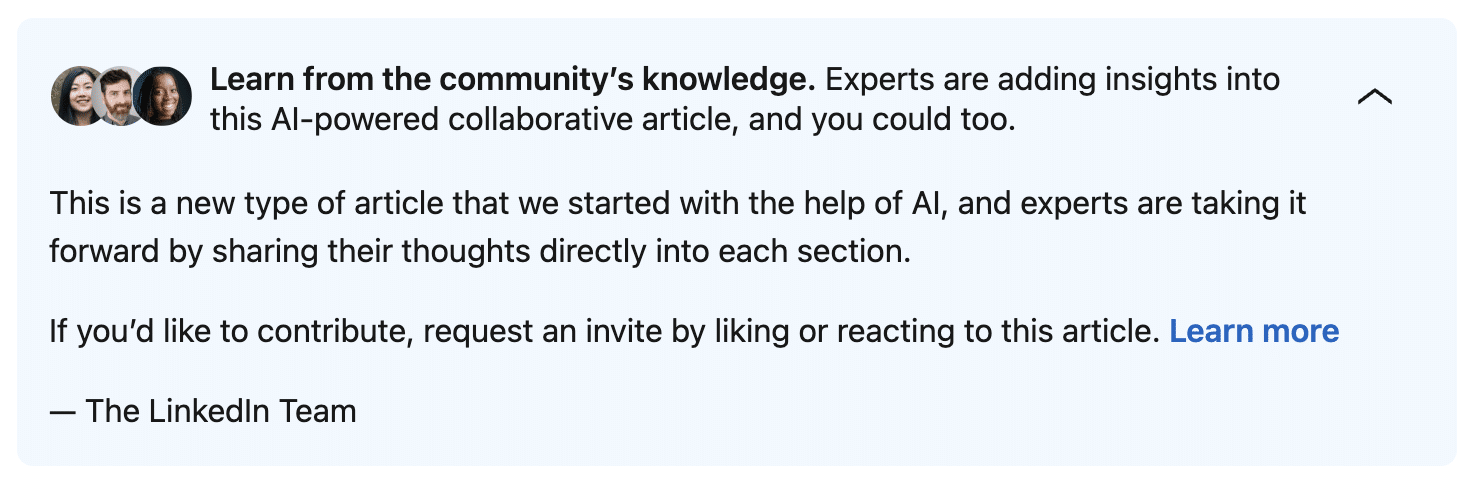
Collaborative articles are clearly labeled as such:
LinkedIn collaborative articles and SEO
“How do you showcase your teamwork skills on your resume?” is an example of the SEO success of collaborative articles.
It is already on Page 2 for the keyword cluster “teamwork on resume,” with 2,290 monthly searches in the U.S.
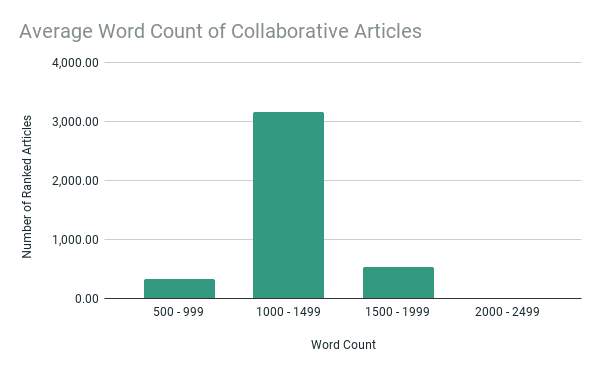
While this piece has 920 words, the average collaborative article is even longer – between 1,000 and 1,500 words. And they get longer with every quote and user insight added.
The content is clearly structured with one H1, several H2s and a unique page title and meta description – all optimized for the keyword cluster.
| URL |
https://www.linkedin.com/advice/0/how-do-you-showcase-your-teamwork-skills-resume-skills-teamwork |
| Word Count |
920 |
| Inlinks |
4 |
| Readability |
Fairly Easy |
| Indexability |
Indexable |
| Title 1 |
Teamwork Skills Resume Examples: How to Stand Out |
| Title 1 Length |
49 |
| Meta Description 1 |
Learn how to use teamwork skills resume examples to impress hiring managers. Choose relevant skills, use action verbs and results, and provide examples. |
| Meta Description 1 Length |
152 |
| H1 |
How do you showcase your teamwork skills on your resume? |
| H2 |
Choose relevant teamwork skills
Use action verbs and quantifiable results
Provide examples from different contexts |
The hub has already collected 343 referring domains., and its popularity is only growing.
Imagine creating 30,000 articles of 1,200 words each and the cost and time associated with it.
AI allowed LinkedIn to scale massively – the community component guarantees pageviews, social shares and backlinks, two perfect loops for growth and engagement.
Why would you want to contribute to a collaborative article?
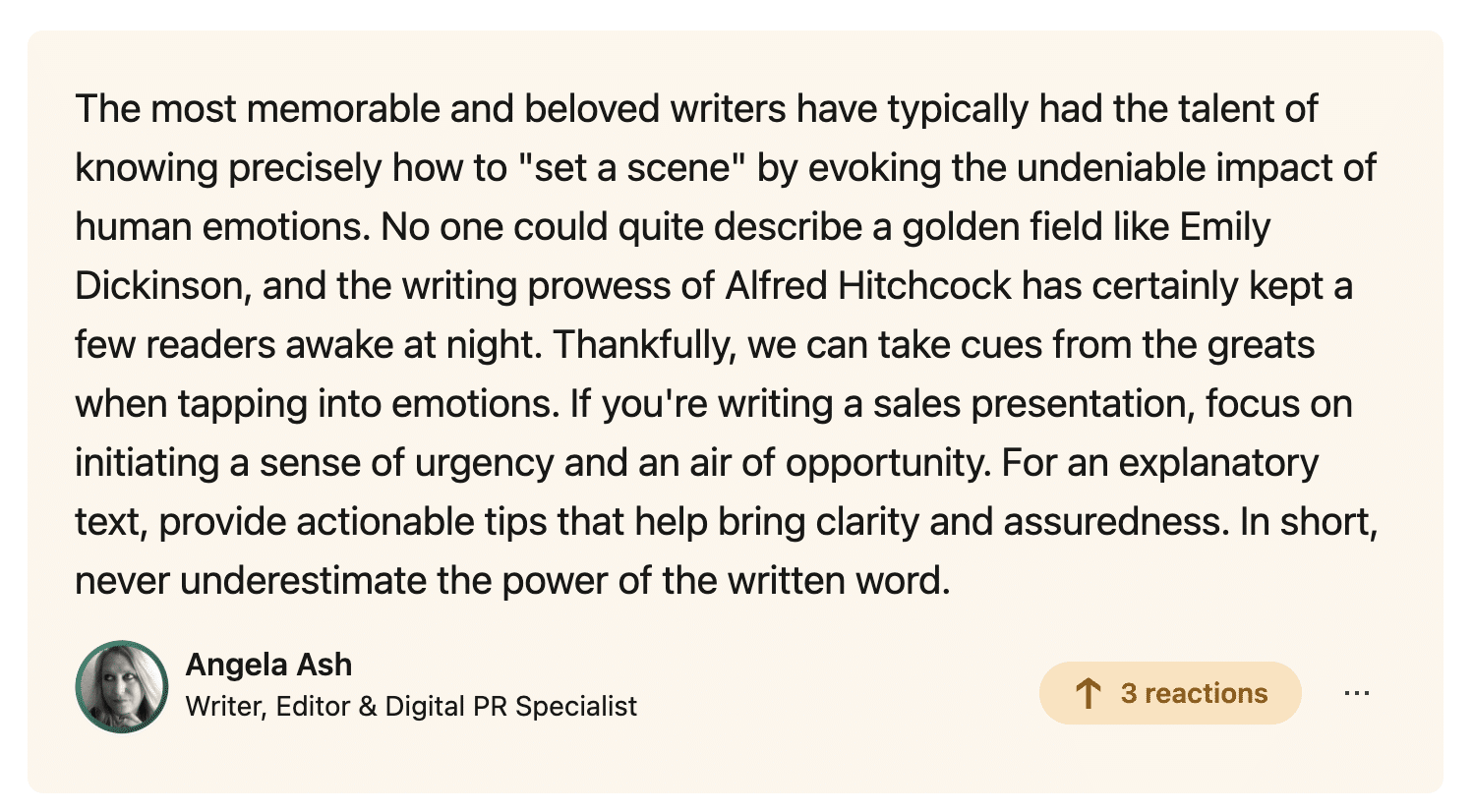
You will receive exposure through the quote box where your contribution will appear:
The whole advice hub is currently gaining massive momentum in Google Search.
LinkedIn is one of the strongest domains on the web, with a domain rating of 98 (Ahrefs). If your website can not rank for a keyword or topic, LinkedIn probably can.
By contributing to collaborative articles, you have a chance to:
- Gain exposure on search queries you otherwise have no chance to rank for.
- Gather credibility as an industry expert and thought leader.
- Build your professional expertise on LinkedIn.
- As LinkedIn puts it, “…to make sure that contributors are rewarded for giving their time and experience, they can earn a new Community Top Voice badge in their skill areas (e.g., “Top Sales Voice”) for adding their insights. You’ll be able to see the badge on profiles and next to contributions on the articles.”
As for selecting who can contribute, Linked states that they:
“[Identify] members who are likely to be experts in a certain topic based on their work experience, skills proficiency, and prior engagement on the platform. They must also meet high trust standards by adhering to LinkedIn’s User Agreement and Professional Community Policies.”
Get the daily newsletter search marketers rely on.
<input type=”hidden” name=”utmMedium” value=”“>
<input type=”hidden” name=”utmCampaign” value=”“>
<input type=”hidden” name=”utmSource” value=”“>
<input type=”hidden” name=”utmContent” value=”“>
<input type=”hidden” name=”pageLink” value=”“>
<input type=”hidden” name=”ipAddress” value=”“>
Understanding user-generated content on LinkedIn
There are two more article types to understand and distinguish from the collaborative articles:
- Users were already able to publish their own articles on LinkedIn and rank.
- LinkedIn already scaled up its content production massively through “LinkedIn News.”
User-generated content: Publishing your own articles
Your own LinkedIn articles already get indexed on the search results. They live on the slug /pulse/. Everyone with a LinkedIn account can create these articles – similar to Medium.
The /pulse/ slug ranks for more than 7 million keywords. The good thing is you do not need to share space with the AI.
So, if you are looking to rank for a competitive term, and you do not see a LinkedIn article ranking on Page 1 yet, write your own unique and keyword-optimized articles, and with a bit of luck (and backlinks), you can secure a top position.
Some people call this on-SERP SEO because it allows you to own real estate on Page 1 even if your own website is not there.
Partner-generated content: LinkedIn News content
You will notice that the /advice/ slug redirects to the /pulse/ hub of the website, with the title:
- “Explore LinkedIn: Dig into what’s trending on LinkedIn. Learn something new, follow a topic of interest, find inspiration and join the conversation.”
Here, you will find LinkedIn News stories produced by the platform’s content creators and collaborators.
Because LinkedIn’s editorial team develops the content hub, it is very focused and structured, strategically speaking to the core areas of LinkedIn’s professional offerings. (Not so much Linkedin, the social media platform.)
You can learn about the following:
- Career.
- Job search.
- Workplace.
- Technology.
- Job skills.
- Human resources.
- And more.
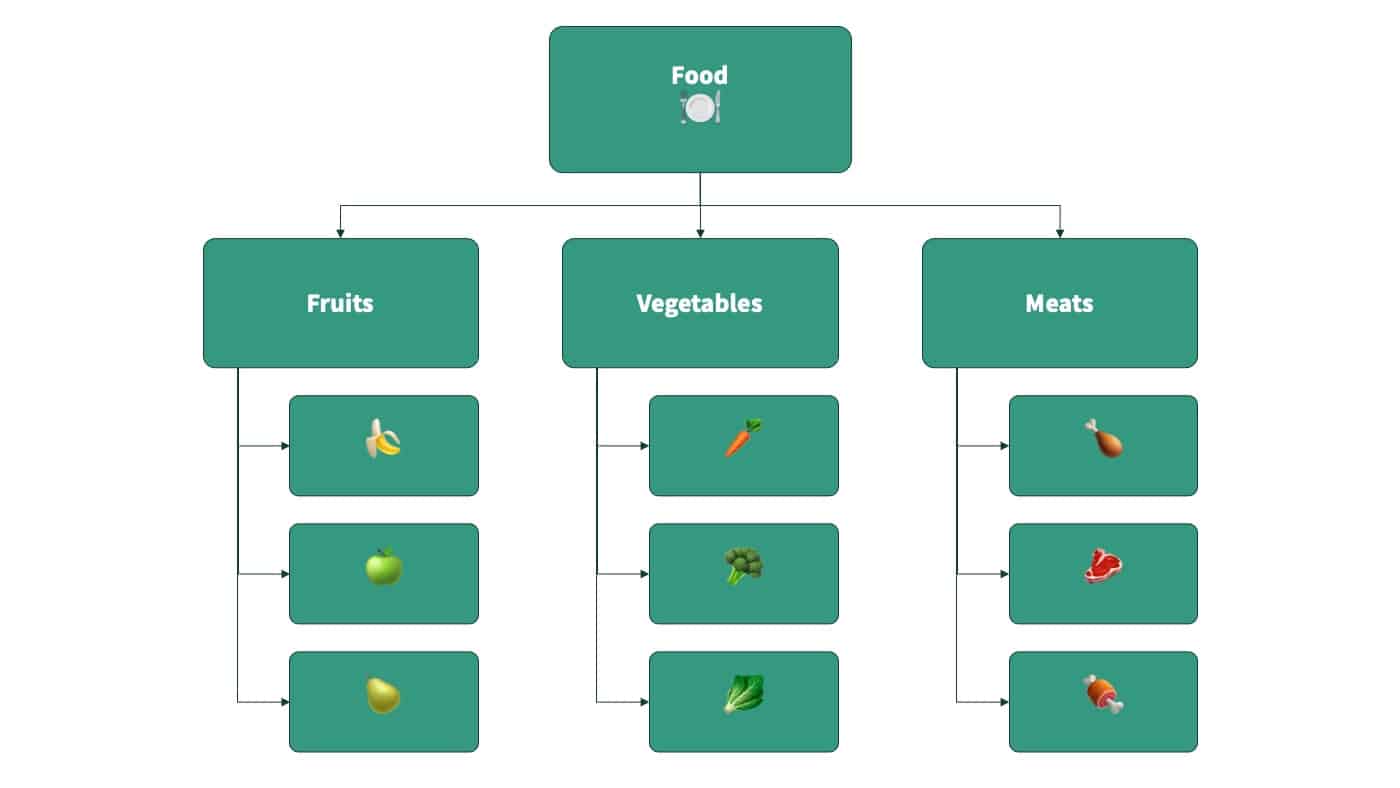
Each core pillar is broken down into subcategories. For example, “Job search” is broken into:
- Resumes and cover letters
- Interviewing
Every SEO loves this clean site structure. And /pulse/ has surely been an SEO play for LinkedIn.
Collaborative articles and skills pages
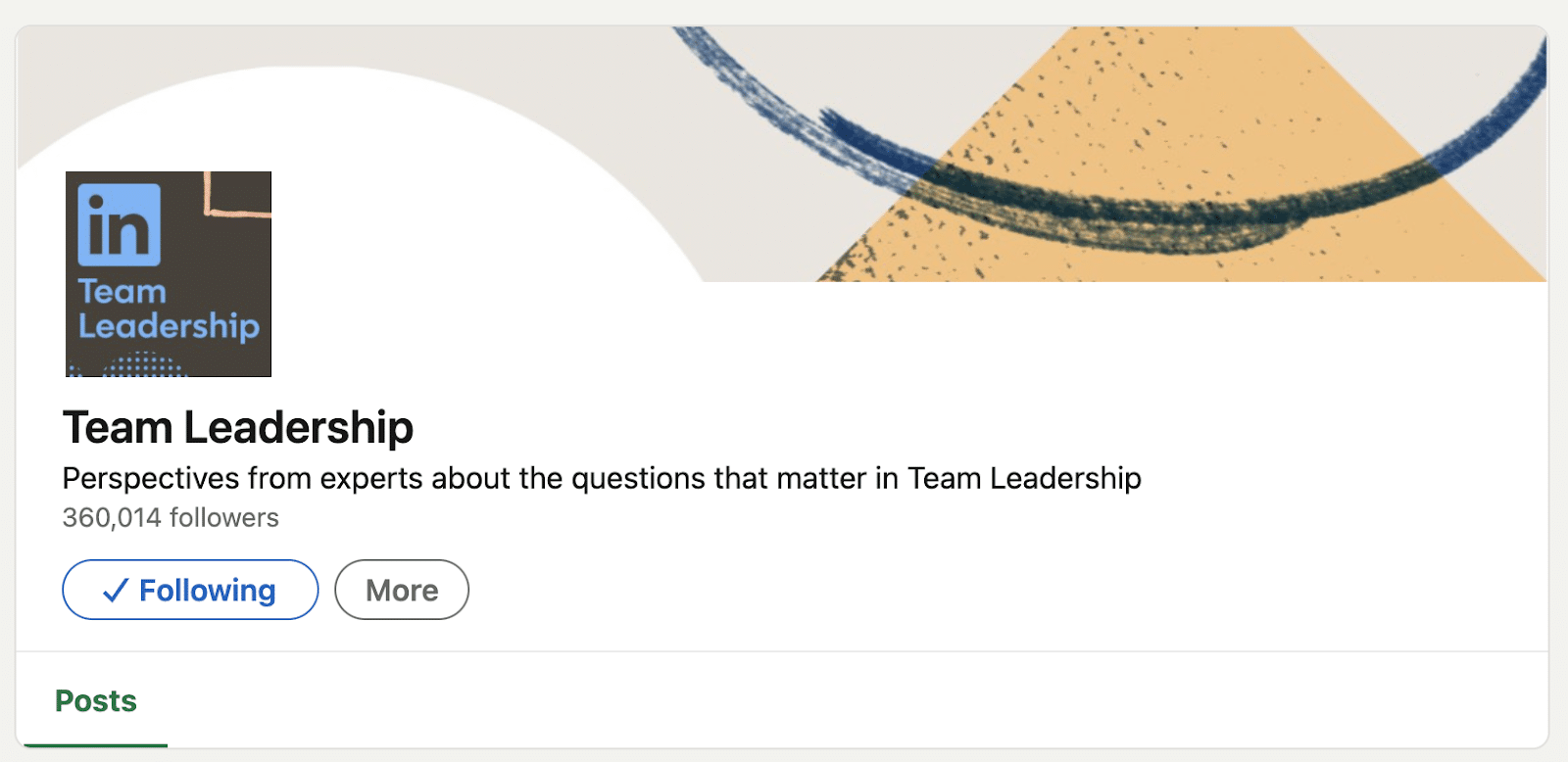
The new collaborative articles are published by skills pages, which look similar to company pages.
Some skills pages already have hundreds of thousands of followers. LinkedIn automatically adds you to relevant pages based on your profile.
Following them is a good way to get notified about new articles going live.
SEO learnings from LinkedIn’s collaborative articles
These AI articles are LinkedIn’s big SEO bet
The collaborative articles are a creative example of AI content at scale. The contributions by LinkedIn users add human editing, stories and examples without making the LinkedIn content team a bottleneck during growth.
Since the LinkedIn editorial team originally briefs these pages, they have a structured approach to scaling content across new areas, e.g., business planning, customer experience, employee training or event management.
The search volume for the main keywords of the first 4,069 pages ranked in the U.S. is already 710,080 per month – and more pages are getting ranked daily.
My hypothesis: Collaborative articles are LinkedIn’s big SEO bet this year.
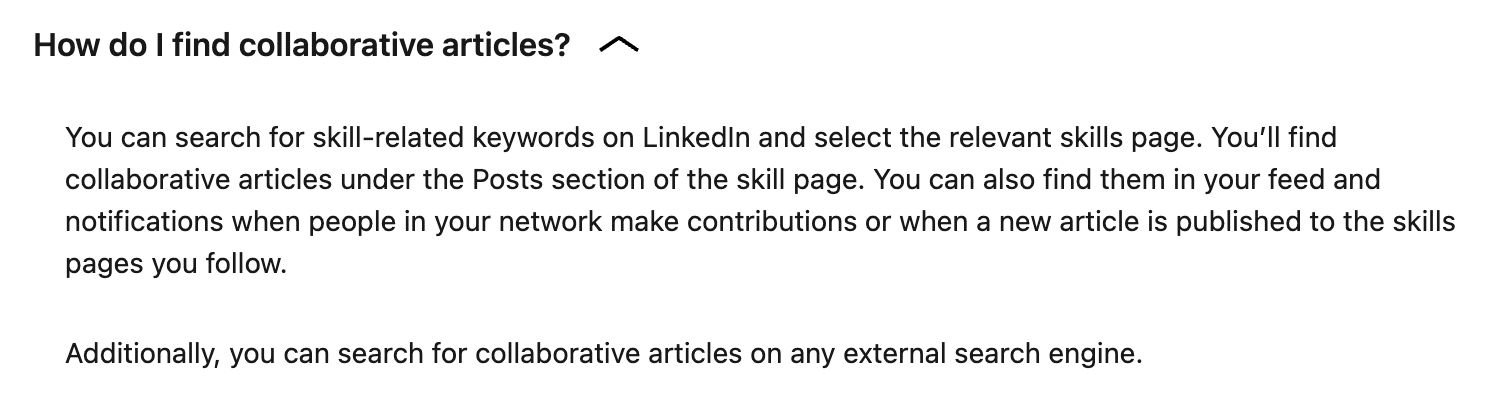
LinkedIn hints at that in its own FAQs, where they note search engines as one of the best ways to find these new articles.
Growth loop
The /advice/ hub works because it is a clever growth loop for Linkedin, as Juliana Mendez, fractional VP Growth and advisor for B2B SaaS, explains:
- “Acquisition loop: AI and user-generated content brings in new users via SEO impact. These potentially contribute to these articles and share them – which again increases SEO impact (content and referrals) and again wins more new users or engages existing ones.
- Engagement loop: Updates and new contributions trigger notifications and hence create higher engagement and likelihood of returning to the platform.”
LinkedIn’s brilliant SEO play
Collaborative articles align with LinkedIn’s general push of becoming a place where professionals come to learn.
With their unique combination of AI and user-generated content, they just put their content marketing and SEO on steroids.
The post Decoding the SEO success of LinkedIn collaborative articles appeared first on Search Engine Land.
Courtesy of Search Engine Land: News & Info About SEO, PPC, SEM, Search Engines & Search Marketing
Monday, April 3rd, 2023
As far as lead magnets go, an ebook is a great one.
A well-written, well-designed, optimized ebook can be an enticing appetizer for your audience. It’s a complete example of your brand voice, expertise, and knowledge in a portable, endlessly sharable format.
And if your appetizer (your ebook) impresses, your audience is likelier to partake in your main course (your products/services).
About 43% of marketers say ebooks are the content assets that produce the best results for them.
In other words, an ebook is an indispensable part of a brand content marketing strategy. For that reason, let’s learn how to create, optimize and promote your ebook.
What is an ebook?
In marketing, an ebook is a digital book designed to teach your audience about a topic relevant to their problems and interests.
Brands make their ebooks available via downloadable files (in formats like PDF or EPUB) that readers can view on their smartphones, tablets, and other devices. Some readers may even choose to print them out.
A typical ebook has a few important elements:
- Written content in book format with a table of contents, chapters, and page numbers.
- Graphic design elements include a designed ebook cover, pages, charts or graphics, and images. (The main draw should be your written ebook content.)
- An author page with a bio or an “About us” if the author is a brand.
- CTAs (calls to action) encourage readers to check out your products, services, or related content.
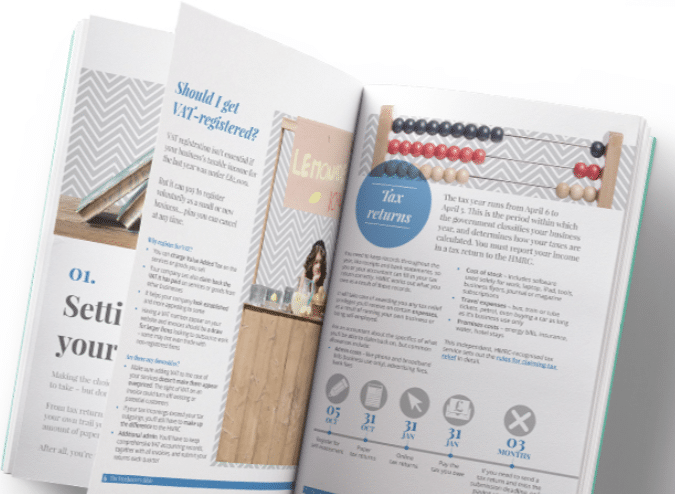
For example, this ebook called The Freelancer’s Bible has all the above elements to create a very effective package.
Why create an ebook?
An ebook is a trust-building, credibility-creating, illustrated digital book that should nurture your audience and pull them further into your marketing cycle.
There are tons of benefits to creating an ebook. Needless to say:
- It’s portable: Download it to read on your phone or tablet, or print it out.
- It’s relatively low-cost to produce: You’ll either have to spend the time and effort to DIY your ebook or pay for a writer and a designer to create it. But ultimately, if you produce an evergreen ebook, it pays for itself over time.
- You can distribute it infinitely without having to pay printing or shipping costs.
- If your ebook has a lot of high-value content, you can charge a flat fee for readers to download it, which will cover your production costs.
- An ebook can be interactive: You can embed links in the text and add CTAs readers can tap or click to further engage with your brand.
- It can be accessible: If you make your ebook available to download in different formats, like EPUB, readers can adjust the text size and other screen options.
- Ebooks aren’t intimidating: Usually, ebooks created for marketing run the gamut from five to 50 pages in length. This means your audience won’t be scared away from downloading it but rather encouraged because ebooks are quick and easy to read.
Ebook creation: How to write content and design your ebook
So it’s time to create your ebook. Before you write a single word of content, you must first have an ebook topic in hand that you know your target audience will love.
After that, you can move on to content creation and design.
1. Choose your ebook topic
Vet your ebook topic carefully. If you choose any random topic out of a hat, you can’t be sure your audience will be interested enough to download your ebook – that’s the entire goal!
Here are some tips to find the right topic:
Follow your content strategy
Your strategy should include guidance on content creation topics your brand focuses on. Refer to these areas to find a topic relevant to both what your audience wants and what you sell.
Look at your blog content for inspiration
Is there a topic you wrote about where you only scratched the surface? Expand on it in an ebook. Did one blog get a lot of engagement? Consider repurposing and expanding your best-performing blog into a high-value ebook format.
Mine your customer questions and feedback for ideas
What’s the number one question your customers ask? What do they wish they knew more about? Could you turn that topic into an ebook?
Research your topic to make sure it’s the right depth
Some topics don’t require an entire ebook to explain them. Others might be too in-depth and can’t be covered in less than 50 pages. For these reasons, look at how other people have approached your chosen topic to see whether what you want to discuss will fit in an ebook.
Research your topic on Google to see what types of content already exist online about it. If you find many books, check out their length and number of chapters.
If you find many articles, check what topic facets they include and what they might be missing that you could cover.
Do keyword research on your topic
Particularly, look at how competitive your topic is in search rankings. You’ll also see how many monthly searches it gets, which can help you understand the topic’s popularity.
2. Create a table of contents
Next, once you’ve chosen a good topic, you can outline what you’ll include in the entire ebook by creating a table of contents.
This doesn’t have to be fancy right now (for example, you don’t have any content written yet, so don’t worry about page numbers). Just list the chapters you plan to include, and brainstorm your titles.
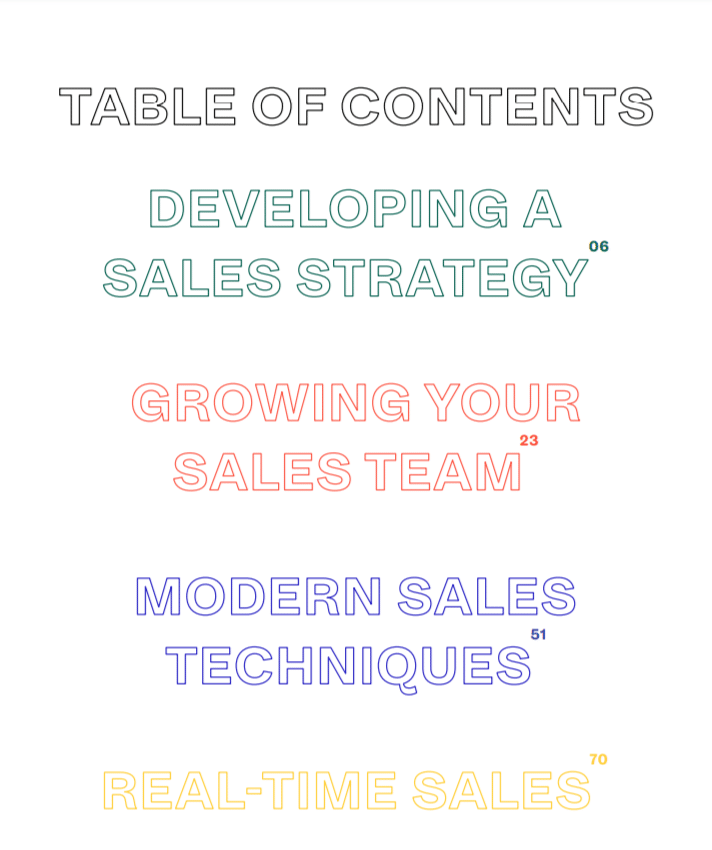
For example, in this ebook by Intercom (called “The Sales Handbook”), the table of contents is very simply laid out, but it tells you what piece of the topic each chapter covers.
(The topic, by the way, is sales strategy and techniques to achieve growth.)
3. Outline what you’ll talk about in each chapter
Once your chapters are laid out, you can outline what you’ll discuss in each.
Don’t skip outlining, by the way. It gives you a roadmap to follow as you write, which is super helpful for creating ultra-long-form content like ebooks. Content this long can quickly become unwieldy if you’re not organized.
Go as deep with your outline as you want. Maybe you’d prefer to keep it super simple and loose, so you just jot down a few key points for each chapter. Or, perhaps, you want to create a point-by-point outline that maps out every paragraph. Or maybe you float somewhere between these two extremes.
However you do it, just create a helpful guideline to follow later when you write the brunt of the content and fill in the blanks.
Remember: Your outline can include more than just text.
For example, you could add placeholders and ideas for visual elements for your ebook, such as charts or graphs, photos you still need to source, or graphics you’d like custom-created. You can also add lists of resources you’d like to reference or content you want to use as inspiration.
This is your outline, so make it work for you.
4. Create a compelling ebook title
If you haven’t come up with a compelling, descriptive title yet for your ebook, now is the time.
Don’t be tempted to phone this part in – it matters because the title is the first thing people will see. They may not be motivated enough to learn more if it doesn’t immediately speak to them.
Consider these three rules when crafting your ebook title:
Keep it simple
A simple title beats a long, convoluted title any day. Especially for an ebook. You want your audience to understand exactly what your ebook is about without any confusion. Let’s reference the ebook examples from earlier to show you what I mean. They’re short, sweet, but effective:
- The Sales Handbook.
- The Freelancer’s Bible.
Keep it clear
What if, instead of “The Sales Handbook,” the title was “The Handbook of Sales Strategy for Faster Business Revenue”? It doesn’t quite have the same ring, does it?
Be descriptive
This doesn’t mean your title has to include a lot of adjectives. Instead, consider one strong word that conveys the purpose of your ebook.
In the above title examples, those words were “handbook” and “bible.” Both tell you that these ebooks are either exhaustive or contain step-by-step practical guidance. That’s the power of one strong word.
Get the daily newsletter search marketers rely on.
<input type=”hidden” name=”utmMedium” value=”“>
<input type=”hidden” name=”utmCampaign” value=”“>
<input type=”hidden” name=”utmSource” value=”“>
<input type=”hidden” name=”utmContent” value=”“>
<input type=”hidden” name=”pageLink” value=”“>
<input type=”hidden” name=”ipAddress” value=”“>
5. Brainstorm visual elements to complement the text
At this point, start thinking more deeply about the visual aspects of your ebook.
And, yes, you do need visuals. They’re standard in a marketing ebook, not to mention they make your content much more engaging.
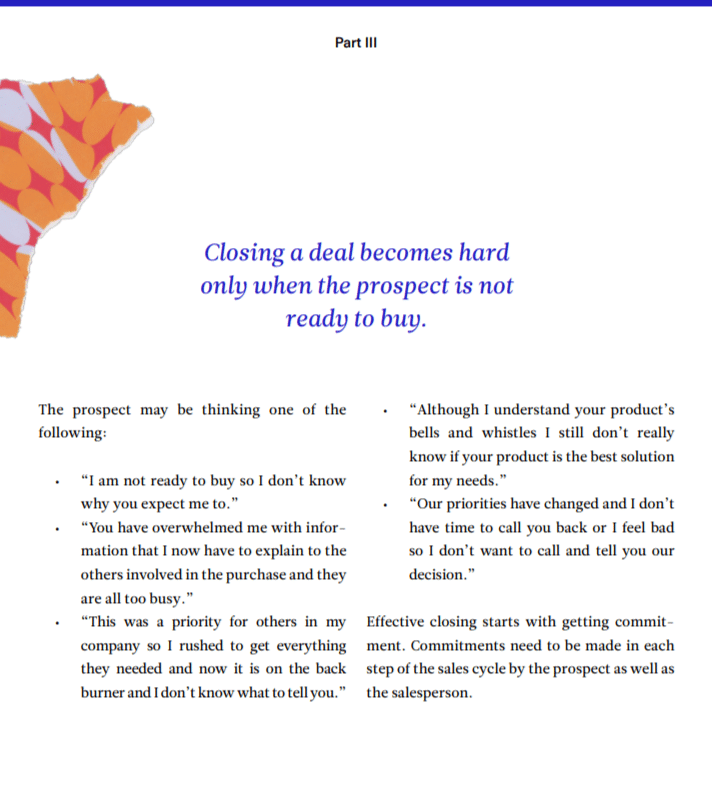
Pull quotes: Highlight important quotes from the content. Here’s an example from The Sales Handbook:
Stats: Similar to pull quotes, use graphical elements to make interesting or valuable stats stand out.
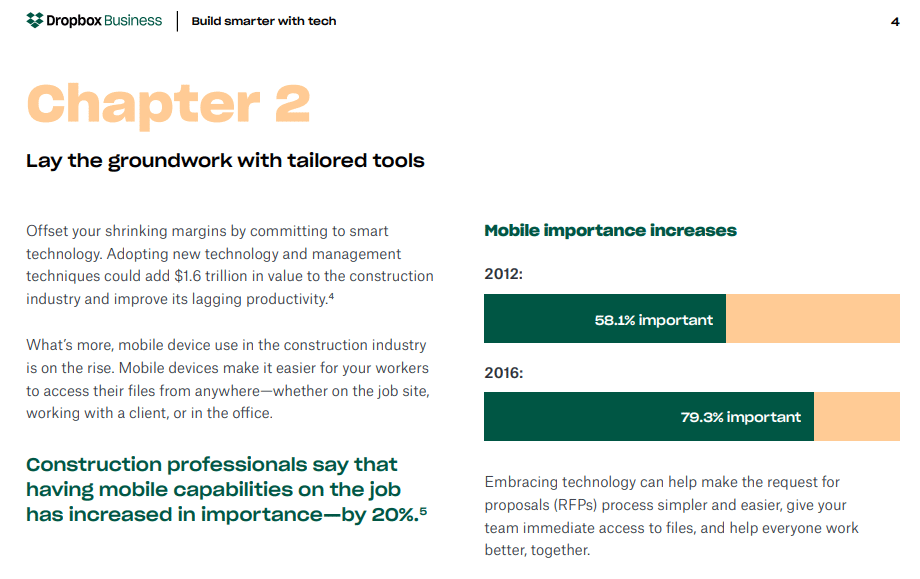
Charts or graphs: If you’re including research in your ebook, help readers visualize the data with a chart or graph. For example, this Dropbox ebook features simple bar graphs:
Infographic-style images: Again, help readers visualize what you’re talking about. Infographics are great for highlighting your most important points, too.
Photography: Photos are engaging and even better when they’re unique to your brand.
Design elements: Consider adding design elements to the text, like call-out boxes, typography, borders, accent colors, or custom illustrations.
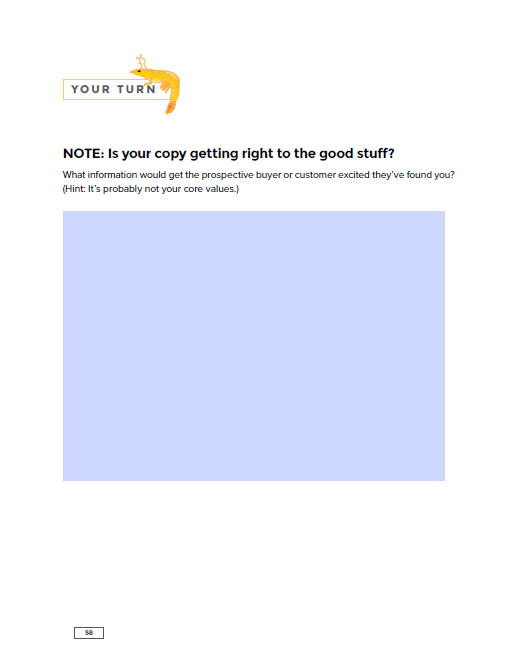
For example, this ebook by Talking Shrimp is simple but features tiny illustrated shrimp around page headers. Note that it also includes blank space for readers to reflect on concepts taught in the content:
6. Strategize CTA placements
Don’t forget to add CTAs to your ebook in strategic spots. For example, you could add a CTA at the end of each chapter that encourages readers to check out related content.
At the end of your ebook, add a CTA pointing to your best landing page selling your best, most relevant product or service.
Most ebook formats allow embedded links in your document, so don’t forget to add links to your website, your social accounts, and a link to sign up for your email list.
7. Enlist editing and graphic design help
You can DIY your ebook design using templates in tools like Canva, Issu, or Adobe InDesign. But, if you have the resources, consider hiring help from a graphic designer who can customize your ebook and align it with your branding.
In addition to design help, consider enlisting an editor who can comb through your ebook and catch any grammar slip-ups or mistakes you might have missed. The more eyes you get on your content, the more likely you will end up with a flawless final product.
A good editor can also help you nail the structure of your ebook and help you come up with engaging titles. If you need help finessing your copy/content, this person on your side will be indispensable.
Ebook optimization
Optimizing your ebook will make it more readable and likelier to rank in Google. Optimize with a few simple tasks:
8. Include relevant keywords
Yes, you can optimize your ebook with keywords. Here are some crucial places where you can add them:
- The ebook file name.
- The ebook title and chapter headings.
- Inside the anchor text for any embedded links.
- If applicable, in image captions or image alt text.
9. Make it easy to read
You should also optimize your ebook for ease of reading. If your audience has to zoom in by 200% just to squint at your tiny text, that’s a barrier to enjoying or learning from your content. And, without those value factors, they may not see any further value in engaging with your other content.
So, make sure your ebook is formatted for readability. Choose a clear, clean font for the majority of the text. Make sure it’s a comfortable size for reading on most devices. Ensure graphical elements don’t disrupt the reading experience or hinder it.
If you enlist a graphic designer, they can take the reins here to ensure your ebook is easy to read – not just pretty to look at.
10. Offer it in multiple formats
Not every reader has access to the same technology. If you offer your ebook in multiple formats (PDF and EPUB are great options), you’ll broaden the number of people who can access and read it.
Ebook promotion
When your ebook is written, designed, formatted, and ready to go, you can start promoting it.
11. Create an ebook landing page
Number one on your list for promoting your ebook should be to create a landing page.
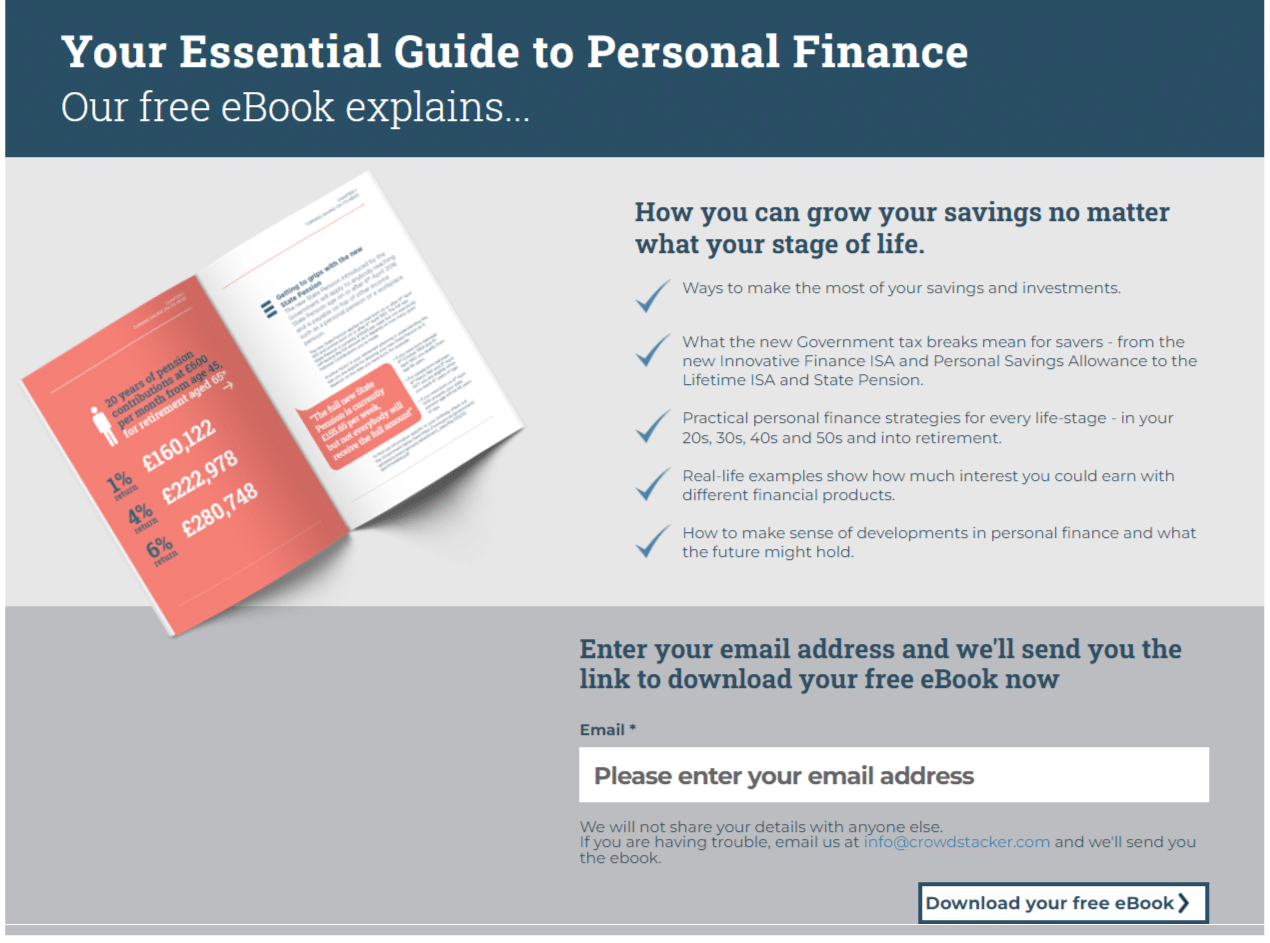
A landing page is a dedicated page on your website that promotes and describes your ebook so people will want to read it.
This page is the main spot where people can download your ebook. When you link to it on social media, in emails, or blogs, you’ll point people to this specific page.
What should you include on your landing page?
- Descriptive/promotional copy: Include your ebook title, a summary of what it’s about, and the benefits of reading your ebook (what will your readers walk away with in terms of education, information, entertainment, growth, or value?).
- A picture of the cover: Display a photo of your ebook cover to entice potential readers.
- A preview of what’s inside: Your preview could include the table of contents or a full-page spread to give your audience a taste of what’s in store. If your ebook is on the longer side, this is especially worthwhile to include.
- A form: Your ebook is meant to convert your audience from casual followers of your content to engaged subscribers. Hook up a form to your landing page that allows the reader to download your ebook only after filling out their contact information.
- SEO: Don’t forget to optimize your landing page for search. Include the keywords you researched earlier in the page title, the meta title/description, the summary, and other bits of copy on the page.
Here’s an example from Crowdstacker:
12. Add CTAs to your ebook in relevant blog and website content
Once your landing page is ready, you can add CTAs that point to it in your blog and website content. Good rules of thumb to follow include:
- Only add a CTA to your ebook when it’s relevant to the topic. For instance, point readers to your ebook when a “learn more about this topic” opportunity presents itself in related blogs.
- Don’t spam your audience with CTAs. Include them at key moments on a page or blog – no more, no less.
13. Promote your ebook on social media and in emails
Share your ebook with a wider audience to get more downloads. Go beyond your website to:
- Post on social media with a link to your ebook. Include an image of the cover or a preview of the contents.
- Send an email to your subscribers alerting them that you just published a new ebook. Include the link to the landing page and photos of the cover and contents.
Create, optimize, and promote your ebook – and convert your audience
Ebooks are a top content type for a reason.
A good ebook converts well because it’s packed with value. Much thought and care should go into creating your ebook, from the presentation to the design and content.
When executed well, it should look like a printed publication in a handy digital package.
All that effort is worth it when considering the infinite ways an ebook can be distributed. As long as you choose an evergreen topic, you’ll have a conversion vehicle in your arsenal for years to come.
The post How to create, optimize and promote an ebook appeared first on Search Engine Land.
Courtesy of Search Engine Land: News & Info About SEO, PPC, SEM, Search Engines & Search Marketing
Saturday, April 1st, 2023
Google Bard just got an upgrade. By incorporating Google’s PaLM language models, Bard is now better at math and logic responses.
“Today I wanted to share that we’ve improved Bard’s capabilities in math and logic by incorporating some of the advances we’ve developed in PaLM,” Jack Krawczyk, the Google executive leading up Bard and Google’s AI efforts, said on Twitter.
What improved. Bard can now better understand and respond to your prompts and questions when they are in a multi-step word and multi-step math problems format, Krawczyk said.
Math improvements coming. Coding is coming soon to Bard, Krawczyk added.
The tweets. Here are his tweets with this announcement:
So what does that mean? Now Bard will better understand and respond to your prompts for multi-step word and math problems, with coding coming soon. This improvement makes Bard even more useful to people using it. 2/
— Jack Krawczyk (@JackK) March 31, 2023
Google PaLM. PaLM stands for Pathways Language Model. It is a large language model developed by Google with 540 billion parameters. Researchers also trained smaller versions of PaLM (8 billion and 62 billion parameter models) to test the effects of model scale.
More on Bard. As a reminder, Google announced Bard was coming the day before Bing Chat launched but Bard did not open to general users until 10 days ago. The response Google received from Bard has been somewhat disappointing and underwhelming compared to that of Bing Chat and ChatGPT’s efforts. Even inside Google, employees urged the company to improve Bard.
But Google promises more is to come and Bard will get better.
Google intentionally launched a lightweight version of Bard and it will continue to get better over time, Google CEO Sundar Pichai said in a New York Times interview published today.
Why we care. Mostly, it is fun and exciting to see how these AI assistants and tools improve and are improving rapidly in such a short period of time. Be it ChatGPT, Bing Chat, Google Bard or others, following this space is a lot of fun.
So give Bard another try and see if you find it to be any better today than it was yesterday.
The post Google updates Bard to improve math, logic responses appeared first on Search Engine Land.
Courtesy of Search Engine Land: News & Info About SEO, PPC, SEM, Search Engines & Search Marketing





 Source: