Archive for the ‘seo news’ Category
Wednesday, August 28th, 2024
Google Ads users no longer have access to Auction Insights fields in new data sources within Looker Studio. Existing data sources will lose this access on Sept. 23.
Why we care. Auction Insights provides critical competitive data, helping advertisers understand their performance relative to competitors in the same auctions. The removal of these fields from Looker Studio will require advertisers to adjust their Looker reports and strategy tools, and revert to getting the competitive metrics they want to see in Google Ads.
Fields impacted. Affected fields include Auction Insight metrics such as Domain, Average Position, Impression Share, Outranking Share and several others critical for competitive analysis.
Action needed: Advertisers should proactively remove these fields from their Looker Studio reports and charts to prevent disruptions. Failing to do so could result in broken reports, impacting the ability to track and optimize ad performance effectively.
Yes but. Advertisers shouldn’t worry here – Google has not said Auction Insights will go away. You can still access all the competitive analysis metrics in Google Ads.
Bottom line: With the removal of Auction Insights from Looker Studio, you will need to find alternative ways to track competitive performance metrics and adjust Google Ads reporting strategies.
Courtesy of Search Engine Land: News & Info About SEO, PPC, SEM, Search Engines & Search Marketing
Wednesday, August 28th, 2024
Google today introduced four updates meant to help retailers ahead of the holiday shopping season.
Key updates:
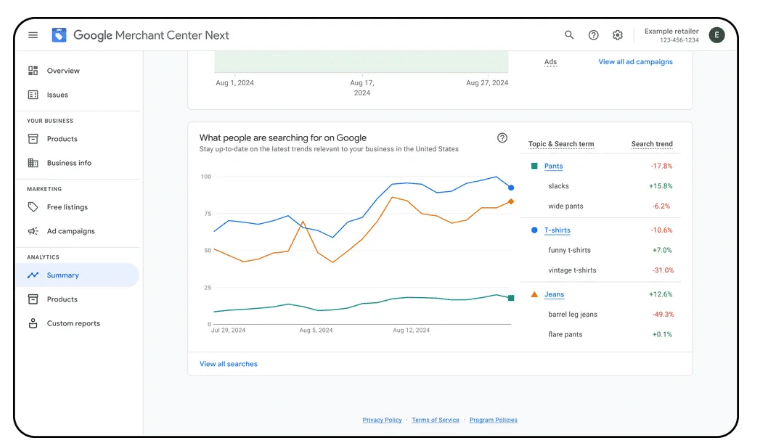
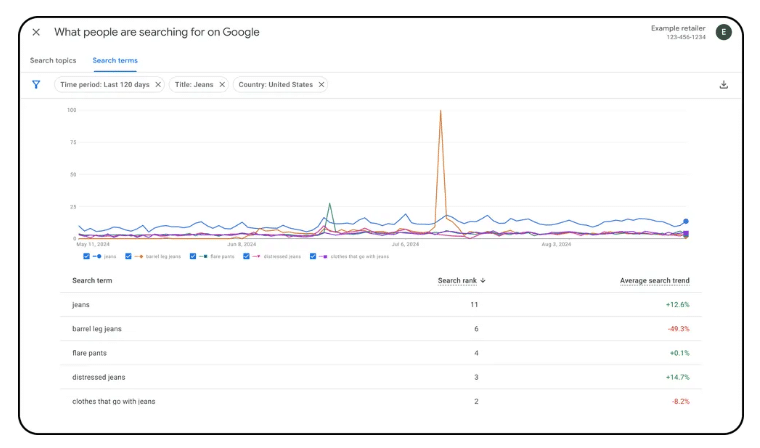
- Shopping trends insights. You can now access real-time shopping trends in Google Merchant Center. This could help you adjust your inventory and product descriptions based on what shoppers are actually searching for or viral trends.
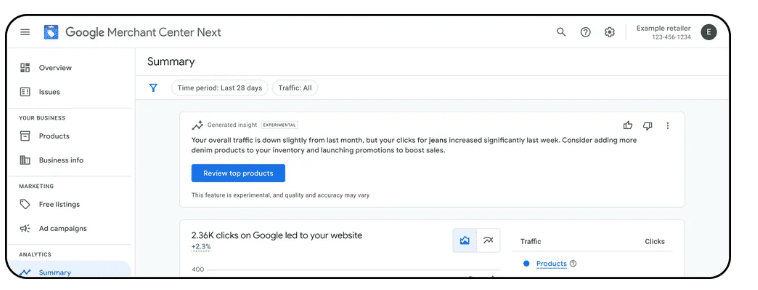
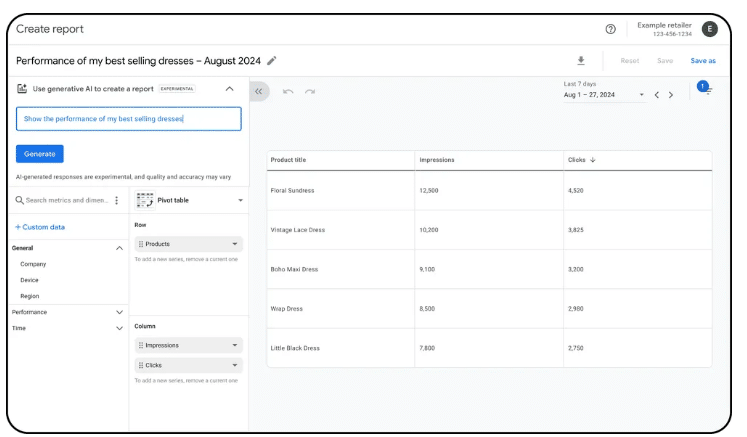
- AI-powered insights. Two new generative AI features in Merchant Center Next provide quick summaries of product performance and custom reports based on specific data queries.
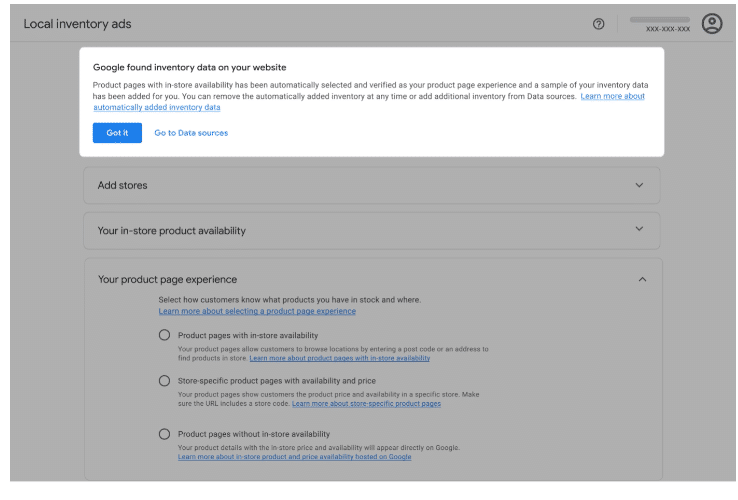
- Automated in-store availability. Google is streamlining the management of local inventory ads by automatically syncing in-store availability from retailers’ websites. This should make it easier for customers to find products nearby.
- New campaign goals. Google Ads now includes options for setting customer acquisition goals and optimizing campaigns with profit-focused metrics, helping advertisers prioritize profit and optimizations during peak shopping periods.
Why we care: There are fewer days between Thanksgiving and New Year’s to reach consumers. This means retailers will be under pressure to hit holiday sales goals. Google’s new tools are meant to help businesses stay agile and make smarter, data-driven decisions.
Courtesy of Search Engine Land: News & Info About SEO, PPC, SEM, Search Engines & Search Marketing
Wednesday, August 28th, 2024
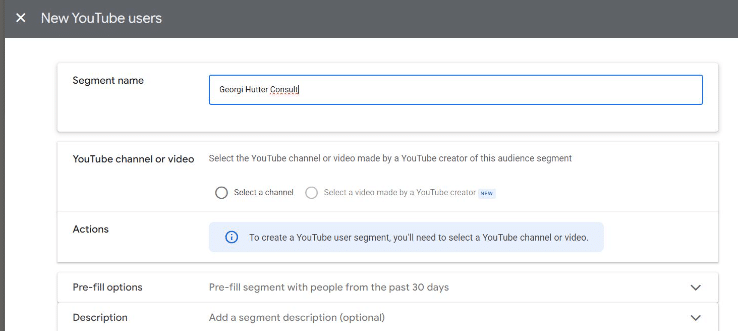
Google Ads now allows advertisers to create remarketing lists based on viewers of specific YouTube creator videos, unlocking new possibilities for targeted campaigns.
Previously, advertisers could only create remarketing lists based on viewers’ interactions with their own linked YouTube channels. This update opens up new opportunities for targeting based on creator content.
Why we care. This new feature allows advertisers to create remarketing lists based on viewers of specific YouTube creator videos, potentially expanding reach and targeting capabilities.
How it works:
- Advertisers can now link YouTube creator videos to their Google Ads accounts.
- This provides access to organic view metrics and the ability to create remarketing segments.
Key features:
- View counts: Access to non-paid metrics for linked videos.
- Remarketing: Create audience segments based on video views.
Between the lines. This feature could be seen as an alternative to impression-based remarketing, offering more precise targeting based on specific creator content.
What to watch: How advertisers will leverage this new capability and its impact on campaign performance and audience targeting strategies.
First seen. We were first alerted to this update by Georgi Zayakov on LinkedIn:
Bottom line: This update expands the toolkit for Google Ads users, potentially allowing for more nuanced and effective YouTube-based remarketing campaigns.
Courtesy of Search Engine Land: News & Info About SEO, PPC, SEM, Search Engines & Search Marketing
Wednesday, August 28th, 2024
With over 6.8 billion smartphone users worldwide, mobile apps are crucial for brands to reach their audiences. However, creating a great app is only half the battle.
A strong app store optimization strategy is essential to ensuring your app stands out in a crowded market.
Let’s explore the fundamentals of ASO and how you can leverage them to increase your app’s success.
What is ASO?
App store optimization (ASO) helps improve your app’s visibility in app stores, making it easier for users to find and download.
It’s the crux of any successful app marketing strategy and indispensable for increasing an app’s visibility and performance.
When done properly, ASO can dramatically increase an app’s discoverability and help with organic installs and paid conversion rates.
But these increases in visibility don’t just happen overnight. Much like SEO, ASO is a long-term game.
Sure, you can see some small improvements within a month or so of launching, but you need patience and sound ASO fundamentals for your app to have any staying power in the App Store or Google Play.
What are the business benefits of ASO?
While the primary goal of any ASO campaign is to improve visibility and place your app higher in store rankings, there are a couple of other benefits to your business:
- Increase brand awareness: With the right ASO strategy, millions of users will have access to your brand, and the right keyword optimization strategy could connect you directly with users looking for exactly what your app offers.
- Reduce user acquisition cost: ASO is a long-term strategy. It often requires a significant up-front investment and relies heavily on paid channels to drive traffic to app pages. Once you establish a solid ASO foundation, it can help sustain a higher rate of conversions from those paid campaigns, reducing overall acquisition costs.
Fundamental 1: Research
 AppTweak ASO Report – Category Rankings example
While ASO research has many components, keyword research is among the most critical. Comb through search data, competitor strategies and even AI suggestions to determine the most effective and relevant keywords for a particular app.
Although ASO keyword research is similar to standard SEO, some significant differences exist.
ASO keyword research focuses on visibility and search traffic while considering conversion rates, which differ from traditional SEO search patterns and goals.
Keywords typically fall into one of two categories for ASO keyword research: primary or secondary.
- Primary keywords are the most popular terms users type in to find your app. You’ll typically find these keywords in the title and subtitle (App Store) and title and short description (Google Play) sections.
- Secondary keywords are still popular and effective, but they may be a lesser-searched variation or keywords centered around one of your specific app features.
Each type serves its purpose and a well-rounded ASO approach contains a strong mix of primary and secondary keywords.
What are the best tools for ASO research?
Research for ASO is an in-depth and ongoing process.
To enhance your ASO strategy, gather data from general research, competitor keyword analysis and market assessments.
Here are some of the most popular tools used for ASO:
- AppTweak: A great all-around ASO keyword research tool.
- Appfigures: The best tool for understanding keyword rank and putting together daily, weekly and monthly reporting.
- App Store and Google Play: A mobile device and the App Store or Google Play are still some of the best ways to conduct research and create strategies. Apple Search Ads is also an excellent tool for understanding search term traffic.
- Sensor Tower: While it’s not specifically an ASO tool, SensorTower is one of the best marketing intelligence tools for app growth.
Keyword research strategies
Focusing on keyword-level data for metadata restructuring and optimization can lead to ASO success in a highly competitive environment.
Here are some effective keyword research strategies you can implement in your own ASO campaigns:
Collaborating with SEO teams
While SEO and ASO research processes differ, it is hugely beneficial to understand what works well on SEO and how people find the brand and its app through natural search.
Understanding how people search for your app on Google can provide valuable insights into how they might find it in app stores.
Use this information to optimize titles, subtitles, and hidden keywords for the App Store, as well as keyword phrase targeting in Google Play.
For most brands, app downloads may come primarily from branded queries. However, that doesn’t mean there’s a lack of opportunity to drive more app visibility and downloads from non-branded keywords with the right strategy and SEO collaboration.
Prompting AI
Platforms such as ChatGPT or Gemini can help identify potential keywords for your research or inspire new ways of thinking about how people might search for an app.
It’s also worth noting that Gemini can access Reddit data, which opens a cool opportunity to get easy insights about what people say about certain apps and why people love (or hate) certain apps.
Dig deeper. ChatGPT prompts for SEO: What you need to know
Analyzing competitors
Evaluate your competitors’ top-ranking keywords to gain insight into their overall strategy.
Some information you find could be relevant to your app or spark new ideas for your keyword research.
The goal is to locate keywords you also want to target and any keywords your primary competitors aren’t ranking for.
Using lower volume keywords
These are great options to support your primary keywords or to overtake competitors in a crowded industry. However, other apps may go after the big terms, making breaking into the rankings difficult.
Targeting a lower search volume variation provides access to a large sector of the same audience without the same level of competition.
Targeting keywords with mid- to low-traffic opportunities means you’ll need to capture more share of voice (SOV) to get the same number of downloads you would from a high-volume search term, so there are tradeoffs to consider.
Regular keyword updates
Regular keyword updates are essential for effective ASO, as they help adapt to evolving market trends, improve visibility and outpace competitors.
To implement this strategy, set an update schedule every 4-8 weeks, monitor performance metrics and conduct ongoing keyword research. This proactive approach ensures your app remains relevant and competitive.
Market and category analysis
Uncover informative trends by analyzing the best-performing apps within your category and peer group. Look at metadata and creative trends and think through optimal category placement.
With a tool like AppTweak’s ASO Timeline, you can reverse engineer your competitor’s A/B tests and analyze their winning assets.
In a recent exchange with Alexandra De Clerck, Chief Marketing Officer at AppTweak, we spoke about the unique competitive advantage from examining rivals’ A/B tests:
- “Analyzing competitors’ A/B tests offers valuable insights into what resonates with your shared audience. These insights allow you to refine your strategy, avoid ineffective tactics and uncover new opportunities you may have previously overlooked.”
Fundamental 2: Title and metadata optimization
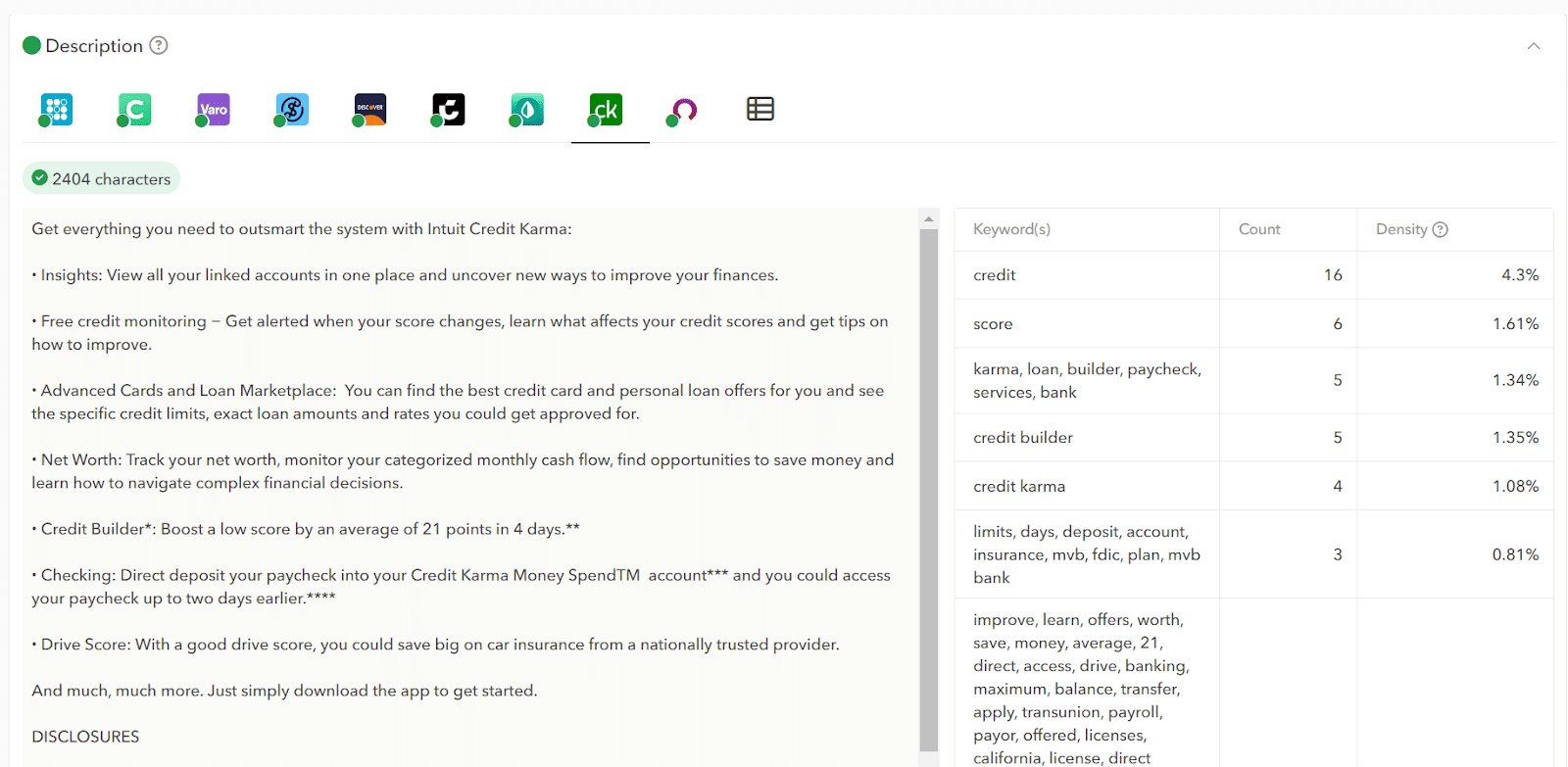 AppTweak’s ASO Report – Current Metadata, Description example
Using keywords strategically in your App Store title, subtitle, hidden keyword field, and Google Play short and long descriptions is essential for maximizing your app’s visibility and attracting more downloads
The App Store and Google Play have their own nuances on properly integrating keywords, though. Content within the App Store is strictly user-facing, so it’s often more flowery, marketing-style language.
Google Play copy is also user-facing, but Google crawls and indexes it – meaning it’s typically simple content with as many keyword iterations as possible (think early-era Google).
I’m not advocating for keyword stuffing here. While repetition is necessary for success on Google Play, there’s a fine line; too much repetition can hurt, so it’s important to strike a balance.
It’s also important to maximize the characters you use on each platform. Both the App Store and Google Play allow up to 4,000 characters for an app description.
- App Store: Try to hit at least 3,000 characters.
- Google Play: You’ll want to aim for 3,800 characters since keyword density is crucial. More copy means more opportunities to optimize. A short or sparse description could hurt your position on Google Play since Google crawls and indexes it.
It’s also important to consider formatting and use headings and bulleted lists to improve scannability and readability.
Headers and bullet points should also be punchy and to the point while highlighting the app’s best functions and features.
Fundamental 3: Creative design
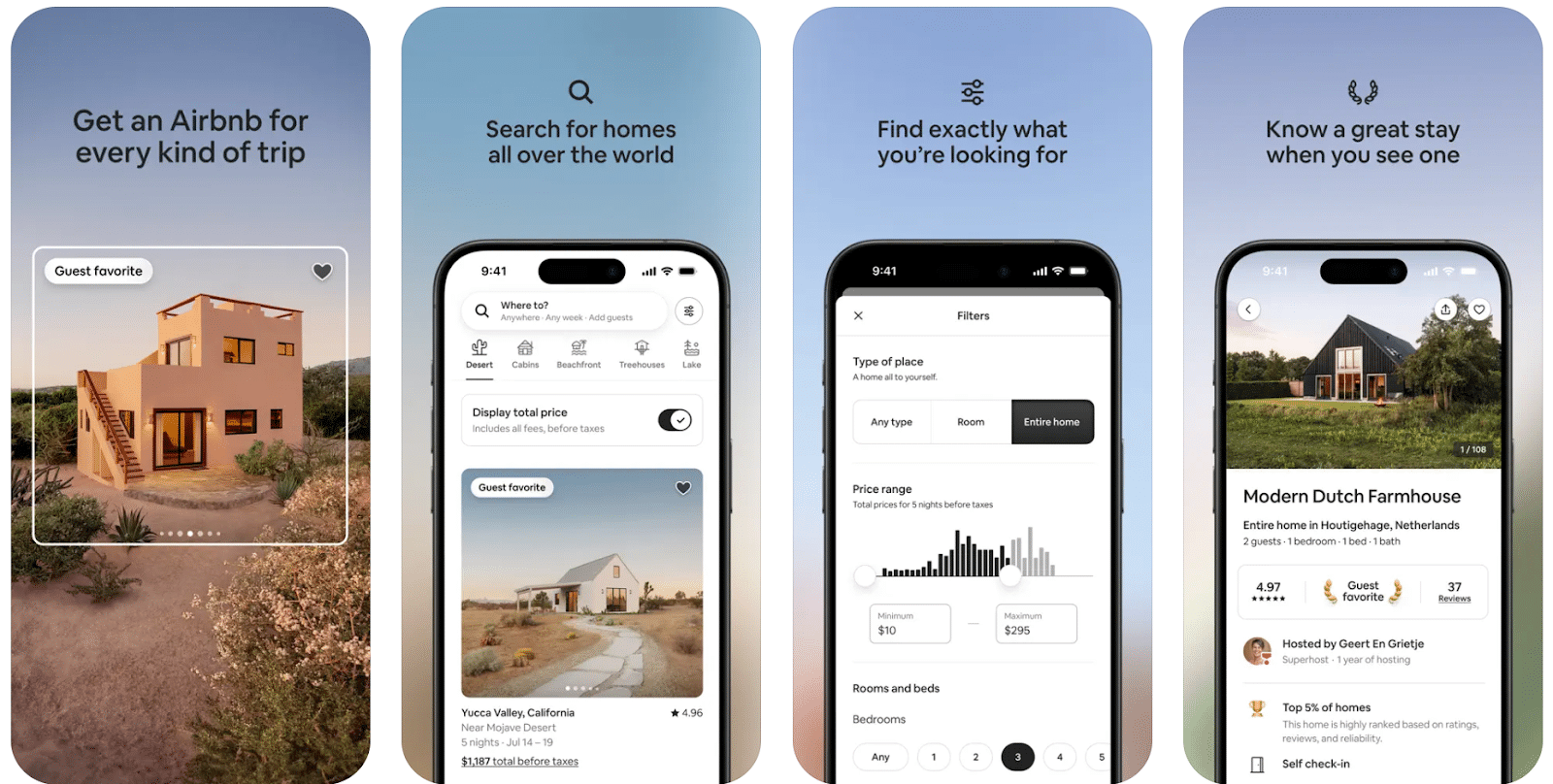 Airbnb iPhone screenshots
Eye-catching and functional visual elements are integral to your app’s success.
In addition to your title and subtitle, your app icon is the other early touch point for your app and brand.
Focus on making the icon simple, engaging and closely tied to the brand.
Your icon doesn’t have to do all the heavy lifting. Screenshots are another crucial element of your app store listing. These help convey main functions and features and even act as another instance of keyword optimization.
However, to maximize their effectiveness, test, track and update your screenshots every 6 to 8 weeks.
Videos can also be helpful for ASO creative, depending on your app’s category. Keep video assets at 15 to 30 seconds.
Be sure to use strategic, engaging graphics and always include a call-to-action (CTA) that stands out toward the end of the video. However, don’t assume video is best for your category.
Testing and letting the data speak for itself is highly recommended, as video doesn’t always work. In many cases, videos can hurt conversions more than they help, so be sure to test, test, test.
Fundamental 4: Testing
“Test and track” is one of the longest-standing mantras in marketing. ASO is no different.
Routine testing gives you the insight necessary to consistently create winning campaigns, grow your app’s performance metrics and steadily increase your revenue curve.
Creative A/B testing is a powerful tool for testing within ASO. Here, you test at least two iterations of screenshots against one another and monitor performance.
The trick is to keep all other elements constant so you can drill down any change in performance to the single element in question.
Although most tests are creative split tests, ASOs also test video vs. no video, Google Play short and long descriptions and feature graphics.
You can think of every update in ASO as a test, even if it’s just measuring pre- and post-optimization or this month versus the same month last year.
While ASO testing products like SplitMetrics Optimize exist, they have a hefty price tag and data complexities.
Using the native app platforms (Store Listing Experiments in Google Play and Product Page Optimization in the App Store) is usually the best and most used A/B testing tool for ASO.
Why is ASO testing important?
Testing is important because it provides in-depth insight into how your audience interacts with your app listing.
Testing, tracking and tweaking each element of your app page over time can lead to a higher conversion rate, more revenue and reductions in customer acquisition costs.
Fundamental 5: Reviews and rating management
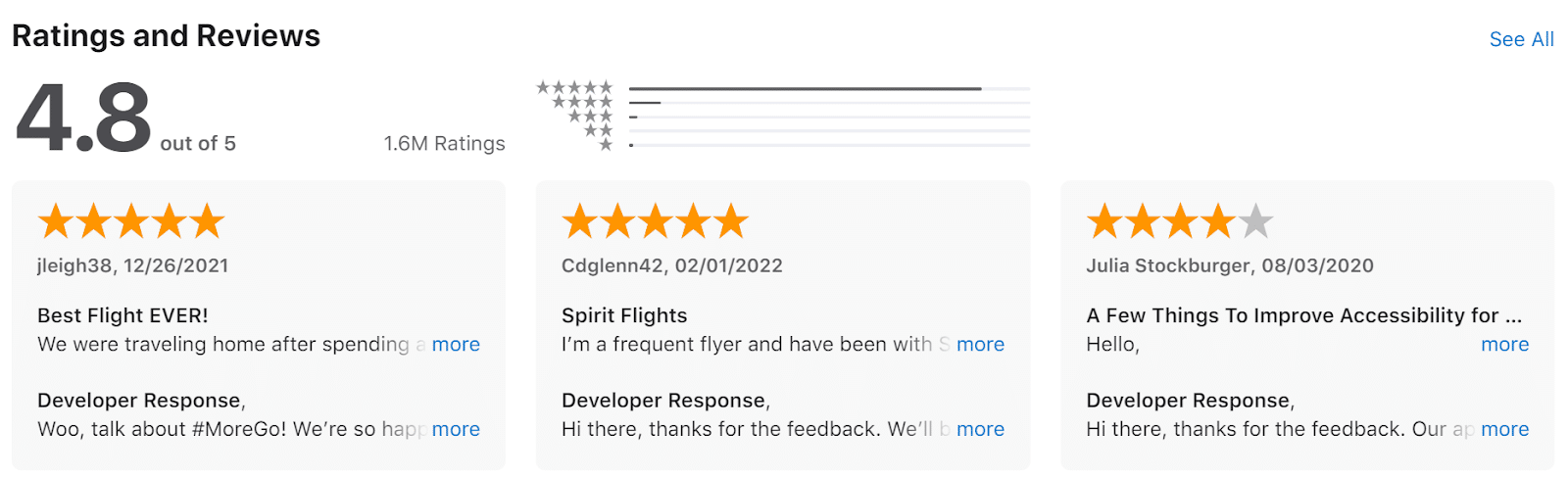 App Store Spirit Airlines app reviews
Authentic, genuine reviews for your app are a powerful component of your position in the rankings.
The right blend of customer reviews and proper management can provide you with a higher position in the app store, improve keyword optimization and impact conversion rates.
However, properly handling reviews is more than just hoping your customers leave positive feedback. You need a ratings and review management strategy.
This strategy should cover two goals:
- How to get users to leave positive reviews.
- How to handle negative reviews.
Strategies for getting positive reviews
The key to getting positive reviews is timing. You want to ask your users for their review at a point when their experience using the app is best.
It’s also important to consider how you will ask for your reviews. In addition to timing, elements like the design and implementation of your app prompts can be incredibly important in creating positive feedback about your app.
Handling negative reviews
The first step in addressing your app’s negative feedback is understanding it.
Ask yourself what topics users are criticizing, how you’ll respond to their criticisms and how you can work with your app developers to prioritize changes.
Take time to provide an engaging, thoughtful answer; users might be more likely to contact you to resolve the issue.
Again, app marketing tools can be indispensable for research like this. Platforms like AppTweak and Appfigures provide consolidated review data, making it easier to measure overall sentiment.
Fundamental 6: Tracking and performance reporting
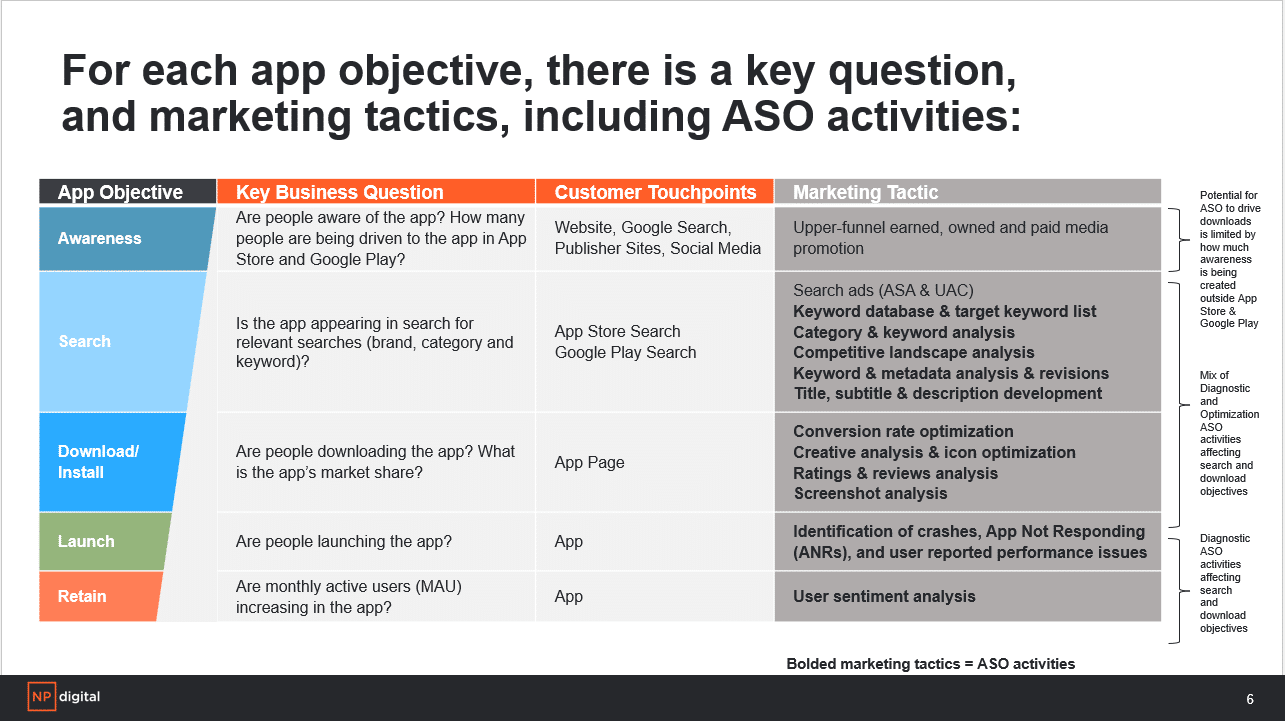 Example
 of an
ASO measurement framework
Continuous monitoring and reporting serve as your roadmap for ASO. The “test and track” mantra mentioned earlier could be applied to your entire campaign.
Use tools with cumulative dashboards to manage and organize the stockpile of data that comes with working on ASO.
With so much data to track, it’s important to follow the key performance indicators (KPIs) that help improve the app’s performance.
While tools and dashboards may vary, focus on the following metrics:
- Visibility metrics: This includes all metrics that directly affect your app’s visibility in the stores. On a more granular level, visibility comes from metrics like impressions, keyword rankings and listing visitors.
- Conversion rate metrics: Conversion rate metrics, including conversion rate and impression-to-download rates, provide insight into your listing’s effectiveness at drawing in and securing potential users.
Fundamental 7: Advanced optimizations
Once you’ve mastered the foundational elements of ASO, you’ll want to explore additional elements or strategies you can add to enrich your app’s presence.
With each of these elements or strategies comes its own nuanced form of optimization. Here are a few to consider and how to approach them:
App Store custom product pages
Custom product pages enable you to create new variations of your main product page by changing things like screenshots, preview videos and promotional text.
You can launch up to 35 custom product pages, each with a dedicated URL to which you can drive traffic through advertising and promotions.
In-app events
 Example of in-app events in App Store
In-app events enable brands to promote limited-time events occurring within their app right on their app product page.
Event promotions are often featured in the app store search results or in editorial content within the app stores.
This increased visibility can lead to higher discovery rates, especially if the event is time-sensitive or aligned with current trends.
Apple Search ads and Google App campaigns
Paid search campaigns are critical for maximizing the impact of ASO.
You can:
- Boost an app’s visibility.
- Target a specific audience.
- Connect with similar businesses.
- Promote at scale.
- Benefit from detailed measurement and optimization.
Boost your app’s discoverability with ASO
Mastering ASO is a necessity to maximize success. ASO serves as the foundation of any app marketing strategy. It enables brands to improve their app’s visibility, attract more downloads and ultimately increase revenue while reducing user acquisition costs.
With billions of apps vying for attention in app stores, the importance of a well-executed ASO strategy cannot be overstated.
By continuously refining ASO efforts through research, testing and optimization, you can stay ahead and ensure long-term growth and success.
Courtesy of Search Engine Land: News & Info About SEO, PPC, SEM, Search Engines & Search Marketing
Monday, August 26th, 2024
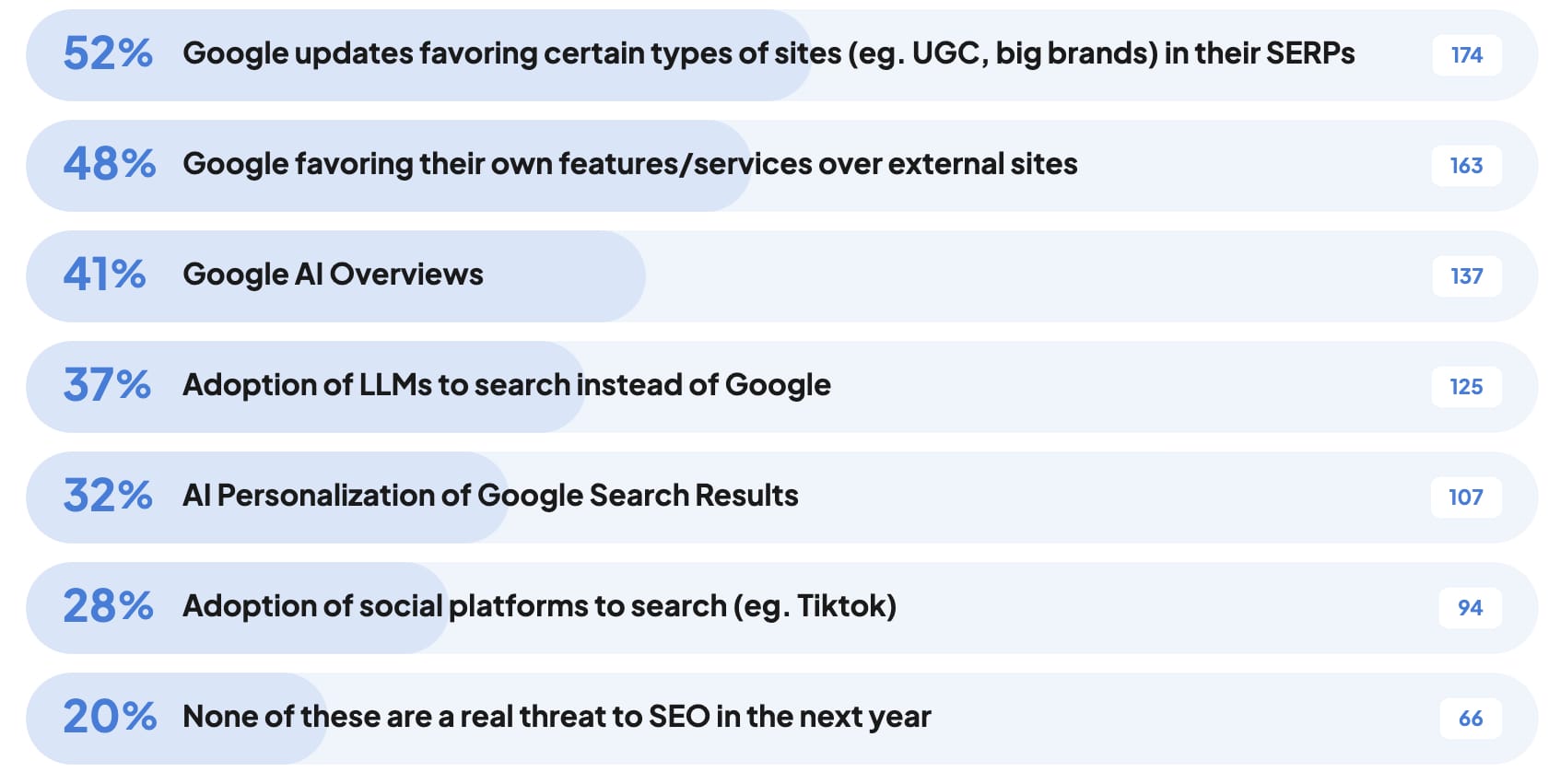
Google’s favoritism of certain types of websites – or itself, in the form of search features and AI Overviews – are the biggest threats facing SEO consultants, according to a new survey from Aleyda Solis.
SEO threats in 2024. Google updates that favor certain types of sites (e.g., user-generated content, big brands) in the search results is the biggest threat to SEO consulting efforts, according to 52% of survey respondents.
- Google favoring its own features/services over external sites was the second biggest threat (48%) while AI Overviews came in third (41%).
- Other real SEO threats are the adoption of LLMs to search instead of Google (37%); AI personalization of Google Search results (32%) and adoption of social platforms to search (28%).
Counter threats. So how are SEOs combating these threats? Based on responses Solis received, SEOs are focusing on:
Why we care. SEO is more difficult than ever in 2024 – especially for smaller and mid-sized brands and websites. We’re already seeing many threats in 2024 (e.g., Google algorithm updates, more competition and complexity, less resources). But there continue to be many opportunities to reach and influence people during search journeys in today’s fragmented search landscape.
About the survey. The results are based on responses from 337 SEO consultants, collected between July 21 and Aug. 21.
The report. You can read it here: The SEOFOMO State of SEO Consulting – Survey 2024 Results.
Courtesy of Search Engine Land: News & Info About SEO, PPC, SEM, Search Engines & Search Marketing
Monday, August 26th, 2024
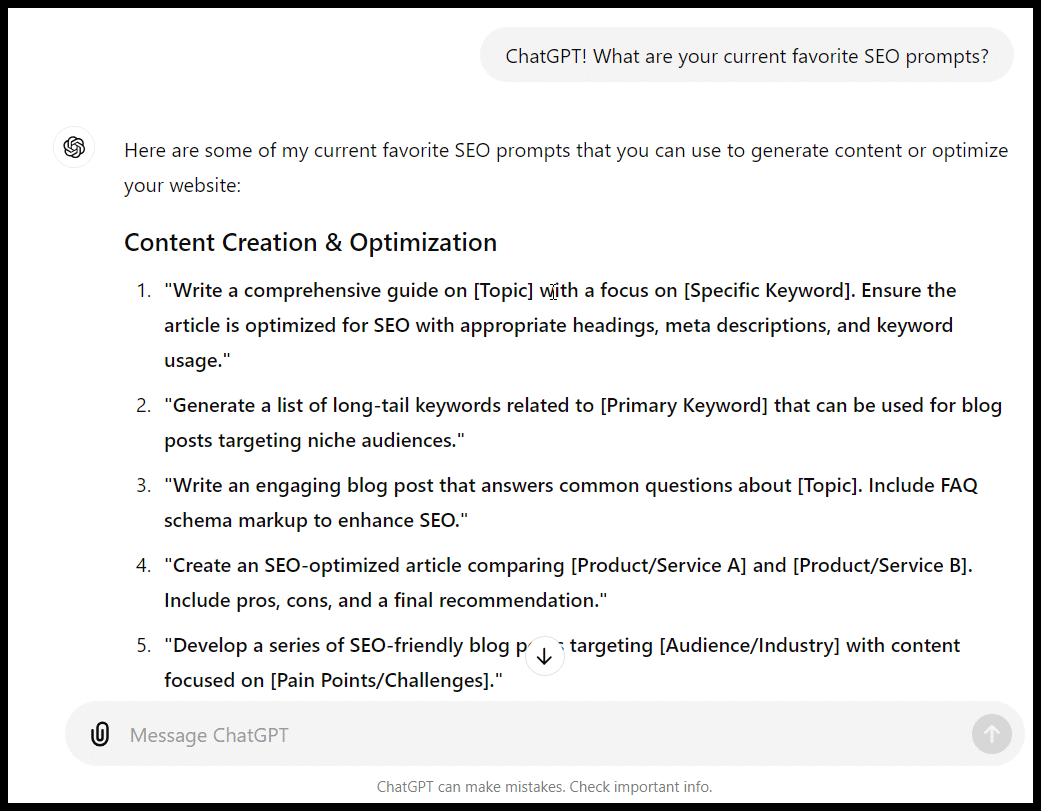
ChatGPT has many applications for content and SEO.
This article will discuss what to keep in mind when creating ChatGPT prompts for SEO and share an extensive list of SEO-focused prompts to use in your day-to-day work.
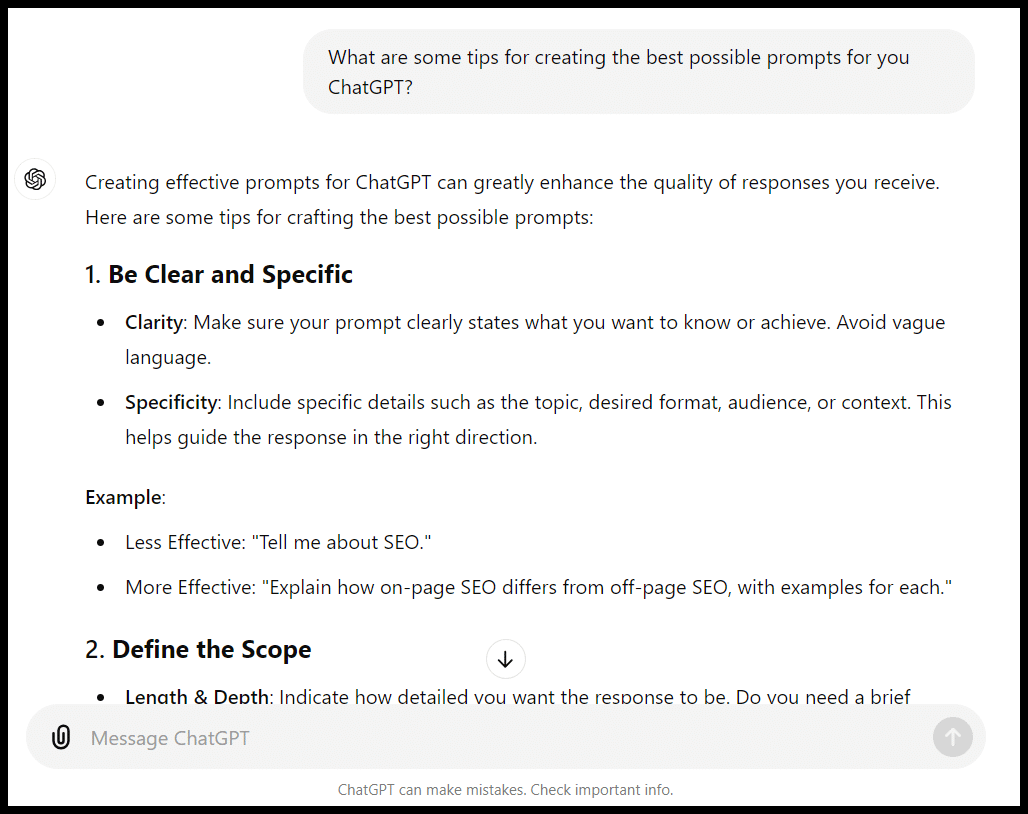
ChatGPT prompt engineering strategy
Before getting into specifics, it is helpful to have a general approach to ChatGPT prompts (and AI chat/writing prompts) so that you can create prompts for your specific applications and be aware of the great SEO prompts other folks have come up with.
In addition to those suggestions, ChatGPT had some others:
- Use contextual information.
- Ask for specific formats or structures.
- Provide examples.
- Limit or expand the scope.
- Iterate or refine.
- Specify the desired tone or style.
- Ask for multiple perspectives.
- Combine multiple requests carefully.
Depending on your prompt and what you’re trying to accomplish, these are pretty good tips.
However, it’s helpful to understand more about how ChatGPT works before assigning it specific tasks (even with very detailed prompts).
ChatGPT’s own prompt engineering guide is actually a better resource on the topic than the tool’s suggestions.
First, it’s vital to understand ChatGPT’s limitations:
- ChatGPT is trained on a large data set and finished training in April 2023, meaning not all of the information is up to date. As you likely know, not everything it’s trained on will be correct. That said, the browser tool available with GPT-4 allows the product to get more recent information.
- There are a variety of things ChatGPT can get flatly wrong: facts, math problems and code.
- While it has access to a lot of data and can organize that data in interesting ways, it’s unlikely to have an expert level of “taste” or knowledge about any individual subject (yet, anyway).
- ChatGPT wasn’t designed to be an SEO tool, so while you can create prompts for things like keyword research, clustering, link building, etc., keep in mind that its responses and suggestions frequently won’t use the same types of data sets (driven by search popularity and competition) as your favorite SEO tools.
If you ask ChatGPT for a list, don’t expect it to be curated at an elite level. Don’t just assume it will work if you ask it to write code or generate an Excel formula.
If you ask it to write an article, don’t assume everything it generates will be accurate or well-written (particularly on topics requiring specialized knowledge).
QA is your friend!
I like to think of prompts as tasks like creating a content brief, using a search operator or creating a statement of work (SOW).
Based on that approach, here are specific tips for crafting a good prompt:
- Be as clear and thorough with your prompt as possible.
- Make sure ChatGPT is capable of doing what you’re asking it to.
- Refine your prompt as you see the output and use your experiences with ChatGPT to inform future prompts.
- Try to anticipate and address the areas where it may get tripped up as much as possible with the prompt itself.
The best (and worst) ChatGPT SEO prompts
As with most topics, many people are sharing great information about ChatGPT prompts for SEO. However, some prompts people have shared fall between mediocre and downright harmful.
Below, I listed examples of what I think are largely “good” (or helpful, to steal a term from Google) prompts and what I think are “bad” (unhelpful to harmful) prompts.
These examples offer specific ideas for prompts that can help make you more efficient and some prompts that can get you into trouble (or waste your time).
The good
We’ll start with some useful prompts. Again, I can’t emphasize this enough: QA the output of everything you get from ChatGPT!
Information can be (dangerously) wrong or misleading and code can break in the worst ways.
While Google has stated that AI-generated content isn’t explicitly in violation of its search guidelines, it’s certainly possible for your site to get into trouble with it.
Keyword and topic brainstorms
ChatGPT is a helpful brainstorming tool for various tasks, including keyword research.
It is particularly useful as an early starting point for getting ideas for keywords and topics.
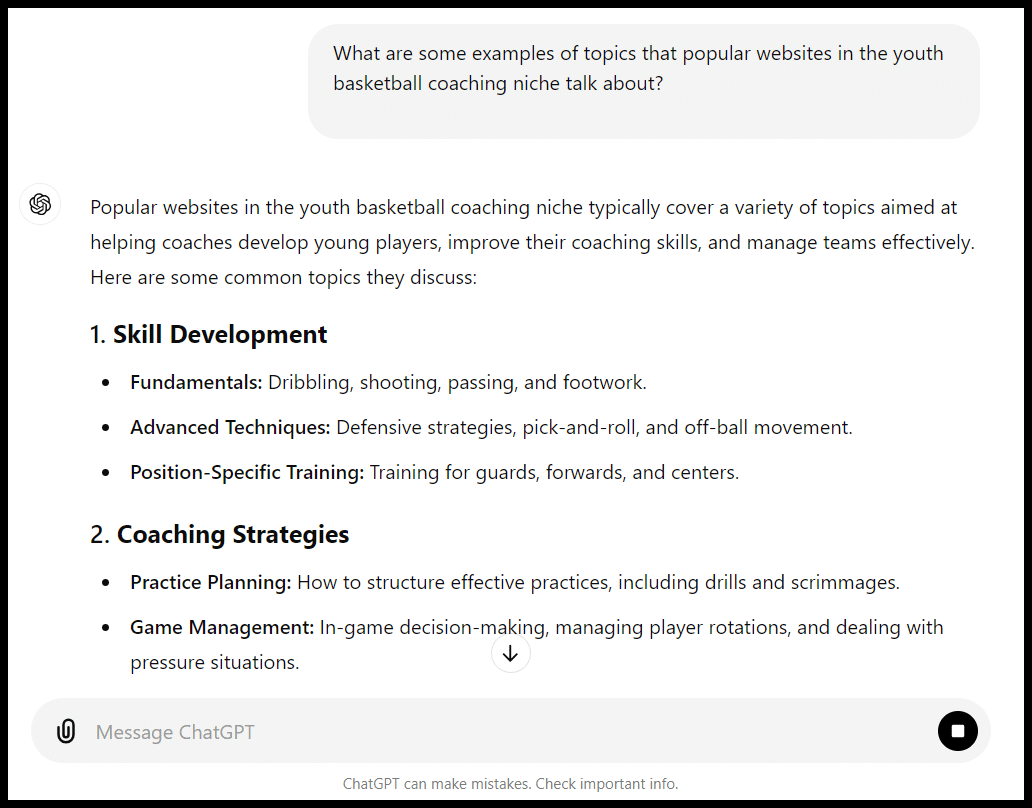
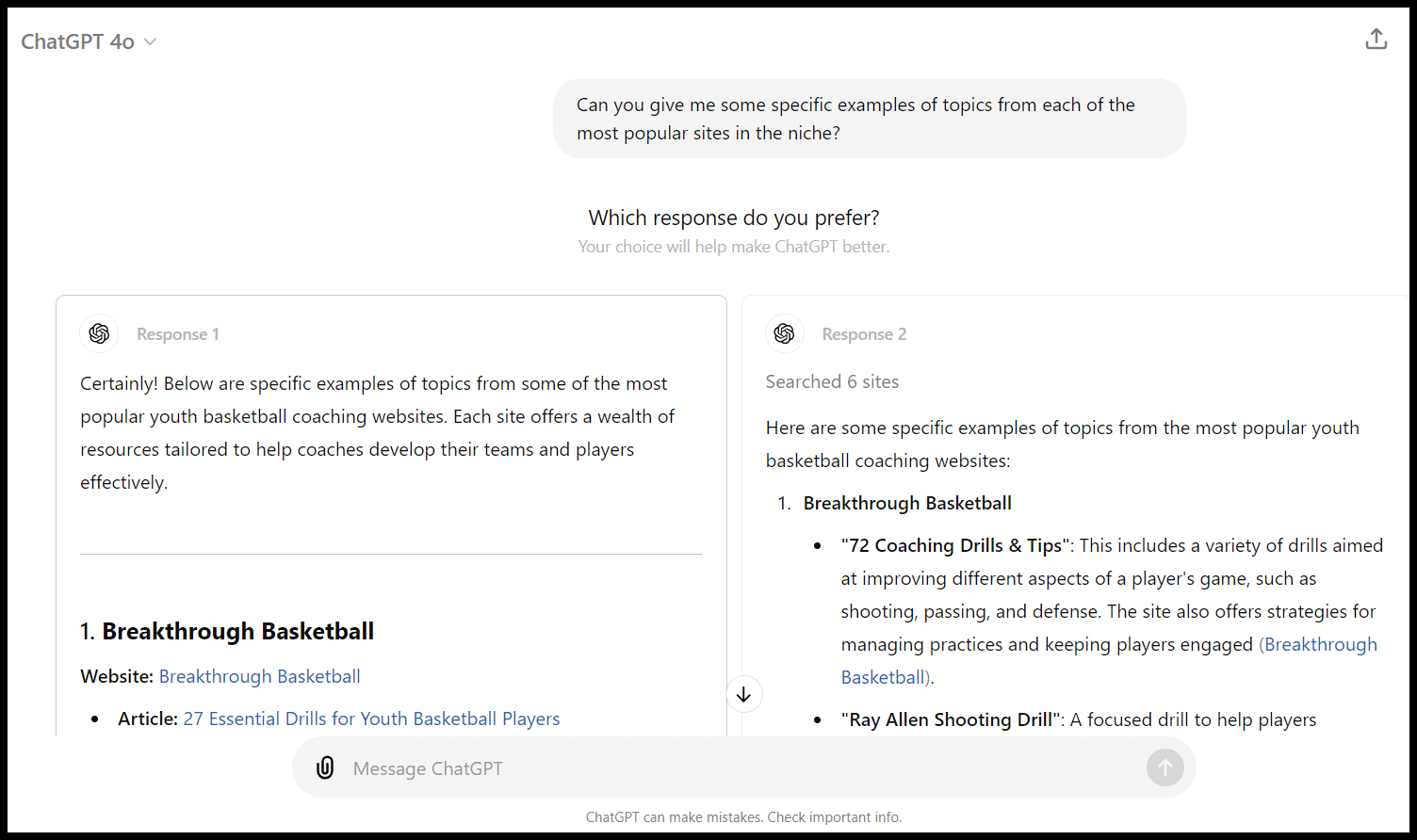
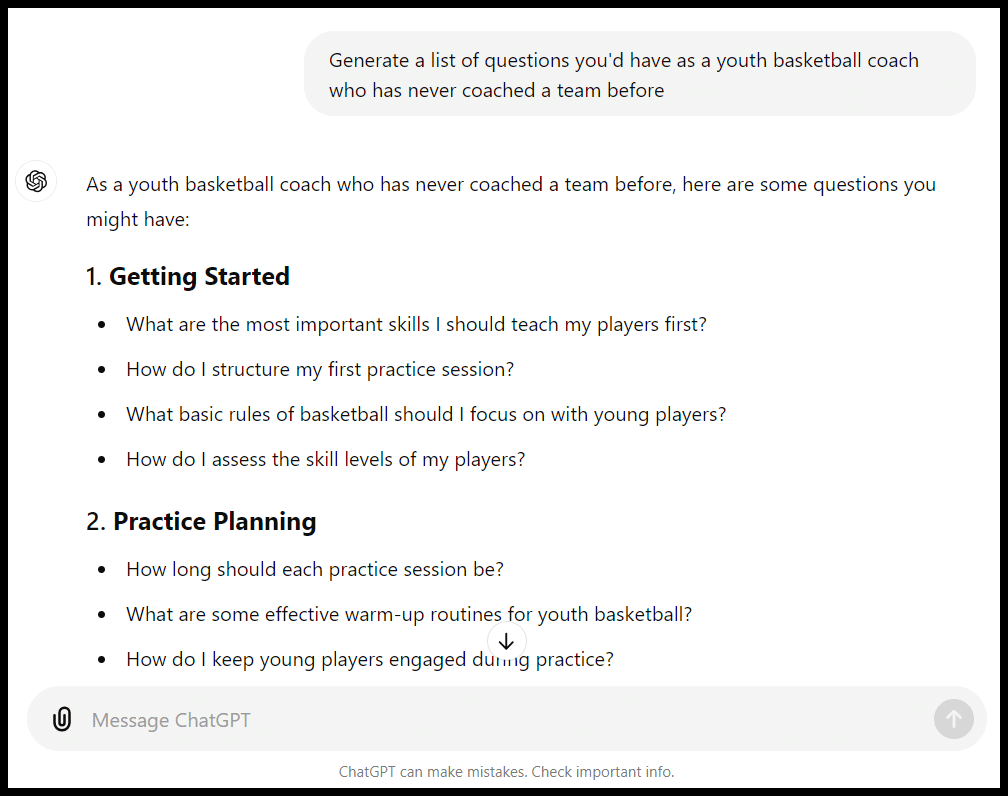
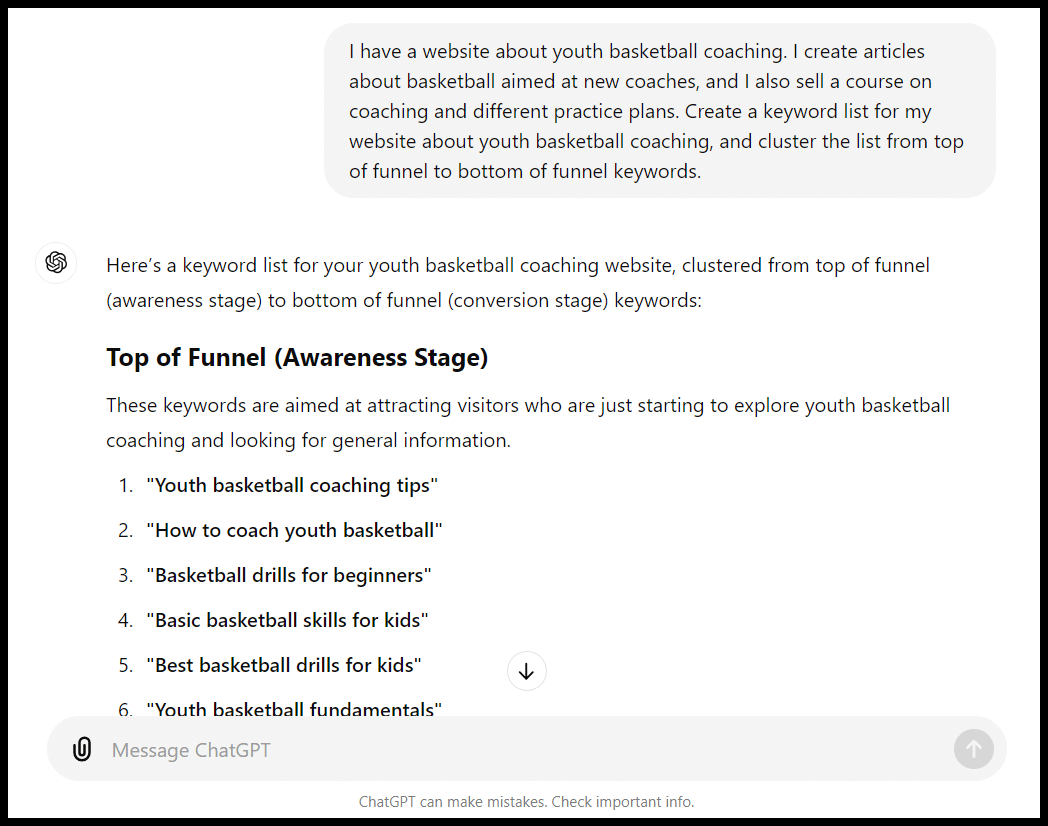
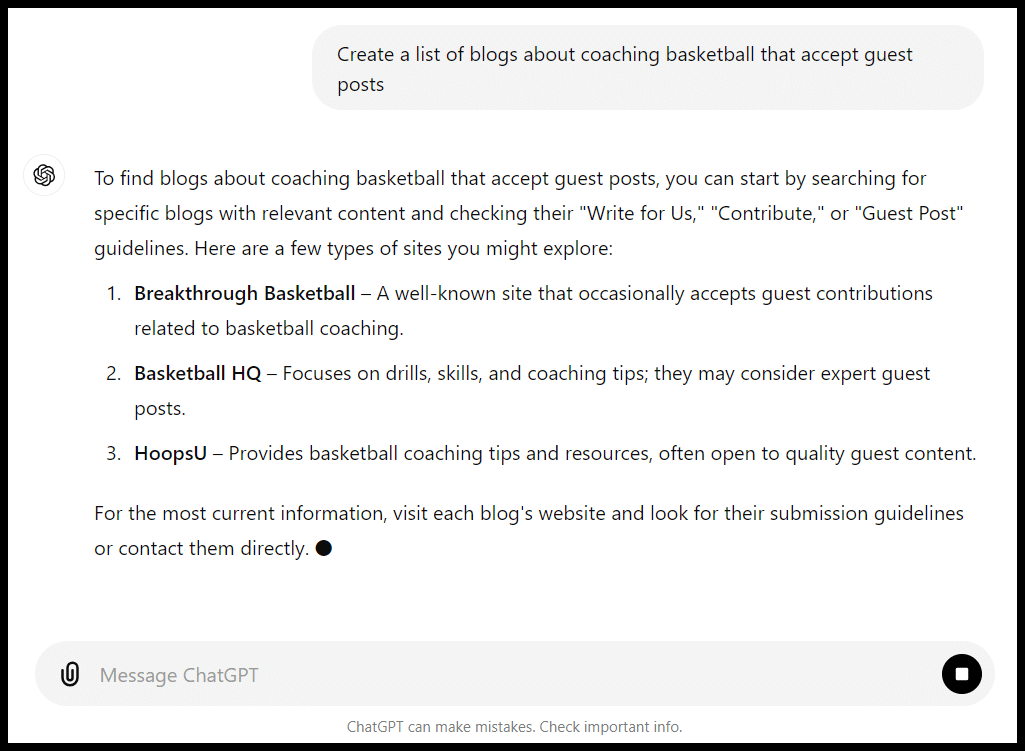
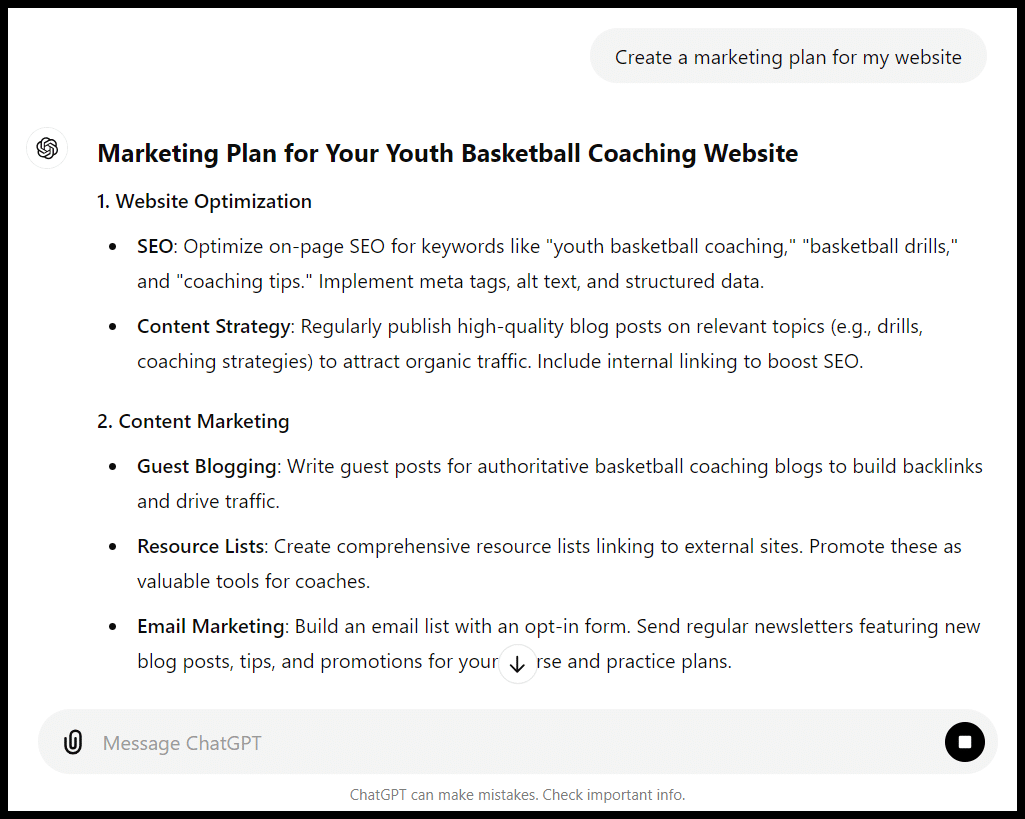
Let’s assume I’m creating a site aimed at delivering information about coaching for youth basketball coaches:
This list is a pretty good overview, and I can refine the query a bit and get a quick run-down of some specific posts and topics from popular sites:
The follow-up prompt gave me an extra layer of both topics and some examples of suitable sites in the niche. (Again, remember, if I’m not using the browse tool and explicitly asking for more recent data, these are from April 2023 or before.)
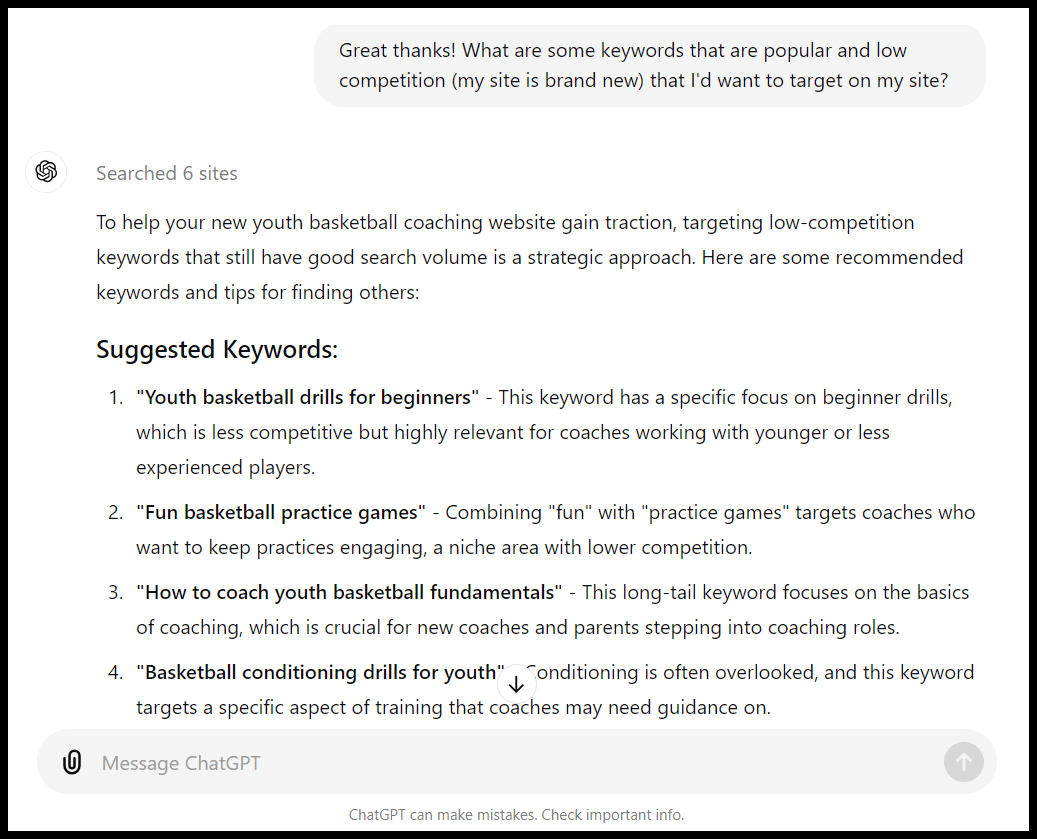
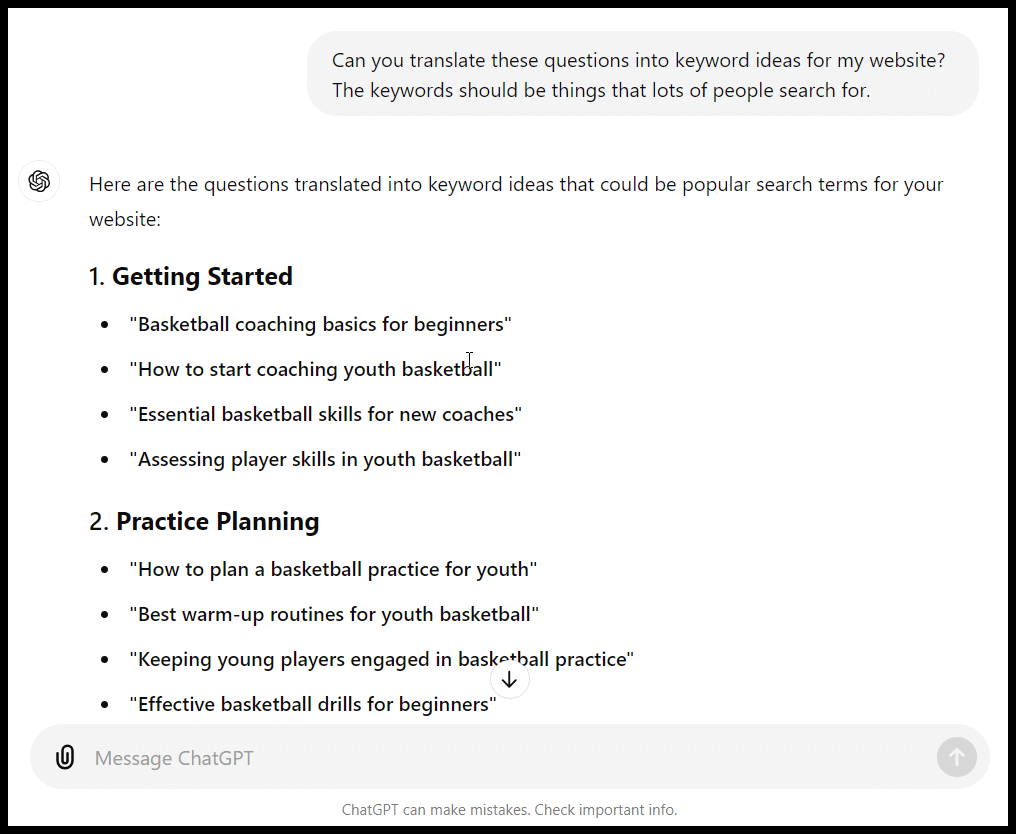
Let’s dig a little deeper into keywords:
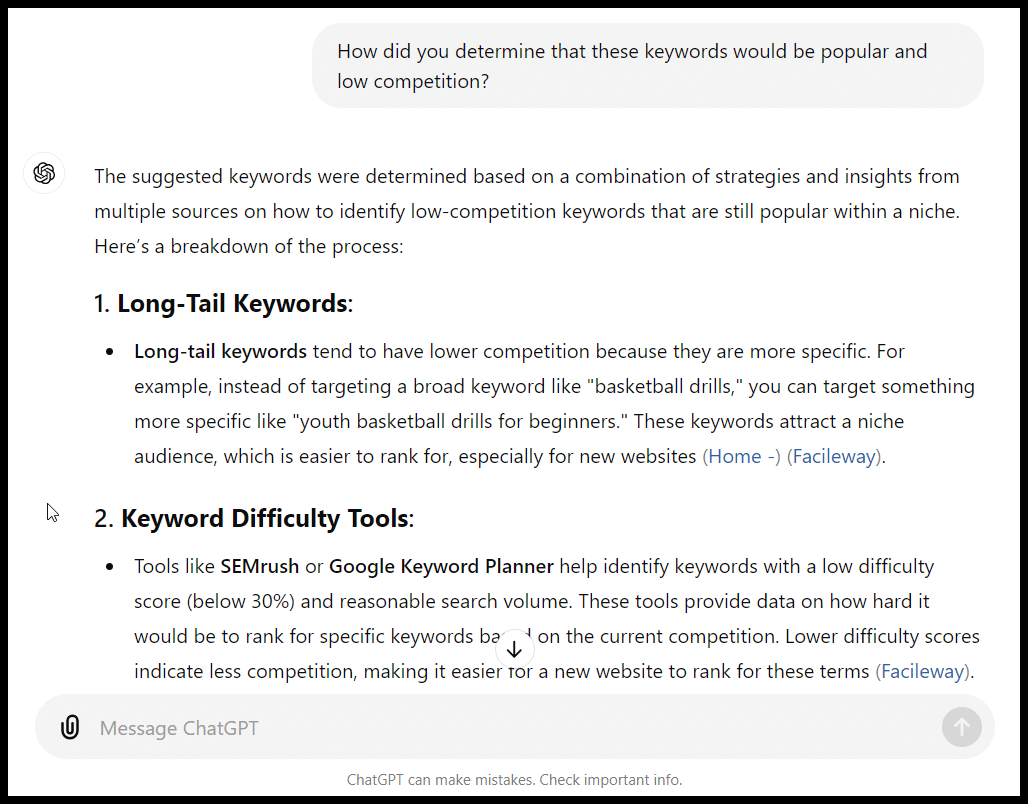
How does ChatGPT determine that these are “popular and low competition”?
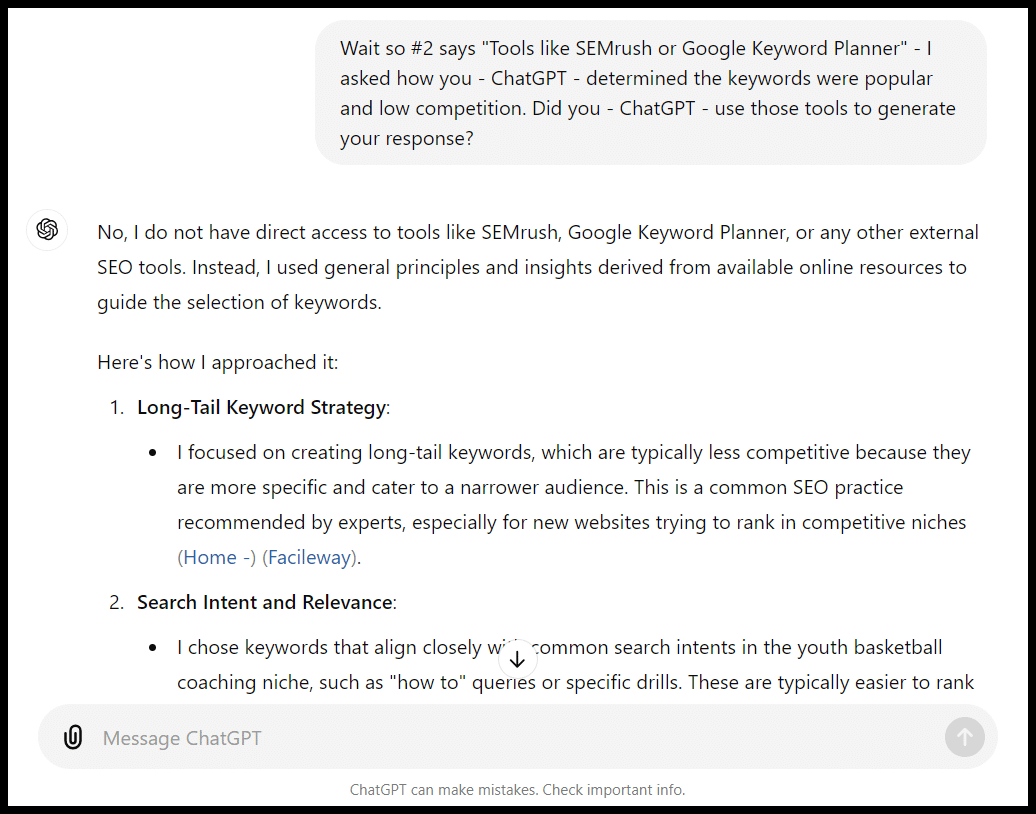
Wow, ChatGPT uses Semrush and Keyword Planner to generate keyword ideas. It only took a few seconds, too.
I decided to ask for a follow-up:
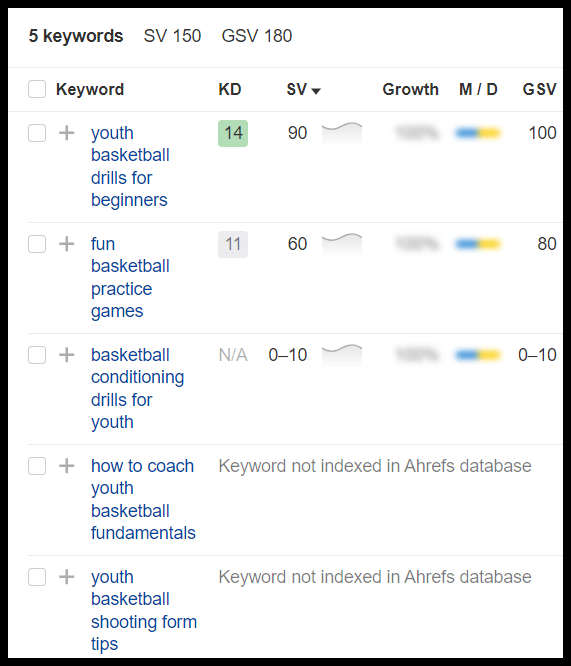
Let’s look at whether these terms are actually low competition, according to Ahrefs:
Well, not much search volume here, but let’s check the actual SERP to get a sense of competition for one of these terms.
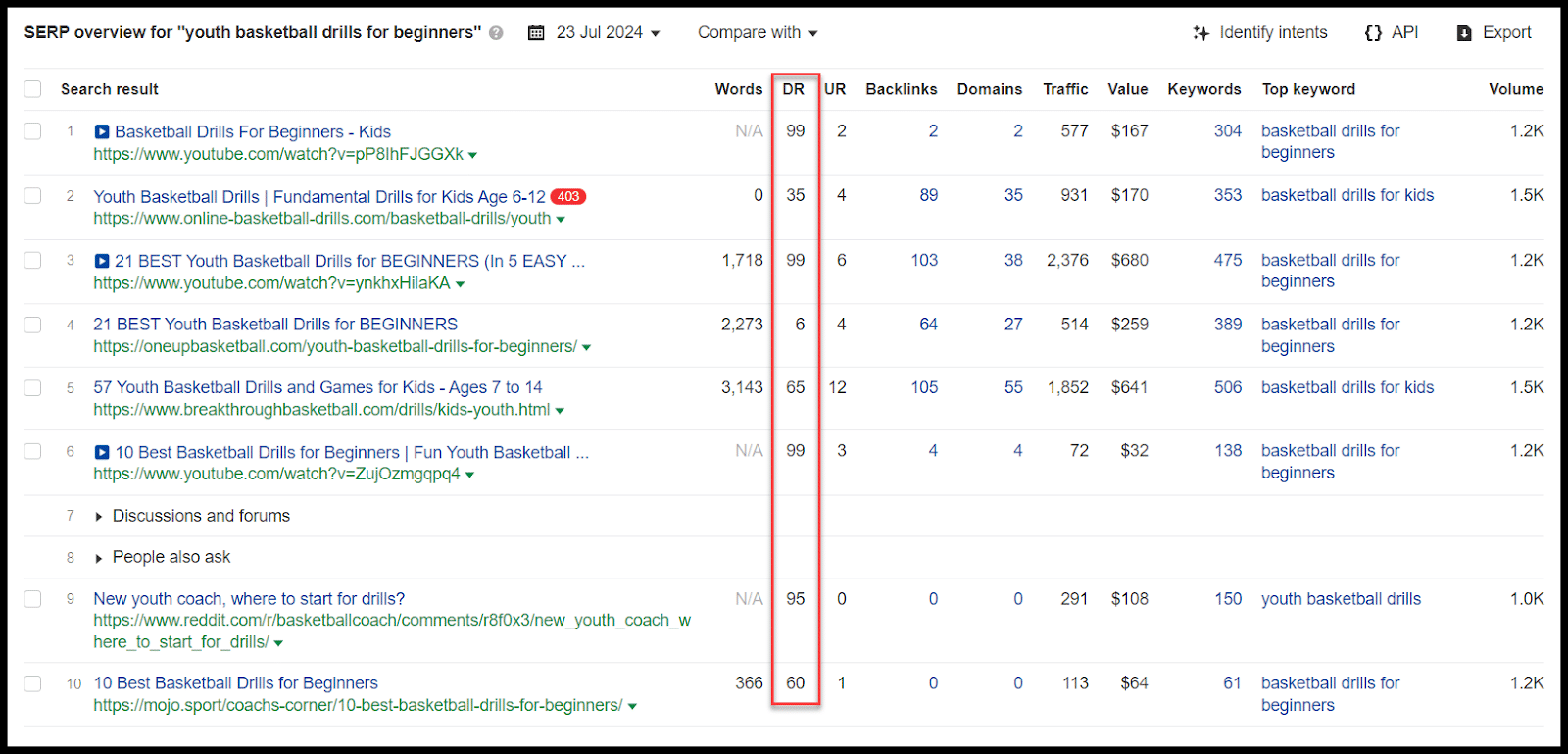
This isn’t an impossible term competition-wise, though it likely isn’t feasible for a new site any time soon.
I can see that these pages are ranking well for other terms, and there’s likely a lot of search volume in this area overall.
A popular prompt framework is to get ChatGPT to answer a prompt “as an X” with X being a person with a specific job, level of experience or expertise, etc.
Let’s see how that impacts things here:
These seem pretty good again.
Let’s dig deeper, the combination of volume and competition maybe tripped the tool up.
I’ll ask for terms with volume this time:
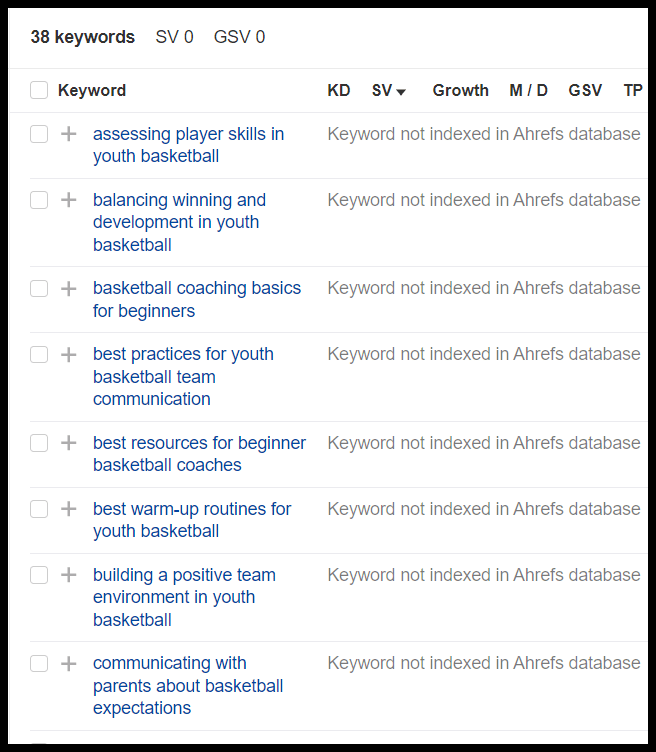
And let’s see the data on that round via Ahrefs:
Volume is even worse.
ChatGPT takes my “prompt history” into account for a specific chat, so if I’d opened a new chat and focused more on volume, I may have done a bit better.
Generally, it’s often the case that if you feel like you’re down a rabbit hole with ChatGPT and aren’t getting the data or responses you want, you may want to consider starting fresh and better orienting the tool to what you want.
These prompts and responses are a perfect encapsulation of ChatGPT for a lot of functions:
- The initial set of results gave a pretty good framework for sites to check out and general topic areas.
- Things got murkier as I niched down and needed to develop specific, actionable plans with search-specific data.
- Those terms don’t look great in terms of volume; my site can’t rank for those terms, and ChatGPT told me something that wasn’t true about how it generated the suggestions! It also states everything emphatically.
This might have been a useful exercise if I were looking for general topic ideas here.
I might have wasted a ton of time and resources if I had just started writing (or paying writers) to create content to target these phrases without checking ChatGPT’s suggestions.
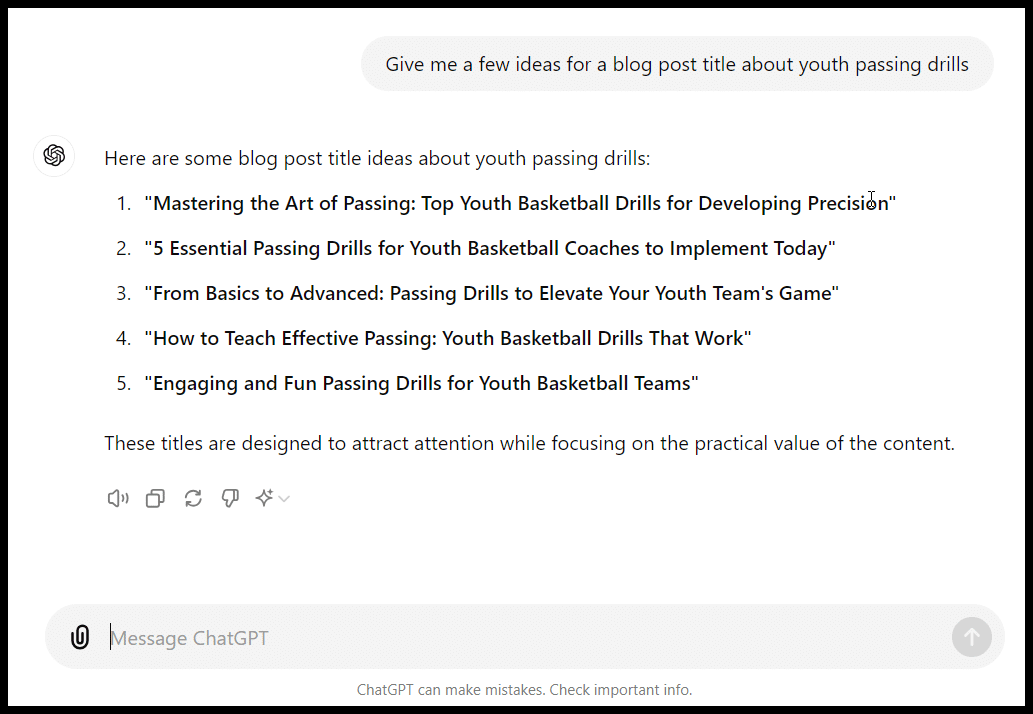
Title ideas
You should have your own ideas about creating titles and title tags for blog posts, but again ChatGPT can be a good place to generate some ideas:
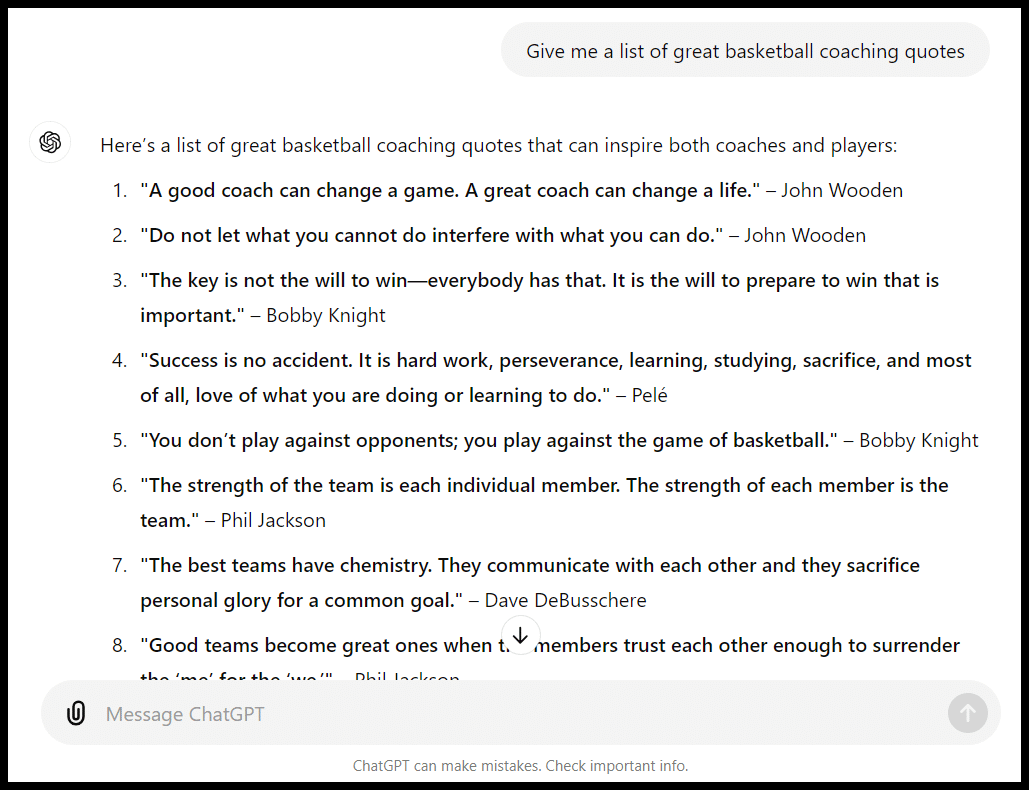
List ideas
Similarly, list types like X examples, tips, quotes, etc., require some digging to come up with ideas – while you want to curate your own list, you can quickly get ideas from ChatGPT:
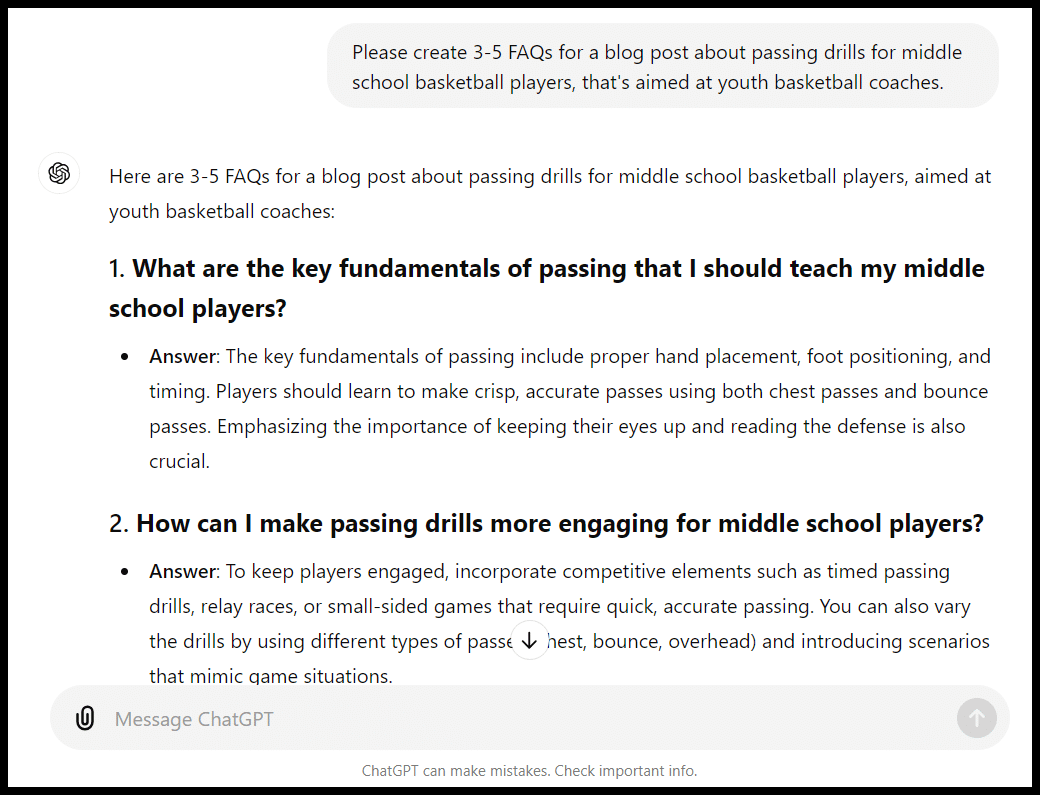
FAQ ideas
The tool can also be useful to quickly get FAQ ideas for an article. Again, layering in specific instructions and a persona can help:
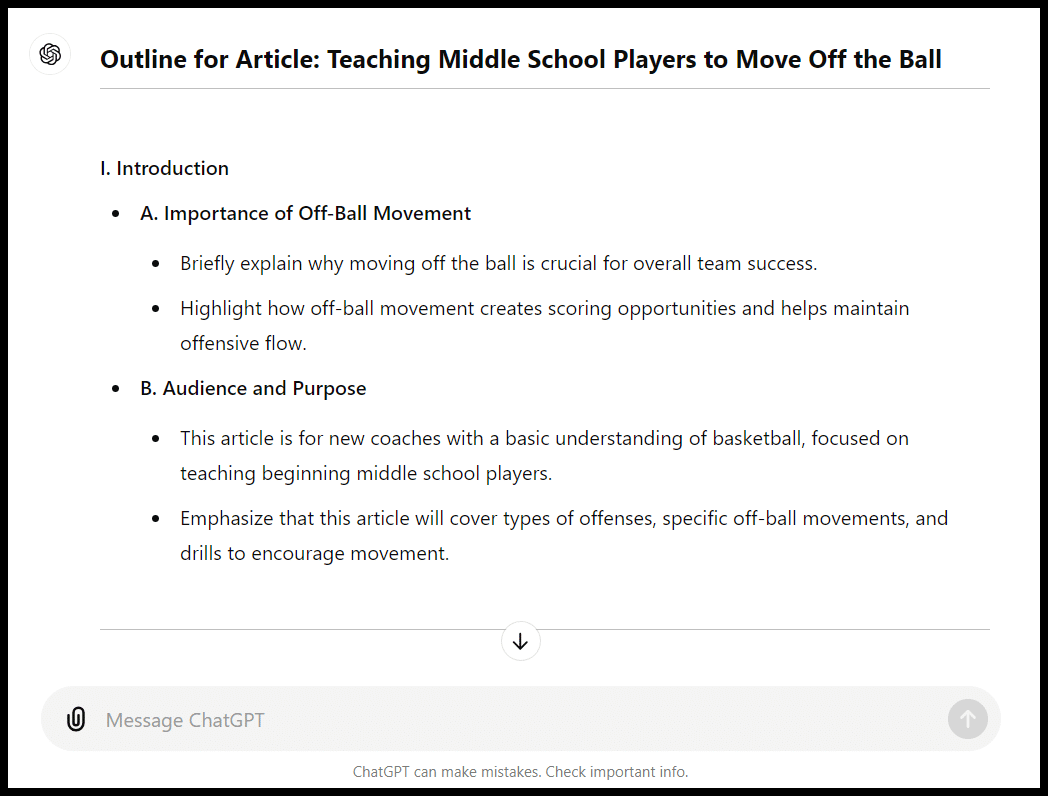
Content outlines
This is also true for content outlines. Again, keep in mind that tools like Clearscope, Content Harmony, Market Muse, Frase and Surfer SEO or AI content tools like Koala or Cuppa create briefs and outlines based specifically on what’s ranking in search results, while ChatGPT doesn’t.
Here is the prompt I used:
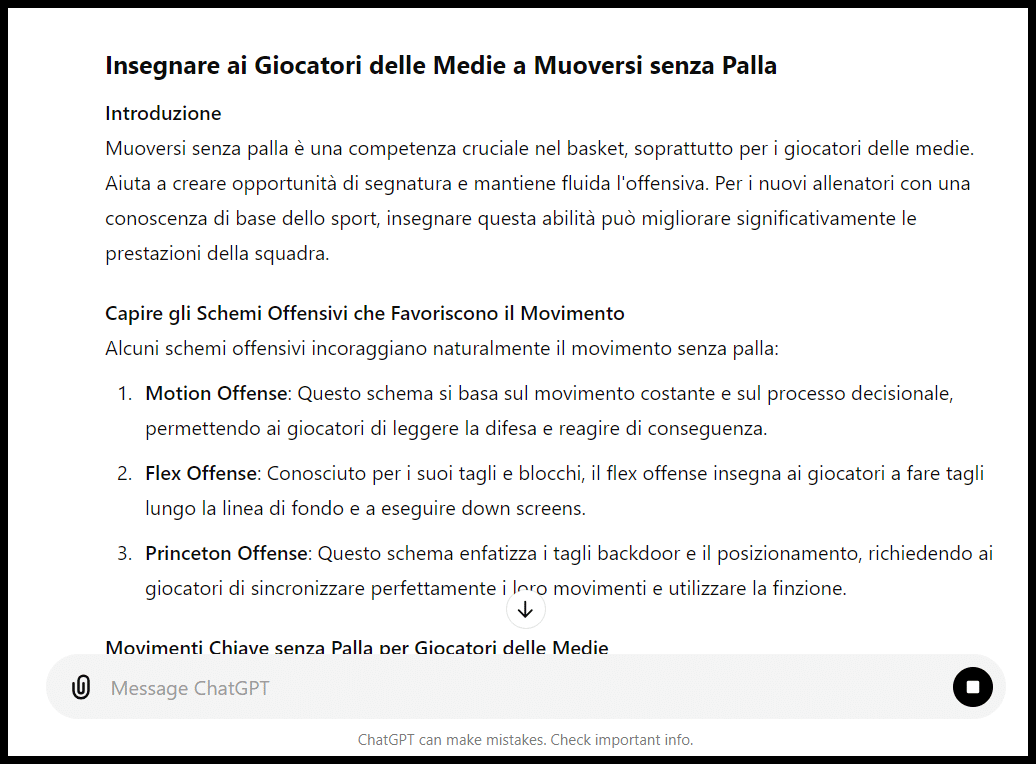
- “Create an outline for an article about teaching middle school players to move off the ball. The article should be for someone new to coaching basketball but with an understanding of the sport and is aimed at beginning players. It should include things like: the types of offenses that encourage movement, specific examples of movements players should be making off the ball (cuts, picks, etc.) as well as some specific drills coaches can run to encourage movement.”
Here is the output:
The outline was 656 words. Again, not perfect, but a pretty decent framework.
Keyword clustering
Clustering with ChatGPT is not going to be search-specific like tools like Keyword Insights or similar.
It won’t necessarily be driven by volume and competition, but you can create clusters either semantically or by things like levels of intent:
And/or just add things like search intent as an additional column.
Summarizing
Be careful with how you use these summaries (as they may get “flagged” as anything from low quality to AI over time).
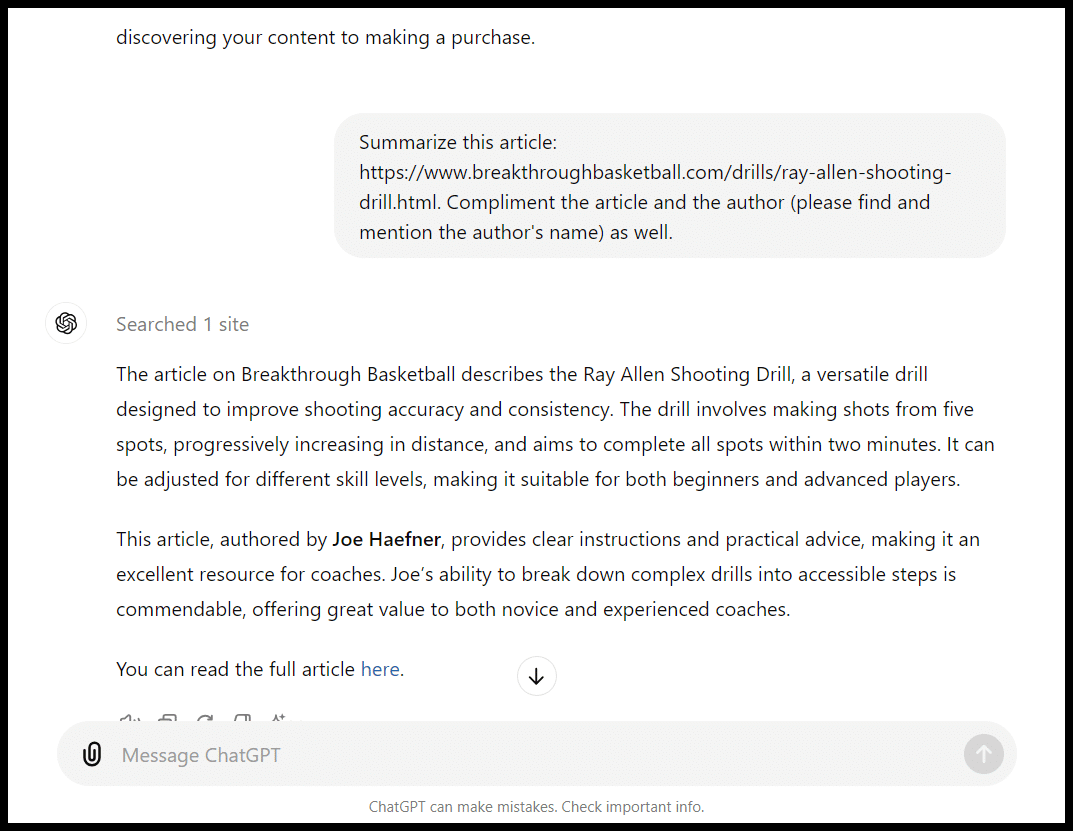
But if you have something like a study or a lengthy article that you want to feature in your own content (and also let folks know you’ve featured in outreach) in something like a tips list, you can get help there:
You can also ask for an outline of an article if you want to understand it quickly.
Technical SEO: Code snippets (schema, hreflang), robots, .htacess and more
Among the most dangerous ChatGPT prompts are code snippets.
These can be great time-savers, but again, give as much detail as possible and QA, QA, QA!
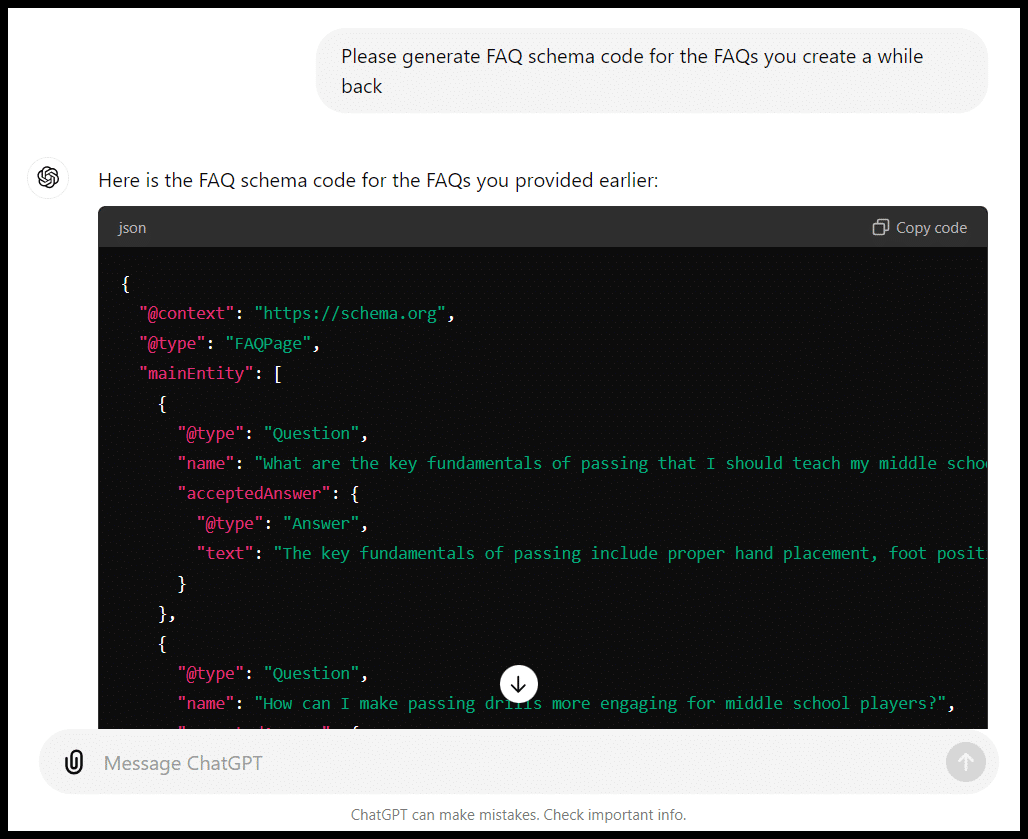
A simple prompt along the lines of “Wrap FAQ schema around these questions and answers” will get you the code to copy:
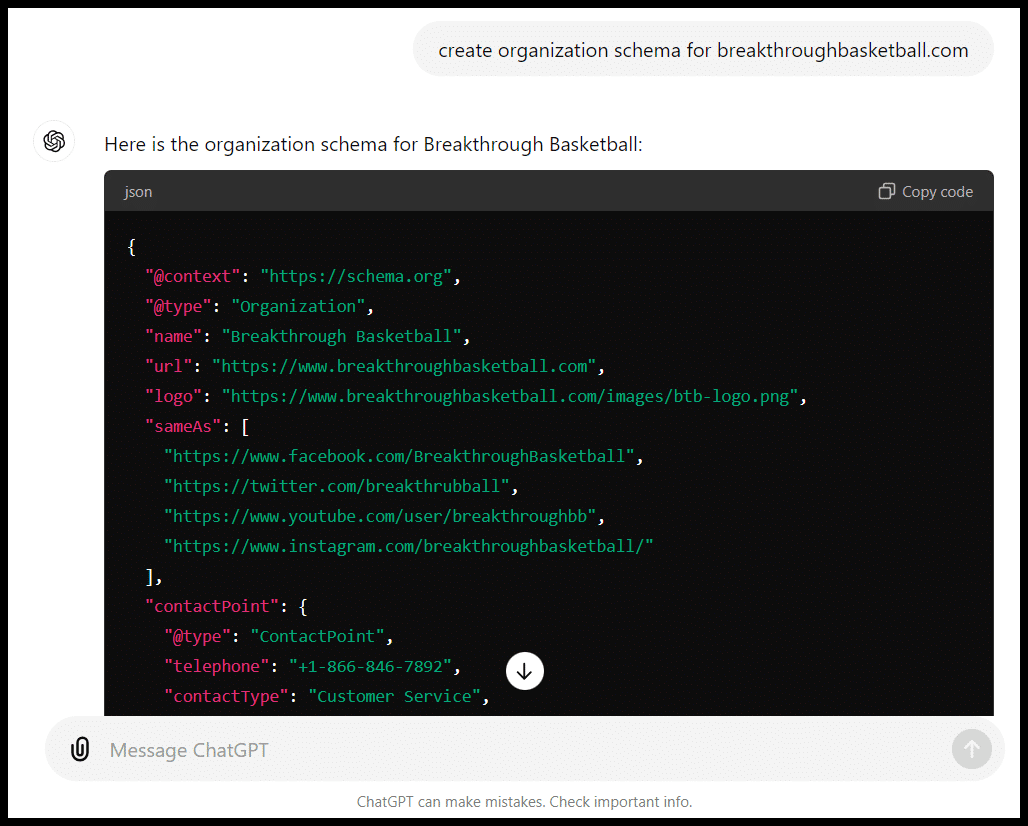
Same for different types of schema like organization schema:
I have had various schema come back from ChatGPT that didn’t work when rendered on a live page, so again, be sure to check everything.
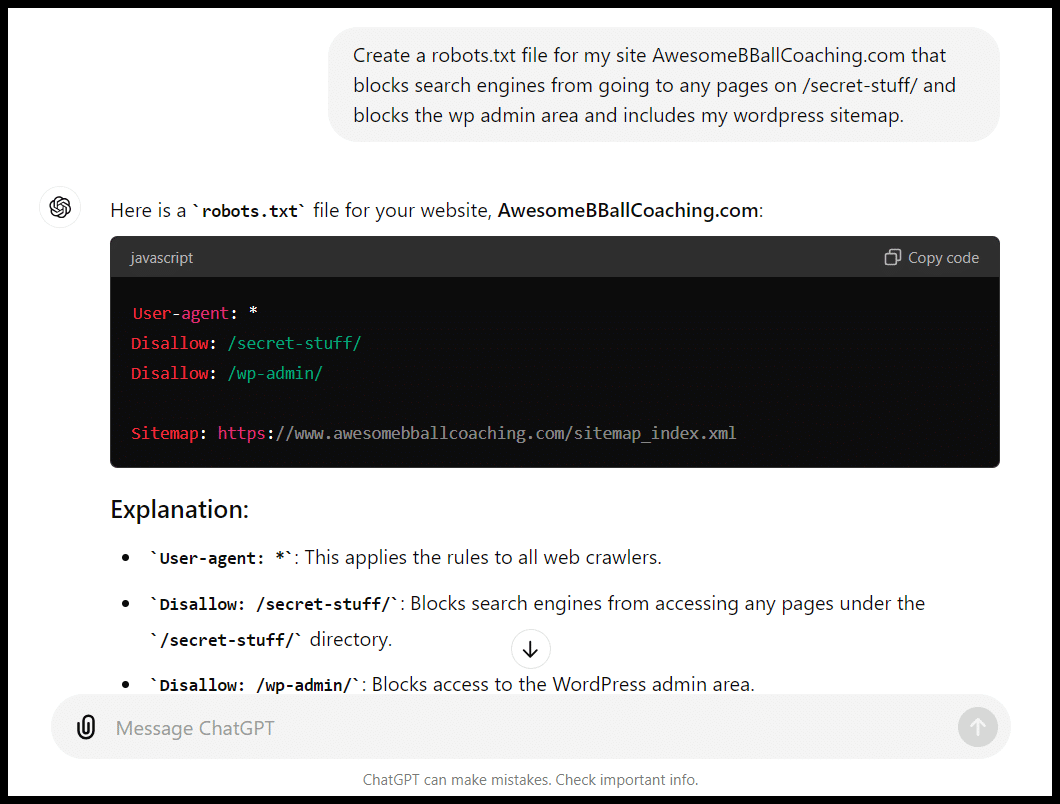
You can also have a robots.txt file created:
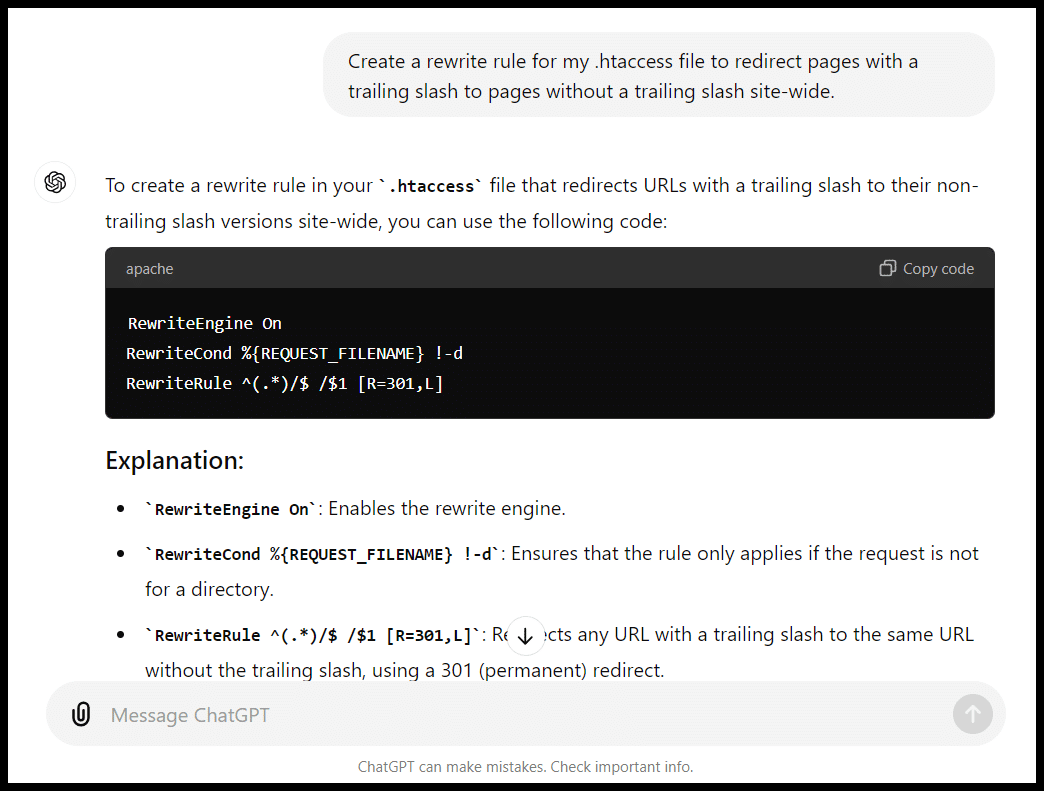
And create rewrite rules. Be careful, though. (More on this later)
Meta descriptions
Hate creating meta descriptions?
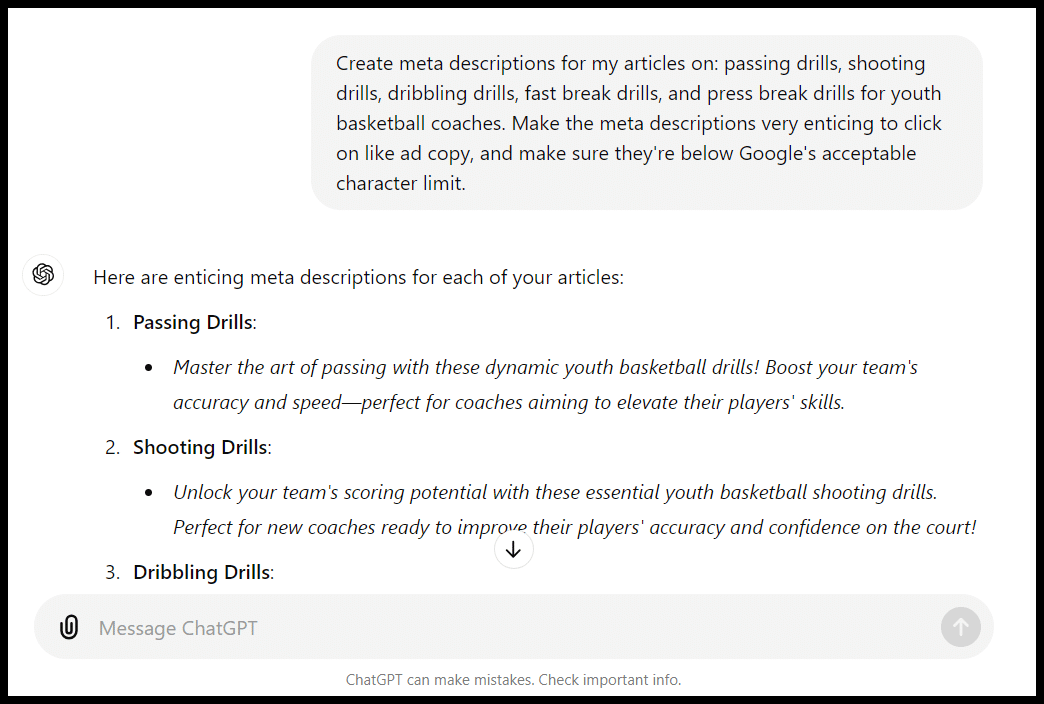
This is really a perfect function for ChatGPT:
This is a quick and simple prompt. Now that ChatGPT can browse URLs, you can provide the URL of your article.
You can also share some example meta descriptions that are performing well in your target search results. ChatGPT can use these as a template to match the style and format.
Alt text
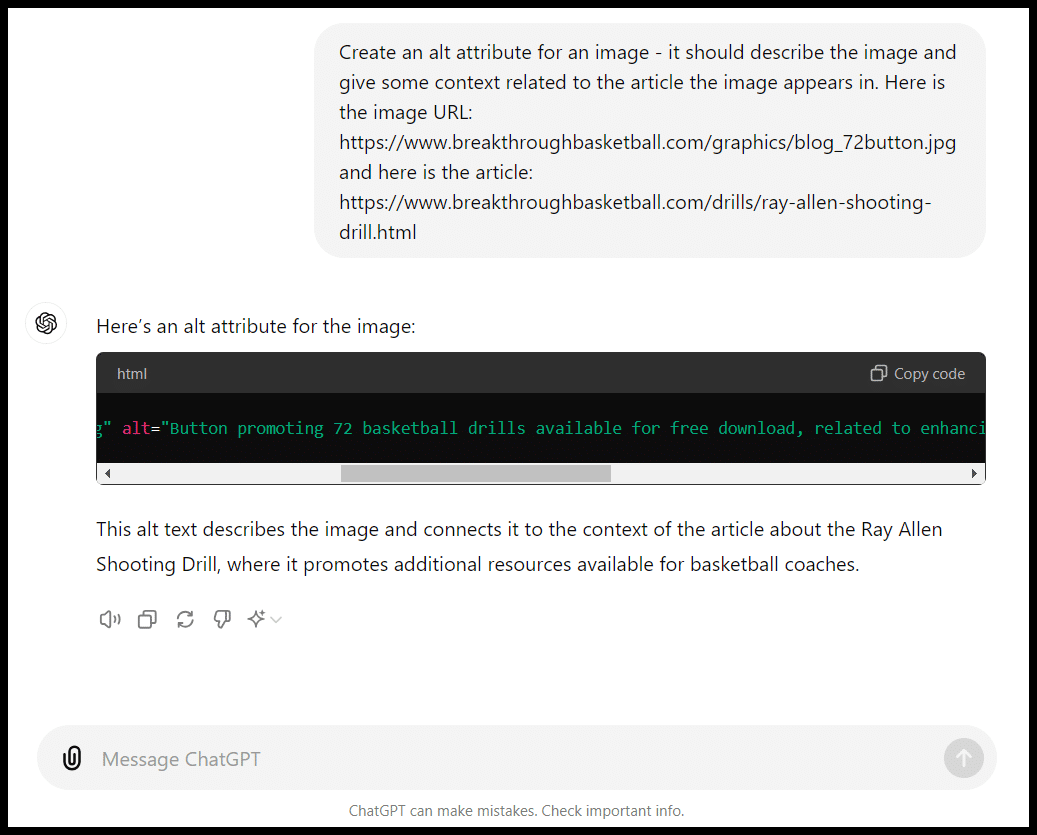
This is another good task for ChatGPT to execute at scale. You can create a prompt that gives you the output you want, and ChatGPT can now scan images and give you a pretty good answer:
Google Tag Manager, Google Analytics 4, Google Search Console and Looker Studio
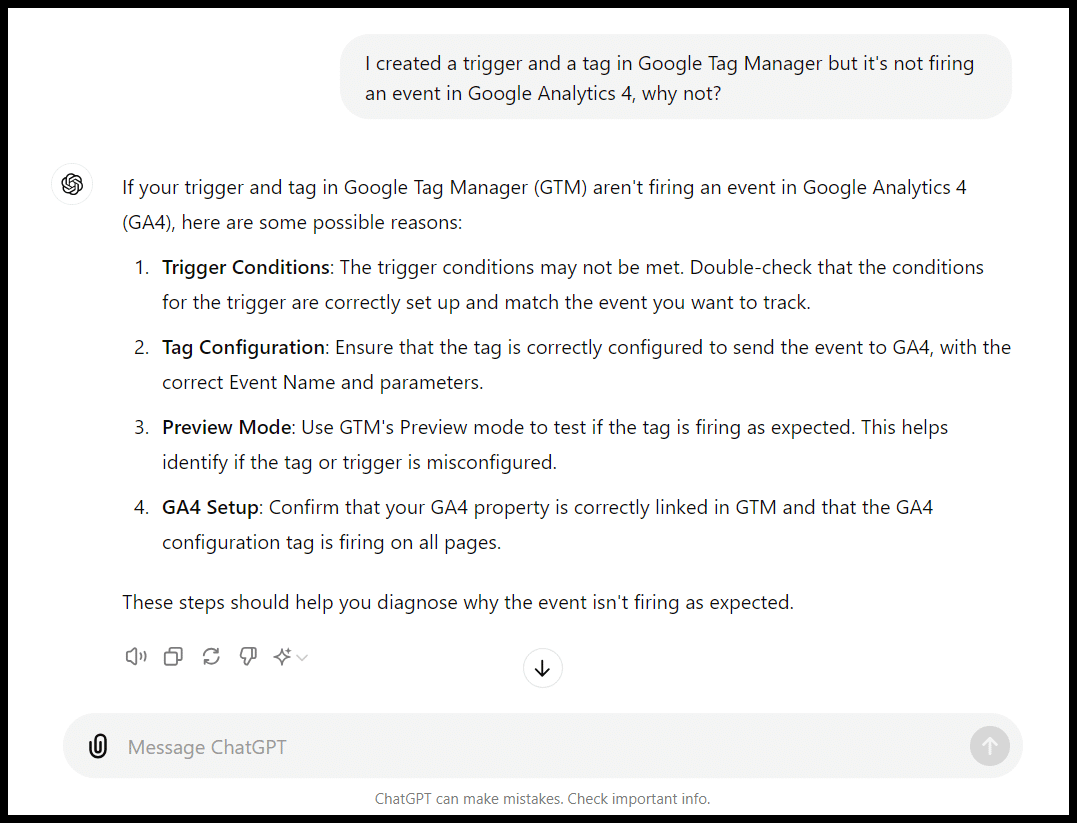
You can get troubleshooting ideas for these platforms:
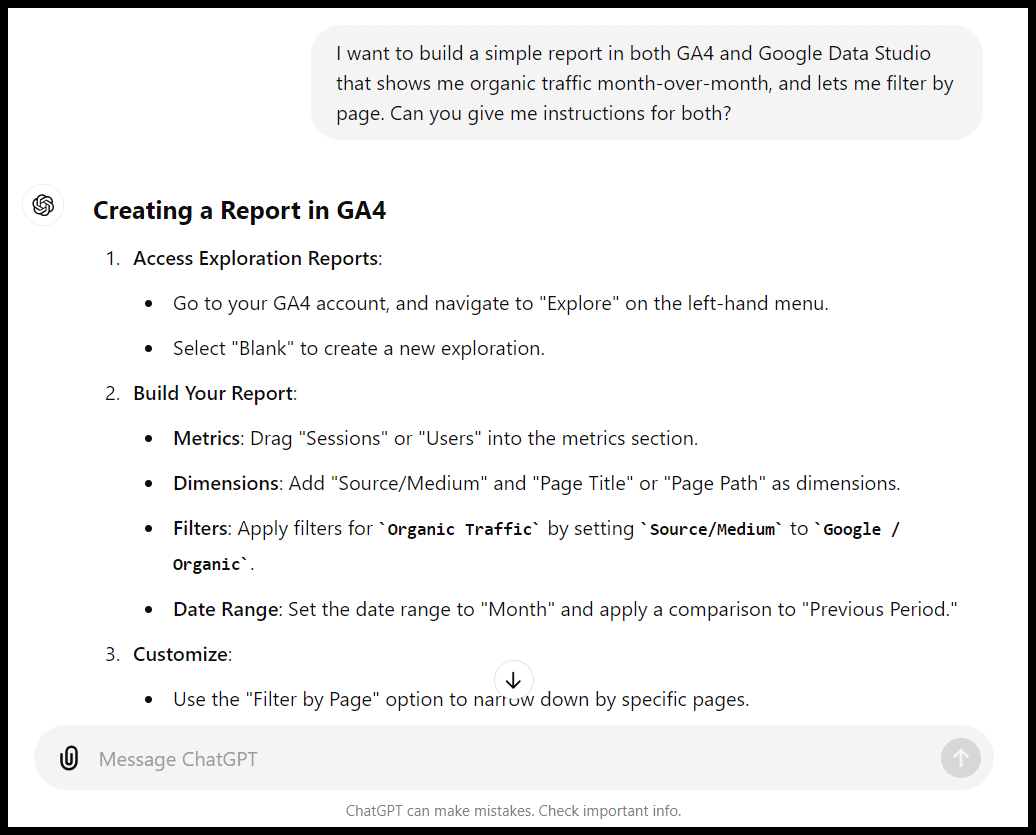
Get instructions for building specific reports:
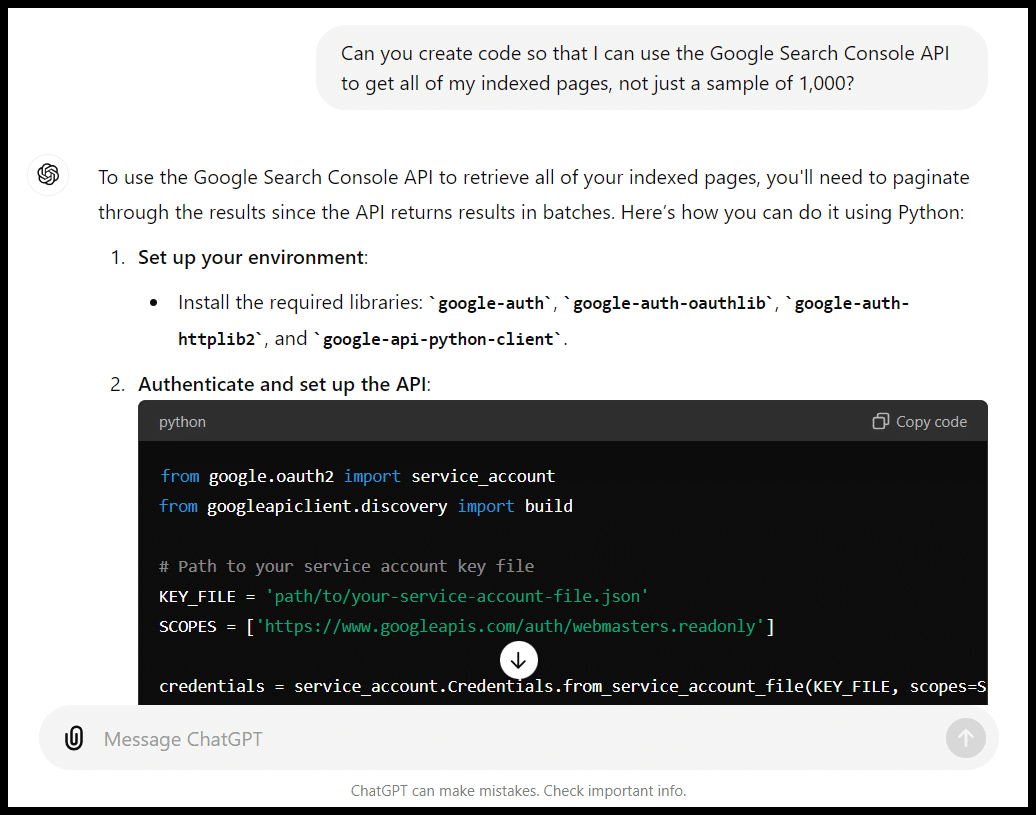
Or even get code to use to interface with their APIs:
Translation
You can translate text to create country-specific pages:
Formatting
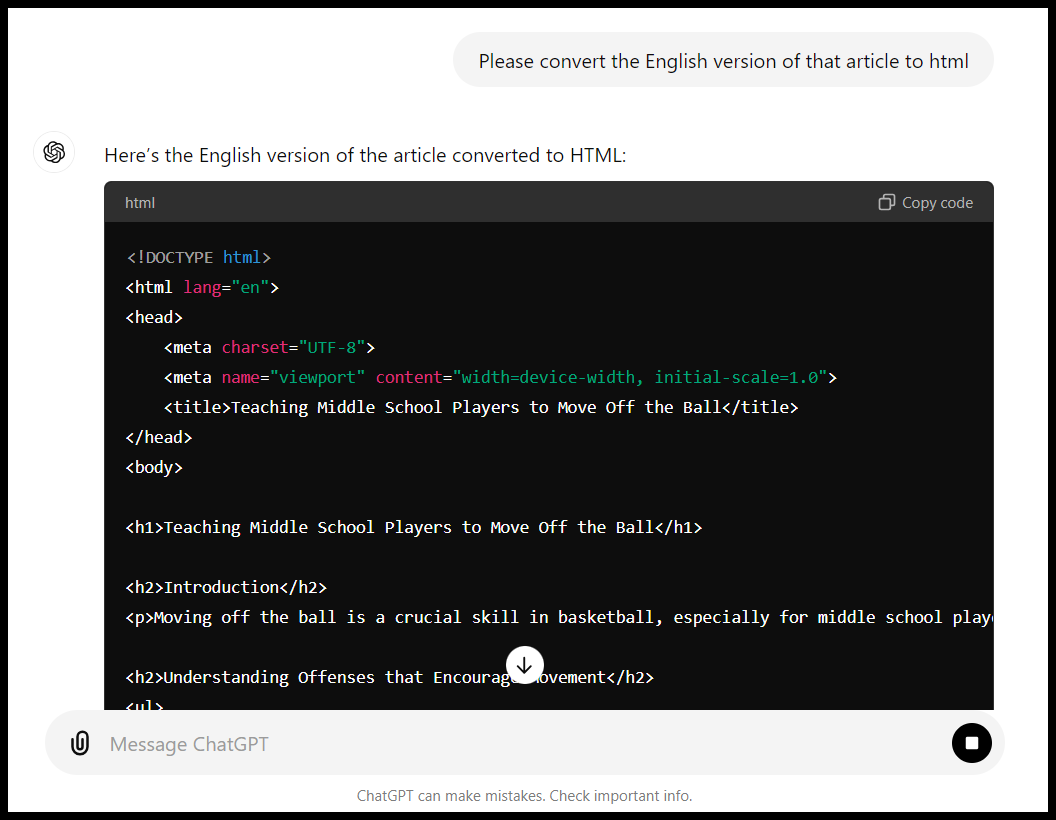
Many quick and simple formatting tasks come up where ChatGPT can be helpful. Things like converting a page to (or from) HTML:
You can also take a list of URLs and extract just the domains from them or convert a list of sites into HTML links (or vice versa).
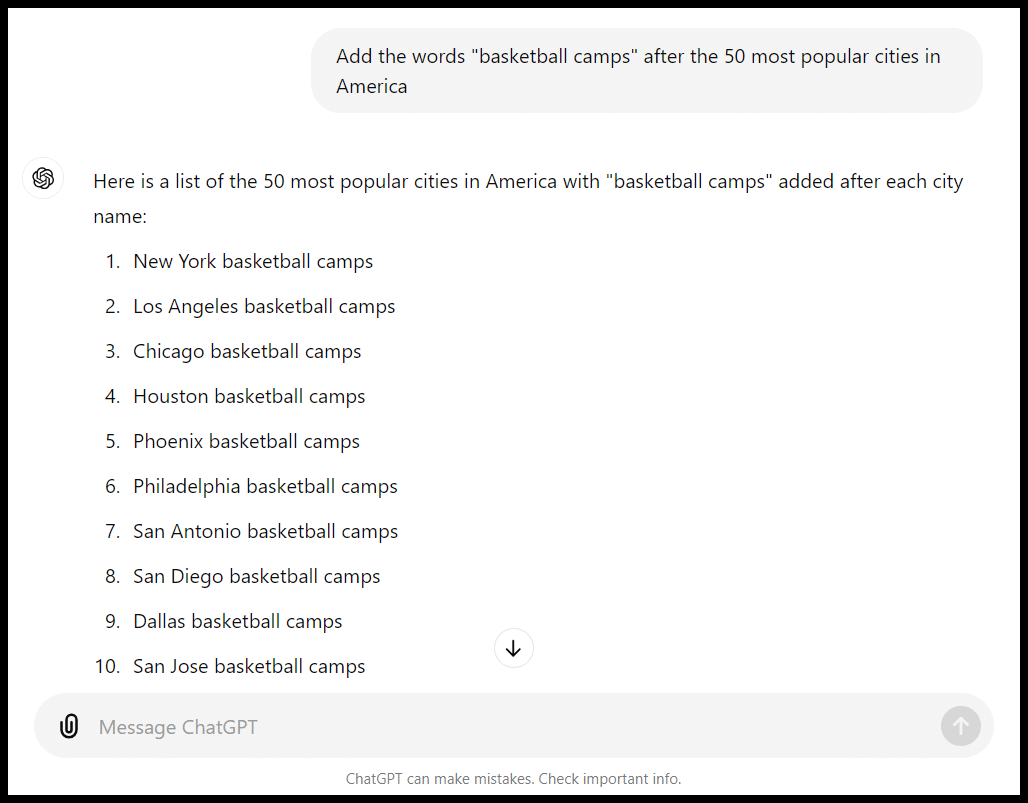
You can also do tasks you might usually handle in spreadsheets, such as combining data or finding a list of cities or states.
Depending on your skill with spreadsheets and workflow, this might be more convenient than a spreadsheet.
In place of VLOOKUP / IF types of functions, you can create a prompt like:
- “Create lists of basketball drills from site A and site B, then show me A) the drills they both cover and B) the drills that are missing from each list that the other covers.”
Code for simple tools and widgets
As I walked through in How ChatGPT can help you create content for SEO, you can use ChatGPT to help you build simple tools like calculators that can enhance content, give you a chance to rank for specific terms (like {subject} calculator) and give you something to promote via outreach.
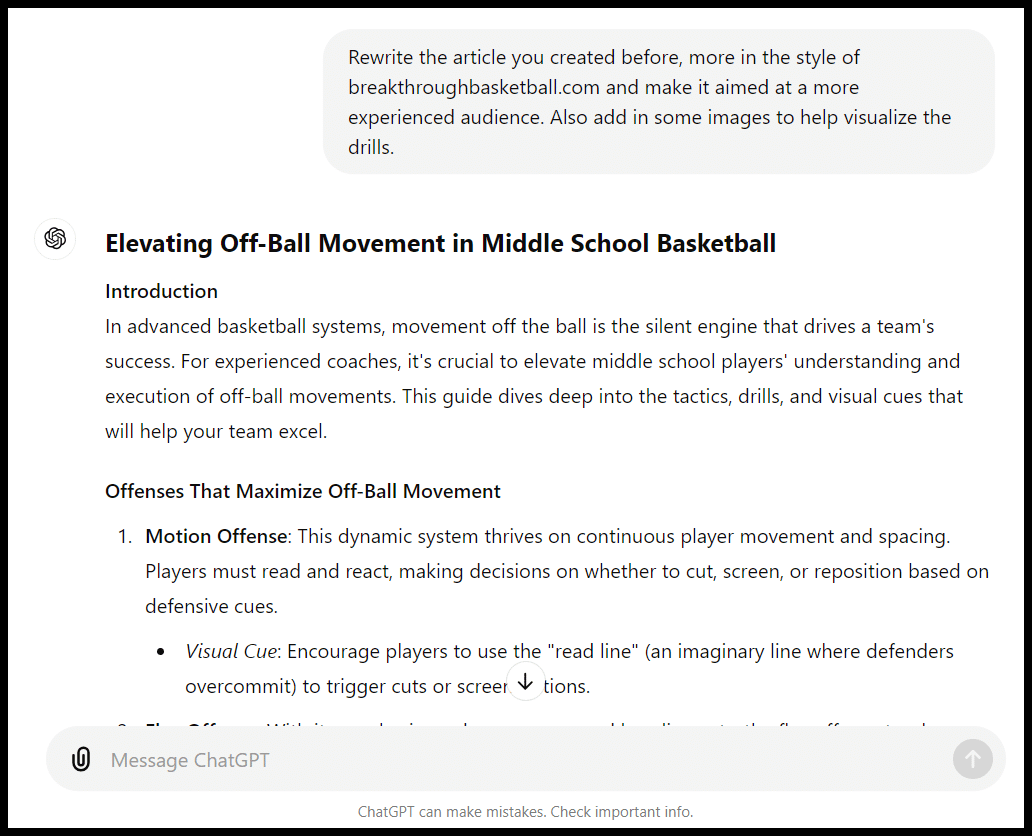
Rewrite content
If you give ChatGPT specific instructions on things like tone and what to include, it can help you rewrite or flesh out content and even add images:
The image generated in this case leaves something to be desired:
While AI-generated images have gotten much better in the last year, you still want to closely inspect anything that’s generated with a particular eye toward things like words and specific details.
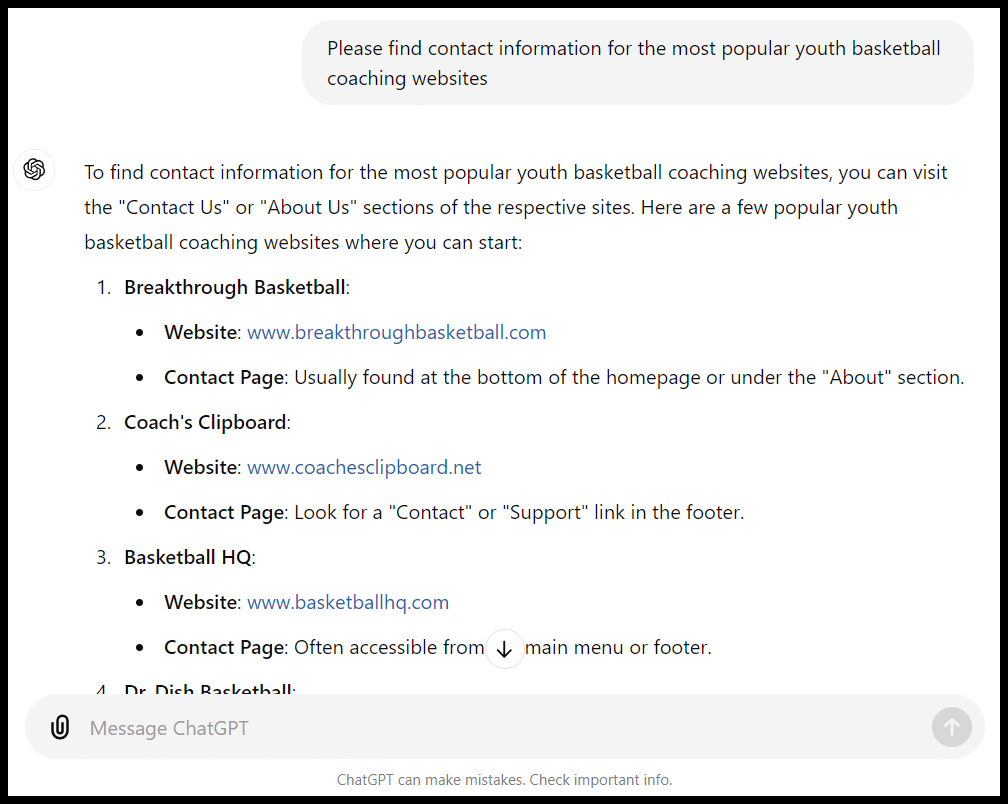
Outreach assistant
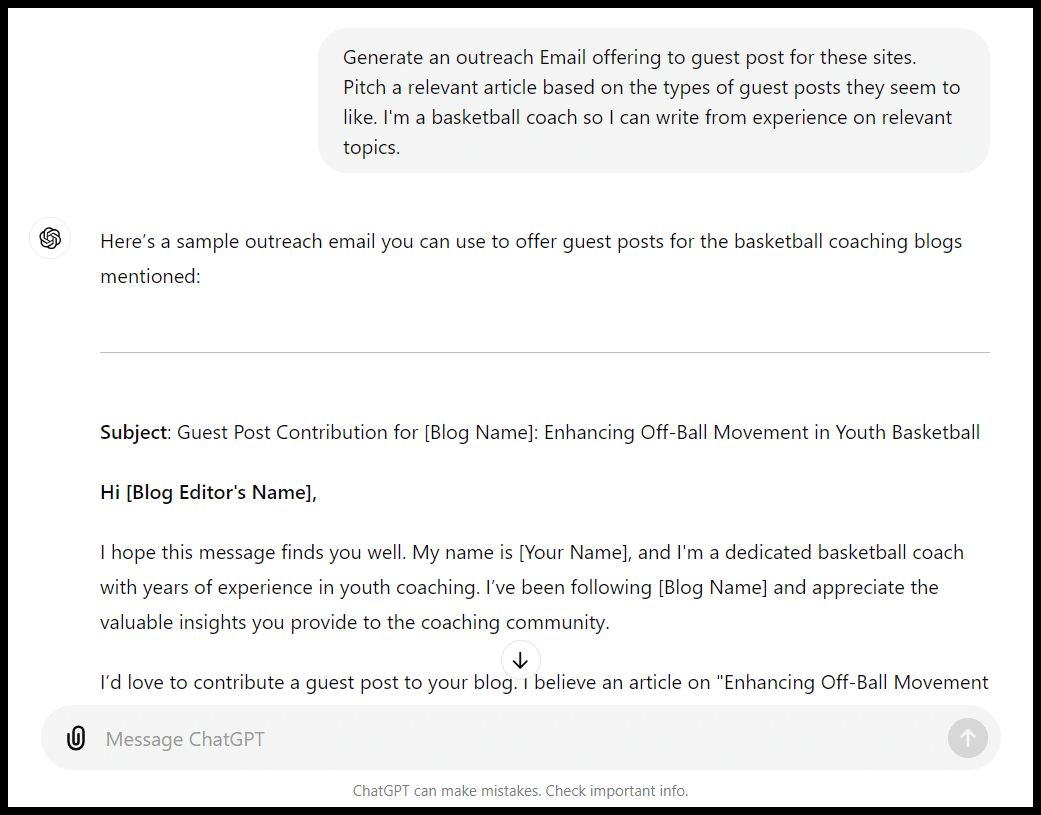
While ChatGPT isn’t great at finding contact information for you (at least for now), there are some specific outreach tasks it can perform:
A better task may be getting a list of ideas of places to guest post:
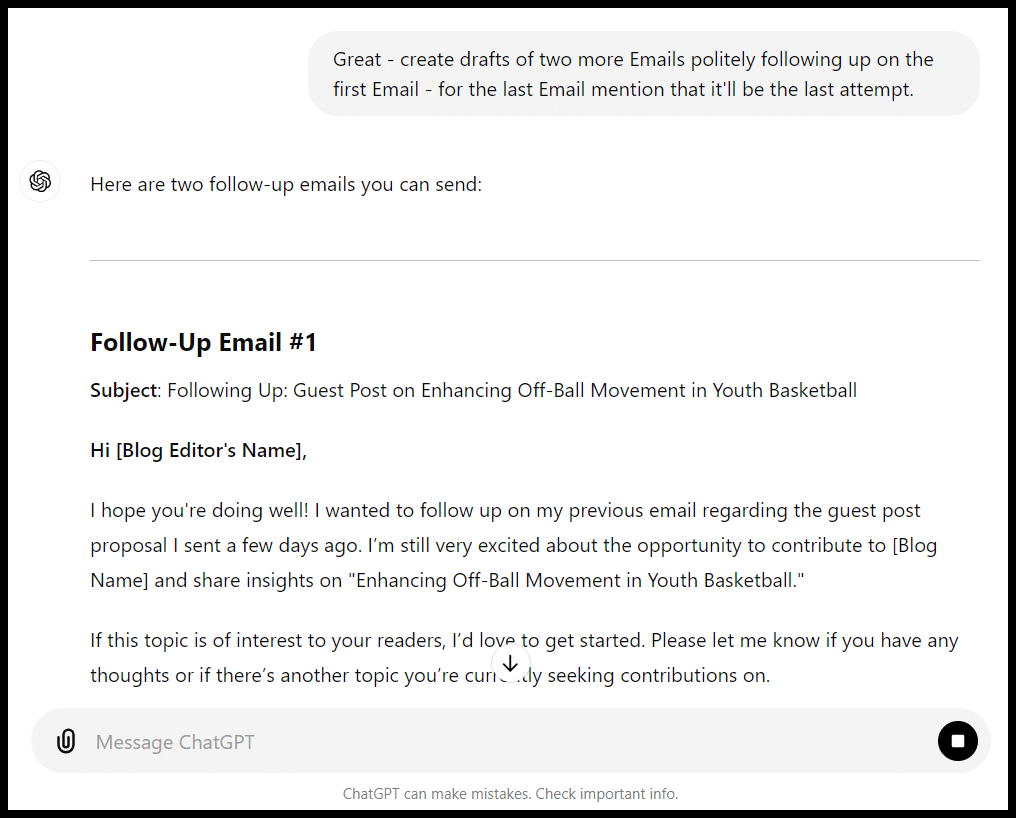
Or drafting a template for an outreach email. This is potentially particularly valuable if English isn’t your first language:
Infuse your prompts here with your own tone and content preferences to make sure the template you get is closer to being consistent with your typical outreach emails.
You can even craft an entire auto-responder sequence:
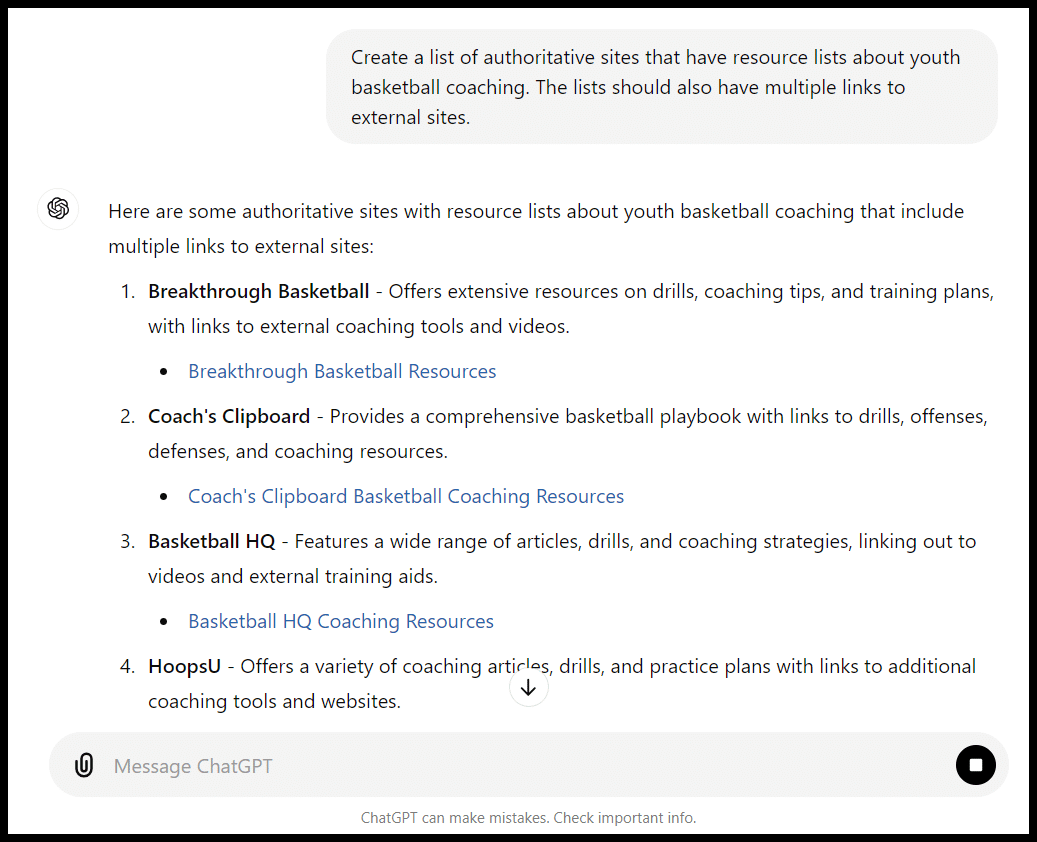
Or you could create different types of outreach lists:
As you work through the outreach process, you can likely find even more opportunities to leverage ChatGPT.
The bad
In my experience, most of the trouble you’ll run into with ChatGPT will be:
- Asking the tool to complete a whole-cloth process for you (rather than particular functions).
- Not providing enough oversight.
Publications have already been accused of publishing AI-generated content with errors and plagiarized content.
If we had unleashed ChatGPT to do all of our keyword research for us, we would likely not have gotten much traction.
When you try to assign it tasks like strategy, you’ll often get the same kind of boilerplate advice you’d get from a beginner-level X tips article on Google:
And without a lot of human input (specific prompts, editing and likely a mix of human and AI content), you’ll likely get warmed-over content.
Depending on your purpose (and your risk threshold), that may be fine, but in a post-HCU world, it may not be very good.
You may not need your meta descriptions, FAQs or certain articles or pages to be “10x”. But make sure you understand what you’re getting.
The ugly
Some areas, like health-related content or critical tasks, on your site can go sideways.
Dig deeper: Why using AI to create YMYL experts is a REALLY bad idea
Be particularly mindful of ChatGPT’s limitations
Proceed with caution with ChatGPT prompts and SEO.
Get good at creating your own prompts and sourcing inspiration (or productivity enhancements) from prompts other people share.
Courtesy of Search Engine Land: News & Info About SEO, PPC, SEM, Search Engines & Search Marketing
Monday, August 26th, 2024
Google Search updated its search documentation to reserve the right to use the OG title meta data for your title link in the Google Search results. That adds a ninth source Google may pull from for your title links.
List of title link sources. Here is list of sources Google may use for your title link:
- Content in
<title> elements
- Main visual title shown on the page
- Heading elements, such as
<h1> elements
- Content in
og:title meta tags
- Other content that’s large and prominent through the use of style treatments
- Other text contained in the page
- Anchor text on the page
- Text within links that point to the page
WebSite structured data
What is new. The new option is the “Content in og:title meta tags” bullet in the middle.
What is an og:title. An og:title is the title of your object as it should appear within the open graph. Often social media platforms use it to decide what the title should be for URLs you share within their platform.
What is a title link in Google Search. The title link in Google Search is the clickable title used in the Google Search result snippet. Here is an illustration of the search result snippet where “How to make crispy fried eggs” is the title link:
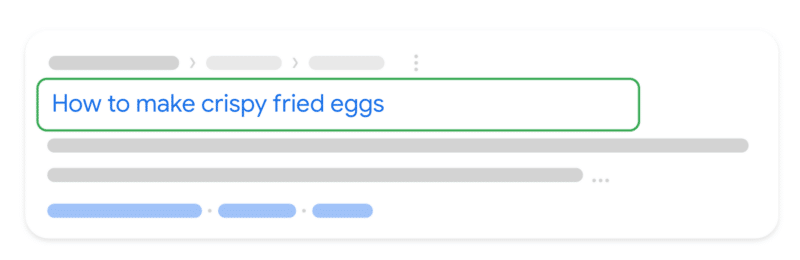
Why we care. This is just one additional source Google may use to decide which title link to use for your search result listings in Google Search. Google is most likely to use your title element in your HTML but often Google may decide to use another source for your title. Most sites tend to match the title HTML element and their OG:title but not all.
Courtesy of Search Engine Land: News & Info About SEO, PPC, SEM, Search Engines & Search Marketing
Monday, August 26th, 2024
Sorry kids, but SEO isn’t what it used to be.
It’s time to bury the old idea of “optimization” and start thinking about what we really do: train search engines.
In this brave new world of generative AI, the way we approach search has fundamentally changed and clinging to outdated concepts won’t get us far.
Why the ‘optimization’ no longer reflects modern SEO
Once every two years or so since the coining of the phrase “search engine optimization” almost 30 years ago, there comes a concerted attempt by an either ill-informed or attention-seeking person or entity who boldly and objectively promulgates the notion that “SEO is dead.”
A digital hornet’s nest is stirred for a bit and then the attention dies down and business continues again as usual.
But in the new world of generative AI and its counterbalance with the convergence of search engines, I have a new issue with the term “optimization,” perhaps one that may have a more lasting effect on how we view and think about this practice.
I’m not here to declare the practice of “SEO” dead – it is not by any means. But linguistically, the term “optimization” is now dead to me.
This shift in language is actually beneficial as we rethink how to approach search in the age of AI, both for me and for many others in the industry.
The term “optimization” no longer fits what we’ve been doing for the past 30 years because search engines have always been a sophisticated form of generative AI.
SEOs have always been knowingly or unknowingly at the forefront of interacting with artificial intelligence on behalf of their websites, digital assets and identities.
Traditional ‘SEOs’ are human intermediaries between our content and generative AI
The rise of modern generative AI and ChatGPT over the last two-plus years has accelerated and illuminated the perception of what the search industry has really been doing all this time – being a human intermediary between digital media and AI.
We haven’t been “optimizing” assets for search engines; rather, we have been training search engines to understand and generate immediate connections to our digital assets in their infinitely generated lists in the most relevant way.
It is common knowledge that generative AI is a workhorse for digital media and that it still requires experienced human guidance to train for full effectiveness.
SEOs have always performed this same important function as a human intermediary between assets and AI within the context of search intelligence.
This simple revelation has major implications for how you view your SEO experience entering this new world of AI and how website owners and companies view their efforts. Like SEO itself, it is still not rocket science.
The etymology of ‘optimization’ and rise of the generative AI human intermediary
Before diving deeper, let’s quickly review the origins of “search engine optimization” and the brief history of how people have interacted with AI.
In my 2012 book, “Search and Social: The Definitive Guide To Real-time Content Marketing” (Wiley/Sybex), I utilized my experience and also went on a deep dive to study every possible origin of the term. Here is a quote from the book:
“Even in their earliest stages, search engines were based on core network principles and they were developed by humans. It is worth noting that early search engineers constantly fought with publishers in terms of optimizing their content. The search engines wanted to capture the Web as an observer and to rank those pages in order as they saw it.
Of course, not every web publisher agreed with their results and some began to reverse engineer the process through what is now known popularly as search engine optimization (SEO), a term coined simultaneously by Bob Heyman, John Audette and Bruce Clay. What the engines did not consider as closely at the time was that their data was an almost living and breathing corpus.
The corpus was interactive and this caused the engines to innovate in ways they had not previously considered. I believe it is unfortunate and misplaced that many people still perceive search-engine algorithms to be purely technical. The more accurate picture is that search is created and edited by people, consisting of content created by people (even if they use technical tools). Links are created by people. The analysis of relationships between links and sites is network analysis. In this sense, search has always been “social” and “networked.”
Most notable here is the concept of human intermediaries interacting with AI in search engine form. It was true in the earliest stage and is even more true now in terms of setting the trajectory for the desired output.
Also, possibly just as notable, those doing the work known as “SEO” were challenging and pushing our friends at Google, Microsoft Bing and other engines forward to innovate with more sophisticated AI technology, leading us largely to where we are today.
Yes, SEOs have, en masse, directly and indirectly pushed generative AI to the state where it is today.
Again both from firsthand knowledge and extensive research, it was clear to me that “search engine optimization” was coined simultaneously and without knowledge of the other by Clay, Audette and Heyman.
Bob Heyman is often left out of this terminology discussion, but he is on equal par with Clay and Audette in this regard.
The first use of the term “search engine optimization” was identified by search journalist and now Google Search Liaison Danny Sullivan, who found the phrase in an unattributed email spam message that appeared in a few inboxes in 1995.
There were also other early viable candidates for what this new search animal was to be called.
“Search engine positioning” was championed by early search marketer Frederick Marckini around 1996 in his tech book of the same name and his then small but growing agency, iProspect (it ain’t so small now, coming under the umbrella of Dentsu-Aegis holdings many years ago, my former employer).
Still, under the shadow of AI, this term also does not fit the current practice.
Perhaps the most vocal industry criticism has been from my friend and search luminary Mike Grehan, who has had an issue with the term “optimization” for decades.
In the earliest days of search, Grehan was and is still known to give some of the smartest and most immutable advice on search, whether speaking from the conference stage, writing for major search sites or talking to executives in the boardroom.
In its simplest form, Grehan’s main complaint is somewhat grammatical and he has a point. “How do you optimize a search engine? You can’t,” he has often said.
I would often counter that perhaps the “optimization” part is grammatically correct in the sense that assets are being optimized and decorated for search engines. But it has never fully set well with me, either.
“Optimization” has become something of a dirty but necessary word in the absence of something better.
The Google ethos: Search engines have always been about artificial intelligence
Semantic issues aside, Google’s ethos is relevant to this discussion in that it has always viewed search as generative AI.
In a discussion I had with Grehan at the Luxor Hotel in Las Vegas for Pubcon last March, I was recalling an indelible casual discussion I had heard in 2004 at the Search Engine Strategies conference in New York.
I was telling him that the talk I attended maybe had only 20 people in a smaller room, which was a one-on-one discussion with Google’s number three employee, Craig Silverstein and an interviewer.
I recalled how Silverstein somewhat stunningly talked about Google as artificial intelligence, which he called “search pets” for humans in the future state of Google AI.
It was an early view into the company’s mindset that what they were doing wasn’t just “search.” They saw their mission as that of AI in the service of people, even in its earliest incarnations.
This talk has stayed with me every day since, and I have often spoken of search engines as AI in the subsequent two decades.
Grehan quickly reminded me that he was the guy interviewing Silverstein and we both had an Oprah “full circle moment,” and also a good laugh.
But again, Google is and has always been about generative artificial intelligence. And those who “optimize” have actually been “training” search engines all along.
In my own work, I have fully shifted in how I explain SEO concepts not as “optimization”, but rather “training a search engine to better perform with our digital content.”
In discussions with people within the range of complete newbies to seasoned professionals, the complex aspects of getting the most visibility for content are more easily understood when discussed as “training”.
The use of “training” also allows for a more reasonable shift in thinking about what is needed for success.
SEO is no longer wholly performance-based and tied to dollar-in-dollar-back expectations; it is now more holistic, the sum of both direct and indirect actions that lead to the ultimate comprehensive goal.
A basic reframing of ‘optimization’ to ‘training’
What does it mean to “train” a search engine, in the context of what is now considered “optimization”? As an example, here are a few very basic ways to recalibrate our thinking:
- Keywords: Trains a search engine to know what our content is about linguistically.
- Content: Depth, length, reading level, topics, subtopics and mixed media all help train a search engine for a level of trust that is high enough to appear at the top of list-generated results in the appropriate context.
- Internal links: Trains the engine on internal relationships to content within a website or domain and adds additional relationship context.
- External links: Trains a search engine about external relationships from other trusted websites, which in turn imparts a level of trust to the website for results generation.
- Schema: Trains a search engine to understand a further level of semantics.
All of these areas above can be noted or discarded by the engines, but they are still being trained nonetheless.
If non-relevant techniques are being utilized, whether in linking, content, relevancy or other elements, then the search engine is still being trained – either knowingly or unknowingly by the website or asset owner.
However, their offering meets the threshold of the feared spam label, which can diminish results from “less than desirable” to outright invisibility. It is an undesirable training threshold that should be primarily avoided.
The pain for your content visibility in unintended spam training becomes a matter of degree – from the annoying “catching a cold,” as ex-Googler Matt Cutts described it, to “never going to perform as well as other websites,” to an outright ban, poisoning a domain to a permanent digital death, as far as the engine is concerned.
Dig deeper: LLM optimization: Can you influence generative AI outputs?
Training a search engine: If a tree falls in the forest with no human to perceive it, does it make a sound?
In my 30 years of experience in search, both as a user and in my job, I have never seen a top result – in even a low-competitive environment – that existed in a vacuum, devoid of any type of content or linguistic training or lacking an external trusted link of some kind.
Show me one example of this, and I will then be able to explain to you definitively whether or not a tree falling in a forest, devoid of human perception, actually makes a sound.
Whether these training concepts are intended or unintended, the generative results are – and have always been – a result of training the search engine.
The limitations of ‘search engine training’ as an industry term
While the term “search engine training” is a more linguistically accurate representation of what is done in this process in the context of generative AI, it does have its obvious limitations.
In short, it could be easily confused with some other type of educational training, even though that perception would also be linguistically inaccurate.
“Training” for a search engine is too broad and meaningless in the context of its potential educational component.
I’m not here to try to recoin the phrase, but rather point out a single word that will help you help others better understand what is needed for success and to have better expectations for what that type of success entails.
If there is a better way of expressing it, that’s great.
“Search engine training” is not a sexy phrase, though there are many cunning linguists in this industry who can probably come up with something better.
But for me, “optimization” is no longer the right term and “training” a search engine speaks to a symphony of elements required to get the results we are looking for.
The industry is still trying to define our new world of search and AI training for digital assets, trying out terms like AIO, GEO and the like. I still haven’t seen one that resonates with me.
“Search training”? “Search intelligence training”?
Personally, this is for someone else to figure out and, hopefully, this article will further promote that discussion to the tens of people who care.
Without your content, search engines and AI won’t exist
I am not so naïve as to think that this whole concept might be offensive to the major search engines in that they may be so susceptible as to be “trained,” and that is certainly not my intention.
But here is one last simple truth for you that I have stated for many, many years:
Without your content, search engines and generative AI do not exist.
In a world where “free speech” is supposedly sacred, you have every right to train a search engine or GPT about your content as you wish.
Your results might vary in how you exercise your right to train, as it is the engine’s right to clean things up as they see fit.
But train them in the language they speak and stay relevant, and the results may just be harmonious.
Dig deeper: How AI will affect the future of search
Courtesy of Search Engine Land: News & Info About SEO, PPC, SEM, Search Engines & Search Marketing
Thursday, August 22nd, 2024
Google is updating its advertising policies for financial products, specifically focusing on cryptocurrencies. The new rules will take effect on Sept. 20.
Why it matters: The new policy clarifies Google’s stance on cryptocurrency-related ads in Switzerland, aiming to ensure that only compliant and licensed entities can promote their services.
What’s new:
- Crypto exchanges and wallets: Advertisers offering cryptocurrency exchanges or software wallets in Switzerland can now run ads if they are licensed by the Swiss Financial Market Supervisory Authority (FINMA). This includes meeting any other relevant local legal requirements.
- Hardware wallets: Ads for hardware wallets — devices that store private keys for cryptocurrencies, NFTs, or other digital assets — are also permitted. However, these products must be limited to storage functions only and must not facilitate purchasing, selling, or trading of assets.
Why we care. Switzerland is a significant hub for cryptocurrency businesses. Advertisers need to stay compliant with Google’s policies to maintain access to this key market, avoid disruptions, and build trust with their audience, all while staying ahead of the competition.
What to watch:
- Certification requirement: All advertisers must obtain certification from Google to promote these products in Switzerland. This certification ensures that advertisers meet both Google’s standards and local regulatory requirements.
- Global impact: While the focus is on Switzerland, this policy update underscores Google’s broader commitment to ensuring compliance with local laws across all markets where financial products are advertised.
Be smart: Google’s policy enforcement will start with warnings, giving advertisers a seven-day grace period before any potential account suspensions. Advertisers should review their compliance status now to avoid disruptions.
Bottom line: As cryptocurrency regulations tighten globally, Google’s updated policy reflects a growing emphasis on protecting consumers while ensuring that only compliant and licensed entities can leverage its advertising platform in Switzerland.
Courtesy of Search Engine Land: News & Info About SEO, PPC, SEM, Search Engines & Search Marketing
Thursday, August 22nd, 2024
SEO can seem overwhelming, with so much information and numerous tools available.
In less experienced hands, the masses of recommendations from these tools can often waste a lot of time while delivering little in the way of results.
Fortunately, Google Search Console (GSC) offers accurate diagnostic information about your website, including rankings and traffic.
This helps you focus on optimizing well-performing areas, leading to better results.
It’s a more practical approach than spending months or years chasing ideal keywords.
By understanding GSC, you can take this intelligence and build an SEO strategy and a simple SEO plan based on the hard facts of your current situation.
This article outlines a three-step process for reviewing, planning and improving your SEO using Google Search Console metrics. The goal is to guide you in finding the most important information for quick SEO wins.
Google Search Console: 3 steps to easy SEO wins
The process has three simple steps:
- Step 1: Review traffic, rankings and opportunities in Google Search Console.
- Step 2: Analyze what ranks currently and look for opportunities.
- Step 3: Optimize and improve your content to get some easy wins.
This simple approach allows you to easily rank the tasks around the potential so you spend time working on what matters the most and will generate actual results as quickly as possible.
Before analyzing Google Search Console, you need to set it up. You can learn how to do that and cover the basics with this Google help doc.
You can also download our template for tracking opportunities here:
Dig deeper: Google Search Console launches recommendations
Step 1: Review your traffic, rankings and opportunities
The first step is to review your visibility and traffic in Google Search Console. This information will help you understand how well you’re performing and guide you in optimizing your approach.
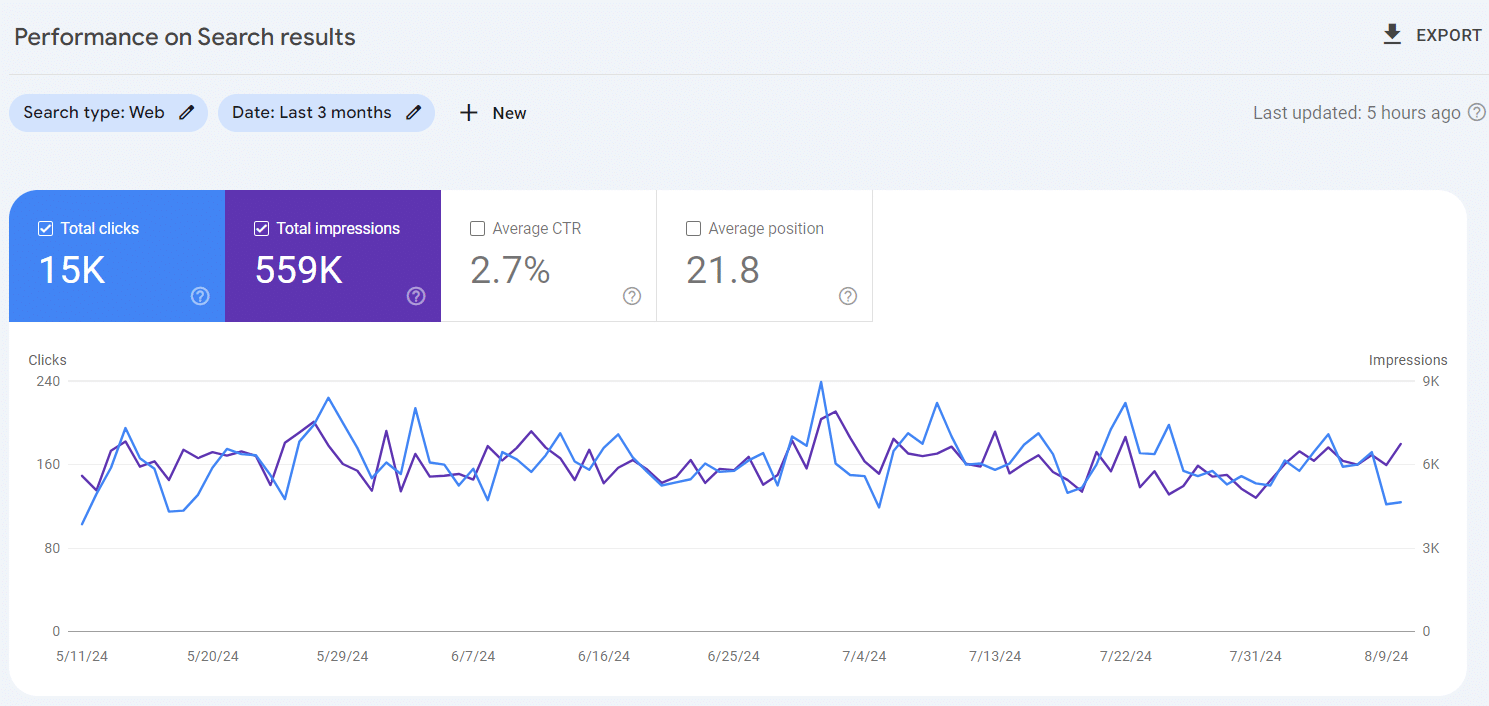
Sign in to Google Search Console at https://search.google.com/search-console. Review your traffic and indexing overview by clicking on Search results under Performance.
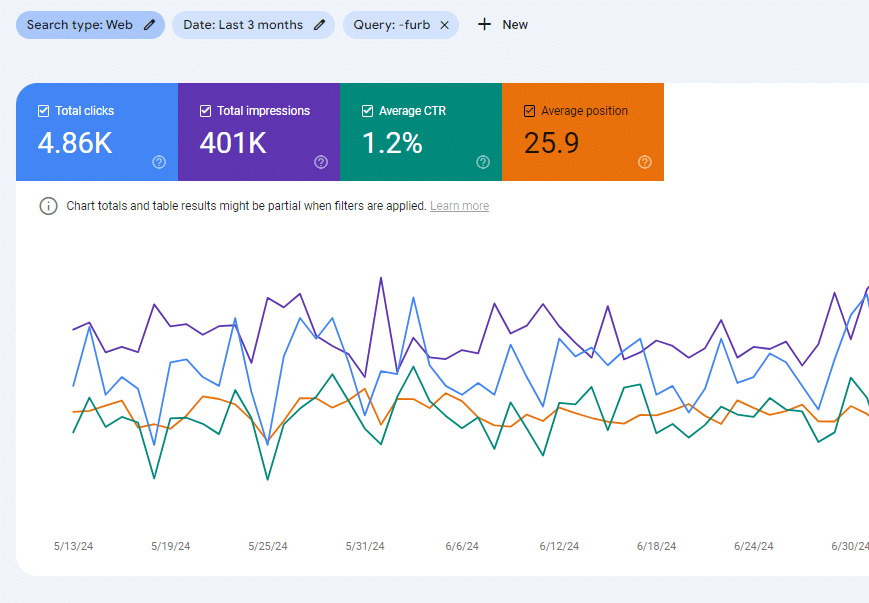
On this screen, you have two of four potential metrics enabled by default:
- Total clicks (enabled).
- Total impressions (enabled).
- Average CTR (disabled).
- Average position (disabled).
Above the main metrics, you have filters that, by default, show web search results for the last three months.
Applying additional filters
To make the data here as accurate and relevant as possible, add some additional filters and you would typically look to:
- Exclude branded search traffic.
- Filter to the primary target geography.
Exclude brand traffic
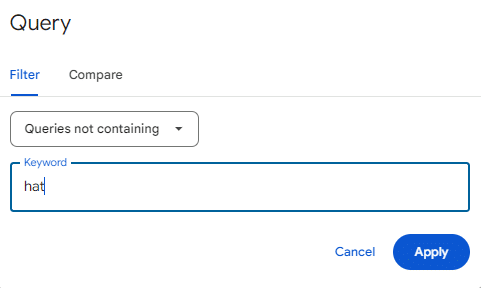
My business is called Bowler Hat, so you will filter anything that mentions “hat” to cover variants like “bowler hat,” “bowlerhat,” “bowler hats,” etc.
To do this, you will add a new filter (next to the type and duration).
- Click New > Query > Queries not containing.
- Type “hat” then click Apply.
Do this for your brand name now. If you review the results, you should not see any branded traffic.
Filter to primary target geography
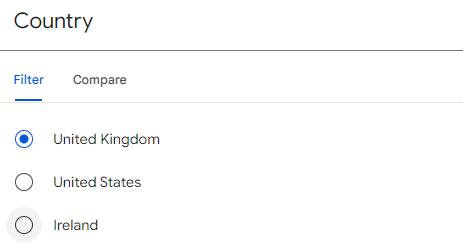
By default, the results shown here will be everything, everywhere, which can skew your results. The best option is to filter this by your primary geography, so you will look at the UK only for this account.
- Click New > Country.
- Select your country (here I am selecting “United Kingdom”) then click Apply.
This now filters the data so you only see your target country (which makes the clicks, impressions, CTR and rankings much more accurate).
Note: If you are only used to seeing traditional rank reports and the like, this kind of filtering, which removes all organic brand traffic and international traffic, can reveal some hard truths.
If I had a dollar for every time you reviewed a client’s search console and there was practically no unbranded organic traffic, I would have a great big jar of dollars.
At the very least, you will start to understand your traffic accurately, which may challenge some of your perceptions about what works and drives clicks.
Also, should your requirements be a little more complicated, you can read up on regular expressions and create filters to exclude or focus on what matters.
Real traffic analysis
By applying the filters above, what is left represents your real exposure and traffic from Google Search.
The next step is to enable the four key metrics and review them individually.
If you use SEO and PPC, note any keywords and landing page combos that may be useful in your Google Ads campaigns.
Clicks
- Clicks are the main goal and what you’re ultimately aiming for.
- Here, you will see precisely how many clicks you get for your target search terms.
Impressions
- Impressions are how many times you showed up in search results.
- The amount of clicks you receive vs impressions gives you an idea of the size of the opportunity.
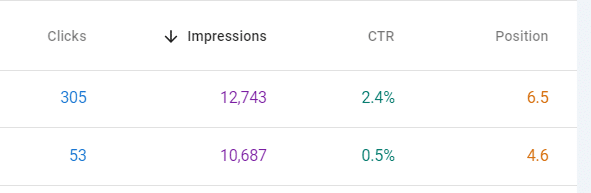
- The screenshot below has a few exciting examples:
- 305 clicks from 12,743 impressions with a CTR of 2.4% in position 6.5.
- 53 clicks from 10,687 impressions with a CTR of 0.5% in position 4.6.
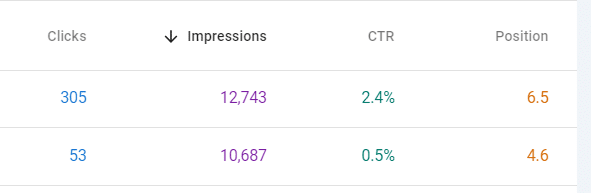 Both of these keywords have room for improvement, but the second line needs further investigation due to a woeful CTR (0.5%) from a very reasonable rank (4.6).
CTR
- CTR (click-through rate) is another metric that often speaks to the overall opportunity.
- The first keyword ranks 6.5 on average and has a 2.4% click-through rate. The second keyword, despite ranking better, which would generally improve click rate, has an appalling 0.5% CTR – only one in every 200 searches results in a click.
- These keywords have room for improvement, but the second one represents a huge opportunity and should be investigated further – why do so few people click?
SEO mix: Clicks, impressions, CTR and position
- Carefully review your keywords, considering clicks, impressions, CTR and ranking position to identify opportunities for optimization.
Optimization targets
As you work through this list of keywords, you should make a list and choose keywords to improve.
We want more clicks, and that can be done by improving rankings and CTR.
Pick three or so keywords, enter them into the SEO easy wins template and then move on to the next step.
Step 2: Landscape analysis
Before working on any optimization, review the search landscape for your target terms. Understanding the page layout will show you where the opportunities are and where to focus.
I’ll use a keyword from a new business we’re helping, Stairfurb, as I feel a real-world example provides the best overall.
Landscape analysis for ‘glass banister’
- 322 clicks.
- 8,636 impressions.
- 3.4% CTR.
- 2.6 position (ranking).
This keyword has reasonable volume, a pretty strong ranking between Positions 2 and 3 and a fairly average CTR of 3.4%.
The intent is right here. As the business sells glass banister kits, we want to see more than a lowly three clicks for every 100 searches. Let’s look at what is happening here.
 Search results for “glass banister”
The image above only shows the initial results, but the full page is structured as follows:
- 8 shopping ads.
- 8 organic shopping (merchant listings).
- 1 organic.
- 1 organic (StairFurb).
- 1 organic.
- 1 organic.
- 6 images.
- 4 People also ask.
- 1 organic.
- 1 organic.
- 1 organic.
- 8 merchant listings.
- 1 organic.
- 8 merchant listings.
- 1 organic.
- 1 text ad.
This is a fairly complex set of blended search results. There are shopping ads, organic shopping listings (three sets of them for 24 organic products), organic results, images and People also ask, among other things.
Yet, for this site, despite a strong showing in the second organic placement, there are still 8 paid shopping and 8 organic shopping listings above the organic, meaning that there are 17 links above (including the one organic in Position 1) that a user can click and head off in a whole other direction.
Opportunities
- Improve organic ranking (move from Position 2 to Position 1).
- Improve exposure in organic shopping listings.
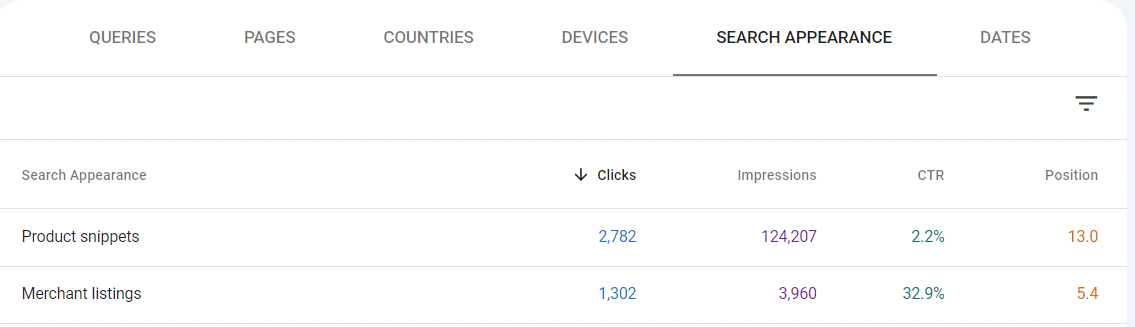
Fortunately, Search Console also gives you some intel on product listings in the Search Appearance tab of the Performance report (Performance > Search Results > Search Appearance tab).
There are two rows of information here:
- Product snippets: These are a traditional listing that includes some product details. In the image below, you can see the price, return details and stock.
- Merchant listings: These are the organic shopping results that feature prominently for this search query (three blocks on Page 1 with a total of 24 organic products listed).
Now, what is really interesting here is the CTR of 34%. One in three people who see that listing will click on it – that is huge.
Contrast that to some of the organic CTRs you see and you can see how improvements here can really scale your traffic.
Landscape analysis for keyword ‘B’
- 60 clicks.
- 630 impressions.
- 9.5% CTR.
- Position 1.
This keyword is slightly different, with a solid Position 1 ranking and ~10% CTR.
The only lever to press here is CTR, so if you review the results, you see:
- 8 shopping ads.
- 1st place listing.
Opportunities
Here, ensure you have the best possible page title, meta description and all the schema data to make this listing as attractive as possible below those pesky magnetic shopping ads.
Landscape analysis for keyword ‘C’
- 25 clicks.
- 9,000 impressions.
- 0.3% CTR.
- Position 7.
This one is a little different again. Clicks are low, with only one in 300 searches giving you a precious click here.
Landscape analysis shows us:
- 8 shopping ads.
- 8 organic shopping.
- 4 People also ask.
- 8 organic.
- 8 organic shopping (second instance).
- 2 organic.
Opportunities
- Optimize for organic shopping.
- Target People also ask / snippets.
- Improve ranking.
- Improve CTR.
Lots of scope here for improvement across various elements of the page.
Step 3: Optimize
If you spend time in GSC like this, you will get familiar with the Search Results section and find a treasure trove of opportunities.
The specifics will always depend on your keywords, industry and location, but just follow the process.
- Filter out the brand and focus on target geography.
- Review high volume, low CTR, etc.
- Review the results.
- Look for patterns.
Some general approaches to try out:
- Keywords in positions 2, 3, 4 and 5 for easy optimization tweaks.
- Keywords in the top three with low CTR for metadata tweaks.
The key is to analyze, keep notes (using this handy document) and identify patterns.
You will soon understand what works for you and can refine your approach over time.
Maximize your SEO potential with Google Search Console
SEO can be complex, and commercial tools often lead to time-consuming technical fixes with limited impact.
Use Google’s diagnostic data to uncover straightforward optimization opportunities that provide quick wins.
Dig deeper: How to link GA4 with Google Search Console
Courtesy of Search Engine Land: News & Info About SEO, PPC, SEM, Search Engines & Search Marketing