Tuesday, May 16th, 2023
So you’ve won a new SEO client – hooray!
Before you officially get the partnership kicked off, there’s a lot of ground to cover to help you set the stage for success and make a great first impression.
As SEOs know, every website has two areas that need focused analysis before you kick off an SEO program: content and back-end setup.
This article will tackle five initiatives my team undertakes right after the contract is signed to find and address those critical fixes and ensure we’re setting up our client for success. They are:
- Audit existing content for opportunities to update.
- Assess the website to prioritize technical optimizations.
- Deliver a keyword research list – well in advance of kickoff.
- Map keywords to site pages.
- Set up a tracker that works for both sides.
Let’s dig into each initiative.
1. Audit existing content for opportunities to update
How many times have you had a client eager to launch into building new content without considering optimizing what’s already on their website? (In my experience, it’s quite common.)
You can add immediate value by encouraging new clients to assign equal resources to updating their old content on top of creating net-new material.
Of course, the optimal frequency of content updates depends on the topic. The three main considerations when assessing topic-related updates:
- Is the topic evergreen? If the answer is a resounding yes – let’s say it’s an article on tax regulations that haven’t changed since the 1990s – the information can stay relevant for a long time. You still should schedule optimizations for evergreen pages, but those won’t be as intensive or frequent.
- Does the query call for super-fresh content? The more dynamic the topic, the more regularly you have to check and update it. For example, content involving social and political events must be updated regularly to show up high in the SERPs.
- Does Google consider the topic “your money or your life” (YMYL)? Google discusses YMYL topics (think: financial or medical advice) in its Search Quality Rater guidelines and holds webpages that contain them to a higher standard. These will need extra attention to make sure they convey actual, updated value to the reader.
Use a simple matrix of potential search volume (high, medium, low) and effort required to update the content (high, medium, low) to give your client a prioritized list of opportunities to gain traction by revisiting what’s already on their site.
2. Assess the website to prioritize technical optimizations
Marketers should have a good eye for reputable visuals. Websites that look like they were built 10 years ago and don’t lead the user through any thought-out journey should draw extra-critical analysis.
These are the fundamentals to get before you pour effort into content.
Some factors to examine after the contract is signed:
- Code that jives with spiders: If search engine spiders struggle to crawl your code, you’re already curtailing your growth. Make sure coding is clear and organized.
- XML sitemaps: Sitemaps are table stakes for SEOs; they lay out pages, images, and videos in a way that helps search engines navigate a site’s content.
- Server maintenance: Server diagnostic reports are great sources of insight on high-priority errors that need attention.
- The content management system: Make sure you know the answers to major CMS questions: Can you update content easily? Are there bugs or red flags? Are plug-ins current and compatible?
- Mobile usability: Websites in every vertical – even B2B – draw a heavy dose of mobile traffic. Responsiveness for both desktop and mobile devices is a must.
- Robots.txt: This is one of our favorite features. Robots.txt signals spiders where they don’t have to crawl, which conserves resources on services and points bots indirectly to the content that matters.
- Site speed: Slow-loading websites lead to poor user experiences and high bounce rates – and are a big factor in Google’s algorithm. What does Google Search Console say are the highest-opportunity areas of improvement?
- 301 redirects: 301s pre-empt error pages by redirecting old or null pages to newer, more relevant content. This can improve user experience.
- Full URLs: URL shortcuts can lead to crawl errors. Ensure you use the complete URL, including https://, for internal links.
- Canonical tags: These tags provide protection against getting dinged for duplicate content. They direct search engines to the URL you’d like to appear in the SERPs.
- The design: Just as marketers can sniff out old or outdated site designs, users are conditioned to keep up with web trends and might be pre-conditioned to bounce if you haven’t shown your site much design love.
Get the daily newsletter search marketers rely on.
<input type=”hidden” name=”utmMedium” value=”“>
<input type=”hidden” name=”utmCampaign” value=”“>
<input type=”hidden” name=”utmSource” value=”“>
<input type=”hidden” name=”utmContent” value=”“>
<input type=”hidden” name=”pageLink” value=”“>
<input type=”hidden” name=”ipAddress” value=”“>
3. Deliver a keyword research list at least two weeks before kickoff
The keyword research list is the most important single document in an entire account as it sets the framework for targeting and helps align goals with the client. This living document should be updated consistently throughout the client engagement.
The sheet is simple. Add headings for:
- Keyword.
- Volume.
- Keyword Category.
- Current Rank.
- Current Ranking Page.
- Strategy.
This gives you and the client an actual baseline of performance and a tool to connect and align our campaigns.
Deliver it to the client well in advance of the kickoff and ask for prompt feedback.
The goal should be to incorporate the feedback and build out a longer list, with ideas for how to rank, to discuss during kickoff.
4. Build a keyword-to-webpage mapping document
Content and keywords need good strategic direction to reach their potential.
While you’re developing the target keyword list, map those keywords to current pages for optimization.
This helps you stay organized on important early projects like title tags and meta description optimization. It also ensures you are aligned on the SEO goals of each page, including the queries they’re intended to address.
5. Set up a project tracker that works for both sides
Whether it’s on Asana, Trello, Monday, or a Google Sheet, it’s a good practice to establish a central reference for tracking all projects, including timelines, priorities, owners, and collaborators.
Basic functions should include:
- The ability to grant different permissions (e.g., edit, view, etc.)
- 24/7 access for all parties.
- The ability to add comments and notes for each task.
- Roll-up and zoom-in capabilities to track progress at scale and by initiative.
Before kickoff, make sure you know the client’s preference for the platform and have a list of collaborators so you can build a skeleton to present as a starting point.
Working toward a successful SEO engagement
This might sound like a lot of work to commit to before the client has paid a dollar for the engagement. The reality is that it is work your team will need to do anyway.
Tackling it preemptively gives you a springboard into an effective engagement and will give the client a clear signal that you’re ready and willing to move the needle for their business.
The post 5 ways to set the stage for a successful SEO engagement appeared first on Search Engine Land.
Courtesy of Search Engine Land: News & Info About SEO, PPC, SEM, Search Engines & Search Marketing
Monday, May 15th, 2023
Your website is the center of your digital marketing world. It’s where you have the most control and where all digital marketing rivers run toward.
Generally, the largest of those traffic sources is organic search.
Yet, all too often, SEO is not deeply embedded when a new website is being designed (or redesigned), and SEO thinking is often only addressed after a site has launched.
This is a problem.
When building a new website as a marketing vehicle for your business, SEO considerations should be included in the planning stages before a line of code is written.
My team and I have helped hundreds of businesses design and build sites that take their SEO and marketing to the next level.
Unfortunately, we have also helped many businesses recover SEO traffic after a botched website redesign that failed to factor in SEO.
This article explores why – and how – SEO plays an integral part in the website design process.
It details exactly what you need to consider to build a site for search marketing and lead generation and how to focus on what your users want to help keep the Google gods on your side.
We will also dive into common pitfalls businesses looking to build a new website and maintain SEO traffic may encounter.
1. How to develop an SEO-friendly website
The following are the key areas to consider in building a truly optimized website.
- Fundamentals: Domains, hosting and CMS.
- Crawling: The technical bit.
- Information architecture: How to structure your SEO-friendly site.
- Mobile: Mobile-friendly sites need more than just responsive design.
- Page speed: Fast sites make for happy users.
- Usability: Confuse them and lose them.
The rest of this article will dive into each of these points in detail.
Fundamentals
There are a few core elements that set the stage for a well-optimized website design process.
Domains
Your domain name is the entry point into your website, and there should be one single (canonical) domain. You may have others, but they should all point (redirect) to this one.
Our business is called Bowler Hat. We operate in the UK. We are a web-based business. It naturally follows that our domain is www.bowlerhat.co.uk. All subdomains 301 redirect back to the main URL www.bowlerhat.co.uk. We have a few domain variations that 301 redirect back to the main URL. This all makes sense.
Your domain should be brand led in the majority of cases, and having www.crammed-my-keywords-in-here.com is not going to help you rank today (1999 just called and wants its SEO back).
Hosting
You can buy hosting for $1 a month – but guess what? It is not very good.
Slow, cruddy hosting creates a poor user experience and ultimately creates a site that Google is not so keen to show in the search results.
Buy the best hosting you can afford and ensure your site has good uptime and runs well on it.
In most cases, hosting should follow common-sense rules:
- Be situated where your audience is
- Be fast and ideally platform-specific (e.g., WordPress hosting for WordPress)
CMS
The CMS (content management system) you choose for your business can hugely influence how successful you are. WordPress is a great platform, but there are other options.
Try to use the path of least resistance for your CMS choice. If one of the ubiquitous CMS platforms works for your needs – go with it. Google has to understand the big players, and they are technically sound and easy to optimize.
The final choice here depends on your utterly unique requirements, but ensure you understand why you are using a given platform and don’t just end up with the one your web agency likes to work with.
Crawling and accessibility
The first step is ensuring a search engine can crawl your site and understand what it is that you do (and where you do it).
Indexing
To understand your site, they have to be able to read the content of the page. This means that the main content of your site should be text-based.
Even as we hurtle forwards towards and have search engines with AI features, the written word is the backbone of a search engine-friendly site, so ensure your text is well-written and sensibly optimized.
Images, videos, PDFs and content are also important and can be a source of search engine traffic. Again, these need to be well-named, organized and discoverable to be indexed.
Link structure
To index your content beyond the home page, you need internal links that the search engine can crawl.
Your primary navigation, search engine directives and tools like XML sitemaps all help the search engine crawl your site and discover new pages.
Information architecture and structuring your site
I have always liked the filing cabinet analogy for website structure.
Your site is the filing cabinet. The major categories are the drawers. The subcategories are the folders in the drawers. The pages are documents in the folders.
- Cabinet: Your website
- Drawer: High-level category
- Folder: Subcategory
- File: Individual document/page
This helps to provide additional contextual information about the content on any given page.
If you have a drawer in your cabinet for services, then anything in that drawer is a service – before a single character has been analyzed.
This is good for Google and your users, which is what Google really cares about (and is a more straightforward concept than the sometimes esoteric nuances of SEO).
Many websites have the following structure:
For our company website, that is:
So, there is a page in this information architecture that is simply /audits/.
- We have services.
- We have SEO services.
- We have SEO audit services.
This all makes sense, and the structural organization of your website can help to provide context and relevance signals beyond the page itself.
This is relevant to blog posts, articles, FAQ content, services, locations and just about anything else that is an entity within your business.
You want to structure the information about your business in a way that makes it understandable (to people and robots).
Some sites may take a deep approach to structuring content. Others may take a wide approach. The important takeaway is that things should be organized in a way that makes sense and simplifies navigation and discovery.
A three- to four-level approach like this ensures that most content can be easily navigated within three to four clicks and tends to work better than a deeper approach to site navigation (for users and search engines).
URLs
The URL further indicates context. A sensible naming convention helps provide yet more context for humans and search engines.
Following are two hypothetical sets of URLs that could map to the Services > SEO > SEO audit path laid out above – yet one makes sense, and the other does nothing to help.
- Example 1:
- www.example.com
- www.example.com/services/
- www.example.com/services/seo/
- www.example.com/services/seo/audits/
- Example 2:
- www.example.com
- www.example.com/s123/
- www.example.com/s123/s1/
- www.example.com/s123/s1/75/
The second set of URLs is a purposely daft example, but it serves a point – the first URL naming convention helps both search engines and users, and the second one hinders.
This further builds upon the contextual signals from your filing cabinet structure.
Navigation
Building an SEO-friendly website navigation can also help indicate the relevant importance of a given page (in the set of pages) and provides additional context.
Your navigation should be text-based and therefore helps send a signal about the keywords you would like a given page to rank for.
I have always liked the signpost analogy for navigation. I walk into a supermarket and look for the signs to find what I need. Your website is no different.
A user lands on your site and has to find where they need to go in the quickest possible time. They then need a signpost to get them there.
SEO thinking can be dangerous here, though. Mega menus with hundreds of spammy page links – this is not the way!
The golden rule is to keep your navigation simple. Don’t make the user have to think.
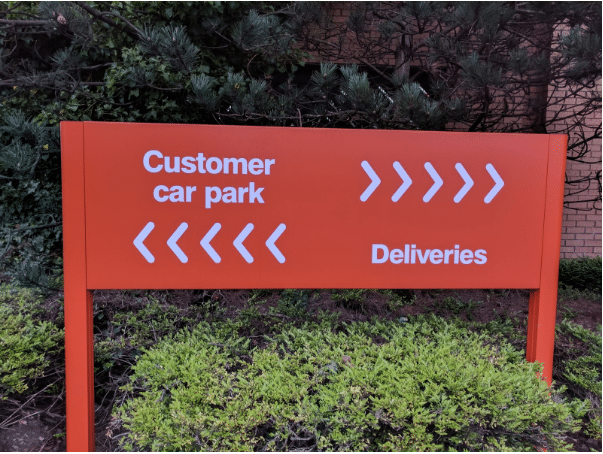
The following image is a sign from my local home improvement store. Which direction takes you to the car park and which direction takes you to the deliveries entrance?
My brain follows the “customer car park” line from left to right, so I turn right. However, the customer car park is to the left.
There is nothing to clearly illustrate right or wrong, and I read right to left – a simple line down the middle separating these would improve this.
As a mental activity, browsing websites is like driving. It is a complicated task, yet, to some degree, the brain is on autopilot.
Leverage this in your website navigation, give people what they expect, make it easy, and remove any potential for confusion else they will bounce back to the SERPs and into the open arms of your competition.
Ensure your navigation is simple to use, promotes your most important pages and does not make your users think too hard (if at all).
Common problems
There are many potential issues with content that can’t be found or understood by the search engine that can work against you. For example:
- Orphaned content that can’t be found.
- Content only available via site search.
- Flash files, Java programs, audio files, video files.
- AJAX and flashy site effects. (Google has gotten a lot better at reading AJAX pages, but it is still possible to obscure content with pointless effects.)
- Frames: Content embedded from another site can be problematic.
- Subdomains: Content split into subdomains rather than sub-folders.
Be sure that important content is easily discoverable, understandable and sits in the overall structure of the site in a way that makes sense.
Summary
If everything is done well, a human and a search engine should have a pretty good idea of what a page is about before they even look at it. Your typical SEO then just builds on this solid foundation that is laid out by your information architecture and site structure.
Mobile-friendly design
Being SEO friendly is having a site that works how your users want it to – and, in many cases, that means mobile.
Many of your future customers use mobile as the first, and often only, device to interact with your business.
Another crucial consideration for many businesses is multi-device interactions. Even if your conversions tend to be from desktop, those initial interactions may be from mobile.
Mobile-friendly means more than just responsive design. I previously looked at 28 key factors in creating mobile SEO-friendly websites that will help you move beyond simple responsive design toward truly mobile-friendly websites.
From an SEO perspective, it is worth noting that mobile-friendliness is a confirmed ranking factor for mobile search, and it is the mobile version of your site that the search engine will use to review and rank your site.
However, far more important, mobile is how your prospective customers search for and browse your site.
It is debatable just how important features like mobile-friendly are for SEO, yet it is completely moot.
Do what works for your users and what is good for SEO.
Page speed
Another key consideration in the mobile era is page speed. Users may be impatient, or they may not always have a great mobile data connection.
Ensuring your pages are lean and mean is a key consideration in modern SEO-friendly website design.
A great starting point is Google’s mobile-friendly test. This tool will give you feedback on mobile-friendliness, mobile speed and desktop speed. It also wraps everything up into a handy little report detailing what exactly you can do to speed things up.
Page speed is yet another essential consideration that spans how your site is built and the quality and suitability of the hosting you use.
Usability
Web usability is a combination of other factors: device-specific design, page speed, design conventions and an intuitive approach to putting the site together with the end user in mind.
Key factors to consider include:
- Page layout: Important elements should have more prominence.
- Visual hierarchy: Make more important elements bigger!
- Home page and site navigation: Clearly signpost directions for users.
- Site search: Large sites need a sensibly positioned search option.
- Form entry: Make forms as lightweight and easy to fill as possible.
- Design: Great design makes everything easier.
This just scratches the surface. Usability really has to be customized to the individual site.
A couple of resources I suggest checking out:
The content marketing funnel
Another key consideration to building a site that ranks is how you structure the content on your site to map to the different stages a potential customer will go through.
The goal of your website is to help your business get in front of prospective customers on search engines and then engage and convert those customers.
A good way to approach this is to structure your content to match the stages in a standard marketing funnel:
Awareness: Top of the funnel
Awareness content will typically be your blog and informational articles. We are helping your prospective customer understand the problems they face and illustrating your experience and credibility in solving them.
Consideration: Middle of the funnel
The content at the consideration stage helps your prospect compare you against the other offerings out there. This tends to be practical content that helps the customer make a decision.
- Case studies
- Product or service information
- Product demonstration videos
- User guides
Conversion: Bottom of the funnel
Bottom-of-the-funnel content drives conversions and should gently encourage a sale or lead.
- Reviews
- Testimonials
- Free trial
- Free consultation
Remember that customers will search across this entire spectrum of content types. Therefore, ensuring all these areas are covered aids discovery via search engines and helps you win more business – win-win.
That’s the basics covered
A lot is going on there but not without good reason, and ensure you have given each of these devil’s their due in the planning of your new site.
Get the daily newsletter search marketers rely on.
<input type=”hidden” name=”utmMedium” value=”“>
<input type=”hidden” name=”utmCampaign” value=”“>
<input type=”hidden” name=”utmSource” value=”“>
<input type=”hidden” name=”utmContent” value=”“>
<input type=”hidden” name=”pageLink” value=”“>
<input type=”hidden” name=”ipAddress” value=”“>
2. SEO: How to optimize your site
OK, so now you have methodically planned and developed your website, laid your SEO foundations, and you are ready to start the actual optimization.
Optimizing that site with a well-structured website that considers all of the points covered above becomes easier.
Keyword targeting
Nailing your keyword strategy is much easier once you have a solid structure without internal duplication.
If we look at our previous examples for site hierarchy and structure, then adding keywords is relatively straightforward (and is something we would often do in a spreadsheet pre-design).
- Services: www.example.com/services/
- SEO: www.example.com/services/seo/
- SEO audits: www.example.com/services/seo/audits/
- www.example.com/services/
www.example.com/services/seo/
www.example.com/services/seo/audits/
If I use these pages as an example, we have a natural progression from broad keywords to more refined search terms. We can even consider basic modifiers such as location if we are a local business.
Home
– digital marketing agency
– digital marketing company
+ Birmingham
+ UK
Services
– marketing services
– digital marketing services
+ Birmingham
+ UK
SEO
– SEO
– Search Engine Optimization
+ Company
+ Agency
+ Birmingham
+ UK
SEO Audits
– SEO Audits
– Technical SEO Audits
+ Agency
+ Company
+ Birmingham
The point here is that a well-structured site gives you a good way to determine your keyword strategy.
You still have to do the research and copywriting, but you can be sure you have a solid strategy to target broad and more detailed terms.
Pro tip: The work done structuring your site up to this point should make this aspect a piece of cake – if you are still struggling, consider revisiting the page structure.
HTML title tags
The <title> tag is the primary behind-the-scenes tag that can influence your search engine results. In fact, it is the only meta tag that actually influences position directly.
The best practice for title tags is as follows:
- Place keywords at the beginning of the tag.
- Keep the length around 50 to 60 characters.
- Use keywords and key phrases in a natural manner.
- Use dividers to separate elements like category and brand.
- Focus on click-through and the end user (think call to action).
- Have a consistent approach across the site.
Remember, don’t overdo it and over-optimize page titles. We want our keywords in the title tag, but not at the expense of click-through and human readability. A search engine may rank your content, but human clicks on it, so keep that in mind.
Pro tip: Google has started to include brand names and logos in search results (again), so you can now use any space you would have used for branding for a call to action or more optimization.
Meta description tags
Sure, meta descriptions don’t directly influence rankings. We all know that, right?
But that is completely missing the point here. Your meta description is the content of your advertisement for that page in a set of search engine results.
It is what wins you the click. And winning those clicks can help improve visibility and is absolutely vital in driving more users to your pages.
Meta descriptions must:
- Truthfully describe the page content.
- Advertise the page and improve click-through rates.
- Consider the user’s thought process and why they will click on this page.
- Include keywords where relevant and natural to do so.
The search engine will highlight search terms in your page title and meta description, which help a user scan the page. Don’t use this as an excuse to spam the meta description, though, or else Google likely will ignore it, and it won’t lead to that all-important click!
There are also situations where it can make sense not to create a meta description and let the search engine pull content from the page to form a description that more accurately maps to a user’s search. Your brief meta description can’t always cover all the options for a longer-form piece of content, so keep this in mind.
Tip: Got tons of meta descriptions to write? This is one of those SEO jobs that ChatGPT can really help with.
Heading tags
Heading tags help structure the page and indicate hierarchy in a document: H1, H2, H3 and so on.
Text in heading tags correlates with improved rankings (albeit slightly), but what matters is the alignment between the structure of the site, behind-the-scenes optimization like page titles and meta descriptions and the content itself.
Line everything up, and things make more sense for users, and we help search engines categorize our content while eking out every last bit of simple, on-page optimization we can.
Remember to align header tags with the visual hierarchy. Meaning the most important header on the page (typically the <h1>) should also be the biggest text element on the page.
You are making the document visually easy to understand here and further ensuring that design and content are working together for the best result.
Tip: The magic here is almost always in the process itself. Thinking of the content in relation to the hierarchy of information and mapping that to the visual hierarchy will almost certainly drive revisions and improve the content – that is the real SEO win!
Page content
The content should generally be the most important part of the page. However, we still see archaic SEO practices like overt keyword density and search terms littered in the copy affecting readability.
This does not work. It makes you look illiterate and certainly does not help with your SEO. Don’t do this.
We want to make sure the context of our page is clear. Our navigation, URLs, page titles, headers and so on should all help here. Yet we want to write naturally, using synonyms and natural language.
Focus on creating great content that engages the user. Be mindful of keywords, but certainly don’t overdo it.
Considerations for page content:
- Keywords in content (but don’t overdo it).
- Structure of the page.
- Position of keywords in the content – earlier can be better.
- Synonyms and alternatives.
- Co-occurrence of keywords – how else do people talk about this topic?
Tip: review individual pages in Google Search Console to see what keywords the page ranks for in lower positions. Using the impression count vs. clicks you can get some easy wins here.
Rich snippets
Rich snippets are a powerful tool to increase click-through rates. We are naturally attracted to listings that stand out in the search engine results.
Anything you can do to improve the click-through rate drives more users and makes your search engine listings work harder.
Factor in possible ranking improvements from increased engagement, and you can have a low-input, high-output SEO tactic.
The snippets that are most relevant to your business will depend on what you do, but schema.org is a great place to start.
Image optimization
Image SEO can drive a substantial amount of traffic in the right circumstances. And again, our thoughts regarding context are important here.
Google does not (yet) use the content of images, so context within the site and the page and basic optimization are crucial here.
As an example, I am looking for a hobbit-hole playhouse for my youngest, and the search brings up image results:
I can dive right into those image results and find a multitude of options, then use the image to drive me to the site that sells the playhouse.
Optimizing your images increases the chance of improving prominence in the image search results.
Image optimization is technically straightforward:
- Provide an image name that clearly describes what the image is.
- Use descriptive alt text to help those who can’t see the images reinforce the image content.
- Add OpenGraph and Twitter Cards so the image is used in social shares.
- Use the image at the right physical size to ensure fast downloads.
- Optimize the image’s file size to improve loading times.
- Consider adding images to your XML sitemap.
Image optimization is relatively simple. Keep the images relevant. Don’t spam the filenames and alt text with keywords. Be descriptive.
Tip: Use captions, titles and alt text to provide as much contextual information as possible about your images.
Optimal optimization
You can always optimize something else, but if you structure and plan your site and then optimize these key areas, you will get 80% of the results from 20% of the effort.
Tip: Optimization is never complete. So focus on what moves the dial and then move on.
3. Common problems
Knowing what to optimize is essential and is the target we aim at.
It is just as important to understand common problems that impact SEO and use this as something to run away from!
Typically, every SEO project starts with an audit, and while we can’t cover every eventuality here, the following are some key points.
Duplicate content
There tend to be two kinds of duplicate content: true duplicates and near-duplicates.
True duplicates are where the content exists in multiple places (different pages, sites, subdomains and so on).
Near-duplicates can be thin content or substantially similar content – think of a business with multiple locations or shoes listed on a unique page in different sizes.
Keyword cannibalization
Keyword cannibalization refers to the situation where multiple pages target the same keywords. This can impact the ability of your site to have one page that strongly targets a given term.
Where the site architecture and hierarchy have been carefully planned, you should eliminate this during the planning and design stages.
Domains, subdomains and protocols
Duplication also crops up when the site is available on multiple domains, subdomains and protocols.
Consider a business with two domains:
- Example.com
- Example.co.uk
With www and non-www versions:
- Example.com
- Example.co.uk
- www.example.com
- www.example.co.uk
And the site runs on HTTP and HTTPS:
- https://example.com
- https://example.co.uk
- https://www.example.com
- https://www.example.co.uk
- https://example.com
- https://example.co.uk
- https://www.example.com
- https://www.example.co.uk
Before too long, we can get to a situation where the site has eight potential variations. Factor in the site resolving on any subdomain and a few duff internal links and we can often add things like “ww.example.com” to the list above.
These kinds of issues are resolved with URL redirections.
Still, again, they deserve consideration by any web design agency that takes care of hosting and is serious about the SEO of their customers’ websites.
Botched canonical URLs
Another common issue we see is an incorrect implementation of canonical URLs.
Typically, the person building the site looks at canonical URLs as an SEO checklist kind of job. They are implemented by dynamically inserting the URL in the address bar into the canonical URL.
This is fundamentally flawed in that we can end up with the site running on multiple URLs, each with a canonical URL claiming that they are the authoritative version.
So the canonical implementation exacerbates rather than resolves the issue (sheesh).
Canonical URLs are a powerful tool when wielded wisely, yet they must be used properly, or they can worsen matters.
Modern web design considers SEO best practices
SEO is not some bandage you can plaster onto an existing site.
Every website developer or CMS will list SEO credentials. Nobody says that they build sites to crash in the search results. SEO, today and beyond, is way more than a dry list of technical must-haves.
Like all good marketing, it is ultimately about helping your prospective customers achieve their goals.
SEO should be woven into every aspect of your marketing, and at the center of that should be your (optimized) website.
There are a lot of moving parts with website design and SEO.
- The first step is to carefully plan your site to have a sensible filing cabinet structure to house your products and/or services.
- Then, optimize the key areas to ensure Google (and your prospects) can clearly understand what they should do next.
- Finally, double-check for typical issues and ensure you eliminate any areas that could be holding you back.
The post SEO and website design: How to build search engine-friendly sites appeared first on Search Engine Land.
Courtesy of Search Engine Land: News & Info About SEO, PPC, SEM, Search Engines & Search Marketing
Monday, May 15th, 2023
“We’re at around 100,000 monthly organic traffic, but we cannot sustain the SERP positions and conversions…”
“We are at 530,000 monthly organic traffic, but our growth has become stagnant and we’re unable to scale up…”
I hear plenty of similar SEO concerns from SaaS companies. After working on numerous audits, I found that most of them struggle with SEO issues that impact their customer acquisition costs and diminish revenues.
1. Branded terms have more visibility
Many SaaS websites get considerable branded traffic but minimal visibility for non-branded search.
Even unicorns from fast-growing regions, such as the U.S., UK, and India, struggle despite more branded traffic.
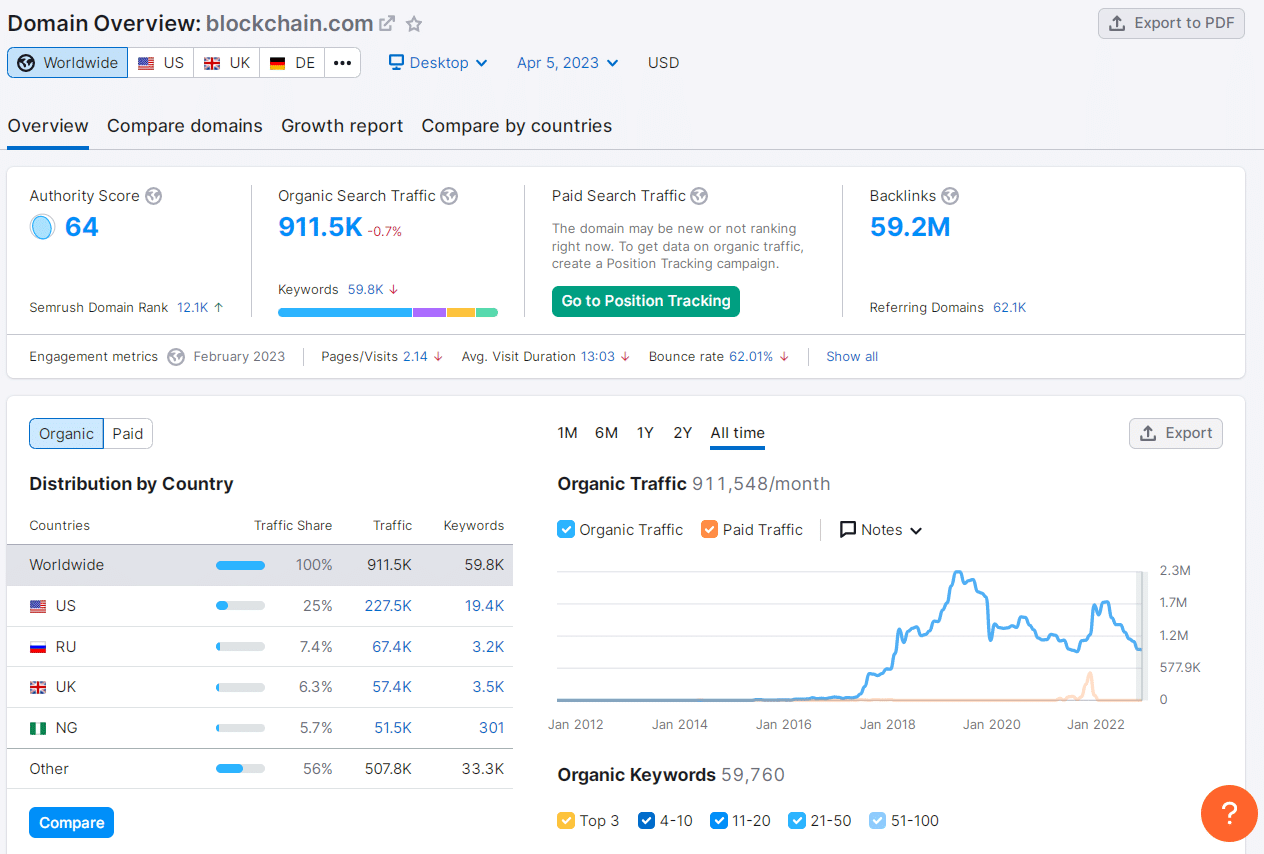
For instance, blockchain.com has ~911,500 monthly organic visits per Semrush:
But looking at branded vs. non-branded traffic tells a different story.
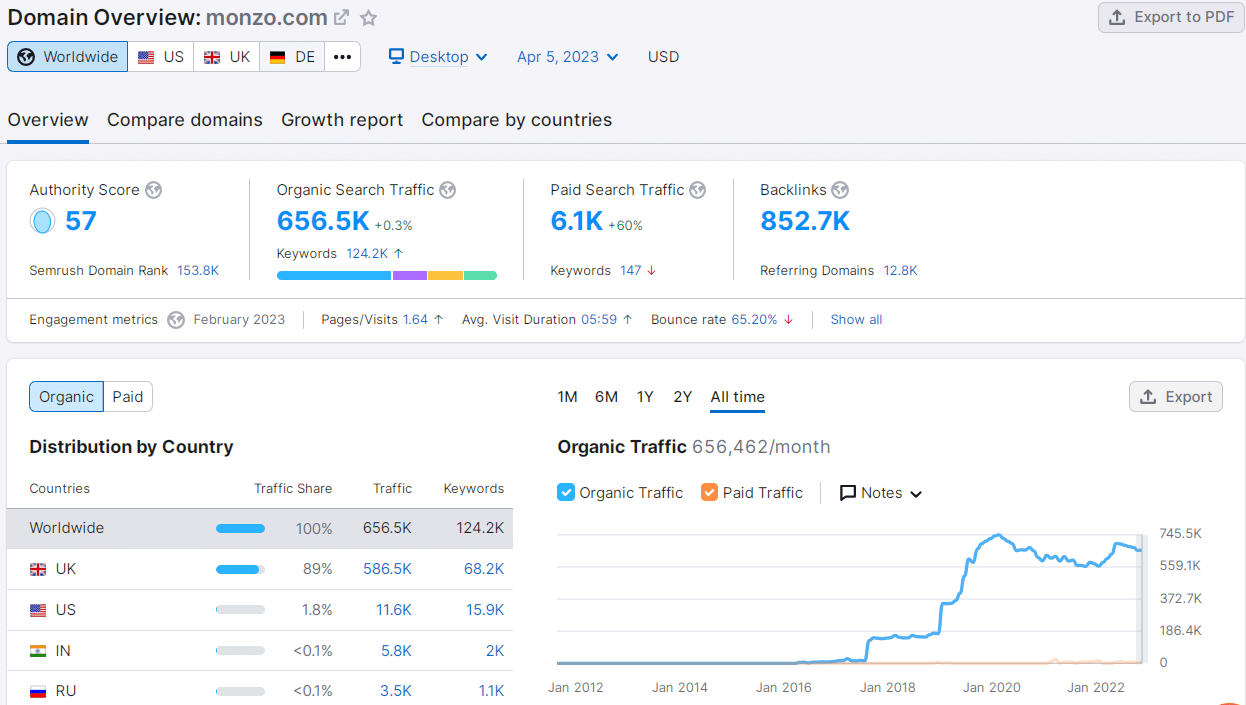
The same pattern can also be seen with Monzo.com.
Out of ~656,500 organic search traffic monthly, 94.4% is branded, and only 5.6% is non-branded.
Driving branded traffic is great if you’re already popular through funding and performance marketing which result in valuations.
By ignoring non-branded terms your searchers use, you’re losing customers to competitors. Missing such opportunities can be prevented when both non-branded and branded traffic is prioritized.
Sadly, most SaaS companies only realize the importance of organic growth when it’s too late.
2. Flawed SEO content strategy
Before investing in SEO, most SaaS product marketing teams will start creating content based on the customer journey stages.
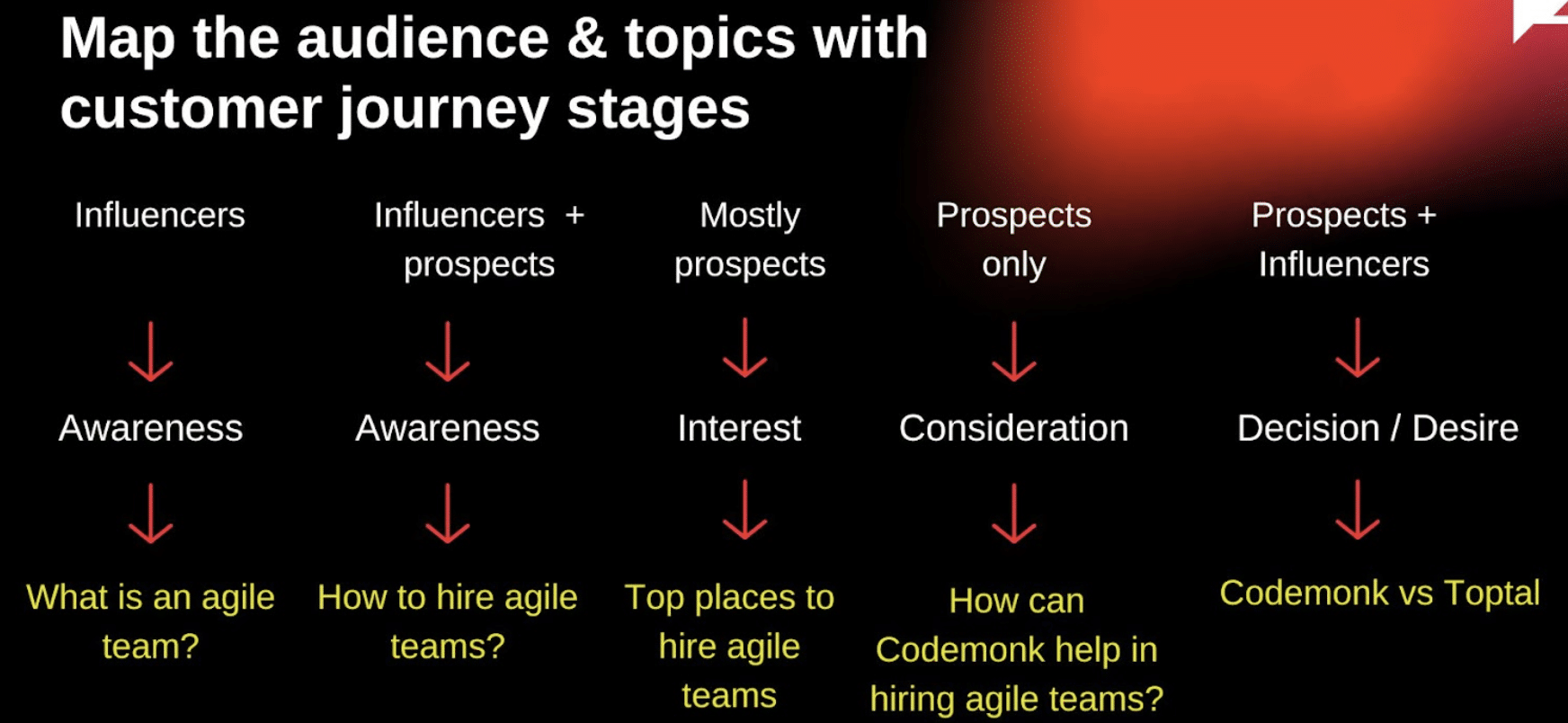 The two rows at the bottom indicate the topics and customer journey stages which align with the specified audience at the top.
Yet, they mostly focus on creating Consideration and Decision content while overlooking Awareness and Interest stages altogether.
This type of content often revolves around branded terms that help with performance marketing and email outreach – but not SEO.
Product marketing teams have metrics to chase, and this content approach supports that.
They want to get MQLs (marketing qualified leads) and SQLs (sales qualified Leads) faster to achieve their MRR (monthly recurring revenue) and ARR (annual recurring revenue) targets.
But when you invest in SEO, the purpose is not just getting more MQLs and SQLs, even though your clients or bosses want them.
Though top management wants leads from the organic channel, they need to know their KPIs differ based on the strategy used.
Growth advisor Gaetano DiNardi offers tips on breaking down traffic sources and their purposes:
Break it down like this:
1. Demand Capture – Paid Search / Affiliates
2. Demand Capture – Pricing Page / Demo Request
3. Education / Exploratory – Main Website Pages
4. Education / Exploratory – Blog & Resources
A SaaS website’s main purpose is to generate visibility on the search engines for the queries the customers search. This can only happen by targeting the right queries.
If your ideal customer is not searching for [Your product name + feature benefits], you won’t get any visibility through the search engines.
Your content strategy for SEO needs to target the queries and topics that at least fall under the Interest stage if you’re not interested in driving Awareness stage people to the website.
3. Unsustained content value
Recently, I spoke to two start-ups that already have an extensive content library or resource. Yet, it has become a bottleneck for scaling organic growth.
How? They have written a lot of blogs, but only a few perform well organically.
What might have been the issue?
When writing and publishing a lot of content without appropriate review and analysis, the content value is not sustained across all the content.
I’ve seen SaaS marketing or SEO teams excited about targeting to publish 40 to 60 articles a month. At such a scale, content quality control might suffer.
That’s why I recommend a thorough content review process that looks at the following:
- Requirements: Was the content delivered according to the brief?
- Contextual intent: Does the content have the right context? Does it serve the user intent?
- Brand messaging and promotional review: Are the brand and its products/services positioned with the right messaging throughout the piece?
Now, with ChatGPT becoming stronger, you would anyways need to have an editor in place.
Putting much content out to scale up is fine, but the results will never sustain if it offers less value than your competitors.
4. Focusing on creativity over SEO
Another significant challenge with SaaS SEO is that the product marketing team needs creative punchlines to attract the crowd.
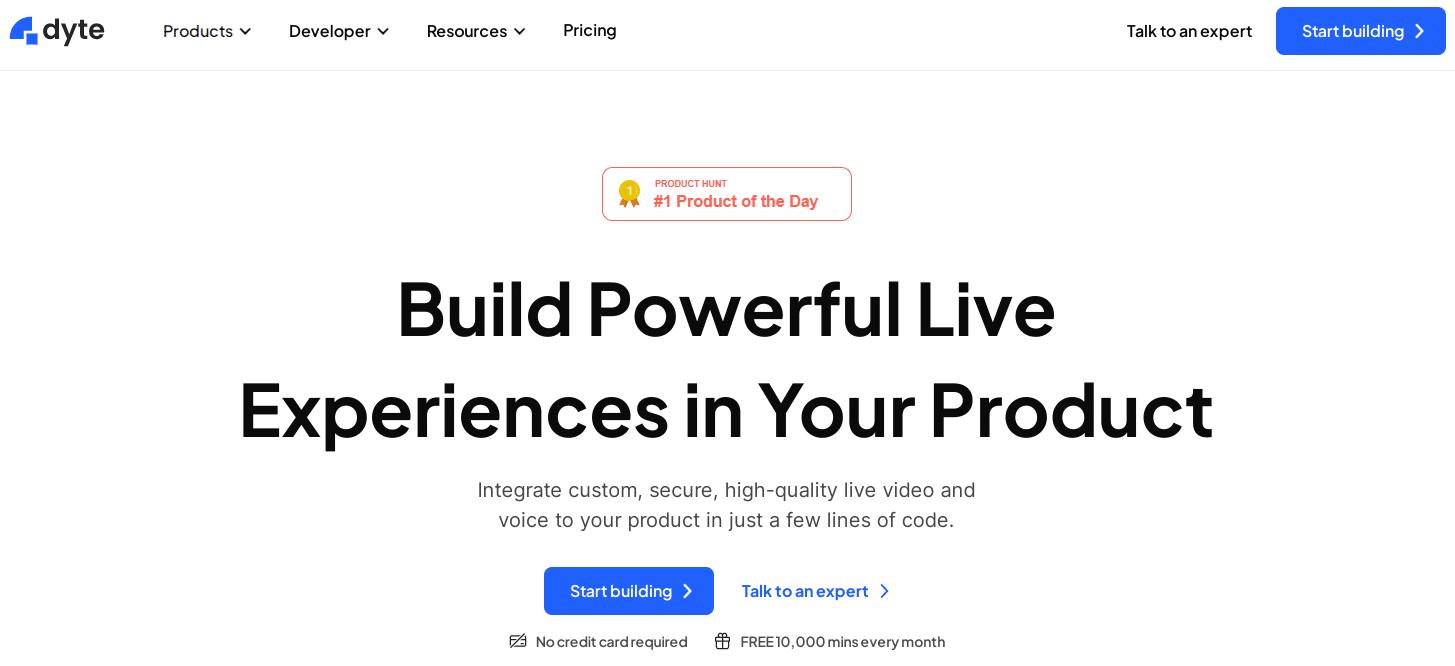
For example, look at the super fantastic headline written by Dyte.io.
Well, it’s a video streaming SDK provider. Their developer or CTO audiences can understand SDK, but because punchlines are catchy and attractive, they use them as headings.
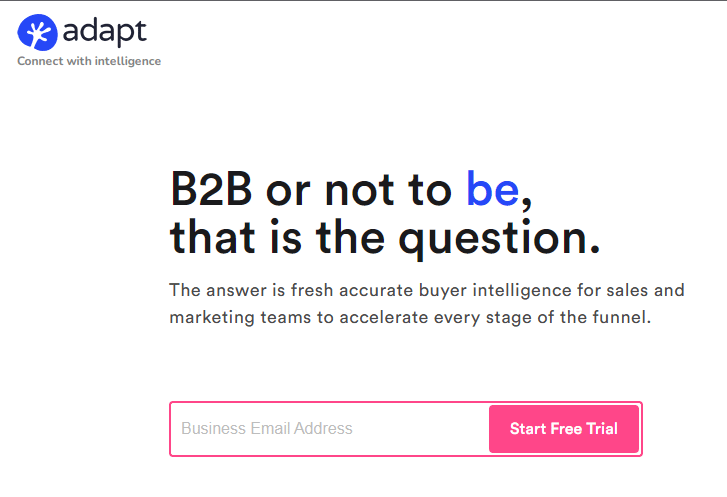
Let’s take another example of an amazing headline from Adapt.io.
They’re the sales acceleration platform that provides intelligent buyer analytics for proper targeting.
Nothing wrong there, but it’s missing out on helping users and search engines understand what exactly they do through the headline.
Google’s SEO Starter Guide maintains that you should use heading tags to emphasize important text.
Google’s documentation on Headings and Titles also suggests writing document titles based on the document’s primary purpose.
Let’s take the example of the largest SaaS platform from whom many of our clients inspire, Salesforce:
They have mentioned what they are as their headline.
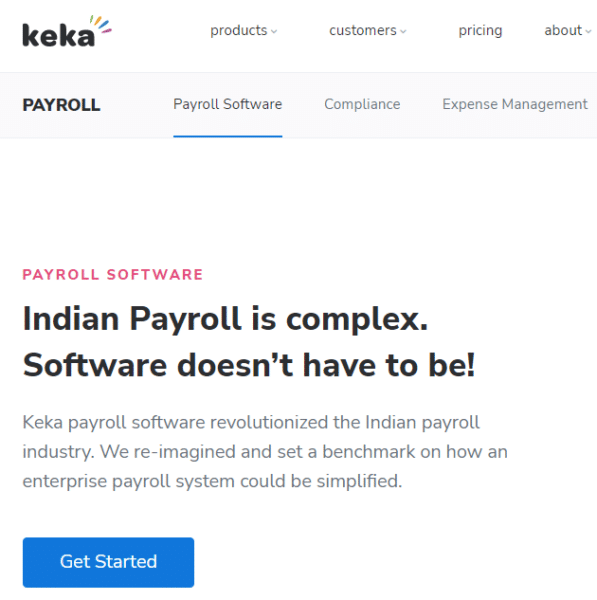
Let’s take another example of a popular HR payroll platform, Keka:
Not just the readers but search engines can understand what this platform is all about.
You need to learn how to help search engines understand what you are and what you do so that they can put you in front of your customers for the correct queries at the right time.
So creative punchlines are great for performance marketing, but balancing them with the correct queries can take you to heights, even in SEO.
Get the daily newsletter search marketers rely on.
<input type=”hidden” name=”utmMedium” value=”“>
<input type=”hidden” name=”utmCampaign” value=”“>
<input type=”hidden” name=”utmSource” value=”“>
<input type=”hidden” name=”utmContent” value=”“>
<input type=”hidden” name=”pageLink” value=”“>
<input type=”hidden” name=”ipAddress” value=”“>
5. Decaying content
Extensive content libraries often suffer from content decay, a continuous but slow decline in the content’s impressions, clicks and traffic.
So when you keep publishing new content, you need to remember the ones published in the past. When they’re no longer valuable to the audience, search engines may take the content off the SERPs for many queries.
Publishing content is only 20% of the task. The rest is optimizing it to own featured snippets.
6. No content optimization plan in place
Once the content is written and published, the team needs to remember to monitor whether they perform.
And this is not just the case with SaaS companies but many companies across various segments that rely on heavy content pipelines for SEO.
They only create blogs to drive value to the commercial-intent pages. If those blogs are bringing that value, it’s good. Otherwise, the focus should be on creating new content.
But when you don’t optimize the content periodically:
- You can’t maximize the content ROI because all content that you publish doesn’t drive traffic or conversions.
- You miss the opportunities of having different touchpoints to bring the target audience to the website.
- If you add filters to your target audience or change your brand positioning and don’t update them on all the content, you struggle with consistent brand messaging, which can confuse your target audience.
7. Keyword cannibalization
Keyword cannibalization is also a big issue among SaaS websites.
For example, these topics can create keyword cannibalization for a VoIP softphone app:
- What is a Softphone? Why Do You Need It?
- Softphone: Definition, Benefits, Challenges, and More
- The Importance of a Softphone
- 6 Advantages of a Softphone
When you write the first topic, you’re exclusively covering the definition of a softphone and its benefits in detail.
And now you know that is what the second and all the other topics mean.
In this case, you feel the first blog has the below target queries:
- What is a softphone?
- Reasons you need a softphone
And the second one has:
- Softphone definition
- Softphone benefits
- Softphone advantages
- Softphone challenges
The intent of someone reading the first two contents is the same. And hence, the target queries are also the same. They are just semantically connected.
The topics may seem distinct, but the audience, context, and queries remain the same. In reality, only the titles differ.
To address this, you can either merge both articles and delete the one that is underperforming or has little value.
8. Underutilizing internal linking
Internal linking on the SaaS websites happens in two ways:
Putting too many ‘Read more’ sections between paragraphs
Even if you add them contextually after a few paragraphs, it brings interruption while reading. Adding them within the sentences using the correct anchor text is better to deliver a better user experience.
The “Read More” section should be used when sharing an extended version of the discussed topic.
Failing to link the high-end anchor text mentioned in the content
All content gets published just while looking at the query for which the content was written.
For example, if the content is about “How do HR management systems work,” the links would be given to all the blogs and landing pages around HR but not to the Payroll page, even if that was used in the content somewhere.
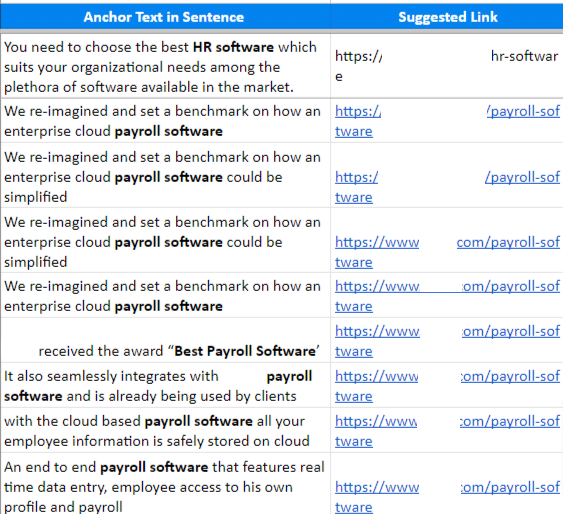
Below is the internal linking sheet for one of our clients:
This is also a content optimization mistake that can diminish your content’s value.
As Google’s Starter Guide suggests, the anchor text should help users and search engines understand what the page is about.
Cyrus Shephard’s latest study on Google’s Selective Link Priority suggests wisely choosing your text and image anchor.
Building an internal linking structure before aggressively creating content can maximize SEO ROI.
9. Blindly copying competitors for backlinks
Most clients I’ve spoken to want all their competitors’ backlinks – even if their own site already has ~600,000 monthly organic visitors.
“My competitor has captured the backlink from Amazon. We need it!”
Well, not really. Just because your competitor earned that backlink doesn’t mean it’s relevant.
They might have gone after irrelevant backlinks. Should you also do it?
It’s should not be about blindly copying someone else’s strategy. Carefully analyze your competitors’ backlinks and identify which are the most relevant.
This helps you avoid putting efforts in the wrong direction and wasting resources that could’ve been well-spent elsewhere.
10. Not enough or zero content distribution
Because growth needs to happen fast for SaaS businesses, SEO needs to pick up the pace. The downside is that content distribution becomes an afterthought.
Your work doesn’t end with publishing content. You should have a distribution strategy in place.
SEO cannot play alone in the game of marketing and business.
You need to think of “remarketing SEO” that focuses on what you can contribute to search, be it people, platforms, or SERP presence.
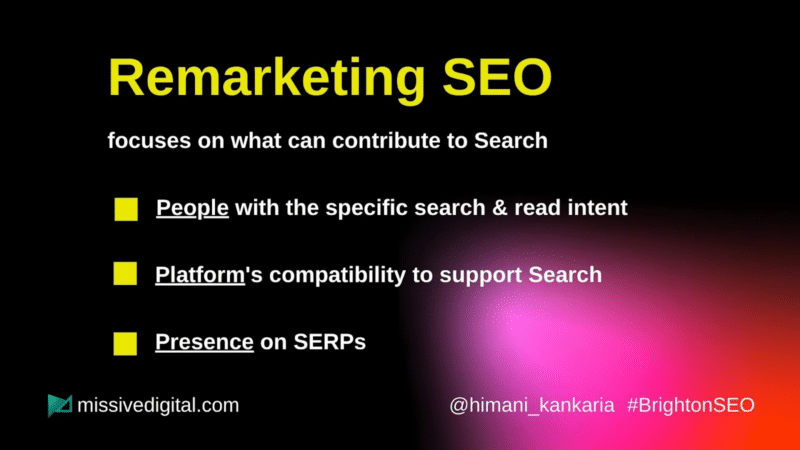 With platforms here, we mean email marketing that can increase organic conversions and social media content that now gets indexed on search engines.
SaaS content can be repurposed, redistributed, or syndicated to ensure your efforts drive the expected results. In short, the content ROI is maximized.
SaaS SEO must be a careful and strategic investment
For SaaS companies, focusing on performance marketing and outbound lead generation strategies is expected.
But when done right, SEO has the capability to reduce your customer acquisition costs and maximize marketing ROI dramatically.
The post 10 SEO challenges faced by fast-growing SaaS companies appeared first on Search Engine Land.
Courtesy of Search Engine Land: News & Info About SEO, PPC, SEM, Search Engines & Search Marketing