Archive for the ‘seo news’ Category
Wednesday, May 24th, 2023

The “New Business Guide to Google Reviews” by GatherUp is an essential resource for growing businesses looking to attract more customers through the power of Google search.
This comprehensive guide provides step-by-step instructions on how to claim and optimize your Google My Business profile, how to solicit and respond to customer reviews, and how to deal with Google and their overall review process.
With real-world examples and expert advice, this eGuide is a must-read for any business looking to build a better review strategy and improve their online reputation. Visit Digital Marketing Depot to download your copy.
The post Boost your visibility in search with online reviews appeared first on Search Engine Land.
Courtesy of Search Engine Land: News & Info About SEO, PPC, SEM, Search Engines & Search Marketing
Wednesday, May 24th, 2023
Marketers have relied on paid and organic search to deliver steady results time and again over the past decade. Changes occurred gradually, giving marketers ample time to adapt their strategies.
But today, the pace of change in search marketing is accelerating, with more shifts expected in the next two years than in the past eight combined.
Evolution in search has been a slow march toward automation and consolidation. To get ahead of the curve, we must stay current on what’s changing and learn the reason behind it.
Here’s a rundown of events that have a significant ripple effect on the search marketing industry.
1. Privacy legislation and signal loss
In May 2018, the General Data Protection Regulation (GDPR) was enforced across Europe. GDPR gave EU citizens many rights over personal data, including access to correct, delete, and port data.
Organizations that violate the GDPR can be fined up to €20 million or 4% of their global annual turnover, whichever is greater.
Another important date for internet privacy is September 2020, when iOS14 launched on Apple devices. The update included a new feature called App Tracking Transparency (ATT), allowing users to opt out of being tracked by apps.
This change has made it more difficult for advertisers to track users across apps and websites, reducing the effectiveness of targeted advertising. This iOS update changed the landscape of digital advertising.
Another watershed event – albeit forthcoming – is on July 1, 2023, when CPRA (California Privacy Rights Act) becomes fully enacted. CPRA applies to businesses that collect personal information about California consumers, regardless of the company’s location.
The CPRA has the authority to investigate and prosecute violations of the law, and it can impose fines of up to $7,500 per violation. CPRA has some legislative teeth with heavy penalties for non-compliance.
Google has announced that it will phase out third-party cookies in Chrome by the second half of 2024. This change will significantly impact online advertising since third-party cookies are crucial for targeting ads. They enable advertisers to target specific audiences and track online advertising performance.
Google aims to improve privacy by phasing out third-party cookies, often used for tracking and advertising. By phasing third-party cookies, Google makes it harder for websites to track users across different sites.
The browser market share in the United States looks is as follows:
- Chrome: 49%
- Safari: 35%
- Edge: 8.5%
- Firefox: 3.5%
By the end of 2024, third-party cookies will be effectively retired, as Chrome, Safari and Firefox represent almost 90% market share of web traffic in the United States.
Google Privacy Sandbox is developing alternative methods to target audiences and track ad performance without third-party cookies. These initiatives from Privacy Sandbox include:
- FLoC (Federated Learning of Cohorts): FLoC proposes replacing third-party cookies with a more privacy-friendly way to group users based on their interests. FLoC would allow advertisers to target ads to groups of users with similar 53gb interests without being able to track individual users across different websites.
- Topics API: The Topics API is a proposal to allow websites to request a list of topics a user is interested in. Advertisers can use this information to show the user more relevant ads.
- Trust Token API: The Trust Token API is a proposal to allow websites to verify the identity of users without the need for third-party cookies. Trust Tokens can be used to prevent fraud and improve the security of online transactions.
Performance measurement and audience targeting have been the cornerstone of digital marketing.
The evolution of digital privacy has forced ad-serving platforms such as Google, Microsoft, Facebook, and others to develop new modes of targeting and measurement.
As the ad serving platforms change, marketers must also modernize their strategies to stay competitive.
Get the daily newsletter search marketers rely on.
<input type=”hidden” name=”utmMedium” value=”“>
<input type=”hidden” name=”utmCampaign” value=”“>
<input type=”hidden” name=”utmSource” value=”“>
<input type=”hidden” name=”utmContent” value=”“>
<input type=”hidden” name=”pageLink” value=”“>
<input type=”hidden” name=”ipAddress” value=”“>
2. Machine learning and automation
Machine learning algorithms have advanced significantly in recent years in parallel with signal loss caused by advancing privacy legislation.
As a result of these two changes, advertising platforms such as Google, Facebook, and Microsoft are overhauling their ad platforms to rely on automation and artificial intelligence.
Google is always playing the long game. Historically, they have known that marketers needed support with cross-campaign attribution.
In addition, Google has known for a long time that data is going to become restricted due to privacy advancement. Finally, this foreknowledge is coming to fruition with automation and consolidation.
Google Ads introduced data-driven attribution (DDA) in September 2021.
DDA is a machine learning model that uses your account’s historical data to determine how people interact with your various ads and decide to become your customers.
DDA can help you improve your Google Ads campaigns’ performance by providing a more accurate view of how your ads contribute to conversions.
Bid algorithms aren’t exactly new in paid search advertising. Google introduced Smart Bidding in 2013 with the launch of target CPA (tCPA) bidding. The ability to bid to dynamic values such as revenue and ROAS was introduced in 2017.
As with most changes, the adoption of these features was slow. Many advertisers did not want to relinquish control of bidding to the platforms.
Loss of control and expanded reliance on machine learning will be a continued theme for digital advertising.
Over time, Smart Bidding algorithms have improved significantly, and they are now the preferred method of bid management. Manual bidding still occurs for some aspects of campaigns, but the usage continues to dwindle.
As data and automation evolve, the core functionality of keywords is changing too. Google Ads changed the functionality of exact match in 2021. Previously, exact match keywords would only trigger ads for searches that matched the keyword exactly.
However, now exact match keywords can also trigger ads for searches that are close variants of the keyword. This change means ads may show for searches that include misspellings, synonyms, and other close variants of keywords.
It is no secret that Google and Microsoft have aggressively encouraged advertisers to expand into the broad match. However, many advertisers, including myself, had a negative perception of broad matches. The query matching was too general, and traffic quality was often subpar.
Over the past two years, we have expanded our broad match usage. Broad match can provide additional search coverage and revenue growth when paired with well-crafted bid algorithms. Consider testing it again if you have shied away from broad match.
In July 2021, Google Ads retired broad match modified (BMM). Microsoft Ads followed suit by retiring their BMM offering in March 2023. This is the beginning of keyword match type consolidation.
(This is pure speculation, but Google/Microsoft will retire another match type within 12-18 months.) If I had to make a prediction, phrase match would be phased out in favor of exact (for control) and broad (for reach).
These changes directly result from machine learning advancement within ad-serving platforms like Google Ads and Microsoft Ads.
3. Campaign consolidation
Data-driven attribution was an essential element for campaign consolidation within Google Ads. Google’s ad serving algorithm mastered user intent on their core search product.
The algorithms needed to understand how ads performed across channels within the Google ad ecosystem.
Once the algorithm understood how to optimize across Google properties, that opened the door for further consolidation. Campaign consolidation first came as Smart Shopping on Google and Microsoft.
Google Smart Shopping was a campaign that allowed businesses to automatically show their product ads across Google’s search network, YouTube, Display Network, and Gmail. Smart Shopping campaigns used machine learning to optimize bids and placements.
Throughout 2022, advertisers had to migrate Smart Shopping campaigns to Performance Max. As a result, performance Max (PMax) is the current peak of campaign consolidation.
PMax allows advertisers to access new inventory, ad formats, and audiences across all Google channels, including YouTube, Search, Gmail, Shopping, and Discovery.
Another consolidation point will include Dynamic Search Ads (DSA) into PMax. Google has not provided a specific date for this migration, but the company has said it is working on integrating the two features and expects to make the change soon.
Staying ahead of the curve
The last five years have felt like the slow incline of a roller coaster. And it feels like the next two years will be a screaming rush of the drop.
The drop will be driven by privacy legislation, machine learning, automation, and artificial intelligence. Buckle in, folks!
The post 3 key trends impacting search marketing today appeared first on Search Engine Land.
Courtesy of Search Engine Land: News & Info About SEO, PPC, SEM, Search Engines & Search Marketing
Wednesday, May 24th, 2023
Google has confirmed a bug in Google Search that resulted in a drop in traffic to video content between the dates of May 4 through May 17, 2023. This was not just a Google Search Console reporting bug, but a bug with Google Search.
What Google wrote. Google posted, “A bug caused a drop in video traffic from May 4 to May 17, and has since been resolved.”
I asked John Mueller of Google if this was just a reporting glitch, and he said no, it was beyond reporting. “It was not just reporting,” he told me on Mastodon.
Search Console reports. If you go to Google Search Console, click on the search performance report, and filter it by “video” content, you will see an annotation added to the chart on May 4:

Why we care. If you noticed a drop in traffic between May 4 through May 17 and you publish a lot of video content, it may be related to this bug.
In this case, the reporting was not the issue and the reports should be accurate. There was a bug with Google Search that resulted in less videos showing up in the search results.
The post Google Search bug caused a drop in video traffic appeared first on Search Engine Land.
Courtesy of Search Engine Land: News & Info About SEO, PPC, SEM, Search Engines & Search Marketing
Wednesday, May 24th, 2023
Well, it’s 2023, and we’re still trying to convince businesses that SEO isn’t just a fancy acronym for “some extra options.”
It’s like trying to teach an old dog new tricks, except the dog is a business and the trick is “not being invisible in the search engine results.”
Some things never change.
It’s not the company leadership’s fault. In most cases, they are aware of SEO. Still, some don’t understand the value it can bring.
This is an issue when there’s competing budgets and the allure of other, more familiar marketing strategies.
You’ve probably heard it before, but educating leadership on SEO is one of the most important things you can do to convince them of SEO’s value.
And that means you must show how SEO is a strategic initiative for any business – and deserves a seat at the table.
Here are steps you can take to help leadership understand why they can’t ignore SEO and why they should get excited about it.
1. Define SEO
Depending on what type of company you’re dealing with, you may have to start with the very basics.
That means explaining what SEO actually does and how it can support basic marketing objectives.
An explanation can be something as simple as:
- What SEO is: SEO improves a website so that it performs better in the search engine results.
- The benefit of SEO: The benefit of SEO is generating more targeted traffic to the website.
- The goal of SEO: The goal of SEO is ultimately to make more revenue for the company by the website’s and business’s ability to convert leads coming from the search results.
2. Explain SEO’s worth
With basic concepts out of the way, you can delve deeper into why a business cannot ignore search engines as a marketing channel.
The following concepts can help:
Your target audience uses a search engine
Google processes 5.9 million searches per minute. It’s not a question of if people are on search engines.
It’s a matter of connecting the dots between the searches that people do and the benefits to the company.
Show leadership how people search for the things the company provides (a bit of keyword data here can help).
Then, explain how SEO supports the customer journey. For instance:
- 71% of people turned to search engines for discovery, and 74% used them for consideration/purchase, according to Forrester research.
- 43% of consumer goods shoppers have used search in their shopping journey to become inspired, browse or research, per Google data.
Your competition is benefitting from the search engines – and you aren’t
Have them look at the websites that appear when people search for what the company provides.
Explain to them the amount of traffic they are potentially getting from being visible in the search results.
Cite studies that demonstrate how much organic search traffic is possible from securing top spots, like this one, this one and this one.
Then explain how this traffic can amount to revenue.
For example, across five sectors, the organic search channel contributed the most revenue at an average of 44.6%, BrightEdge research found.
And B2B companies, in particular, generated twice as much revenue from organic search as from any other channel.
So the next question to leadership is: Would you like a piece of the pie or not?
Your digital ads are important, but what happens if you turn them off?
Digital ads are the darling of many marketing programs. More than 60% of digital spend is allocated to paid channels, a 2022 Gartner research.
In search engine marketing, paid ads – if done well – can secure a top spot in the search results – and offer near-instant gratification.
And while pay-per-click (PPC) ads have their place, you’ll need to show leadership how putting all your eggs in one basket is not a smart strategy.
Explain what would happen if they had to turn off their ads (i.e., they’d disappear from the search results entirely).
Now contrast that with the results they may see from SEO.
Yes, there is usually a bigger upfront investment to get things going, and yes, it can take months (six months on average) to see the results.
But once you start to realize those results, you own that traffic, meaning no one can take it away from you for nonpayment.
Some webpages that have built value over time from SEO continue to bring in growing amounts of traffic to a website for years to come.
3. Dispel common SEO myths
Even if leadership initially sees the value, they may be skeptical. There are plenty of commonly held SEO beliefs that are false.
Now is your chance to address all the perceived pain points they have noodling around in their heads.
Here are a few:
Myth: ‘SEO is unreliable’
Maybe members of the leadership team are jaded by headlines of website traffic vanishing overnight because of an algorithm update.
They may be wary of investing time and resources into something perceived as unstable. That’s why reframing how leadership thinks about algorithm updates is important.
So here are some talking points:
- SEO’s job is not to beat the algorithm. We will never know exactly how the algorithm works, and we don’t have to. We just have to create a great website using SEO best practices and be “least imperfect” compared to our competitors. This will help us better weather any algorithmic storm. See my article on how to survive a Google core update and come out on top for more.
- Google typically gives a heads-up for major updates. If something really big is on the horizon, Google will usually give ample time to prepare. A good SEO strategy stays on top of all potential changes and responds accordingly.
A final note to drive home: Like investing in the stock market, SEO is a long-term strategy with inevitable ups and downs. But staying in it for the long haul allows websites to reap the rewards.
Myth: ‘SEO is a one-time thing’
Decision-makers may sometimes mistakenly believe that SEO is simply a matter of checking off a few items on a checklist and calling it a day.
Nothing is further from the truth.
Make sure leadership knows that they are investing in a long-term strategy… as in for the entire lifecycle of a website.
As a business strategy in a complex and ever-changing environment (search results change, competition changes, economics change and so on), SEO is always on – proactively handling the things we can anticipate and expertly reacting to the things out of our control.
As ex-Googler Kaspar Szymanski says:
“At industry conferences, attendees hear people say that it is important to “get it right” to rank. This is true, yet not entirely accurate. Like any other company investment in assets, over time that very same investment will inevitably wear off.
Best practices of the past become outdated or downright obsolete. To keep up with the competition, especially in the more lucrative niches, SEO needs to be considered an ongoing effort with planned, periodic spurts of increased activity scheduled ahead of time.
Some factors such as snippet representation, directly impacting user experience and signals must be continuously monitored and improved. The same applies to page performance, which again is directly responsible for how users experience the website.
Other factors, such as managing backlink liabilities, may only require spot checks and be part of an annual on- and off-page SEO audit.”
In other words, a casual approach to SEO will not produce results.
Check out my article on how to implement SEO – even in the face of common challenges – for more.
Myth: ‘You can’t measure SEO’
Digital ads have ruined SEO in terms of where executives want to spend their budgets.
The instant gratification of paying for an ad and seeing a direct result is intoxicating.
Earlier, I talked about explaining how traffic can turn into revenue. This is an important concept.
However, you also want to make sure that leadership understands the job of SEO and how it relates to other important concepts like turning traffic into revenue.
The best way to measure SEO’s success is by traffic to a website.
Let me repeat that: The best way to measure SEO’s success is by traffic to a website.
To measure, the company will need to track the website’s total number of visitors from organic search traffic and ensure it has seen positive growth over time.
But what about conversions? This is where it gets tricky.
Here’s the thing: SEO’s job is to drive traffic. It’s a website’s/business’s job to convert those visitors.
A good SEO program will:
- Drive targeted traffic.
- Create a good user experience so that visitors are more likely to convert.
- Track conversion coming from organic traffic.
But leadership needs to know going into an SEO program that in order to reap the most rewards, they will need to invest in making it easy for a lead to convert.
Consider all the factors that go into converting a lead – a conversion-optimized website, the company’s sales process, the price point of products or services, the product or service features, etc.
All of these things are out of the hands of an SEO team. And so leadership needs to clearly understand that qualified traffic is the most important metric to show SEO success.
Yes, tey will always want to know what results they can ultimately see.
You can come armed with case studies of similar websites or businesses to show what they might expect.
And you can explain how to use platforms like Google Analytics to see how the organic search channel contributes to leads and sales for the business.
There are always calculations you can use to estimate SEO results.
4. Pilot a project
Sometimes, the proof is in the pudding.
Suggest piloting an SEO project if you’ve gotten far enough with the leadership team to pique their interest.
Consider starting with an in-depth, technical SEO audit. This will show them all the website’s issues hindering search engine success.
Then, have them commit to implementing the highest priority items.
While the results of those efforts are coming to fruition, you can think about an SEO initiative that might support a key group or business goal for the company.
Maybe it’s a website redesign, a new product or service or something else. Map out an SEO strategy to help that team or initiative be more successful.
Sometimes small wins lead to a bigger commitment to SEO in the long run.
Guide decision-makers to the right decision
In a world where marketing channels always compete for budget, you must help make the decision easier for the leadership team to invest in SEO.
The post How to convince leadership why they can’t ignore SEO appeared first on Search Engine Land.
Courtesy of Search Engine Land: News & Info About SEO, PPC, SEM, Search Engines & Search Marketing
Tuesday, May 23rd, 2023
Within months of publishing, our “resignation letter templates” article climbed to number one in the SERPs for a client.
If you know how to engineer success before starting then this shouldn’t be surprising.
But hitting number one for a single keyword wasn’t the most impressive thing about this article.
Because after about a year, it was ranking for 1,830 keywords.
That’s not a typo. It wasn’t a fluke.
And this article will explain exactly how to replicate it.
Long vs. short content? Here’s why you’re asking the wrong question
“It depends.”
Everyone is looking for a trick or a hack. A silver bullet that prints money without actually having to lift a finger.
But the unfortunate truth is that “it depends.”
- Should you write a long, in-depth article or a short, snappy one? It depends.
- Should you produce content in high volume or prune your site to limit the noise? It depends.
- Should you try to target one keyword per article or multiple? Once again, it depends.
There is no one-size-fits-all approach. (Despite what LinkedIn gurus guarantee.)
Here’s a quick example:
 Typically, you’d want to create one article around one primary topic.
Add in your semantic themes and blend them together with similar-yet-complementary, laser-focused content.
Tie it all up in a bow with internal links to create a dense web of content.
Then, let topical authority + some high-quality backlinks do their thing.
But this might not always be the case.
Imagine you’re doing your keyword research. As you do. And you see something like this:
- Lots of closely-related keywords sharing similar intent.
- Volume on the low (to long-tail) side of the spectrum.
- With lower keyword difficulty targets, too.
The next step isn’t to send all these to your favorite cheap writer. Or, god forbid, ChatGPT.
‘Cause the wrong content or just plain bad content isn’t going to help you, anyway.
Instead, it’s to roll up those sleeves and do some basic investigating.
First, compare parent + child keywords (and ‘volume’ vs. ‘potential volume’)
The raw data an SEO tool spits out isn’t all that helpful – mostly because it’s garbage.
Let me explain.
For starters, volume numbers are entirely inaccurate! Look up volume in three different tools and you’ll undoubtedly get three different answers.
You know what else those three answers will have in common? They’re completely wide of the mark from the actual, real-life volume or click-through rate data you might see.
While others, like keyword difficulty, heavily bias things like the number of page-level referring domains instead of the quality of said domains or even the overall domain strength (like domain rating) across the top 10 on any given SERP.
The point here is to focus less on the actual numbers and more on what the relationship of the numbers might be telling you.
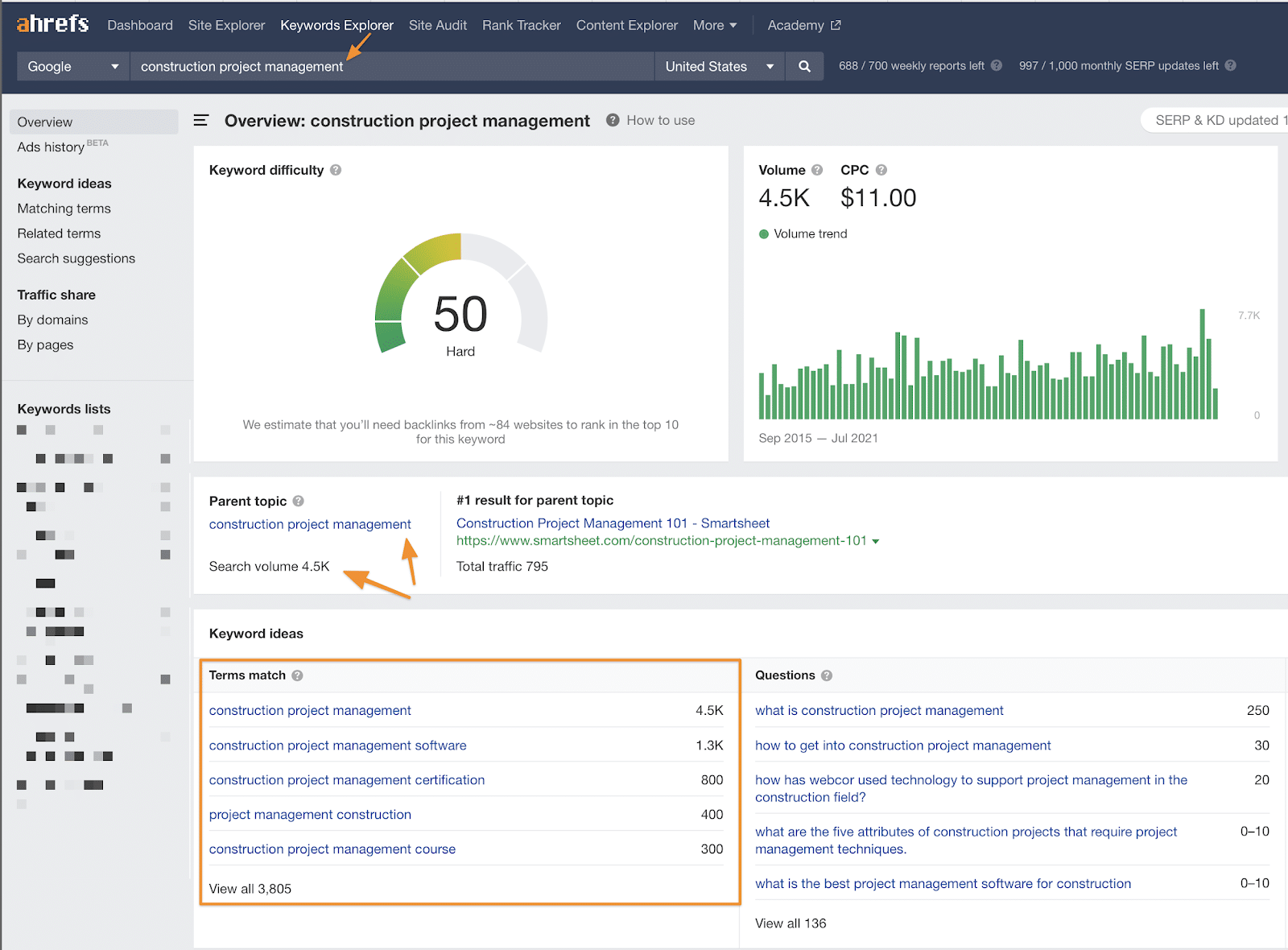
Check out this “construction project management” example. Look it up in Ahrefs, then drill down into the “child” keyword ideas sorted underneath the primary “parent” topic.
Now, you’ll see a list of closely related keywords that could be the perfect starting point for a brand-new cluster of a dozen or so articles.
Or it could just be one really long, in-depth article.
How do you know?

Here’s a giant clue.
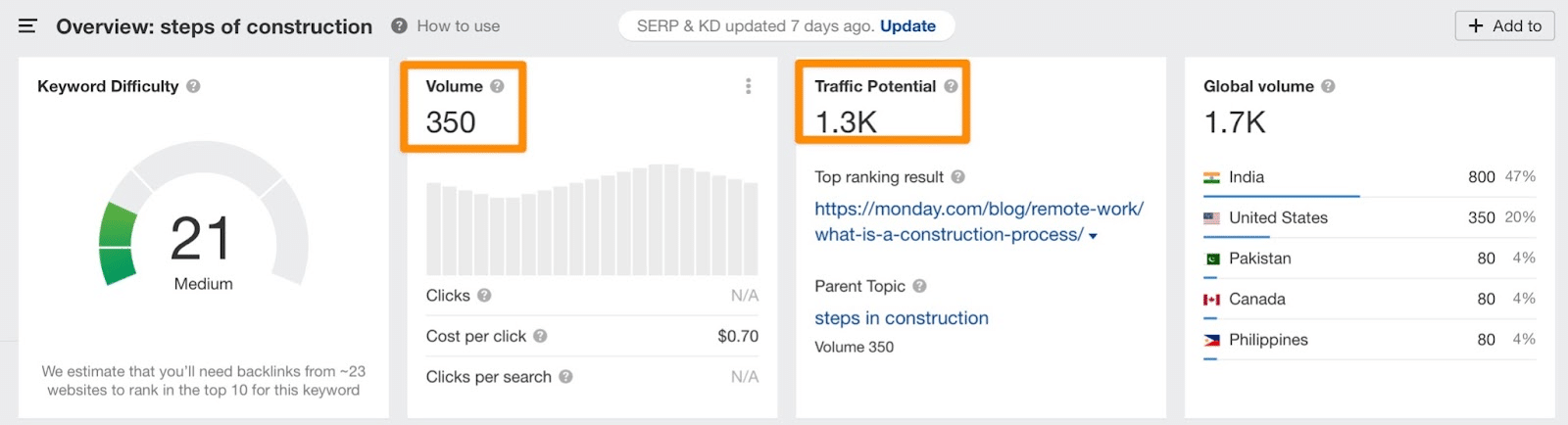
Compare the difference or ratio between Volume (local, specific to this keyword) and Traffic Potential (as in, with other keywords, too). You can even compare Global Volume if you appeal to international customers, too.
The fact that the Traffic Potential to Volume ratio here is ~4:1 tells me that you probably have a lot of very similar keywords displaying the same content pieces.
In other words, one really good, probably longer, and in-depth article on “steps of construction” will most likely be displayed for many long-tail variations around the same theme.
This means you also don’t need to create unique pieces of content to rank for each.
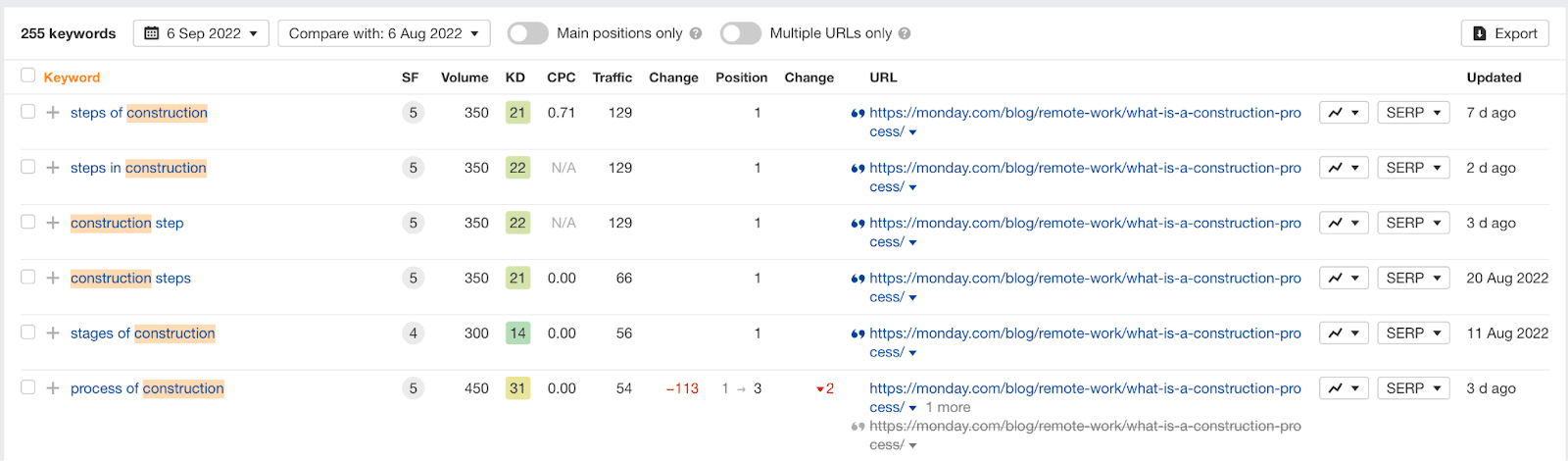
And that’s exactly what happened.
We created one in-depth piece of content and picked up the first position for lots of similar keywords – effectively ~4xing (or more) the traffic to this article vs. what any keyword tool might have originally told us.
The good news is that you don’t have to rely on hunches or decades of experience to verify this.
You just need to do a little additional legwork when you spot these clues.
Get the daily newsletter search marketers rely on.
<input type=”hidden” name=”utmMedium” value=”“>
<input type=”hidden” name=”utmCampaign” value=”“>
<input type=”hidden” name=”utmSource” value=”“>
<input type=”hidden” name=”utmContent” value=”“>
<input type=”hidden” name=”pageLink” value=”“>
<input type=”hidden” name=”ipAddress” value=”“>
Then, compare the content currently ranking across each unique SERP to look for ‘overlaps’ vs. ‘unique’
SEO isn’t all that hard at the end of the day.
Yes, there are some complicated elements to think through. But it’s not a complete mystery or black box.
Heck. Google literally shows you exactly what works vs. what doesn’t. Hiding in plain sight.
That means whenever there are doubts about what people want to find out about a particular keyword and, therefore, what Google wants to display, all you have to do is simply…
Google it!
Seriously, don’t overthink it.
Pull up the keyword we’ve been discussing, like “steps of construction.” Then, look at the actual content already ranking for this query.
- What do they have in common?
- What are they all doing well?
- What gaps are there that you think you can exploit?
- And last but not least, how much of this same exact content is showing up for other closely-related keywords you’ve found?
The easiest way to do this is a simple side-by-side comparison. So take your “steps of construction” SERP…
… and compare it with the top 10 articles ranking for “process of construction,” too.
See that?
Several articles that are exactly the same, showing up for different (yet similar) keywords – that most keyword research tools tell you are actually separate or distinct.
But in Google’s mind, they’re not.
And at the end of the day, that’s the only perspective you should care about when it comes to SEO.
Conclusion
Don’t lose sight of the forest through the trees.
SEO tactics or metrics or “best practices” – in isolation – are limited at best or completely misleading at worst.
That means Ahrefs’ volume metric doesn’t matter. Same as Moz’s or Semrush, or [insert new cool hipster tool here].
At least not on their own. They don’t.
What matters is how you interpret the data and see the relationships or patterns in SERPs to understand what’s happening under the surface.
That means sometimes you want to do more frequent, short articles. While other times, you want to do the opposite.
As the saying goes, everything looks like a nail to the man with the hammer.
The post How to land 1,830 ranking positions with only one article appeared first on Search Engine Land.
Courtesy of Search Engine Land: News & Info About SEO, PPC, SEM, Search Engines & Search Marketing
Tuesday, May 23rd, 2023
Paid search advertising and SEO are among the channels most likely to have reduced investment in 2023, according to Gartner’s latest CMO Spend and Strategy survey. But it’s not all bad news for search marketing.
Search advertising. Although 26% of CMOs planned to reduce their investment in paid search, 40% of CMOs said they plan to increase investment in this channel.
SEO. While SEO was identified by 20% of the survey respondents as a channel to reduce investment this year, 46% of CMOs planned to increase their SEO budget.
Social advertising and beyond. Surprisingly, 53% of CMOs planned to invest more in social advertising, compared to 14% who are decreasing investment. Two other categories that can expect more budget in 2023: digital video advertising and influencer marketing.
Here’s the full chart from Gartner:
 Source: Gartner 2023 CMO Spend and Strategy Survey
Why we care. Organic and paid search are two proven marketing channels that can drive visibility, brand awareness, leads, revenue, profit and more for brands. If you aren’t investing in search, you’re potentially taking money off your table.
Dig deeper. SEO vs. PPC: Differences, pros, cons & an integrated approach
Budget woes. Marketing budgets are flat – and 71% of CMOs believe they lack the budget successfully to execute this year’s strategies. So it will be important for CMOs to make smart decisions about where they spend their budget.
About the survey. 410 CMOs and marketing leaders were surveyed in March and April 2023. Respondents were based in North America and Europe, representing various industries and company sizes, with most reporting annual revenue exceeding $1 billion.
The post 20% of CMOs to invest less in paid search, SEO this year appeared first on Search Engine Land.
Courtesy of Search Engine Land: News & Info About SEO, PPC, SEM, Search Engines & Search Marketing
Tuesday, May 23rd, 2023
Much has been written about the challenges marketers are up against in 2023.
From economic volatility and growing technological complexity to changes in data privacy policies and exponential improvements in AI (yes, ChatGPT, we’re talking about you – again!), this year has been a heady mix of uncertainty and excitement.
This is especially true for marketers, who have had to course-correct on-the-fly, retro-fitting strategies and tactics to accommodate ever-shifting business goals.
If nothing else, this has forced marketers to rethink both the art and the science of the campaigns they plan, build and execute.
Unpacking the art and science of marketing
The old adage that marketing comprises both science and art in equal measure still holds true. To better understand this, let’s first unpack what exactly we mean by “art” and “science.”
- The science of marketing can certainly involve creativity, but it’s primarily about the “how” and “why” of what you’re doing. That’s where science comes in. Think data, IT and technology, and measuring revenue impact.
Brands that have perfected the blend of art and science
When it comes to real-world success stories of brands that are effectively blending the art and science of marketing, the following brands stand out:
Reformation and the “text message heard around the world.”
Sustainable fashion brand Reformation harnessed the power of SMS to engage their mobile-first, Millennial and Gen Z audience while staying true to their brand voice.
By marrying provocative, deliberately non-promotional creative with smart targeting, the brand created the “text message heard around the world,” which achieved a 96% CTR and 963x total program ROI in just six months.
BrandAlley, advocacy data and supercharged growth
The cost of acquisition vs. retention is a conversation that’s become particularly relevant in the face of tightening marketing budgets and smaller teams.
To bring down acquisition costs, BrandAlley (with the help of Mention Me) married advocacy data with personalized content to fuel customer loyalty campaigns that reward customers who generate revenue for BrandAlley via referrals. This is a powerful example of the art and science of marketing working hand-in-hand.
Ochsner Sport’s personalization journey
As Switzerland’s largest sporting goods retailer, Ochsner Sport has felt the pressure in recent years to up its personalization game. They achieved this by doing two important things – balancing the art of building a cross-functional personalization program with the science of using data-driven insights to unlock true customer centricity.
Hear from these brands first-hand
SAP Emarsys will showcase these brands and many more at its Omnichannel Masterclass, which forms part of this year’s Power to the Marketer Festival.
See how leading brands and innovative marketers are elevating the art and science of marketing.
Join the Festival
Power to the Marketer Omnichannel Masterclass June 7- 8
Day 1 is all about the art, and you’ll get insights on topics like:
- Mastering SMS to reach new audiences
- Perfecting customer loyalty to increase retention
- Redefining the value exchange for better customer data
Day 2 is all about the science, and you’ll learn about:
To join the omnichannel masterclass event or to learn more about speakers and topics, visit the event registration page.
The post 3 brands that have mastered the art and science of marketing appeared first on Search Engine Land.
Courtesy of Search Engine Land: News & Info About SEO, PPC, SEM, Search Engines & Search Marketing
Tuesday, May 23rd, 2023
Google now supports Site names for subdomains on mobile devices, the search company just announced. Google wrote, “Site names are now supported for subdomains on mobile devices.”
Google updated its help documentation to specify subdomains on mobile.
Site names. Site names is the title and name of the site Google shows in the search results listings. “When Google lists a page in search results, it shows the name of the site the page comes from,” Google explained.
What it looks like. Here is where the site name shows in the search result snippet:

Site names timeline. Here is the timeline Google posted of the evolution of site names since it launched in October:
- October 2022: Site names for the domain level were introduced for mobile search results for English, French, German and Japanese.
- April 2023 (I have this as March): Site names were added for desktop for the same set of languages.
- May 2023: Site names are now supported on the subdomain level for the same set of languages and on mobile search results only.
Need support. Having issues with your site name? Google posted a support thread in the Google support forums over here, including more FAQs.
We recently saw some issues with site names, some of which Google resolved.
Controlling site names. Google back in October explained that Google Search uses a number of ways to identify the site name for the search result. But if you want, you can use structured data on your home page to communicate to Google what the site name should be for your site. Google has specific documentation on this new Site name structured data available over here.
Upgrading the favicon. Google also recommended revisiting the documentation for favicons for the latest best practices. Google is now also suggesting you provide an icon that’s at least 48 pixels and follows the existing favicon guidelines.
Ads. This is also rolled out to the Google search ads on desktop, so the size of the site name, favicons, and also the ad label will be more prominent in mobile search. In fact, Google rolled out the “Sponsored” label in mobile search last October and today on desktop, officially replacing the “Ads” label from January 2020.
Why we care. Now the site names will potentially show a different name for subdomains on mobile devices. So make sure to test to see how Google shows your site name for your subdomains on mobile, for multiple queries.
The post Google Site names now support subdomains on mobile devices appeared first on Search Engine Land.
Courtesy of Search Engine Land: News & Info About SEO, PPC, SEM, Search Engines & Search Marketing
Friday, May 19th, 2023
Non-skippable ads are coming to YouTube Select on connected TV. This means that viewers will see one 30-second ad instead of two consecutive 15-second ads.
Why we care. YouTube was the most popular U.S. video streaming platform in April and watch time increased, according to Nielsen. It remains to be seen whether a non-skippable 30-second format provides a good advertising ROI.
What YouTube said. YouTube explained in a blog post:
“We know that running longer-form creative on the big screen aligns with your objectives, and allows for richer storytelling. YouTube Select is now landing over 70% of impressions on the TV screen, so we’re making it easier for you to use existing assets in front of the most-streamed content.”
YouTube Select is the top 5% of the most-viewed and most-engaging content.
U.S. first. YouTube’s new ad type will initially be available only in the U.S., with plans to expand availability internationally later this year.
Pause Ads. YouTube also announced it will be testing “Pause experiences” on CTV. This experimental feature will allow viewers to pause videos, to potentially help drive awareness or an action – perhaps via a QR code.
The post YouTube to offer unskippable 30-second ads on connected TV appeared first on Search Engine Land.
Courtesy of Search Engine Land: News & Info About SEO, PPC, SEM, Search Engines & Search Marketing
Friday, May 19th, 2023
Instacart made $740 million in ad revenue in 2022, a 30% increase over 2021.
Surging ad business. The Information reported:
“The grocery-delivery firm’s ad revenue totaled about $740 million last year, up 30% from 2021, according to a person familiar with the matter. That’s a striking increase, given that the digital ad market was largely stagnant last year. Nearly 30% of Instacart’s 2022 revenue came from selling advertising rather than actually delivering groceries.”
Ads accounted for about 20% of Instacart’s $1.5 annual revenue in 2021 – about $300 million – according to a June 2021 Insider report.
For comparison. Advertising accounted for about 10% of Amazon’s revenue in 2022, according to The Information. Meanwhile, Amazon made $37.7 billion in revenue through advertising last year.
Why we care. Instacart remains a viable alternative for brands to promote products directly to consumers. And the company has updated its platform to attract more advertisers.
The bigger picture. In 2022, Google and Meta’s advertising market share dropped below 50%. This trend is expected to continue in 2023, in part, due to the rise of emerging ad platforms like Instacart.
The rise of retail media networks. Retail media search spend is forecast to be near $30 billion this year – and RMN digital ad revenue is expected to hit $45 billion. Dig deeper in U.S. paid search spend forecast to hit $110 billion in 2023.
The post Nearly 30% of Instacart’s revenue is from advertising appeared first on Search Engine Land.
Courtesy of Search Engine Land: News & Info About SEO, PPC, SEM, Search Engines & Search Marketing