Archive for the ‘seo news’ Category
Monday, June 5th, 2023
With 39 million views, Netflix’s “Wednesday” earned the top spot on YouTube’s Cannes Ads Leaderboard 2023, a roundup of the top global video ads since last year’s festival.
Leading video ads trends. Music (Telecom Egypt, Qatar Airways, Orange Egypt, Burger King), authenticity (Peacock, Netflix, HBO Max/The Last of Us), cross-generational appeal (Bulgari, Peacock) and emotion (HBO Max, Bulgari and Qatar Airways) were the hooks that elevated the most popular video ads to earn more than 214 million video views, according to YouTube.
Why we care. YouTube is the most popular U.S. streaming service on TV screens, with an estimated 150 million unique viewers. It is also a profitable platform for creators. Video ads continue to be a great way to drive views by telling stories that connect with your target audience.
YouTube’s top 10 most popular global video ads
These were the top 10 most popular video ads globally from June 2022 to May 2023, along with how many views they have as of publishing.
- “The ad ranking is determined using some of YouTube’s strongest signals of viewer choice – including factors like organic and paid views, watch time and audience retention (i.e. how much of a video people watched),” YouTube noted.
10. Burger King: Whopper Whopper (Extended)
9.3 million views
9. Peacock: Kevin Hart can’t stop attacking ‘old’ celebrities #shorts
9.1 million views
8. Bulgari: Unexpected Wonders – a movie by Paolo Sorrentino
9.3 million views
7. Orange Egypt: World Cup 2022 campaign – Crazy about Football
19 million views.
6. Galaxy S23 Ultra: Official Introduction Film
23 million views
5. Qatar Airways: C.H.A.M.P.I.O.N.S – official FIFA World Cup song featuring DJ Rodge and Cheb Khaled
23 million views
4. Max: The Last of Us
24 million views
3. Apple: Introducing iPhone 14 Pro
26 million views
2. Telecom Egypt: WE Summer Campaign 2022 – Akram Hosny
33 million views
1. Netflix: Wednesday Releases Thing In New York
39 million views
Dig deeper. YouTube year in review: The top 10 ads of 2022
The post Netflix tops list of YouTube’s top 10 most popular video ads appeared first on Search Engine Land.
Courtesy of Search Engine Land: News & Info About SEO, PPC, SEM, Search Engines & Search Marketing
Monday, June 5th, 2023
Linda Yaccarino today became Twitter CEO – and she’s got some hard work ahead of her. That’s because Twitter’s advertising revenue has declined 59% year on year, according to an internal presentation acquired by The New York Times.
Despite Elon Musk’s recent optimism about Twitter’s advertising progress, stating that “almost all advertisers have returned” and predicting profitability for the platform, the situation remains uncertain.
Something doesn’t add up. During the five weeks from April 1 to the first week of May, Twitter’s U.S. advertising revenue was $88 million. Twitter frequently fell short of its weekly sales forecasts, sometimes by as much as 30%, The Times reported.
Why advertisers are fleeing. A surge in hate speech and explicit content, along with an increase in advertisements for online gambling and marijuana products, caused concern.
Twitter’s U.S. ad revenue is projected to drop by at least 56% each week compared to the previous year, according to the internal document.
Twitter’s advertising sector is crucial to its success and value, accounting for 90% of its revenue.
When he acquired Twitter for $44 billion in October and privatized the company, Musk pledged to create “the most respected ad platform.” However, he soon strained relationships with advertisers by terminating key sales executives, promoting a conspiracy theory on the platform and reinstating previously banned Twitter users.
How brands reacted. Several major ad agencies and brands, including General Motors and Volkswagen, suspended their Twitter ad investments. Musk had projected that Twitter’s revenue for 2023 will reach $3 billion, a reduction from $5.1 billion in 2021 when Twitter was a publicly-traded company.
Several of Twitter’s major advertisers, such as Apple, Amazon, and Disney, have reportedly reduced their spending on the platform compared to the previous year, according to three former and current Twitter employees. They also noted that high-value banner ads on Twitter’s trends page, typically purchased by large brands for promotional purposes, are frequently remaining unsold.
Twitter has faced public relations issues with major advertisers, including Disney. In April, Twitter mistakenly gave a gold checkmark, indicating a paying advertiser, to an unaffiliated account called @DisneyJuniorUK. The account then posted offensive content, causing Disney to demand an explanation and assurances from Twitter to prevent such errors in the future.
Why we care. Despite its challenges, Twitter is still a powerful platform that reaches a vast, global audience. The platform still has a user base of millions who engage daily, offering unique opportunities for brand visibility and interaction.
Changes are starting. Yaccarino, the NBCUniversal executive recently appointed as Twitter’s CEO by Musk, is inheriting several challenges. She has taken over as CEO today – weeks earlier than expected, BBC reported.
Damage done? The new leadership under Yaccarino could signal upcoming changes in their approach to problematic content, potentially improving the advertising environment. Twitter has also added Joe Benarroch, formerly NBCUniversal’s senior vice president of communications, advertising and partnerships.
Advertisers should watch Twitter’s changes, as it may continue to be a potential key player in digital marketing strategies.
The post Twitter’s U.S. ad revenue drops 59% appeared first on Search Engine Land.
Courtesy of Search Engine Land: News & Info About SEO, PPC, SEM, Search Engines & Search Marketing
Monday, June 5th, 2023
Last month, I shared my first GPT-enabled Google Ads script. It identifies missing RSA headlines and suggests new variants.
This month, I wanted to push the limits of GPT a little harder and see if I could get it to write my next script for me. Spoiler alert: It worked! But it needed some handholding to get there. I’ll teach you how I engineered the prompt to get a successful result.
The script I am sharing uses OpenAI’s GPT to write an account performance summary along with some suggestions for how to improve the performance of a Google Ads account.
Making PPC reports more descriptive
PPC reporting can be a tedious task. By nature, it’s also repetitive because clients and stakeholders expect the latest report in their inbox regularly – be it weekly, monthly, or, heaven forbid, even daily.
There are plenty of great reporting tools (I work for one). While they can automate pulling in the data and visualizing it, making sense of and telling a story with the data usually still require a human’s touch. GPT excels at writing compelling stories, so it seemed like a good solution for my problem.
GPT and generative AI are adept at producing well-written text. Because large language models (LLMs) have read billions of words, they’re very good at predicting how to put words together in a way that makes for a compelling read.
But as compelling as they may be, they’re not always true, and that’s a big problem when the goal is to share trustworthy reports with clients.
So I set out to figure out if I could force GPT to be correct and a great storyteller about the data in an ads account.
GPT’s truth problem
A weakness of GPT is that its core strength is predicting the next word in a string. It’s much less reliable when it comes to fact-checking and ensuring what it says is correct.
Its training might have included dozens of blog posts about how to get more conversions in Google Ads.
Because those articles probably frequently mention tasks like checking budgets and managing CPA targets, GPT will likely include those things when it generates advice related to getting more conversions.
But it may get the details slightly wrong, like whether an advertiser whose CPA is lower than the target CPA should increase or decrease their ad budget. GPT isn’t solving a problem analytically but rather predicting the words to include in its advice.
Another problem is that GPT remains bad at math despite openAI’s work to address this known problem.
For example, if provided with facts like how many clicks and impressions a campaign has, it’s not safe to assume that it will know how to determine the correct CTR from this information. We all know it’s a simple formula: clicks/impressions = CTR.
Sometimes GPT will get it right, but there’s no guarantee.
To avoid calculation errors, I decided it would be safer to do the math myself and provide the results in the prompt.
Rather than trusting GPT to calculate metrics like CTR, conversion rate, etc., correctly, I provided the values for those metrics in the prompt.
How to provide GPT with facts about your business
The specific task I wanted to automate was describing how an account’s performance changed last month compared to the month before and including some optimization suggestions.
When creating this automation, I couldn’t jump straight into the code. I had to manually create a process that worked before turning that process into an automation.
The first step was to experiment with GPT to determine what data it needed so it would stop making up facts and instead rely on the truth for crafting its stories. This required giving it Google Ads data with the facts I wanted it to describe.
Fortunately, GPT can take a table as input and figure out how to interpret the various cells. So I created a table of campaign performance and exported it as a CSV text file which could be copied and pasted into a GPT prompt.
Because I wanted GPT to comment on the changes in performance between two date ranges, I initially brought in two separate CSV strings, one for each period.
But two separate CSV strings use more tokens than the same data combined into a single CSV with separate columns for different date ranges.
So to make the automation slightly better at working with bigger accounts, I generated the combined CSV string.
With factual data ready to insert into a prompt, I could then move on to engineer the prompt to give me the best results possible.
Prompt engineering
With factual data to work with, I next needed to tell GPT what to do with those facts. The prompt could be as simple as:
- “Write a summary of the campaigns’ performance comparing the two periods.”
GPT is smart and figures out what the different periods in the CSV data are.
If it tends to focus too much on certain metrics you’d like to deprioritize, add more detail to the prompt, like:
- “Do not include Search Lost IS in the summary.”
Next, I wanted it to include some optimization tips. To make the suggestions more reliable and more in line with my own management style, I loaded the prompt with some additional facts like these:
- The target CPA is $20. A cost higher is bad, and a cost lower is good.
- If the Search lost IS (budget) > 10% and the CPA is below the target, the budget should be raised.
- if the CPA is above the target, the bids should be adjusted.
Then when sending a very detailed prompt with CSV data, facts, and a request for what to do with this data, GPT started giving solid answers.
With all the puzzle pieces in place, it was time to ask GPT to write me the automation.
Get the daily newsletter search marketers rely on.
<input type=”hidden” name=”utmMedium” value=”“>
<input type=”hidden” name=”utmCampaign” value=”“>
<input type=”hidden” name=”utmSource” value=”“>
<input type=”hidden” name=”utmContent” value=”“>
<input type=”hidden” name=”pageLink” value=”“>
<input type=”hidden” name=”ipAddress” value=”“>
Getting GPT to write Ads scripts
The code for a Google Ads script to pull data from an account isn’t particularly complicated. It’s part of almost any script and very well documented.
So I crossed my fingers and asked GPT to write a script to pull the data for me with this prompt:
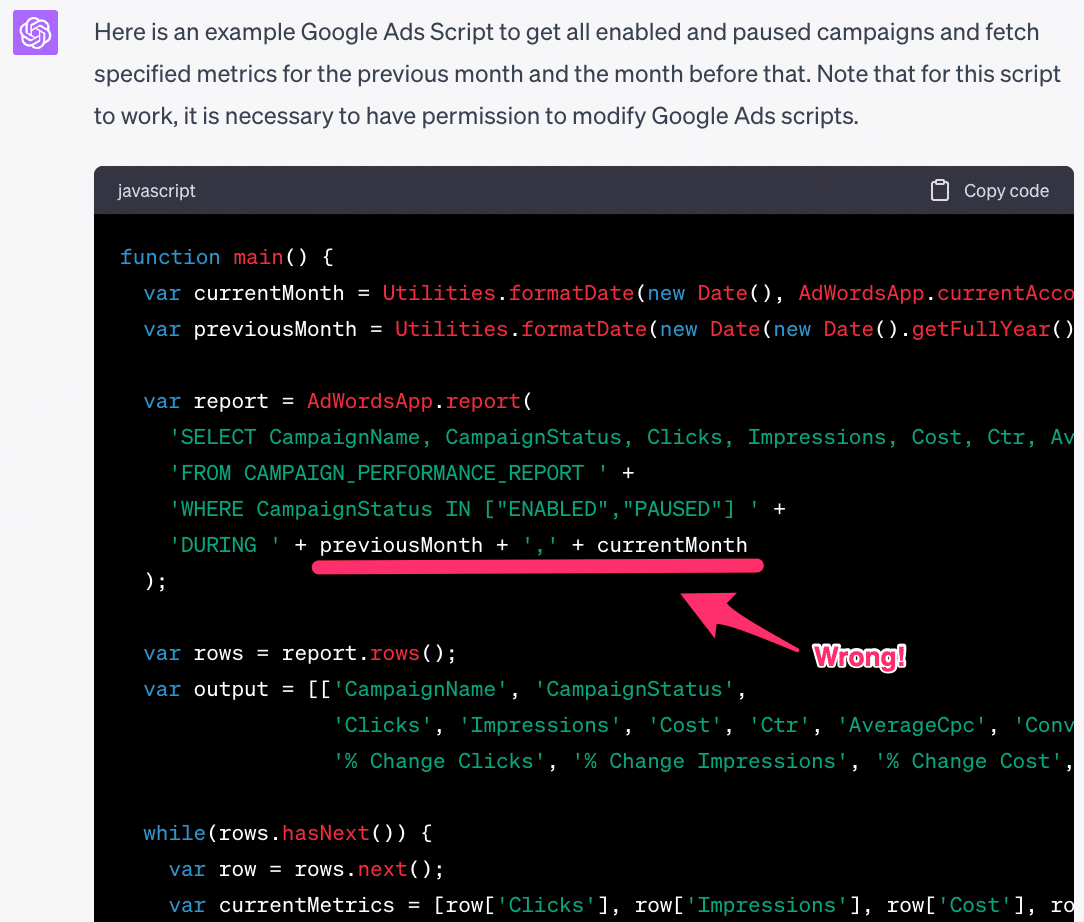
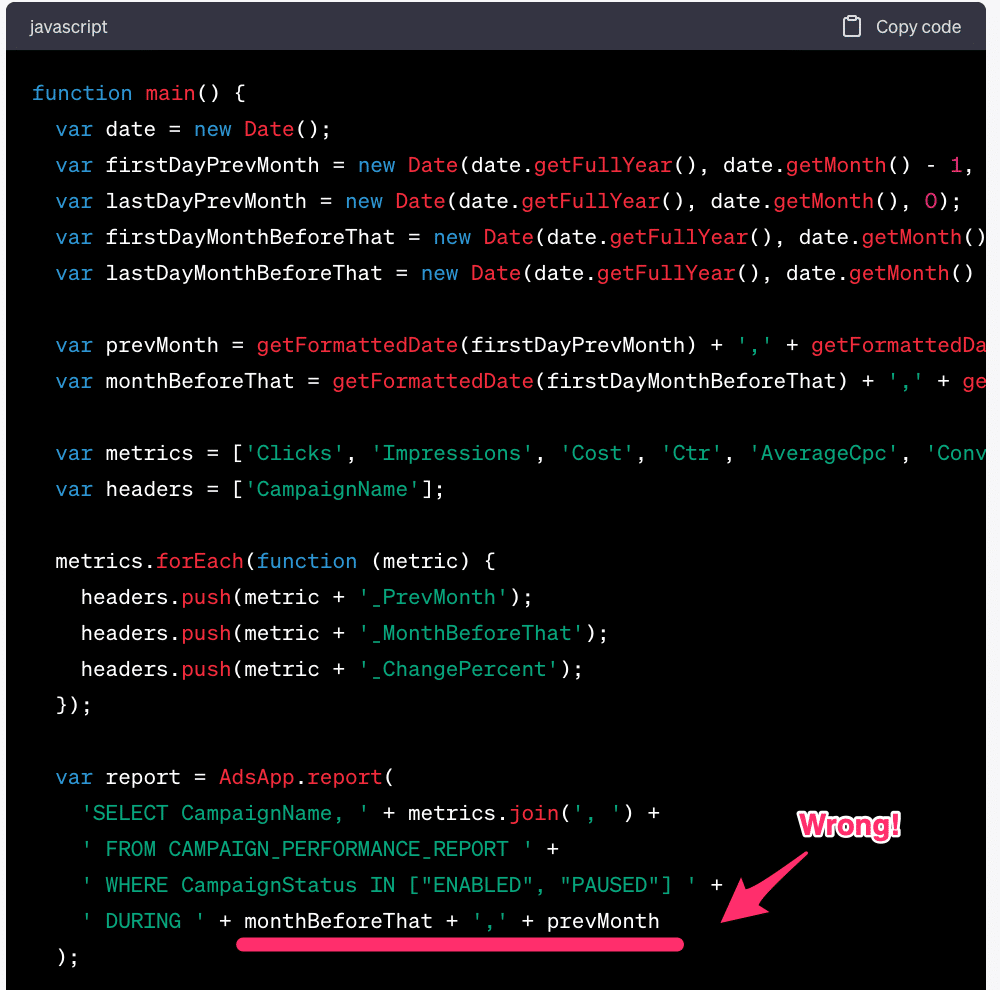
The response looked like a good script, but one thing seemed a bit off. It was writing a GAQL query that included the two date ranges I wanted to compare in a single query. That is not supposed to work.
So I asked GPT to try again, and while the implementation changed slightly, it once again messed up the date ranges in the GAQL query:
At this point, I could have given up and fixed the code myself, but instead, I did some prompt engineering.
What if my prompt was confusing GPT?
I told it to:
- “Get the clicks, impressions, cost, CTR, average CPC, conversions, conversion rate, and cost per conversion metrics for the previous month and the month before that.”
Could I be clearer and tell it this should be done in two separate queries that would be merged later?
So I changed the prompt to include this new text:
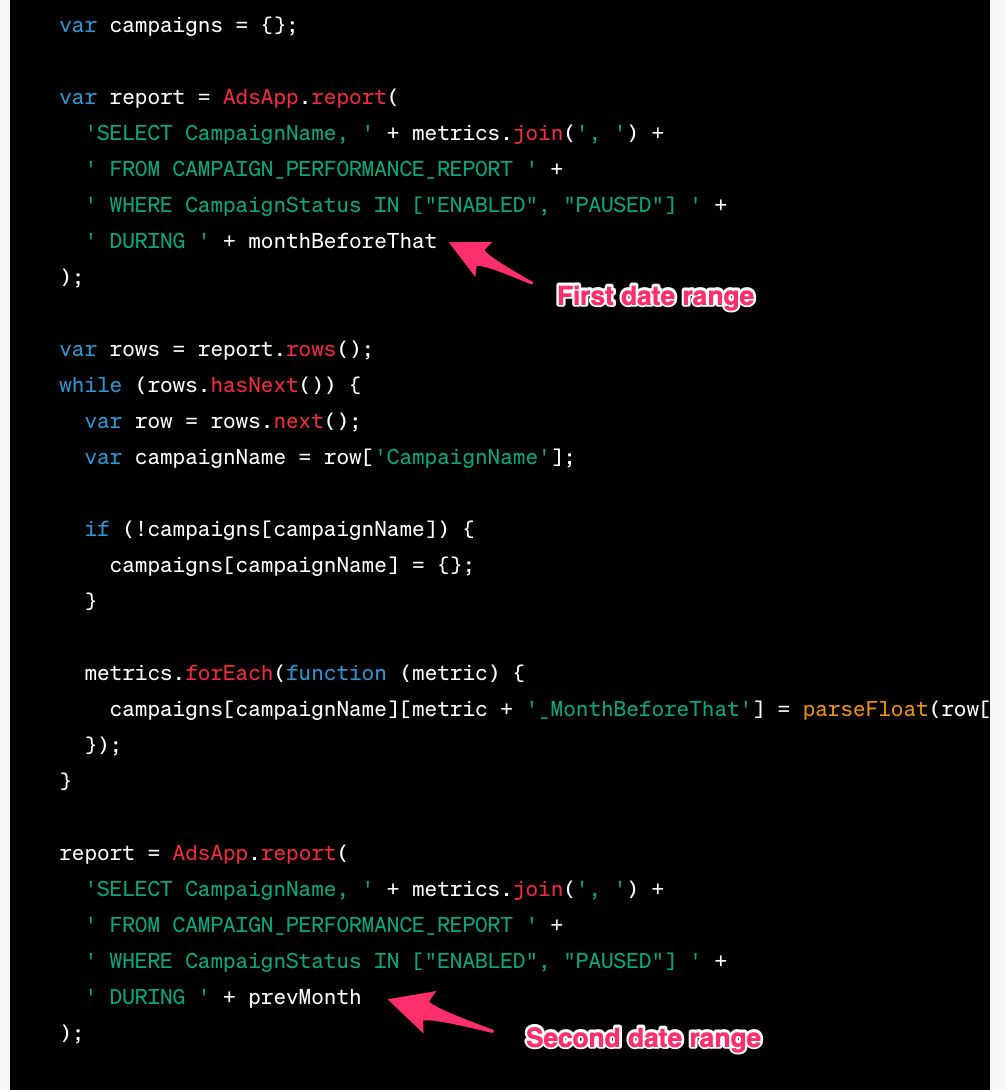
- “Get the clicks, impressions, cost, CTR, average CPC, conversions, conversion rate, and cost per conversion metrics. Get the report for 2 date ranges: last month and the month before that. build a map where the key is the campaign name and it includes the stats from the 2 date ranges.”
This is much more precise, and the result came back as follows:
Now GPT was writing the correct code. After installing it in my Google Ads account, it immediately worked as expected and generated the needed CSV data.
This was a good lesson in prompt engineering for me. If you hire a new team member who’s never done PPC, you probably need to be pretty precise in your instructions when you ask for help. It’s the same with GPT, precision matters!
Also, it still matters to be a subject matter expert. Someone who’s never worked with GAQL or API reports from Google Ads might not know that you can’t get data for two date ranges in a single call. Without that knowledge, finding the error in the GPT response could be very difficult.
Bottom line, when asking GPT to generate code, it’s helpful to write pseudo-code rather than being too general and only telling it what outputs you expect. The more you tell the system how to arrive at that output, the more likely it will write code that works.
With the code to pull CSV data working, I now needed some code to send that data to GPT to ask for a summary.
Using GPT in Google Ads scripts
To use GPT in a script, you need API access and an API token. You can sign up for this on the OpenAI website. With that, you can write a simple function that calls the API with a prompt, gets the response, and prints it on the screen.
This code could be requested from GPT, but I already had it from last month’s RSA script so I just reused that.
Here’s the code snippet to use GPT in Google Ads scripts
Putting it together
Next, I put the two scripts above together. The first script gets the data I need for my prompt, and the second script sends that data as a prompt to GPT and captures the response, which is then rendered on screen.
Grab a copy of the complete code here and remember to add your own API key to start using it:
Then you should experiment with the facts and prompt. The line in the code where you enter facts should include details you want GPT to know, such as:
- What your target is.
- Whether a number higher or lower than the target is good or bad.
- Facts about your account optimization methodology (i.e., what you would recommend doing if the CPA is too high and the impressions have decreased).
GPT will pull from the facts you provided rather than making stuff up when it summarizes the performance.
You can also engineer the prompt to do things the way you want.
For example, you could ask GPT to include or exclude particular metrics in its summary or tell it what style to write in, e.g., conversational or business-oriented.
Remember that this script uses the OpenAI API, which is not free. So every time you run this, it will cost money.
I recommend running this script as needed and not putting it on an automated schedule.
Summarizing PPC performance with GPT
GPT is excellent at writing but can have problems with factual correctness. That is why providing as many facts as possible in the prompts is helpful.
By using a Google Ads script, facts about account performance can automatically be prepared in a format that works with GPT.
Use this script to provide GPT with facts about your account and get a performance summary that can be shared with clients and stakeholders.
I encourage you to check it out and let me know what you think.
The post This Google Ads script uses GPT to summarize account performance appeared first on Search Engine Land.
Courtesy of Search Engine Land: News & Info About SEO, PPC, SEM, Search Engines & Search Marketing
Saturday, June 3rd, 2023
Creators earn the most from their brand partnerships on YouTube – more than Instagram and TikTok, according to a new survey.
By the numbers. On YouTube, 6% of creators earned more than $10,001 per month – compared to 3% of Instagram creators and 2% of TikTok creators.
- 50% of YouTube creators earn more than $500 per month vs. Instagram (40%) and TikTok (36%).
More expensive, but. While it’s more expensive to work with YouTube creators, brands should work with them because the platform has high engagement metrics.
Creators get a 50% engagement rate, on average, which beats all other platforms by far (TikTok and Instagram had a 3% and 2% engagement rate, respectively). Engagement on YouTube was defined as views, likes, comments and shares. Also:
- “YouTube’s longer video format allows creators to dive deeper into your products in each video — which is especially helpful if you’re selling products like tech gear or ready-to-build furniture, which may need step-by-step tutorials.”
About the survey. It is a combination of internal data from Aspire, an influencer marketing platform, plus a survey of 1,000 “diverse creators, varying in audience size, main platform of choice, industry, and more.” Most of the creators were U.S.-based.
Why we care. Influencers can help your SEO campaigns. And with big investments continuing in influencer marketing, YouTube seems to offer brands the most ROI for working with influencers right now.
Go deeper. If you want to learn more about how much to pay influencers, you can download the survey results for free from Aspire.
Creators frustrated with TikTok. Disappointed about how much they were being paid, creators were leaving TikTok claiming mental health blows and burnout, as we reported last year. Some creators claimed they were being paid between $0.02 – $0.03 per 1,000 video views.
The post YouTube is the most profitable platform for creators, survey shows appeared first on Search Engine Land.
Courtesy of Search Engine Land: News & Info About SEO, PPC, SEM, Search Engines & Search Marketing
Saturday, June 3rd, 2023
Microsoft Bing has released a number of improvements to Bing Chat this week, including more chat turns, more visuals and expanding Bing Image Creator.
More chat turns. Bing Chat now supports 30 chat turns per conversation, which is up from 20 chat turns per conversation. Plus, you are now allowed 300 total chat turns per day. Bing explained, “This increase also applies to any conversations in your chat history.” So you are allowed to return to conversations where you may have previously reached your turn limit and pick up where you left off, without it counting against your turns.
Eventually, these limits will go away but AI tools like these are expensive and server intensive to run, so Microsoft is scaling it up slowly.
Visuals in travel. Bing Chat now will show and generate more visual results for your travel queries. These visuals also contain links directly to Bing Travel results.
Here is what it looks like:

Bing Image Creator expanded. Bing Image Creator now works not just in creative mode, as it launched in within Bing Chat, but now works in all chat modes, including Precise and Balanced modes.
Here is a GIF of that in action:

Why we care. We will continue to keep track of these improvements to Bing Chat, Google Bard, SGE and other AI improvements. The pace of improvements are increasing and a super fast rate.
The post Bing Chat increases chat turns, adds visuals to travel queries and expands Bing Image Creator appeared first on Search Engine Land.
Courtesy of Search Engine Land: News & Info About SEO, PPC, SEM, Search Engines & Search Marketing
Saturday, June 3rd, 2023
Instacart is adding generative AI to its search experience. Called Ask Instacart, the new search feature is designed to help answer shoppers’ grocery-related questions and give a boost to sponsored product campaigns.
How it works. Just like with Google and Microsoft Bing, Instacart users will be able to search via natural language queries and get personalized recommendations. For example:
- “What kind of side dishes should I serve with lamb chops?”
- “What are dairy-free snacks for kids?”
- “What are the best veggies to roast?”
Ask Instacart is built using OpenAI’s ChatGPT plus Instacart’s own AI models. Instacart said this is “a highly specialized model designed to only respond to relevant food-related questions.”
What it looks like. Here’s a screenshot of Ask Instacart:

Search prompts. Instacart has also added “personalized question prompts” to the search bar. Instacart said these prompts “anticipate customer preferences, remind them of their needs based on their shopping history, and inspire them to discover new products.”
Why we care. For CPG brands and retailers, this AI-powered search offers a new way to potentially get your product campaign seen by more shoppers – aiding in discovery and driving more sales.
Rollout timeline. More than half of Instacart app users now have access to generative AI search. It will roll out to all U.S. customers “over the coming weeks.”
Intro video. Here’s the video introducing Ask Instacart:
The post Ask Instacart brings generative AI to Instacart’s search experience appeared first on Search Engine Land.
Courtesy of Search Engine Land: News & Info About SEO, PPC, SEM, Search Engines & Search Marketing
Thursday, June 1st, 2023
Google has updated its help documentation to specify that Google Search now considers .ai domain names as a generic top-level domain, such as a .com, .org and others. Google posted the update over here, by adding .ai to the list of ccTLDs that Google treats as gTLDs.
What it means. This just means that if you are using a .ai domain for your website, Google will no longer consider that domain to be geo-related to Anguilla. Anguilla, a British Overseas Territory in the Eastern Caribbean, comprises a small main island and several offshore islets.
Gary Illyes from the Google search relations team posted on LinkedIn saying, “we won’t infer the target country from the ccTLD so targeting Anguilla became a little harder, but then again there are barely any .ai domains that try to do that anyway.”
Why we care. If you were avoiding using a .ai domain name because you were concerned Google might target it to Anguilla, then you no longer need to worry about that. Go ahead, build your next business under a .ai domain.
The post Google now treats .ai domains as generic top-level domains appeared first on Search Engine Land.
Courtesy of Search Engine Land: News & Info About SEO, PPC, SEM, Search Engines & Search Marketing
Thursday, June 1st, 2023
Google’s announcement of Search Generative Experience (SGE) and the release of Bard are reshaping the digital landscape. These evolutions have many SEO implications. One of the most important is the renewed focus on brand entity SEO.
In the past, SEO was largely focused on marketing to humans. However, with the rise of large language models, such as OpenAI’s GPT-4 and Google’s PaLM 2, MUM and BERT, SEO is now also about marketing to machines.
But no matter the interface, whether blue links, rich results, Google surfaces, SGE or chatbot, the timeliness imperative of SEO is for searchers to find and choose our brand.
And no matter the user, whether human or AI, brand awareness and brand preference are vital for inclusion in the target audience’s consideration set.
Therefore, building a well-known, top rated and trusted brand entity is the cornerstone of organic visibility.
Brands, entities and the Google Knowledge Graph
The Google Knowledge Graph is a database that understands relationships between and “facts” about entities.
Google defines an entity as “a thing or concept that is singular, unique, well-defined and distinguishable” that is represented linguistically by nouns. For example, an entity may be a person, place, product, event, idea or brand.
Knowledge Graphs allow entities to be contextualized through their connections to other entities.
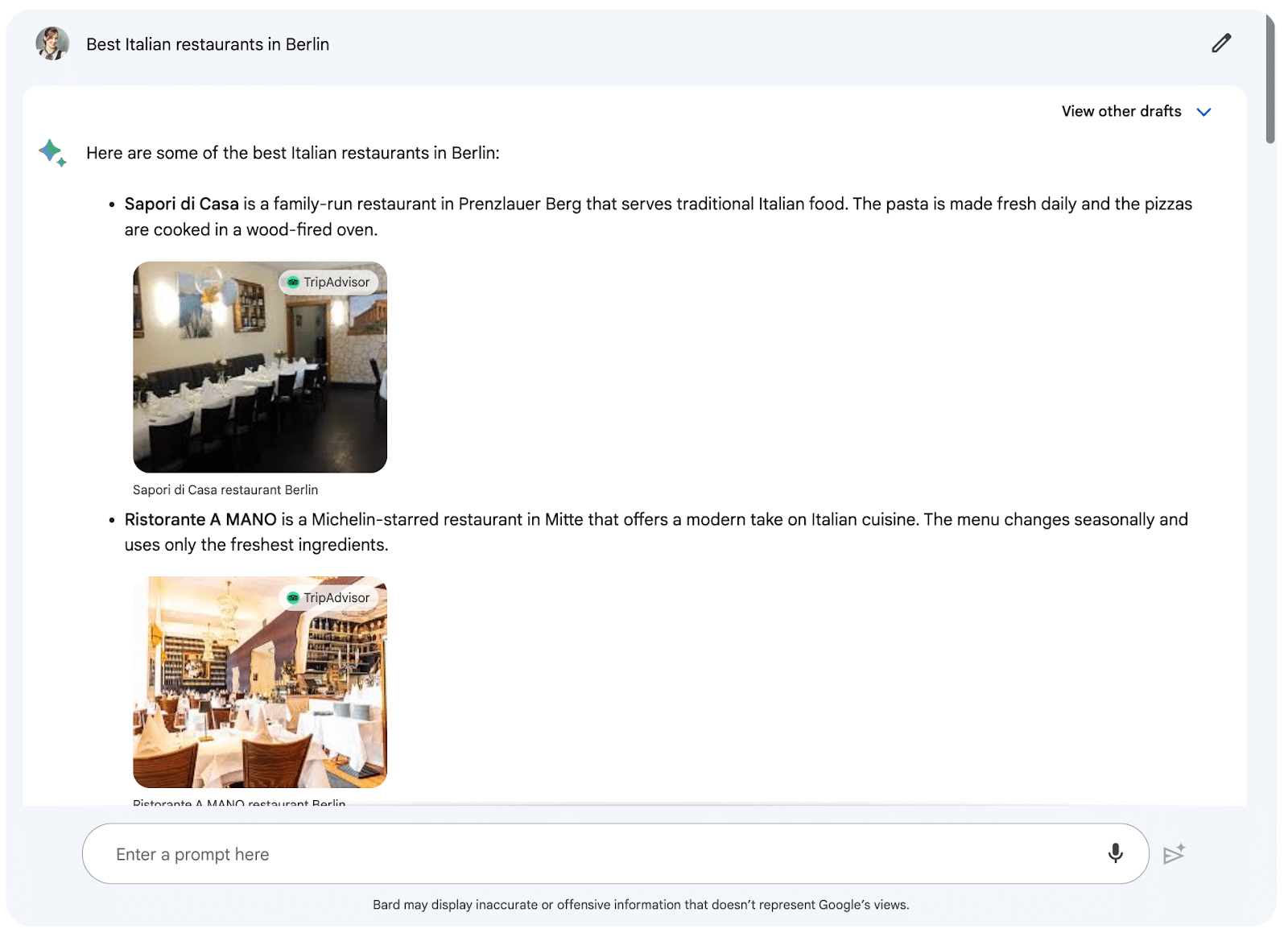
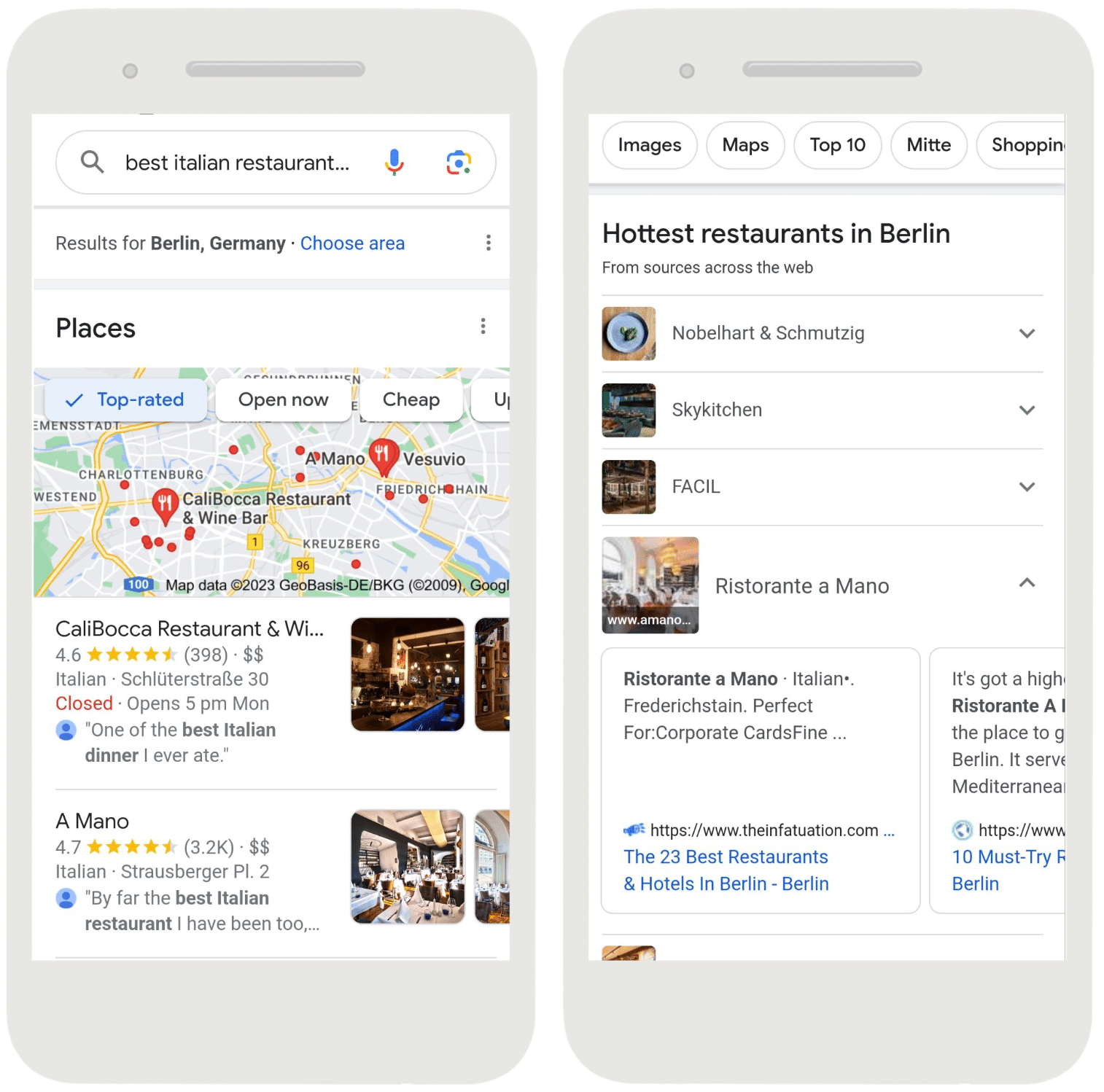
So when I type into Bard “Best Italian restaurant in Berlin,” it does not match based on keywords, but rather on entities.
It connects the:
- Location entities: Neighborhoods of the city of Berlin (Prenzlauer Berg, Mitte, etc.)
- Cuisine entity: Italian
- Dish entities: Pasta, pizza
- Restaurant brand entities: Sapori di CasaIl Punto, Ristorante A MANO
- Directory brand entities: TripAdvisor, Top10 Berlin
And the “facts” it knows about the restaurant entities in terms of reviews to present its opinionated recommendations.
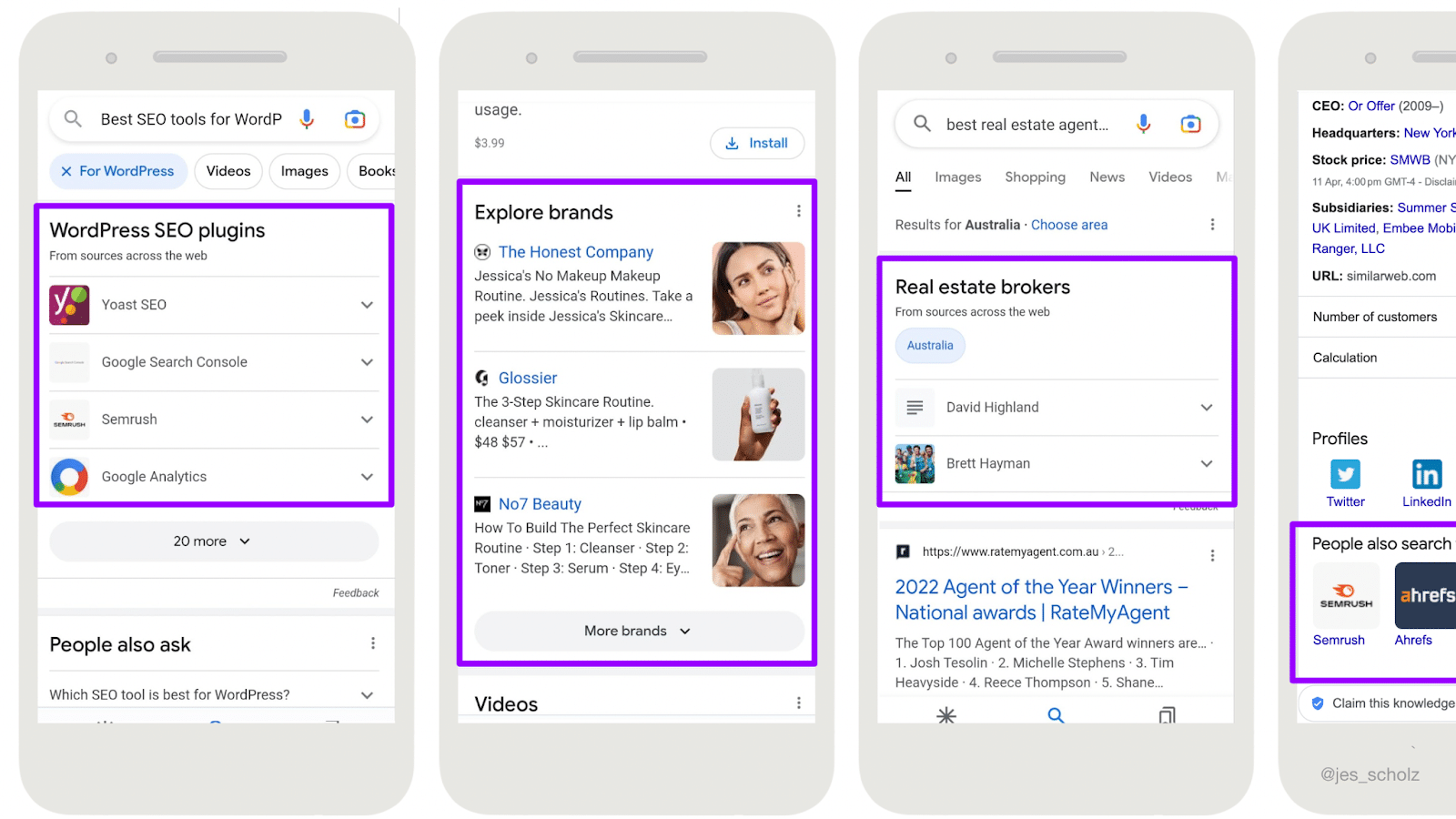
A similar process happens in the SERPs to create rich results such as local packs or related searches.
There are many Knowledge Graph entities you could optimize for, including:
- Location: City and neighborhood
- Cuisine: Italian
- Dishes: Pizza, pasta, etc
- Ambiance: Fine dining, family-friendly, etc
- Awards: Michelin stars, Gault et Millau, etc
- People: Owner, Chef, etc
But the most valuable is the brand entity. This must be at the center of all things.
Brand entity SEO already significantly impacts most industries where we see many entity-only rich results in the SERPs.
And it will impact every industry as Bard becomes more popular and SGE rolls out.
Why? Because Google is disinclined to give visibility to brands it doesn’t know explicitly.
If your brand is not an entity in the Knowledge Graph, Google has less confidence in the ‘facts’ about that brand, its relevance to the user query and its relationship to other entities.
In this case, Google will only partially apply entity-level visibility signals (formerly known as site-level ranking factors, but rank is somewhat antiquated and a brand entity is more than just a website).
This means your brand is significantly less likely to be included in the AI’s consideration set. And since Google’s AI acts as a gatekeeper, also the end user’s consideration set.
If, on the other hand, Google has a detailed dossier for your brand entity and its relationships to other entities in the Knowledge Graph, it can confidently make matches that matter. Granting you more visibility in the SERPs, Bard, Discover and other Google surfaces.
To build your brand into an entity, follow these five steps.
Step 1: Secure CMO sponsorship
Building a brand entity is not a solo mission.
It goes beyond the scope of what SEO has commonly been defined to encompass. This is branding, this is your CMO’s territory. You will struggle to make meaningful changes if you do not have them onboard.
Get in front of your CMO and convince them to be the executive sponsor of a ‘brand entity establishment’ project.
This not only secures their buy-in for the idea but also their guidance and ability to free up resources in other departments, such as development or content resources, that will be needed.
To get a CMO onboard, show the opportunity (or threat depending on their mentality) through presenting:
- Your branded SERP: Do you dominate it with a fully-fleshed out knowledge panel, social media profiles and digital PR articles or at there irrelevant or unwanted links.
- Industry-relevant entity-only SERP features: What rich results exist for key user intents and is your brand included (being on mobile and incognito is essential).
- Industry-relevant Bard results (and SGE if you have access): What results are returned for key user intents and is your brand included.
- Current brand entity presence: What does Google understand about your brand entity its associated assets and its connections to other entities.
- Competitor brand entity presence: What does Google understand about your competitors’ entities.
When assessing brand entity presence, don’t be fooled into thinking this has anything to do with the number of branded search queries or number of indexed pages of a website.
To understand if a brand is an entity, and if so, in what context, the ideal is to query the brand name in the Google Knowledge Graph Search API daily and keep a record of the returned result details.
But for a quick check, it’s easier to use the Kalicube Google Knowledge Graph API Explorer.
Step 2: Define and align your brand entity bio
To become an entity in the Google Knowledge Graph, you must be clear and consistent on who your brand entity is and your relationship to other entities.
Start by defining your official brand name.
I know this sounds ridiculously easy, but I have a challenge for you. When you are next in your office, ask someone from each department to write down the brand name on a piece of paper.
Some will write:
- The brand you expect: “Brand Name”
- The brand with different spacing: “BrandName”
- The brand with different capitalization: “Brandname” or “brandname”
- The partial URL: “brandname.com”
- The legal entity: “Brand Name Inc.”
As Google’s natural language processing is sensitive to spelling and casing, these can all be interpreted as different entities.
Once you settle on an official brand name, define a brand entity bio. The aim is to tell Google about your brand in a way its algorithms can confidently understand in order to extract “facts” and connections.
The entity bio should begin with a semantic triple to summarize the brand entity in a way Google can clearly understand.
For example:
- “Jes Scholz is a marketing consultant.”
Where “Jes Scholz” is the entity subject, “is” is the predicate, and “marketing consultant” is the object.
That said, a pure semantic triple can be a bit too bland for the humans that will read the bio. So feel free to spice it up with an adjective or a secondary object.
For example:
- “Jes Scholz is an organic marketing consultant and SEO futurist.”
Where “organic” is the adjective and “SEO futurist” is the secondary object.
Then address your core offering and target audience. For example:
- “She delivers award-winning audience development strategies focused on entity optimization, smart content distribution and data-driven marketing from Sydney to enterprise businesses worldwide.”
Then expand on this with concise paragraphs that address all key details about your brand entity in order of importance for your market. For example, the:
- Core value propositions
- Awards
- Key people or partners
- Relevant history
This should all be written with a view to building Google’s understanding of your brand entity and what other entities, especially topical entities, you are related to.
As Google’s confidence in these areas grows, so do your chances of appearing on Google surfaces.
Once you have drafted your brand entity bio, evaluate it with Google’s Natural Language API (you can use the free demo) to see how Google processes the text, identifies entities within it and categorizes it.
Once you have defined a clear, meaningful and topical brand entity bio and aligned it with all key stakeholders, it’s time to repeat it ad nauseam. Brandsplain it through corroboration.
Get the daily newsletter search marketers rely on.
<input type=”hidden” name=”utmMedium” value=”“>
<input type=”hidden” name=”utmCampaign” value=”“>
<input type=”hidden” name=”utmSource” value=”“>
<input type=”hidden” name=”utmContent” value=”“>
<input type=”hidden” name=”pageLink” value=”“>
<input type=”hidden” name=”ipAddress” value=”“>
Step 3: Corroborate topical relatedness
Google understands entities based on relatedness, which is determined based on the co-occurrence of entities.
If two entities, like a brand and a topic, are referenced together frequently by multiple authoritative sources, it strengthens Google’s connection of those two entities in the knowledge graph.
This has many benefits but is especially powerful when it comes to generative AI marketing.
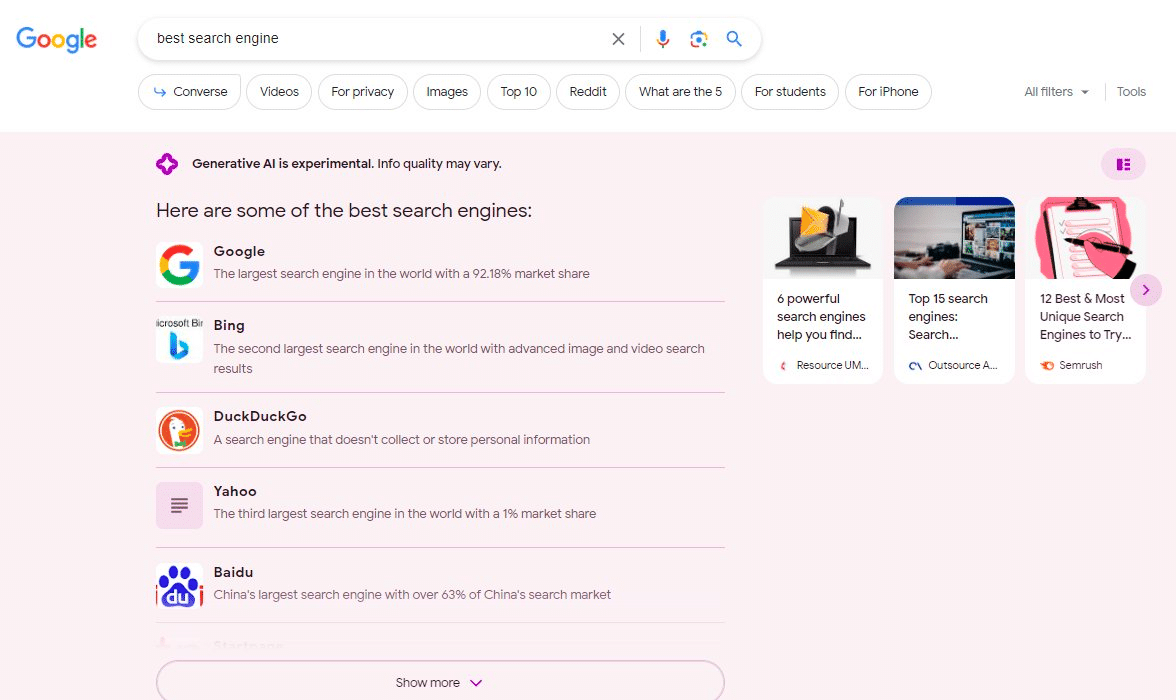
I was amused by a recent SGE example tweet from Lily Ray. But similar associations of a brand, in this case, “Google”, and a topic, in this case, “search engines”, can apply to any industry.
If your brand doesn’t have an industry association, you won’t show in the list when searchers ask for the thing your brand does. Establishing entity co-occurrence through authoritative repetition is key.
As your site should be the most authoritative source on your brand entity. Your About page is the first place to publish your brand entity bio.
The About page is better than the homepage as it can be dedicated primarily to the brand entity.
At the same time, the homepage must represent the entire website offering and potentially other entities as well, such as products, clients or key members of the team.
That said, aspects of the brand entity bio should be seen in the homepage copy. It is a point of corroboration.
This will be true of many of your brand assets that will duplicate appropriate aspects of the brand entity bio, especially the semantic triple about what the brand entity is. This should feature in:
- All social media profiles, such as LinkedIn, Twitter or TikTok.
- Relevant business directories, such as CrunchBase, Trustpilot or Yelp.
- Relevant industry sites, such as Entrepreneur.com, Forbes or Spotify.
- A Google Business Profile for any brand with a physical address.
- If possible, Wikipedia and Wikidata.
During this process, don’t neglect to revisit previously posted digital PR articles. Fact-correct them and request changes as needed to ensure the details align with your official brand name and bio.
This repetition on relevant platforms is vital. The more corroboration, the greater Google’s confidence their “knowledge” about your brand entity is credible and the more notable they believe your entity is. Both of these increase the likelihood that Google will show your brand entity for a topical query.
But don’t spam! If a site is authoritative but not appropriate to your industry, it won’t help. If a site is industry-appropriate but low quality, it won’t help. If the social profile is inactive, it won’t help.
Step 4: Markup all the things
Using Organization schema markup in JSON-LD format on the About page.
Think of it as communicating to the search engine’s in their mother tongue. Allowing you to confirm important attributes of the brand entity is a critical step to Google accepting those “facts.”
Google’s Logo (Organization) Structured Data only requires:
- URL: The homepage URL of the brand website
- Logo: The logo of the brand
Don’t implement this blindly.
When relevant, use a more descriptive “@Type”. Organization is the most general. There are potentially more relevant subtype values.
A newspaper can identify as a NewsMediaOrganization. A charity can identify itself as an NGO. Local businesses can choose from many descriptive categories such as Florist, Restaurant or RealEstateAgent.
Also, go beyond the required properties. Include as much relevant information as the structured data allows, to establish ‘facts’ about your entity in the Google Knowledge Graph.
Pay special attention to:
- Name: The official brand name you have aligned with stakeholders.
- AlternateName (if needed): An shorter variation of your official brand name that is commonly used on the wider web for your brand entity. For example, the Better Business Bureau being called the BBB.
- LegalName: Add the legal entity name to help disambiguate references on the wider web of your brand entity.
- Description: The semantic triple from your entity bio.
- Image: An array of ImageObjects which represent the brand.
- Address, telephone and email: Brands with readily available contact details are inherently more trustworthy.
- Awards: Being nominated for or winning awards boosts credibility.
- @id: An identifying URL intended as the explicit, unambiguous reference for your company. As such it should be unique and never change. Jono Alderson, Head of SEO at Yoast, recommends site’s home URL appended by #/schema/Organization/1.
- SameAs: To disambiguate your brand entity presence to aid corroborations, list all relevant brand profiles. Include active social media pages, directory listings, wikipedia and wikidata entries and Google Business Profile and Google knowledge panel URL (aka https://www.google.com/search?kgmid={id}) when available. If your brand has multiple knowledge panel URLs, add them all to help consolidate them into a single strong entity.
Once the about page contains a valid structure data markup brand bio, manually submit the URL in Google Search Console to encourage Googlebot to swiftly update the details in its index.
But don’t stop your entity optimization there.
Step 5: Establish related entities
Every relevant entity on your site should be marked up with structured data.
When these entities are explicitly understood by search engines, it strengthens the connection between those recognized entities and the brand entity.
This can work to strengthen the brand’s notability further. Relatedness increase the probability of your brand being found in the context of topical queries.
While this article focuses on brand entity optimization, you can adjust the process to establish other business assets.
Your key people, podcast, products or events can all become entities in the knowledge graph. Which is beneficial in its own right as those entities can earn visibility in the Google ecosystem.
But additionally, building Google’s confidence in its understanding of these other entities can further cement Google’s understanding of the brand entity due to the connection between the assets.
This entity relationship building can also work beyond the bounds of your owned assets.
Collaborating with established high-authority entities related to your industry or a targeted topic can solidify your own status within that area.
Building a strong brand entity
If you want to be visible in generative AI, build a strong brand entity in the knowledge graph.
This allows you to control the brand positioning Google presents to your audience while increasing the chance your brand will be shown on Google surfaces.
The importance of entities is only going to grow. Now is the time to invest.
The post How to establish your brand entity for SEO: A 5-step guide appeared first on Search Engine Land.
Courtesy of Search Engine Land: News & Info About SEO, PPC, SEM, Search Engines & Search Marketing
Thursday, June 1st, 2023
Ready to discover three incredibly simple (yet powerful) strategies that will help you optimize quicker and more effectively?
Here’s what you’ll learn in this article:
- How to use AI to provide a data source for on-page optimization.
- Using AI to quickly create multiple schema types for every blog article on your website.
- A free internal link solution that makes internal linking a breeze.
Key terminology
Before we begin, it’s important to connect these concepts to entities.
Entities
In machine learning, particularly in natural language processing, an entity is a significant thing or concept in a specific context.
For instance, “Apple” could be an entity that represents the technology company or an entity that represents a type of fruit, depending on the context.
Internal links
Internal links are hyperlinks that direct to another page on the same website. They help to establish an information hierarchy for the given website and guide visitors to high-priority sites.
From an SEO perspective, these links aid search engines in discovering, indexing, and understanding all the pages on your site.
Internal links can also help search engines understand the context and relationship between different pages and their content. This can assist the search engine in identifying relevant entities on your site.
Schema
Schema (or Schema.org) is a collaborative, community-driven project with a mission to create, maintain, and promote schemas for structured data on the Internet.
In other words, it’s a way to tag and categorize information on your webpage so that search engines can better understand what your page is about. This could be anything from a product review to an event announcement.
By using schema markup, you’re helping search engines identify and understand the entities present on your webpage.
EAV (Entity-Attribute-Value)
EAV is a data model used to describe entities where the number of attributes (properties, parameters) that can be used to describe them is potentially vast.
This is particularly useful in SEO because it helps represent information about entities flexibly, which can be beneficial in situations where the attributes used to describe an entity can vary widely.
Search engines seek to understand the searcher’s intent and the contextual meaning of terms as they appear in the searchable dataspace.
The concept of entities, backed by the use of schema, EAV, and internal links, enables the search engine to comprehend a website’s content more effectively and present the most relevant results to users.
Get the daily newsletter search marketers rely on.
<input type=”hidden” name=”utmMedium” value=”“>
<input type=”hidden” name=”utmCampaign” value=”“>
<input type=”hidden” name=”utmSource” value=”“>
<input type=”hidden” name=”utmContent” value=”“>
<input type=”hidden” name=”pageLink” value=”“>
<input type=”hidden” name=”ipAddress” value=”“>
Overall, the following three tactics enhance the “semantic understanding” of your website. Along with other SEO practices, they can help improve your site’s visibility in the SERPs.
1. The hexa grammarian prompt sequence
This prompt is specifically designed around entities. As we’ve covered in the definitive guide to entities, entity understanding is largely tied to grammar.
The nouns, adjectives, verbs, adverbs, prepositions, and EAV are all integrally tied to entities.
While it sounds confusing, it’s simpler than you might think. Here’s what ChatGPT says about its importance.
Here are the six prompts:
- “Provide a comprehensive list of the most common verbs associated with the topic. Cluster the list and nest associated verbs.”
- “Provide a comprehensive list of the most common nouns associated with the topic. Cluster the list and nest associated nouns.”
- “Provide a comprehensive list of the most common adjectives associated with the topic. Cluster the list and nest associated adjectives.”
- “Provide a comprehensive list of the most common adverbs associated with the topic. Cluster the list and nest associated verbs.”
- “Provide a comprehensive list of the most common predicates associated with the topic.”
- “Provide a comprehensive list of attributes associated with the topic.”
When you get your answers, you can save them however you like. I prefer a Google sheet.

I suggest using this list in a couple of different ways.
You can use the hexa-list to inform your content briefs. You could use the hexa-list to optimize existing content. You could even use this list to help you craft clever prompts for OpenAI.
I can’t give away all of the in-house secrets, but suffice it to say that this list can be used to help you with programmatic AI content deployment.
2. Schema and AI
Creating schema for hundreds of web pages is an absolute slog. Over the past few years, agencies have productized schema because it’s one of those tasks that no one wants to do.
Since schema is hard to understand and the benefits aren’t always understood, many people use an out-of-the-box solution (e.g., SEOpress, RankMath, Yoast).
This article’s co-author, Andrew Ansley, developed a straightforward system for schema generation. You don’t need to understand anything about schema to make this work.
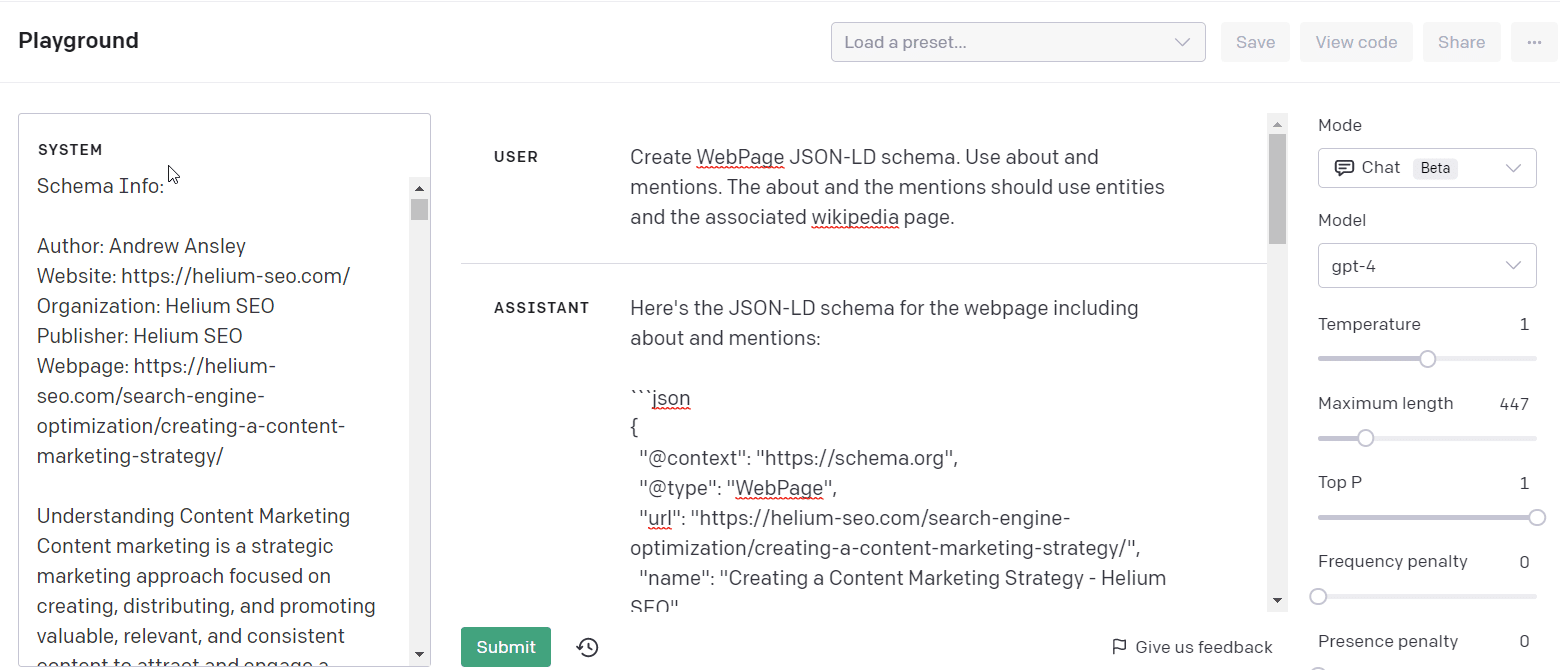
All you need is an OpenAI playground and access to GPT-4.
For this example, we are going to use webpage schema so we can create a clear and structured declaration of the entities that are found in the blog article.
Setting up
Step 1: Grab the URL for your blog article.
Step 2: Provide the author, website URL, organization name, publisher name, and web page URL in the system text.
Step 3: Copy and paste your blog article text into the system text.
As you can see from the image, the system text is on the left. The actual prompting is in the middle of the page, functioning exactly like ChatGPT – with a major upgrade.
In playground, you can adjust settings and the system text functions as memory/context.
Inside the playground, you can use around 8,000 tokens (.75 words per token = 6,000 words).
The schema prompt
The prompt is straightforward. All you need to enter into the user box is:
- “Create WebPage JSON-LD schema. Use about and mentions. The about and the mentions should use entities and the associated Wikipedia page.”
After you’re done, you’ll get some pro schema to add to your article. We typically use a plugin to inject header code into a blog article, but that is just one of many options.
If you don’t trust the AI, you can go to https://validator.schema.org/ and provide the code to see if it has any errors.
As you can see from the image, my pro schema code designed for entity optimization is free from flaws. Huzzah!
Another schema type that you can easily add to a blog is FAQPage schema.
FAQPage Schema
This schema type is simpler than the previous example. For this schema, you can delete your article text from the system and you can replace it with whatever you like.
The prompt is:
If you have the text inside of the system, it will generate something like the following example.
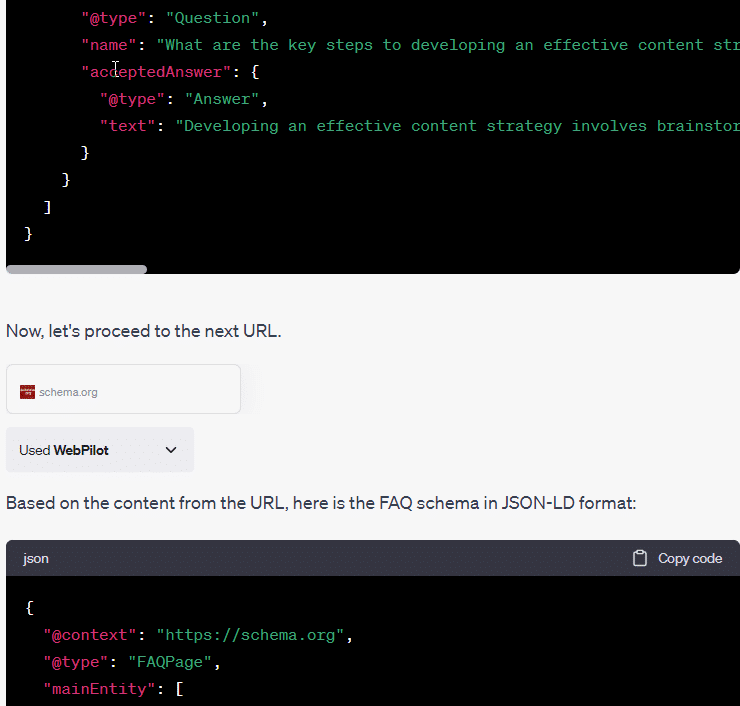
For those who prefer ChatGPT, you can just use the web browsing plugin (which is even simpler to use).
The only prompt you need is:
- “Create FAQ schema for the URL [insert link here].”
If you want to do multiple URLs, you can add additional URLs and ask ChatGPT to create FAQ Schema for each URL.
I can’t help but nerd out over how easy it is to accomplish SEO tasks with AI. While I am showing a non-programmatic example here, you can literally explain what you want to build, and the AI will provide the code.
You don’t even need to ask the AI for code to accomplish a more programmatic approach to schema. You can use this simple prompt sequence:
- “Create FAQ schema in JSON-LD format. Process one URL and when you are done with that task, initiate another prompt that continues the task until you process the final URL in the list.”
The answer looks like this:
When you use this method, the generation of results will end around the 6th URL.
If you give a list of URLs that exceed the output length, you can type the word “continue,” and then the AI will continue down the list of URLs.
3. The internal link script
Internal links are incredibly important for passing authority between pages, improving crawlability for Google Bot, and communicating topic relationships for entity optimization.
Here’s a script that Ansley created that only needs three things.
- A Google Doc.
- A Google Sheet.
- App Scripts.
The doc is the article you’re writing that will link out to your other articles.
The Google Sheet contains all of your keywords and URLs. I use a sitemap.
The next step is to ask ChatGPT to identify the keyword from the URL slug.
Here is the script.
function addLinksFromSheet() {
// Your Google Sheets ID
var sheet = SpreadsheetApp.openById('1AOvyOL0PCVVjY86aEEx77RqUWthV1m5Vzs2SyXE2f7g').getActiveSheet();
// Get all the rows of data in the Sheet, excluding the headers
var data = sheet.getRange("A2:B" + sheet.getLastRow()).getValues();
// Iterate over all the rows
for (var i = 0; i < data.length; i++) {
// The first column in the row contains the text to be hyperlinked
var searchPhrase = data[i][0];
// The second column contains the URL
var hyperlink = data[i][1];
// Use your addLinks function to add the hyperlink to the doc
addLinks(searchPhrase, hyperlink);
}
}
function addLinks(searchPhrase, hyperlink) {
if (!searchPhrase) {
return;
}
// Your Google Doc ID
const document = DocumentApp.openById('1_T5BRHiNi3iPnEL6xtys2qEV9WNzPZAwsQdIqtgiFtI');
const body = document.getBody();
let search = null;
let count = 0;
while (count < 1) {
search = body.findText(searchPhrase, search ? search : null);
if (!search) {
break;
}
const searchElement = search.getElement();
const startIndex = search.getStartOffset();
const endIndex = search.getEndOffsetInclusive();
searchElement.asText().setLinkUrl(startIndex, endIndex, hyperlink);
count++;
}
document.saveAndClose();
}
I emphasized the part of the script that requires your own unique document slug.
The inspiration for this script came from Hamish’s YoTtube channel, Income Surfers. Hamish is a new YouTuber, but his content is solid if you’re wanting AI + SEO.
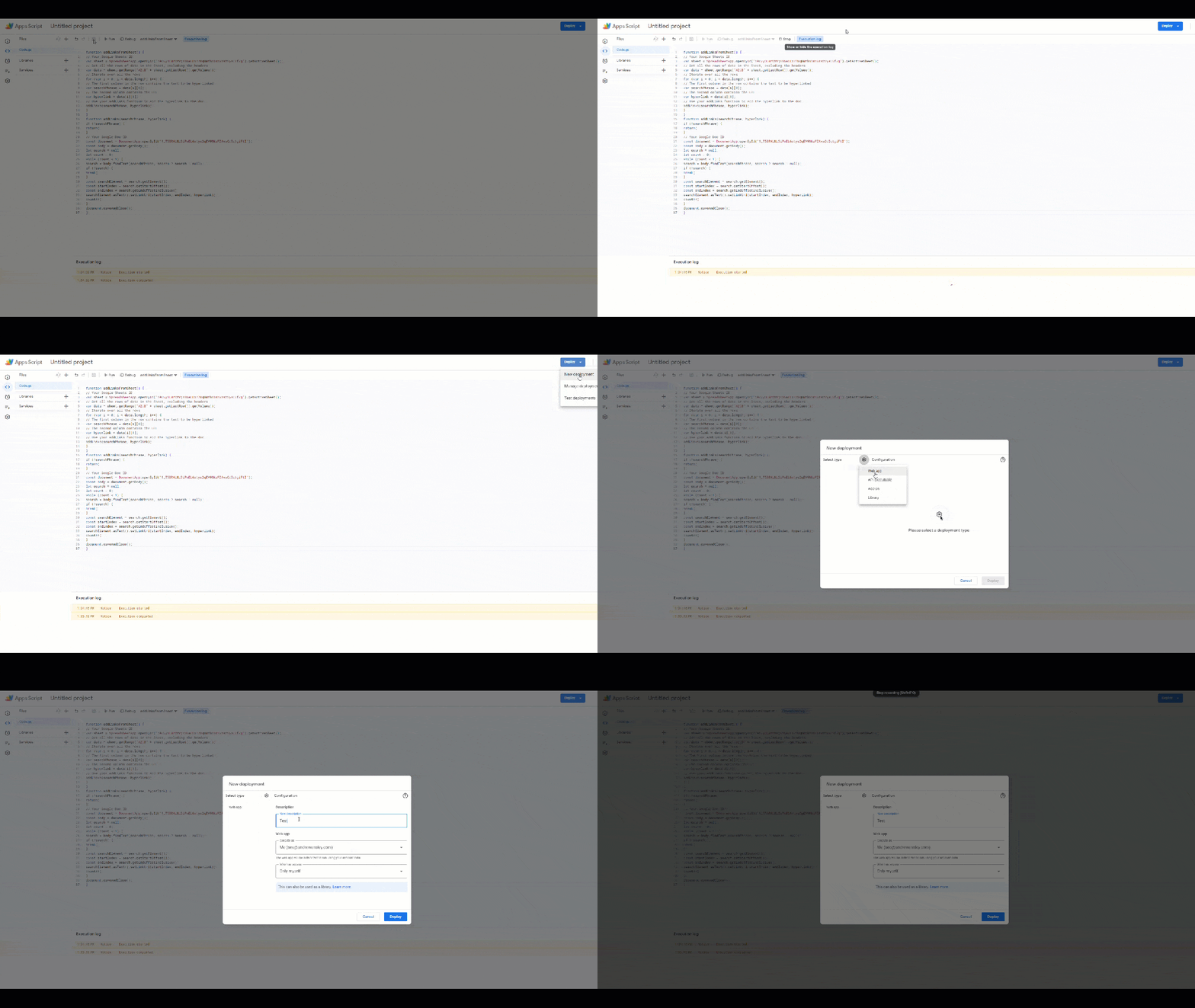
The GIF below demonstrates what to do with Google App Scripts.
- Save project.
- Click Run and accept permissions.
The results look like the screenshot below.
The perk of this setup is you can essentially equip any of your writers with an easy way to internally link.
One of the most difficult aspects of internal linking is the fact that most outsourced writers don’t know what to link to.
Set up a database and maintain that list so your writers can apply all the internal links you want them to use.
If you’d like to include additional keywords, you can go to ChatGPT and paste your data. I used five keywords and five URLs for illustration purposes.
Prompt:
- “I want to expand this table further. Repeat each URL 5 times and provide 4 additional keywords associated to each URL. The new keywords should have high semantic relevance to the original keyword in the list.”
Output:
As you can see, I now have five keywords to choose from. To avoid linking to the same URL, you’ll need to modify the script. Here is the new version:
function addLinksFromSheet() {
  // Your Google Sheets ID
  var sheet = SpreadsheetApp.openById('1jTwgsEgz5X4BbiNDjQeHJrRVtYdGi3LEKEBvPgIYtg8').getActiveSheet();
  // Get all the rows of data in the Sheet, excluding the headers
  var data = sheet.getRange("A2:B" + sheet.getLastRow()).getValues();
  // Keep track of the used URLs
  var usedUrls = [];
  // Iterate over all the rows
  for (var i = 0; i < data.length; i++) {
    // The first column in the row contains the text to be hyperlinked
    var searchPhrase = data[i][0];
    // The second column contains the URL
    var hyperlink = data[i][1];
    // Check if this URL has been used already
    if (usedUrls.indexOf(hyperlink) === -1) {
      // It hasn't, so add the hyperlink to the doc
      addLinks(searchPhrase, hyperlink);
      // And mark this URL as used
      usedUrls.push(hyperlink);
    }
  }
}

function addLinks(searchPhrase, hyperlink) {
  if (!searchPhrase) {
    return;
  }
  // Your Google Doc ID
  const document = DocumentApp.openById('1rLL9J6Lag6McZ6F22R3ptyb7XFqg9Bc1qmEgobrTa3w');
  const body = document.getBody();
  let search = null;
  let count = 0;
  while (count < 1) {
    search = body.findText(searchPhrase, search ? search : null);
    if (!search) {
      break;
    }
    const searchElement = search.getElement();
    const startIndex = search.getStartOffset();
    const endIndex = search.getEndOffsetInclusive();
    searchElement.asText().setLinkUrl(startIndex, endIndex, hyperlink);
    count++;
  }
  document.saveAndClose();
}
Using AI for entity SEO
The three specific examples above show how AI can be used to dramatically reduce the time involved in optimizing for entities.
We always recommend utilizing AI for any repetitive or highly technical task and spending more of your time on the strategy or creative functions of SEO. Entity SEO is no different.
However, it is important to know that there are many other uses for AI when optimizing for entities, and this is by no means an exhaustive list.
Make sure to attend my session at SMX Advanced, taking place June 13-14, to learn more about Entity SEO and AI and why we believe Entity SEO will be crucial to top SERP positions in the future.
This article was co-authored by Andrew Ansley.
This is the third article in the entity SEO series. If you would like to start by reading the first two articles, they are linked here:
The post 3 ways to use AI for sitewide entity optimization appeared first on Search Engine Land.
Courtesy of Search Engine Land: News & Info About SEO, PPC, SEM, Search Engines & Search Marketing
Thursday, June 1st, 2023
Google has been sending policy violation notices to Local Service Ads advertisers, but it is currently unclear if these are being sent out due to new enhanced enforcement or if there was a bug that triggered these from going out.
The policy notice. The email notification reads, “Your account has policy violations that need to be resolved.” It goes on to say that “if you do not take action by 12 of June, your ads could stop running.” Here is a screenshot of the email notification sent to me by Jason Brown:

When you click through t to “view policy issues” you are taken to a screen that shows you your policy violations, but when you dig deeper, you likely won’t have an issue listed. This screenshot is from Crystal Horton, who posted it on Twitter.

Some say this notice was sent to mostly garage door repair listings, but I am not sure if that is 100% validated or not.
Bug or not. Ginny Marvin, Google’s Ads Liaison, is currently looking into if this is a bug or not. Last night at around 5:50 pm ET, Ginny posted on Twitter, “I don’t have an update, but the team is looking into it.”
Why we care. If you received this notice, for now, wait, check back here to see when Google gives us more clarity on the issue. At least according to the email, you have 12 days to act on this before it becomes a potential issue for your ads.
The post Google Local Service Ads mass policy violations appeared first on Search Engine Land.
Courtesy of Search Engine Land: News & Info About SEO, PPC, SEM, Search Engines & Search Marketing