Archive for the ‘seo news’ Category
Monday, July 10th, 2023

Universal Analytics has gone the way of the dodo. Generative AI is taking the industry by storm. The anatomy of SERPs is undergoing a radical makeover. Paid search is becoming more competitive than ever.
Capitalize on the endless changes, challenges, and chaos and become a master of search marketing while you’re at it: Attend your choice of SMX Master Class online, August 16-17, to learn actionable tactics that will help you drive more awareness, conversions, and sales.
Early Bird rates expire this Saturday, July 15… book NOW to save 20% off your Master Class!
Choose from seven essential search marketing topics:
Each Master Class packs a ton of value:
- Six focused hours of training split across two days ensures you get maximum value with a minimal time commitment.
- 100% live means plenty of opportunities to get your specific questions answered by your expert instructor.
- No plane ticket, hotel reservation, or travel risks required with this exclusively digital experience.
- Scheduling conflict? Your Master Class will be available on-demand until October 16 so you can train at your convenience.
- Showcase your commitment to continued learning and justify registration expenses with a personalized certificate of completion.
There’s only one catch: This $249 Early Bird rate expires this Saturday, July 15 and once it’s gone, it’s gone. Why pay more next week? Select your Master Class and secure your spot today!
Psst… Think you have what it takes to be an “award-winning” search marketer? Enter the 2023 Search Engine Land Awards for your chance to boost team morale, attract new business, and stand apart from the competition!
The post Become a search marketing expert: Attend an SMX Master Class! appeared first on Search Engine Land.
Courtesy of Search Engine Land: News & Info About SEO, PPC, SEM, Search Engines & Search Marketing
Monday, July 10th, 2023
The forced migration to Google Analytics 4 hasn’t been an easy ride for marketers.
Some advertisers are finding it so difficult to navigate that they have abandoned the tool and jumped ships to a rival platform – a move that would have seemed unthinkable not too long ago.
But what GA4 alternatives are marketers genuinely switching over to?
Below, we take a look at the up-and-coming analytics platforms that are proving increasingly popular among former Google Analytics devotees.
1. Plausible
Tech engineer Mark Phillips explained why he is now using Plausible instead of GA4:
- “I had ended my subscription to Plausible a couple of months ago for no reason other than I didn’t need stats any more.
- “Then I started doing some work for a client this week, and was so pained by how awful GA4 is, I resubscribed.
- “The UX of Plausible is such a delight!”
Cost: Plans start at $9
Plausible is a popular GA4 alternative because it is easy to use, complies with he EU’s General Data Protection Regulation (GDPR) and is relatively low cost. It also tracks valued basic data such as pageviews, session duration and referrer information. The disadvantage is that its functionality is quite basic.
2. Semrush
One marketer, who wished to remain anonymous, told Search Engine Land:
- “GA4 is an unfinished product that was rushed to market.”
- “We will likely pivot to Semrush, and use first-party data collected from customers instead of bothering with GA4.”
Cost: Prices start from $195.95 a month.
Semrush has always been a popular tool amongst marketers, but now, some are making it their go-to data analytics tool instead of Google Analytics. In addition to monitoring the performance of keyword rankings, content gaps and backlink profiles, this platform can be used to analyze your competitor’s traffic trends, keywords and more.
3. Matomo
Lee Foot, eCommerce SEO, explained why he is now using Matomo instead of GA4:
- “We’ve subscribed to Matomo for day to day quick checks.
- “We’re keeping GA4 for Google Ads and API stuff but that’s about it.
- “Seems really good so far, familiar interface and have just imported all our legacy data in.”
Cost: Free if hosted on your servers.
Matomo provides real-time data, a customizable dashboard and detailed reports, making it a very good option for marketers who were fans of Universal Analytics. On this platform, users are given complete control over their data. It also has an array of privacy features for extra security.
4. Fathom
Ross Stevens, independent SEO consultant, explained why he thinks Fathom is an excellent alternative to GA4:
- “I get the feeling that SEOs are migrating to GA4 just because it’s convenient and has Google’s name behind it. Not because it’s actually good!
- “They’re not making the effort to spend the time to consider the alternatives and convince clients there are better options out there.
- “Personally, I’m setting up GA4 as a backup, and using Fathom as the main analytics/reporting tool.
- “If you’re going to use GA4 as your main tool, you’re going to need to setup a few screens in Looker Studio, but even then, there’s certain metrics still missing at the moment.”
Cost: Plans start at $14.
Fathom is proving to be a popular analytics tool because it’s easy-to-use and is privacy-focused. Unfortunately, this program doesn’t offer the more complex data that GA4 does, but the platform is a good option for marketers wanting a lightweight website analytics tool.
5. Clicky
Web developer Ian Nuttall explained why he prefers Clicky to GA4:
- “I’ve switched to Clicky and it works just fine for me. GA4 is a joke.
- “The way Google closes sh*t down on a whim, I’d rather move away from relying on them. Clicky is great and I can see all of my sites at a glance.
- “I have two GSC accounts and I switched to Clicky now because GA4 sucks.
- “But I don’t worry about Google ‘finding all my sites’ – they probably know.”
Cost: Clicky has a free option and four paid options.
We’ve seen many marketers showering Clicky with praise as a fantastic alternative to GA4. People that have switched over so far seem to huge fans of how easy the real-time platform is to use, as well as features such as heat mapping, backlink analysis and mobile compatibility.
6. Simple Analytics
Alex Bass, data scientist at Dynata, explained why he switched from GA4 to Simple Analytics:
- “Google Analytics has changed and become more complicated to the dismay of many people (now called Google Analytics 4).
- “Recently, there have been government bans over privacy concerns from Google Analytics. I am not extremely knowledgeable about all things data privacy, but really just wanted another analytics platform that was simple and delivered what I needed to track traffic ethically on this website you are on now.
- “Simple Analytics was easy to set up and delivers exactly what I wanted to see in a clean dashboard that worked out of the box.
- There are options to customize specific goals or events of special interest. Also, they have the option of sending a weekly email summary of visiting stats.”
Cost: Prices start from $11 a month.
Simple Analytics describes itself as a “privacy first Google Analytics alternative,” making it a popular choice for marketers within the EU. More than 600 businesses and organizations, including Michelin, Hyundai and the British government, are all customers. It’s a popular choice for marketers who want access to audience data but also want to protect the privacy of their website users.
Why we care. If you’re struggling to get to grips with GA4, then you may be thinking of alternative platforms to use instead. There are many options available – but how do you know which one to pick? By reading the opinions of your peers who have already tried and tested GA4 alternatives of course.
The post 6 Google Analytics 4 alternatives that marketers are switching to appeared first on Search Engine Land.
Courtesy of Search Engine Land: News & Info About SEO, PPC, SEM, Search Engines & Search Marketing
Saturday, July 8th, 2023
YouTube is testing a new feature that could help brands and creators engage with viewers while causing minimal disruption.
YouTube will enable hyperlinking over single words or phrases in the comments section for the first time.
Links will direct viewers to a YouTube search results page while still playing the video they were originally watching.
Why we care. Viewers are more likely to follow a link if their streaming experience isn’t interrupted. This means that marketers may have an increased chance of reaching more people and engaging more effectively with potential customers.
But. While this could be good, some marketers are concerned that leading people away from videos could do more harm than good. Search from Comments could lead viewers to a YouTube search results page that then takes them directly to rival brands and competitor videos.
How it works. The pilot, which is being rolled out over the next few weeks, will work as follows:
- Phrases or single words in the comments section that encourage exploration will be hyperlinked.
- Clicking on a link will initiate a new YouTube search with that term, navigating users to the search results page.
- To avoid interruption, the video will stay playing in the Miniplayer.
- Linked words are determined by YouTube based on what users are likely to want to explore further.
- The links cannot be added or modified by the commenter, though creators can remove links on their video comments if they’d like.
- Viewers will be able to opt out of the experiment if they prefer their comments not to be hyperlinked.
What has YouTube said? YouTube released a video via its Creator Insider channel to announce the pilot:
- “We’re experimenting with a new way to explore topics and recommendations in comments.
- “Currently, if a viewers wants to learn more about a topic or a product they find in a comment, they have to navigate away from the video they’re watching to learn more.
- “We’re experimenting with new hyperlinked keywords in comments to reduce friction for viewers looking to discover new and relevant content on the platform.
- “We’ll be experimenting with this in the coming weeks but would love your feedback in the comments whether you’re in the experiment or not.”
Other news. Hyperlinking in the the comments section isn’t the only news YouTube confirmed this week. The social media platform also made three other announcements:
- Visibility on tablets: Although creators could create posts on tablets previously, those posts were not visible on tablets to creators and their viewers. YouTube acknowledged that this has been a top feature request for many creators and viewers, so it is now giving visibility to all Android tablets and iPads users. This means posts can now reach viewers who mainly use YouTube on tablets.
- Reminders for live streams and premieres: Currently, viewers on YouTube are able to set reminders for upcoming live streams or premieres by clicking the ‘notify me’ button to get email and push notifications for when that live stream or premiere starts. Now, a new metric is being added in YouTube analytics that will show creators how many reminders were set for an upcoming live stream or premiere. You can find the Reminders Set metric in YouTube Analytics Deep Dive.
- Channel membership management: Eligible creators can now set up and manage channel memberships and other fan funding offerings via Studio Mobile. Previously, this was only available on desktop. Additionally, members-only videos were not served in members’ home feeds, subscription feeds or channel page content tabs. Now members-only videos will surface on members home and subscription feeds, and on your channel page.
Get the daily newsletter search marketers rely on.
<input type=”hidden” name=”utmMedium” value=”“>
<input type=”hidden” name=”utmCampaign” value=”“>
<input type=”hidden” name=”utmSource” value=”“>
<input type=”hidden” name=”utmContent” value=”“>
<input type=”hidden” name=”pageLink” value=”“>
<input type=”hidden” name=”ipAddress” value=”“>
Important reminder. YouTube advises accepting the new YPP program terms in Studio if you’re currently in YPP and haven’t done so already.
If the terms are not accepted by July 10, marketers will be removed from the YouTube partner program and their content will no longer be eligible to monetize on the platform. Any previously monetized content will stop accruing revenue effective July 11 and all monetization features including and not limited to channel memberships, SuperChat and similar features, will be turned off.
To see if you’ve already accepted the terms or still need to take action, please take the following steps:
- Go to Studio > Settings > Agreements.
- Here, if you see View Agreement for the base terms you’ve previously accepted, then you’re all set.
- If you see Review and Agree, this means that you still need to accept.
Deep dive: For more information on changes to the YouTube Partner Program terms, you can read YouTube’s full announcement on the YouTube Help Center.
The post YouTube Search from Comments: New test adds links to keywords appeared first on Search Engine Land.
Courtesy of Search Engine Land: News & Info About SEO, PPC, SEM, Search Engines & Search Marketing
Friday, July 7th, 2023
Unless you’ve been away on a desert island for the last 18 months, you’re well aware that Google Analytics 4 (GA4) took center stage on July 1 as the source for our web metrics. We’ve had to say goodbye to Universal Analytics (UA), an old friend to many marketers.
One of the biggest challenges marketing teams may face will be comparing a current period of data to year-over-year (YOY) historicals to measure growth success.
There are fundamental changes in how GA4 measures data vs. how UA does, so comparing data between the two won’t be an apples-to-apples scenario.
The apples-to-apples YOY comparison scenario is why there was a big push by many to get GA4 set up, running and collecting data by July 1, 2022. That would allow for a true comparison.
So what happens if you’re one of the procrastinators (don’t feel bad – there are plenty!) who won’t be able to make a true apples-to-apples comparison? Well, here’s what you need to know.
Fundamentally different data models
UA was based on sessions and pageviews. GA4 is based on events and parameters. Both methods can collect and tally data, but the output in a report will look different.
So what does this mean in plain English?
Different numbers in metrics you report
You’ll encounter cases where the metric is called the same thing so you’re tempted to believe the number should completely match up (or at least come close). However, you may find some variances.
For example:
User counts
Here is a small website’s UA user/new user count for one month:

UA count of users and new users
Now here is that same small website’s GA4 user/new user count for the same exact time period:
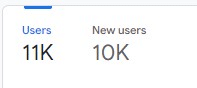
GA4 count of users and new users
In the reports snapshot, GA4 rounds the numbers, but you can see the users reported in GA4 is about 8% lower than what’s seen in UA.
The new users metric is even more pronounced (a difference of almost 14%) if you look at the rounded number. (Actual number reported in GA4 when you drill down is 10,443 – a difference of just under 10%.)
Sessions
GA4 has a couple of key differences when it comes to counting sessions, which actually make the count more accurate.
While both platforms have a default session timeout setting of 30 minutes, UA restarts the session at midnight and generates a new one when a UTM promo code is clicked on.
If you could follow that, basically, the “session count” numbers you’ve been reporting on forever aren’t exactly an exact tally.
GA4 does not restart at midnight and does not generate a new session if a UTM promo code is clicked.
For example, I have seen some websites put a promo UTM code on a link to an internal page (bad idea and unnecessary, by the way).
In UA, that causes a new session to be started and it overwrites any other UTM promo code that may have actually driven the traffic.
Conversions
The way conversions are calculated between the two platforms differ.
UA will only count one conversion per session for each goal. So for example, a user clicks on the “click to call ” multiple times.
However, the user doesn’t follow through and cancels before the call goes through the first time. Only one conversion will be counted for that goal.
Here’s an example of the “Clicks to Call” goal setup in UA:

Clicks to Call goal completions in UA
In contrast, GA4 will count a conversion every time even if that same conversion event is recorded multiple times during a session (Same user, same site, same visit):

Click to Call goal completions in GA4
Understanding the proper context matters here.
On the one hand, you could argue GA4 inflates the actual number of conversions since you basically have the same individual clicking on the “call” link multiple times (presumably for a single purpose).
On the other hand, you could argue that all you really cared about was whether the user converted on the call to action – not how many attempts it took on a particular session. Regardless of which method you feel is better, the GA4 method is now the way forward.
If we’re talking about an “Add to cart” conversion where the user put one pair of shoes in a cart, then continued to shop and added socks, GA4 would count this as two conversion events.
You could argue that GA4 counting two conversion events is appropriate (depending on how you choose to look at it).
Get the daily newsletter search marketers rely on.
<input type=”hidden” name=”utmMedium” value=”“>
<input type=”hidden” name=”utmCampaign” value=”“>
<input type=”hidden” name=”utmSource” value=”“>
<input type=”hidden” name=”utmContent” value=”“>
<input type=”hidden” name=”pageLink” value=”“>
<input type=”hidden” name=”ipAddress” value=”“>
Rethinking our web performance metrics
GA4 is giving us a new way to think about success metrics for the business and what really matters. Here are a couple of examples:
Sessions
We already covered the differences in how the two platforms calculate sessions, but GA4 steers us to thinking about sessions that actually result in meaningful engagement on the site.
One of the first callouts you’ll notice is “Engaged sessions,” which is simply a count of sessions where the user actually did something.

Engagement metrics
An “engaged session” can only be considered if it lasts longer than 10 seconds, has one or more conversion events, or has two or more page/screen views.
You may or may not agree, but that’s what GA4 uses for its standard. “Engaged session” is not a canned metric in UA.
Bounce rate
For a generation, marketers loved to report a low bounce rate as a measure of success. However, it’s not always a great metric. As with any success metric, context is king.
For example, a simple recipe page could do its job perfectly but show a high bounce rate.
The user got what they came for (the recipe) and then made a happy exit. Is that bad?
No, actually. It’s a good thing for the user.
Bounce rate is now gone as a stand-alone metric in GA4. Now you can refer to the engagement rate intended to show you the percentage of quality site visits. (Again, according to the definition of quality.)
If you start with 100 and subtract the engagement rate from it, in theory, you get something similar to a bounce rate.
Events
How GA4 handles events could easily be the subject of a separate article. (See Event tracking in Google Analytics 4: What marketers need to know for more details.)
For this article, just a quick high-level reminder of the differences:
In UA, events are used to track site actions that don’t necessarily generate a success page.
For example, you have a video on your home page. That video is played all the way through.
Upon completion of that video, there is no “Thank You” page you can easily set up as a standard conversion goal. This is where events come in.
UA lets you give “events” a category, action, and label to provide more description and context. An event is counted when an action is triggered. For example, if you have a video on the home page and track completions.

A wireframe example of a video on the front page of a site
GA4 has no category, action, or label, so there’s no point in learning it now. And with GA4, everything is an event. For example:
- Pageview = Event
- Session Start = Event
- First Visit = Event
- Scroll = Event
- Click = Event
- Video Start = Event
- File Download = Event
- Video progression = Event
- Video complete = Event
- Newsletter Signup = Event
- Contact Submission = Event
- View Search Results = Event
You get the idea.
Everything remotely worth measuring is an event.
Views vs. data streams
In UA, you can have one simple website and a mind-boggling number of views set up. You can see different numbers depending on which view you’re looking at, so it was worth understanding.
There are no more views in GA4. Instead, there are data streams. Those can be seen in Admin > Data Streams:
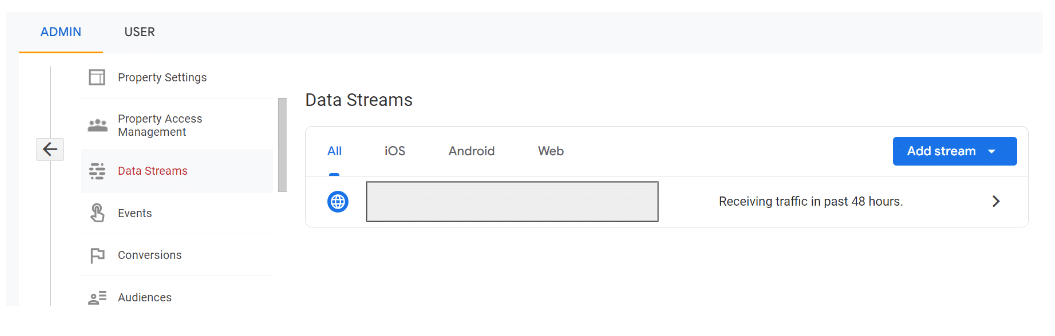
If you had previously set up multiple views in UA, you’ll want to look at the data stream settings in GA4 to make sure you’re measuring what matters to your business.
One of the benefits of GA4 is you can better see a more accurate reflection of the number of users.
For example, a data stream can be a website or an app. If your business also has a native mobile app, that can be a plus.
Moving on from UA to GA4
If you didn’t have GA4 set up and running by July 1, 2022, you will not have a true apples-to-apples YOY comparison for July 2023 data. So be careful how you report the numbers.
If you have no choice but to show UA data for the previous year, include a big asterisk along with an explanation. Hopefully, this article provides a little context and backup info when you’re asked why.
The post Comparing UA vs. GA4 metrics: Key differences you need to know appeared first on Search Engine Land.
Courtesy of Search Engine Land: News & Info About SEO, PPC, SEM, Search Engines & Search Marketing
Friday, July 7th, 2023
With more startups than ever entering the market, it is becoming more difficult for SaaS brands to cut through the noise.
That’s why many have realized that PPC can be a fantastic way to build brand awareness and draw in new customers.
However, a more strategic approach is required to run campaigns effectively and gain a competitive edge.
It is not enough to set and forget campaigns. There is a lot more that SaaS brands can do to elevate their performance.
Here are five ways SaaS brands can get the most out of PPC campaigns.
1. Build a cold audience display campaign
Dear SaaS businesses: not everyone knows about your brand.
Most people are aware that there are solutions available to solve their problems. But they are less likely to know specific brands which provide a suitable product.
To build brand awareness and influence consideration with these types of individuals, you must reach out to them through your marketing efforts.
One way to do this is to run a cold audience display campaign in Google Ads.
The term “cold audience” refers to individuals who have not yet engaged with a brand and, in this case, still fall within the parameters of the brand’s target audience.
By running display campaigns targeting these individuals, SaaS brands can build brand awareness with new potential customers and influence their purchasing decisions.
Display campaigns enable brands to showcase their software through image and video assets, which can be more eye-catching than text-based ads.
Through these visual assets, SaaS brands can give potential customers a feel about how their software looks and feels.
What’s more, SaaS brands can use a range of targeting options to reach their target audience while they browse the web.
To effectively run a cold audience display campaign, consider targeting your campaigns by:
Custom segments
Custom segments enable advertisers to target audiences based on a range of online behaviors, including:
- What they have searched for in Google.
- What websites they have browsed.
- What apps they have used.
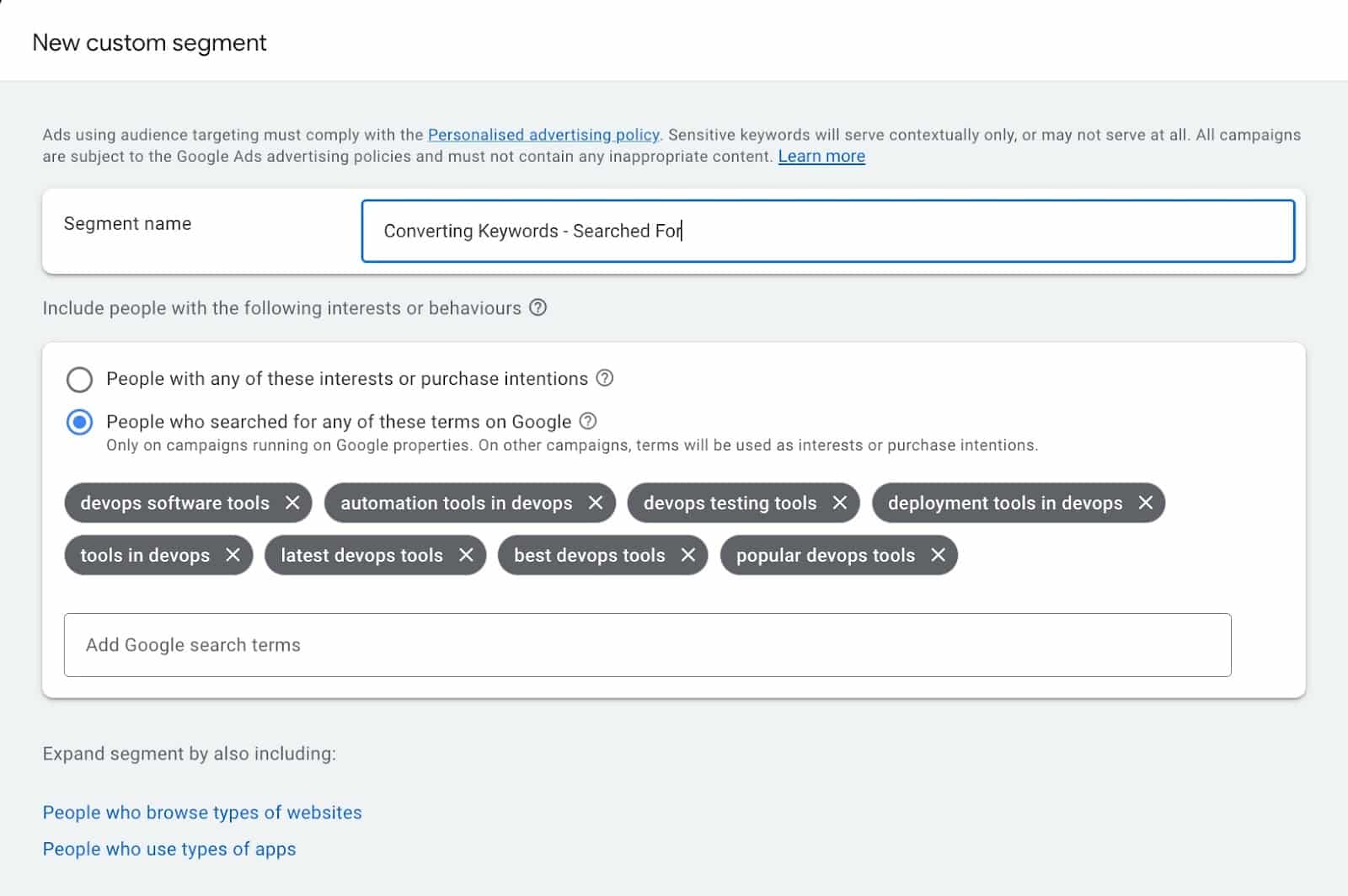
Creating a new custom segment in Google Ads
Use converting keywords from your search campaigns and research into websites and apps your target audience frequently uses to build these segments.
In-market audiences
In-market audiences let you target people actively researching or comparing SaaS products or services. Relevant segments include antivirus and security software, video software and accounting software.
Individuals within these groups have been categorized by:
- The types of websites they use.
- The content they engage with.
- How frequently they have been visiting relevant websites.
This indicates they have a relevant intent to convert in the near future.
Affinity audiences
Affinity audiences enable you to reach people based on who they are, what their interests are and what types of habits they have.
Use match affinity audience options with the personas of their target audience. For example, high-end computer enthusiasts, PC gamers or cloud services power users.
2. Use customer match exclusions
With the average CPC of a PPC campaign in 2023 coming in at $4.22, you need to ensure every click counts.
One thing you don’t want to be doing is paying for clicks from existing customers looking to log into their accounts.
By excluding current customers from seeing ads, you can ensure your budget is spent on reaching potential new customers, not those already using their software.
To do this, create a new audience list by uploading a list of your current customers using first-party data, such as email addresses, phone numbers and user IDs.
Then, manually add them as exclusions under the Audience tab of each of your active campaigns.
Consider creating exclusions for those currently within the “lead to sale” process.
For example, those who have already claimed a free trial, are newsletter subscribers or are in contract discussions with the sales team.
There is little value in spending money on those who are already:
- Engaging with the software.
- Communicating with the sales team.
- Receiving marketing communications through emails/newsletters.
Get the daily newsletter search marketers rely on.
<input type=”hidden” name=”utmMedium” value=”“>
<input type=”hidden” name=”utmCampaign” value=”“>
<input type=”hidden” name=”utmSource” value=”“>
<input type=”hidden” name=”utmContent” value=”“>
<input type=”hidden” name=”pageLink” value=”“>
<input type=”hidden” name=”ipAddress” value=”“>
3. Use remarketing lists
Rarely will an individual engaging with your website for the first time be ready to convert.
It’s more likely that they will need time to find out more about your brand, continue researching their situation, check out alternative providers and discuss their options with other stakeholders.
During this period (which could be weeks or months), it is vital to retain top-of-mind awareness. You can not afford to fall off a potential customer’s radar before the final consideration stage.
One way you can reach out to previous site visitors and remind them of your product is by using remarketing lists and using them as targeting for display campaigns (Google Ads) or audience ads campaigns (Microsoft Advertising).
The biggest advantage of running such campaigns is that the audience has already shown interest in the software and will therefore have a higher intent to convert.
By reaching out to these previous site visitors again, you can encourage them to return to the website to convert.
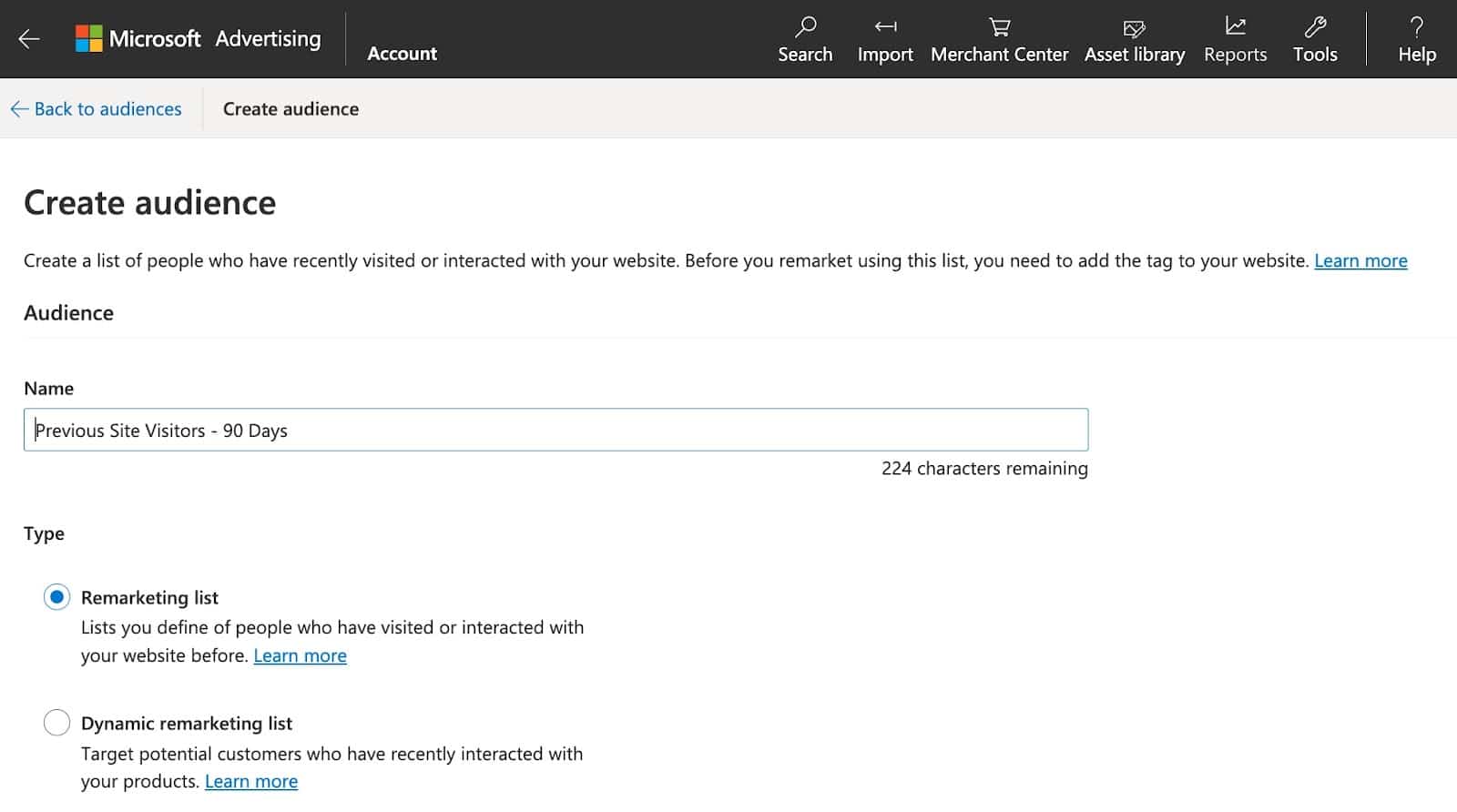
Creating a Remarketing List in the Microsoft Advertising platform
To take this to the next level, consider offering something extra in your ad messaging that wasn’t available during the initial website visits.
This could be more information about your brand, such as a glowing customer review or reviewing website ratings, or an extended trial or discount code.
For example: If a website offers a 7-day free trial, the messaging in the remarketing display campaign could offer an exclusive 14-day free trial.
While a 7-day trial may not have persuaded an individual to convert, an exclusive extended trial could be what it takes to bring them in.
4. Engage in competitor bidding
SaaS is a real dog-eat-dog industry. Brands must do what they can to outsmart their competitors. One way to do this is by engaging in competitor bidding.
Competitor bidding refers to running search campaigns or ad groups with keyword lists targeting competitors’ branded keywords.
So when someone is searching for a particular software provider, they are presented with an ad for an alternative provider instead.
This can be an effective strategy in SaaS as it enables you to get in front of an audience actively searching for a solution you can provide.
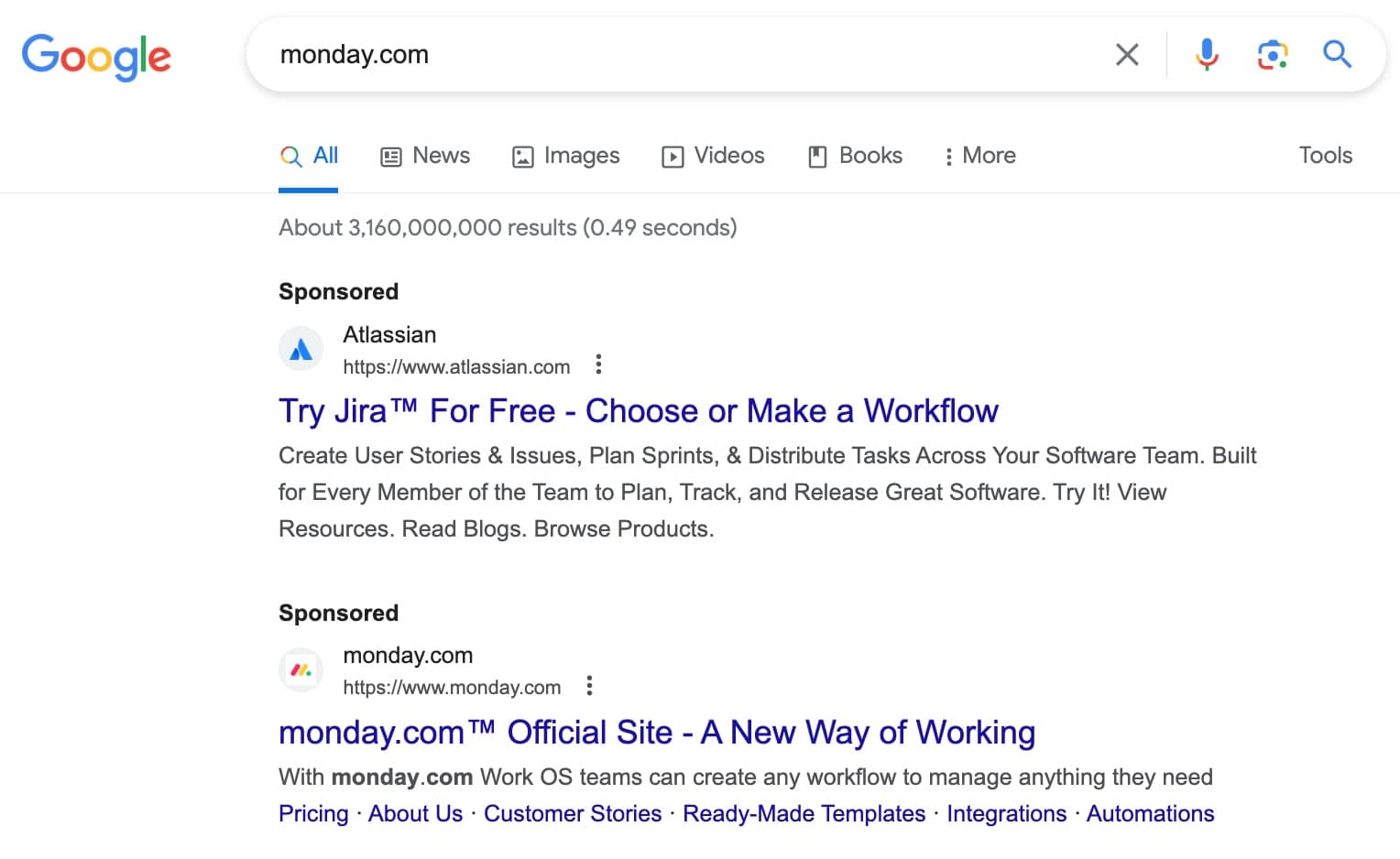
An ad for Jira appearing for a search for Monday.com
Consider creating designated landing pages when using competitor bidding, where the content focuses on differentiating them from your competitors.
This could include a breakdown of your exclusive features and industry-recognized rating cards, such as those available via G2.
The page’s purpose should be to demonstrate what makes your software great, not be a despairing remark on the competitor’s product.
While this can be a successful way for SaaS brands to steal attention away from competitors, it is always worth remembering that the competitor can retaliate and do the same in return.
This can result in an aggressive bidding situation where brands end up paying inflated CPCs for their own brand name. It is a powerful strategy but should be used with caution.
5. Optimize ad copy
As the saying goes: You never get a second chance to make a first impression.
Ensure you’re making the most out of your first interactions with potential customers by using ad copy that is both persuasive and informative.
The messaging needs to demonstrate how your software solves their problem and why they should choose you over competitors.
Work out how to communicate these points by reading and analyzing reviews and feedback left by actual users of your software.
These individuals are best placed to describe how they have benefited from the product. They will also use terminology and adjectives which will resonate with your target audience.
For example, a review for Google Ads on Capterra states:
“Google Ads is very useful in my business since it helps me in advertising, in this era of digital advertising it is very intuitive. The bidding strategies are flexible enough for a variety of businesses which makes carrying out different campaigns way easier. Real time tracking has also been made easier. Customers and clients can easily find our products online.”
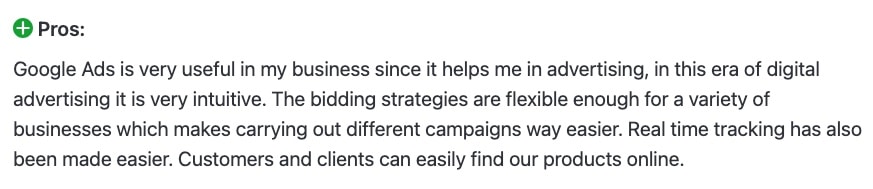
A review for Google Ads on Capterra
This could be used to create messaging such as:
- Intuitive and easy-to-use platform.
- Flexible advertising solutions.
- Help potential customers to find your products online.
- Campaign types suitable for all businesses.
This type of messaging can help your brand to portray relevance and suitability to potential customers, helping to reassure them that you are the solution they need.
PPC strategies to make your SaaS shine
You’ll need to work your PPC accounts hard to build brand awareness and influence consideration in a rapidly expanding industry.
Luckily, you can implement many campaign types and strategies to help you get there.
The post How to get the most out of PPC for your SaaS brand appeared first on Search Engine Land.
Courtesy of Search Engine Land: News & Info About SEO, PPC, SEM, Search Engines & Search Marketing
Friday, July 7th, 2023
Implementing systems in your SEO business is crucial, but starting can feel overwhelming or confusing.
You may have attempted it before but gave up due to the complexity or lack of guidance. Perhaps you made some initial progress, but the systems were not effectively implemented and followed.
Systemizing your business well can provide ample time and cost savings and potentially boost your sales.
By allowing you to focus on those all-important income-generating tasks instead of dealing with the small stuff, you can turn your business from one that plods along to one that brings you closer to those big goals of yours.
I’d go as far as to say that it’s tough to scale or grow meaningfully unless you have systems in place.
What is a system?
A system is a chain of processes, each containing a sequence of individual steps that make the system operational.
So a process might be creating a form on a WordPress website but the system could be an entire marketing funnel.
For example:
Form submission > email response > discovery call booking > call script/plan > closing
Why systematize your SEO business?
Benefits of systemizing your business:
- It will free up decision-making headspace for more important matters.
- It ensures consistency.
- It helps you to stay organized.
- You can manage your time better.
- It’s easy to delegate or for team members to cover for others.
- Your customers get high-quality service every time.
- It stops things from being missed or forgotten.
- It’s essential if you ever want to sell your business.
Let’s look at each of these in a little more detail.
Freeing up decision-making capacity
Taking the decision out of your hands can help you focus on crucial work instead of making decisions about less important tasks.
Ensuring consistency
Systems mean that tasks are done in the same order and in the same way over and over again.
This is why production lines always have systems in place.
Can you imagine a factory producing chocolate bars, and they all came out tasting slightly differently or in three pieces instead of two?
Staying organized
Systems allow you to stay super organized. In some cases, not doing so can have severe consequences – an example being your invoicing system.
Managing your time
While it is a big time investment to get all of this set up, once done, you will save hours of time across your day.
Knowing that your systems are taking care of day-to-day business means you are less likely to be pulled away to deal with issues that arise.
This enables you to focus on the really important tasks, the income-generating tasks, looking after your customers and working on business growth.
Delegation
Handing work over to someone where systems are in place makes it much easier for everyone involved. If someone goes off ill unexpectedly, it is easy for someone else to pick up the work.
Customer service
Giving the same high-quality experience time and time again will keep your customers coming back for more.
They know what to expect and so feel comfortable doing business with you.
Systems make sure that all customers are treated exactly the same way and that any disputes are handled according to your internal policies.
All of this helps to take the emotion out of situations, especially concerning non-payment or complaints.
Helping you remember
If you have a system, it’s much more difficult to forget to do something.
Think about an email you read last thing on a Friday, thinking you will get to it the following week.
But come Monday, you forget all about it, and it sits in your inbox for the rest of the week. It’s only when your customer chases you do you remember that it even exists.
I’m sure we have all been there. I certainly have.
Systems help to avoid this from happening because once an input arrives and feeds into the relevant system, it’s in the right place, and that individual process begins.
Long-term plans
Do you have an exit strategy for your business?
If so, it may well include selling it to someone else at some point. If this is the case, then systemization is essential.
It is much easier to sell a business that has systems in place already. The handover becomes easier for everyone involved.
Get the daily newsletter search marketers rely on.
<input type=”hidden” name=”utmMedium” value=”“>
<input type=”hidden” name=”utmCampaign” value=”“>
<input type=”hidden” name=”utmSource” value=”“>
<input type=”hidden” name=”utmContent” value=”“>
<input type=”hidden” name=”pageLink” value=”“>
<input type=”hidden” name=”ipAddress” value=”“>
How to get started with systems in your SEO business
You may want to view this as a stand-alone project as it may take a little time to fully systemize everything.
Start with the big stuff, the important ones and the ones that will free up the most amount of time for you.
This may also need investment to enable you to properly automate some of these systems too, which will help free up even more time, so work out a budget ahead of time.
Start with one and map out that system from start to finish
Each system will contain several individual processes. We often see these processes recorded as standard operating procedures (SOPs).
I would suggest having a templated document with a title, version number, date, and number to identify the document and how it fits into the overall system.
You’ll also need to create an index so that at any time, if someone needs to know how to do something, they can go to your systems ‘bible’ and find the relevant one.
Testing and improvements
Once your processes are written out and system maps are created, you can move into the test and improve phase.
Test it as much as you can. Breaking the system then enables you to account for different scenarios.
Pass your SOPs to someone completely new to the tasks involved and ask them to follow them. A fresh pair of eyes can often pick out problems that might otherwise get missed.
Storage
Don’t currently have a central storage system for all of your documents? Now is the time to have one.
You could set up a Google Drive, One Drive or Dropbox account.
Whichever you use, make sure that it’s stored in a way that makes sense with filenames clearly written and simplified titles so it’s easy to find everything. Then ensure that everyone in your business can access the files.
Regular review
Once you have your systems in place, it is important to make sure that they stay relevant.
Set aside regular reviews of existing systems by going through them step by step and amending anything that has changed.
Likewise, archive anything that is no longer relevant and add in any new systems.
This folder of documents is basically the inner workings of your business, it should tell anyone exactly what they need to do to run the business your way.
You should, in essence, be able to walk away from it all tomorrow, and someone else could come in, pick up the systems and be able to carry on.
Systematize and thrive
I am a massive fan of systemization. I believe that it is essential to the success of any business owner looking to grow.
That said, while every area of your business can be systemized, I also believe that our SEO clients buy into us as people too.
So don’t completely lose that human connection element and personalization you give them.
A monthly phone call or personalized email will go a long way toward maintaining the relationships you have worked so hard to build.
The post Why systems will revolutionize your SEO business appeared first on Search Engine Land.
Courtesy of Search Engine Land: News & Info About SEO, PPC, SEM, Search Engines & Search Marketing
Friday, July 7th, 2023
Marketers are not happy with the Google Analytics 4 user interface (UI).
In fact, social media has been inundated with complaints about the Universal Analytics replacement – but it’s concerns over the UI that have been dominating the conversation.
So, is the GA4 UI really as bad as some are claiming? We spoke to three digital marketing experts to find out…
‘Usability is poor – but hang in there!’
Janet Driscoll Miller, president and CEO of Marketing Mojo, isn’t a fan of GA4’s UI but said “it’s not terrible”. She believes the difficulties that arise are due tot he platform being so new and different to Universal Analytics. “I don’t think Google did a very good job with usability in the design of the interface,” she tells Search Engine Land.
- The settings and layout aren’t intuitive – “For example, if you create an Explorations report, you must first essentially import the dimensions and metrics you’d like to pull from in the first settings column, then pull from those into the second column which creates your data visualization. That’s certainly different than UA and not necessarily very clear to new users.”
- Google needs to make some tweaks – “I think I speak for most Google Analytics power users here, they really need to add back the Annotations feature. It was a great UA feature and likely isn’t difficult to program (it’s literally a note and a date) but it was so helpful to many of us, especially when doing forensic or troubleshooting projects and working with large teams.”
- Fix the sharing of Explorations reports – “When you currently create and share an Explorations report with others, you a) cannot limit who it is specifically shared with and b) those that it is shared with cannot change the report date range. Currently for others to change a shared report’s date range, the user must make a copy of the report so that user becomes that new report copy’s owner and then the date can be altered.”
If you’re struggling to navigate the new UI, simply keep practicing, Miller said.
“The more you become accustomed to how GA4 works, the easier it will get over time,” she said. “Change is hard, but this is here to stay. Before too long, we’ll all be much better with it. Hang in there!”
‘GA4 lacks basic capabilities – but we’ll get used to it’
Independent contractor and advisor, John Erikson, has been feeling increasingly frustrated with the GA4 UI. Universal Analytics was more straightforward and easier to navigate, which made simple tasks, like creating reports, much easier to carry out, he said.
Erikson explained:
- No ability to use regex in the search box: “You can only search one phrase at a time which is very limiting. The only way I could find to filter by URL patterns was to set up Audiences. But Audiences have to be set up in advance, cannot be edited/changed, and the regex is limited to 100 characters so I had to split long patterns in to many chunks to build audiences.”
- Problems arise if URL structures are tweaked: “If anything changes in the site in URL structure (which is guaranteed to happen many times in the future), the audience becomes obsolete and no way to look backwards.”
- Time-consuming mistakes: “If you make any mistake in creating an Audience, you have to discard what you did and create a new one.”
- Segments/dimensions issues: “On selecting segments/dimensions in GA4, instead of the ability in Universal to select/deselect one or more segments in a single list and click apply, you have to open customization or add comparison, click add filter, select a dimension from a long dropdown, then select dimension value from another dropdown, then apply (and you can only select one). Granted it is only a few seconds difference, but when you look at many different patterns every day, it becomes frustrating to repeat those excess UI moves over and over when you used to do it faster.”
- Clumsy design: “That same dropdown structure is used in creating/editing GA4 reports. The dropdown lists are long and it is hard to find what you are looking for. You can type in partial names and more quickly find them once you know them, but initially it is very hard to scroll through them all and find what you want. Also, you can only select one so it is hard to look at multiple dimensions/values. I do find it clumsy to use.”
Despite Erkison’s issues with the new platform, he realizes it’s here to stay and is confident he will get used to it and adapt.
“It’s just frustrating when you’ve used a system that works well for many years and see it replaced by a supposed improvement that is just harder to use and lacks such basic capabilities,” he added
Get the daily newsletter search marketers rely on.
<input type=”hidden” name=”utmMedium” value=”“>
<input type=”hidden” name=”utmCampaign” value=”“>
<input type=”hidden” name=”utmSource” value=”“>
<input type=”hidden” name=”utmContent” value=”“>
<input type=”hidden” name=”pageLink” value=”“>
<input type=”hidden” name=”ipAddress” value=”“>
‘GA4 is missing the simplest functions’
Chris Fox, independent analytics strategist, has also been experiencing problems with GA4’s UI. He notes that simple functions that were present in UA are now either completely missing or are more complicated and time-consuming to perform. He explained:
- “Time Series charts can only show data at the day level and cannot be changed to view data at a Week/Month level.”
- “You have to edit reports to be able to use basic dimensions like Landing Page in a Traffic report.”
- “Segments are gone and instead we have ‘Comparisons’, which don’t have preset options and do not allow you to save the ‘Comparisons’ you create like you could with Segments.”
- “If you want to add a filter to both dimensions in a report with a secondary dimension, you cannot do it in the table — rather, you have to filter one in the table and the other at the report-level at the top of the page (or both at the report-level).”
- “When you edit a report to add metrics, you are limited to 12; so I’m often editing a report just to view a certain metric and then resetting back to the previous configuration.”
- “Before, if I wanted to look at a visualization of monthly traffic for the last year, I just had to change the date granularity in the line chart on the Channels report to ‘Monthly.’ To do that in GA4, I’d have to download the data and create the chart myself in Excel/Tableau/etc.”
Venting his frustrations, Fox told Search Engine Land that these unnecessary, time-wasting changes have made GA4 “feel like a free edition of the full product which was Universal Analytics”.
Unfortunately, he joins a long list of marketers that have been making the same complaints about the GA4 UI.
Why we care: If enough people are experiencing the same problems with GA4 and these issues are then reported to Google, the search engine may review its product to make necessary changes. In the event it doesn’t, marketers will be forced to come up with their own solutions – and it will undoubtedly be easier to come together in order to brainstorm ideas.
Deep dive. For more information on how to migrate to GA4, read Google’s ‘Learn how to make the switch‘ guide.
The post Why people hate the Google Analytics 4 user interface appeared first on Search Engine Land.
Courtesy of Search Engine Land: News & Info About SEO, PPC, SEM, Search Engines & Search Marketing
Thursday, July 6th, 2023
Meta is expected to launch Threads, a “text-based conversation app,” under the Instagram brand, tomorrow (July 6).
What is Threads. According to the download page:
“Threads is where communities come together to discuss everything from the topics you care about today to what’ll be trending tomorrow. Whatever it is you’re interested in, you can follow and connect directly with your favorite creators and others who love the same things – or build a loyal following of your own to share your ideas, opinions and creativity with the world.”
Why we care. Since Elon Musk bought the platform, Twitter has found new and exciting ways to upset many of its users and lose advertising revenue. Threads may be a platform for marketers and advertisers to watch – but ultimately wherever users go, the budgets and marketing investments will follow.
Admit one. You can sign up for the app already. To do so, go to Instagram search, type in “Threads” and you’ll see an “Admit One” ticket in the right side of the search box.

Clicking on that will take generate your ticket, which you can then click on to be notified when the app is available to download.

Not available in EU. One region where Threads won’t be launching is the EU. Meta has received multiple fines in the EU for violating the General Data Protection Regulation (GDPR).
According to the Independent:
“Sources close to Meta said that the tech giant has refrained from rolling the service out in the EU because of what the company believes is a lack of clarity contained in the EU’s Digital Markets Act. Under the Act, companies such as Meta become “gatekeepers”, with restrictions on how they mingle users’ personal data.”
No Instagram Threads app in the EU: Irish DPC says Meta’s new Twitter rival won’t be launched here, The Irish Independent
Extensive data collection. Meta will be collecting a lot of user data, including search history, browsing history and much more:
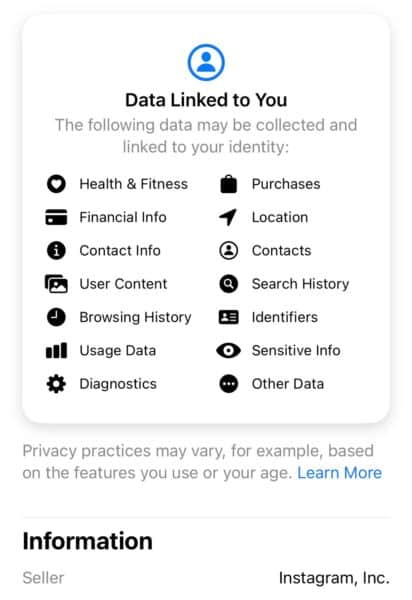
The post Threads, Meta’s Twitter alternative, to launch July 6 appeared first on Search Engine Land.
Courtesy of Search Engine Land: News & Info About SEO, PPC, SEM, Search Engines & Search Marketing
Thursday, July 6th, 2023
Fewer U.S. adults are beginning their product searches on TikTok than a year ago, according to a CivicScience study.
Why we care. This is the latest evidence that Amazon is a platform that retail brands must pay attention to. While TikTok intends to build a $20 billion ecommerce business, the U.S. won’t be a big factor yet – and may never be. Regardless, marketing and advertising budgets will continue to follow users. But ultimately it comes down to whether TikTok is an effective platform for your brand.
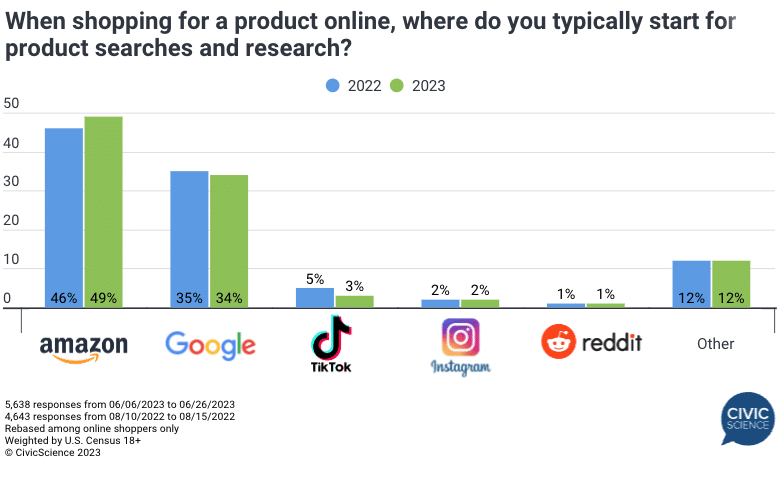
Amazon and Google reign. Overall, the starting point for product searches among online shoppers is Amazon (49%, up from 46% in 2022), followed by Google (34%, down from 35% in 2022).
Amazon also increased its popularity among younger age groups, compared to last year:
- 18- to 24-year-olds: Up 45%
- 25- to 34-year-olds: Up 44%.
Additional context. These results are similar to another U.S. survey we reported on in Amazon beats Google as starting point for product search. That survey found 38% of shoppers began product searches on Amazon, while 35% started searching on Google.
TikTok’s YoY decline. After hitting a new high in 2022, CivicScience noted a “steep decline” for TikTok among younger generations this year:
- “Usage fell from 18% to 11% among Gen Z (18-24) and from 10% to 5% among young Millennials (25-34) from August 2022 to June 2023.”
Most people who start their product searches on TikTok, Instagram or Reddit are between the ages of 18-34, CivicScience noted.
About the study. The CivicScience study asked U.S. online shoppers: “When shopping for a product online, where do you typically start for product searches and research?” It then compared 5,638 responses received between June 6 and 26 to 4,643 responses from August 2022.
The post Study: TikTok loses popularity as ecommerce search engine appeared first on Search Engine Land.
Courtesy of Search Engine Land: News & Info About SEO, PPC, SEM, Search Engines & Search Marketing
Thursday, July 6th, 2023
Google Analytics 4 hasn’t exactly got off to the best start with marketers.
In fact, it’s getting pretty awkward – some advertisers are so disappointed with the new program that they’ve even been hosting funerals for its predecessor, Universal Analytics.
But what is it about GA4 that’s got the world of digital marketing so riled up?
We decided to ask our readers in a GA4 readiness poll to find out. Below, we’ve put together a list of the most common complaints. Let us know if you and your team can relate…
1. User interface
GA4’s user interface was hands-down the biggest issue our readers reported.
The UI was described as “slow”, “laughable” and a few other adjectives we’re opting not to publish.
Independent sales and marketing contractor, John Erikson, told us:
- “When on selecting segments/dimensions in GA4, instead of the ability in Universal to select/deselect one or more segments in a single list and click ‘apply’, you have to open customization or add comparison, click add filter, select a dimension from a long dropdown, then select dimension value from another dropdown, then apply (and you can only select one).
- “Granted it is only a few seconds difference, but when you look at many different patterns every day, it becomes frustrating to repeat those excess UI moves over and over when you used to do it faster.”
- “That same dropdown structure is used in creating/editing GA4 reports. The dropdown lists are long and it is hard to find what you are looking for. You can type in partial names and more quickly find them once you know them, but initially it is very hard to scroll through them all and find what you want.
- “Also, you can only select one so it is hard to look at multiple dimensions/values. I don’t know the answer to fixing this, but I do find it clumsy to use.”
2. Data lag
Another major concern for marketers has been the delay of same day data on GA4.
Advertisers have stressed that they need the ability to monitor performance constantly and are confused as to why the new analytics platform doesn’t appear to have this function.
Ron Weber, Sr Director at Actian, explained:
- “The data latency is a joke, taking 12-24 hours to report on what is happening prevents this from being an actionable tool.”
- “I wish I wasn’t backlogged for the past few years and thus could/would have realized this before.”
- “Maybe Google will just move the computing power from UA -> GA4 so that this will change? [praying]!”
3. Data discrepancies
Marketers raised concerns about discrepancies on GA4 too.
Differences in information had resulted in some worrying that the data being served therefore couldn’t possibly be accurate, resulting in people questioning if they can trust GA4.
Sabine Walton, Senior SEO Manager at Handlerbund Marketplace, told us:
- “What I find problematic is the discrepancy between GA4 API and the respective Looker Studio Connector. Dimensions that are present in the API and even per default in the GA4 reporting interface are apparently missing in the Looker Studio connector, e.g. Landing Page dimension.”
- “The Google Team seems to work on that, because at least the landing page dimension is now present. But that also means that I have to minus two days before UA data collection comes to an end – then adjust and check my numerous reports again and again.
- “I am as ready as the tool is, but I certainly do not look forward to working solely with GA4. I am also thinking about looking for alternative tools to GA4.“
4. Hard to use
Marketers across the board have been reporting that GA4 is incredibly difficult to use.
Even seasoned advertisers are finding it challenging trying to navigate their way around the new platform.
SEO and marketing consultant Jason McDonald told Search Engine Land:
- “GA4 is a disaster. It is so much harder to use than UA, and completely non-intuitive.”
- “It is nearly impossible to drill down by clicking as was possible than UA.
- “It is the Windows Vista of Google Analytics, and all the cognoscenti are afraid to say publicly that it is garbage. But everyone knows it is garbage.”
5. Lack of resources
With so many marketers struggling as they try to figure out GA4, many are questioning why Google hasn’t provided more educational resources explaining how the new tool works.
The marketing team at Storis told us:
- “I found most of the answers that I was stuck on from taking private courses through SMX or finally getting to a knowledgeable Google team member.
- “Their documentation really lacked especially where there were major functional changes or gaps. I kept trying to figure out how to replicate things that weren’t brought over.
- “Also, many of the people on Google’s own team aren’t up to speed making support calls confusing.”
6. No basic option
Some advertisers explained that marketing doesn’t wear a one size fits all hat.
While some of the more complex settings may suit some, other professionals, such as bloggers, would just like access to basic tools on GA4 and are wasting time and money trying to understand features they don’t need to use.
Eb Gargano from Productive Blogging told us:
- “One of the things I have observed is that many bloggers and online businesses have been totally losing their minds over GA4 – wasting days (and in some cases weeks) stressing over this, when their time could have been much better spent elsewhere.”
- “The truth is most bloggers and online businesses need only a simple setup and an understanding of the basic reports. But no one is saying that, and online business owners are being scared into believing they need to spend lots of money on expensive courses and a lot of time creating multiple custom reports.”
- “I think it’s a real shame there isn’t a ‘GA4 Lite’ for users who only need basic data.”
7. Lack of features
Another common complaint from marketers responding to our poll was the lack of features GA4 has to offer in comparison to Universal Analytics.
Marketers seemed particularly bothered by the removal of attribution features.
Elizabeth Rule, account manager and local SEO analyst for Sterling Sky, told us:
- “I’ve been using GA4 as much as possible the past month to get used to it, but honestly it just feels like a clunkier version of GA3 with fewer features that I actually want to use.
- “I find myself wanting to go back to GA3 every time I use GA4 – and it’s not because I’m just too used to it. Some of the features I use every day are missing or extremely complicated to find in GA4.”
Get the daily newsletter search marketers rely on.
<input type=”hidden” name=”utmMedium” value=”“>
<input type=”hidden” name=”utmCampaign” value=”“>
<input type=”hidden” name=”utmSource” value=”“>
<input type=”hidden” name=”utmContent” value=”“>
<input type=”hidden” name=”pageLink” value=”“>
<input type=”hidden” name=”ipAddress” value=”“>
8. Difficulty recreating reports
Clients and marketers alike have desperately been trying to recreate reports in GA4 that they previously relied upon when using Universal Analytics.
Unfortunately, it seems for many that this task has proved far more difficult than it should have been.
Tom Demers, co-founder and managing partner of SEO and PPC agency Measured SEM, told us:
- “Clients are frustrated with recreating their existing reports in GA4, particularly for specific edge cases, recreating dashboards in third-party reporting tools – including Looker Studio.”
- “There is also a lot of work around recreating events / goals within GA4 (and confusion around not seeing those events in certain reports).”
9. Reports
Marketers also complained that they were struggling to simply create reports in GA4 – an issue that didn’t impact them when they were working with UA.
According to many marketers who took part in our poll, Google has made many unnecessary changes when it comes to building reports, making their workload more difficult.
Eric Bushaw, search engine optimization manager at G5, told us:
- “In time, I think GA4 will enable greater insights than UA did.”
- “With that said, some of the seemingly arbitrary changes to how reporting can be done are frustrating.
- “Eliminating views, restrictions around how custom segments can be used, and other seemingly unnecessary changes are going to make life difficult for us once UA is really gone.”
10. Bugs
Several marketers contacted Search Engine Land to report bugs within GA4, claiming many features weren’t working as intended. Issues being flagged included syncing issues with Looker Studio Dashboard and AMP new script not working.
SEO consultant John McAlpin told us:
- “The platform still has a lot of bugs, and we find ourselves spending more time figuring out why attribution is not properly labeled and why the data is inconsistent.”
Let’s not panic
Marketers have found the enforced migration from Universal Analytics to GA4 tough, so it can be reassuring to know this challenge is being felt across the industry.
But regardless of how difficult the adjustment has been, search marketing expert and SMX Advanced speaker Kayle Larkin told Search Engine Land it’s important marketers get on board with Google’s latest analytics program as it will likely be around for a long time. She said:
- “There’s an age-old saying that the grass isn’t always greener on the other side.”
- “People use the internet in completely different ways than in 2012, and I see GA4 as Google’s answer for future-proofing website analytics. The industry needs a free option.”
- “Marketers need to pause for a moment and think about what information is really useful and helpful - what they need to know.”
- “Himanshu Sharma said it well on LinkedIn: ‘It is important to remember that we are not in the business of data retrieval. We are in the business of data analysis to improve ROI.’”
- “Either way, you need to understand your data and how that supports your marketing initiatives.”
Larkin went on to explain that change within any platform and any industry can cause people to panic. But as time passes, confidence and familiarity increases, causing attitudes to change. She concluded:
- “Everyone was mad when Facebook updated their interface and ‘couldn’t find anything’. It was ‘horrible’ and ‘the end of Facebook.’”
- “Because we use Facebook daily, that was quickly forgotten, and no one even remembers what the old interface looked like.”
- “The response to the GA4’s interface – you see the same reaction when any platform changes its interface. People do not like change.”
- “But GA4 is so customizable, and with LookerStudio – there are a lot of options for getting the reports to visualize information and insights in a meaningful way.”
Did deeper
If you’re struggling to navigate GA4, why not sign up for a GA4 training course?
Alternatively, for free information and resources on how to use GA4, read the Google Analytics 4 account training guide and support guide
The post 10 things we hate about Google Analytics 4 appeared first on Search Engine Land.
Courtesy of Search Engine Land: News & Info About SEO, PPC, SEM, Search Engines & Search Marketing